

 Extension
TL;DR: A skill agent resource kit for faster competitor analysis
Use this competitor analysis example to start a free AI workspace and turn public competitor facts into a structured report, scoring table, SWOT, positioning map, and visual comparison matrix.
Manual research gets messy fast. When notes, pricing pages, reviews, and screenshots sit in separate files, teams waste hours reconciling sources and still miss gaps. A project-based AI workflow can organize evidence, label confidence, and draft the competitive intelligence report without copy-paste.
Copy the tables, prompts, ethical-source checklist, and scoring rubric, then adapt them to your niche.
A competitor analysis example you can reuse
Use this competitor analysis example for a local mobile dog grooming business deciding whether to raise prices and rewrite its landing page. The analysis covers the next 90 days, one metro area, and three segments: busy professionals, senior pet owners, and multi-pet households. The goal is simple: find where the business can charge more, explain its value clearly, and avoid copying competitors blindly.
Build a focused competitor list
Don't research every brand in the category. Pick alternatives that a customer would actually compare before booking.
| Category | Example list | Selection rule |
| Direct competitors | 3 mobile groomers in the same city | Same customer, same job-to-be-done, similar service area |
| Indirect competitors | 1 pet salon, 1 vet clinic with grooming | Same customer need, different service model |
| Substitutes | DIY grooming kit, marketplace sitter add-on | Different approach that solves part of the problem |
Skip famous national brands unless they compete for the same search results, ads, or local buyers. Relevance beats brand size.
Define the final report before collecting data
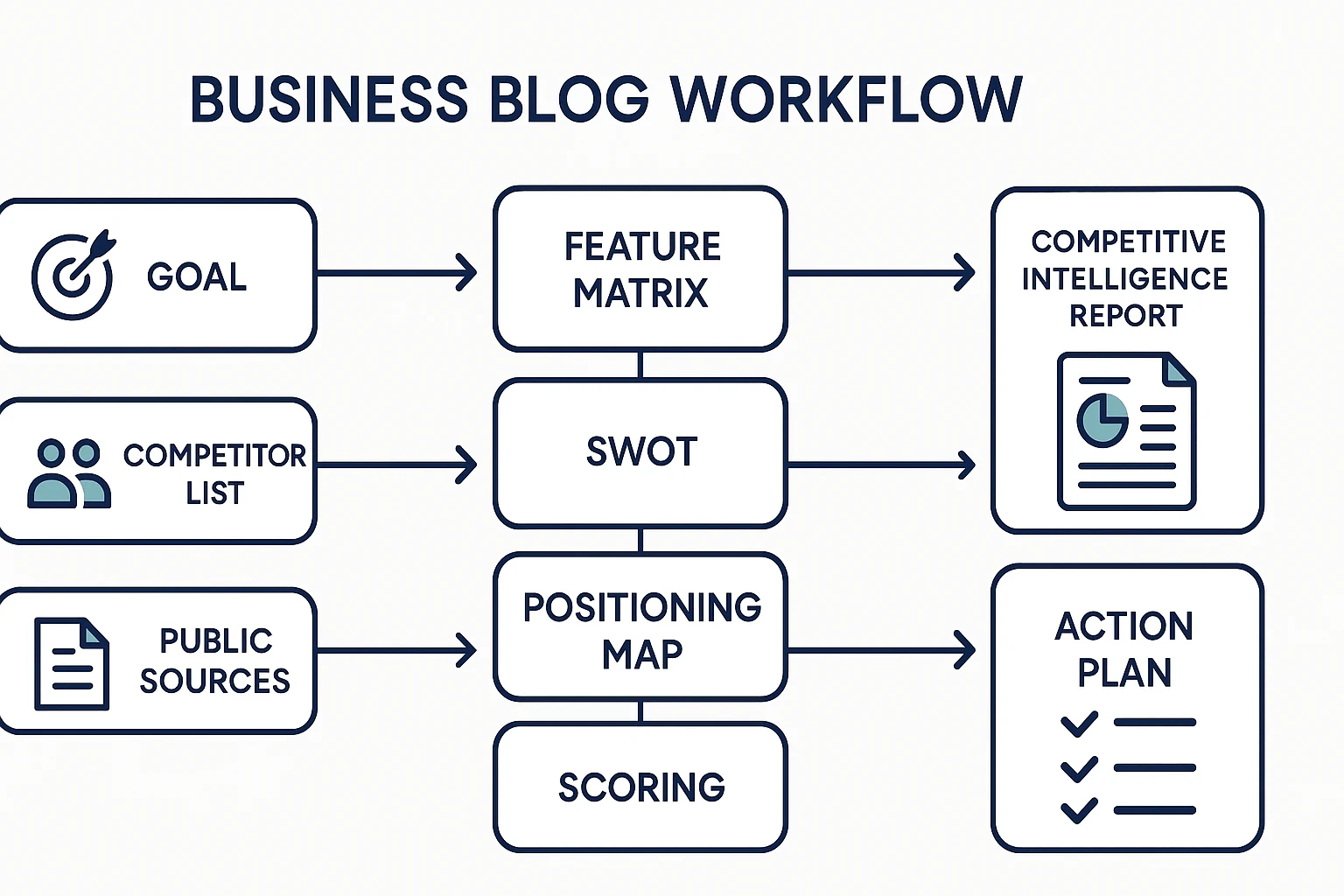
A strong competitor analysis report example should read like a decision tool, not a research archive. Use this filled blueprint:
- Executive summary: "Two direct competitors win on price. One wins on convenience. Our best move is a premium landing page focused on same-week booking and low-stress care."
- Competitor snapshots: audience, offer, service area, proof points, visible pricing, and booking path.
- Feature and pricing comparison: mobile visit fee, package tiers, add-ons, cancellation terms, and guarantees.
- Marketing and positioning notes: headline themes, review claims, trust signals, and calls to action.
- Review sentiment themes: top 3 praise points and top 3 complaints per competitor.
- SWOT: strengths, weaknesses, opportunities, and threats for each competitor, plus your own business.
- Positioning map narrative: explain who is cheap, premium, fast, or specialized.
- Confidence labels: mark each finding as confirmed, likely, or inferred.
- Actions: 3–5 next steps, each tied to pricing, copy, offer design, or segment focus.
Confirmed facts come from public pages and reviews. Inferences explain patterns, but they need clear labels.
The practical competitor analysis resource kit
A useful competitor analysis example isn't a long document. It's a compact kit that turns public evidence into choices. Use the templates below to collect the same facts for every rival, rate confidence, and avoid comparing guesses with facts.
Build a competitor overview table
Start with one row per competitor. Keep it factual and update the "last verified" date whenever pricing, packaging, or positioning changes.
| Competitor name | Category | Target segment | Core promise | Key offer | Price range notes | Distribution channels | Proof points | Source links | Confidence | Last verified |
| ExampleCo | Direct / indirect / substitute | SMB teams | Faster reporting | SaaS plan + services | Public tiers / quote-based | Website, partners, app store | Reviews, case studies | Add URLs | High / Med / Low | YYYY-MM-DD |
Keep the feature and pricing matrix short
Limit the matrix to 5–10 decision-driving items. If a feature doesn't change buyer choice, move it to notes.
| Area | Decision-driving item | Your business | Competitor A | Competitor B | Impact on buyer choice | Packaging notes |
| Must-have feature | Feature 1 | Yes / No / Partial | High / Med / Low | Tier, limit, or add-on | ||
| Must-have feature | Feature 2 | |||||
| Differentiator | Unique capability | |||||
| Onboarding friction | Setup time, migration, training | |||||
| Support model | Chat, email, success manager | |||||
| Integrations | Key tools buyers already use | |||||
| Packaging | Tiers, limits, bundles |
Use one SWOT worksheet for every player
SWOT analysis means strengths, weaknesses, opportunities, and threats. Use the same worksheet for each key competitor and your own business so the comparison stays fair.
| Subject | Strengths | Weaknesses | Opportunities | Threats | Evidence sentence | Confidence |
| Competitor A | One sentence tied to a source | High / Med / Low | ||||
| Your business | One sentence tied to a source | High / Med / Low |
For the positioning map, choose two buyer-relevant axes. Good options include "hands-on support ↔ self-serve" and "specialist niche ↔ generalist." Plot only competitors with enough evidence. Label each point with one sentence, such as: "Competitor A sits near self-serve because its site emphasizes free signup, docs, and automated onboarding."
Rate sources with confidence levels
| Source type | Best for | Typical confidence |
| Website and pricing pages | Positioning, offers, public plans | High when current |
| Documentation and changelogs | Feature depth, release speed | High |
| Review platforms | Buyer pain, satisfaction themes | Medium |
| Social content | Messaging, launches, audience fit | Medium |
| Job listings | Strategy signals, new markets | Low to Medium |
| App marketplaces | Ratings, integrations, update history | Medium |
| Partner directories | Channel strategy and ecosystem | Medium |
Use this confidence rule: High = primary source plus corroboration. Medium = one strong source. Low = inference or marketing claims. That simple label helps teams act on strong evidence and flag weak assumptions for follow-up.
How should small businesses collect competitor data without guessing?
A strong competitor analysis example starts with evidence, not hunches. Your goal is to capture what competitors claim, what customers report, and how the market reacts, then label each finding so anyone can verify it later.
Start with public sources
Check the sources that competitors control first. They show positioning, pricing logic, and product priorities.
- Homepage and main landing pages
- Pricing and plan pages
- Feature docs and help centers
- FAQs, terms, and privacy pages
- Case studies and customer logos
- Comparison pages
- Changelog or release notes
For every claim, copy the exact quote, page title, URL, and capture date. Example: "Unlimited projects," pricing page, captured March 12, 2026. This prevents vague notes like "they seem enterprise-focused."
Group customer reviews and sales signals
Reviews are useful, but one angry post shouldn't steer your strategy. Tag at least 20–30 review snippets before drawing conclusions. Group them into five buckets: onboarding, reliability, support, pricing fairness, and missing features.
Then add sales-signal sources: webinars, newsletters, public communities, app marketplaces, partner directories, and public pitch decks when available. Use simple tags such as pain:setup, love:support, risk:pricing, or gap:integration to spot repeated patterns fast.
Validate each finding with three angles
Use triangulation: compare "what they say" on their site, "what users experience" in reviews, and "how they sell" in messaging. If all three align, confidence is high. If only one source supports a claim, mark it clearly.
Use plain uncertainty labels:
- Not disclosed
- Unclear
- Likely—needs verification
- Confirmed from public source
- Confirmed across 2+ source types
Stay inside ethical boundaries
Use only public information. Respect terms of service. Don't misrepresent yourself. Don't scrape private areas, gated dashboards, or login-only communities. For U.S. teams, 18 U.S. Code § 1030 - Fraud and related activity in connection with computers prohibits "access[ing] a computer without authorization, or exceed[ing] authorized access," making unauthorized scraping behind logins a potential federal crime.
Paste this ethics checklist into your workflow:
- Source is public and accessible
- Collection follows site terms
- No fake identity used
- No proprietary files copied
- Employee data handled with care
- Quotes include URL and date
How do you score competitors and turn findings into action?
A good competitor analysis example doesn't stop at "Competitor A has feature X." It converts evidence into a score, then turns that score into a decision. Use a 1–5 scale, multiply each score by its weight, and keep notes beside every number so the team can audit the logic later.
Build a weighted scoring rubric
Set weights based on the business goal. If you need to win more deals, give more weight to pricing clarity, proof, and messaging. If you need to reduce churn, raise the weight for support, onboarding, and feature depth.
| Criteria | Default weight | Win-more-deals weight | Reduce-churn weight |
| Fit for target segment | 20% | 25% | 15% |
| Feature coverage | 20% | 15% | 25% |
| Time-to-value | 15% | 15% | 20% |
| Support and onboarding | 15% | 10% | 20% |
| Trust signals | 10% | 15% | 10% |
| Pricing clarity | 10% | 15% | 5% |
| Marketing clarity | 10% | 5% | 5% |
Use a scorecard with evidence notes
| Competitor | Feature coverage | Pricing and trust | Marketing clarity | Deal-breakers |
| Competitor A | 4/5: covers core workflows; confidence high from product pages | 3/5: public pricing, few security details; confidence medium | 5/5: clear niche promise and strong proof | None found |
| Competitor B | 3/5: strong basics, weak reporting; confidence medium | 4/5: transparent plans and reviews; confidence high | 3/5: broad messaging, less segment focus | Missing required integration |
| Competitor C | 5/5: broad feature set; confidence medium because claims need testing | 2/5: pricing hidden; trust page thin | 4/5: good comparison pages | Long setup time |
Treat deal-breakers as overrides. One missing requirement, such as compliance, integration, or data export, can beat a high total score.
Turn scores into a priority roadmap
Sort findings into three action buckets:
- Quick wins: fix unclear pricing, rewrite the homepage promise, add proof, or improve comparison pages.
- Medium bets: close onboarding gaps, improve templates, or add one missing feature that blocks sales.
- Strategic bets: shift positioning, focus on a tighter niche, or build a wedge competitors can't copy quickly.
Use this rule: pick one wedge where you can win and one defense where you must not lose.
Recommendation summary format: "Based on the scorecard, our best wedge is [advantage] because [evidence]. Our main risk is [gap] because [competitor] is stronger on [criterion]. In the next 30 days, we should prioritize [quick win], validate [medium bet], and monitor [strategic risk]."
An AI competitor-research workflow: generate a competitive intelligence report and visual matrix
A strong competitor analysis example doesn't stop at a list of rival websites. It turns public competitor data into a structured report, a feature matrix, and a short action plan your team can use in the next meeting.
Start with a tight input pack
In TicNote Cloud, add the Competitor Analysis skill agent from the Skill Agent library. This creates a repeatable workflow for small business owners who need a report without building a research system from scratch.
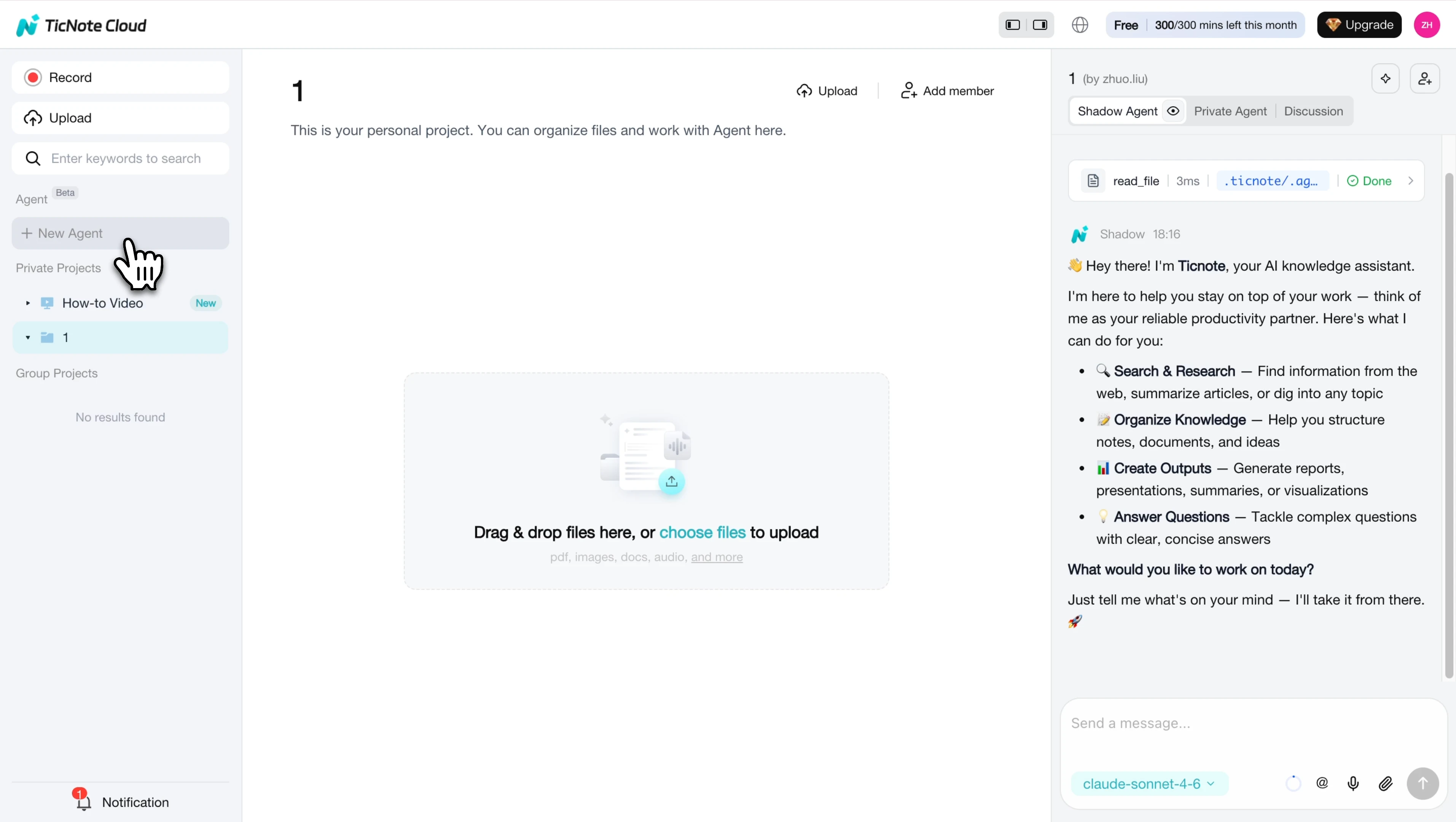
After you add it, the agent appears in your workspace and is ready to run. No complex setup is needed before the first analysis.
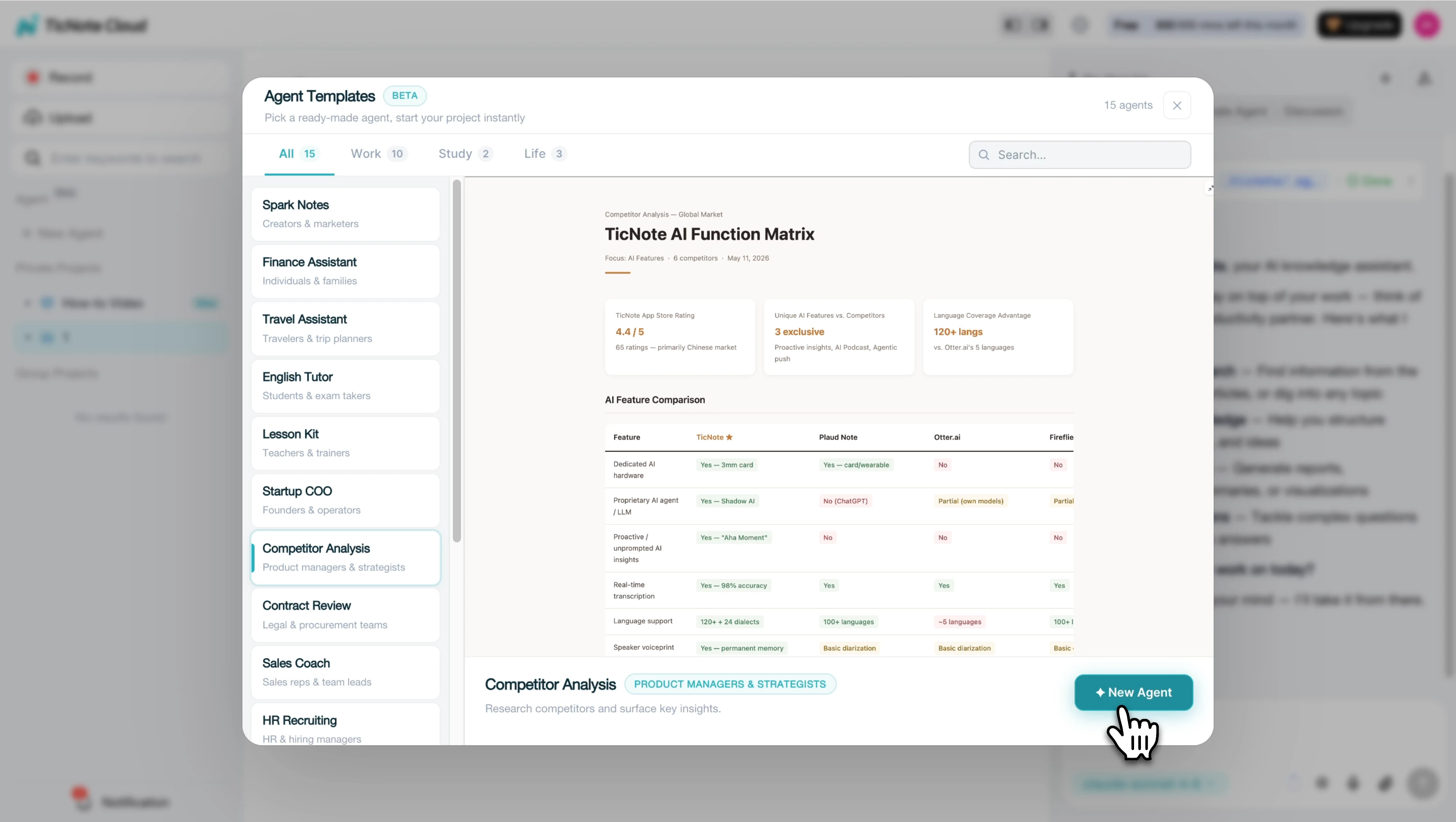
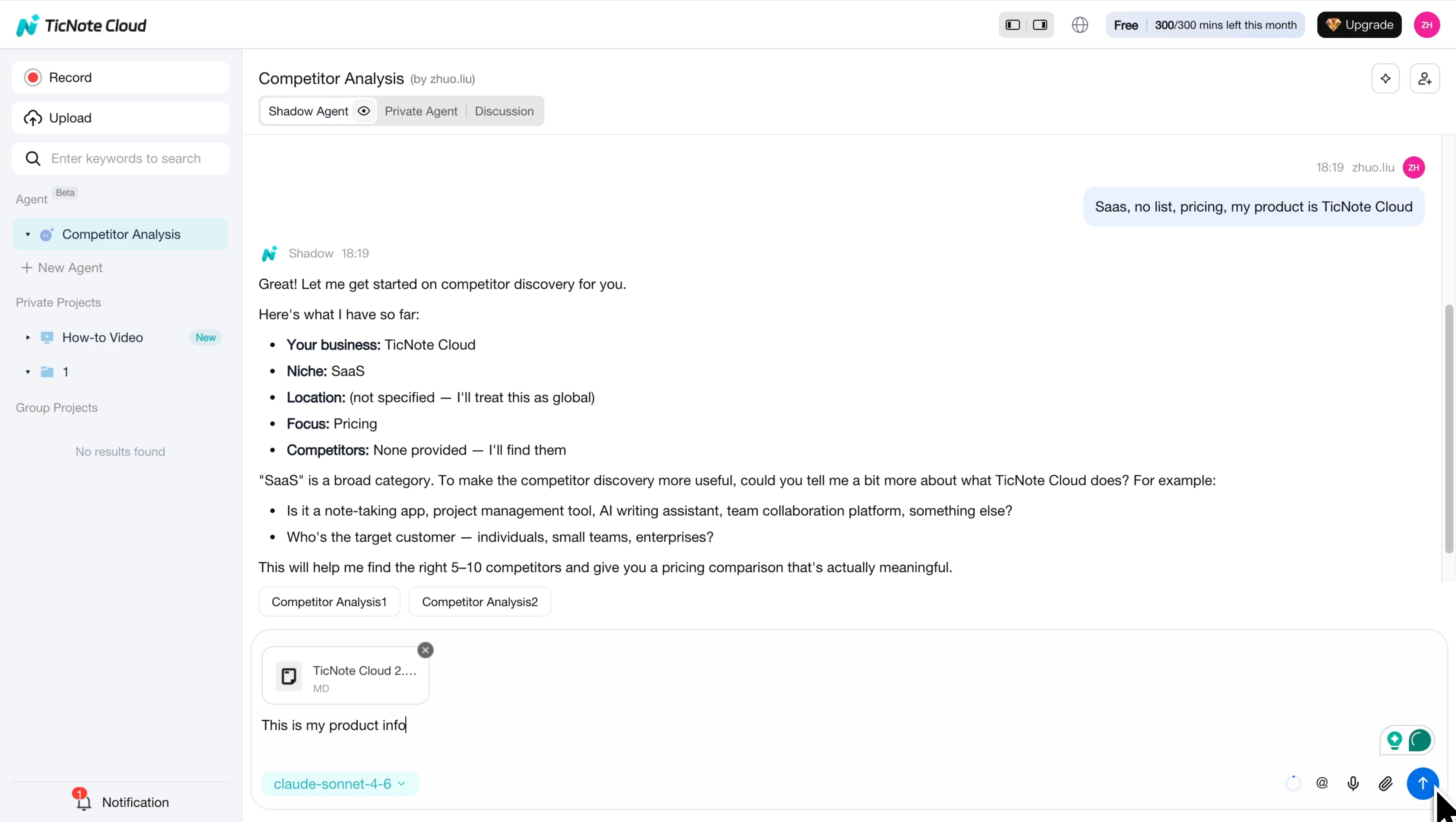
Give the agent a simple input pack:
- Your niche or product category.
- Your location or market, such as "Austin" or "Online/Global."
- 5–10 competitor names or URLs.
- An optional focus, such as pricing, reviews, social media, or product range.
- Your decision goal, such as "find a pricing gap" or "improve positioning."
Review the report, then verify weak signals
The skill agent researches public sources and returns a competitive intelligence report with an executive summary, competitor profiles, a head-to-head comparison table, market gaps, and 3–5 recommended actions. Treat any "Low confidence" item as a manual review task before you share the report.
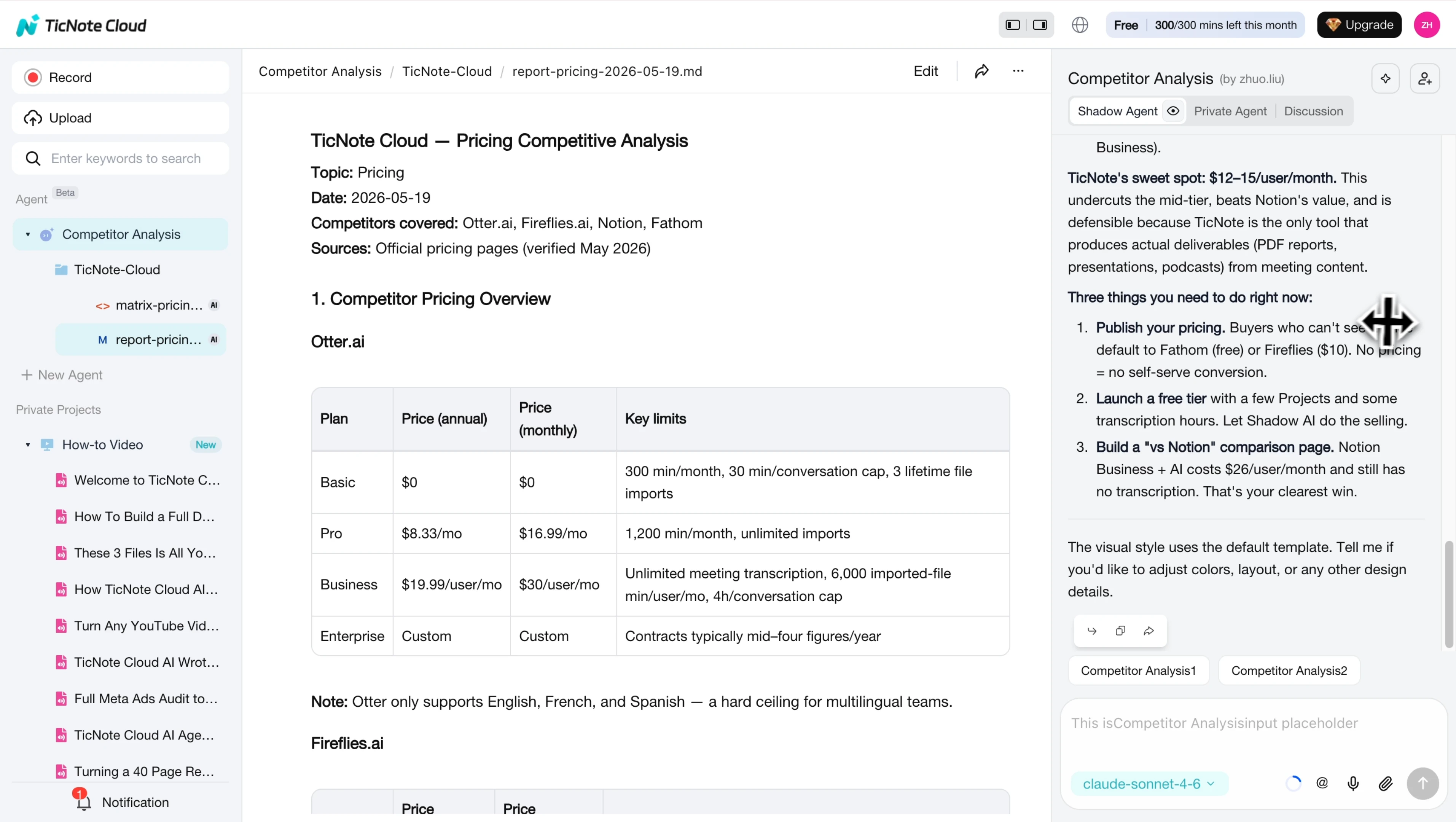
This is where TicNote Cloud adds practical leverage. Projects keep competitor notes, source files, and follow-up research together. Shadow AI can answer questions across the project with citations, while Deep Research supports a traceable analysis flow instead of one-off answers.
Use the visual matrix to make decisions faster
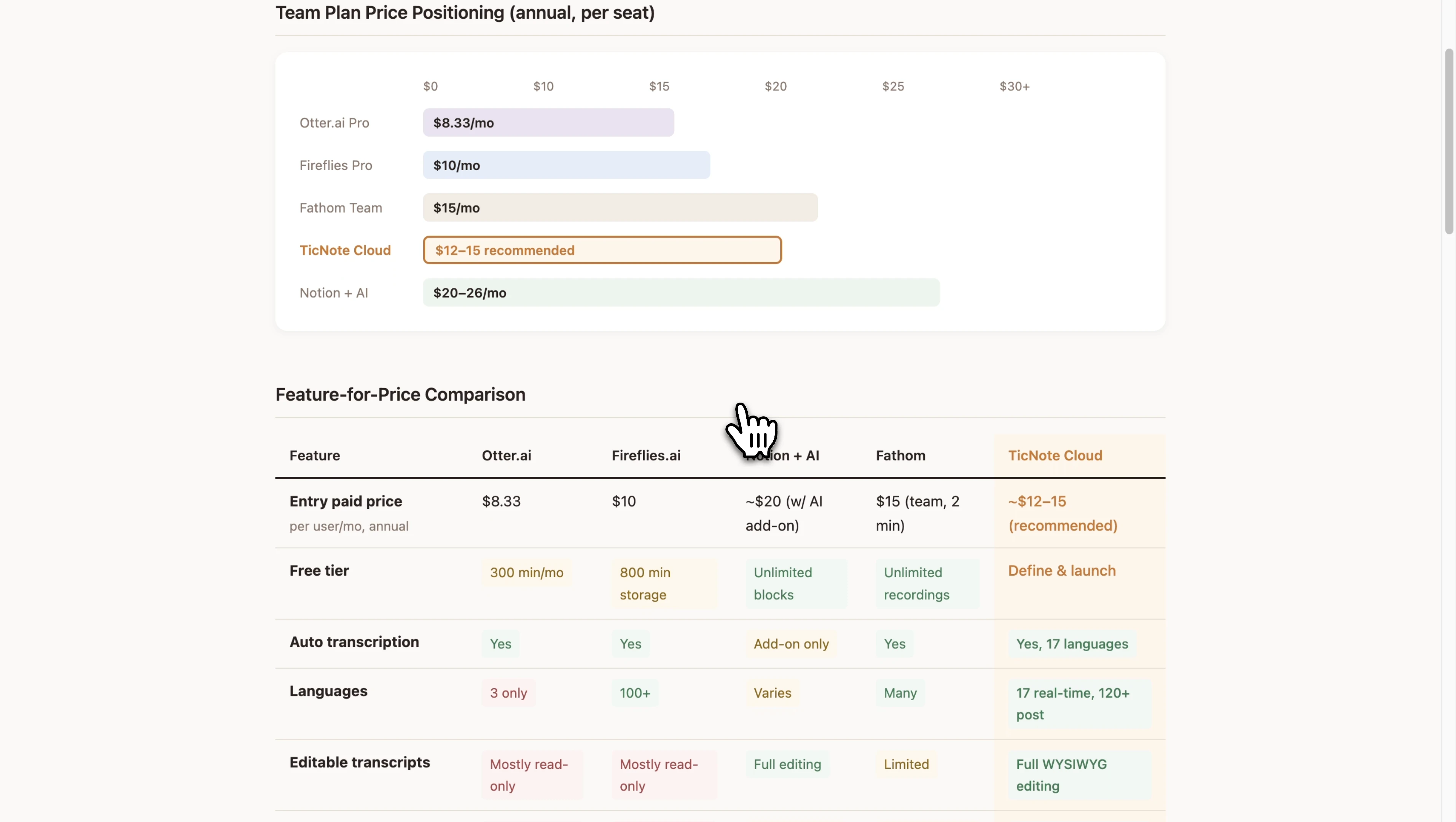
Open the visual HTML comparison matrix and check whether the feature list matches your decision. If it feels too broad, narrow the inputs and rerun the agent. The best matrix shows Yes/No/Partial feature coverage, 4-quadrant SWOT cards, and the top 3 actions.
Basic note apps usually store findings, but they don't create project-scoped intelligence. Generic chat tools can answer prompts, but they often lack shared memory, source grouping, and repeatable report outputs. TicNote Cloud fits teams that need one shareable document plus a visual matrix.
You can also provide the same input pack in the mobile app, review the report and matrix, then share or export the files to collaborators.
Generate your first competitor report from a product niche
Here is part of the demo output for TicNote Cloud competitor pricing research - the ONE click output.
It focuses on not only the pricing competitor analysis, but also USP/ratings/social media and more.
If you are interested in the skill, please try it now in the TicNote Cloud "Agent" feature.
Copy-ready templates, tables, and prompts to include
Use these prompts as the working layer of your competitor analysis example. Paste them into your research tool, attach your notes or source list, and require confidence labels so weak claims don't slip into the final report.
Prompt library for repeatable analysis
- Competitor selection prompt: "Act as a competitive intelligence analyst. For [business/niche/location], list direct, indirect, and substitute competitors. Explain why each was chosen, what data to collect first, source links to verify, and a confidence label: High, Medium, or Low."
- Feature matrix prompt: "Create a feature comparison matrix for [our business] and [competitors]. Include must-haves, differentiators, packaging notes, and impact on buyer choice. Mark Yes/No/Partial where useful. Finish with the top 3 takeaways in plain English."
- SWOT prompt: "Generate a SWOT analysis example for each competitor and for our business. Each Strength, Weakness, Opportunity, and Threat must include one evidence bullet, one source link, and a confidence label."
- Positioning map prompt: "Suggest 2–3 positioning map axis pairs for this market. Choose the most decision-relevant pair. Return a map description, optional coordinates, and one evidence sentence for each plotted company."
- Recommendation summary prompt: "Turn all findings into a one-page executive summary. Include 3 strategic recommendations, 3 quick wins, top risks, and what to monitor monthly. Separate evidence-backed facts from assumptions."
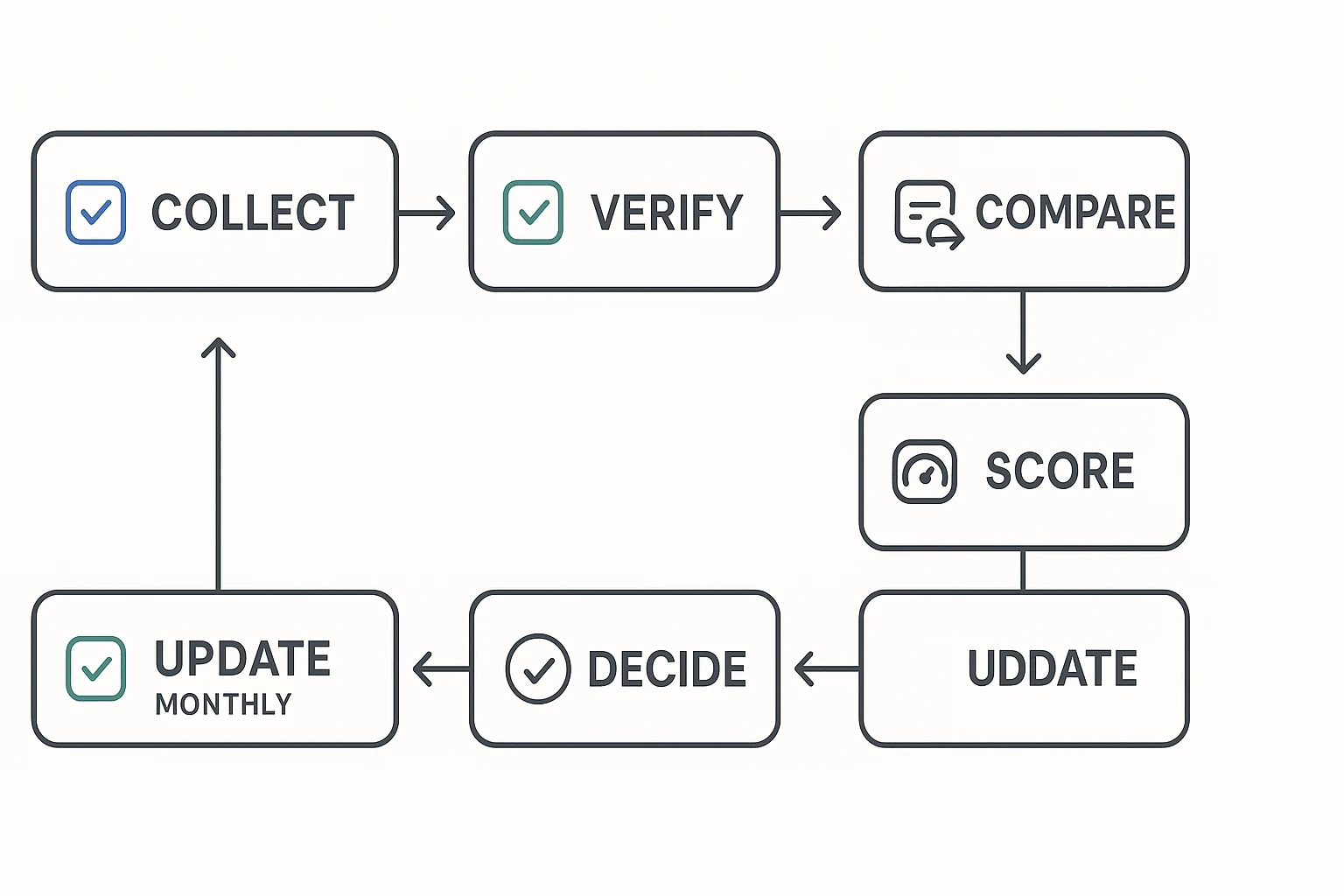
For best results, run the prompts in order: selection, matrix, SWOT, map, then recommendations. If social channels shape buyer choice, add a social media competitor workflow before the recommendation step. Keep all outputs in one project space, rerun the same prompts monthly, and compare score changes over time.
Final thoughts
A useful competitor analysis example isn't a bigger research dump. It's a repeatable system that turns public signals, customer priorities, and clear scoring into decisions your team can ship.
Keep the loop simple:
- Keep scope tight: 5–10 competitors and 3–5 buying factors.
- Label uncertainty: mark every claim as high, medium, or low confidence.
- Score what customers value: pricing clarity, proof, speed, support, and fit.
- Ship one change: update positioning, pricing, product packaging, or a campaign.
Use the same fields each time so trends stand out: who changed offers, who gained reviews, and where your message now wins. Then revisit the scorecard monthly.