


 Extension
TL;DR: A Skill Agent Workflow for Competitor SWOT Analysis
A competitor SWOT analysis works best when you use evidence, not opinions: try a free AI workspace to turn a niche brief into a report, positioning map, and comparison matrix, then validate every source.
Manual research gets messy fast. Links, pricing notes, reviews, and feature claims spread across tabs, making weak claims look equal to proven facts. A project-based AI workspace can organize evidence into outputs your team can check.
Use this workflow:
- Pick 3–5 competitors.
- Attach a link, quote, or metric to every SWOT point.
- Score impact, likelihood, and confidence.
- Turn the highest scores into positioning moves and experiments.
What Is a Competitor SWOT Analysis—and When Should You Use It?
A competitor SWOT analysis applies the SWOT matrix to one rival, a shortlist of rivals, or a market leader you want to beat. It explains how they win business across four quadrants: strengths and weaknesses sit inside the competitor; opportunities and threats come from the market around them.
Keep the four quadrants clean
Use this rule before you score anything: The U.S. Small Business Administration — Conduct market research and competitive analysis states that "Strengths and weaknesses are internal factors, while opportunities and threats are external factors." In competitor research, internal means product, brand, distribution, pricing power, resources, or unit economics. External means regulation, search demand, platform changes, buyer budgets, or new entrants.
Quick checks:
- "Their onboarding is faster" = Strength.
- "Their setup takes three calls" = Weakness.
- "Search demand is rising" = Opportunity.
- "A low-cost entrant is gaining reviews" = Threat.
Common pitfall: don't place customer trends in Strengths. Also don't label your own weak onboarding as a competitor threat.
Use it at clear decision points
Run the analysis when it supports a specific decision:
- Launch: shape messaging against the 2–3 rivals buyers already know.
- Repositioning: prove which narrative is credible.
- Stalled growth: find friction, feature gaps, or channel limits.
- New market entry: test risk before spending on sales or ads.
For example, a local HVAC company may compare reviews, service radius, and emergency pricing. A vertical SaaS team may compare integrations, onboarding time, and switching costs.
Know when SWOT needs support
SWOT is not a full strategy system. Pair it with Porter's Five Forces for industry pressure, jobs-to-be-done (JTBD) for buyer motivation, and customer interviews or usability tests to validate value and friction. In this guide, SWOT is the output. Research discipline is the input.
Set the Scope Before Research Starts
A competitor swot analysis gets useful only when the playing field is narrow. Start with 3–5 competitors: direct rivals sell to the same buyer and hit the same budget line; indirect rivals solve the same problem through a workaround, agency, spreadsheet, or bundled tool. Expand to 8–10 only in crowded SaaS categories where buyers compare many tabs before booking a call.
Tighten the market lens
Turn "who are we competing with?" into one scope statement: "We're comparing SMB accounting apps in the UK, acquired through inbound search, for first-time buyers." Name the segment, geography, channel, and buying scenario. Scope drift is the fastest way to make SWOT generic because every strength starts to sound true for everyone.
If your channel is social-led, pair this work with a repeatable social competitor benchmark so the same rivals are reviewed across content, reviews, and positioning.
Write the decision question
Pick one question the SWOT must answer:
- How do we win deals against Competitor X in 90 days?
- Where can we charge more without losing SMB buyers?
- Which feature gap is actually costing us deals?
- What positioning claim can we own in this geography?
Create a competitor profile card
Use one card per company before scoring.
| Field | Notes |
| Target customer | Segment, role, company size |
| Core offer | Main product or workaround |
| Pricing model | Free, tiered, usage-based, custom |
| Positioning claim | Primary promise on homepage |
| Primary channel | Search, outbound, marketplace, social |
| Proof points | Reviews, case studies, logos |
| Review themes | Top praise and complaints |
| Watch items | Hiring, integrations, partnerships |
Build an Evidence Base Competitors Cannot Hand-Wave Away
A competitor SWOT analysis is only useful when each point can survive a hard question: "What proves this?" Build your evidence base before you write the matrix, not after. That keeps the work factual, current, and hard to dismiss.
Collect sources by signal type
Use a mix of public and customer-facing sources:
- Websites and landing pages: positioning claims, target segments, proof points. Look at homepages, feature pages, and comparison pages.
- Pricing pages and FAQs: packaging, limits, contract friction, add-ons. Check plan footnotes and "fair use" terms.
- Reviews and app stores: recurring pain, delight, churn triggers. Sort by recent 1-star, 3-star, and 5-star reviews.
- Social channels and ad libraries: campaign themes, offers, creative angles. Look for repeated messages over 30–90 days.
- SEO tools and search results: content strategy, keyword gaps, category ownership.
- Job posts and press releases: roadmap signals, new markets, hiring priorities.
- Customer interviews: buying criteria, objections, switching reasons, unmet needs.
Apply the evidence rule
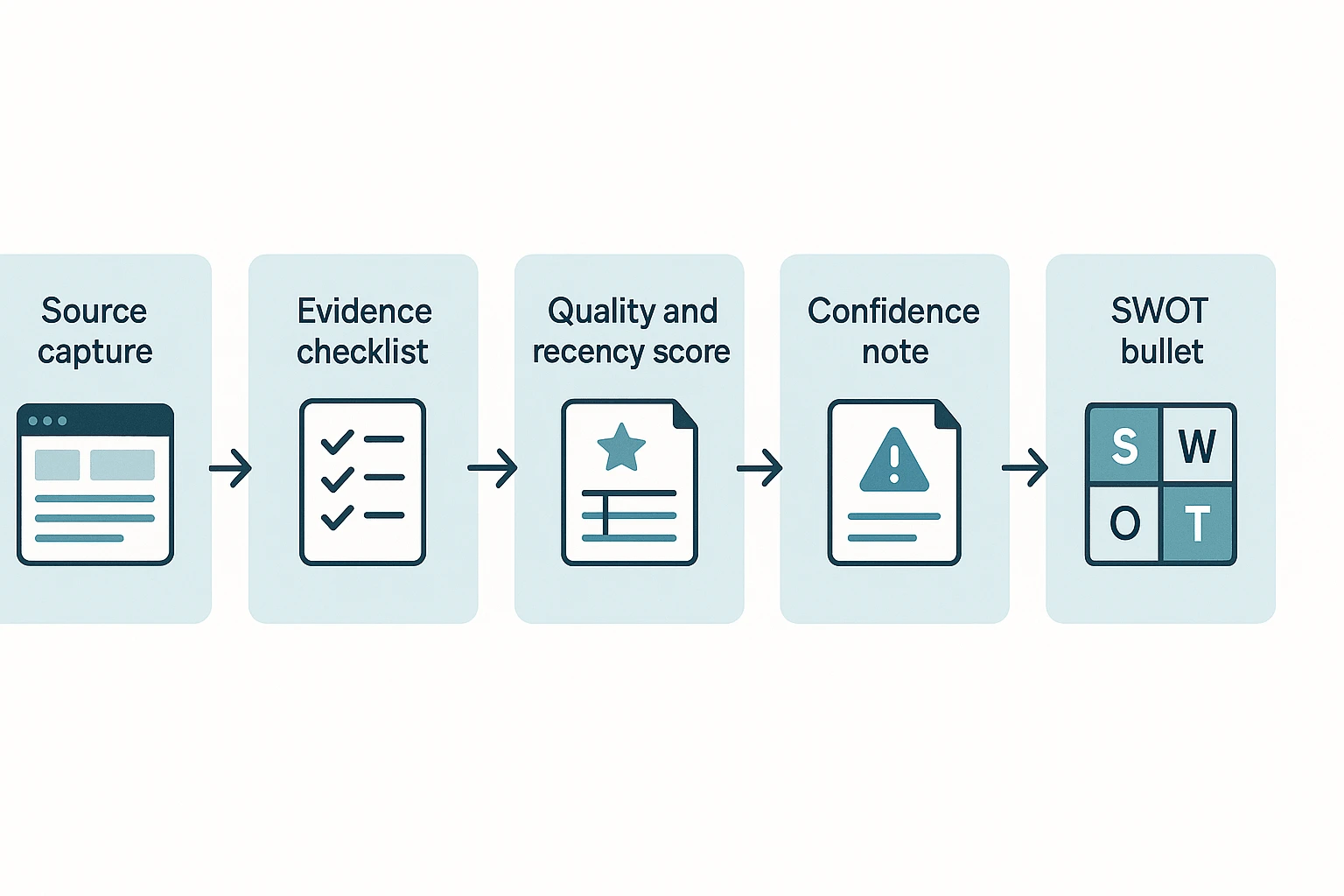
Every SWOT bullet needs three parts: claim, proof, and why it matters.
Bad bullet: "Competitor A has weak onboarding."
Good bullet: "Competitor A has weak onboarding; 18 of its last 60 G2 reviews mention setup confusion; this creates an opening for a simpler first-run experience."
For source discipline, Meriam Library, California State University, Chico (CRAAP Test) states, "The CRAAP Test was developed in 2004 by Sarah Blakeslee at the Meriam Library, California State University, Chico." Use that same mindset: check currency, relevance, authority, accuracy, and purpose.
Score quality and handle conflicts
Rate each source from 1–3:
- Weak: old, indirect, unclear sample, or pure marketing copy.
- Useful: current secondary source or small customer sample.
- Strong: primary source, direct customer voice, recent update, or review pattern with 30+ examples.
Recency matters most in fast-moving categories. A pricing page from this week beats a two-year-old blog post.
When signals conflict, document both. Example: "Pricing page says unlimited projects; reviews mention hidden usage caps. Confidence: medium. What would change my mind: updated terms page or five recent reviews confirming the cap is gone." This turns your SWOT into a living intelligence system, not a one-time opinion dump.
How Do You Turn Research Into a Weighted SWOT Matrix?
A competitor SWOT analysis becomes useful when it stops being a brainstorm and becomes a scored decision tool. Use the same SWOT analysis template for every rival, then score each item so your team can see which market moves deserve attention first.
Use quadrant prompts to force better evidence
Ask the same questions for each competitor:
- Strengths: What do buyers praise repeatedly? Which features, service claims, or ratings appear across 3+ sources?
- Weaknesses: Where do buyers complain, churn, wait, or pay extra?
- Opportunities: Which segment, location, use case, or price band looks underserved?
- Threats: What external shift could compress margins, such as ad costs, labor costs, regulation, or a new platform feature?
Keep each bullet tight: one idea, one measurable sign, one source note. For example, "Competitor A replies to Google reviews within 24 hours" is stronger than "good customer service." Add the metric, quote, screenshot note, or source URL in your working file.
Add weighted scores
Use a 1–5 scale for each factor:
- Impact: How much this could affect revenue, conversion, retention, or cost.
- Likelihood: How likely it is to happen or continue in the next 90–180 days.
- Confidence: How strong the evidence is. A pattern from 50 reviews scores higher than one anecdote.
Simple formula: Priority = Impact × Likelihood × Confidence. Confidence keeps you from overreacting to weak evidence.
Worked example: local home-cleaning booking platform
Scenario: Your app compares itself with CleanNow and SparkleBee.
| Quadrant | SWOT item | Evidence note |
| Strength | CleanNow offers same-day booking in 6 service zones. | Pricing page and booking flow checked |
| Strength | SparkleBee has 4.8 stars across 220+ reviews. | Review count trend recorded |
| Weakness | CleanNow charges a $19 weekend fee. | Checkout pricing logic |
| Weakness | SparkleBee has no recurring-plan discount. | Plan page reviewed |
| Opportunity | Neither competitor serves move-out cleaning for landlords. | Service menus compared |
| Opportunity | Both lack Spanish booking pages. | Website language audit |
| Threat | CleanNow is bidding on "same-day house cleaning" locally. | Search ad observed |
| Threat | Labor cost increases could shrink fixed-price margins. | Cost assumption logged |
Now rank the highest-value items:
| Rank | Item | Impact | Likelihood | Confidence | Priority |
| 1 | Add landlord move-out cleaning package | 5 | 4 | 4 | 80 |
| 2 | Launch Spanish booking page | 4 | 4 | 4 | 64 |
| 3 | Match same-day booking in 3 zones | 5 | 3 | 3 | 45 |
| 4 | Test "no weekend fee" offer | 3 | 4 | 3 | 36 |
This one-page matrix becomes your quarterly review artifact. Update the evidence, rescore the top items, and turn the highest scores into experiments.
Move From SWOT Notes to Prioritized Market Moves
A competitor swot analysis only matters when it changes what your team does next. Start by clustering repeated findings into strategic themes: speed, trust, coverage, price transparency, service quality, or workflow fit. This keeps you from chasing one loud anecdote and helps you see patterns across 3, 5, or 10 competitors.
Prioritize the few moves that matter
Pick the top three items in each SWOT quadrant using the highest Priority score. Then sanity-check each one against your decision question, budget, channel access, and product limits. Keep one wildcard slot for a low-confidence but high-impact bet, such as a new partnership angle or an underserved buyer segment.
Convert SWOT themes into action
Use this playbook:
- Strengths → amplify proof in pages, sales decks, reviews, and ads.
- Weaknesses → exploit gaps through sharper messaging or product fixes.
- Opportunities → run experiments, bundles, or partner tests.
- Threats → build risk controls and backup options.
Example action rules:
- If competitors hide pricing, then test a transparent pricing page.
- If they win on reviews, then launch a 30-day review recovery push.
- If their onboarding is slow, then promote your setup speed.
- If they lack integrations, then pitch workflow-fit content.
- If they dominate one city, then target a nearby niche market.
- If they bundle services, then test a starter package.
- If they outrank you for problem terms, then build comparison pages.
Measure each move with lean checkpoints
| Action | KPI | Baseline | Target | Owner | Timebox |
| Pricing page test | Conversion rate | Current % | +10% | Marketing | 2 weeks |
| Review push | Review score | Current rating | +0.2 | CX lead | 30 days |
| Comparison campaign | Share of search | Current share | +5% | Content | 30 days |
| Sales proof update | Sales cycle length | Current days | -10% | Sales | 30 days |
Review the first signal after 2 weeks. Keep, cut, or adjust each action at day 30.
Competitor-Analysis Skill Agent Workflow: Generate a Competitive Intelligence Report
This workflow uses TicNote Cloud as the example tool for running a faster, evidence-based competitor swot analysis. Its competitor-analysis AI research assistant, or skill agent, turns a niche brief into a structured competitive intelligence report with an executive summary, competitor profiles, market gaps, recommended actions, a positioning map, and a visual HTML comparison matrix.
Run the workflow on the web
- Create or open a Project. In TicNote Cloud, use Add Agent and browse the Skill Agent library. Choose the Competitor Analysis skill, then add it to your workspace.
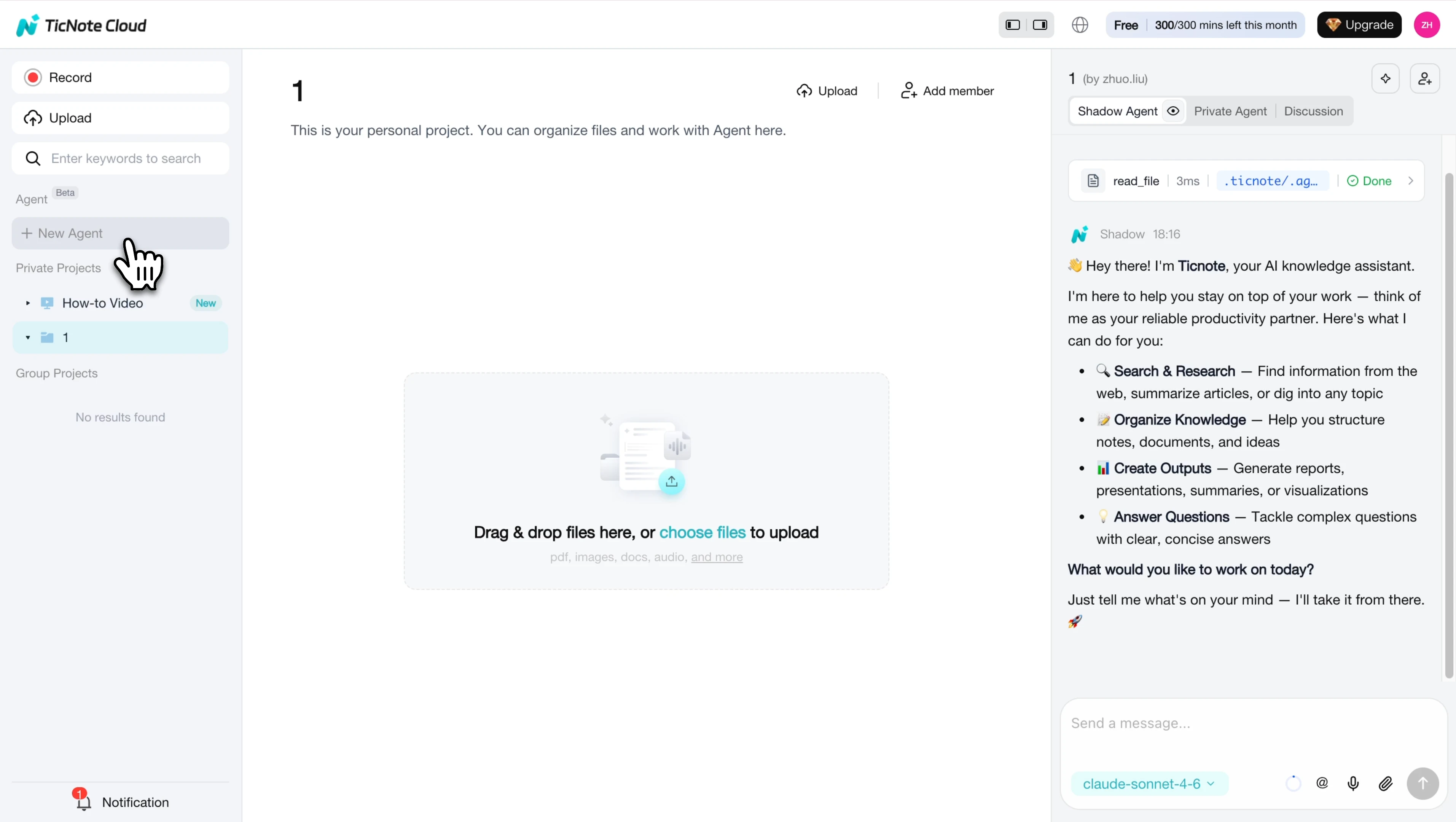
Once added, the agent appears in your list and is ready to use without extra setup.
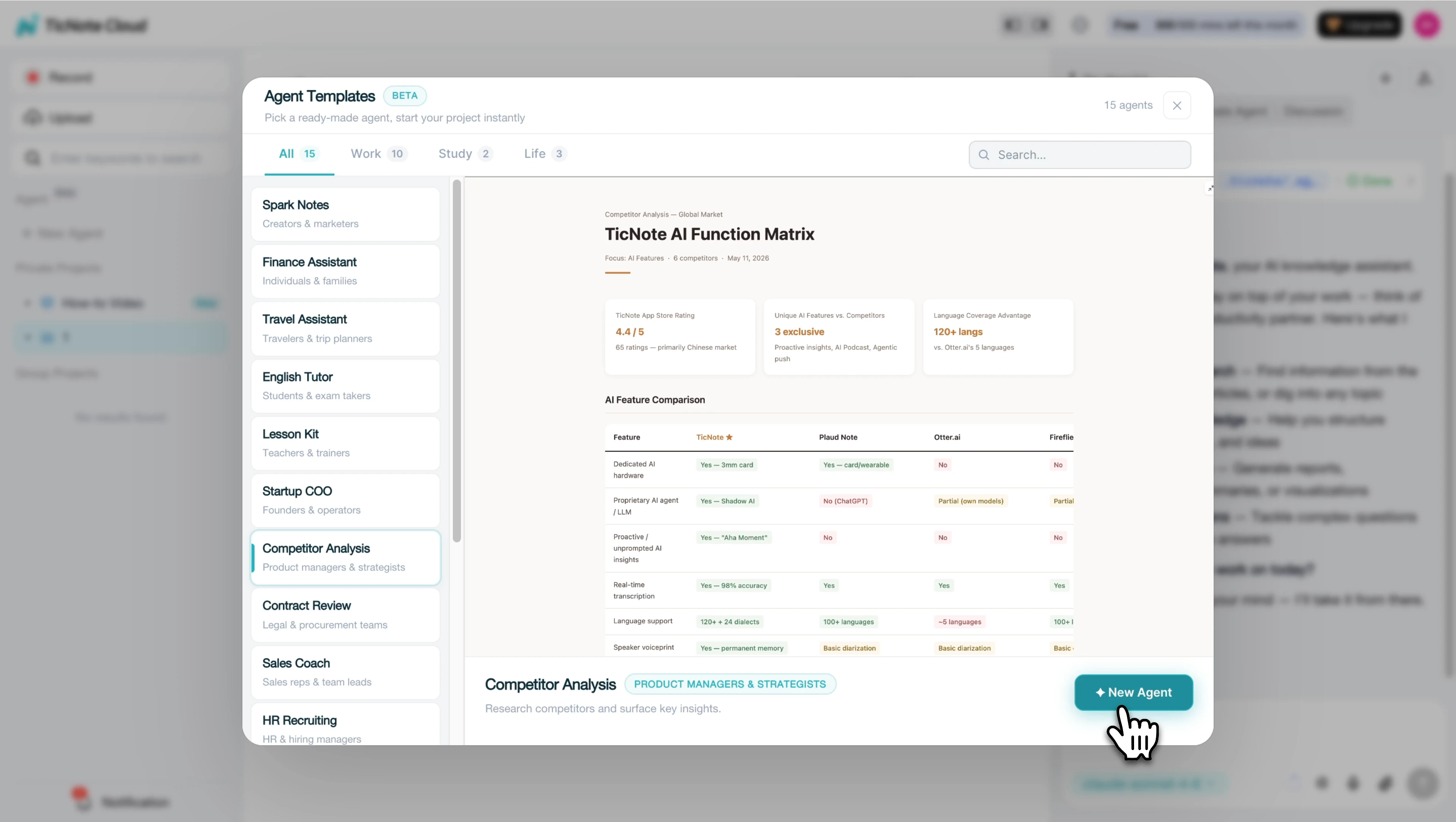
- Enter the core brief. Add your niche or industry, your location or market, and 5–10 competitor names or URLs. For sharper output, set one focus area: pricing, reviews, social media, or product range.
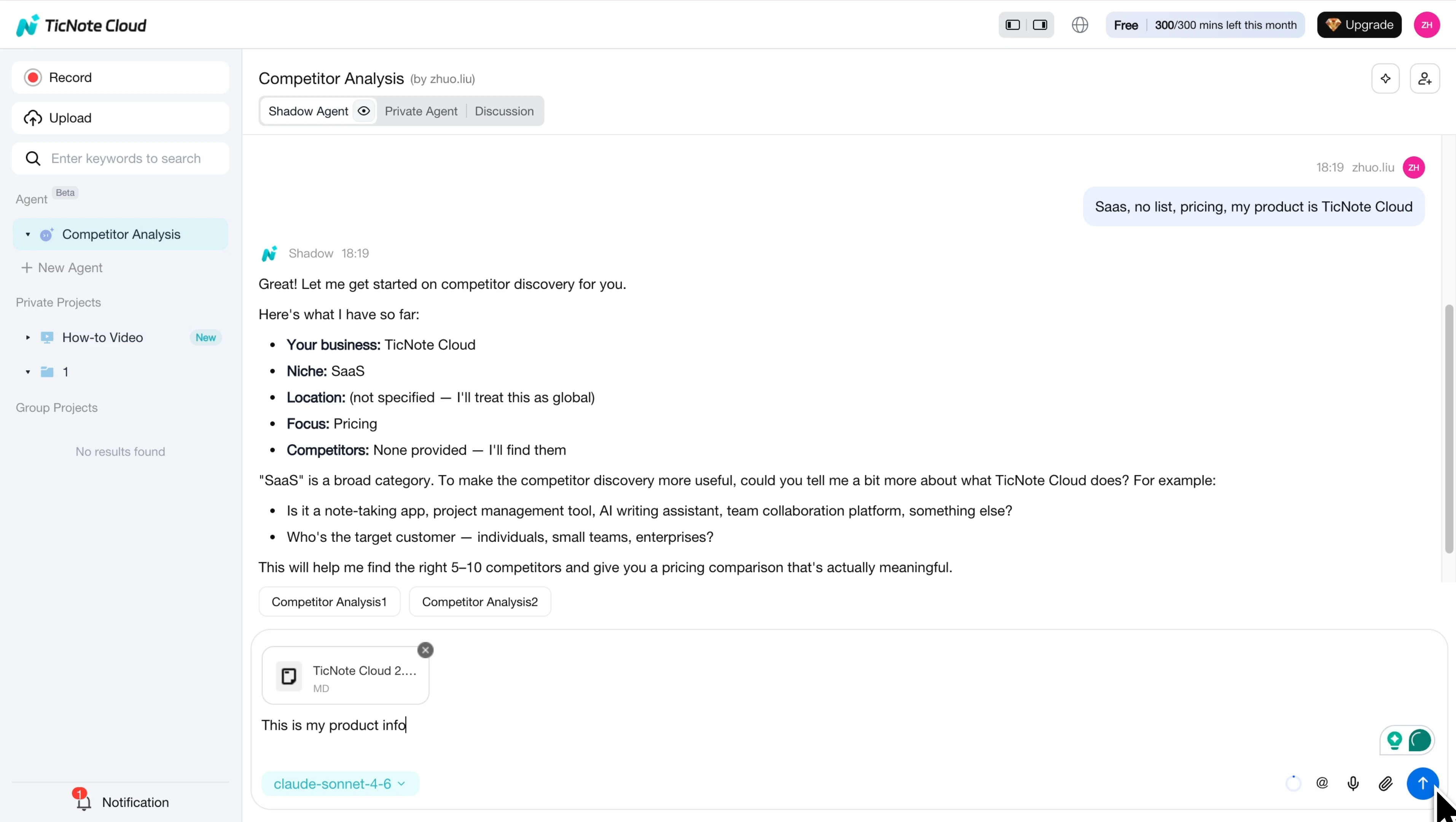
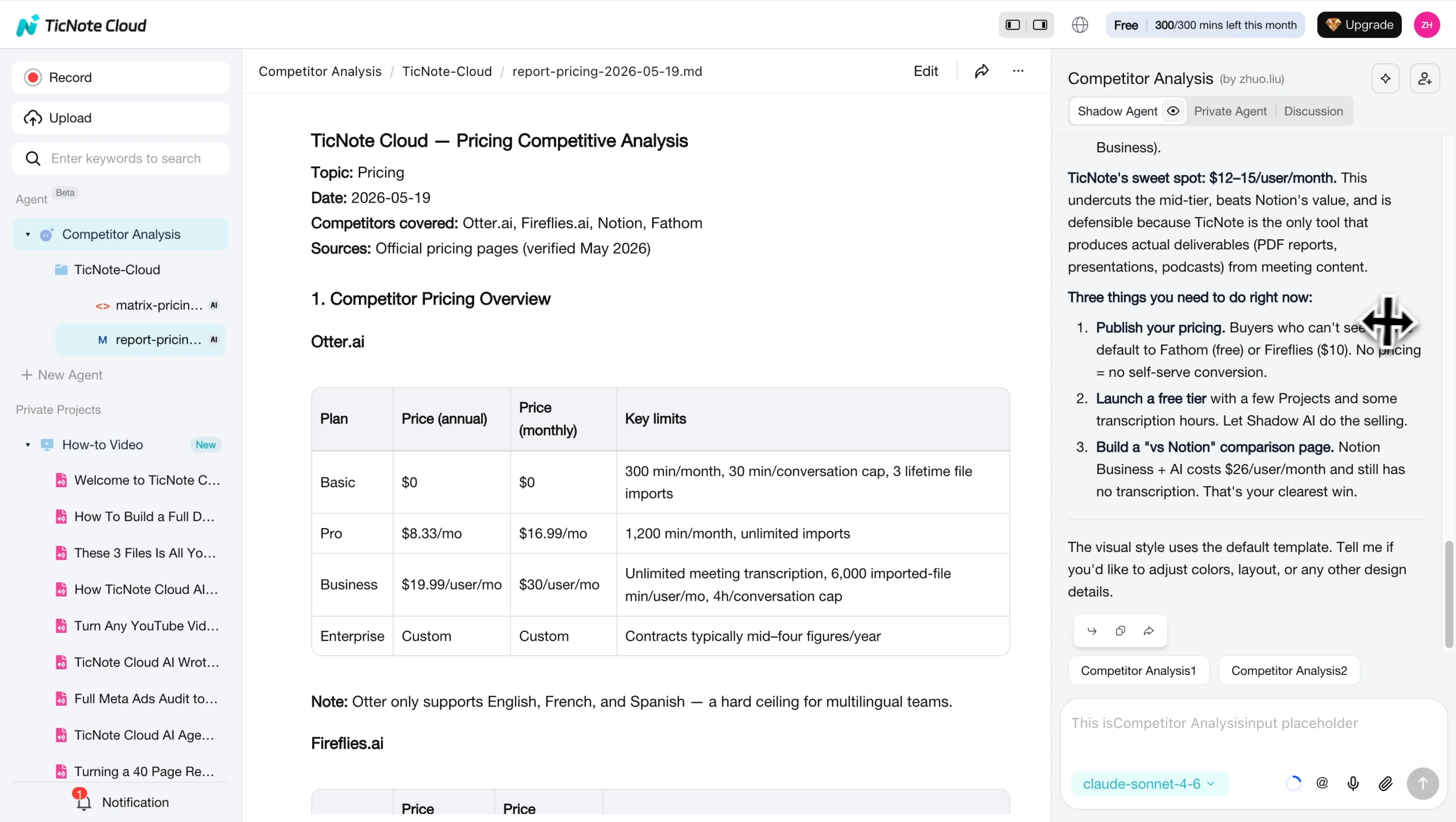
- Generate the intelligence report. The agent reviews public competitor signals, including website positioning, pricing model, review ratings, social presence, and differentiators. It returns a written report with an executive summary, head-to-head comparison table, competitor profiles, market gaps, and 3–5 prioritized actions.
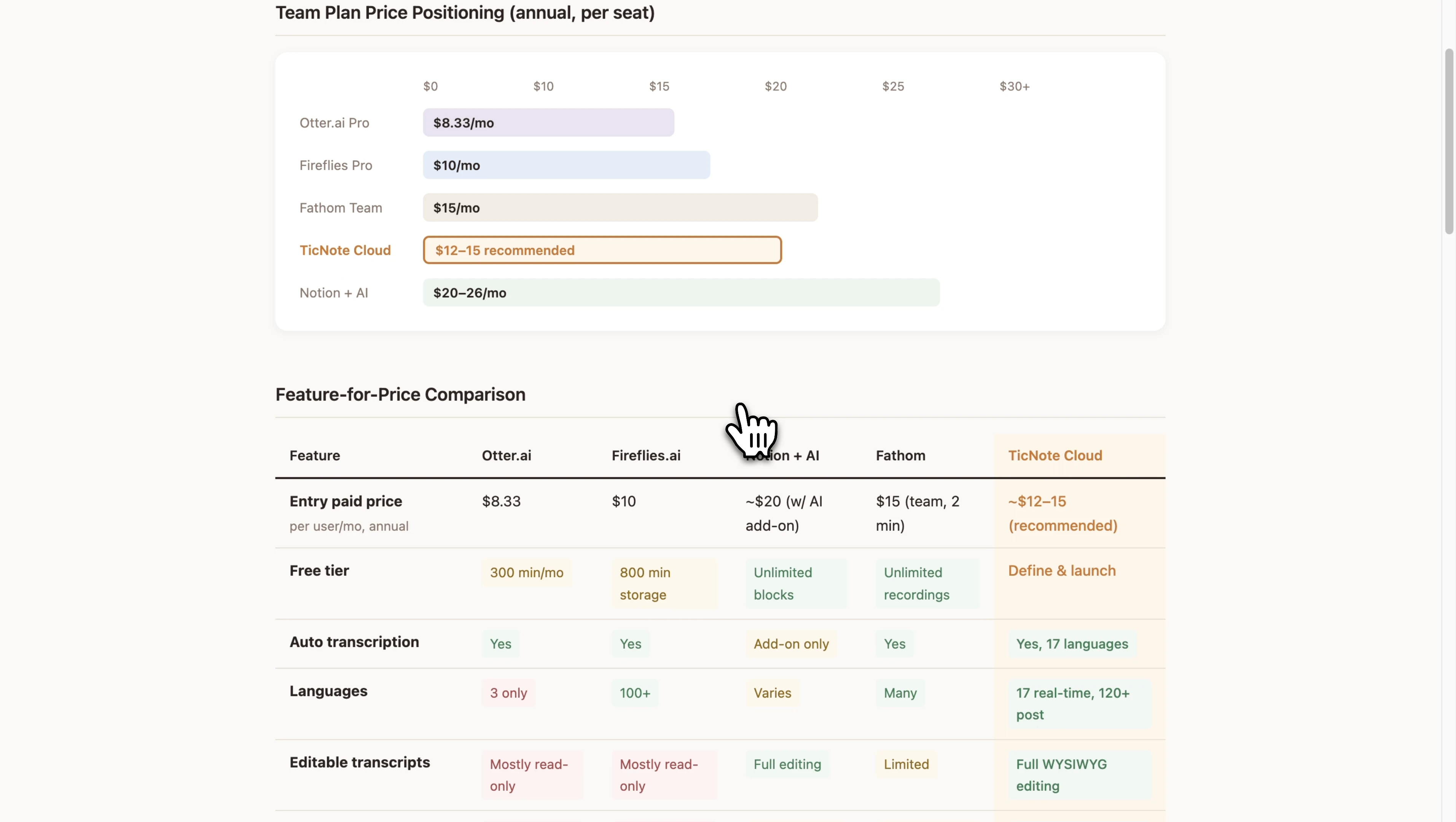
- Review the visual outputs. Open the companion HTML matrix to inspect the color-coded Yes/No/Partial feature grid, 4-quadrant SWOT cards, positioning notes, and top recommendations.
- Validate and refine. Add your own notes, attach trusted sources, and re-run with tighter prompts such as "SMB only," "city-specific," or "home page + pricing page only." Then export the report and HTML page, and keep both in the Project so future updates build on the same context.
Here is part of the demo output for TicNote Cloud competitor pricing research - the ONE click output.
It focuses on not only the pricing competitor analysis, but also USP/ratings/social media and more.
If you are interested in the skill, please try it now in the TicNote Cloud "Agent" feature.
Use the same input-first flow on mobile
On the TicNote Cloud app, open the Project, enter the niche, location, and competitor list, set a focus area, then generate the report and matrix. Review the findings, share them with your team, and keep the files in the Project for repeat research.
This workflow fits founders, consultants, and product marketers who need a repeatable system without a dedicated research team.
Run a Bias-Resistant SWOT Review Process
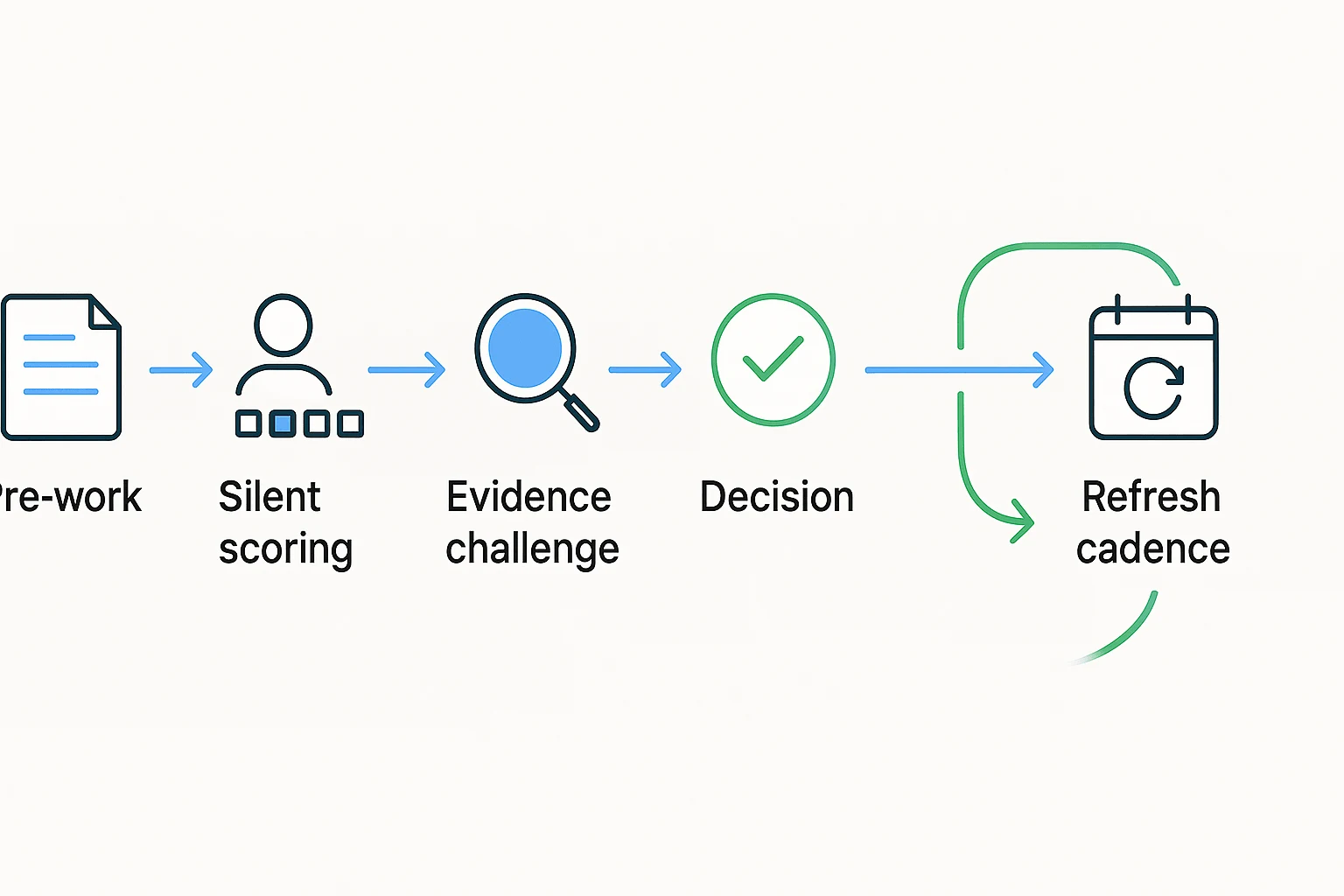
A bias-resistant competitor SWOT analysis is a meeting design, not a debate. Use 60–90 minutes: 10 for pre-read, 15 for silent scoring, 25 for evidence challenge, 15 for decisions, and 10 to assign 30-day actions. Before the call, send competitor cards and ask each reviewer to score alone. Log every weak point as an evidence-gap task.
Give each person a job
- Facilitator: keeps time and separates facts from assumptions.
- Evidence owner: opens source links and notes dates.
- Skeptic: tests claims before they become strategy.
- Decision maker: picks the final actions and owners.
Skeptic checklist:
- Is there a source link?
- Is it current within 90 days?
- Did we compare the same segment, plan, or use case?
- Are we rating evidence, or just confidence?
Prevent HiPPO bias (the highest-paid person's opinion) with anonymous first-pass scores, timeboxed debate, required evidence links, and separate columns for "known" and "assumed." Is There Such a Thing as 'Evidence-Based Management'?, Academy of Management Review (2006) defines "evidence-based management" as translating principles based on the best available scientific evidence into organizational practice (2006).
Refresh quarterly in stable markets, monthly in fast-moving categories, and immediately after pricing, funding, regulation, or new-entrant shifts.
Conclusion: Make Competitor SWOT a Repeatable Skill
A competitor SWOT analysis earns trust only when it's scoped, evidence-backed, and weighted. Define the market, buyer, and decision first; then collect proof competitors can't dismiss. Score each finding by business impact and evidence strength, then move the top items into positioning choices and small experiments.
Make the loop repeatable:
- Scope the niche, audience, and competitors.
- Build the evidence base from public sources and customer signals.
- Create a weighted SWOT matrix.
- Turn scores into positioning moves and tests.
- Refresh the file every quarter or after major market shifts.
With TicNote Cloud, Shadow AI can turn a niche brief into a structured competitive intelligence report, positioning map, and visual comparison matrix you can update over time.