

 Extension
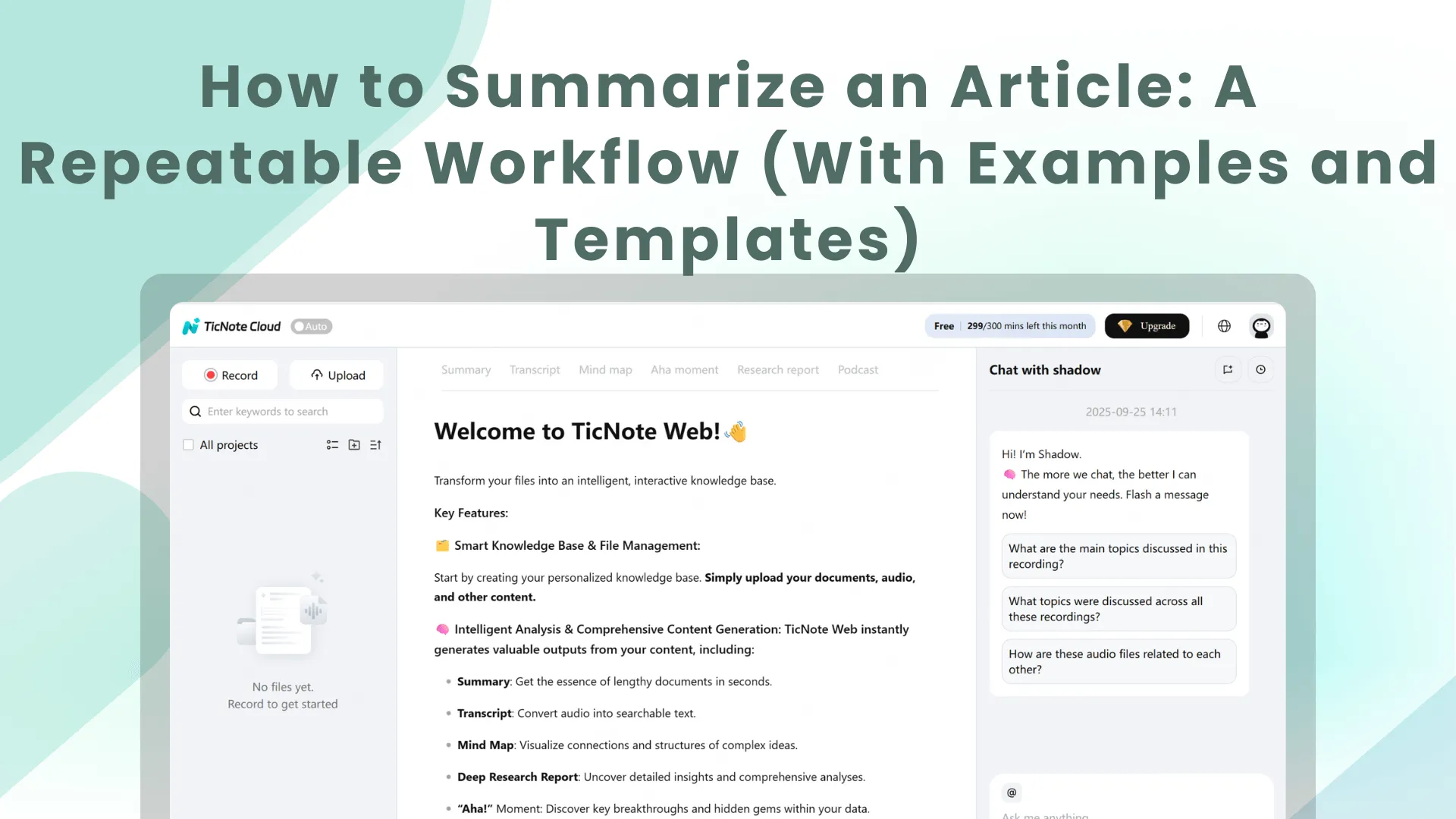
TL;DR: A fast notes → outline → summary workflow
Try this 10 minute method to learn how to summarize an article fast: open TicNote Cloud, paste the text, and let it draft a clean first pass you can verify.
You're short on time, so you copy lines and hope it's right. Then your summary sounds biased or misses the thesis. Use TicNote Cloud to turn quick notes into an outline and a neutral draft, then confirm key details.
The 5 moves in 10 minutes:
- Scan title, lede, and conclusion. 2) Mark the thesis. 3) Capture 3 to 5 section claims. 4) Write a one line outline. 5) Draft one neutral paragraph from memory, then verify.
Include every time: author, title, and date (if needed); main claim; 2 to 4 key points; and the so what (result). Avoid: copying phrases, adding your opinion, listing small examples, or dropping qualifiers like may, suggests, or limited to. Generate your first AI summary in minutes.
How to summarize an article without missing the main point
If you want to learn how to summarize an article well, start by finding the author's main point before you write a single line. That one step keeps you from turning a summary into a list of random details. It also makes your summary clearer and easier to trust.
What counts as the "main point" (claim vs topic)
First, split topic from claim.
- Topic = what the article is about (the subject). Example: "remote work."
- Claim (thesis) = what the author says about that topic. Example: "remote work raises productivity when teams set clear norms."
Quick cues to locate the claim fast:
- Check the intro and conclusion. Writers often state the thesis there.
- Look for repeated framing. If the author keeps returning to one idea, that's usually the main point.
- Match evidence to purpose. Ask: "What is this evidence trying to prove?"
Article type changes what "main point" looks like:
- Opinion or argument: the main point is the thesis plus 2 to 4 key reasons.
- Empirical or technical: the main point is often a chain: question → method → key finding → implication.
Summary vs paraphrase vs analysis (quick comparison table)
| Type | Purpose | Typical length | What changes | What graders or bosses expect |
| Summary | Give the core message and key support | Shorter than source | Compress ideas | Students: shows understanding. Workplace: helps decisions fast. |
| Paraphrase | Restate one passage clearly | Similar to original snippet | Reword, keep detail | Students: proves you can restate accurately. Workplace: clarifies a tricky point. |
| Analysis | Judge or interpret the ideas | Can be longer | Add evaluation | Students: argument and evidence. Workplace: risks, tradeoffs, recommendation. |
When to summarize vs quote vs paraphrase
Use this rule of thumb:
- Summarize when you need the overall argument, results, or storyline.
- Paraphrase when one specific idea matters, but the exact wording doesn't.
- Quote when wording is distinctive, a definition must be exact, or the author's phrasing is the point.
Mini checklist for assignments or meetings:
- Audience: Do they need a big-picture brief or one key detail?
- Space: One sentence, one paragraph, or a full brief?
- Exact wording: Would changing phrasing weaken meaning or accuracy?
- Attribution rules: Do you need to name the author, source, or date?
Next, I'll walk through the full workflow end to end: reading notes, a reverse outline, what to cut or keep, and three final summary lengths.
What length should your summary be for your use case?
Before you summarize, pick a target length. It changes what you notice, what you note, and what you cut. In practice, the best summaries start with a clear deliverable, not a blank page.
Simple rule-of-thumb ranges (1 sentence, 1 paragraph, 1 page)
Use these as default targets:
- 1 sentence (15 to 35 words): the thesis plus the direction of support or findings. Think "what they claim and how they back it."
- 1 paragraph (80 to 160 words): the thesis, 2 to 4 supports, then the outcome or implication. Keep the order the author uses.
- 1 page or executive brief (300 to 600 words): structured bullets for key points, a short wrap-up paragraph, and an optional "limits" line (scope, data limits, or what the author did not cover).
Here's a quick menu for common tasks:
- Class response post: 1 paragraph
- Literature review note: 1 page brief
- Meeting pre-read for a busy team: 1 sentence or 1 paragraph
Percent-of-original guidance (and when not to use it)
Percent rules can help, but keep them loose:
- Short articles (under ~1,500 words): aim for about 10 to 20%.
- Long academic pieces: aim for about 5 to 10%, then add a tiny "limits" line if needed.
Skip percentages when the piece is very dense (lots of definitions), uses long narrative examples, or mixes methods and results. In those cases, the right length depends on the reader's goal, not the word count.
Picking details under tight word limits
When space is tight, keep what changes meaning:
- What the author argues, does, or finds
- The one constraint that shapes the claim (sample, setting, time, or assumptions)
- 1 to 2 examples only if they clarify the claim
Detail triage checklist:
- Must keep: thesis, key results or reasons, constraints, conclusion
- Nice to have: small illustrations, vivid anecdotes, extra context
- Cut: history, tangents, repeated points, background you already know
How do you read and take notes so the summary writes itself?
If you want to learn how to summarize an article without staring at a blank page, fix your reading notes first. Your goal isn't to copy sentences. It's to capture the article's structure and the author's logic in a way you can restate later.
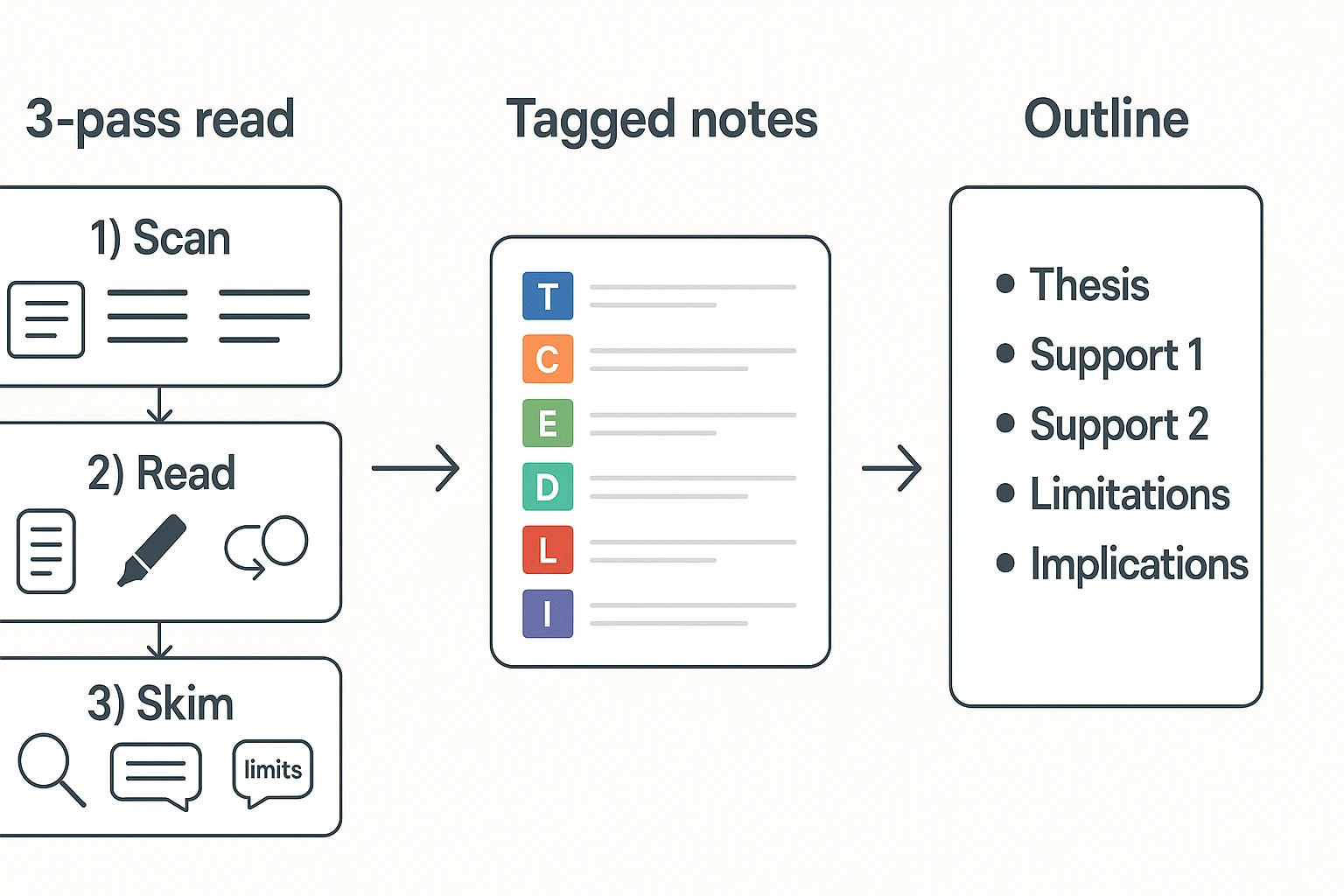
3-pass read (scan → read → skim)
Pass 1: Scan (2 to 5 minutes). Read the title, subheads, abstract or lede, and conclusion. Then check any figures, tables, or callouts. Write a quick prediction: "This will argue X, using Y reasons, with Z limits."
Pass 2: Read (slow, section by section). After each section, stop and write one line: the main claim and why it matters. Hunt for logic words like "because," "therefore," and "however." Also capture definitions, scope (who or what it applies to), and conditions (when it holds).
Pass 3: Skim (quality check). Re-scan topic sentences and transitions. Look for what's easy to miss: limitations, counterarguments, and small but important qualifiers (often, may, in some cases). If you find one, tag it as a limit.
Reverse outlining in plain language
Reverse outlining means you outline after reading. It's the fastest way to see what's core versus background.
Here's how: for each section or paragraph, write a one-line purpose in plain words. Start with stems like "This part argues…," "This part explains…," or "This part tests…". When you're done, you can see the author's real spine. Anything that doesn't support the spine is likely background, an example, or a detour you can compress.
Copy this mini template:
- P1 purpose:
- P2 purpose:
- P3 purpose:
- So what is the thesis in one line?
- Top 3 supports (in order): 1) 2) 3)
- Biggest limit or counterpoint:
Note types: thesis, section claims, evidence, definitions, limitations
Use a simple tag system so your notes stay clean. One bullet per idea.
- T (thesis): the main point in one sentence
- C (claim): what the author says is true
- E (evidence): data, examples, studies, or reasoning used
- D (definition): what key terms mean (in this article)
- L (limit): boundaries, caveats, counterarguments
- I (implication): what changes if the claim is true
Worked example preview (dense opinion or academic style):
- T: Remote work boosts output for some roles, but not all.
- C: Focus time rises when meetings drop.
- E: Case examples from two teams with fewer syncs.
- D: "Productivity" means completed tasks, not hours.
- L: Results may not hold for new hires or creative work.
- I: Policies should vary by team and tenure.
How do you turn notes into a clean outline?
To outline fast, turn messy notes into 3 to 5 "moves" the author makes. This step keeps you from writing a summary that's just random facts. It also makes the main point easier to restate in your own words.
The "Author + verb + claim + reasons + so what" frame
Use this sentence frame:
Author + reporting verb + main claim + because (top reasons or evidence) + so what (why it matters).
Two variations:
- Argumentative piece: "The author argues that ___ because ___, which implies ___."
- Empirical study: "The paper reports that ___ based on ___, suggesting ___."
To stay neutral, pick calm verbs: argues, suggests, reports, describes, finds. Avoid "proves" unless the author truly proves it.
Mapping sections to 3 to 5 bullets
Rule: one bullet per major move:
- Problem or question
- Approach (method, lens, or how it's structured)
- Key supports or findings (merge repeats)
- Implication (what changes, who should care)
Trim "scene setting" like long history, anecdotes, and throat clearing. Also merge points that say the same thing in new words.
Quick check:
- Do my bullets match the article's section headers?
- Can I point to where each bullet appears?
- Does each bullet help explain the conclusion?
Spotting (and trimming) background, examples, and tangents
Use the test: "If I cut this, does the conclusion change?" If not, drop it.
Keep examples only if they:
- Define a term
- Show a key mechanism (how it works)
- Raise the stakes (why it matters)
Paste-ready outline template:
- One-sentence frame: Author + verb + claim + because + so what.
- Move 1 (problem):
- Move 2 (approach):
- Move 3 (supports/findings):
- Move 4 (implication):
- Must-keep terms/names/stats:
How do you write the first draft in your own words (and keep it neutral)?
Your first draft is where you prove you understand the source. The goal isn't to sound fancy. It's to restate the author's main points in plain, neutral language, without copying their phrasing or adding your own opinions.
Use the draft-from-memory method to avoid copying
This is the simplest way to reduce patchwriting (copying the source sentence shape and swapping a few words).
- Close the article (or scroll away).
- Write from your outline only. Use short, direct sentences.
- Reopen the article to verify details. Fix any misquotes, wrong numbers, or missing qualifiers.
Why it works: when the text isn't in front of you, you can't mirror it line by line. You're forced to explain the idea, which usually makes the summary clearer and more original.
Swap "signal words" that inject bias
Neutral summaries describe what the author says, not what you think. Watch for words that imply judgment, certainty, or emotion.
Biased → objective rewrite box:
- "Obviously the policy failed." → "The author argues the policy failed."
- "The results are terrible." → "The results are negative in the author's view."
- "This proves X." → "The evidence suggests X."
- "The company lies about…" → "The author claims the company is inaccurate about…"
- "It's clear that…" → "The article reports that…"
Quick guardrail: if your sentence includes a new reason, example, or takeaway that wasn't in the article, cut it or label it as your own analysis (and save it for a separate section).
Keep qualifiers so you don't overstate the claim
Most articles are careful. Your summary should be, too. Do a fast qualifier checklist:
- Scope: Who or what does this apply to?
- Uncertainty: Does the author say may, might, could, suggests?
- Limitations: Any data gaps, small sample, timeframe, or method limits?
- Exceptions: Cases where the claim doesn't hold?
Mini self-edit pass (2 minutes): highlight (1) hedges like may/suggests, (2) numbers, and (3) names. Then confirm each one matches the source exactly.
Revision pass list (rubric-style):
- Clarity: Can a reader follow it without the article?
- Neutrality: Did you remove judgment words and certainty boosts?
- Accuracy: Do facts, qualifiers, and relationships match the source?
- Originality: Is the phrasing clearly yours, not a near-copy?
How should you handle quotes, statistics, and named entities?
When you summarize an article, treat quotes, numbers, and names like evidence: keep what carries the claim, trim what only adds flavor, and double-check every detail. Your job is to preserve the author's meaning without copying their wording or warping the facts.
Decision rules: keep, compress, or drop
Use this quick table while you draft:
| If the detail is… | Do this | What it looks like in a summary |
| A key definition, a central claim, or a number the whole argument depends on | Keep | "The author defines X as…" / "The study reports a 23% drop in…" |
| A supporting stat, a date, a secondary result, or a list of examples | Compress | Round, group, or generalize: "several studies," "about one-quarter," "in the early 2020s" |
| A decorative name, anecdote, brand, minor quote, or one-off example that doesn't change the point | Drop | Remove it and keep the idea only |
Rule of thumb: summaries prefer meaning over detail, but you can't change the claim. If removing a number or name changes what's true, keep it.
How to attribute stats and claims in one line
Attribution keeps you neutral and clear. Try these one-line patterns:
- "The author reports that [claim/stat]."
- "In the study, X was measured by [method], and [result] was found."
- "The article cites [source type] to argue that [claim]."
- "According to the article's [section name], [finding]."
If your class or workplace needs it, add a locator: "(p. 6)" or "(Methods section)."
When a direct quote is acceptable (and how to format it)
Quote sparingly, mainly for:
- A precise definition you can't reword safely
- Distinctive phrasing that would lose meaning if paraphrased
Format it simply and consistently: "Exact wording here" (Author, Year, p. X) or "Exact wording here" (Section/para #). Follow whatever style guide you've been given.
Micro-checklist before you submit:
- Verify every number against the original.
- Verify every proper noun (names, organizations, places).
- Verify every quote is exact and attributed.
- Re-read your summary and confirm it matches the author's claim, not your opinion.
How do you summarize technical or dense articles accurately?
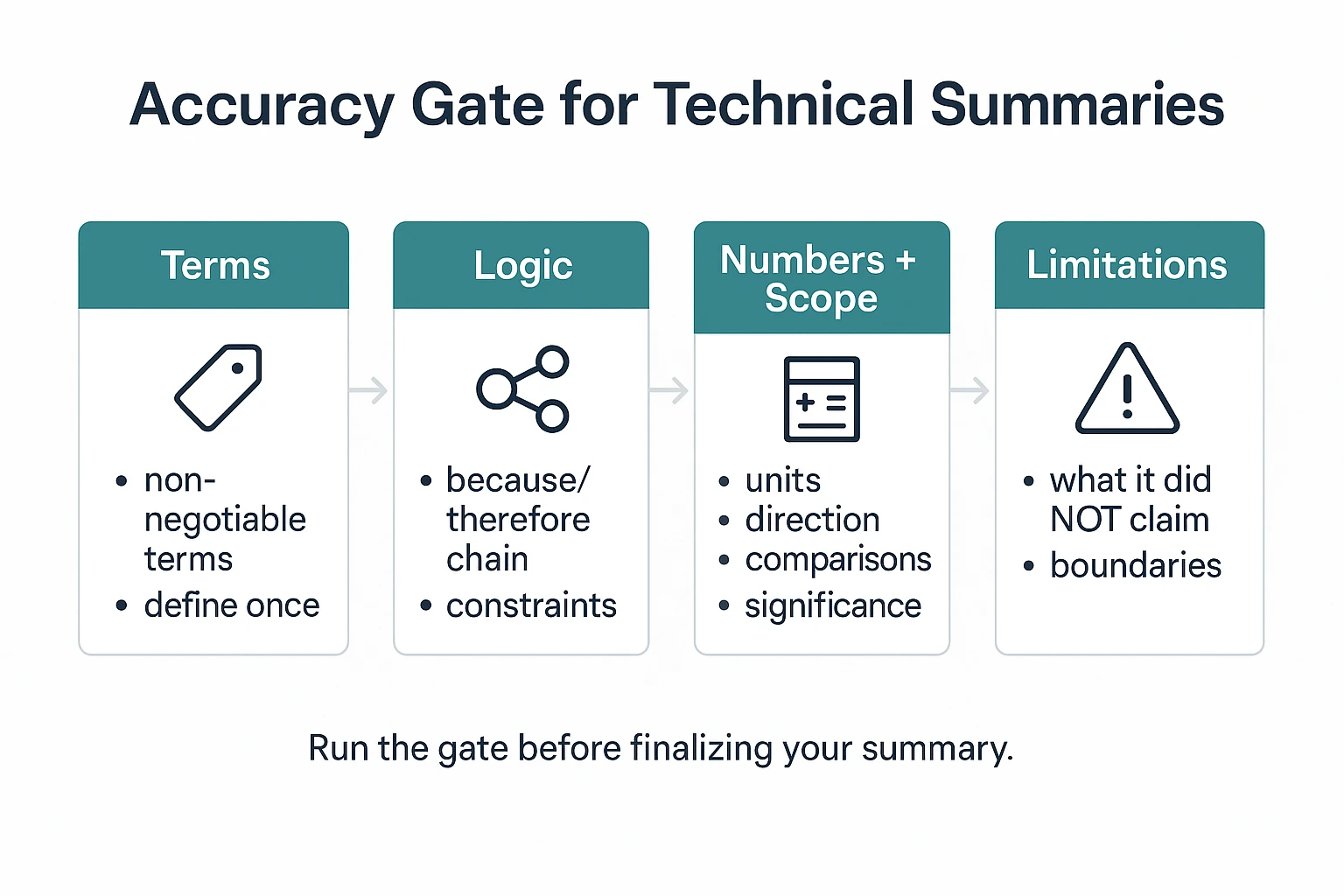
Dense articles can feel "unsummarizable" because every sentence seems important. The fix is to add an accuracy gate before you write. You'll keep key terms, keep the logic, and report results with the right limits. That's how you summarize an article like a study, spec, or white paper without drifting.
Keep essential terms; define once
First, list the non negotiable terms. These are variables, mechanisms, standards, and named methods. If you swap or drop them, you change the meaning.
Use this one line pattern the first time a term appears:
- Term: plain meaning (in simple words) + role in the argument
Example: "Sensitivity (true positive rate) tells how often the test detects real cases."
Preserve cause and effect and constraints
Technical writing runs on logic. Your summary should keep the "because" and "therefore" chain, but in fresh wording.
Also keep constraints, since they define what's true:
- Population or dataset (who or what was studied)
- Conditions (time frame, setting, hardware, protocol)
- Assumptions (what must be true for results to hold)
- What the method can and can't show
Accuracy checks: numbers, scope, and what the article did NOT claim
Before you finalize, run this quick checklist:
- Numbers: did you copy units and scales (ms vs s)?
- Direction: did the effect go up or down?
- Comparison: what is it compared to (baseline, control, prior work)?
- Significance: is it statistically significant (unlikely by chance) or practically meaningful (big enough to matter)?
- Limits: did you keep the study's limitations and open questions?
Don't overclaim:
- Correlation (moves together) is not causation (causes it)
- "Associated with" is not "proves"
- One study rarely "settles" a debate
Next, we'll apply these checks to a dense piece. You'll see the notes, outline, and three final summaries: one sentence, one paragraph, and an executive brief.
Try TicNote Cloud for Free to turn long papers into structured notes, then sanity check terms and numbers with Shadow cross file Q&A before you share your summary.
How to summarize an article faster with an AI workflow (step-by-step)
These steps are demonstrated using TicNote Cloud as an example tool, but the workflow is the same in any summarizer: upload the source, generate a draft, then edit it to your needed length. AI saves time, but you still own accuracy, tone, and attribution.
Step 1 (Web): Upload the source
Start by creating or opening a project for the class, client, or brief. This keeps your sources and summaries in one place, so you can reuse them later.
In TicNote Cloud web studio, create a new project, then click Upload at the top. Add your article as a PDF or Word file, or paste long text into a document. If your "article" is really a talk or recorded briefing, upload audio or video instead so you can also get a transcript.
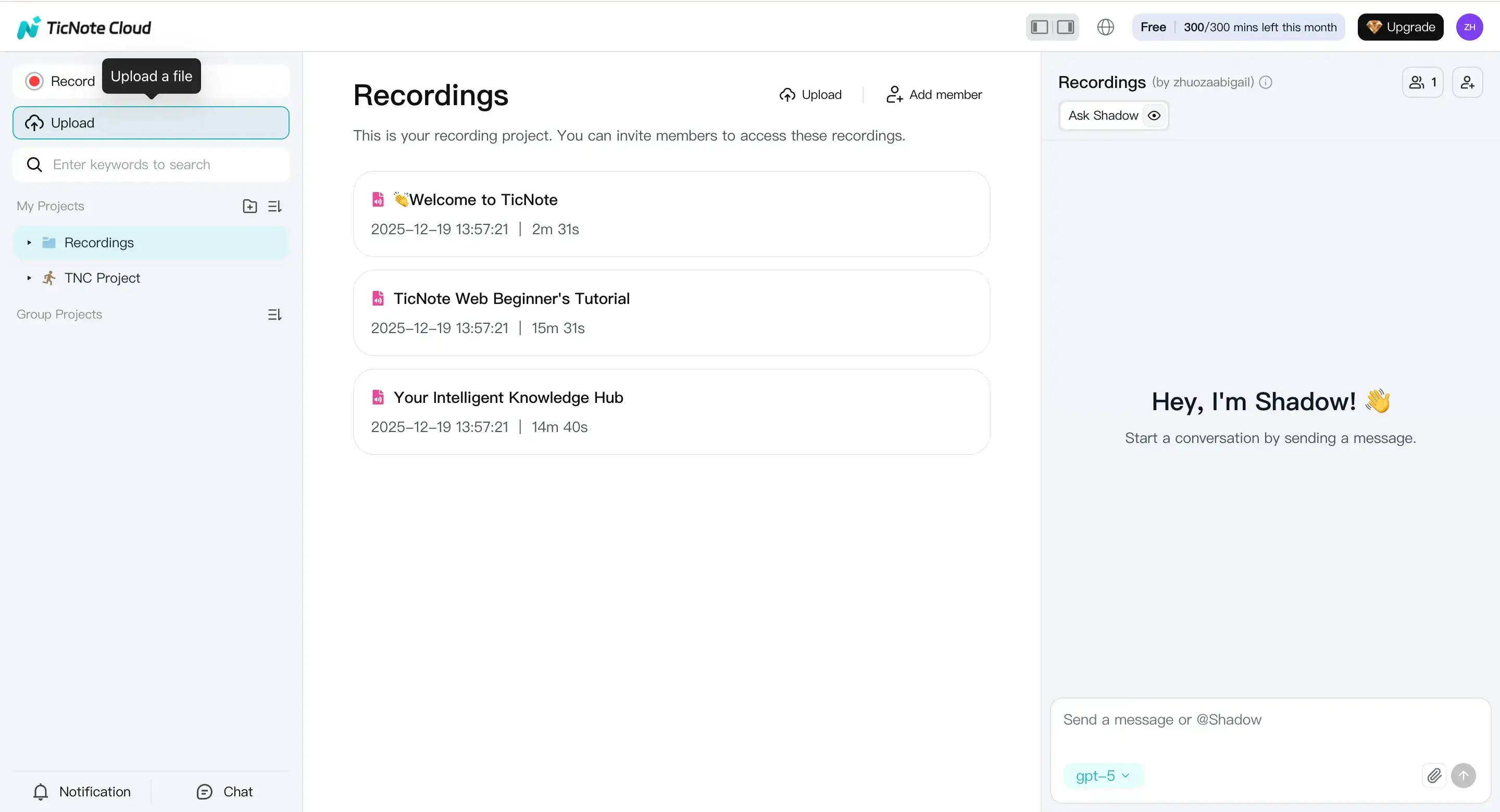
Before you summarize, confirm you picked the right file. Then rename it with a clear label, like "Author, Short Title, Year". That name will matter later when you search, cite, or compare sources.
Step 2 (Web): Get the summary, then shape it into your required length
Next, generate a first pass summary. In TicNote Cloud, open the file and click the Summary tab at the top.
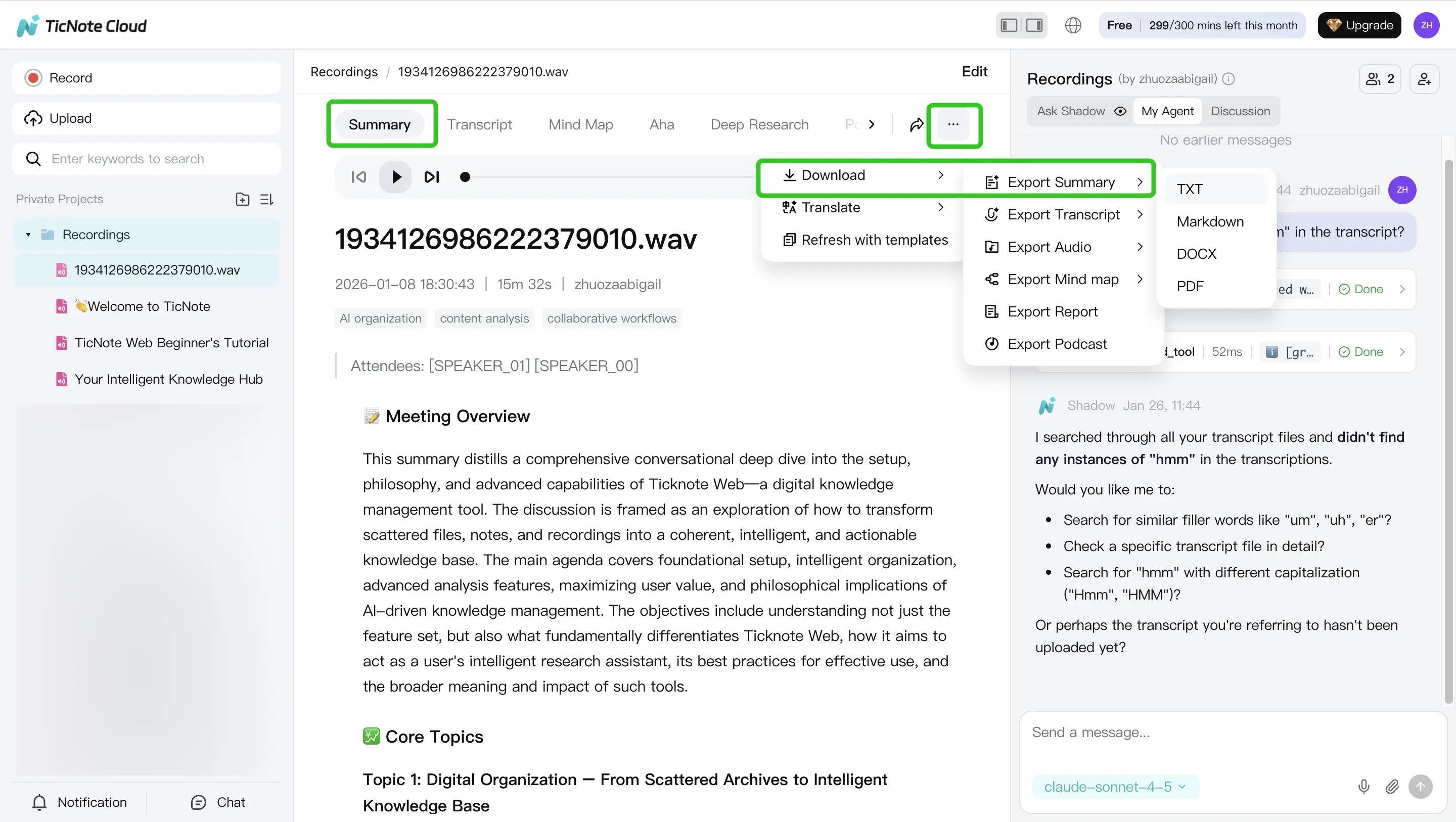
Now do the part that makes the summary useful: reshape it to match your use case.
- Pick a target format
- 1 sentence: the thesis plus the main reason.
- 1 paragraph: thesis, 2 to 4 key points, and the conclusion.
- Executive brief: purpose, key findings, evidence, limits, and action items.
- Edit with the source open
- Keep qualifiers like "may," "suggests," or "in this sample."
- Verify key names, dates, and numbers against the article.
- Remove side examples, jokes, and repeated points.
- Add attribution lines Add a simple header so the summary can stand alone later:
- Author:
- Title:
- Publication and date (if known):
If you're new to AI tools, it also helps to know what models do well and where they fail. This quick guide on how AI summarizers work and how to judge their output will help you spot common mistakes.
Helpful add-ons (optional, but fast):
- Templates: keep every summary in the same structure.
- Mind Map: compress a dense section into a few linked ideas.
- Deep Research: turn notes into a structured report.
- Shadow cross-file Q&A: ask, "Does any other source disagree?" to sanity-check claims.
App workflow (short): Upload → summarize → edit on mobile
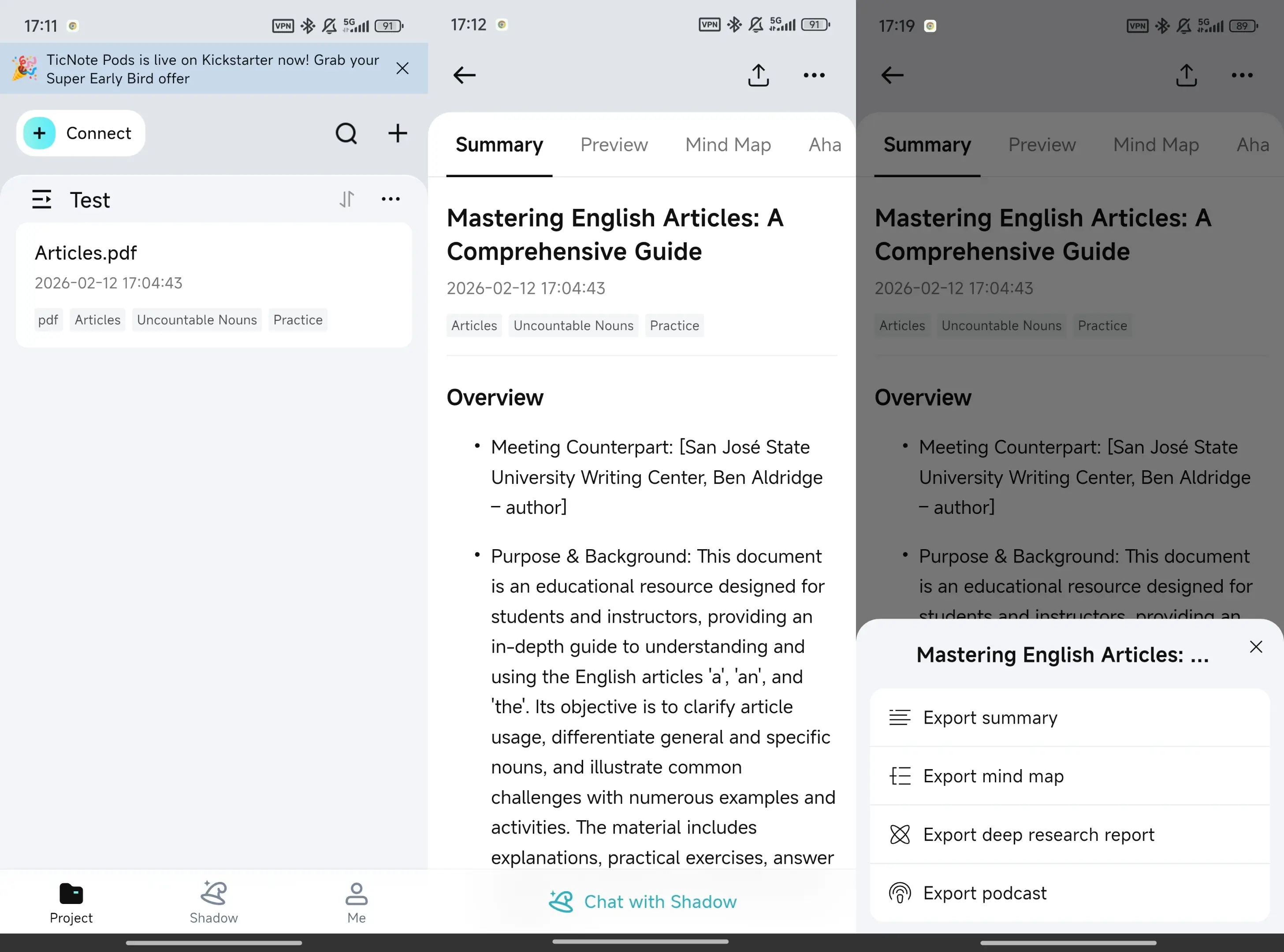
On mobile, the flow stays the same: upload, summarize, then edit for length. Open the TicNote app, tap the add button, and upload your file into a new or existing project.
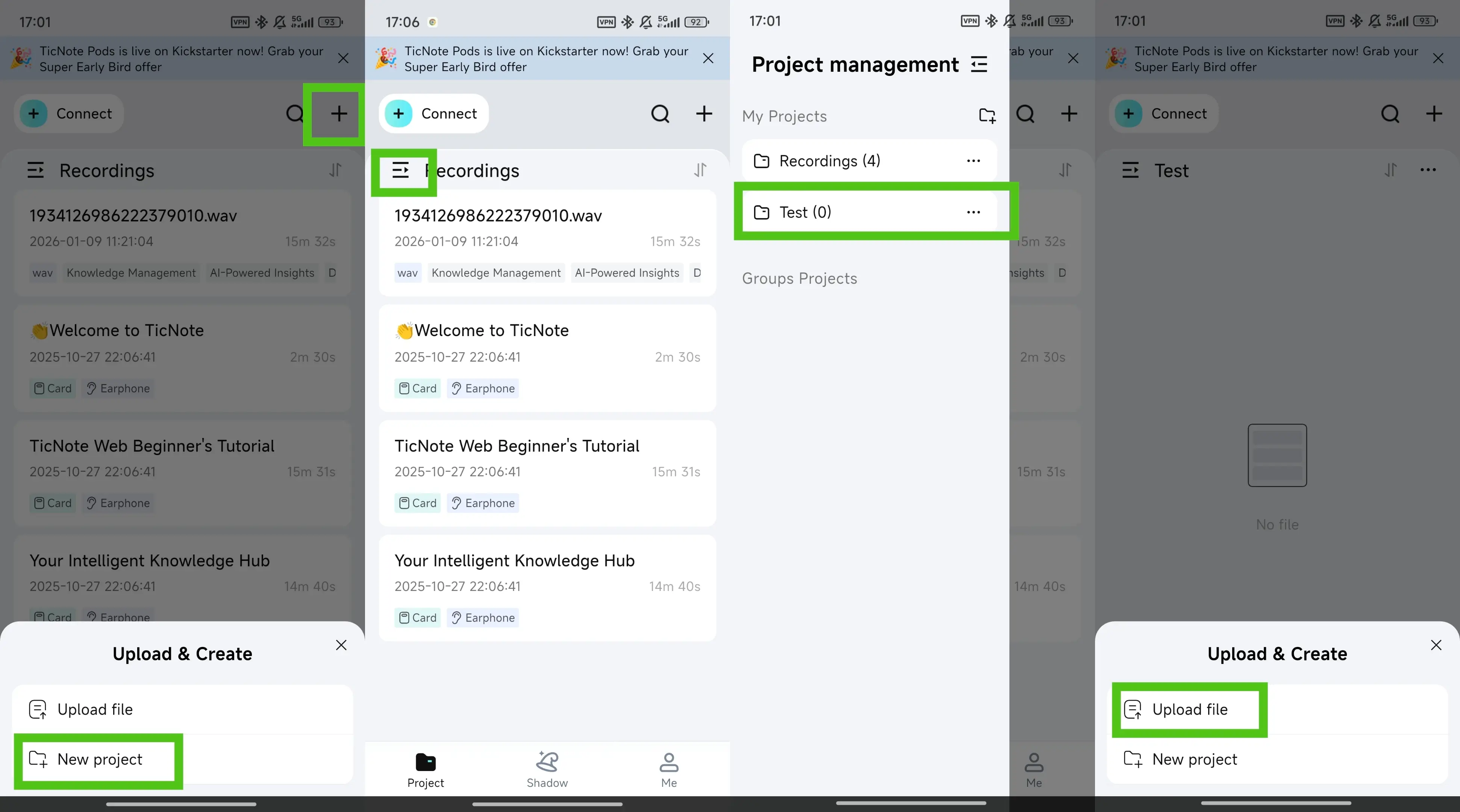
Then tap the Summary tab to view the result. If you need to share it, use the three-dots menu to export the summary in your preferred format.