

 Extension
TL;DR
Most communication style quizzes ask what you think you do. But your real communication style shows up in meetings: who talks, who listens, who interrupts, and how you respond under pressure. This article walks through the major communication style frameworks, then introduces a different approach: discovering your actual style from your meeting recordings using AI.
Try TicNote Cloud for Free and let the Meeting Personality Test skill analyze how you actually communicate.
Self-report quizzes are unreliable because people describe their ideal self, not their real behavior. Your meeting transcript reveals patterns you can't see on your own — from talk share to interruption frequency to how your tone shifts when things get tense. Try TicNote Cloud for Free and run your first meeting personality analysis in minutes.
What Is Your Communication Style and Why It Matters at Work
Your communication style is the pattern of how you give and receive information. It shows up in every meeting, every email, and every difficult conversation. Most people assume their style is clear and appropriate. Research says otherwise.
Why communication style shapes your career
Communication style affects how colleagues perceive your competence, confidence, and willingness to collaborate. A direct communicator can seem aggressive to someone who processes information more slowly. A quiet communicator can seem disengaged even when they're fully present. These misreads compound over time: they shape who gets promoted, who gets heard in brainstorms, and who gets left off the project kickoff.
Understanding your style doesn't mean changing your personality. It means knowing how you come across so you can adapt when it matters, and stop leaving things to guesswork.
Tools like AI meeting assistants have made it easier to capture and review the raw material of your communication patterns — your actual words, in your actual meetings.
Self-perception vs reality
Research consistently shows that people misjudge their own communication patterns. You may think you're a good listener, but a recording of your last team meeting might show you speaking 65% of the time. You may believe you invite input, but your interruption count tells a different story.
The gap between self-perception and actual behavior is precisely where growth happens. And you can't close the gap if you don't know it exists.
The 4 Classic Communication Styles Explained
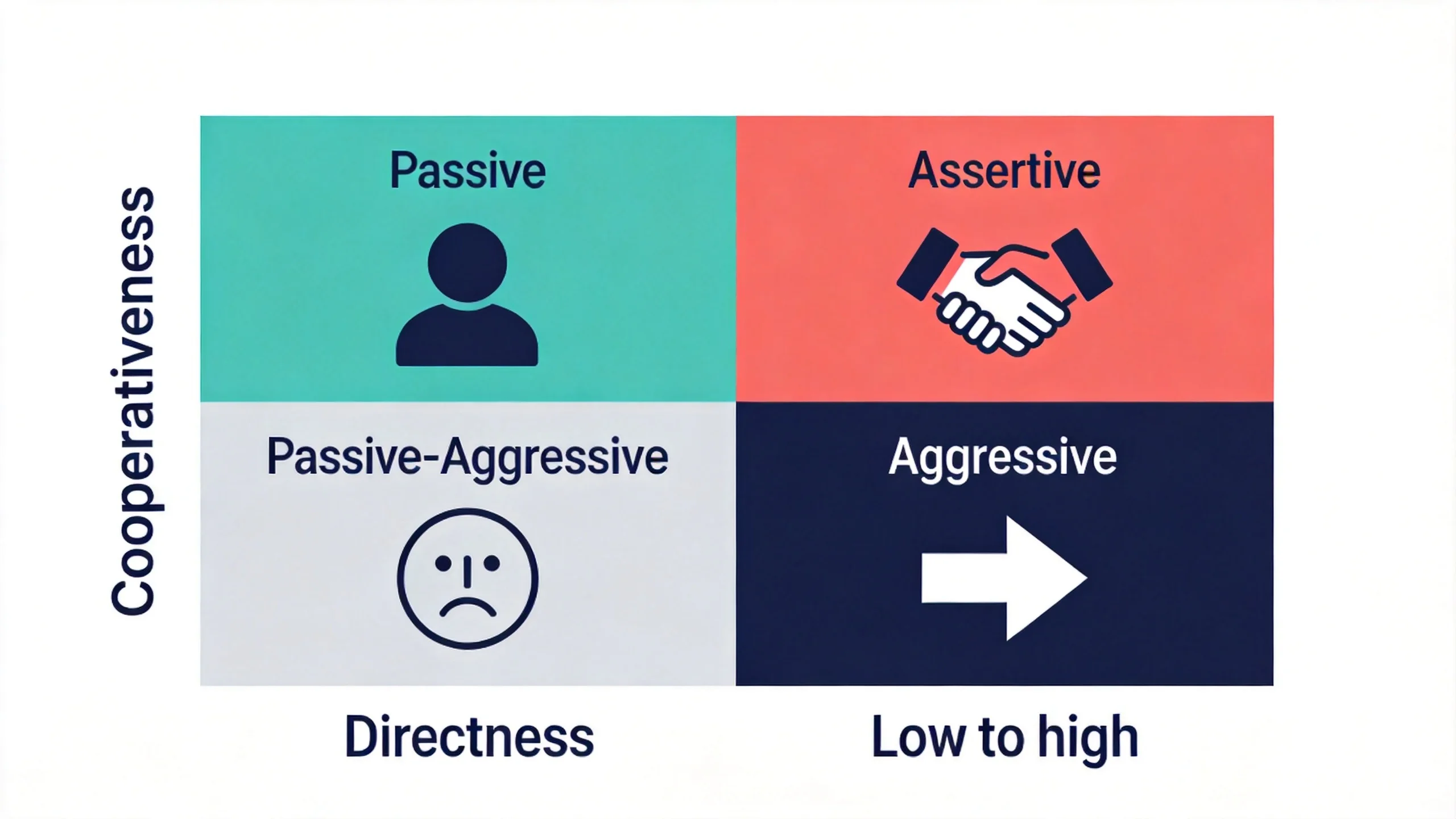
The most widely cited framework describes four communication styles based on how people express themselves and handle conflict. Each one has strengths and predictable blind spots.
Passive communication
Passive communicators avoid expressing opinions, yield to others, and prioritize harmony over honesty. In meetings, this looks like staying silent when you disagree with a decision, deflecting when asked for your opinion, or going along with a plan you know won't work.
The short-term benefit is avoiding conflict. The long-term cost is that your perspective never lands, and colleagues often don't know where you stand.
Aggressive communication
Aggressive communicators speak over others, use a demanding tone, and prioritize winning over collaboration. In a brainstorm, this looks like dismissing ideas before they're fully explained, raising your voice when challenged, or cutting off a colleague mid-sentence.
It can be effective in a crisis where speed matters. In most team settings, it shuts down the people around you.
Passive-aggressive communication
This style is the hardest to spot from the inside. Passive-aggressive communicators appear cooperative on the surface but act out frustration indirectly. In a meeting, you might agree to a deadline out loud and then miss it without explanation. Or offer a compliment that's really a critique.
Colleagues feel the friction but can't quite name it. That ambiguity makes it the most damaging style for team trust.
Assertive communication
Assertive communicators express thoughts clearly while respecting others. They're direct without being domineering. In a meeting, this looks like stating your perspective with evidence, inviting counterpoints, and holding your position without raising your voice.
Assertive communication is widely recognized as the most effective style — not because it's the most comfortable, but because it's honest without being damaging. Most communication coaching aims to move people toward this style.
Alternative Frameworks: Workplace Communication Styles
The classic four-style model is useful for understanding conflict dynamics. But in workplace settings, a different framework is often more practical: the analytical, intuitive, functional, and personal styles.
Analytical communicators
Analytical communicators are data-driven. They want facts, numbers, and logic before they accept an argument. They may seem cold or disengaged, but they're being thorough. In meetings, they ask for evidence, push back on assumptions, and dislike vague agreements.
Intuitive communicators
Intuitive communicators think in big pictures. They want the headline first, the details second (if at all). They're fast-paced and sometimes impatient with step-by-step explanations. In meetings, they cut to the point quickly and get frustrated by lengthy process updates.
Functional communicators
Functional communicators are process-oriented. They want to understand how something works before committing to it. They prefer structure, timelines, and clear ownership. In meetings, they tend to be the ones asking "but what's the actual plan?" when a decision gets made without clear next steps.
Personal communicators
Personal communicators lead with relationships. They want to build connection before getting to the task. They're empathetic and attuned to team dynamics, but may avoid difficult conversations or resist direct feedback.
Which framework fits?
The classic four-style model works better for conflict resolution and interpersonal dynamics. The workplace four-style model is better for team collaboration and communication planning.
Both share a core limitation: they rely on self-assessment. You answer a quiz based on how you think you communicate, not how you actually do. That's the gap worth closing.
How to Identify Your Communication Style Using Real Meeting Data
The most accurate way to discover your communication style isn't a quiz. It's your meeting transcript.
Why meeting recordings beat self-report quizzes
Quizzes measure your self-image. Meeting recordings measure your actual behavior. A transcript captures talk share, interruption patterns, response time, tone shifts, and how often you ask questions versus make statements. These objective signals reveal your communication style more accurately than any questionnaire.
When you answer a quiz, you describe the version of yourself you aspire to be. When you review a meeting recording, you see the version of yourself that actually showed up.
How TicNote Cloud's Meeting Personality Test works
TicNote Cloud's Meeting Personality Test skill reads your meeting transcript and generates a full personality archetype report. No questionnaire, no self-reporting. The skill analyzes who said what and how — then gives you a named archetype with scored behavioral metrics.
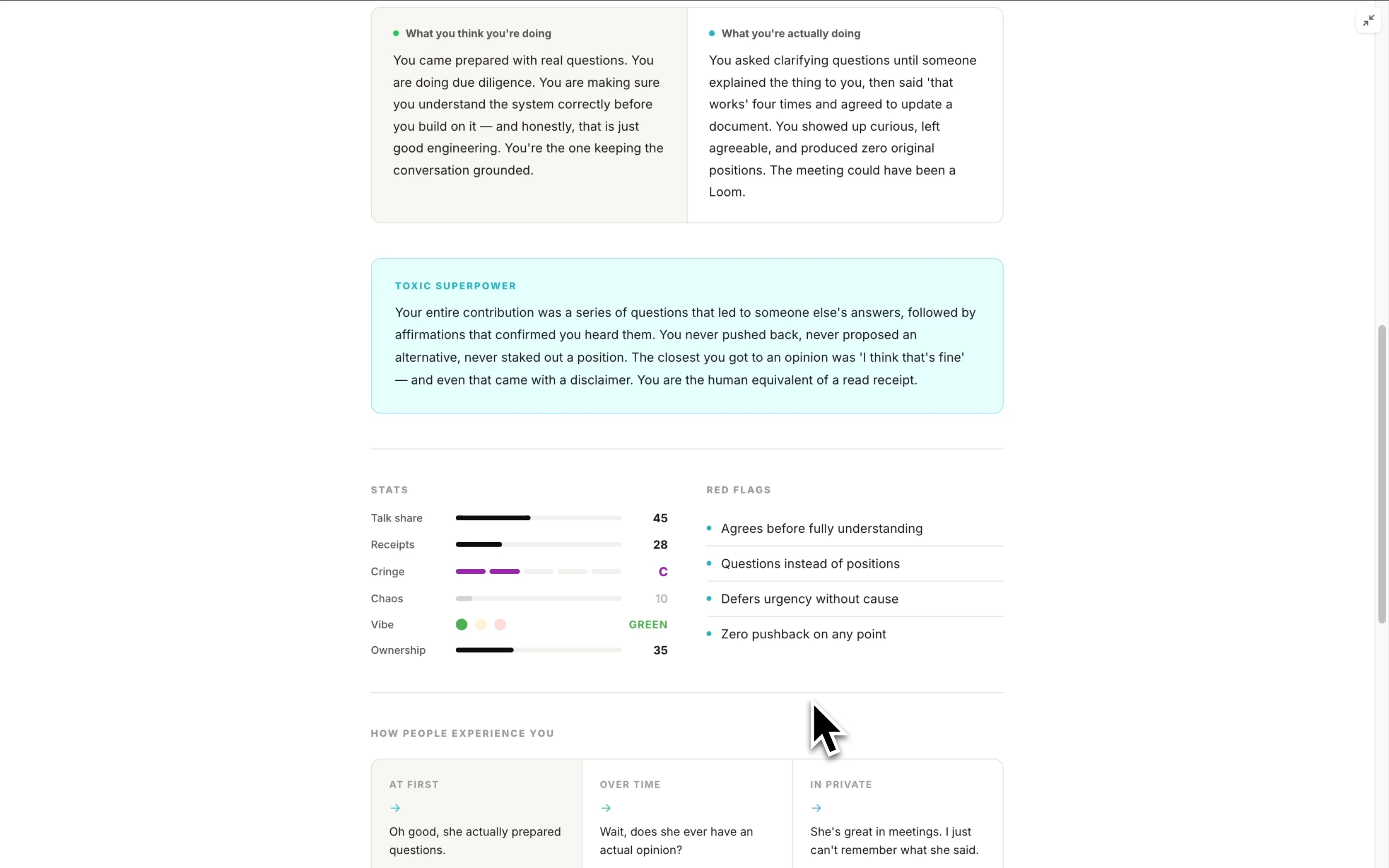
Your report includes talk share, chaos level, cringe moments, vibe rating, and your "toxic superpower" — the one behavioral pattern that defines your meeting presence. Each insight is grounded in specific transcript moments, not generic feedback.
To get started, add the Meeting Personality Test skill from the Skill Agent library in TicNote Cloud. No configuration is required. Then upload any meeting recording, audio file, or transcript, and the skill handles the rest. For those tracking structured outputs across projects, TicNote Cloud's workspace keeps your analyses organized and searchable over time.
Step-by-step: running your first meeting personality analysis
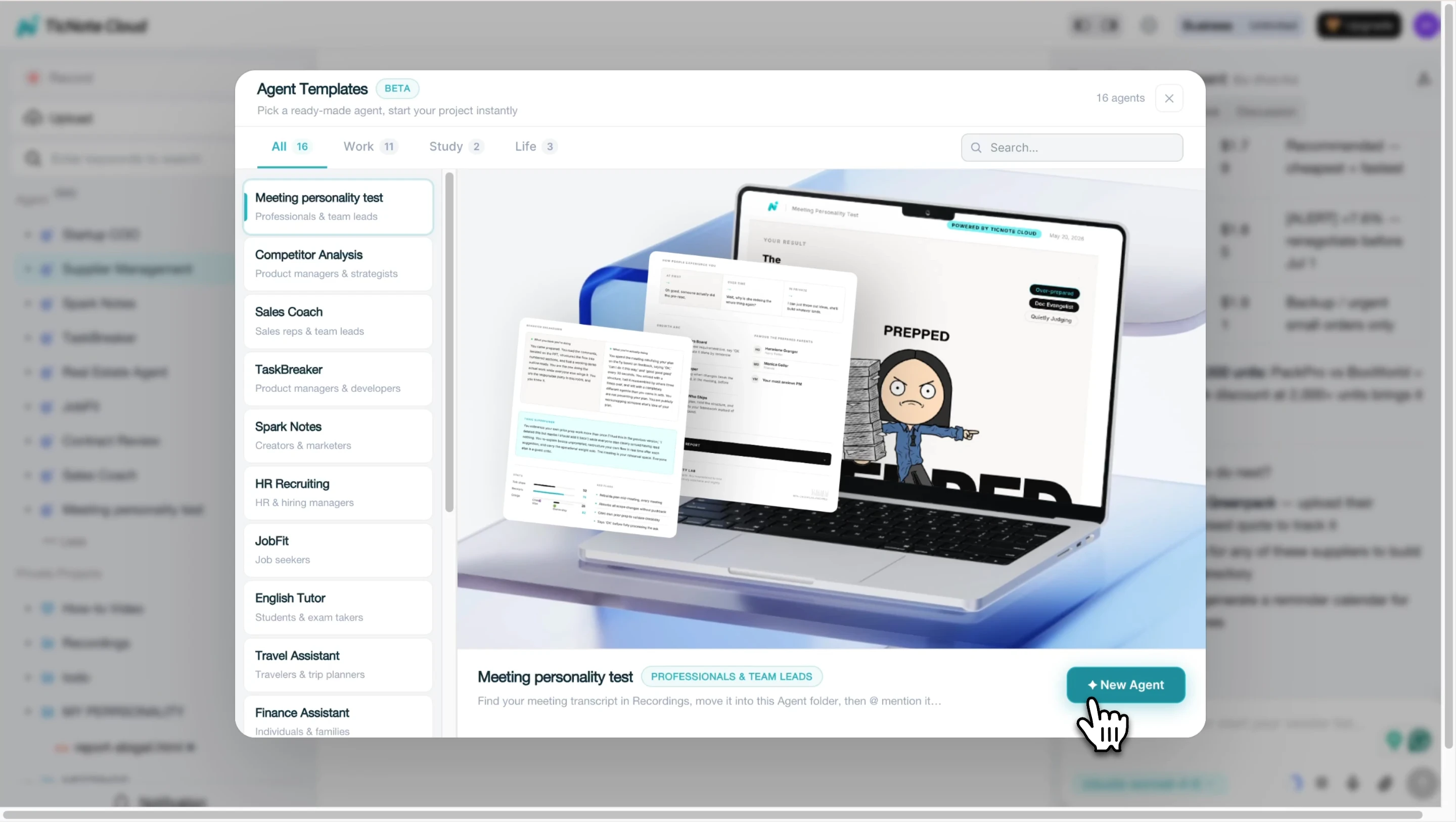
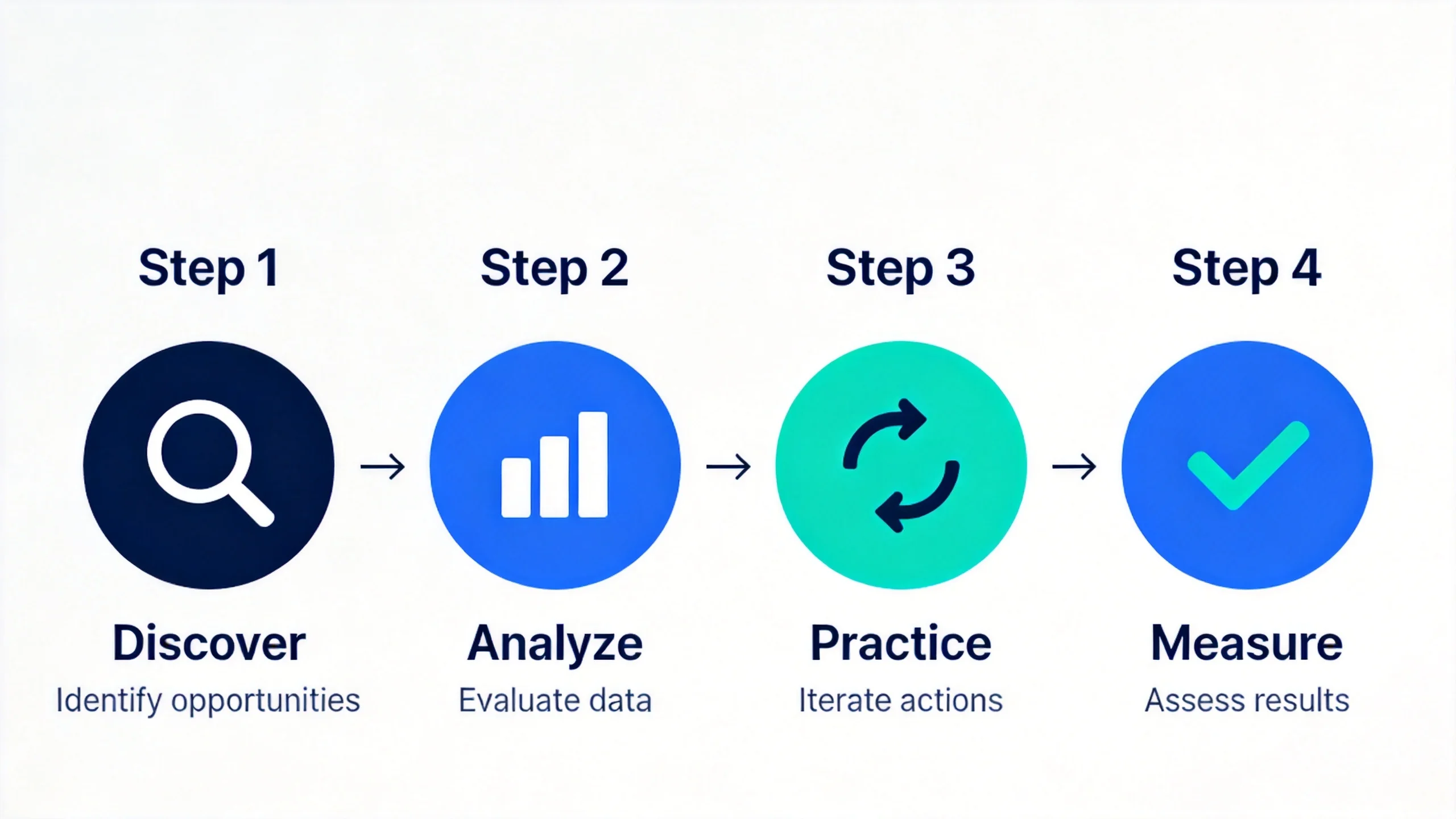
Step 1. In TicNote Cloud, click "Add Agent" and browse the Skill Agent library. Select Meeting Personality Test to add it to your workspace.
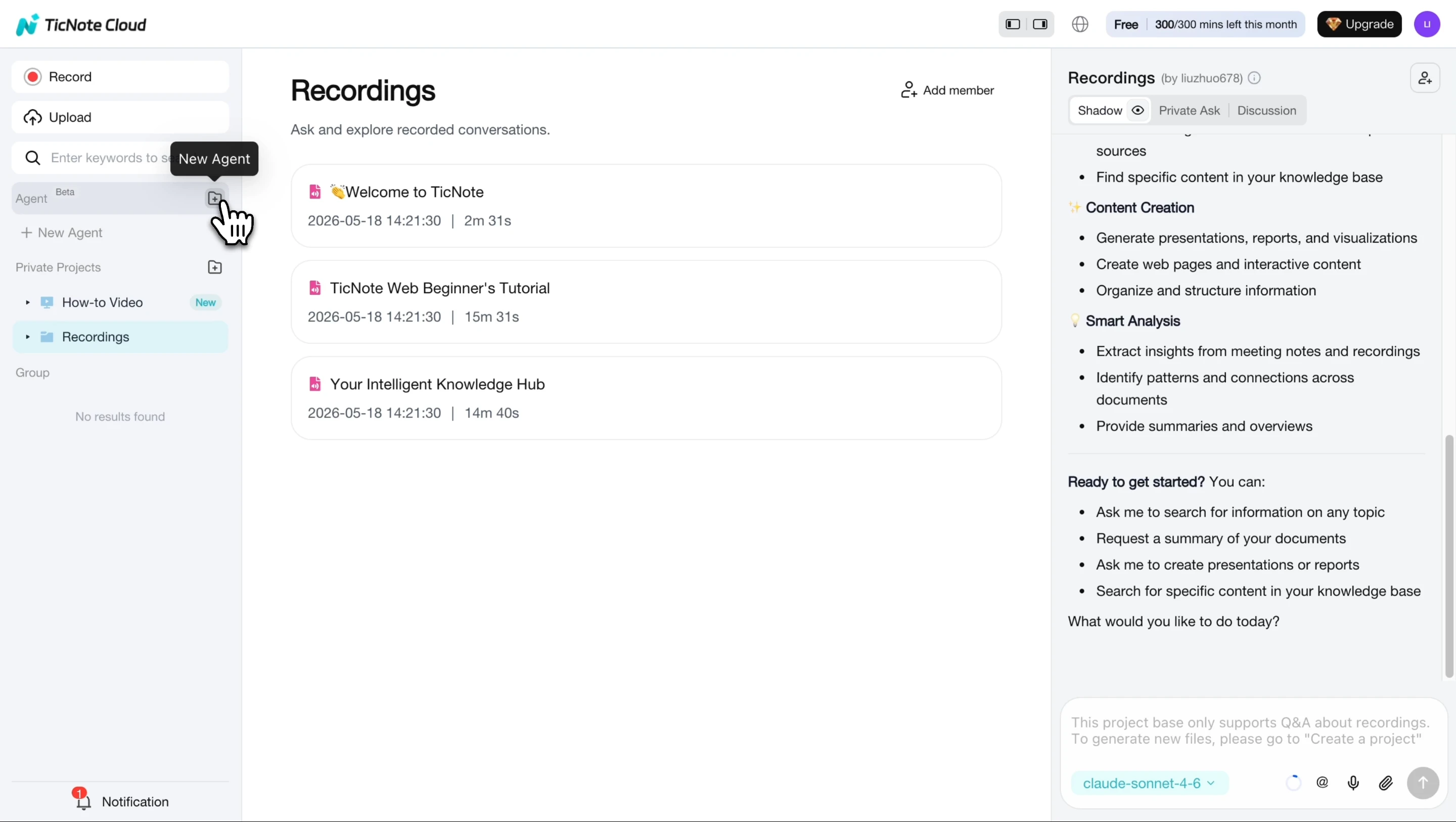
Once added, the skill appears in your agent list and is ready to use immediately.
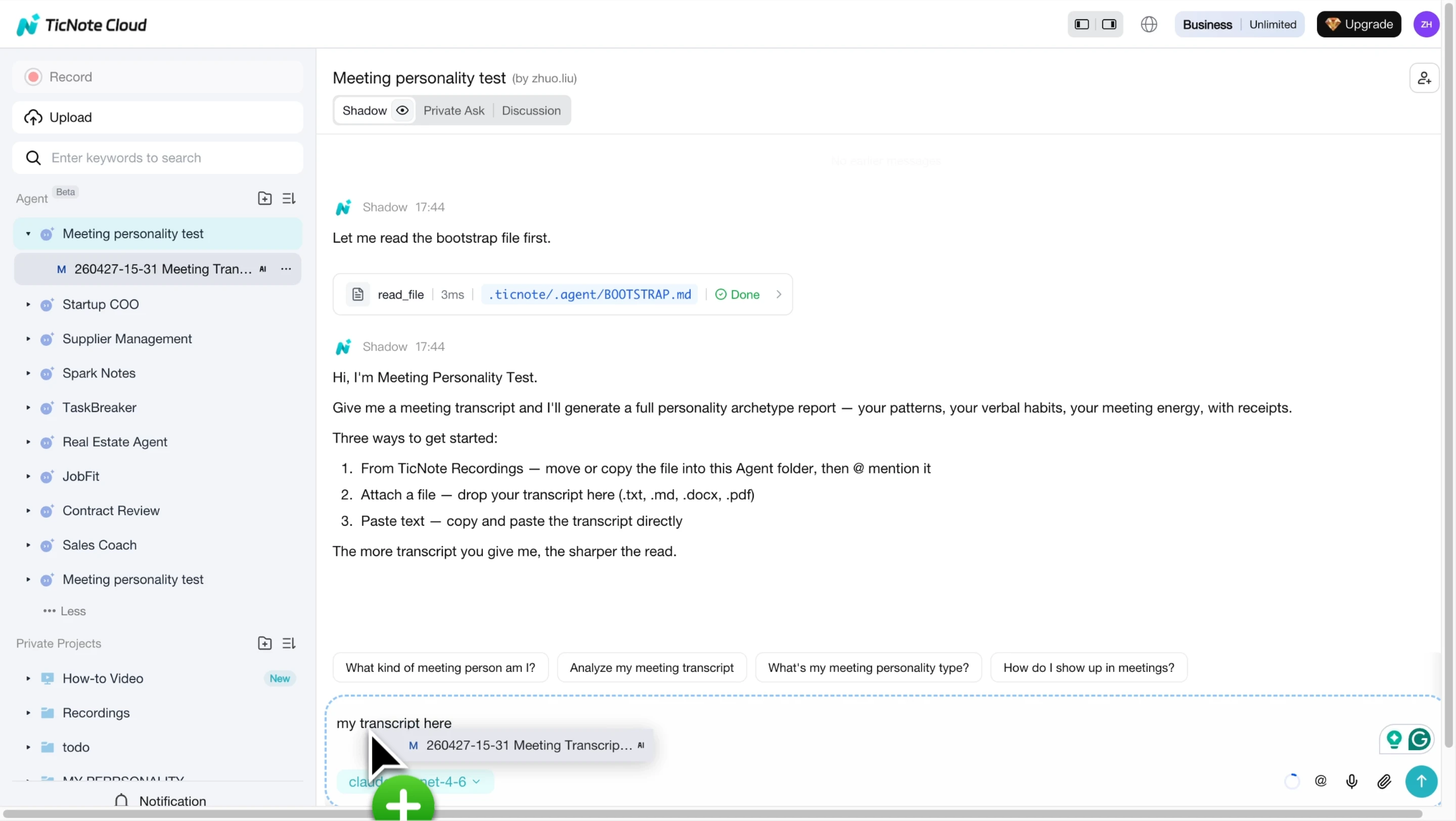
Step 2. Attach a meeting recording, audio file, or transcript to the chat. Tell the skill the names and genders of the participants so it can attribute behaviors accurately.
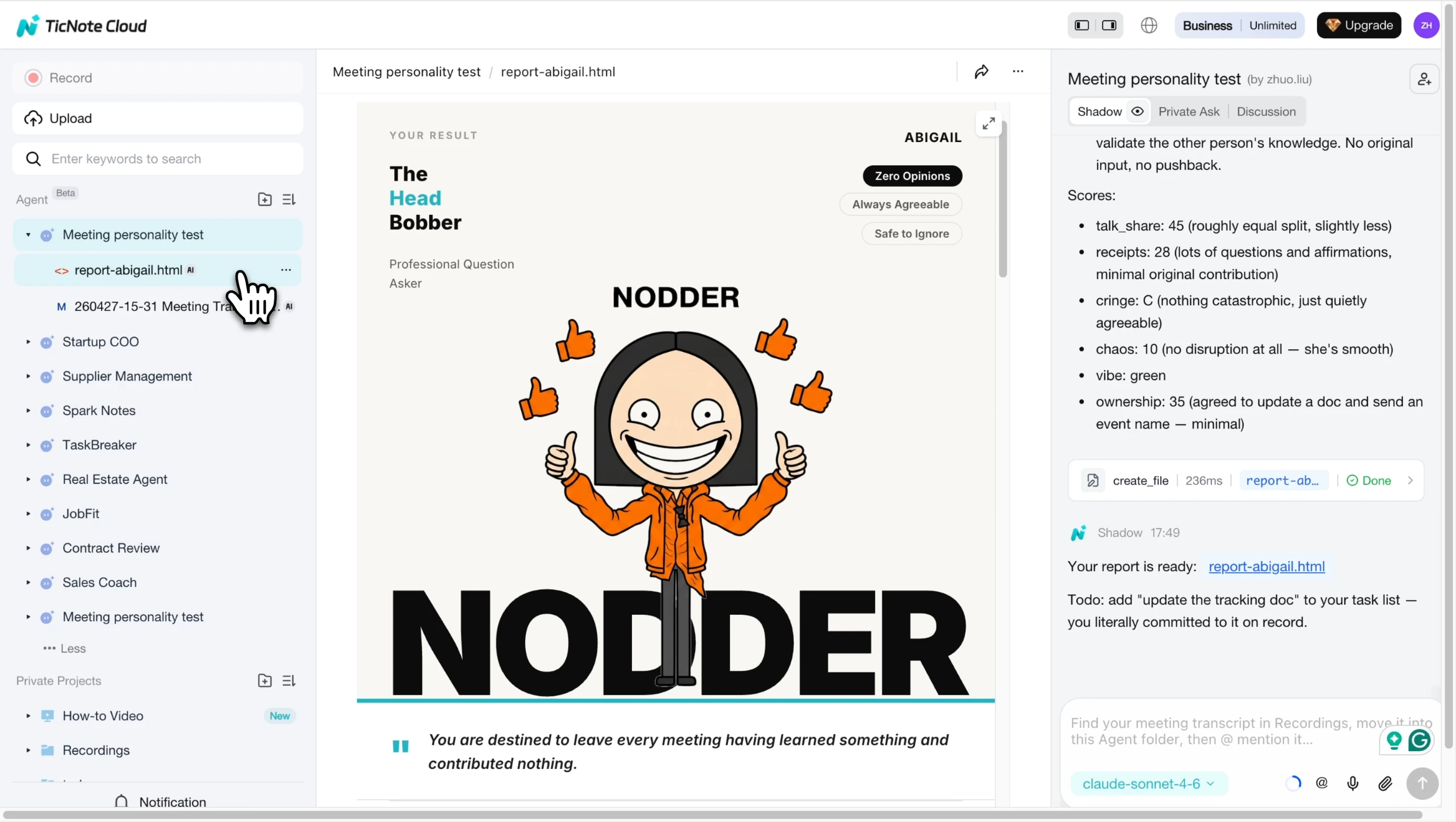
Step 3. The skill generates an HTML report and names your personality archetype. Open it to see your type, mascot illustration, archetype title, and tag labels at a glance.
Step 4. Scroll through the full report for behavior stats, your red flag checklist, and how people experience you across three timeframes. Every section is backed by actual transcript moments.
How to Improve Your Communication Style Based on Your Results
Once you know your actual patterns, improvement becomes targeted rather than generic. Here's how to act on what the data shows.
If you are passive
Practice stating your opinion before someone else does. Start in low-stakes meetings, where the consequences of being direct are minimal. The "think-write-share" technique helps: write down your position privately before the meeting opens, then share it early rather than waiting to see which way the room goes.
If you are aggressive
Try "stop-breathe-think" before responding to anything that triggers a strong reaction. The pause breaks the reactive loop. Track your talk share across meetings using TicNote Cloud's personality analysis: if you're routinely above 50%, that's a data point worth taking seriously.
If you are passive-aggressive
Practice saying what you mean during the meeting, not in a message afterward. Weighted anonymous feedback tools can help surface concerns constructively when direct feedback feels politically risky. The goal is to reduce the gap between what you think and what you say in the room.
If your style shifts by context
Most people don't have one fixed style. You may be assertive in one-on-ones but passive in large group meetings, or aggressive under deadline pressure but collaborative otherwise. Run multiple meeting analyses in TicNote Cloud across different meeting types to spot these patterns. Context-specific awareness is more useful than a single label.
Conclusion
Your communication style isn't what you think it is. It's what your meeting recordings show. Traditional quizzes give you a label based on self-perception. TicNote Cloud's Meeting Personality Test gives you receipts: scored behavioral metrics, specific transcript evidence, and a named archetype based on how you actually communicate. If you're curious about the gap between how you think you show up and how you actually do, the fastest way to find out is to run the analysis yourself.