

 Extension
TL;DR: A fast story summarizer workflow (manual + AI-assisted)
To summarize a story fast, paste your notes into a structured template in Try TicNote Cloud for Free and let it draft a neutral plot summary you can tighten in minutes.
You're short on time, so you skim and then your "summary" turns into a scene-by-scene retell. That's frustrating, and it also makes editing slow. With TicNote Cloud, you can capture only story-changing moments, then turn them into a clean summary with a repeatable format.
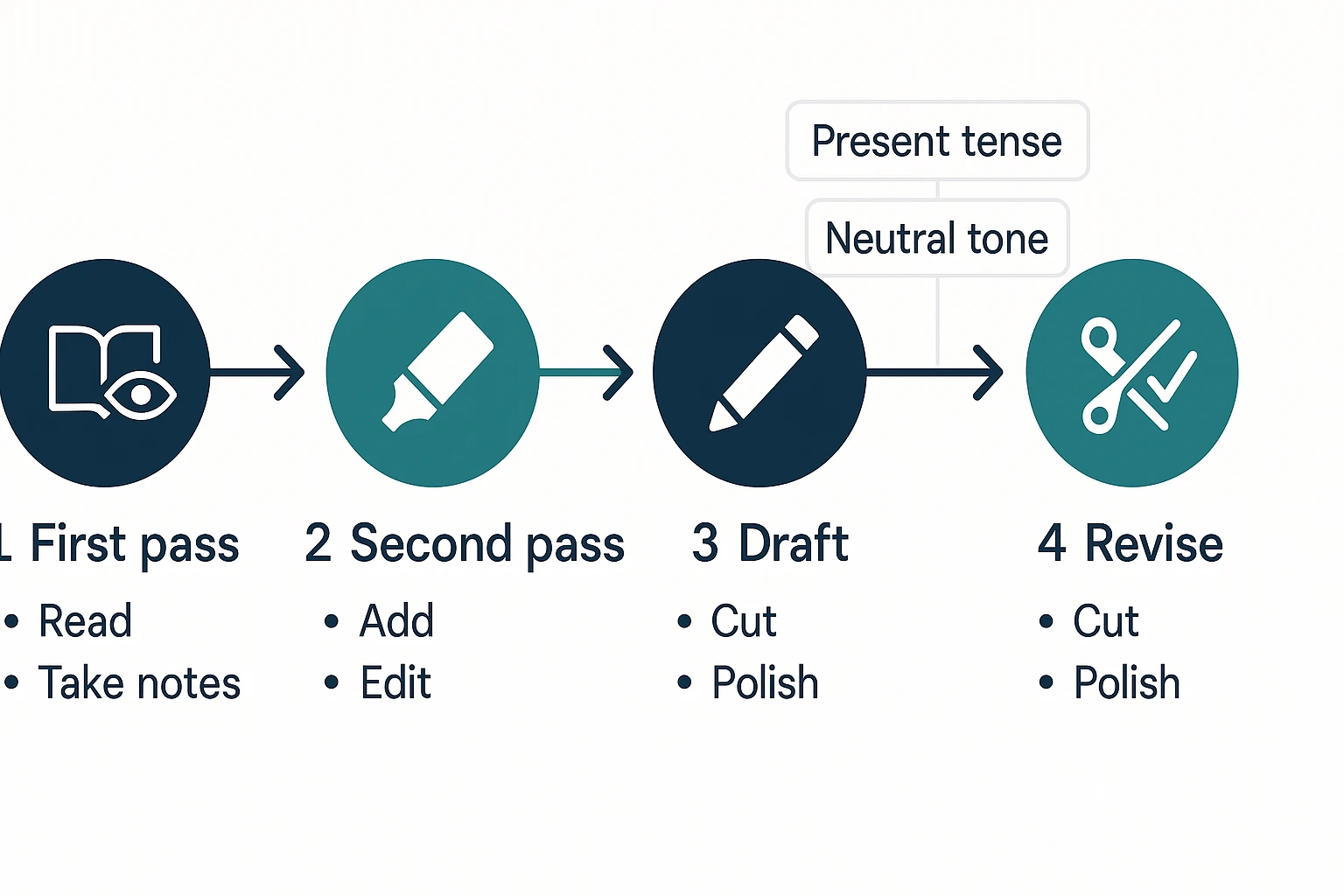
20-minute method: read once for the arc, note only story-changing moments, draft in present tense, then cut repeats and extras.
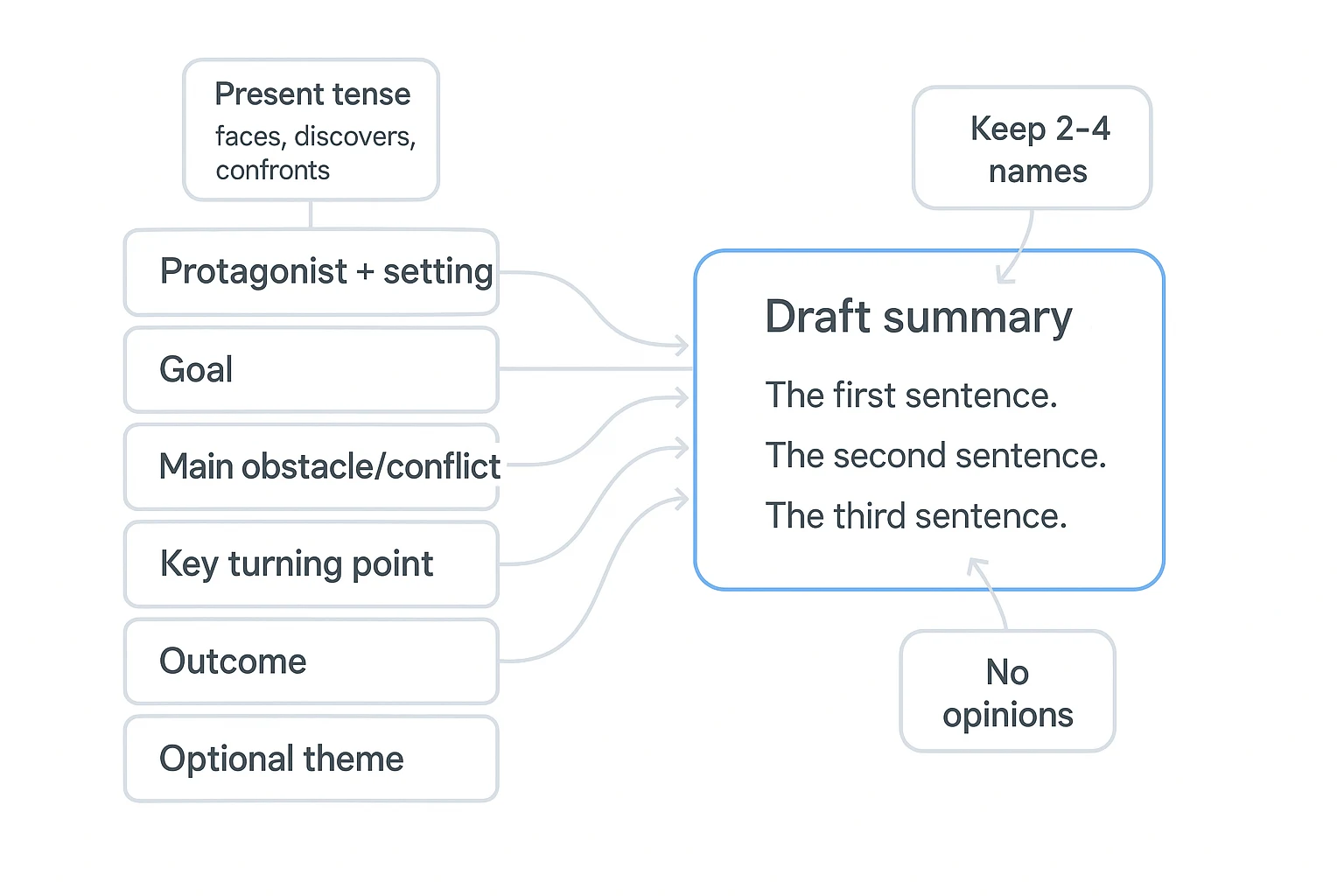
Quick copy checklist: Who + where/when; want (goal); obstacle (main conflict); turning point; outcome; present tense; 2 to 4 names max; no opinions, long quotes, or "I think."
How to summarize a story step by step (beginner-friendly method)
If you're learning how to summarize a story, don't start by trying to write "perfect" sentences. Start by finding the story's spine, then turn that into a clean, neutral recap. This method works for class, book club notes, or a quick recommendation.
Step 1: Do a first pass for the big picture
Read from start to finish without stopping to polish notes. Your only job is to understand what happens.
As you read, track the story's spine:
- Beginning situation (what life looks like at the start)
- Change (the event that knocks things off balance)
- Escalation (problems grow, options shrink)
- Turning point (a key choice or reveal shifts the outcome)
- Ending (how things resolve, and what's different now)
Also decide your purpose before you draft. A study summary can spoil more than a blurb. A book club note may need key turning points.
Step 2: Do a second pass and mark only "story-changing" moments
Now reread fast and highlight moments that change one of these:
- Goal: what the main character is trying to get
- Stakes: what they can lose or gain
- Choice: what they decide to do next
For each highlight, capture simple facts:
- Who does what
- Why it matters
- What changes after
Keep names consistent. If someone has no name, label them once and stick with it, like "the teacher" or "a stranger."
Step 3: Draft in present tense and a neutral tone
Write your plot summary in present tense: "She discovers…," "He decides…". It keeps the recap clear and direct.
Stay neutral. Avoid review words like "amazing," "boring," or "deep." And don't add your interpretation unless the task asks for it.
Most of the time, go in order. If your assignment wants a theme-first summary, you can reorder later. But draft chronological first so cause and effect stays intact.
Step 4: Revise with a quick 3-pass edit
This is where your summary gets shorter and easier to follow.
- Clarity: replace vague words ("things get bad") with concrete facts ("the plan fails and he loses his job")
- Length: cut repeats and side details that don't change the outcome
- Order: fix cause then effect (so readers never get confused)
Finally, write a one-sentence version of the whole story. If that sentence feels wrong, your summary probably missed the real turning point.
Expert tip: fix the most common beginner mistakes fast
- Mistake: listing every event. Fix: include only moments that change goals, stakes, or choices.
- Mistake: mixing summary and opinion. Fix: save judgments for a separate "analysis" paragraph.
- Mistake: vague pronouns like "they" or "it." Fix: repeat the name or noun when it matters.
If you want a broader framework that works for stories, articles, and lectures, use this simple 5-step summarizing method to keep your notes consistent across formats.
What should you include in a story summary (and what should you cut)?
When you summarize a story, include only what drives the main conflict forward. A good rule is simple: every sentence should explain a key choice, change, or result.
Include the 6 essentials (the only "must haves")
Use these six slots to decide what stays. If a detail doesn't fill one slot, it probably goes.
- Who: the protagonist, plus the main opposing force (a person, group, rule, or fear).
- Where/when: only what changes the problem (setting as context, not decoration).
- Want: the main goal that drives the character's choices.
- Obstacle: the central conflict blocking that goal (person vs person, society, self, or nature).
- Turning point: the moment that flips the direction (often the climax).
- Outcome: how it ends, or where things stand if you stopped mid-read.
Cut fast with clear rules (what to remove or compress)
Most summaries get bloated from repetition and "play by play" action.
- Remove repeated attempts, travel and setup scenes, most side conversations, and long descriptions.
- Replace lists of actions with one higher-level line. Example: "After several failed tries, she changes tactics and…"
- Skip most dialogue. Keep only a line that changes a decision or reveals a key truth.
Keep only "plot-moving" events (what earns space)
If an event changes the goal, stakes, or choices, it's worth keeping.
- New information that forces a decision
- Consequences that raise the stakes
- Irreversible actions (a betrayal, a death, a public commitment)
Mini checklist (use this on any chapter):
- Does this scene change the goal?
- Does it raise the stakes?
- Does it force a new choice?
- Does it cause a lasting consequence?
- Can I explain it in one sentence without losing the thread?
If you answer "no" to the first four, cut it. If you answer "yes," keep it and make sure it fills one of the six essential slots. That also sets you up to use the fill-in template later without hunting for "extra" details.
How do you handle dialogue, subplots, and a large cast without losing the plot?
When you summarize a story, dialogue, side plots, and extra characters are the first things that bloat your draft. The fix is simple: turn talk into actions, run an impact test on subplots, and control names so readers never get lost.
Turn dialogue into decisions (quote only when wording matters)
Default to paraphrase. Convert the line into what it does in the plot.
- Paraphrase most dialogue as an action, choice, or new info: "They agree to leave," "He lies about the key," "She warns him."
- Quote only if the exact words are the point (a rule, promise, clue, or twist). Keep it to a short phrase.
Mini before and after:
- Dialogue-heavy: "If you tell anyone, I swear I'll never forgive you. Not ever."
- Clean summary: She makes him promise to keep the secret.
Use the one-sentence subplot impact test
Ask: If I remove this subplot, does the ending change?
- If the main outcome stays the same, compress it to one sentence or cut it.
- If it changes the hero's choices, stakes, or timing, keep it and show the cause and effect.
Examples:
- Keep: A romance subplot pushes the protagonist to risk everything for one person.
- Cut: A string of comic relief scenes that don't change any decisions.
Control the cast: name 2 to 4, group the rest by role
Too many names makes a summary hard to follow. Name only the people who steer the main conflict.
- Name the protagonist.
- Name the main opposing force (person, group, or system).
- Name 1 to 2 key supports.
- Group everyone else by function: "her coworkers," "the villagers," "a jury," "the crew."
Stick to the same role labels each time. That keeps the plot clear and the summary short.
Which summary length and format should you use (1 sentence, paragraph, 1 page, blurb)?
Pick your summary length based on why you're writing it. If you're trying to show you understood the story, include the ending. If you're trying to recommend the story, keep the ending out.
Match the format to the purpose
Here's the simple rule: school and study notes reward clarity, not suspense. A blurb rewards curiosity, not completeness.
| Purpose | Best length | Spoiler level |
| School assignment | 1 paragraph to 1 page | Usually includes the ending (unless told "no spoilers") |
| Book club or study notes | 1 page | Includes turning point and ending |
| Recommendation or back-cover style | Blurb | Avoid the ending |
| Personal quick recall | 1 sentence | No ending, just the core problem |
Use the "summary length ladder" (with targets)
Use these as targets, not strict rules:
- 1 sentence (25 to 35 words): premise plus conflict
- 1 paragraph (80 to 120 words): add turning point plus outcome
- 1 page (250 to 400 words): add the key steps that connect conflict to resolution
- Blurb (40 to 70 words): hook plus setup, no resolution
Same story at each length (what gets cut and what stays)
Example story: A new park ranger finds a missing child during a storm.
1 sentence (about 30 words): New ranger Mara must track a missing child through a mountain storm before nightfall, while her radio fails and her fear of getting lost threatens every choice.
1 paragraph (about 100 words): On her first solo shift, park ranger Mara learns a child has wandered off just as a storm rolls in. Her radio cuts out, so she follows small clues: broken branches, snack wrappers, and faint footprints. As the wind rises, she reaches a washed-out bridge and must decide whether to turn back or cross. She crosses, finds the child hiding in a rock hollow, and calms him with a simple plan: stay low, move slow, and follow her voice. They reach the trailhead at dusk, soaked but safe.
1 page (about 300 words): Mara starts her first solo patrol hoping for an easy day. Then a frantic parent reports their child missing near a steep ridge trail. A storm builds fast, and visitors begin leaving the park, which makes the search harder. Mara tries to call for backup, but her radio fails in the dead zone.
She follows the last known spot and begins a basic grid search, but she keeps it simple: look for anything that doesn't belong. She finds a torn map corner and a wrapper caught on a bush. The clues pull her away from the main trail, and she worries she's doing the one thing new rangers are warned about: getting lost while searching.
The storm hits. Visibility drops. Mara reaches a narrow bridge that's partly washed out. Turning back means losing time and maybe losing the child. Crossing means risking her own safety, and no one will know where she went. She marks a tree with bright tape, crosses slowly, and keeps checking her bearings.
On the far side, she hears a short cry between gusts. She finds the child curled in a shallow rock hollow, scared and cold. Mara doesn't lecture. She names what's happening, offers one clear next step, and gets him moving. She uses a whistle pattern and steady talk to keep him focused. When the trail disappears under runoff, she chooses higher ground and backtracks to her tape marker.
They reach the trailhead near dusk. The parent runs to the child, and Mara finally gets a signal. The rescue team arrives minutes later. Mara files the report and realizes the point of the job is not hero moments. It's calm choices, made in order.
Blurb (about 60 words, spoiler-safe): A storm is rolling in, and a child is missing on Mara's very first solo shift as a park ranger. With her radio dead and daylight fading, she follows tiny clues off the main trail. Then she hits a washed-out bridge that could end the search, or save it. But can she find the child without getting lost too?
Spoiler policy: when the ending belongs in the summary
Use this decision rule:
- If the goal is comprehension (class, notes, discussion), include the ending.
- If the goal is marketing (recommendation, blurb), stop before the resolution.
A reliable spoiler-safe pattern is to end on the turning point question: "But can she…?" It signals the central problem without giving away the final outcome.
What is a reusable story summary template you can fill in every time?
If you want a repeatable way to write a clear plot recap, use one fill-in template every time. It helps you keep the same core parts in place, so your story summary stays tight and easy to read.
Fill-in-the-blank story summary template (copy-ready)
Fill the blanks, then rewrite as smooth sentences:
- Protagonist + setting: [Name], a [role], lives in [place/time].
- Goal: They want to [goal].
- Main obstacle or conflict: But [opposing force/problem] blocks them by [how].
- Key turning point: Things change when [major event/choice/reveal].
- Outcome: In the end, [result], and [new normal or consequence].
- Optional theme (neutral): The story explores [theme phrase].
Present-tense verb list (pick one): faces, learns, discovers, realizes, decides, risks, tries, refuses, escapes, hides, investigates, confronts, loses, wins, sacrifices, protects, betrays, exposes, admits, forgives, accepts.
Inline tip: you can Create a reusable template in TicNote Cloud so these same fields pop up for every book, short story, or chapter summary.
Alternative templates by story type
Mystery or thriller template
- Protagonist and setting: [Name] in [place/time].
- Case: They investigate [crime/mystery].
- Suspect or opposing force: [suspect/organization] interferes by [method].
- Clue or reveal: A key clue appears when [clue], leading to [reveal].
- Outcome: The truth is [truth], and [resolution].
Character-driven template
- Protagonist and setting: [Name] in [place/time].
- External goal: They try to [goal].
- Internal conflict: They struggle with [fear/belief/flaw].
- Relationship shift: Their bond with [person/group] changes when [event].
- Outcome: They end up [result], and they [internal change].
Pre-submit checklist (quick and strict)
- Tense: Is the whole plot recap in present tense?
- Names: Do you use only 2 to 4 names, grouping the rest by role?
- Objectivity: Do you avoid opinions and copied phrasing?
- Completeness: Does each sentence connect to goal, conflict, turning point, or outcome?
How can you tighten a summary fast? (good vs bad example)
A fast way to tighten a story summary is to cut anything that doesn't change the main problem, the key choices, or the ending. Keep the cause and effect chain. Drop the extra "camera work" like outfits, weather, and walk-and-talk travel.
A "too-long" paragraph and what's wrong with it
Too long (on purpose):
Mina, a new student at Harbor High, arrives on a rainy Monday and feels nervous because she misses her old town. She meets her neighbor Jay, then in English class she meets Chloe and Ben, and later at lunch she sits by the window and thinks about the smell of the cafeteria and how loud everyone is. After school she goes to the library, talks to Ms. Ortega the librarian, and finds a flyer for the Harbor Clean-Up Club. She attends the first meeting, where many students introduce themselves, and the club president, Leah, gives a speech about community spirit. Mina also hears gossip that the principal might cancel the spring fair. Jay says they should do something, Chloe says it's probably fine, and Ben jokes about it. Mina feels confused and then walks home slowly, thinking about her dad's advice to "be brave," and she decides maybe she will join the club and also maybe she will ask the principal about the fair.
What's wrong here (quick notes):
- Too many names: Jay, Chloe, Ben, Ms. Ortega, Leah. Most don't matter.
- Minor scenes: cafeteria smells, walking home, introductions.
- Repeats feelings: nervous, confused, thinking, maybe.
- Weak cause to effect: we don't see what forces a choice.
- Extra adjectives and "camera": rainy Monday, loud cafeteria, slowly.
A revised version with notes on each cut
Tightened paragraph:
New student Mina finds a flyer for the Harbor Clean-Up Club and learns the spring fair may be canceled. Wanting a way to belong, she joins the club and decides to ask the principal what's happening.
Why this works (decision rules):
- Group characters: "classmates" and "club president" become one idea.
- Merge scenes: school day plus library becomes "finds a flyer."
- Cut repeats: one clear motivation replaces several feelings.
- Lock cause to effect: rumor leads to a decision and a next step.
Editing passes: cut 30%, then cut another 10%
- Pass 1 (cut 30%): remove setting bits and repeated beats.
- Pass 2 (cut 10%): merge sentences; replace lists with one label.
- Pass 3 (sharpen verbs): swap "goes/does/feels" for plot verbs like learns, joins, decides, asks.
Quick checklist to shorten any summary:
- Does this detail change the plot? If not, cut it.
- Can three scenes become one sentence? Merge them.
- Can five names become two roles? Group them.
- Does every sentence show a cause or a result? If not, fix it.
- Are your verbs specific (decides, reveals, confronts)? Upgrade them.
How do you avoid plagiarism and cite a story summary correctly?
Plagiarism usually happens when your summary sticks too closely to the original wording. The fix is simple: show you understand the story, in your own structure, while keeping the facts true.
Paraphrase vs. summary (know the difference)
A paraphrase restates a passage at about the same length. A summary compresses the whole story into fewer lines. If you're trying to summarize a story, you should cut detail, not just swap words.
Use a safe paraphrase rule set
When you restate a key moment, use these rules:
- Change the sentence structure, not just the vocabulary.
- Change the order of ideas when it still makes sense.
- Replace specifics with general terms (names, minor actions, small settings).
- Keep the core facts accurate (who did what, why, and what changed).
Red flags your version is too close:
- You kept distinctive phrases from the text.
- Your sentences match the original shape, line by line.
- You only swapped synonyms, but kept the same order.
Quote only when it earns its place
Direct quotes are fine for a single line that matters, like a theme statement, a vow, or a twist. Keep it short, put it in quotation marks, and introduce it: who says it and why it matters to the plot.
Use simple citation patterns (then follow your required style)
Different classes use different formats, so follow your teacher or style guide. Here are clean, generic patterns you can adapt:
- Book: Author. Title. Publisher, Year.
- Anthology: Story Author. "Story Title." In Collection Title, edited by Editor, Publisher, Year.
- Online story: Author or Organization. "Page Title." Site Name, URL, Accessed Day Month Year (if required).
A plagiarism-safe summary isn't about sounding fancy. It's about proving you understood what happened and why it mattered.
How to summarize a story using an AI note-taking workflow (templates + Q&A + mind map)
AI helps most when the story is long, the chapter is dense, or you're summarizing a class or book club talk. It's also great when you already have messy notes and need a clean plot summary fast. The goal is simple: get a draft summary, then shape it to your exact length and tense.
Web workflow: from source to polished summary
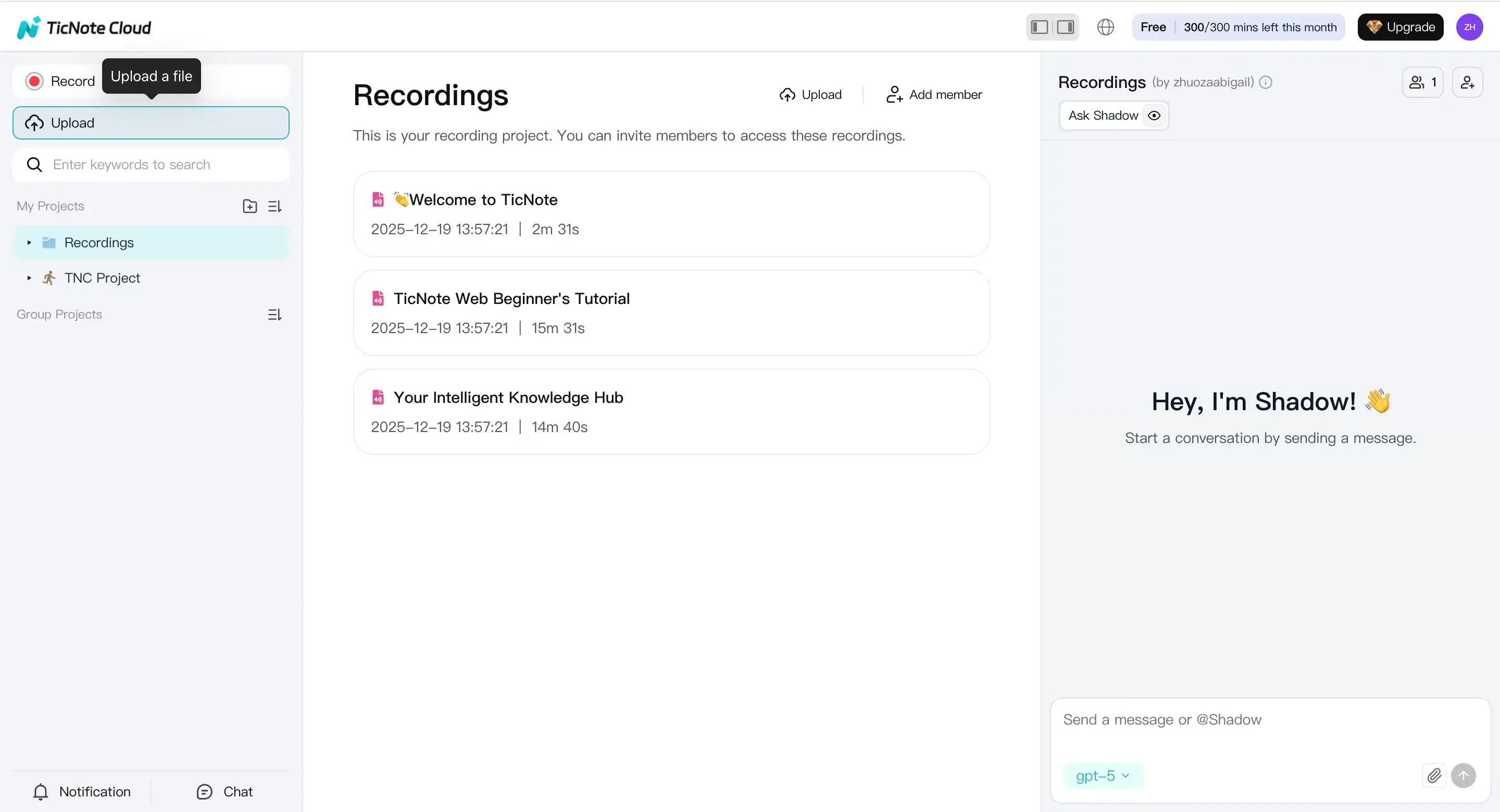
- Upload your source into one project
In TicNote Cloud Web Studio, start a new project, then use Upload to add your source file. Text, PDFs, Word docs, audio, and video all work. If it's audio or video, you can also generate a transcript so you can search the story later.
- Generate a first-pass summary, then "lock" the format
Open the Summary tab to get the initial summary. Treat this like a rough draft. Your next prompt is what makes it usable.
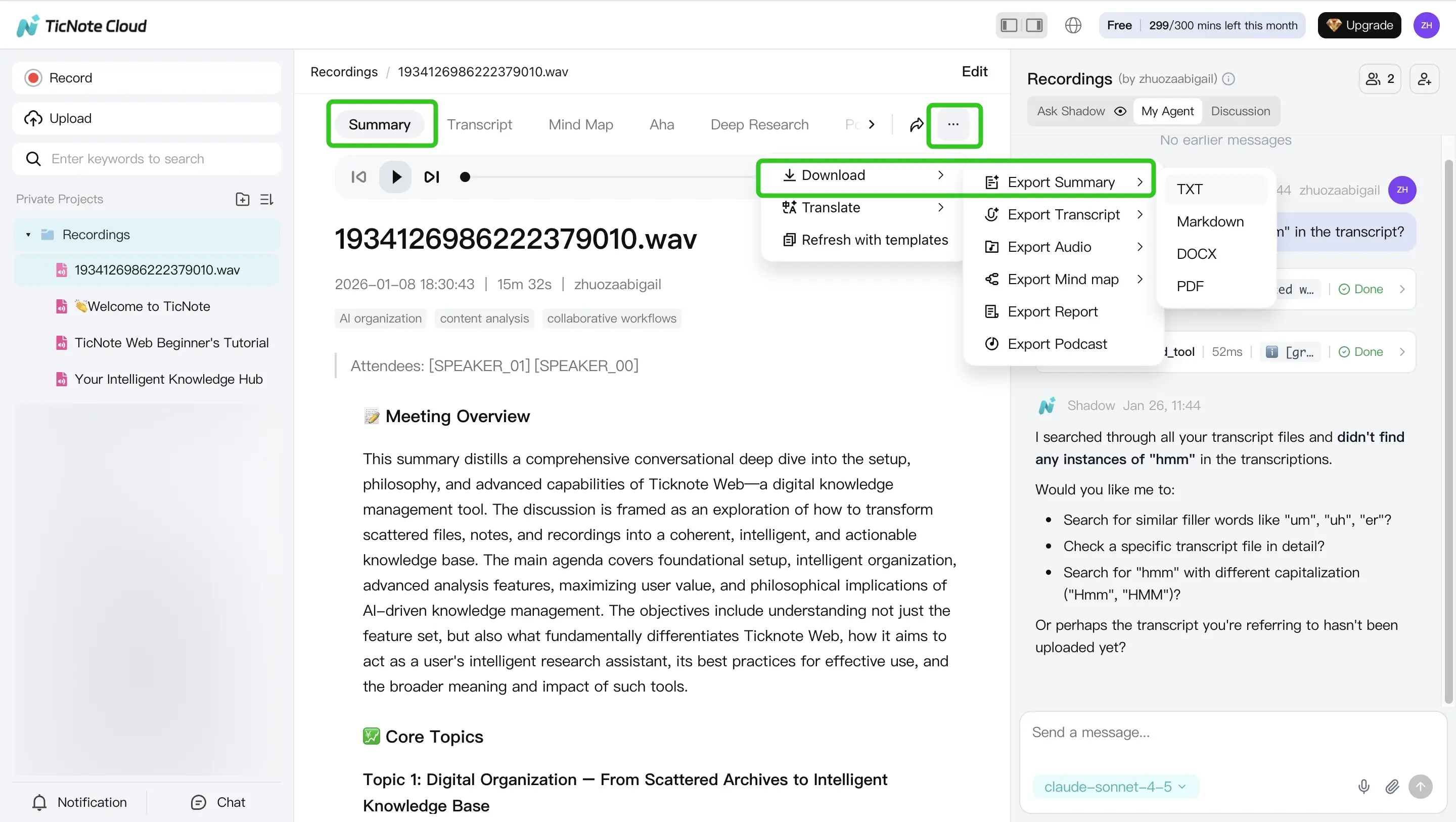
Use prompts like these to improve accuracy and keep the summary consistent:
- "Write a 1-paragraph plot summary in present tense."
- "Include the 6 essentials: protagonist, goal, conflict, setting, key turning point, outcome."
- "Use a neutral tone. No quotes unless needed for clarity."
- Reuse a template, so every summary looks the same
Save a story summary template as a note structure you can reuse (for school, book club, or study notes). Example sections: Characters, Goal, Conflict, Turning Point, Ending, Theme.
- Ask focused questions with Shadow Q&A
Instead of "Summarize this," ask targeted questions: "What does the main character want?" "What blocks them?" "What changes after the turning point?" "What is the final outcome?" If you want a deeper read, pair this with a quick explainer on how AI summarizers work and how to trust outputs.
- Use a mind map to spot gaps and trim side branches
Review the mind map like a story outline. If a branch doesn't connect to the main conflict or ending, it's often a subplot you can cut. If a key link is missing, you know what to reread.
- Optional: translate for multilingual groups
If you're in a bilingual class or book club, translate the summary so everyone discusses the same plot.
App workflow (quick version)
On mobile, upload the same file types by tapping the add button and saving to a project. Then open Summary to generate a draft, make quick edits, or translate while you're on the go.