


 Extension
TL;DR: A skill agent workflow for ranking candidates with evidence
Try a free evidence workspace to make candidate ranking a structured review of job-relevant proof, not memory, charisma, or scattered comments.
Hiring teams often leave interviews with 3 different note styles and no shared baseline. That makes debriefs slower and raises the risk of gut-feel decisions. A role-based workspace keeps resumes, transcripts, assessments, and feedback together so reviewers can compare cited evidence.
Use a scorecard, set evidence rules, weight criteria, keep humans in the loop, and document any override.
What does candidate ranking mean in a hiring workflow?
Candidate ranking is the relative ordering of people who already passed key hiring checks. Candidate scoring is different: it gives each person an absolute rating, such as 0–4 for job knowledge, communication, problem solving, and role-specific skills. In a structured workflow, teams score first, then rank finalists for next interview order, debrief focus, or an offer decision.
Score candidates before you rank them
A simple rule keeps the process fair: compare candidates only after you have comparable evidence. If you need the foundation, start with a job-relevant evaluation scorecard before the first interview.
For example:
- Candidate A scores 3/4 in sales discovery and 4/4 in enterprise negotiation.
- Candidate B scores 4/4 in discovery and 3/4 in negotiation.
Both are qualified. But for a role focused on closing complex accounts, Candidate A may rank higher. For a role focused on pipeline creation, Candidate B may lead. The ranking changes because the role priorities change.
Place comparison at the right funnel stage
Candidate comparison usually happens after resume screening, structured interviews, work samples, and the interview debrief. Don't rank candidates before must-have thresholds are met. Also pause ranking when evidence is incomplete, such as missing interviewer notes or an unfinished assessment.
The goal is not to pick the "best conversation." It's to make tradeoffs explicit, written, and defensible.
Replace vague notes with evidence
Unstructured notes create weak rankings. Common problems include different rubrics by interviewer, recency bias, the loudest voice winning, and vague comments like "seems smart." Good ranking notes reference the same criteria and specific evidence: a transcript moment, a work sample, or a documented answer.
Tools can help organize that evidence. But the hiring team still owns the judgment, the rationale, and any documented override.
How do you build a job-relevant scorecard before comparing candidates?
A strong scorecard turns candidate ranking from a debate into a documented decision. Build it before interviews, so every interviewer looks for the same job-related evidence instead of rewarding confidence, familiarity, or personal style.
Start with outcomes, not traits
List what the hire must deliver in the first 30, 60, and 90 days. Then convert those outcomes into 6–10 observable competencies. Good criteria describe work behavior, not personality.
For example:
- Use "diagnoses customer churn using CRM data," not "analytical thinker."
- Use "writes clear handoff notes for engineering," not "great communicator."
- Use "ships two onboarding experiments in 90 days," not "startup mindset."
Split the list into two groups:
- Must-haves: minimum skills needed to do the job safely and effectively.
- Nice-to-haves: useful differentiators that should not outweigh core requirements.
The Uniform Guidelines on Employee Selection Procedures (1978) require that selection procedures be "job-related and consistent with business necessity." That standard should shape every competency on your scorecard.
Set weights before interviews
Assign weights with the hiring manager before anyone reviews candidates. This reduces post-hoc rationalization, where teams raise or lower criteria after meeting someone they like.
| Competency | Type | Weight | What a 1 looks like | What a 3 looks like | What a 5 looks like |
| Core technical skill | Must-have | 25 | Cannot complete basic tasks | Handles routine tasks | Solves complex cases independently |
| Role experience | Must-have | 20 | Little relevant exposure | Similar scope | Direct, repeated success |
| Collaboration | Must-have | 15 | Vague handoffs | Clear updates | Aligns teams under pressure |
| Customer judgment | Nice-to-have | 10 | Misses user needs | Understands common needs | Anticipates trade-offs |
| Domain knowledge | Nice-to-have | 10 | New to domain | Basic fluency | Deep pattern recognition |
Keep total weight at 100. Give heavier weights to 3–5 high-impact competencies, not every preference.
Define what counts as evidence
For each competency, decide which evidence sources are valid. This is the backbone of fair candidate comparison.
Use simple rules:
- Resume: relevant scope, outcomes, tools, tenure, or project scale.
- Interview: STAR examples (Situation, Task, Action, Result) with clear ownership.
- Work sample: code, writing, design, analysis, or portfolio artifact.
- Assessment: rubric-based score, role-play result, or case output.
Missing evidence should not equal a low score. Mark it as "no evidence" and assign a follow-up. If evidence conflicts, document both sources and the interviewer's confidence level.
Exclude protected and proxy attributes
Never score protected traits or proxies, including age, race, gender, disability, religion, photo, accent, family status, address, school prestige as a shortcut, or "culture fit" without job evidence.
Use a red-flag language check before debrief:
- "Not polished enough"
- "Wouldn't fit the vibe"
- "Too junior-looking"
- "Has an accent"
- "Seems distracted" without job-related evidence
A reusable scorecard gives your team a common yardstick. It also creates an audit trail for comparing candidates for a job later, when decisions need to be explained clearly.
How to compare candidates with interviews, notes, and assessments (step-by-step)
Candidate ranking works best when every person is compared against the same job evidence, not a loose pile of resumes and interview notes. The workflow below uses TicNote Cloud as an organizing workspace for screening-style comparison. It does not replace recruiter judgment, panel discussion, or final hiring approval.
For a deeper setup before this stage, use a documented resume screening workflow to define criteria, reduce ad hoc review, and keep your evidence trail clean.
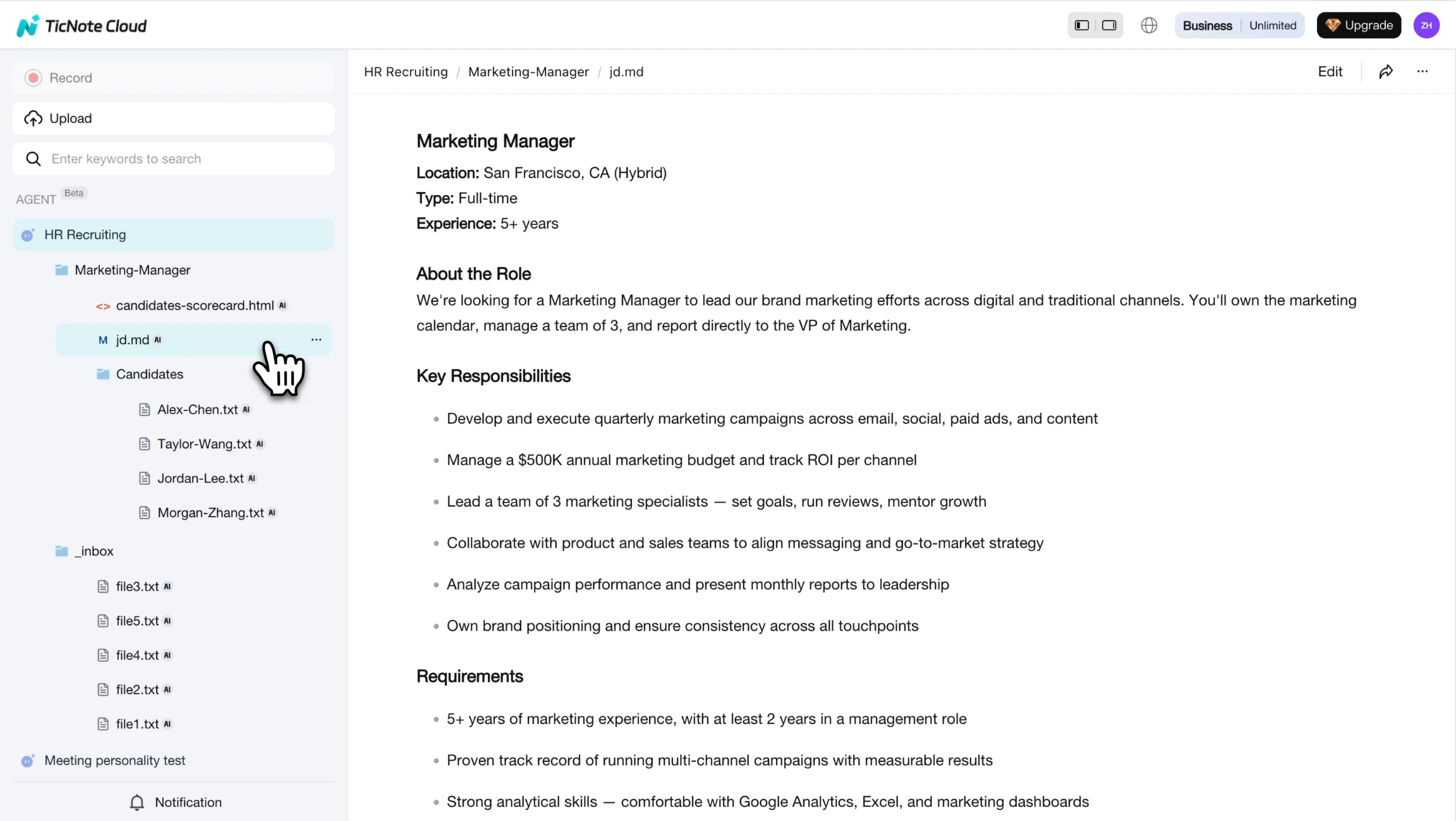
1. Add the HR Recruiting skill agent
Start in your TicNote Cloud workspace. Select Add Agent, then browse the Skill Agent library and choose HR Recruiting. There's no complex setup step; once added, the agent appears in your list and is ready for role-based candidate comparison.
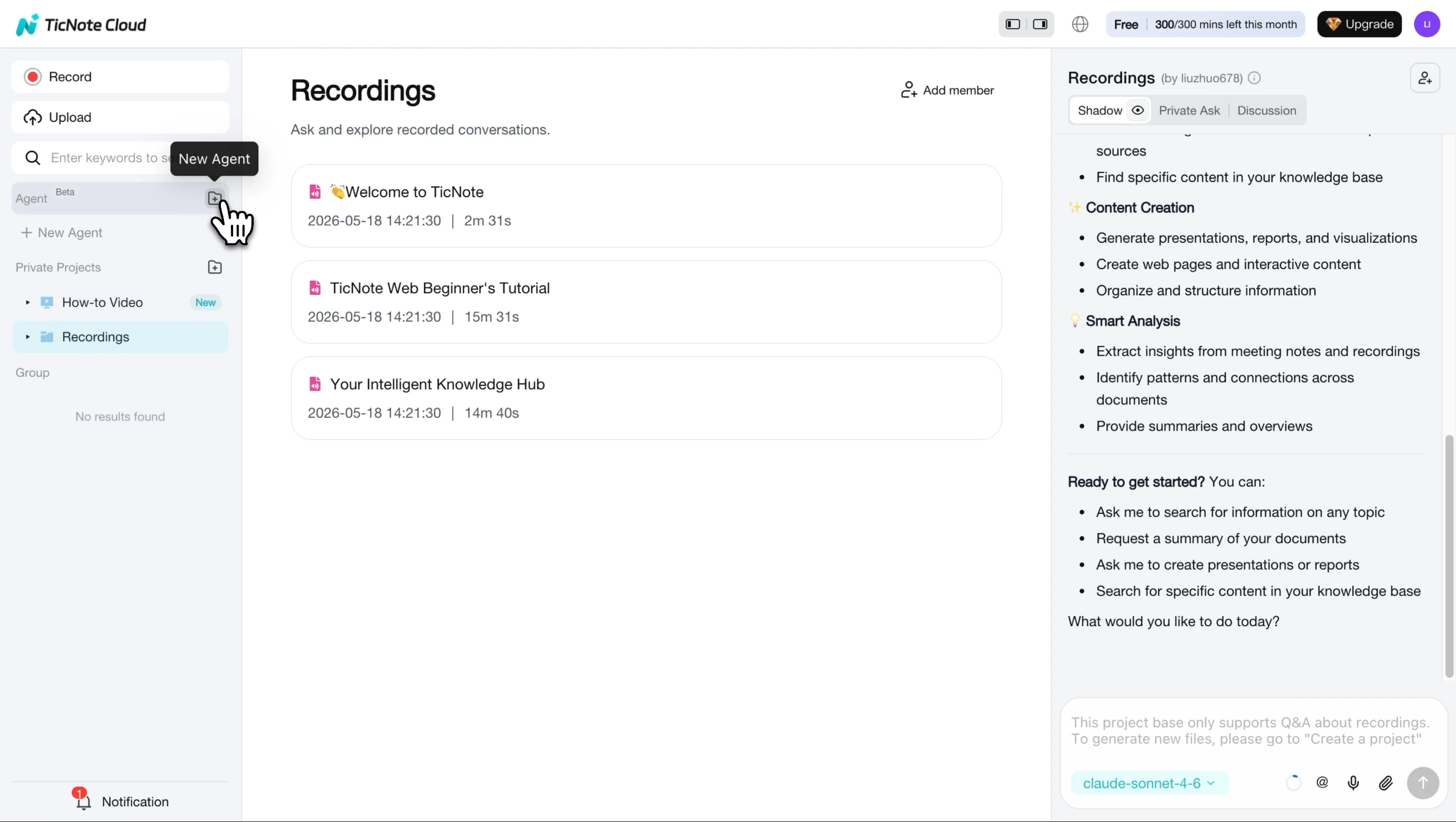
After you add it, open the HR Recruiting agent from your workspace. This keeps the hiring workflow separate from other projects, which matters when multiple roles are open at the same time.
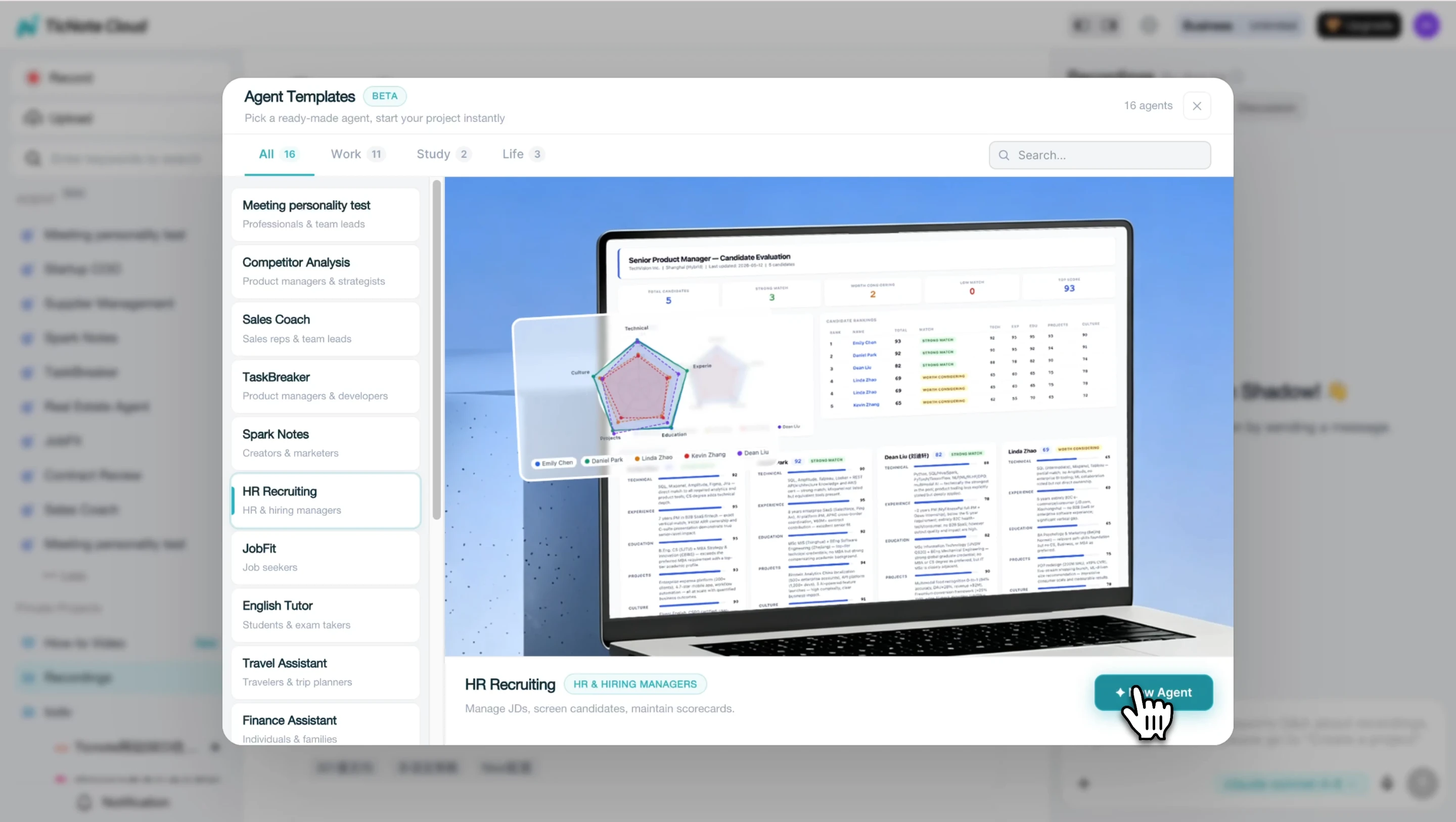
2. Paste the job description and upload resumes
Create a role folder or Project, such as "Data Analyst — May Hiring Round." Paste the job description into the agent first. TicNote Cloud uses that text as the shared reference for all candidates, so each resume is assessed against the same role requirements.
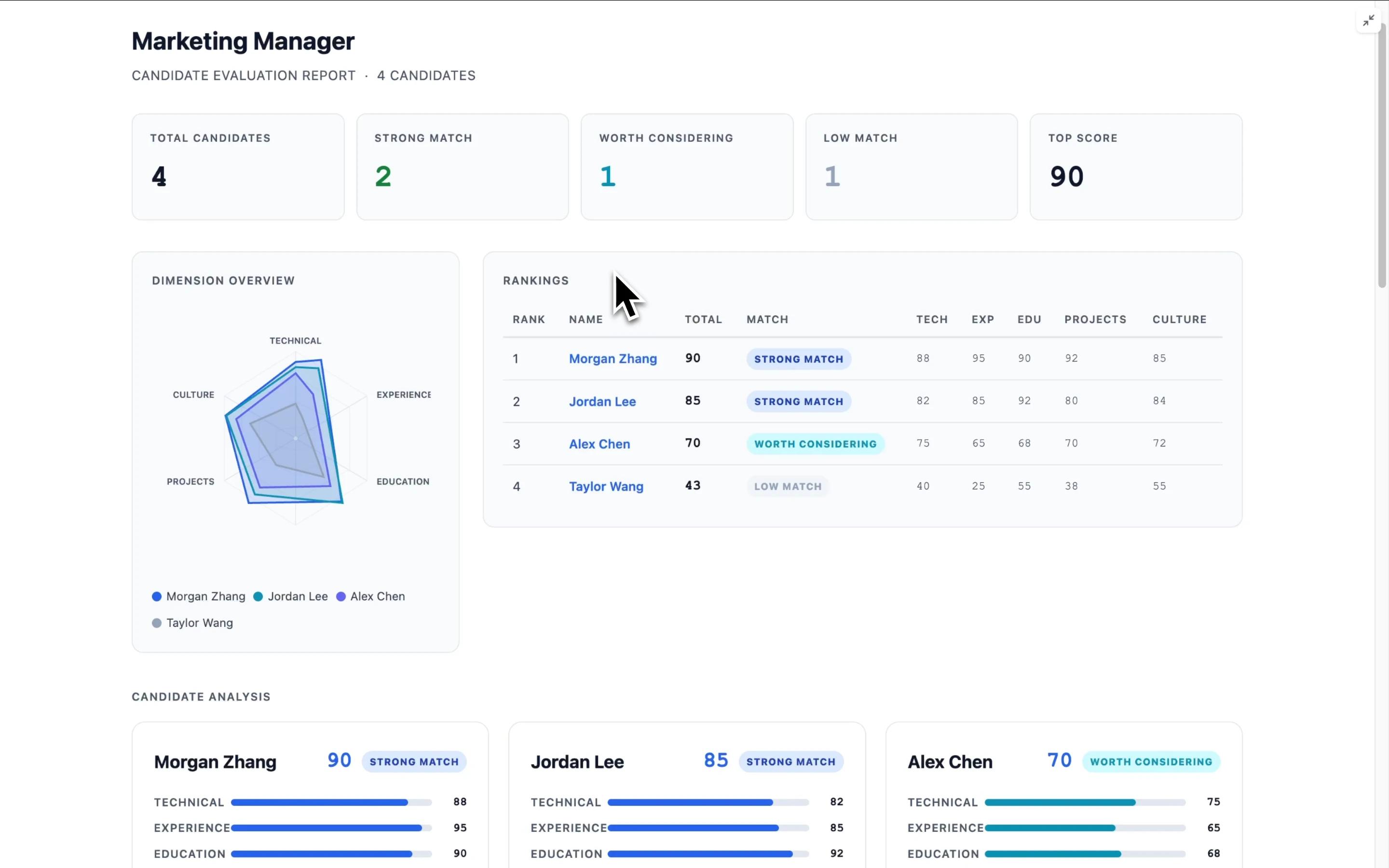
Next, add resumes by pasting text, uploading PDFs, or dragging files into the chat. The HR Recruiting agent evaluates each candidate across five dimensions:
- Technical fit
- Experience fit
- Education fit
- Project relevance
- Culture fit
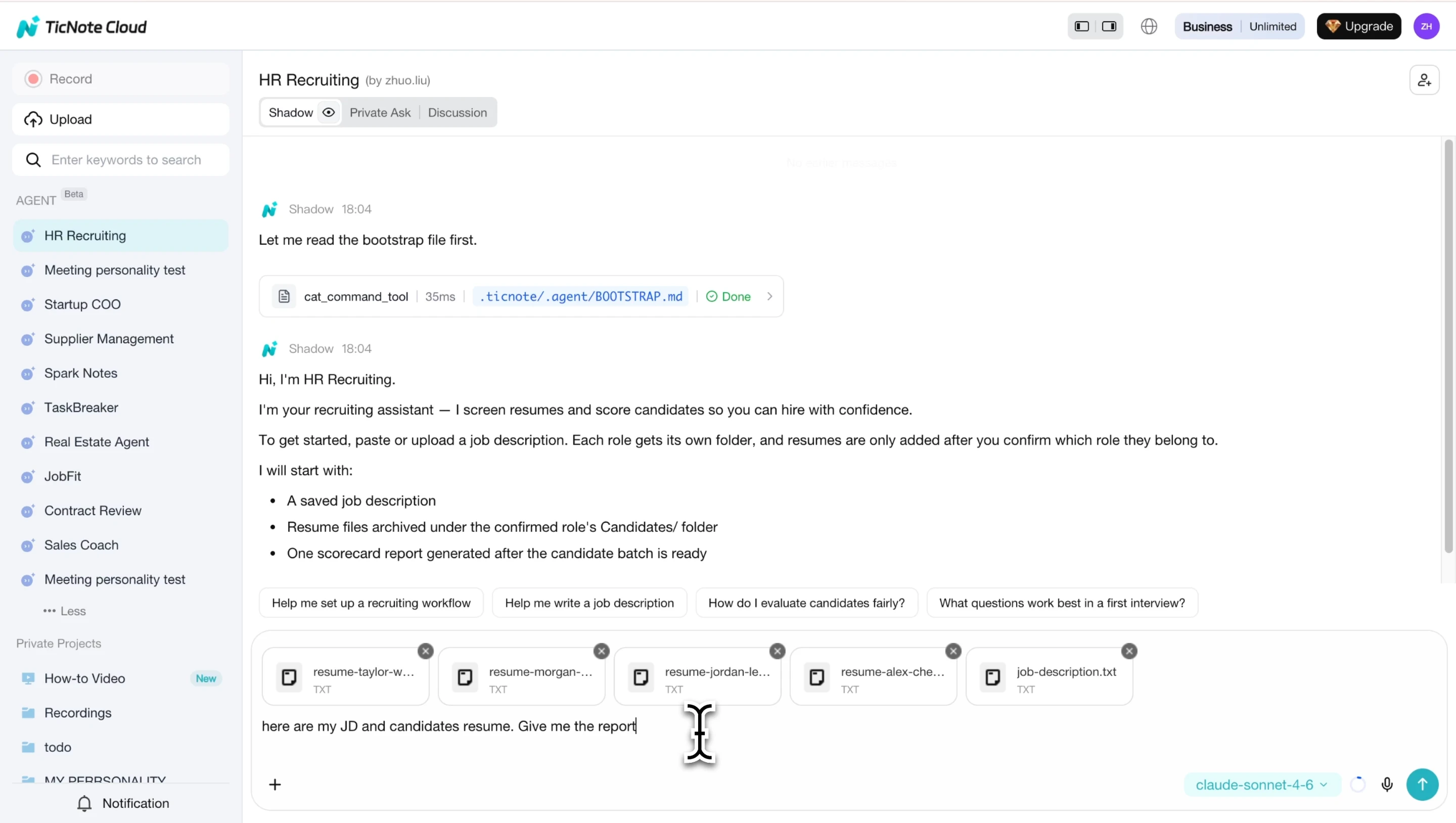
If the job description changes or new resumes arrive, don't patch the ranking manually. Use re-evaluate all so every candidate is scored again against the current criteria. Each evaluated resume stays archived in the role folder, which helps with traceability if a hiring manager asks, "Why did we rank this person above that one?"
3. Open the evaluation report and review the evidence
Open the generated interactive HTML evaluation report. It shows candidate scores, radar charts, a ranked leaderboard, and color-coded recommendations such as Strong Match, Worth Considering, or Low Match.
Use the ranking as a starting point, not a decision. Read the one-line justification for each dimension, compare it with your scorecard, and add human review notes where context matters.
App workflow: compare candidates on the go
On iOS or Android, use the same basic flow: add the HR Recruiting agent, paste the job description, upload resumes from your device or cloud storage, and open the evaluation report. This is useful for recruiters who need to review shortlists between debriefs or hiring manager syncs.
Once interviews and assessments are complete, move beyond resume screening. Map transcripts, panel notes, work samples, and assessment results back to your scorecard, then document the final ordering with clear evidence and any override reasons.
Candidate ranking methods and a worked scoring example
The safest default for candidate ranking is a weighted scorecard: define job-relevant factors, score each candidate on the same scale, multiply by agreed weights, then add the results. This turns candidate comparison from a debate about impressions into a review of evidence.
Use it especially when several interviewers are involved, when the role has clear success criteria, or when you need a defendable hiring rationale. The Uniform Guidelines on Employee Selection Procedures (1978) require that selection procedures be demonstrated to be valid for the job by showing content validity, criterion-related validity, or construct validity.
Use minimum thresholds before ranking
Start with gates before scores. A gate is a must-have that a candidate must pass before they can be ranked.
Examples:
- Legal right to work in the location
- Required certification or license
- Minimum portfolio quality for a design role
- Baseline coding assessment score for an engineering role
- Required language fluency for a customer-facing role
This prevents a common error: a high-charisma candidate with a weak must-have floats to the top because they interviewed well. If the must-have is real, it should be pass/fail or carry a minimum score.
Score with anchors, not vibes
Use a 1–5 scale, but define the anchors before interviews begin:
- 1 = limited evidence or below role requirement
- 3 = meets the role requirement with usable examples
- 5 = strong evidence, repeated examples, or standout work sample
Every score needs a short evidence note. Separate signal strength from likability. "Clear communicator" is weak. "Explained a delayed launch, named 3 stakeholders, and described the tradeoff that saved 2 weeks" is evidence.
Worked scorecard example
In this example, each score is 1–5. The weighted total is calculated as weight × score ÷ 5, then summed to 100.
| Factor | Weight | Candidate A | Candidate B | Candidate C |
| Role-specific skills | 25 | 5 | 4 | 3 |
| Work sample or assessment | 20 | 4 | 5 | 3 |
| Problem solving | 15 | 4 | 3 | 5 |
| Stakeholder communication | 15 | 3 | 5 | 4 |
| Relevant experience | 15 | 5 | 3 | 4 |
| Values and team behaviors | 10 | 3 | 4 | 5 |
| Final weighted score | 100 | 83 | 81 | 77 |
| Rank | Candidate | Short ranking rationale |
| 1 | Candidate A | Strongest role-specific skill evidence; work sample met core requirements with few gaps. Lower team-behavior score needs reference follow-up. |
| 2 | Candidate B | Best assessment result and strongest stakeholder story; less direct experience in this job context. |
| 3 | Candidate C | Strong problem-solving and team behaviors; weaker must-have skill depth and average work sample. |
Use pairwise comparison only for close finalists
If the top two candidates are within a narrow band, such as 2–4 points, use pairwise comparison as a tie-breaker. Compare A versus B only on the highest-weight competencies, not on every trait.
Rule: pairwise comparison comes after threshold checks and scorecards. It never replaces them.
Document the final call in one paragraph: "Candidate A ranks ahead of Candidate B because the role-specific skill score and relevant experience carried 40% of the scorecard, and the interview notes show stronger direct evidence in both areas. Candidate B had the stronger stakeholder story, but that factor carried 15% and did not offset the must-have skill gap."
When new evidence appears, such as references or a final exercise, update the scorecard version. Keep the old version, the new version, who changed it, and why. That audit trail protects the decision and makes comparing candidates for a job much easier to explain.
Bias, privacy, and audit guardrails for comparing candidates for a job
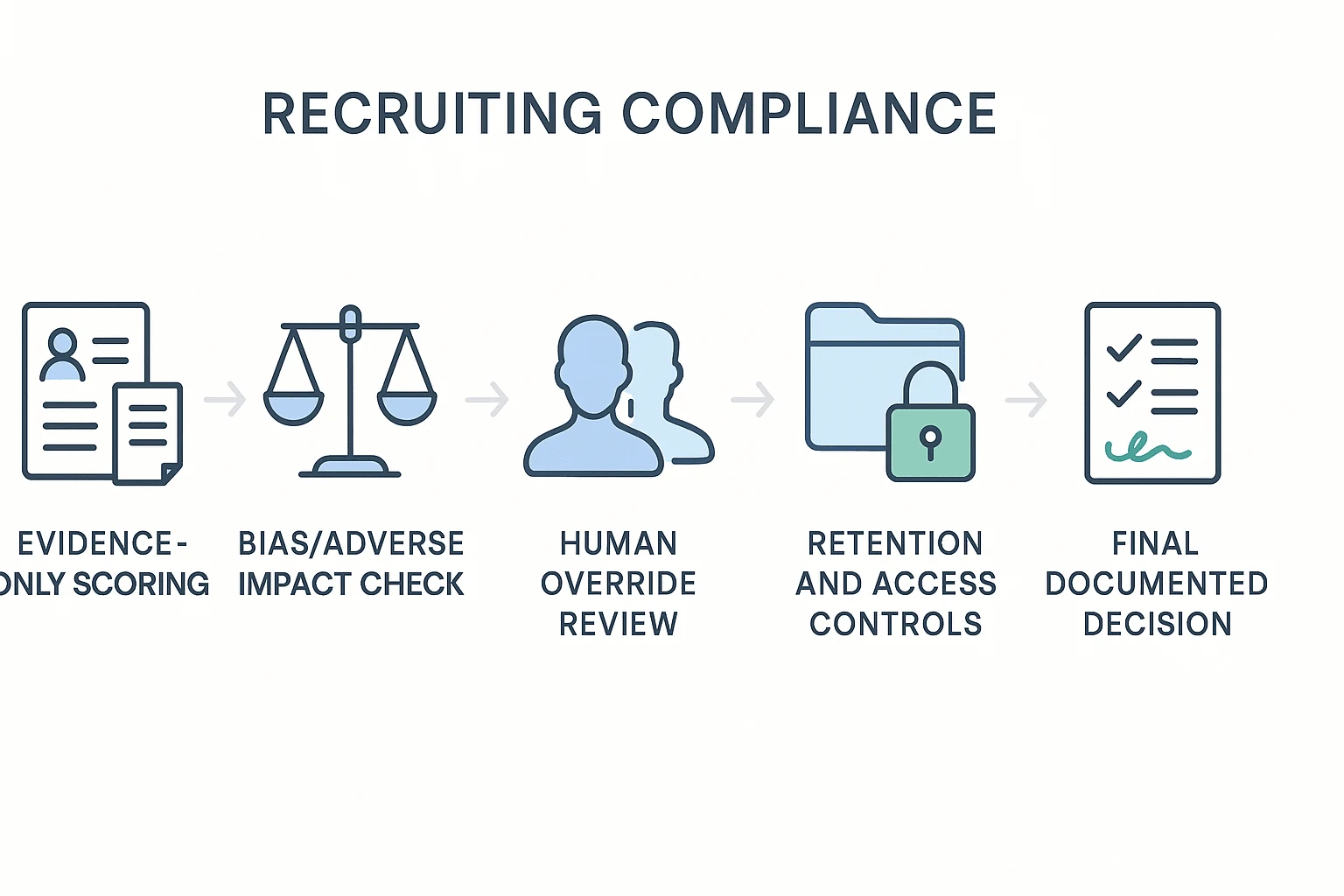
Candidate ranking is only defensible when every decision can be traced to job-related evidence. That means scores should come from the scorecard, not from personality impressions, resume polish, or who interviewed best under pressure.
Score only what the job requires
Before finalizing any rank order, check each score against two tests:
- It maps to a defined competency, such as SQL debugging, stakeholder communication, or territory planning.
- It points to evidence, such as an interview answer, work sample, assessment output, or hiring manager note.
| Weak ranking note | Evidence-based ranking note |
| "Great presence." | "Explained tradeoffs in the data migration scenario and addressed the 2-week deadline constraint." |
| "Seems like a culture fit." | "Gave a specific example of resolving a sales-engineering conflict and named the decision criteria used." |
| "Not senior enough." | "Missed 2 required architecture risks in the system design exercise." |
Check for adverse impact before final decisions
Run a light adverse-impact review before offers or final shortlist changes. Monitor pass-through rates by stage, such as resume screen, first interview, assessment, and final panel.
For U.S. hiring teams, the Uniform Guidelines on Employee Selection Procedures (1978) state that "a selection rate for any race, sex, or ethnic group which is less than four-fifths (4/5) of the rate for the group with the highest rate generally is regarded as evidence of adverse impact." Don't overread tiny samples. If patterns appear, involve HR or legal and review whether criteria, interview questions, or scoring rubrics need repair.
Require human review for overrides
Automation can organize evidence, but people own the decision. Define who can override a rank, when it's allowed, and what must be written: the evidence, the reason, the approver, and the date.
Use a two-person rule for high-stakes changes, such as moving someone onto or off the final shortlist. This protects the candidate and the hiring team.
Control interview data access and retention
Set retention periods for recordings, transcripts, scorecards, and assessment files. Align them with company policy and local law. Limit access by role, and avoid sharing raw recordings broadly when a cited summary is enough.
Capture candidate consent where required, especially for recorded interviews or AI-assisted transcript review. Store that consent with the hiring file.
Write notes that survive audit
A reviewable ranking record should include criteria, weights, evidence links, decision rationale, date, and version. The standard is simple: a later reviewer should understand the decision without hearing "because the tool said so."
TicNote Cloud's exclusive skill-agent workflow for candidate comparison
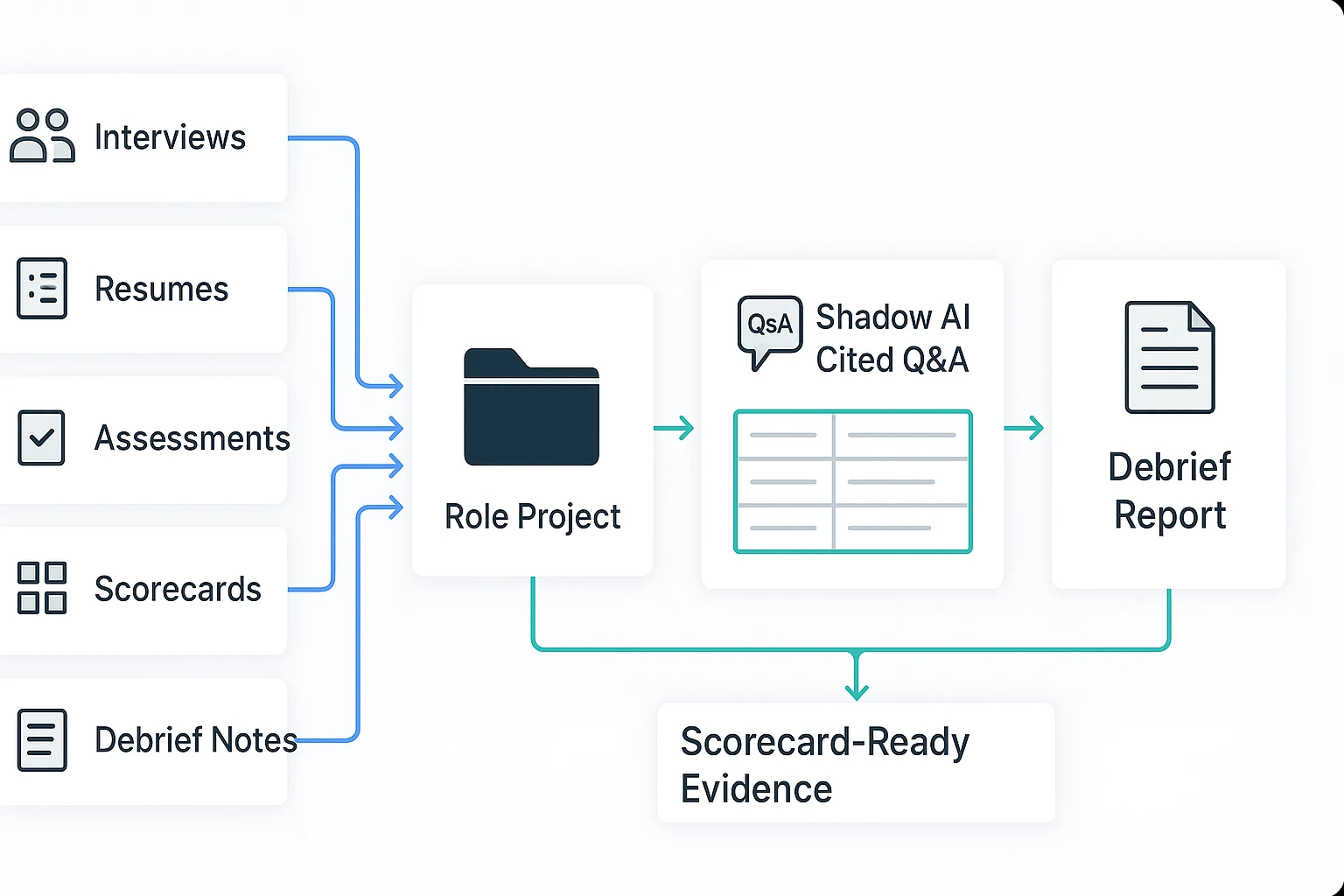
Candidate ranking improves when the evidence lives in one place, not in inboxes, spreadsheets, and half-finished interview notes. TicNote Cloud works as a skill-agent workspace: it helps hiring teams turn conversations and documents into a cited, reviewable evidence base for candidate comparison.
Build one role Project for every opening
Create a role-specific Project for the job. Then add the key materials:
- Interview transcripts from each round
- Resumes and portfolios
- Assessment notes or work samples
- Scorecards from each interviewer
- Hiring manager debrief notes
This gives the panel one shared memory layer for the role. A recruiter can see what the technical interviewer heard, what the hiring manager flagged, and what changed between round 1 and the final debrief. It also fits a broader meeting workflow system where decisions stay connected to the meetings that produced them.
Ask Shadow AI for cited evidence
Shadow AI can answer across files inside the Project. For example: "What evidence supports ownership for Candidate B?" or "Which candidates showed customer-facing communication skills?"
The important part is citation. Answers point back to the source transcript, resume, or note, so reviewers can verify the claim before it affects a score. That reduces misquoting and keeps AI in a support role, not a decision-maker role.
Clean transcripts before scoring
Editable transcripts matter because interview evidence is only useful when it's accurate. Teams can correct names, product terms, acronyms, and speaker labels. They can also annotate key moments with standard competency tags such as "problem solving," "role scope," or "collaboration risk."
That makes comparing candidates for a job faster and more consistent.
Generate debrief-ready outputs
Use the same scorecard structure for every AI-generated summary. Good outputs include:
- Candidate-by-candidate debrief summaries
- Panel themes and disagreements
- Evidence mapped to each competency
- Risk list and missing signals
- Next-step questions for references or final interviews
Keep access controlled and traceable
Candidate data is sensitive. TicNote Cloud supports role-based sharing with Owner, Member, and Guest permissions, so teams can limit who sees each Project. Shadow AI operations are traceable, and sources remain clickable for review. That creates an audit-friendly workflow: people still make the hiring call, but the evidence behind that call is easier to inspect.
Final thoughts: rank candidates faster without reducing hiring judgment
Candidate ranking improves when the process is simple, visible, and tied to the job. Start with a scorecard, capture the same evidence for every interviewee, calibrate as a panel, then record the human reasons behind the final order.
Use this four-part workflow:
- Define weighted criteria before interviews begin.
- Store resumes, transcripts, assessments, and debrief notes together.
- Compare candidates against evidence, not memory.
- Document overrides when context changes the score.
This approach doesn't replace hiring judgment. It gives that judgment a cleaner record. TicNote Cloud fits this stage by turning interview notes and hiring documents into a cited workspace your team can compare, revisit, and audit later.
Try TicNote Cloud for Free to build a reusable evidence base for your next hiring decision.