


 Extension
TL;DR
You can spark creativity on demand by combining the right environment, mindset triggers, and consistent habits, then capturing every idea the moment it surfaces. Try TicNote Cloud free and start capturing your creative sparks instantly.
Creativity doesn't fail at the spark. It fails at the capture. Your best ideas arrive during a walk, mid-shower, or right before sleep, and they're gone before you reach a notebook. Without a system that saves every fleeting thought the moment it occurs, even the most powerful creative methods leave you empty-handed.
TicNote Cloud's Spark Notes skill agent solves this. It captures every idea the moment you type it, organizes your sparks into a visual Ideas Calendar by date and pillar, and converts your disorganized thoughts into structured content outlines ready to act on. Creativity starts from capturing every spark, and Spark Notes makes sure none of them slip away.
What Does It Mean to Spark Creativity?
Creativity isn't a trait, it's a trigger response
Most people treat creativity as something you either have or you don't. That framing is wrong, and it's the reason so many people feel stuck. Creativity is a cognitive state, not a fixed characteristic. It responds to conditions: the right input, the right environment, the right level of mental relaxation. When those conditions are present, ideas surface. When they're not, nothing comes.
This means creativity can be triggered deliberately. You don't have to wait for inspiration to strike. You can create the conditions that make it more likely to arrive, and you can build habits that make those conditions repeatable.
Why creativity feels unpredictable
The reason creativity feels random is that the conditions that trigger it tend to be random. Ideas arrive in the shower because your mind is relaxed and not actively trying. They surface on walks because movement and novel visual input activate associative thinking. They appear mid-conversation because someone else's words create an unexpected connection.
None of that is magic. It's just the brain doing what it does when you stop forcing it. The goal of every method in this article is to recreate those conditions on purpose, so you're not waiting for the right moment. And when a spark does arrive, you need a system to capture it immediately, because the moment passes faster than you think.
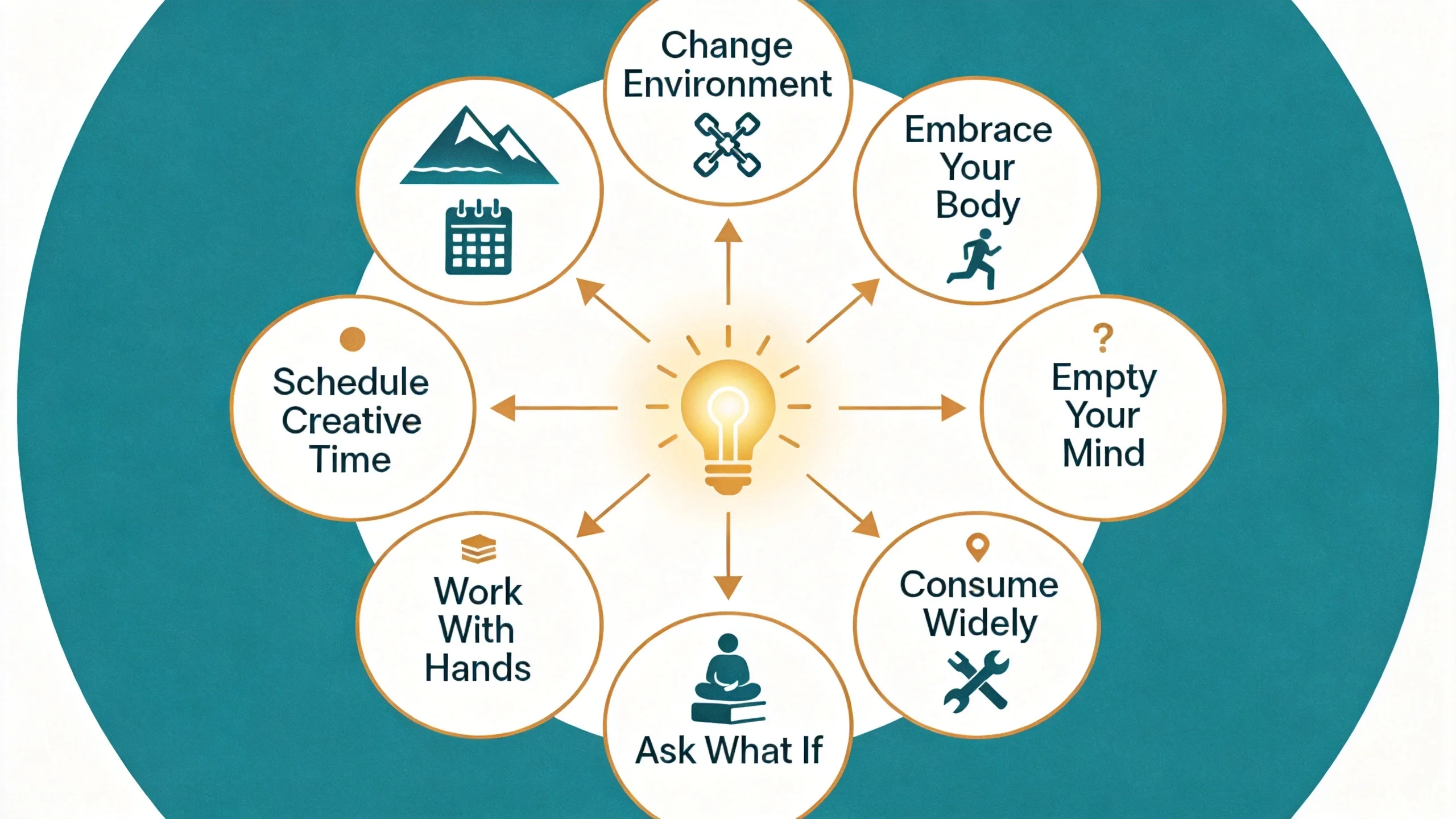
How to Spark Creativity: 8 Methods That Actually Work
These methods don't require talent or a perfect setup. They work by changing your cognitive state so ideas have somewhere to go. Pick two or three and use them consistently.
1. Change your environment
Novel surroundings activate divergent thinking. Your brain pays more attention when inputs are unfamiliar, which loosens fixed associations and creates space for new connections. Moving to a coffee shop, a park, or even a different room in your home can shift your mental state faster than any technique. You don't need to go far: you just need something your brain hasn't tuned out yet.
2. Embrace constraints
Counterintuitively, limiting your options tends to spark more creative output than having full freedom. When you tell yourself "I can only use three elements" or "this has to be done in one hour," your brain starts problem-solving rather than wandering. Constraints force specificity, and specificity is where interesting ideas live. Try imposing a format limit, a time limit, or a scope limit on your next creative task.
3. Move your body
Physical movement increases cerebral blood flow and breaks the cognitive fixation that comes from sitting still and staring at a problem. Even a 10-minute walk is enough to shift your mental state. For deeper creative blocks, exercise that requires coordination, dancing, swimming, climbing, works especially well because it demands just enough attention to quiet the inner critic without fully occupying your thinking mind.
4. Empty your mind first
You can't fill a full cup. If you sit down to create while mentally rehearsing a to-do list or replaying a difficult conversation, you've already blocked the channel. Before a creative session, spend five minutes offloading: write down everything on your mind, set it aside, and give yourself permission to return to it later. The act of externalizing clears the mental queue and makes room for something new.
5. Ask 'what if' questions
"What if we did the opposite?" "What if the constraint didn't exist?" "What if this was for a completely different audience?" Reframing prompts divergent thinking because it forces your brain out of its default path. Keep a short list of go-to 'what if' questions for moments when you're stuck. The goal isn't to answer them immediately; it's to interrupt the pattern that's keeping you blocked.
6. Work with your hands
Tactile, repetitive activity, sketching, building, kneading, folding, bypasses the analytical part of your thinking and lets the associative brain run in the background. Many creators report their best ideas arrive while doing something manual that doesn't require conscious problem-solving. Keep something tactile near your workspace for exactly this reason.
7. Consume widely outside your field
Creative connections are made between ideas from different domains. If you only consume content in your own field, you'll only generate ideas that already exist in your field. Read books in unrelated disciplines. Follow creators from other industries. The raw material for genuinely new ideas almost always comes from somewhere unexpected. For research-heavy work, free competitor analysis tools can also surface patterns across industries that spark new angles.
8. Schedule creative time like a meeting
Waiting for inspiration is a strategy that reliably fails. Showing up at the same time each day, even for 20 minutes, trains your brain to enter a creative state on cue. Over time, the routine itself becomes the trigger. Start small: one consistent block per day, no distractions, same location. The quality of what you produce matters less than the habit of showing up, and the ideas improve as the habit solidifies.
These eight methods generate sparks. But sparks only matter if you catch them. The next section explains why capture is the other half of the equation.
Why Capturing Your Creative Sparks Matters as Much as Finding Them
The gap between spark and action
A creative idea is most fragile in the first few seconds after it arrives. You're mid-task, mid-conversation, or mid-sleep, and something clicks. You think "I'll remember this," and then you don't.
This isn't a memory failure. It's just how working memory works. According to working memory research published by the National Institutes of Health, unrehearsed information decays in working memory in up to about 30 seconds. A creative spark that isn't captured immediately has a very high chance of being gone before you can act on it.
This is why the most productive creators aren't always the most creative people in the room. They're often just the ones with the best capture habits. Every spark goes somewhere the moment it appears. Nothing relies on memory.
What a good capture system looks like
The right capture system has three properties:
- Zero friction: no app-switching, no logging in, no deciding where to file it
- Always available: works wherever you are, the moment an idea appears
- Automatically organized: you shouldn't have to sort, tag, or search later
This is exactly where TicNote Cloud's Spark Notes skill agent fits. Spark creativity starts from capturing every spark thought, since they're fleeting. TicNote Cloud helps you capture your notes immediately the moment you type them and converts your disorganized thoughts into action or content. You type an idea, a headline, a question, a half-formed angle, and it's saved to today's date and organized into your Ideas Calendar by content pillar automatically. No folders, no tags, no friction.
When you're ready to develop a captured spark, the skill turns it into a structured content outline with hook, argument, key points, and CTA, adapted to your platform. The idea that would have vanished in 30 seconds becomes a ready-to-write brief. For creators who also need to break those outlines into concrete next steps, this approach pairs naturally with how content ideas translate to actionable work.
How to Use an AI Skill Agent to Capture and Develop Every Creative Spark
The steps below walk through the full workflow using TicNote Cloud as an example, from adding the skill agent to turning a captured spark into a structured creative outline.
Step 1. Add the Spark Notes skill agent
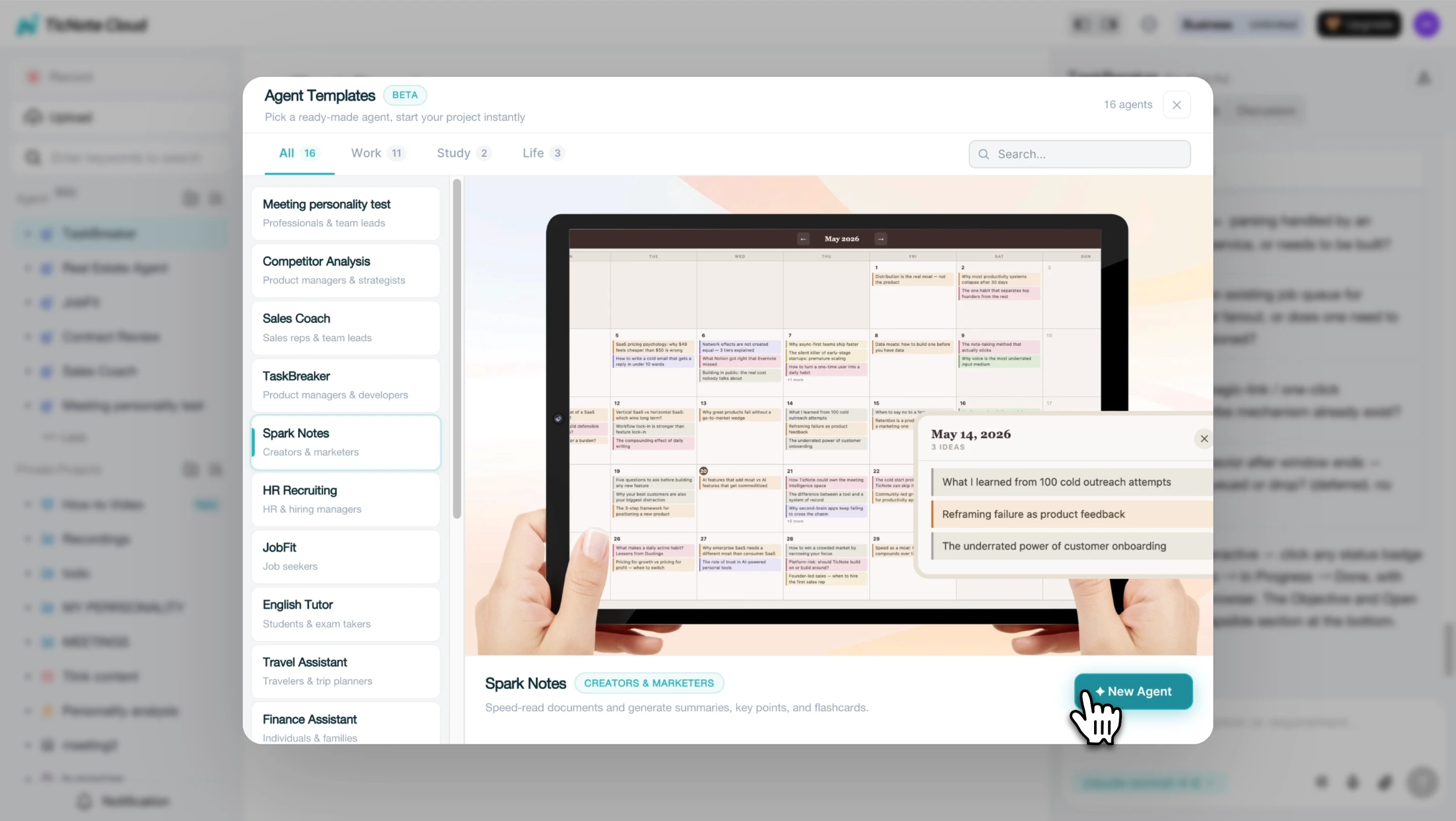
In TicNote Cloud, click Add Agent and browse the Skill Agent library. Select the Spark Notes skill to add it to your workspace, no configuration required.
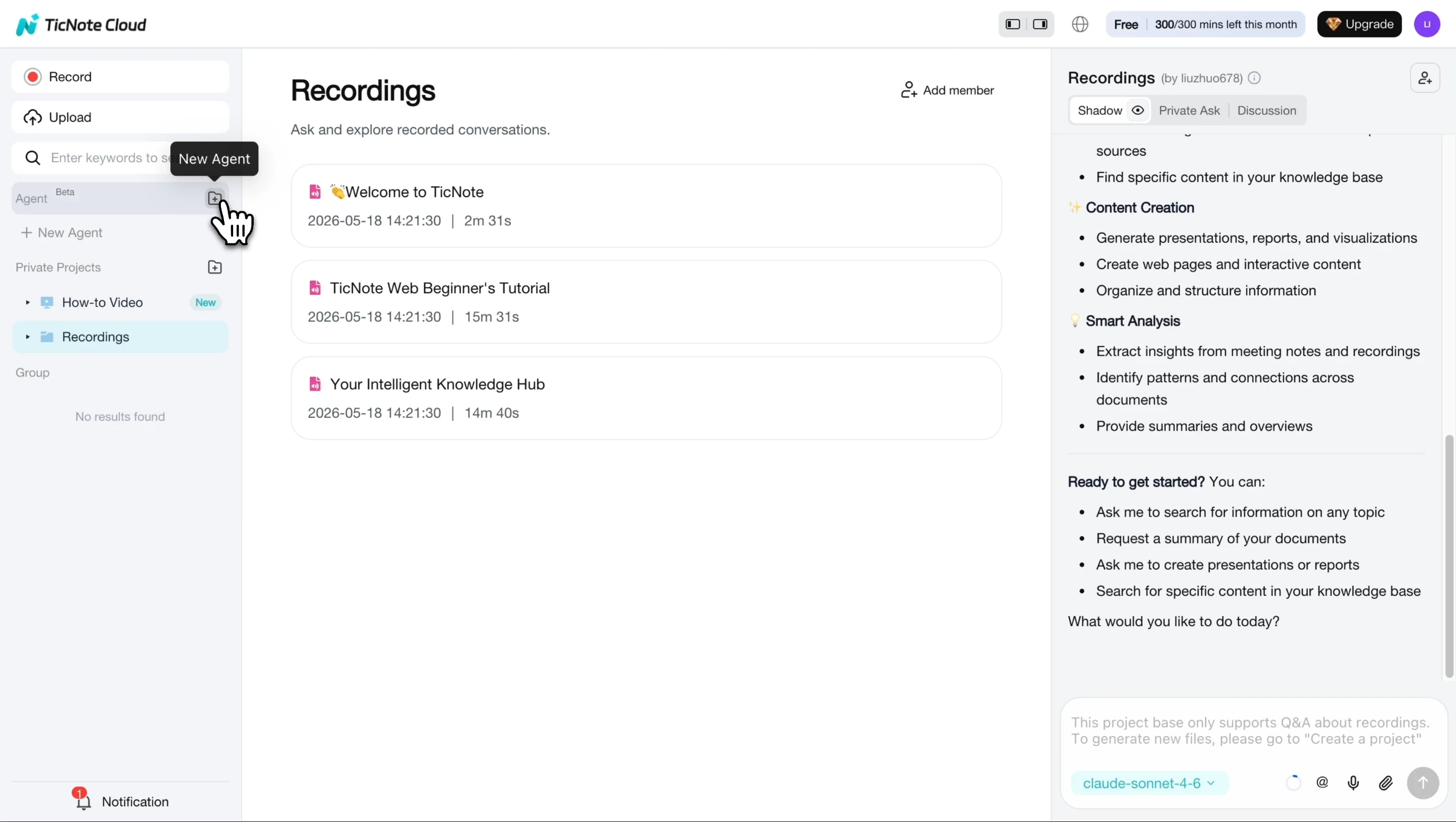
Once added, the skill appears in your agent list and is ready immediately, no onboarding, no setup forms.
Step 2. Capture every spark the moment it occurs
Tell the skill whether you want idea capture only or capture plus outline creation. Then start typing, anything: a half-formed title, a question that just came to you, an image that triggered something, a phrase you overheard. TicNote Cloud captures your notes immediately, the moment you type them. Each entry saves to today's date and the Ideas Calendar updates in real time.
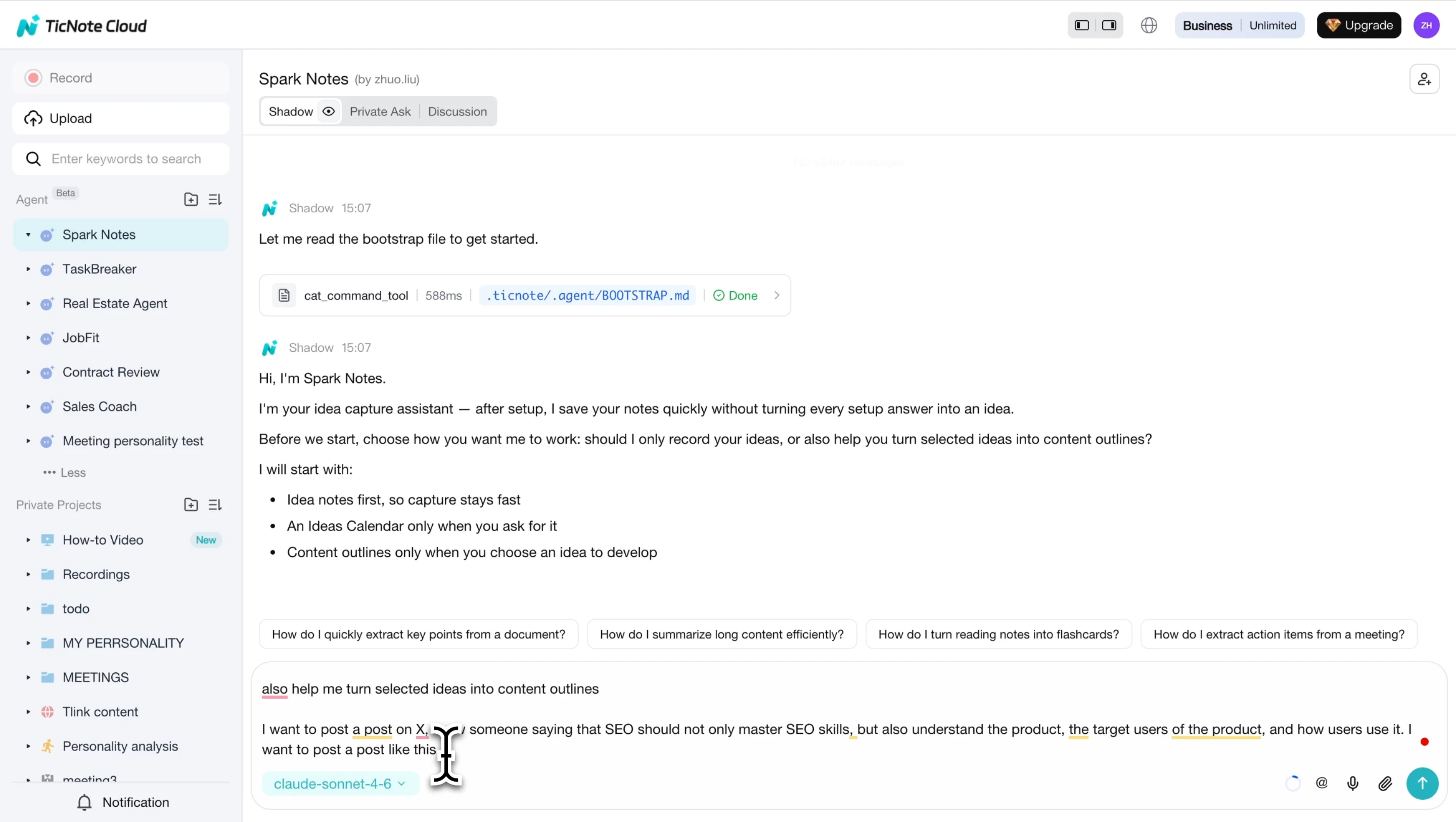
The skill learns your content pillars and tone from conversation. You don't need to tag or categorize anything manually.
Step 3. Develop captured sparks into structured outlines
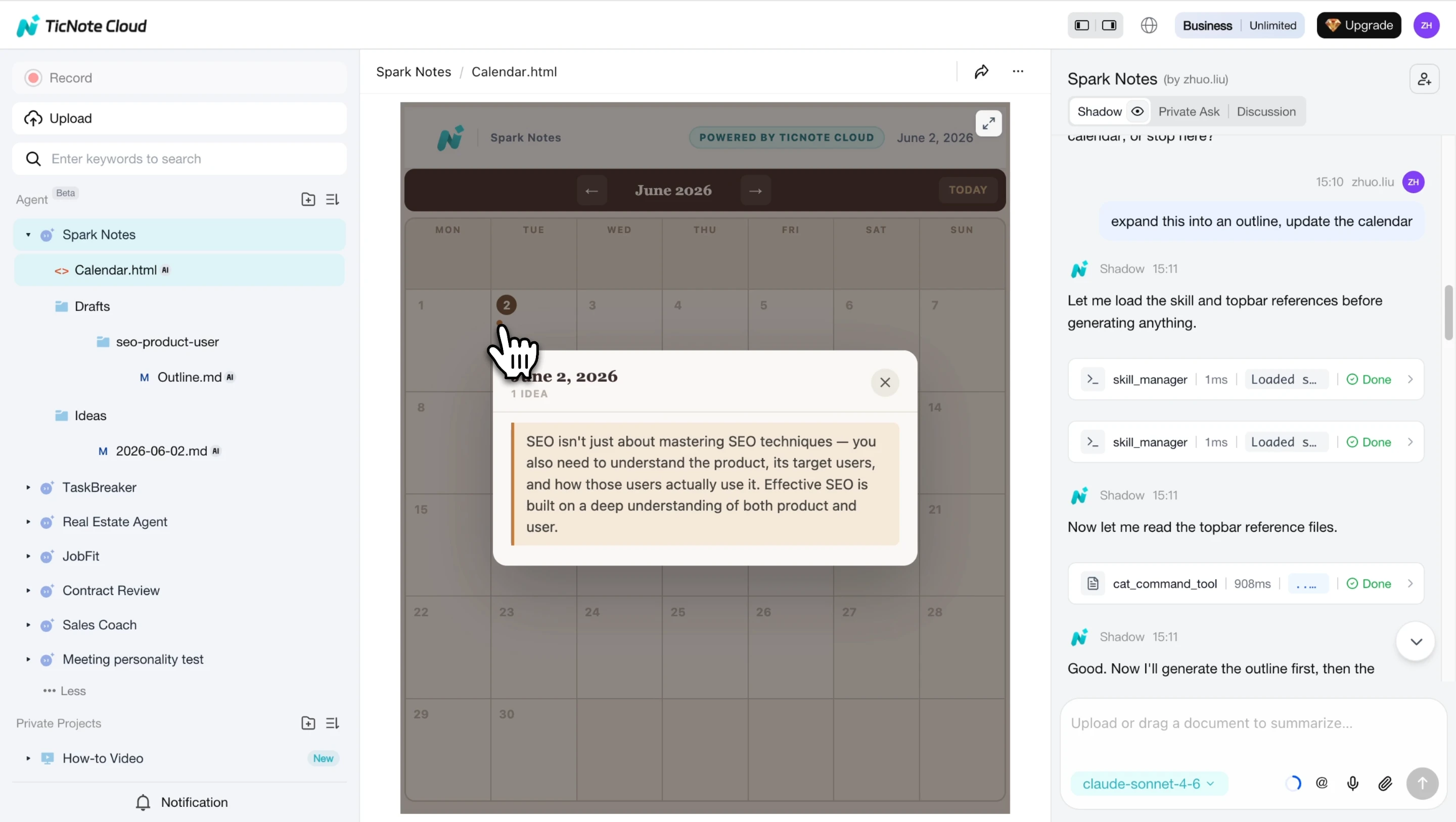
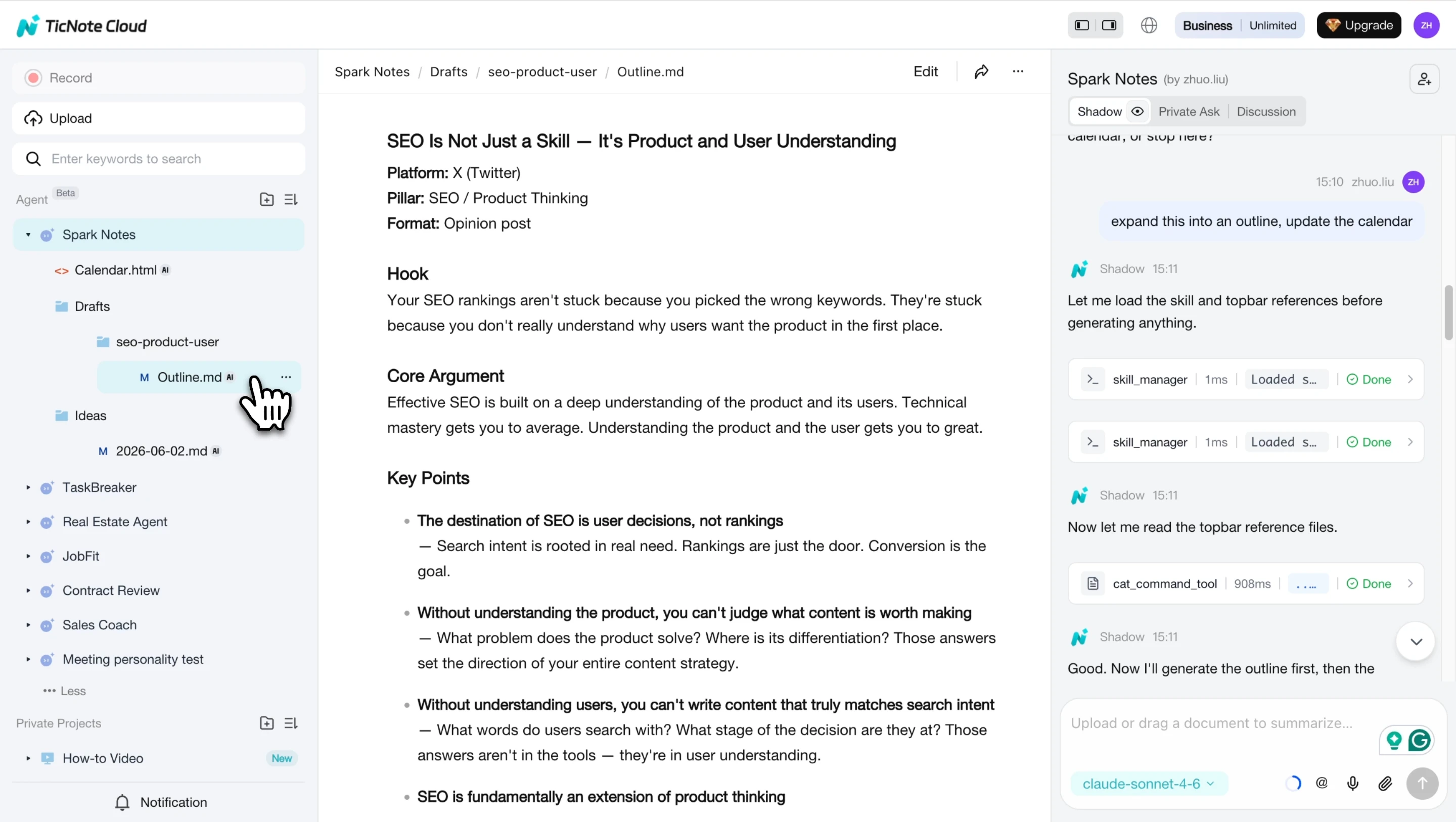
Open the Ideas Calendar to browse all your content by date and pillar, color-coded chips make it easy to see what's there at a glance. Click any day to view every idea in full detail. When you're ready to develop one, tell the skill, it generates a complete creative outline: hook, core argument, key points, supporting material, and CTA, all adapted to the platform you're writing for (LinkedIn, newsletter, blog, or any format). If you want to break that outline into executable tasks, this guide to structured task breakdown shows how to take any deliverable from outline to action plan.
The outline saves as a Markdown file and a clean HTML reading view, ready to share, present, or write from directly.
Conclusion
Creativity isn't something you wait for. It's something you trigger, with the right environment, the right constraints, the right habits. The eight methods in this guide give you reliable ways to create the conditions ideas need to surface. But methods alone aren't enough if the sparks vanish before you act on them.
Capture is the other half of the equation. When every creative thought goes somewhere the moment it appears, organized automatically and ready to develop, you stop losing your best ideas to timing and start building a creative output that compounds over time.
Try TicNote Cloud free and start capturing every creative spark before it disappears.