


 Extension

TL;DR
The best way to spark content ideas consistently is to combine proven ideation methods, social listening, keyword gaps, repurposed content, with a system that captures every spark the moment it occurs. Try TicNote Cloud free and start capturing your content ideas instantly.
Most creators don't have an idea problem. They have a capture problem. A great angle surfaces in the shower, a compelling hook appears mid-conversation, a trending question pops up on Reddit, and then it's gone before you open a notes app. That gap between spark and capture is where most content dies.
TicNote Cloud's Spark Notes skill agent fixes this. It saves every idea the moment you type it, organizes them into a visual Ideas Calendar by date and content pillar, and turns the best ones into structured outlines ready to write from, converting your disorganized thoughts into action, one spark at a time.
Why Sparking Content Ideas Is Harder Than It Looks
The real problem isn't a lack of ideas, it's losing them
Most content creators have more ideas than they think. The problem is the timing. An idea surfaces at the wrong moment, on a run, mid-meeting, right before sleep, and by the time you're at your desk, it's gone.
That's not a creativity failure. That's just how working memory works. According to working memory research published by the National Institutes of Health, unrehearsed information in working memory decays in up to about 30 seconds. A fleeting content angle that isn't captured immediately has a high chance of being gone before you can act on it.
This is why the standard advice, "just brainstorm more" or "use a content calendar", often doesn't help. You can't schedule a spark.
What actually blocks consistent ideation
Three things compound the problem:
- Topic fatigue: you've covered your core subjects and don't know where to expand
- Blank-page paralysis: you sit down to brainstorm but nothing comes because there's no trigger
- No capture system: ideas arrive randomly but there's no frictionless way to save them in the moment
The fix is two-part. First, you need reliable methods to trigger ideas on demand. Second, you need a system that captures every spark instantly, before your working memory discards it. The rest of this article covers both.
How to Spark Content Ideas: 7 Proven Methods
These methods work because they give you a trigger, something external to react to, instead of staring at a blank page. Use two or three consistently, and ideas stop feeling scarce.
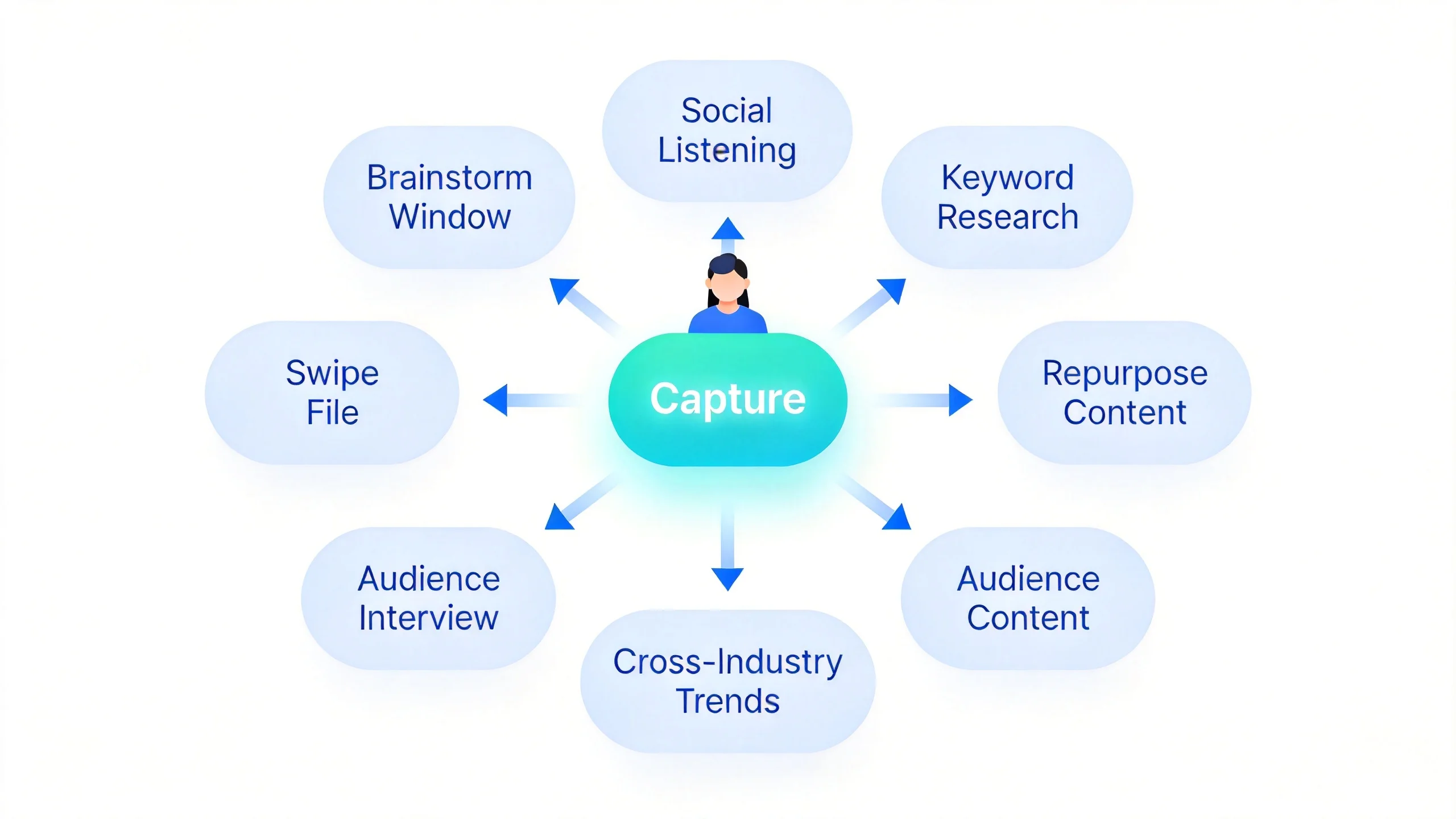
1. Mine social listening
Reddit, Quora, and niche Facebook or LinkedIn groups are search engines for pain points. Search your topic and look for questions that come up repeatedly, especially ones where the existing answers are vague or outdated. Each recurring complaint or unanswered question is a content gap you can fill.
2. Use keyword research as an idea trigger
Google's "People Also Ask" boxes and "related searches" at the bottom of results pages surface exactly what your audience wants to know. Don't just look at volume, look at the questions. A high-intent question with no strong answer in the SERP is a ready-made content angle. For competitive niches, free competitor analysis tools can reveal what topics your competitors rank for that you haven't covered yet.
3. Repurpose and remix old content
Your highest-performing posts are already validated ideas. Turn a long guide into a focused how-to. Split a listicle into individual deep dives. Update a post from two years ago with current data. Repurposing isn't recycling, it's finding angles in content you've already proven works.
4. Cross-industry trend mapping
Pick an industry adjacent to yours and look at what's trending there. A framework popular in B2B SaaS often translates to content marketing six months later. A format working in fitness content, challenges, tracking, streaks, can be adapted for productivity or learning content. The best angles often come from outside your niche.
5. Interview your audience or community
Direct questions surface real pain points faster than any tool. A one-question poll in a newsletter, a reply thread on social media, or a quick DM to five engaged followers will give you more specific, high-quality topic ideas than an hour of keyword research. People tell you exactly what they don't understand or can't find a good answer for.
6. Keep a swipe file
A swipe file is a running collection of content that sparked something in you, a headline structure, a fresh angle, a counterintuitive claim, a format you hadn't considered. It's not plagiarism; it's pattern recognition. Review it weekly when you need a trigger. Over time it becomes one of your most reliable ideation sources.
7. Set a dedicated brainstorm window
Open-ended "I'll brainstorm later" never happens. Time-box it: 20 minutes, a specific prompt, no editing. The goal is volume, not quality. Combine this with any method above as a starting trigger. The key constraint: you must capture every idea that surfaces immediately, because even in a structured brainstorm, the best ones arrive fast and fade just as quickly.
How to Capture Every Content Idea Before It Disappears
Why capture matters as much as ideation
Generating ideas and keeping them are two different skills. Most systems fail at the second one. You save something to a notes app, forget it's there, and rediscover it six months later when it's no longer relevant. Or you rely on memory and lose the idea entirely within the minute.
The 30-second decay window isn't just theory, it shapes how content actually gets made. Creators who produce consistently aren't necessarily more creative than those who struggle. They're better at capture. Every idea goes somewhere the moment it appears, which means nothing is lost to friction or forgetfulness.
The instant capture workflow
The best capture system is the one with the least friction. That means:
- Available everywhere: no switching apps, no logging in, no searching for where to put it
- Organized automatically: you shouldn't need to file or tag ideas manually
- Developable on demand: when an idea is ready, the system should help you turn it into something
This is where TicNote Cloud's Spark Notes skill agent fits. It captures your notes immediately the moment you type them, a headline idea, a competitor angle, a customer question overheard on a call. Each entry is saved to today's date and instantly organized into a visual Ideas Calendar by content pillar. There's no setup, no folder structure, no manual tagging.
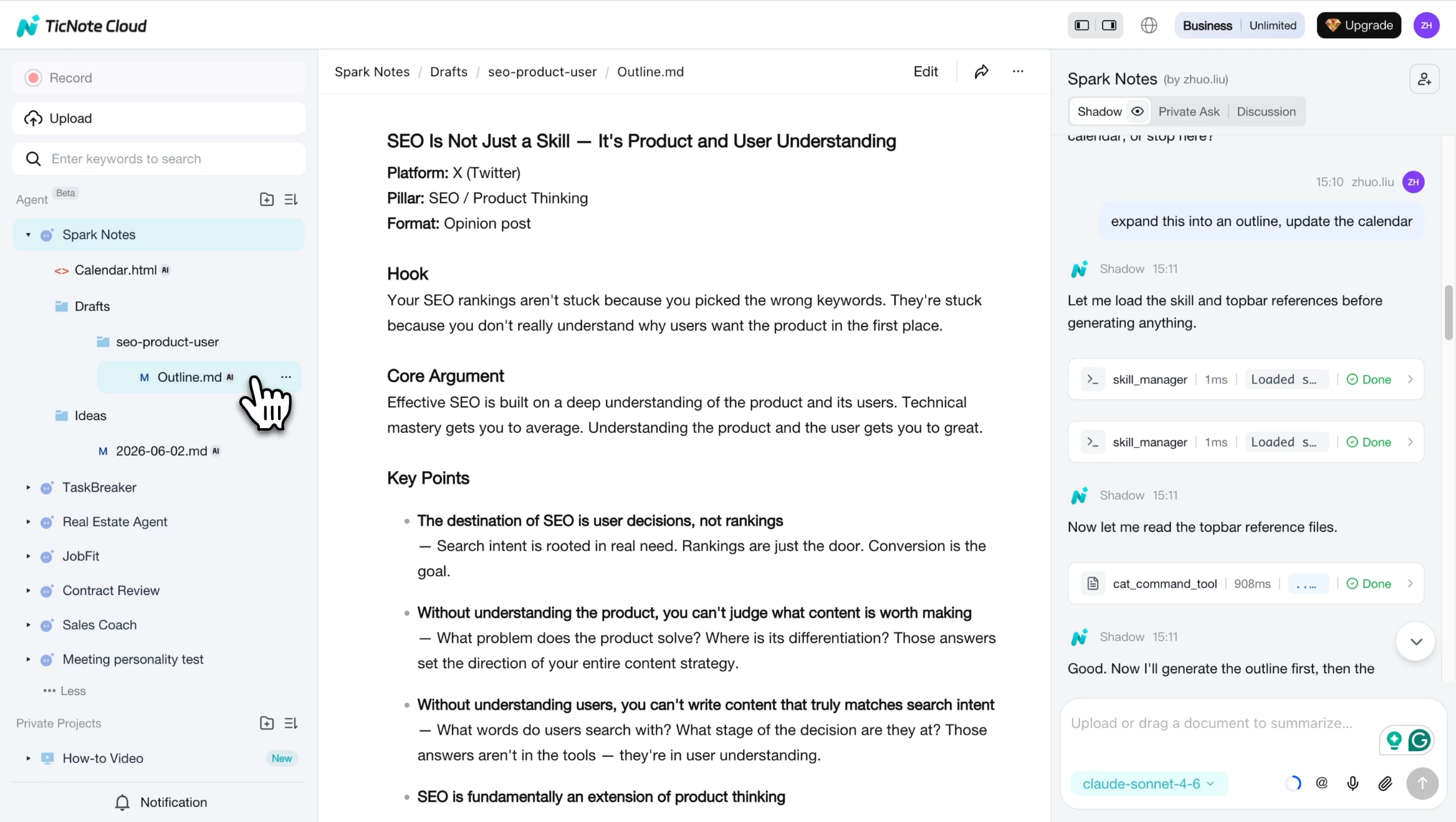
When you're ready to develop an idea, Spark Notes converts your disorganized thoughts into action: a structured content outline with hook, core argument, key points, and CTA, adapted to whatever platform you're writing for. The spark that would have faded in 30 seconds becomes a ready-to-write brief. For teams that also need to break those outlines into executable tasks, AI task breakdown tools can take the output one step further.
How to Use an AI Skill Agent to Capture and Develop Your Ideas
The steps below demonstrate the full workflow using TicNote Cloud as an example, from adding the skill agent to developing a captured idea into a structured content outline.
Step 1. Add the Spark Notes skill agent
In TicNote Cloud, click Add Agent and browse the Skill Agent library. Select the Spark Notes skill to add it to your workspace, no configuration required.
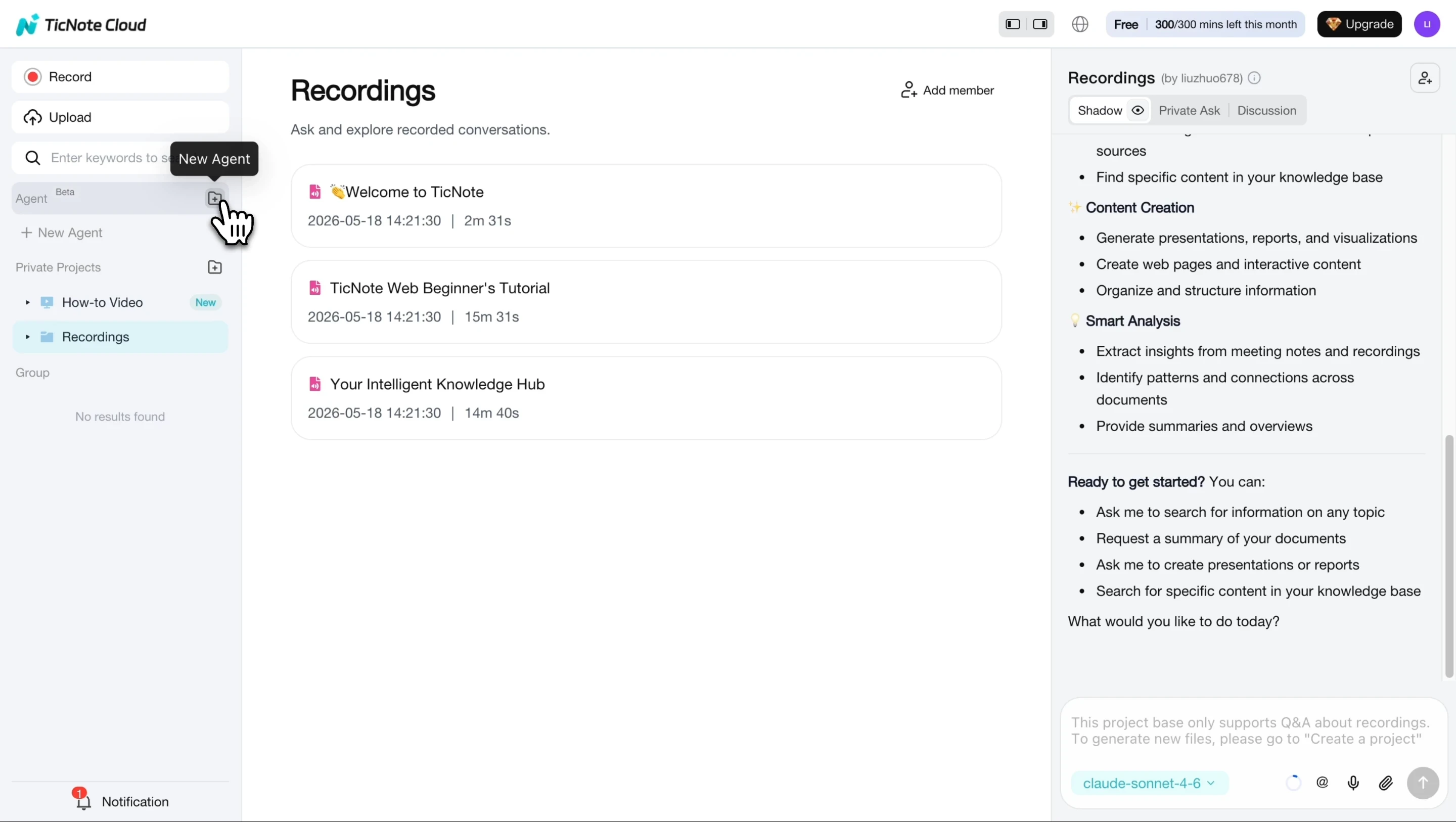
Once added, the skill agent appears in your agent list and is ready to use immediately.
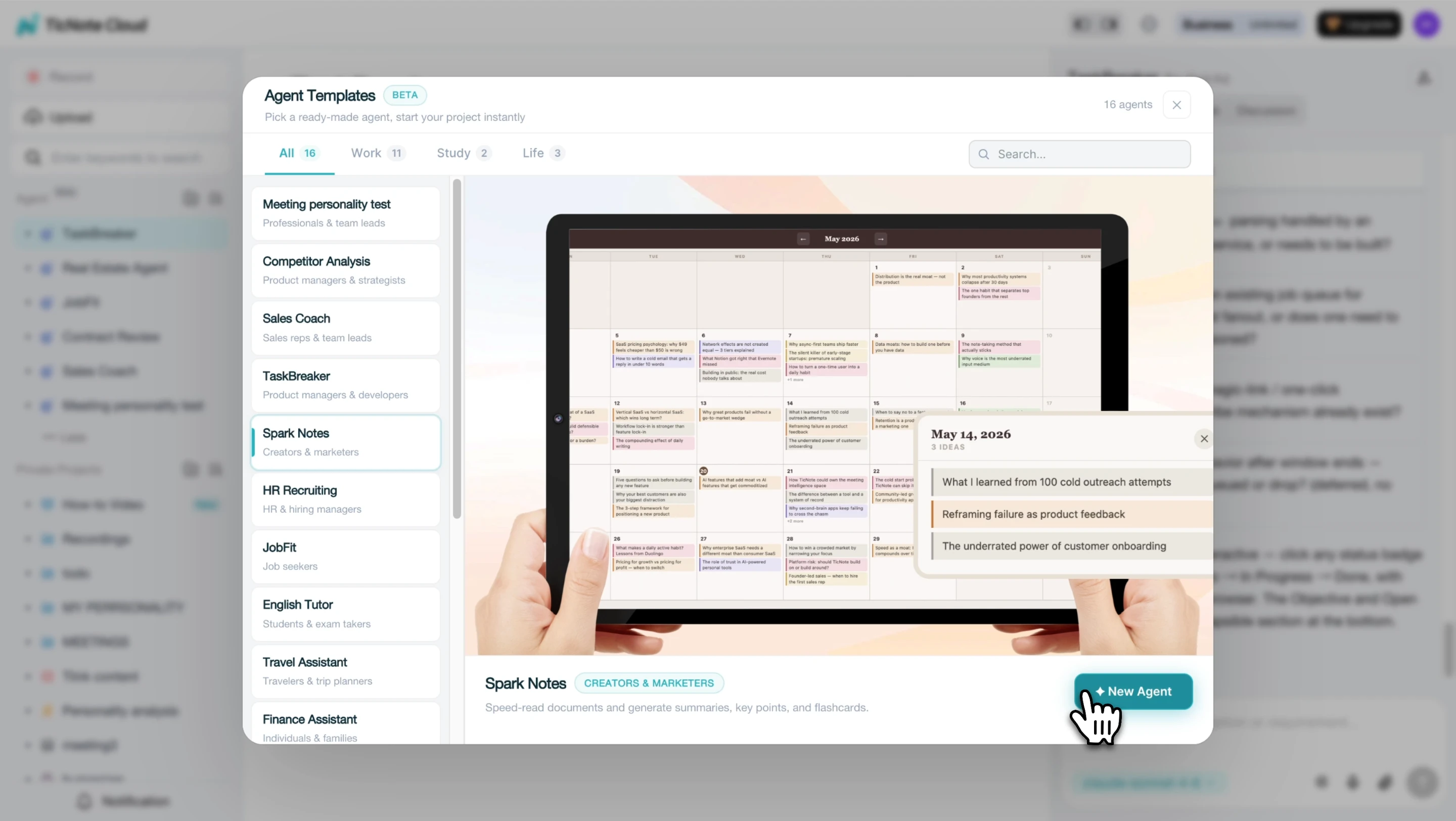
Step 2. Start capturing ideas instantly
Tell the skill whether you want idea capture only, or capture plus content outline creation. Then start typing, a headline idea, a topic angle, a question you heard from a reader. TicNote Cloud captures your notes immediately the moment you type them. Each idea is saved to today's date and the Ideas Calendar updates in real time.
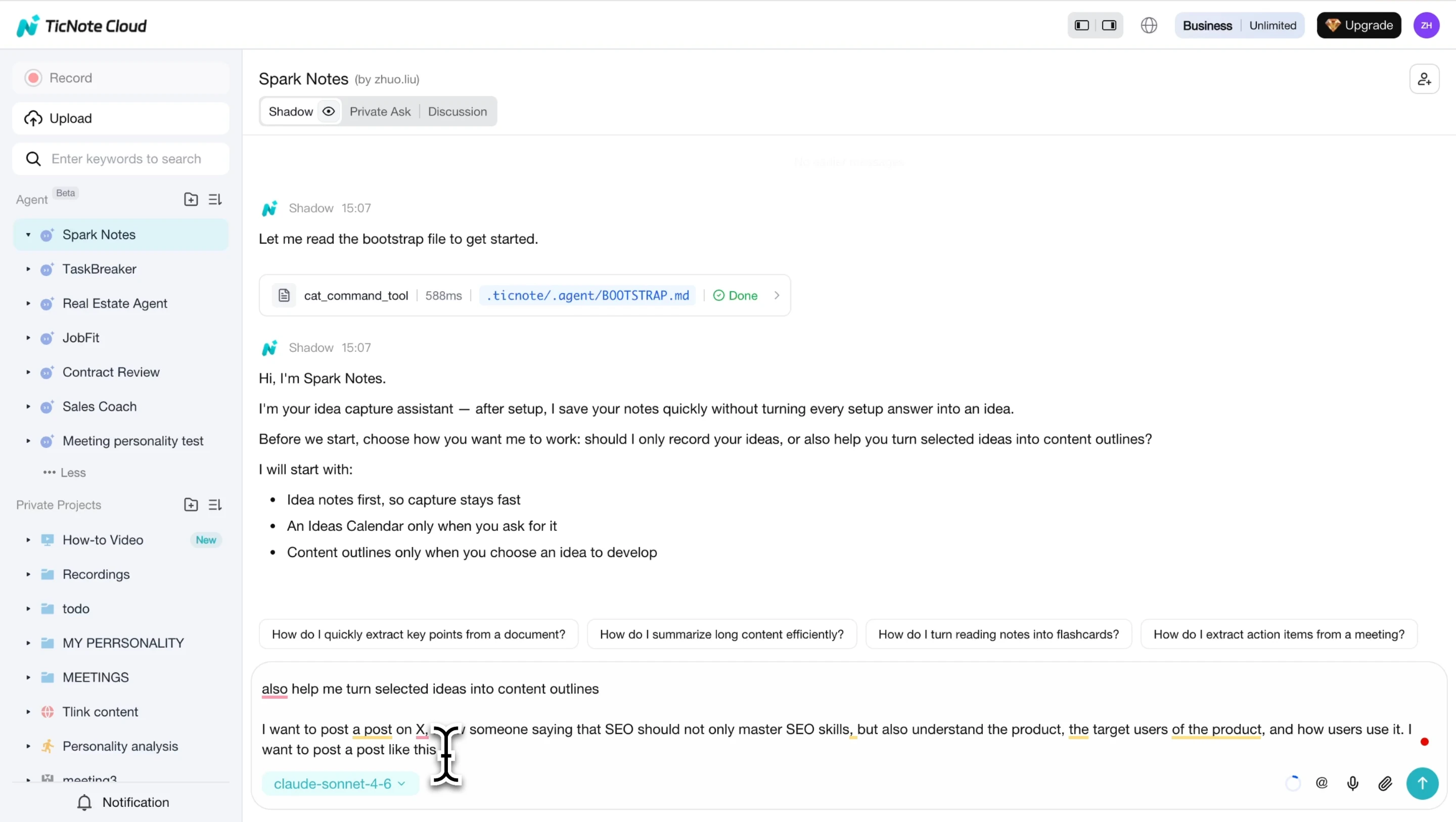
You don't need to organize anything manually. The skill learns your content pillars and tone from conversation, no setup forms, no tagging required.
Step 3. Browse your calendar and develop ideas into outlines
Open the Ideas Calendar to see all your content organized by date and pillar with color-coded chips. Click any day to view every idea in full. When you're ready to develop one, tell the skill, it generates a full content outline with hook, core argument, key points, supporting material, and CTA, adapted to your platform (LinkedIn, newsletter, blog, or any format you specify). If you want to go further and break the outline into executable tasks, this guide to structured task breakdown walks through how to decompose any deliverable into actionable steps.
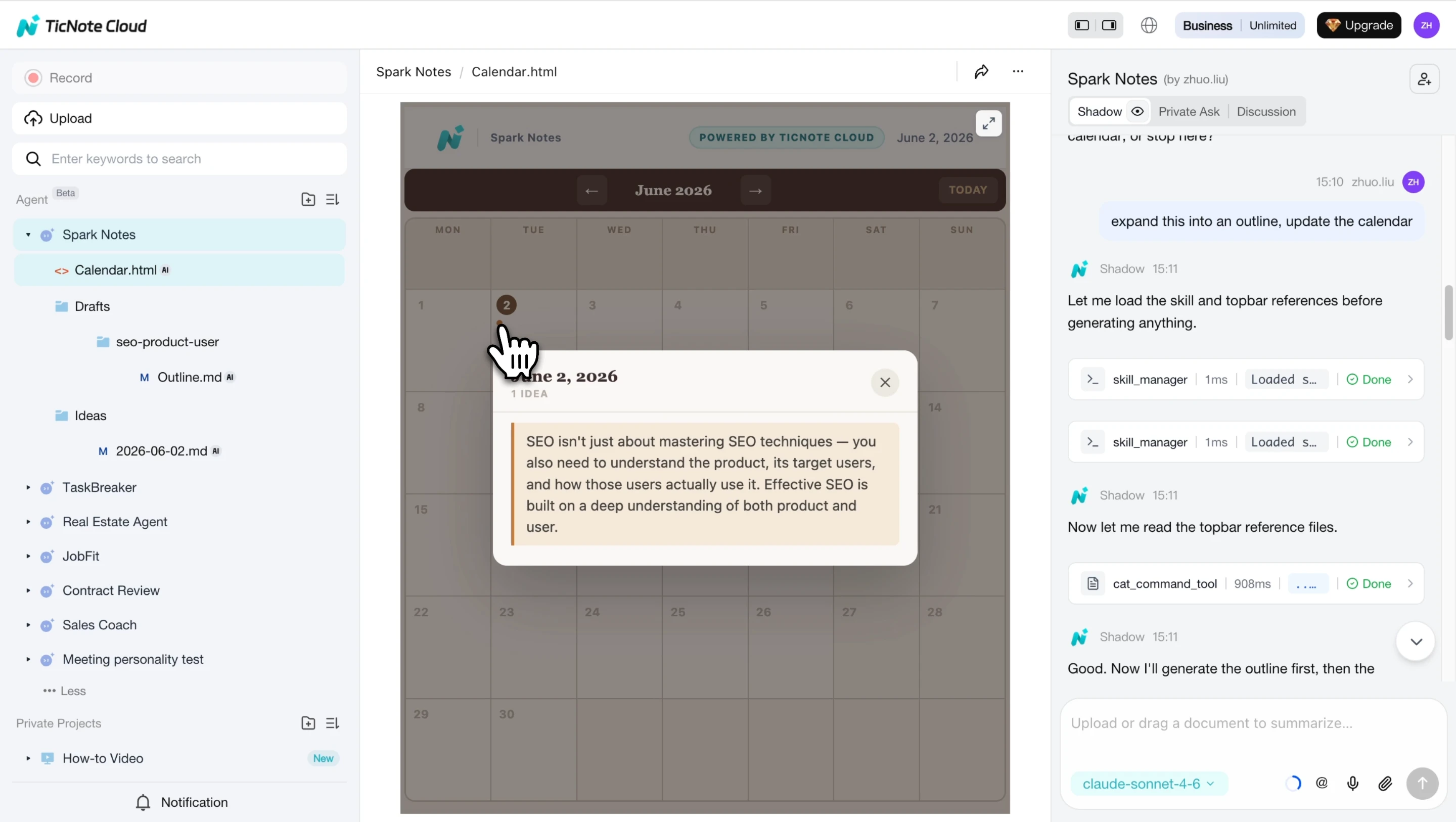
The outline saves as both a Markdown file and a clean HTML reading view, ready to share, present, or write from directly.
Conclusion
Consistent content creation comes down to two habits: generating sparks on demand and capturing them before they disappear. The seven methods in this guide give you reliable triggers, social listening, keyword gaps, repurposed content, cross-industry trends, audience interviews, a swipe file, and timed brainstorms. But methods alone aren't enough if the ideas vanish before you act on them.
A frictionless capture system closes that gap. When every spark goes somewhere the moment it surfaces, organized automatically and ready to develop, you stop losing your best ideas to timing and start building a pipeline that compounds over time.
Try TicNote Cloud free and capture your first content idea in seconds.