


 Extension

TL;DR
Task breakdown converts a vague project scope into a tree of concrete, assignable work packages using a method called Work Breakdown Structure (WBS). Start with the final deliverable, split it into phases, keep decomposing until every task is owned by one person and takes two days or less, and you have a breakdown ready to schedule. Skip this step and you risk scope creep, blown estimates, and missed handoffs. This guide walks through the full 6-step method, a real example, and the most common mistakes teams make.
Try TicNote Cloud for Free -- turn your PRD into sprint-ready issues in minutes.
Most teams lose hours turning a PRD into actionable issues -- and still end up with tasks that are too vague to estimate. Without a structured breakdown, engineers guess at scope and PMs spend sprint planning arguing over what's actually in or out. TicNote Cloud's TaskBreaker Skill Agent reads your product document and generates a complete, sprint-ready issue list in minutes -- ambiguities flagged, acceptance criteria included.
What Is Task Breakdown -- and Why It Comes Before Everything Else
Task breakdown is the process of dividing a project into smaller, manageable components until every piece of work is specific enough to estimate, assign, and track. The formal version is called a Work Breakdown Structure (WBS): a hierarchical decomposition of the total scope of work into deliverables and work packages.
The WBS 100% rule is the core principle: the WBS must capture 100% of the project scope -- no more, no less. Every deliverable, sub-deliverable, and work package must roll up to the project level, and nothing outside the scope should appear in the tree. This rule prevents both scope gaps (work that gets forgotten) and scope bloat (work that was never agreed to).
According to PMI's PMBOK Guide, a well-structured WBS is the foundation for every other planning activity: scheduling, budgeting, risk assessment, and resource allocation all depend on it. Without a complete breakdown, your Gantt chart is built on guesswork and your sprint planning is a negotiation over unknowns.
The practical payoff is clarity. When a developer asks "what exactly am I building?", the WBS is the answer. When a stakeholder asks "will this be done by Friday?", the WBS is what lets you say yes or no with confidence.
How to Do Task Breakdown in 6 Steps
A reliable task breakdown follows the same structure every time: start at the top with the final deliverable, decompose down level by level, and stop only when each task is small enough to own, estimate, and track.
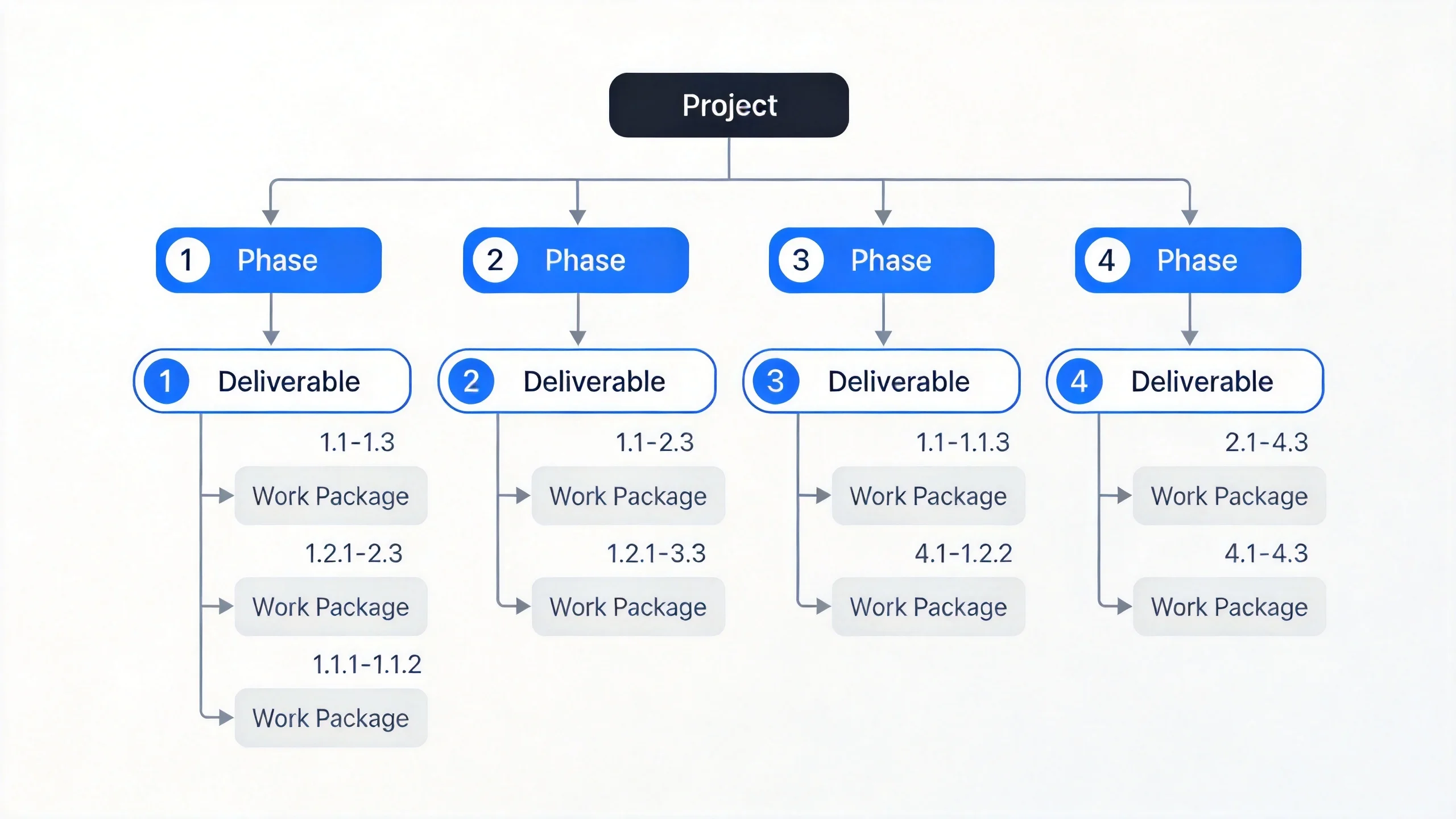
Step 1: Define the project scope in one sentence. Before you break anything down, write the project deliverable as a single, outcome-focused sentence. "Launch onboarding feature for mobile app by Q3" is good. "Work on the app" is not. Everything you decompose must trace back to this sentence.
Step 2: Identify the top-level phases or deliverables. Divide the scope into 3-6 major components -- typically phases (Discovery, Design, Build, Test, Launch) or major deliverables (API, Frontend, Data Layer). These become Level 1 nodes in your WBS.
Step 3: Decompose each phase into sub-deliverables. For each Level 1 node, ask: "What are the distinct outputs I need to produce this?" Each answer becomes a Level 2 node. Keep these deliverable-focused, not activity-focused -- "API documentation" not "write the docs."
Step 4: Break sub-deliverables into work packages. A work package is the lowest level of the WBS -- a unit of work with a clear output, a single owner, and an estimable duration. A common rule: if it takes more than two working days, break it down further.
Step 5: Assign owners and estimates. Every work package gets one owner (not a team) and a time estimate. If you cannot assign an owner, the scope is still too vague. If you cannot estimate it, it is still too large.
Step 6: Validate the 100% rule. Sum the scope of all work packages and check that they cover -- and do not exceed -- the original project deliverable. Any gap is a missing work package. Any excess is scope that needs approval or removal.
For teams that run sprints, this breakdown maps directly to your sprint backlog. Each work package becomes an issue. For a deeper look at how to structure your research before decomposition, see How to Perform Competitor Analysis: A Repeatable Scorecard Workflow That Turns Research Into Actions.
Seeing It in Action: A Task Breakdown Example
Abstract steps become clear fast with a concrete example. Take a common scenario: a product team needs to launch a new user onboarding feature.
Level 0 -- Project: Launch User Onboarding Feature
Level 1 -- Phases:
- Discovery
- Design
- Build
- Test + Launch
Level 2 -- Sub-deliverables (Build phase):
- Welcome screen
- Progress tracker component
- Onboarding API endpoints
- Analytics events
Level 3 -- Work packages (Welcome screen):
- Design mockup (0.5 day, Designer)
- Frontend implementation (1 day, Frontend Dev)
- Copy finalization (0.5 day, Product)
- QA sign-off (0.5 day, QA)
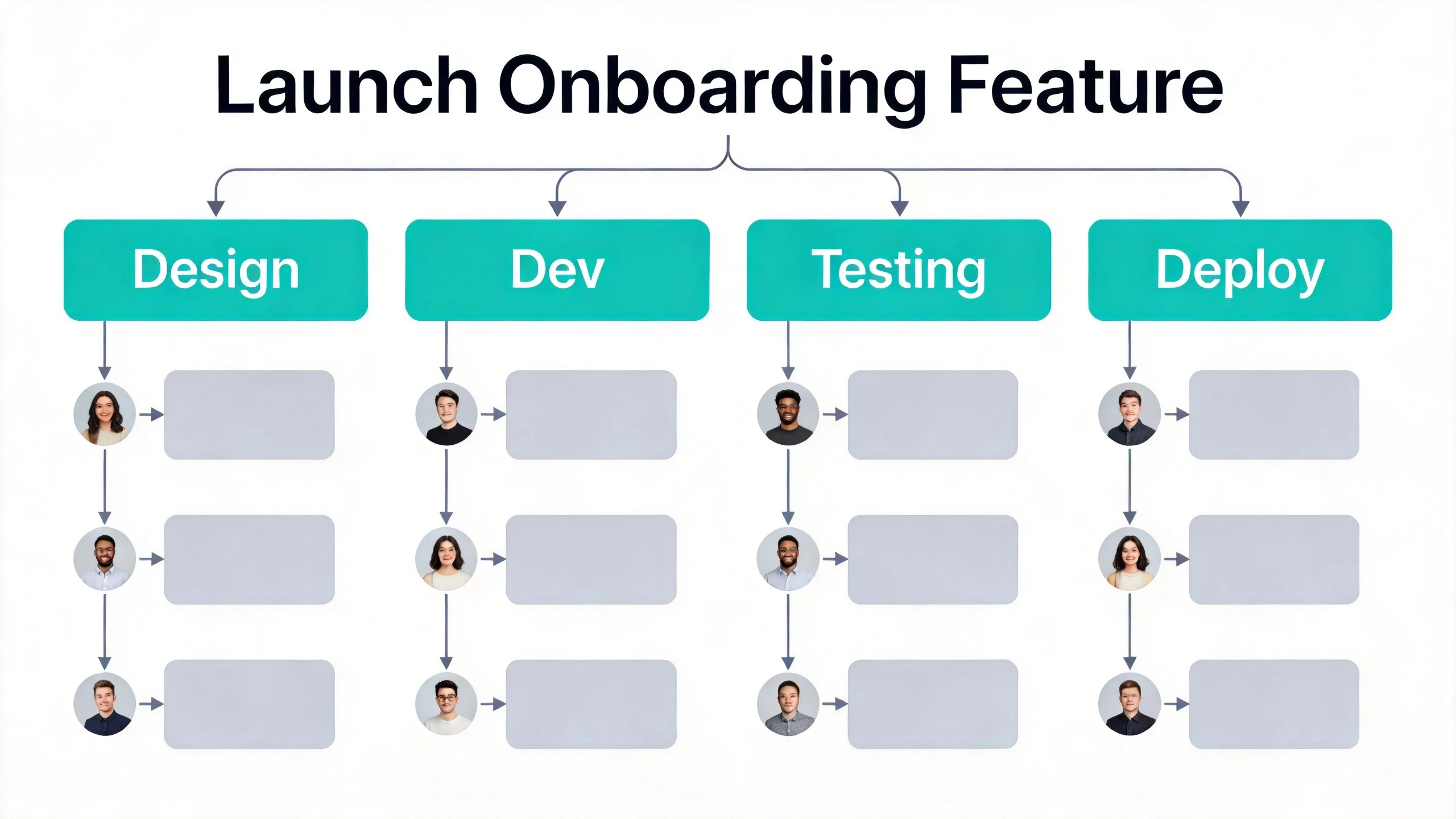
Notice the pattern: each work package has a clear output ("QA sign-off"), a single owner (QA), and an estimate (0.5 day). There is no ambiguity about what "done" looks like. The full breakdown for this feature would produce 20-30 work packages -- a sprint backlog that's ready to import.
| LevelNodeOwnerEst. | |||
| 1 | Discovery | Product | 3 days |
| 1 | Design | Designer | 4 days |
| 1 | Build | Dev team | 10 days |
| 1 | Test + Launch | QA + PM | 3 days |
Benefits of Task Breakdown for Project Teams
Teams that skip the breakdown phase tend to discover the cost late -- in missed deadlines, rework, and sprint planning arguments. Teams that do it well gain four compounding advantages:
- Better estimates. Estimation accuracy improves significantly when scope is decomposed to the work-package level. PMI's Pulse of the Profession (2021) found that organizations with mature project management practices -- including structured decomposition -- waste 28 times less money than their low-maturity counterparts. Vague scope is the root cause of most estimate failures.
- Scope creep prevention. The WBS 100% rule creates a forcing function: any new request has to be explicitly added to the breakdown and re-estimated. Without this structure, scope expands by default. PMI data shows scope creep affects approximately 52% of projects, and in most cases the cause is a scope that was never fully defined at the start.
- Cleaner handoffs. When every work package has one owner and a clear output, handoffs stop being verbal and start being trackable. "Who's responsible for the API docs?" becomes a lookup, not a meeting.
- Faster sprint planning. A complete breakdown converts directly into sprint backlog items. Instead of spending half your planning session arguing about whether something is in scope, you spend it prioritizing.
For a practical list of tools that support structured planning workflows, see Best Free Competitor Analysis Tools - Ready out of the Box.
How to Use a Skill Agent to Automate Task Breakdown
The 6-step method above is effective. It's also manual, which means it takes time and depends on the PM getting every sub-deliverable right from memory. A Skill Agent changes that.
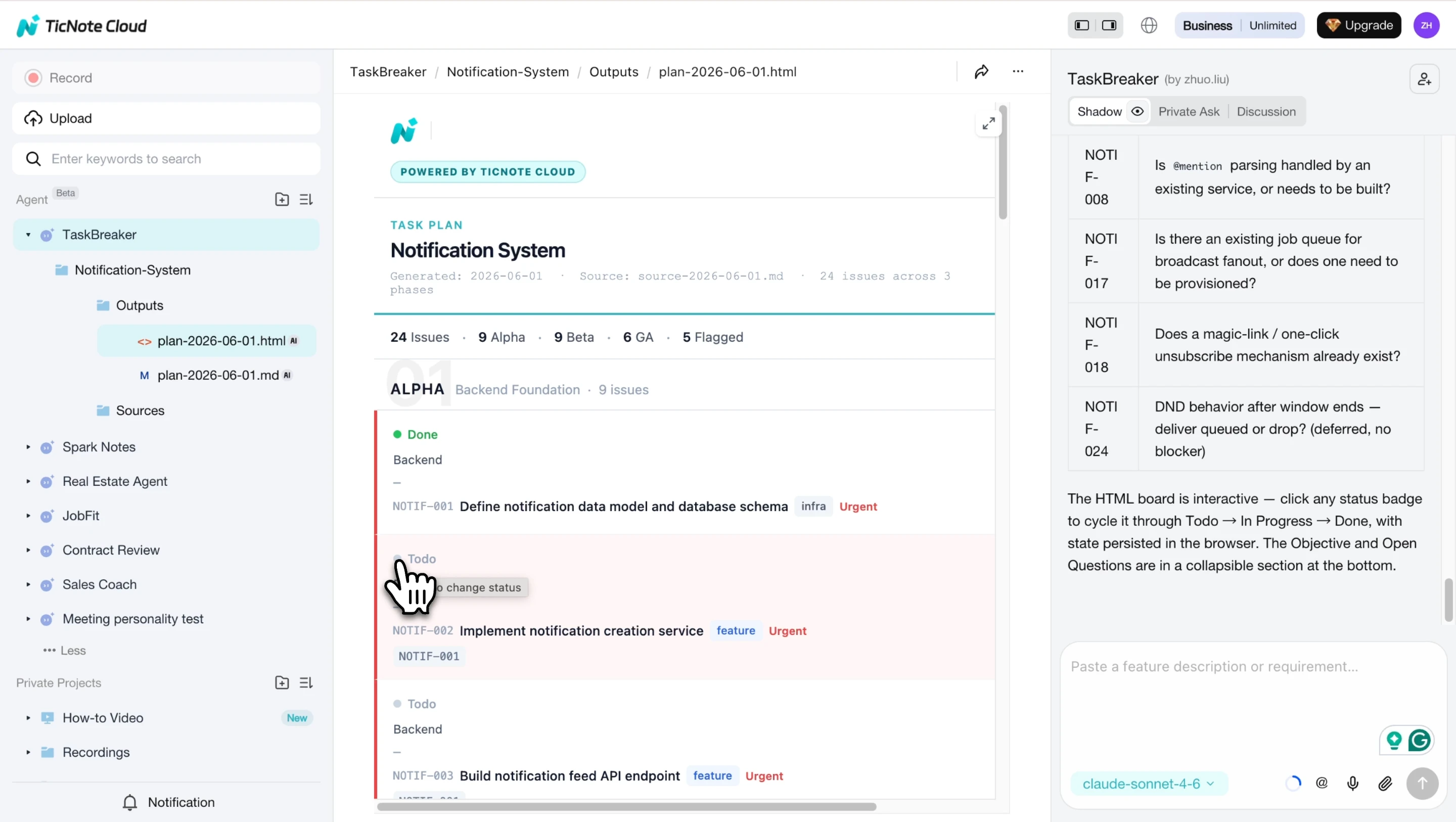
TicNote Cloud's TaskBreaker Skill Agent reads your PRD, feature spec, meeting notes, or audio recording and produces a complete, structured project plan -- every requirement broken into sprint-sized issues with titles, descriptions, testable acceptance criteria, labels, priorities, phases, and dependency mapping. It flags ambiguities before they reach engineering. The output is a Markdown plan file and CSV ready to import into Jira, Linear, or GitHub Issues.
Here is how to use it:
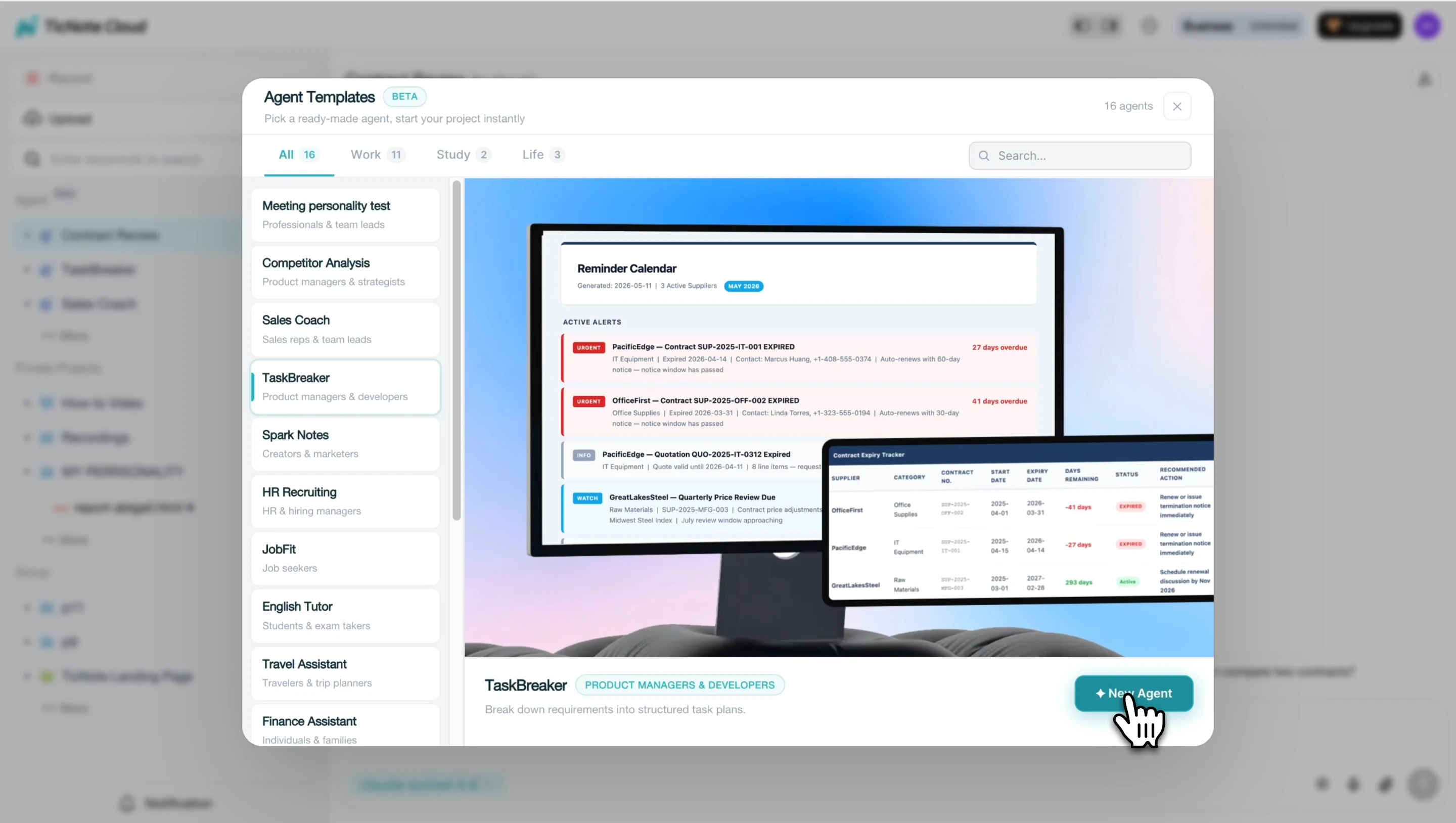
Step 1: Add the TaskBreaker skill agent on TicNote Cloud
In TicNote Cloud, click Add Agent and browse the Skill Agent library. Select the TaskBreaker skill to add it to your workspace -- no configuration required.
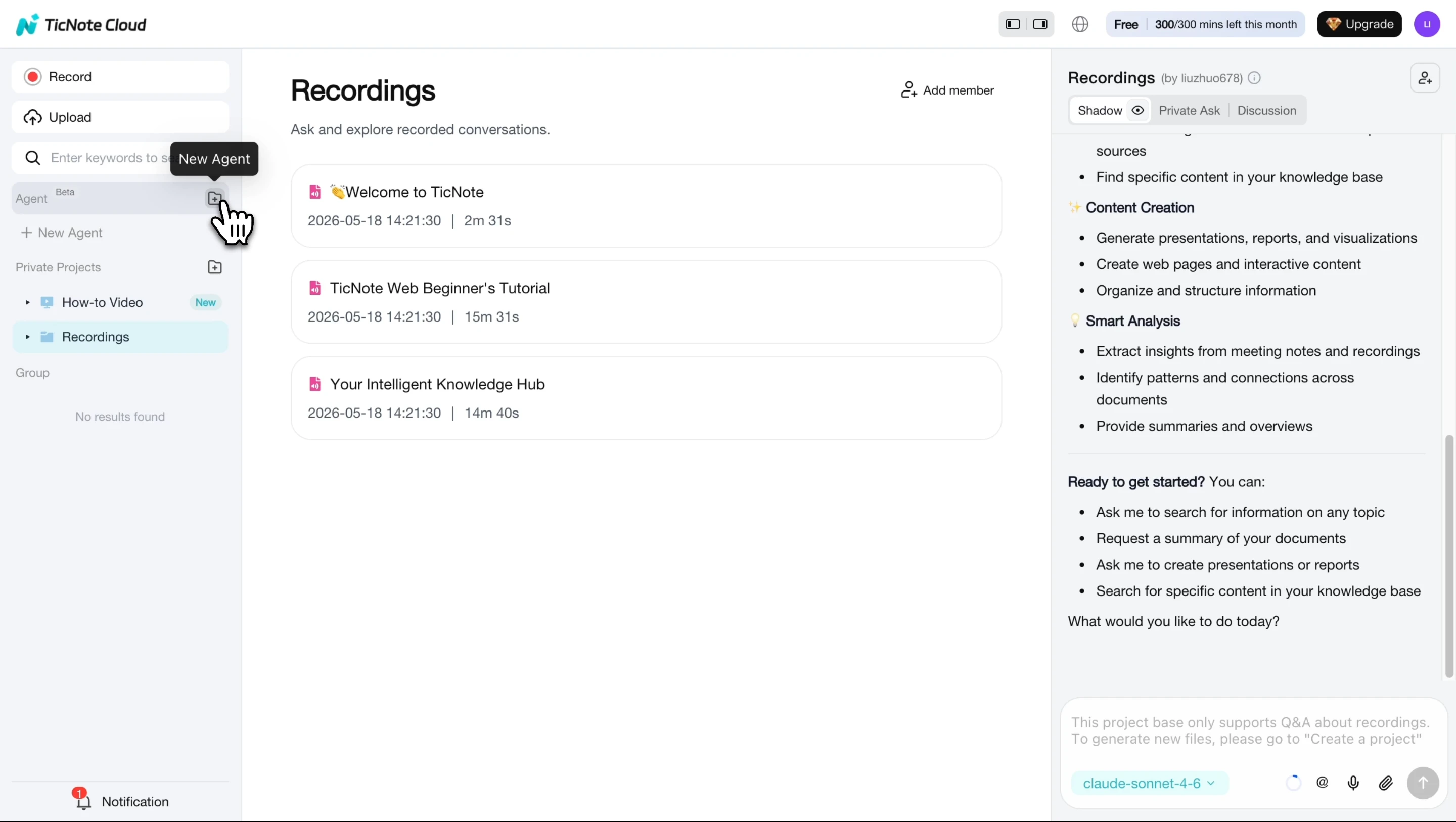
Once added, the skill agent appears in your agent list and is ready to use immediately.
Step 2: Paste or upload your product document
Provide a PRD, feature spec, meeting transcript, or audio recording. The agent reads the full document and returns a structured project summary -- objective, scope in/out, team roles, proposed milestones, and any open questions it identified -- for your confirmation before generating the plan.
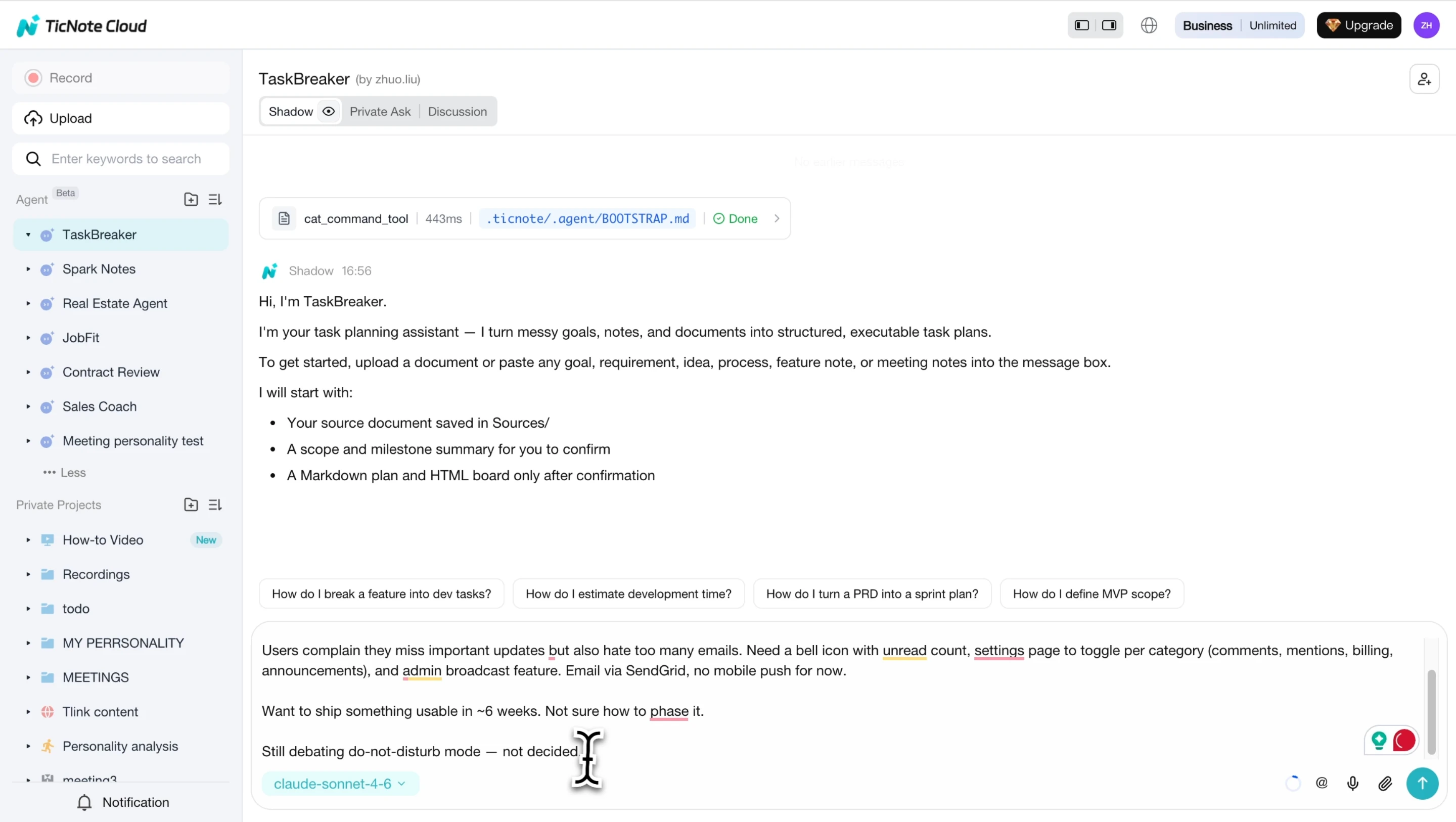
Step 3: Review and import your project plan
After you confirm the summary, the agent surfaces any open questions it identified -- answer them in the chat so the plan reflects your actual decisions before anything is generated.
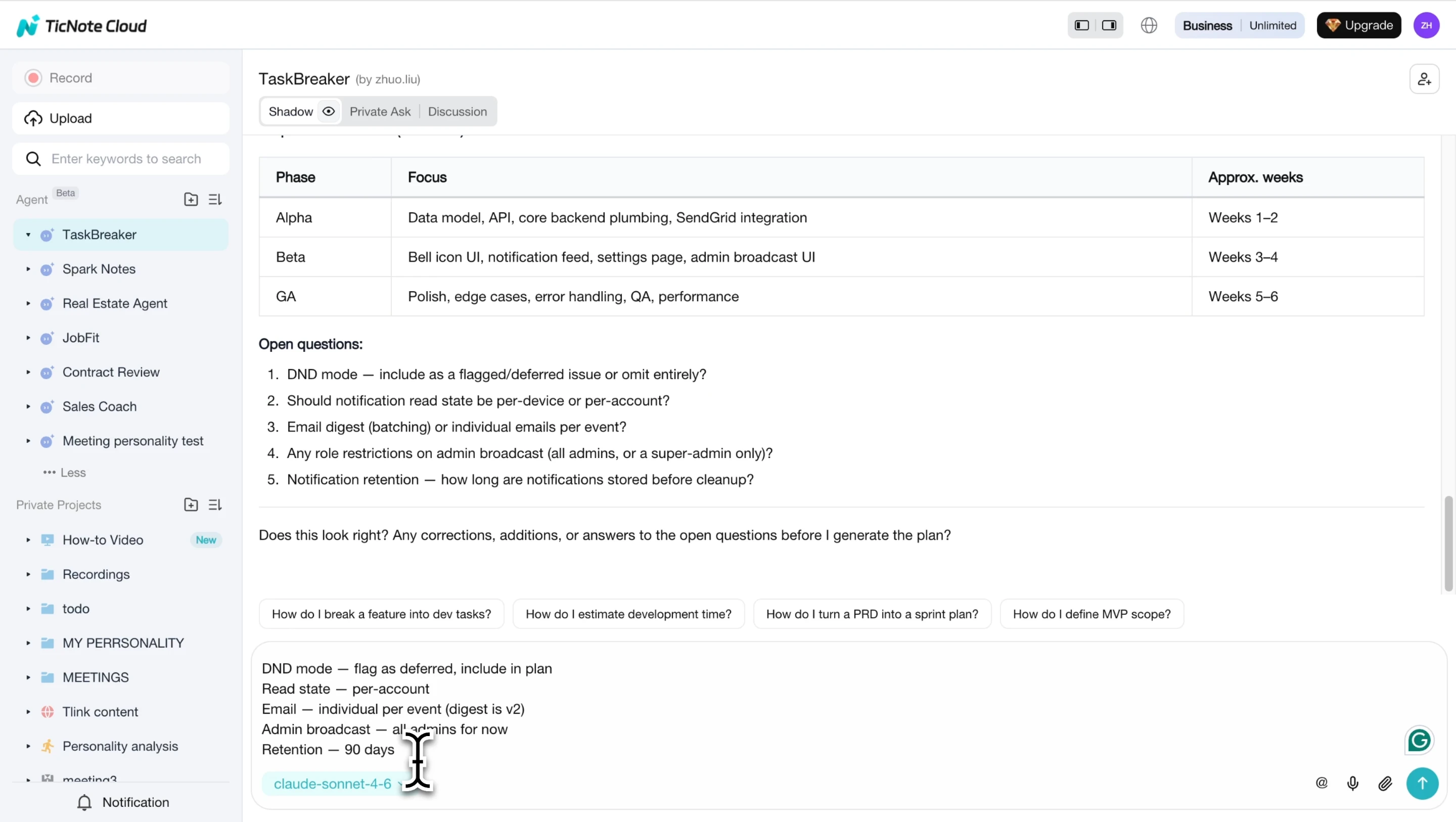
The plan also comes with an interactive HTML board where you can track progress across phases -- move issues between status columns as work gets done.
For more on how Skill Agents handle structured research and analysis workflows, see Competitor Analysis Example: Copy-Ready Templates, Scoring, and an Actionable Report Blueprint.
Try TicNote Cloud for Free -- turn your PRD into sprint-ready issues in minutes.
Common Task Breakdown Mistakes and How to Avoid Them
Even experienced teams make the same three mistakes. Knowing them in advance cuts the rework.
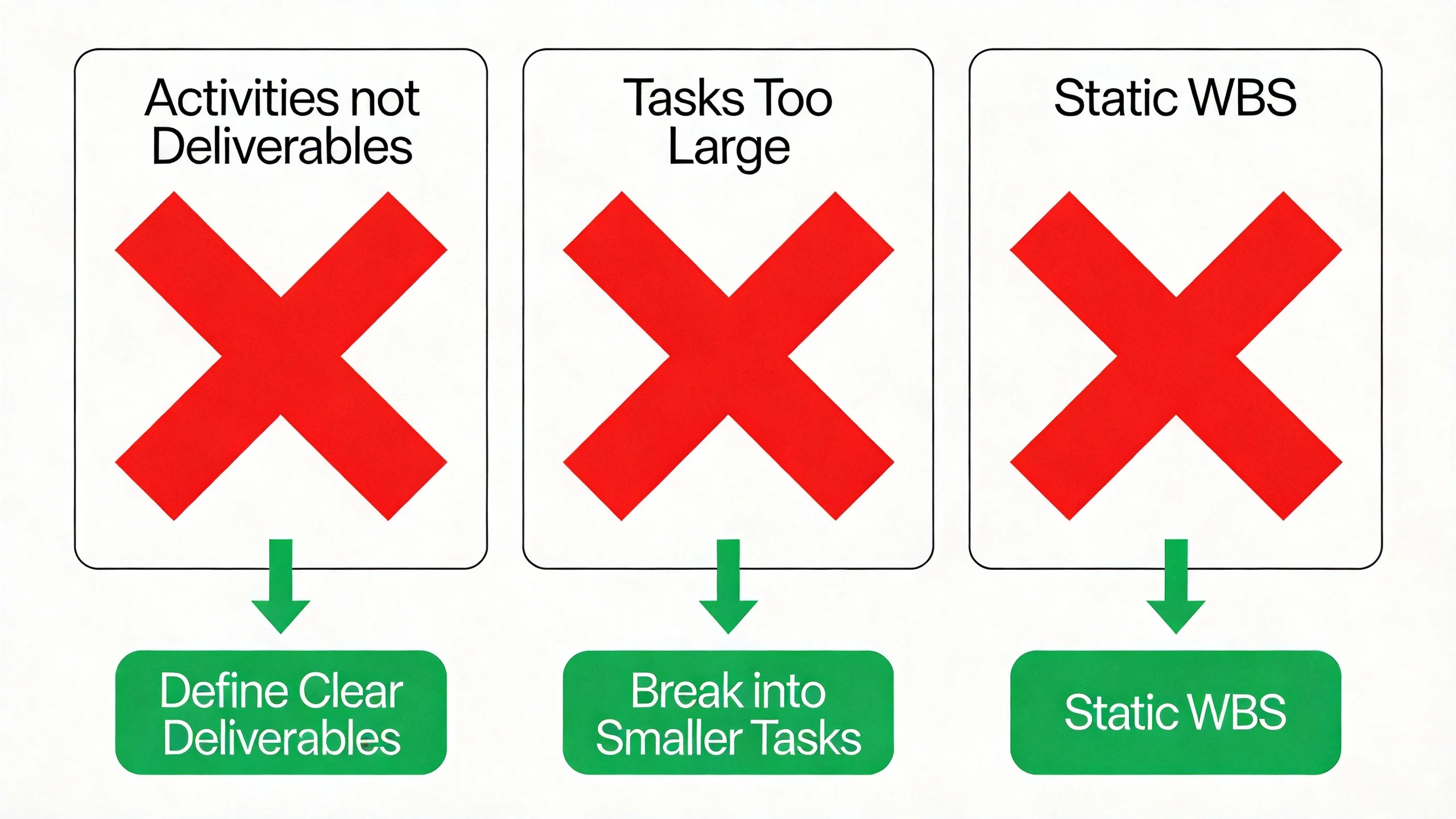
Mistake 1: Listing activities instead of deliverables. The most common error. "Write API documentation" is an activity. "API documentation (v1, published)" is a deliverable. WBS nodes must be deliverables -- outputs you can verify -- not actions. Activities belong in your schedule, not your breakdown structure.
Mistake 2: Work packages that are too large. A work package that takes two weeks cannot be tracked or estimated reliably. When something slips by a day in week one, you find out in week two. The two-day rule exists for a reason: small packages surface problems early.
Mistake 3: Treating the WBS as static. Projects change. Scope gets added, requirements shift, and technical constraints surface. A WBS that was correct at project kickoff may be wrong by sprint three. Build in a review cadence -- at the start of each sprint or phase -- and update the breakdown to match reality. PMI's research on scope creep identifies the failure to update project baselines as one of the top five causes of project overruns.
For a practical checklist approach to structured review workflows, see Contract Review Checklist: A Risk-First Workflow for Faster, Safer Sign-Offs.
Conclusion
Task breakdown is the difference between a project plan and a project guess. The 6-step WBS method gives you a repeatable way to turn any scope -- no matter how vague -- into a tree of owned, estimable, trackable work packages. Add the 100% rule as your validation step and you have a planning foundation that holds up through sprints, stakeholder changes, and scope additions.
For teams that want to get from PRD to sprint backlog without the manual decomposition work, TicNote Cloud's TaskBreaker Skill Agent automates the entire process. Paste your product document, confirm the project summary, and get a complete issue list ready to import. Start breaking down your next project today.