


 Extension
TL;DR: A reliable book-summarizer workflow in 7 steps
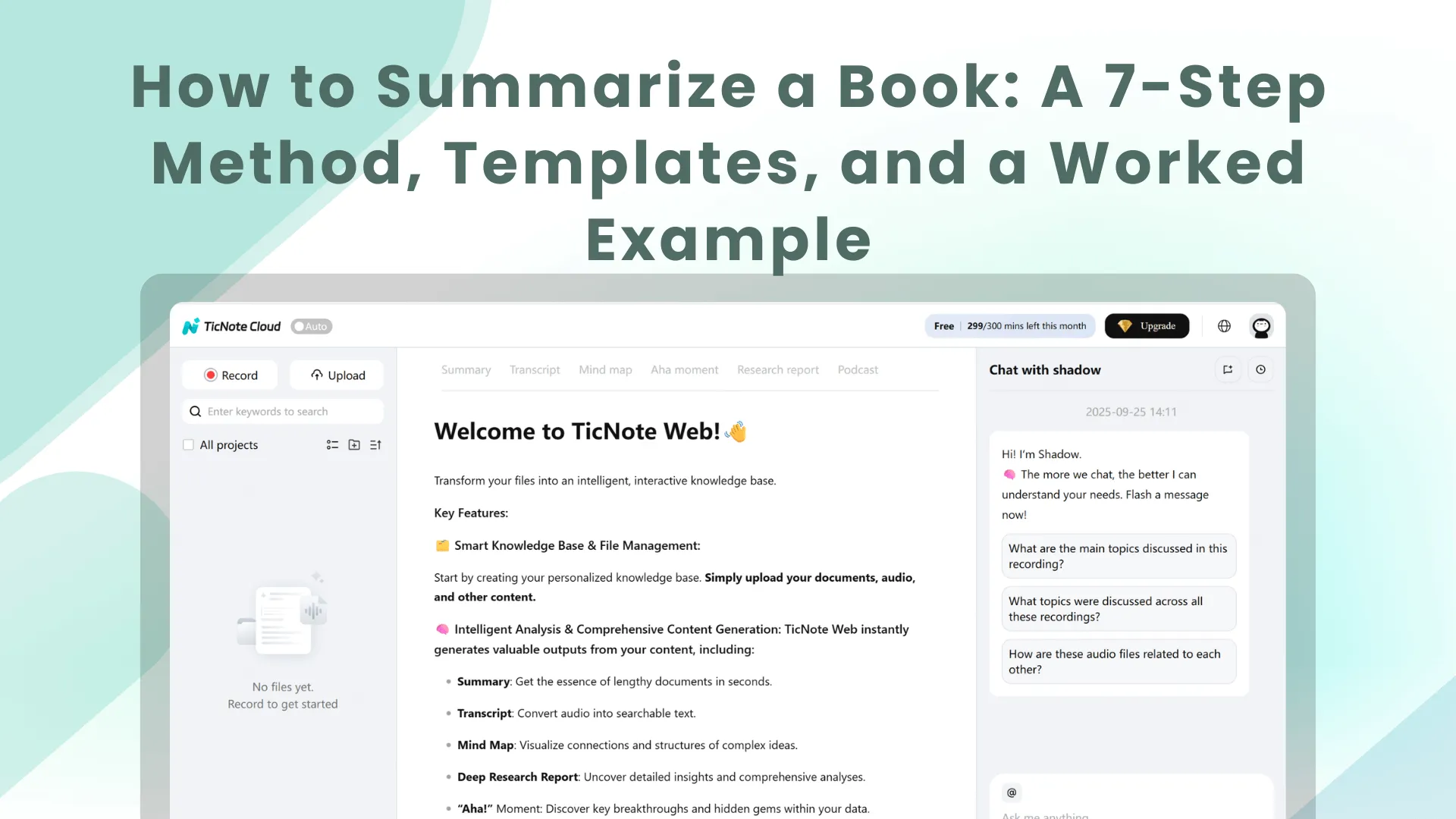
If you want a faster, repeatable way to summarize a book, start by collecting clean notes and (optionally) organizing them in TicNote Cloud so your outline and final summary stay grounded.
It's easy to lose the main point when your notes are scattered. Then your "summary" turns into quotes, hot takes, or plot-by-plot retelling. A simple fix is to use TicNote Cloud to store your excerpts and notes in one place, then draft from an outline.
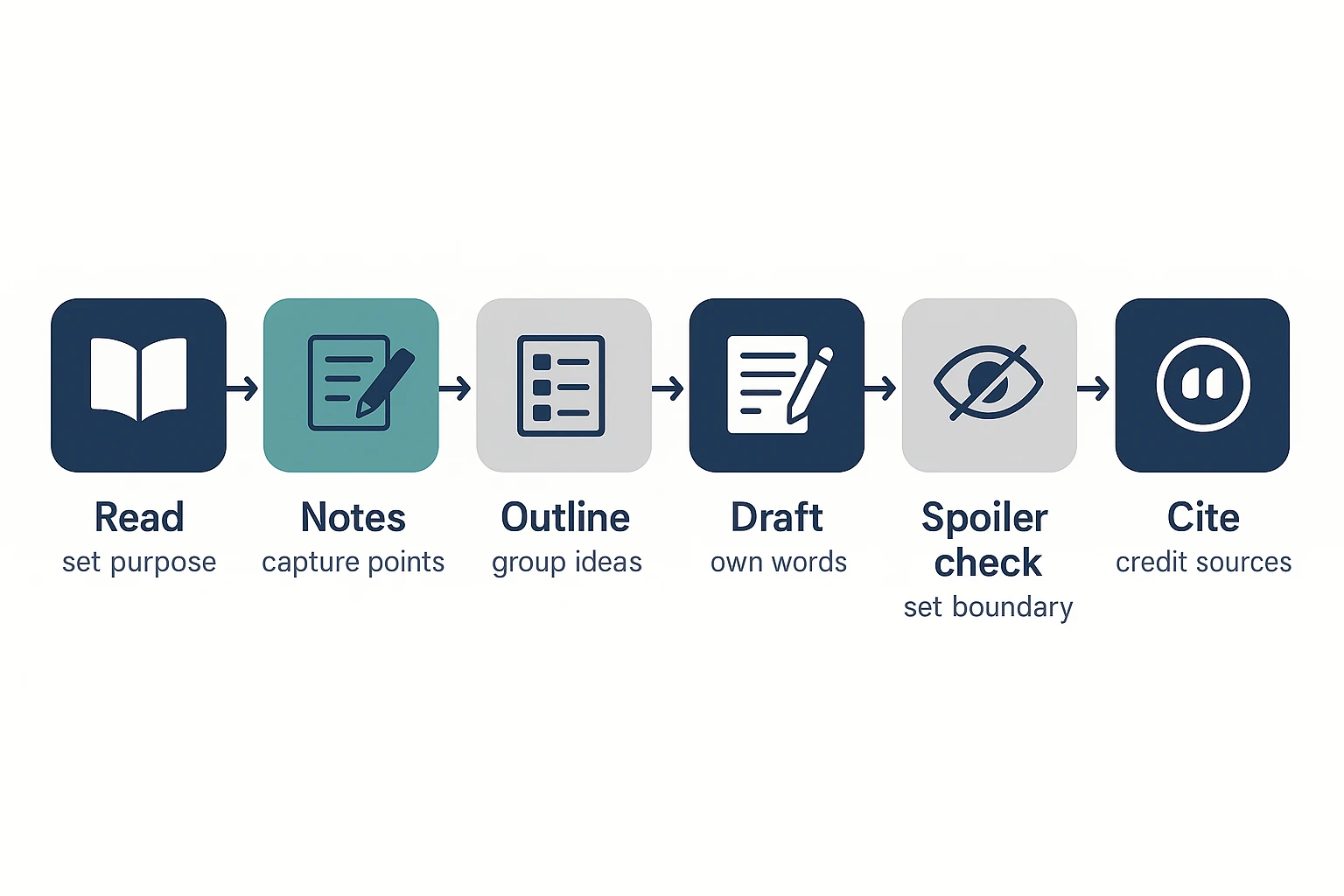
- Read with a purpose: you can't summarize what you didn't track. 2) Take lean notes: notes stop memory drift. 3) Group notes by idea: grouping shows what matters most. 4) Build an outline: it prevents rambling. 5) Draft in your own words: it keeps it objective. 6) Tighten: it cuts side plots and repeats. 7) Spoiler check + cite: it protects readers and integrity. Reminder: work from your own notes or short excerpts, and don't paste or share full copyrighted text.
Quick length targets: 75 to 150 words (short recap) for quick refresh; 250 to 500 words (standard class or book club) for clear discussion; 1 to 2 pages (executive-style) for decisions and takeaways. Match the rubric, audience, and whether spoilers are allowed.
How to summarize a book without missing the main point
If you're learning how to summarize a book, the goal isn't to shrink every page. It's to capture the book's core message or story arc so someone else can understand it fast, and accurately.
What a book summary is (and isn't)
A book summary is a short, neutral overview of what the book argues (nonfiction) or what happens (fiction). It should be clear enough that a reader could explain the book's central point after reading your summary.
What it's not:
- Not a chapter-by-chapter retelling
- Not a critique (what you liked or hated)
- Not a quote dump
- Not a place to add new claims the author didn't make
Summary vs. review vs. analysis (spot the difference fast)
These formats sound similar, but they do different jobs:
- Summary: What it says or what happens
- Review: What you thought about it
- Analysis: What it means, how it works, or why it matters
Quick rule: if you're writing "I think," "I felt," or "it was good," you're drifting into a review. If you're explaining symbolism, themes, or the author's technique, you're drifting into analysis. Pull back to facts.
What to include every time (a simple checklist)
No matter the genre, include these basics:
- Title and author
- The central point (or main conflict)
- 2 to 4 key supports or turning points
- The outcome or takeaway (in spoiler-safe terms)
Here's how it shifts by genre:
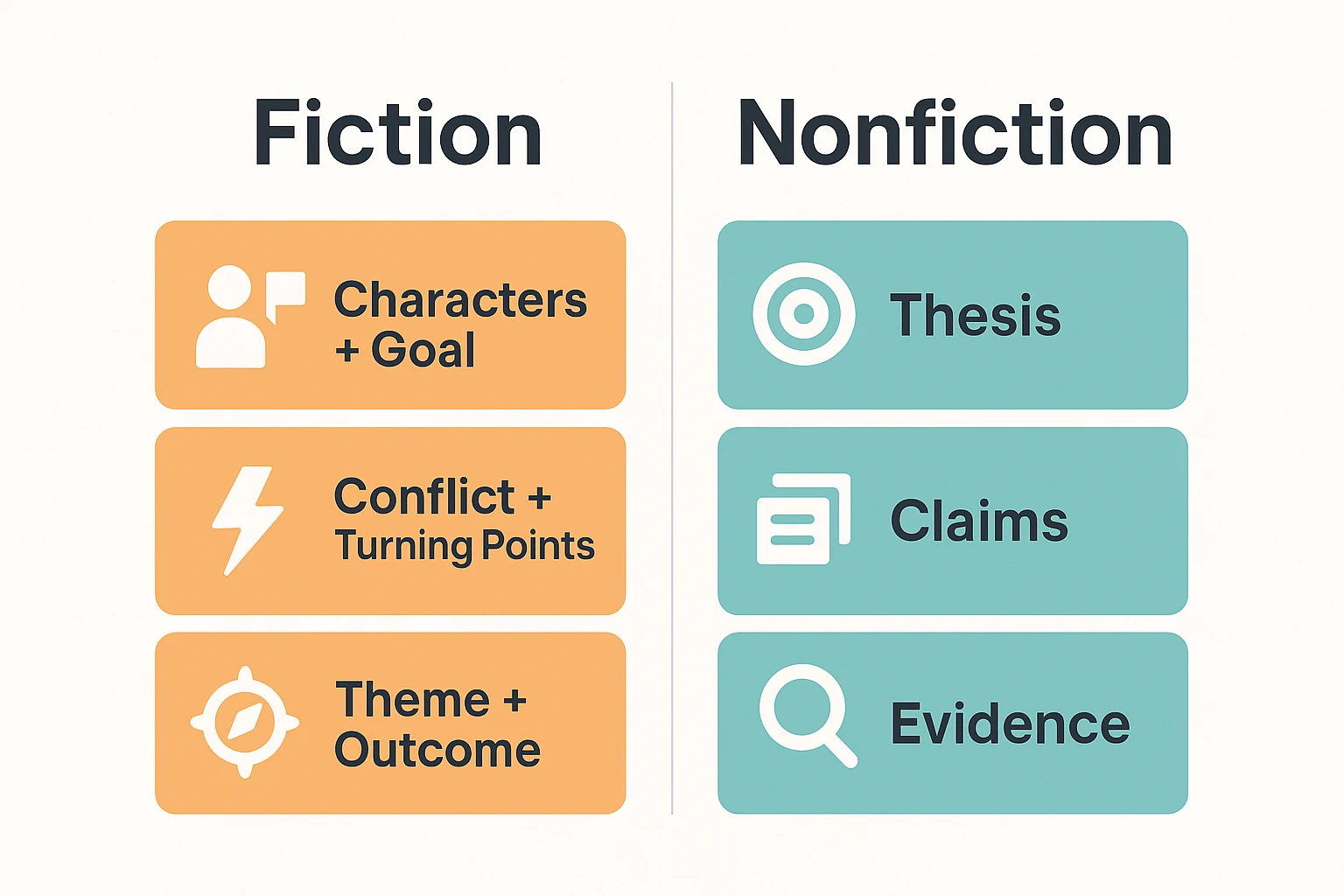
- Nonfiction: state the thesis, then the strongest supporting ideas, evidence, or examples
- Fiction: name the protagonist and core conflict, add key turning points, then describe the ending status without revealing twists, plus the big theme
Mini quality check: after reading your summary, could someone explain the book's point in one sentence? If not, you may have listed details instead of the main idea.
What should you do before you start writing the summary?
Before you draft, do three quick moves that make it easier to summarize a book without losing the main point. You'll spot the book's shape, capture clean chapter notes, and build a one-page outline while you read. That way, writing the final summary is mostly assembly, not guesswork.
Read for structure (find the book's "shape")
Start by mapping what kind of book you have.
- Fiction: beginning (setup), middle (pressure and turning points), end (resolution). Track the main conflict and the moments that change the character's goal.
- Nonfiction: thesis (main claim), then supporting claims, evidence (examples, studies, stories), and implications (so what, now what).
Quick signals help you find this fast: chapter titles, section headers, repeated terms, and recurring conflicts. If you read on Kindle or listen on audio, bookmark any moment where the author changes direction (new problem, new rule, new plan).
Take "chapter in 3 lines" notes as you go
After each chapter or major section, write three lines:
- What changed?
- Why does it matter?
- Key term or quote cue (a short phrase, not a full passage)
Add page numbers or locations so you can double-check details later. Keep notes paraphrase-first to lower the risk of accidental copying. If you need a quote, mark it clearly as a quote so it doesn't slip into your draft.
Build a one-page scratch outline while you read
As your chapter notes pile up, sort them into 3 to 5 buckets. For example: Setup, Key Turning Points, Outcome, Themes, Takeaways. Under each bucket, paste in your best "what changed" lines.
Keep a small parking lot list for fun details that don't serve the main point. Before you start drafting, do one checkpoint: can you state the thesis (nonfiction) or main conflict (fiction) in one clean sentence?
How do you turn notes into a clean outline that's easy to write from?
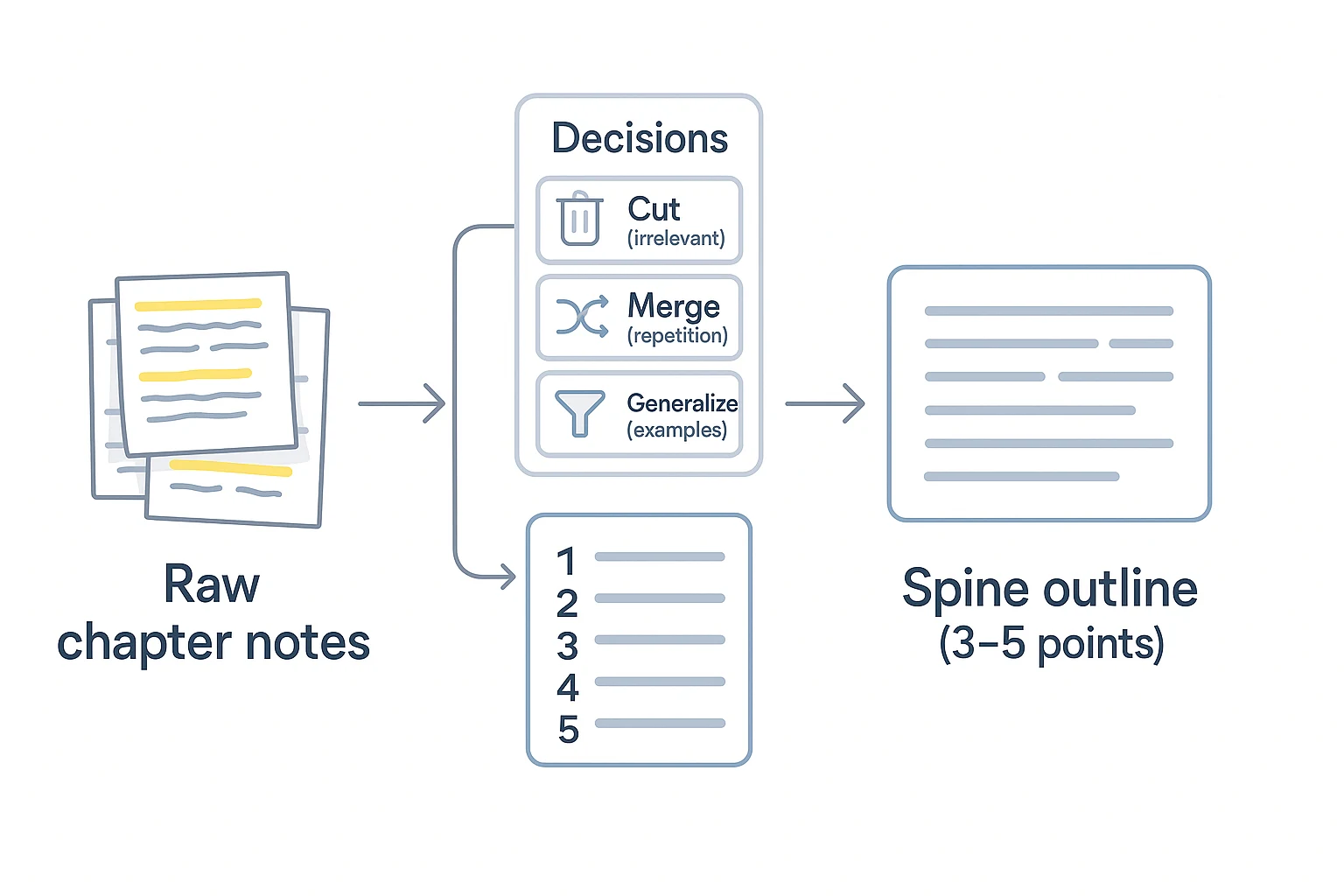
Your notes get easier to write from when you turn them into a short outline with a clear "spine" (the few points that still make sense in order). That spine becomes your map for how to summarize a book without drifting into random details or long quotes.
Build the "spine": the minimum story or argument
Think 3 to 5 main points. If you delete everything else, these beats should still explain the book.
- Fiction spine (beats): inciting incident, escalation, turning point, climax, resolution status
- Nonfiction spine (claims): thesis plus 3 to 5 main claims
- Give each claim 1 to 2 supports (a key fact, example, or reason)
If you also summarize articles, this same structure works well with a repeatable article summary workflow because it forces a main point plus proof.
Cut with two fast tests (and keep only "signature" specifics)
Use these filters on every note:
- Relevance test: Does this detail directly support the spine? If not, cut it.
- Repetition test: Did the author say this idea five ways? Merge it into one clean statement.
Keep specifics only when they earn their spot:
- Proper names only if they matter to the spine
- One signature example if it is the author's key proof
Choose the best order: chronological or logical
- Fiction: usually chronological (what happens next)
- Nonfiction: often logical (problem, framework, evidence, implications)
A simple nonfiction outline pattern is:
- Claim (what the author says)
- Evidence (how they support it)
- Takeaway (why it matters)
Here's the handoff to drafting: each bullet becomes one sentence in your first draft. Then you can combine sentences into a tight paragraph.
Try TicNote Cloud for Free to turn your notes into an outline you can draft from.
Worked example: notes → outline → first draft → final 1–2 paragraph summary
Here's a complete, copyable pattern you can use when you want to summarize a book without getting lost. To keep it clean and legal, we'll use an original "mini-book" with three short chapters. You'll see messy notes turn into an outline, then a draft, then a tight 1 to 2 paragraph summary.
1) Sample raw notes (3 short "chapters")
Mini-book title (fictional): The Quiet Ledger
Chapter 1 notes (rough):
- Main setup: Mira starts at Port Relay Library, a city archive.
- The "quiet rule" is strict. People whisper like it's a law.
- She finds an old ledger with missing pages.
- Repeated idea: "Records keep power." (I wrote this twice.)
- Small detail: librarian Jae taps the desk three times before speaking.
- Quote placeholder: "Nothing in here is neutral." (Ch.1, p. 14)
- Conflict hint: The mayor's office funds the archive.
Chapter 2 notes (rough):
- Mira asks questions. Jae warns her to stop digging.
- She learns that edits were made to public records.
- A side scene: Mira watches a parade and notices posters with the same slogan.
- The ledger points to a "blackout week" in the city.
- Quote placeholder: "A missing page is still a message." (Ch.2, p. 63)
- Repeated point: Archive staff are scared of being blamed.
- Extra example: a birth record changed. A permit "never existed."
Chapter 3 notes (rough):
- Mira meets an ex-clerk who kept private copies.
- Turning point: Mira decides to publish a short public report.
- The mayor's aide offers her a promotion if she drops it.
- Ending status: She doesn't fix everything, but starts a public review.
- Loose end: Jae's motive is unclear. Was he protecting people or himself?
- Quote placeholder: "Truth isn't loud, but it spreads." (Ch.3, p. 112)
What these notes capture (the minimum you need):
- Main conflict: a new archivist finds signs of record tampering.
- 2 to 3 turning points: missing pages, proof of edits, decision to publish.
- Ending status: starts accountability, no neat wrap-up.
2) Outline built from the notes (spine method)
Summary purpose: Book club recap (spoiler-safe, focus on premise and arc).
- Spine: Who, where, and what changes
- Mira starts work at a city archive.
- She finds a ledger with missing pages.
- She uncovers evidence of altered records.
- She chooses to go public.
- Key supports (keep it to 2 or 3)
- The archive depends on the mayor's funding.
- Staff fear consequences.
- An ex-clerk has backup copies.
- End state (no twist details)
- She triggers a public review and wider scrutiny.
Cuts and merges (so the summary stays tight):
- Cut: parade scene, desk-tapping habit, most slogan/poster detail.
- Merge: "birth record changed" and "permit never existed" into "everyday records were edited."
- Cut: long quote text. Keep only short, labeled placeholders in notes.
3) First draft (too long on purpose)
Mira begins her new job at the Port Relay Library archive, where everyone treats silence like a strict rule and the staff act nervous. She meets Jae, a librarian who seems careful and kind but also strange, and she notices lots of little rituals and habits that make the place feel controlled. Soon, Mira finds a ledger with missing pages, and she starts to suspect something is wrong with the city's records because the mayor's office funds the archive and that seems like a conflict.
As Mira keeps digging, she asks Jae and others questions, but they warn her to stop, which makes her more determined. She notices public messaging around the city and goes to a parade and sees posters and slogans that suggest the city wants one story. She finds signs that key records were edited, like birth records and permits, and that there was a "blackout week" that the ledger points to. She also hears the idea that records equal power many times, and it feels like the point is repeated. Later, Mira meets an ex-clerk who kept private copies, and this gives her enough proof to write a public report. The mayor's aide offers her a promotion if she drops it, but she refuses. In the end, she can't fix the whole system, and Jae's motives remain unclear, but her report starts a public review.
Common draft problems to notice: too many small scenes, repeated claims, and extra names. Also, keep the summary in your own words. Don't paste long passages from the book.
4) Tightened final summary (with quick edit notes)
The Quiet Ledger follows Mira, a new archivist in the city of Port Relay, who discovers a ledger with missing pages and starts to question what the public record leaves out. As she investigates, she finds signs that everyday documents have been quietly edited, and she realizes the archive's political ties make truth hard to protect.
With help from a former clerk who saved private copies, Mira gathers enough evidence to share a public report. The story ends with scrutiny beginning to spread, not with every problem solved, as Mira chooses accountability over comfort.
What changed and why (quick edits):
- Cut minor characters and scenes so the main arc stays clear.
- Merged repeated examples into one sentence about "everyday documents."
- Generalized events (parade, posters) into "public messaging" so it stays spoiler-safe.
If you want to speed up the notes to outline step, tools like TicNote Cloud can help you turn your own notes and excerpts into a cleaner structure faster. The key is to keep it grounded in what you captured, not in text you didn't write or paste.
For a smaller scale version of this workflow, use these simple paragraph summary length rules to practice tightening before you summarize a full book.
How does summarizing fiction vs. nonfiction change your approach?
The core rule stays the same: be objective, lead with the central point, and only keep details that support it. But the "logic" changes. Fiction summaries follow story logic (who wants what, what blocks them, what changes). Nonfiction summaries follow argument logic (what the author claims, how they support it, what it means).
Summarize fiction by tracking change, not scenes
A clean fiction summary answers: who is the story about, what's the main problem, and what shifts.
Use this quick checklist:
- Protagonist and their goal
- Main conflict (person, society, nature, self)
- 3 to 5 turning points (events that change choices or stakes)
- Outcome status (resolved, unresolved, bittersweet)
- Theme (the big idea the story explores)
Subplots belong only when they reshape the main conflict or theme. If a subplot is fun but "optional," cut it.
Spoiler-safe option: name the stakes, not the twist. For example: "A late reveal forces her to rethink who to trust," instead of explaining the reveal.
Summarize nonfiction by mapping the author's argument
For nonfiction, you're not retelling. You're compressing an idea.
A reliable structure:
- Thesis in one sentence
- 3 main claims (the author's key points)
- Signature evidence or examples (only the strongest)
- Limits or counterarguments (if the book addresses them)
When method matters (research-based books), mention it at a high level: interviews, case studies, surveys, experiments. Don't list every dataset or chapter.
Summarize biographies and memoirs as a life arc plus a lens
Think "milestones plus meaning." Outline the life arc in 3 to 5 turning points (early life, a break, a crisis, a pivot, where they end up).
Then add the author's lens: what the memoir is trying to show, defend, or understand. Keep your opinion separate from events as presented in the book.
How long should a book summary be for different situations? (With templates)
The right length depends on why you're writing it. A short blurb helps you share a book fast. A mid-length recap fits class or book club. A longer executive summary supports decisions and next steps.
50 to 100 words: teaser or blurb
Use this for a quick share, a reading list, or personal notes.
Template (copy and fill in):
- Title (Author): [________]
- Premise or thesis (1 sentence): [Who/what is it about, and what's the big idea?]
- Stakes or value (1 sentence): [Why it matters, what changes, or what you'll learn]
Spoiler rule: don't reveal the twist or the ending. Stop at the setup.
150 to 300 words: class summary or book club recap
Teachers and discussion groups want clear main points, a neutral tone, and proof you understood the text.
Template:
- Title, author, genre: [________]
- Thesis or premise: [________]
- Key points (2 to 3):
- [Main support or turning point]
- [Main support or turning point]
- [Optional third]
- Theme or takeaway: [What the book argues or shows]
- Outcome (no spoilers if asked): [Where things stand by the end]
Quick checklist:
- Keep the order of events or ideas easy to follow.
- Use names only when they help clarity.
- Stick to what the book says, not your review.
400 to 800 words: executive book summary or detailed notes
Use this at work to brief a manager, share knowledge with a team, or support a decision.
Executive template:
- Context or problem: [What situation the book addresses]
- Core idea in plain words: [One paragraph]
- Key arguments: [3 to 5 bullets with brief support]
- Implications: [What changes for your role, team, or project]
- Recommended actions or next questions: [What to do, test, or discuss]
- Optional add-ons: Key terms [3 to 7] and Open questions [2 to 5]
How do you avoid spoilers, plagiarism, and accidental copying?
A good book summary is useful and fair. That means two things: you respect spoiler boundaries, and you keep your wording original. If you're learning how to summarize a book for class, a club, or work, these rules keep you accurate without giving away key moments.
Set spoiler boundaries before you write
Spoilers aren't just "the ending." They include:
- Identity reveals (the culprit, the traitor, the hidden ally)
- Hidden motives (why a character really did something)
- Surprise endings (who lives, who wins, what the final choice is)
- Last-act reversals (the twist that flips the meaning of earlier scenes)
Use safe phrasing that signals impact, not details:
- "The story builds toward a reveal that reframes earlier events."
- "Later chapters complicate what the reader thought was true."
- "The final act forces the main character to reassess their goal."
Mini examples:
- Mystery do: "The investigation uncovers a pattern of lies."
- Mystery don't: "The killer is the victim's sibling."
- Thriller do: "A late turn changes who can be trusted."
- Thriller don't: "The partner is working for the enemy agency."
Paraphrase in a way that stays honest and sounds like you
To avoid accidental copying, use this 4-step paraphrase method:
- Read the passage until you understand it.
- Close the book (or hide the text).
- Restate it from memory in your own words.
- Compare and revise until it's clearly new.
Helpful transformation levers:
- Change the structure (combine, split, or reorder ideas).
- Swap specific examples for a general point.
- Keep technical terms if they're required (you can't "synonym" legal or scientific terms).
Watch for patchwriting (too-close paraphrase). If your draft keeps the author's sentence shape, restart from your notes instead of the original lines.
Quote only when exact wording matters, and cite lightly
Quoting is justified when the exact words carry meaning, like:
- A definition
- A famous line
- A claim where wording affects the interpretation
For a basic citation, include: author, book title, edition or year, and page or location. Then match the style your teacher or workplace wants (MLA, APA, or Chicago). If you use AI to help polish a summary, don't treat the output like it's "from the book." Check it against your notes and page references.
How can you use an AI note tool as an alternative way to summarize a book from your own notes?
An AI note tool can speed up how to summarize a book by turning your own notes into a clean outline and draft fast. The key is control: you give it only what you wrote down, you set spoiler rules, and you verify every claim before you share the summary. If you want a quick primer first, this guide on how AI summarizers work and how to judge the output helps you set the right expectations.
Web Studio workflow: notes to outline to final summary
- Prep your inputs (keep it grounded). Collect your reading notes, short snippets you're allowed to quote, and page or location numbers. Don't paste the full book text.
- Upload your notes into a project. In TicNote Cloud Web Studio, create a new project and use Upload to add your file (PDF, Word, text, or even an audio note that can be transcribed).
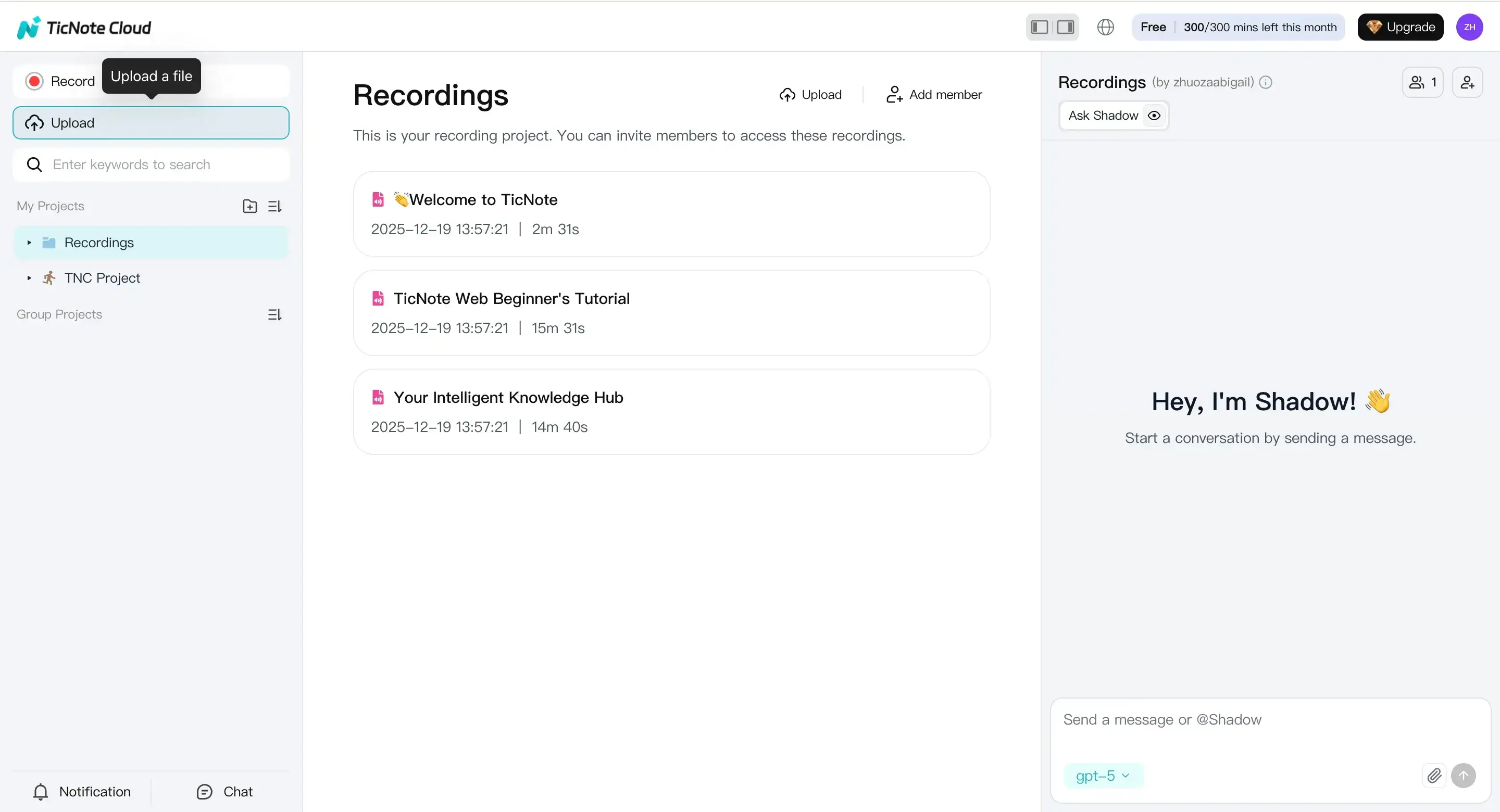
- Generate a first summary, then steer it with constraints. Open the Summary view. Then refine with prompts like:
- "Create an outline first, then a 200-word summary."
- "Use a neutral tone. No opinions."
- "Keep it spoiler-safe. Don't reveal the ending."
- "Use only my notes. If something is missing, say so."
- Iterate for length and accuracy. Ask for a tighter version at a target word count. Then request a quick checklist: "Match this draft against the outline and flag gaps."
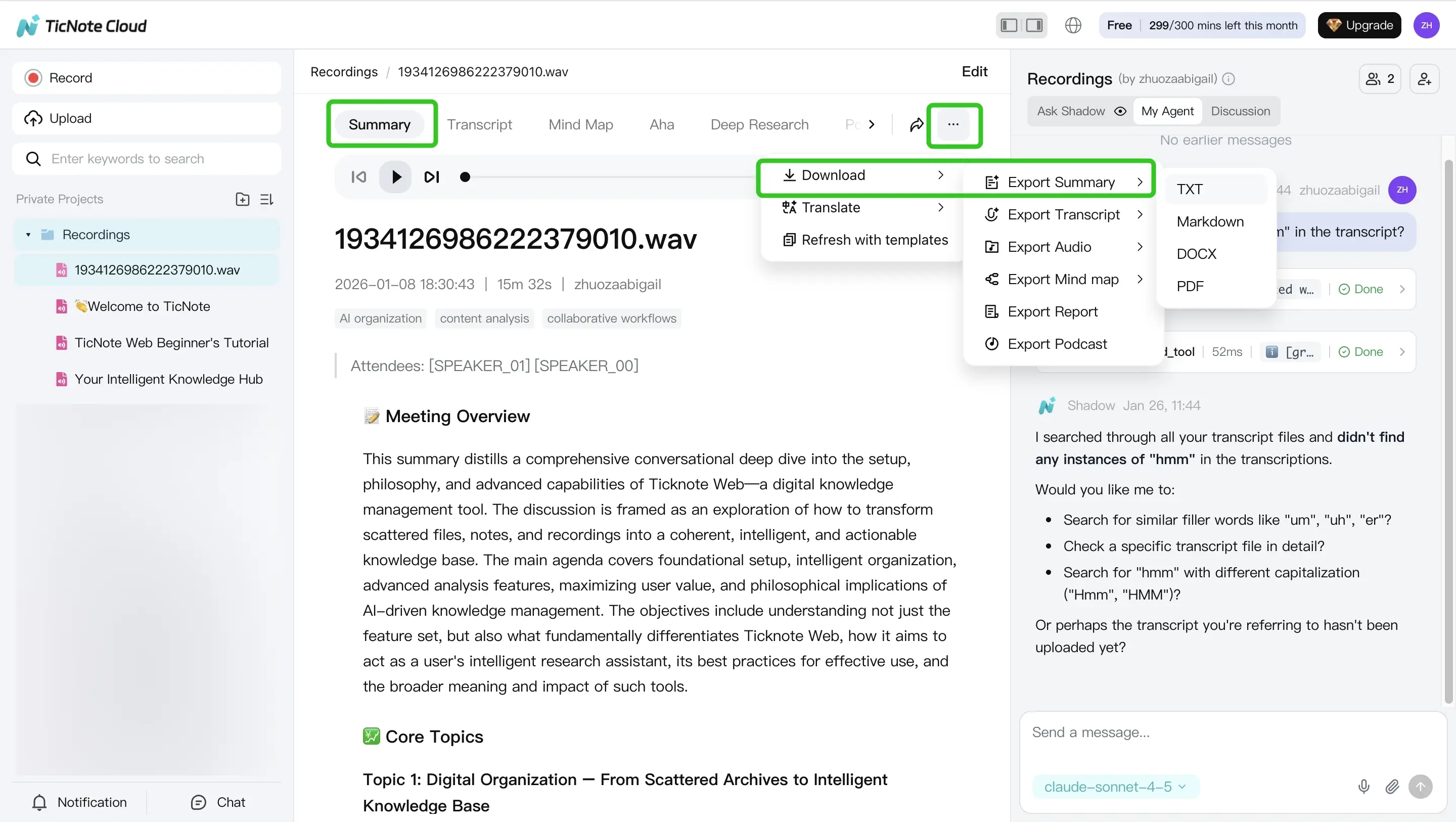
- Export and do a human edit. Export in Markdown, DOCX, or PDF, then do a final pass for accuracy, citations, and wording.
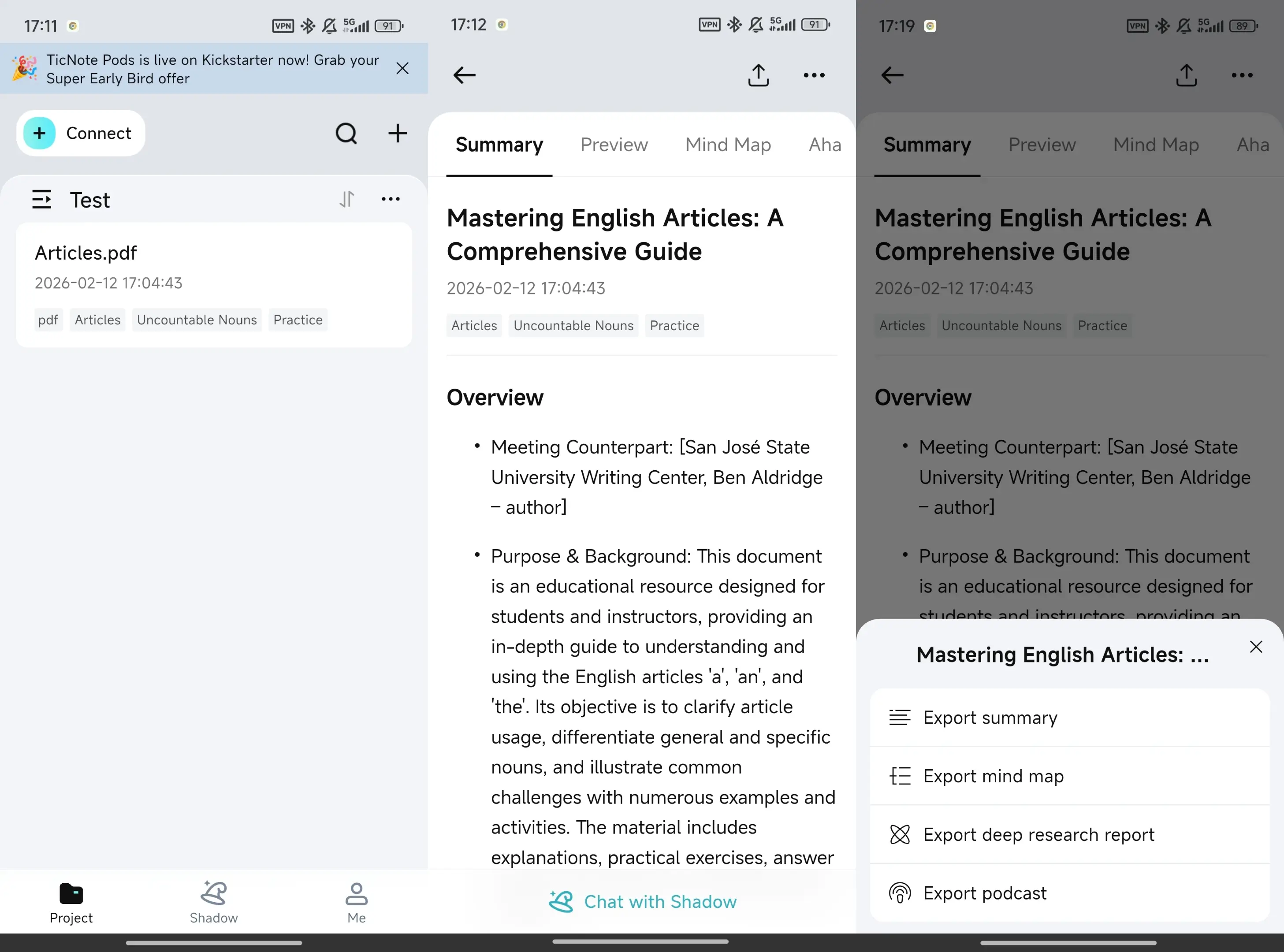
App workflow (condensed): do it from your phone
On the TicNote app, upload your notes to a project, generate the summary, and edit before exporting. Keep the same guardrails: "use only my notes," "no spoilers," and "target 200 words."
One responsible-use note: AI can reorganize and rephrase well, but it can still miss context or invent details. Treat it like a fast drafting partner, not a substitute for reading.