


 Extension
TL;DR
A startup one pager is a single-page document that distills your company's value, market, team, and traction into a format investors can review in under two minutes. It is not a pitch deck -- it is the document that gets you a meeting to show your pitch deck.
Try TicNote Cloud for Free and generate your one pager content from your actual company context -- no generic templates required.
Most founders write a one pager too late, after the pitch, not before it. Investors see hundreds of decks and almost never open cold attachments. The founders who get meetings send a sharp one pager first. TicNote Cloud's Startup COO skill turns your raw notes and company description into a structured, investor-ready one pager in minutes.
What Is a Startup One Pager Template (and Why It Matters)?
Investors get hundreds of cold pitches every month. A startup one pager template gives you a structured way to present your company in the format they actually want to see before agreeing to a meeting.
What a startup one pager actually is
A one pager is a single-page document, not a slide deck and not a PDF report, that summarizes your company's pitch, traction, team, and ask. It answers the question every investor has on their desk: is this worth 45 minutes of my time?
The format is intentionally constrained. One page forces founders to prioritize. If you can't explain your company's value in that space, the problem is usually with the message, not the page limit.
Why investors read one pagers first
Venture investors operate in an attention economy. A deck attachment that has to be opened, scrolled, and interpreted is a barrier. A one pager that answers the key questions in 90 seconds is not. It's the filter investors use before they agree to the meeting where you show the deck.
One pager vs. pitch deck: a quick comparison
| One PagerPitch Deck | ||
| Length | 1 page | 10-15 slides |
| Depth | High-level overview | Full narrative |
| When to use | Cold outreach, warm intro | In-person or video meeting |
| Required to get meeting | Yes | No |
| Format | PDF, HTML, print | Slides (PDF, PowerPoint, web) |
Think of the startup one pager template relationship this way: the one pager earns the meeting, and the deck closes it.
What to Include in a Startup One Pager
Every investor-facing one pager covers six core sections. Skip one, and you give investors a reason to pass before the meeting.
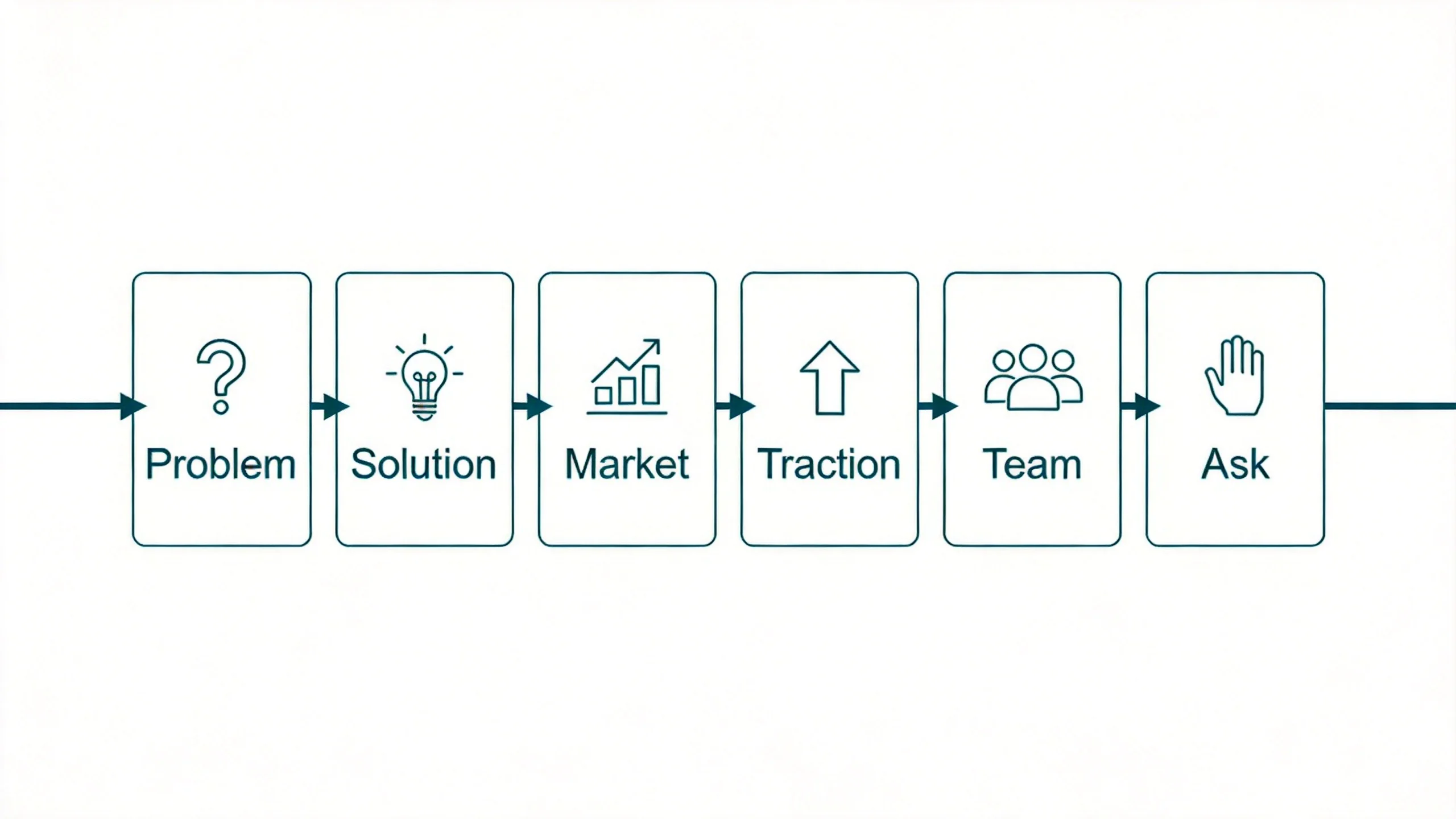
Company overview and value proposition
Lead with your company name, a one-line description, and your unique value proposition. Be specific: "We help enterprise sales teams reduce deal cycles by 30%" is fundable. "We make sales easier" is not. Investors need to know what you do, who it's for, and why now, in two sentences.
Problem and solution
The problem section earns trust by showing you understand the pain, not just the product. Write 2-3 sentences each. A strong problem statement is investor-recognizable: a large market with recurring pain that existing tools don't fix well. The solution should name your approach and why it works, not just describe features.
Target market and TAM
State your total addressable market (TAM), serviceable addressable market (SAM), and serviceable obtainable market (SOM). Explain why this market is worth pursuing now. Timing matters, and investors know it.
Traction and milestones
This is the section investors weight most heavily. Revenue, active users, pilots, notable customer names, partnerships, or prior funding rounds all belong here. Skip vanity metrics like total sign-ups or app downloads. Show signal: paying customers, month-over-month growth, a marquee name that validates demand.
Team
List founder names with one to two lines each. Highlight relevant domain expertise, prior exits, or technical credentials that explain why this team is the right one for this problem. Investors bet on people as much as ideas.
The ask
State the funding amount, high-level use of funds (e.g., "60% engineering, 30% sales, 10% ops"), and your target close timeline. A vague ask reads as unpreparedness. Investors want to know exactly what they're being asked to do.
Startup One Pager Template: Fill-In-the-Blanks Format
Use this startup one pager template as a starting point. Every line has a purpose -- fill each one with specifics, not placeholders.
[Company Name] | [One-Line Pitch] | [Website URL]
Problem: [2-3 sentences describing the pain point and why current solutions fall short]
Solution: [2-3 sentences on your approach, what makes it work, and why now]
Target Market: [Description of customer segment] | TAM: [$X billion] | SAM: [$X million]
Traction: [Key metric 1, e.g., "$45K MRR"] | [Key metric 2, e.g., "3 enterprise pilots"] | [Key milestone, e.g., "ex-Stripe lead engineer joined as CTO"]
Team:
[Founder 1 Name], [Title] -- [1-line credential, e.g., "10 years in B2B SaaS, previously VP Sales at Acme"]
[Founder 2 Name], [Title] -- [1-line credential, e.g., "PhD CS Stanford, built 3 ML pipelines at scale"]
Ask: Raising $[X]M | Use of funds: [Y%] engineering / [Z%] sales / [W%] ops | Close: [Q X 202X]
Contact: [Email] | [LinkedIn] | [Website]
Filled-in example: Waveline (B2B SaaS)
Waveline | AI-powered pricing optimization for mid-market SaaS | waveline.io
Problem: Mid-market SaaS companies lose 15-20% of potential revenue to inconsistent pricing and manual discount approvals. Existing CPQ tools are built for enterprise teams and take months to deploy.
Solution: Waveline connects to your CRM and billing data to recommend deal-specific pricing in real time, cutting approval cycles from 3 days to under 2 hours.
Target Market: Mid-market SaaS (50-500 employees) | TAM: $4.2B | SAM: $680M
Traction: $62K MRR (18% MoM growth) | 14 paying customers including Draftbit and Passionfroot | $280K ARR
Team:
Sara Kim, CEO -- Former head of revenue ops at Intercom, scaled pricing function from $20M to $150M ARR
Dave Okafor, CTO -- Led pricing algorithms at Stripe, 3 ML patents
Ask: Raising $1.5M seed | 65% engineering / 25% sales / 10% ops | Close: Q3 2025
Contact: sara@waveline.io | linkedin.com/in/sarakim | waveline.io
For additional context on how teams document and share resources like this, the SOP template guide for startups covers how to structure operational documents alongside investor materials.
How to Write a One Pager for Investors Using AI
Most founders spend hours tweaking layout and wording -- TicNote Cloud turns a 5-question conversation into a structured, investor-ready one pager.
The steps below demonstrate the workflow using TicNote Cloud's Startup COO skill, available on both Web and App.
Step 1: Add the Startup COO skill agent
In TicNote Cloud, click Add Agent and browse the Skill Agent library. Select the Startup COO skill to add it to your workspace -- no configuration required.
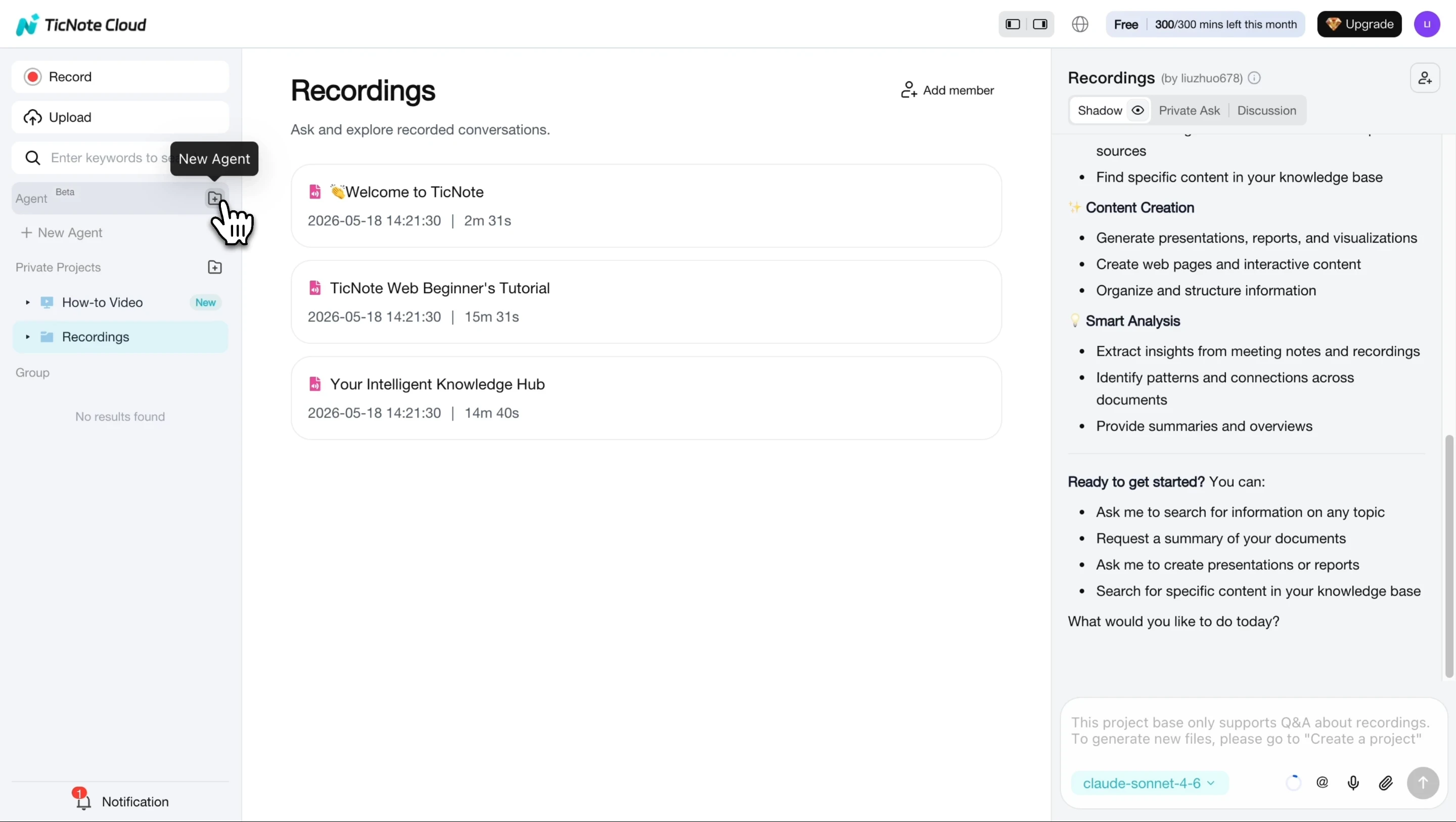
Once added, the Startup COO skill agent appears in your agent list and is ready to use immediately.
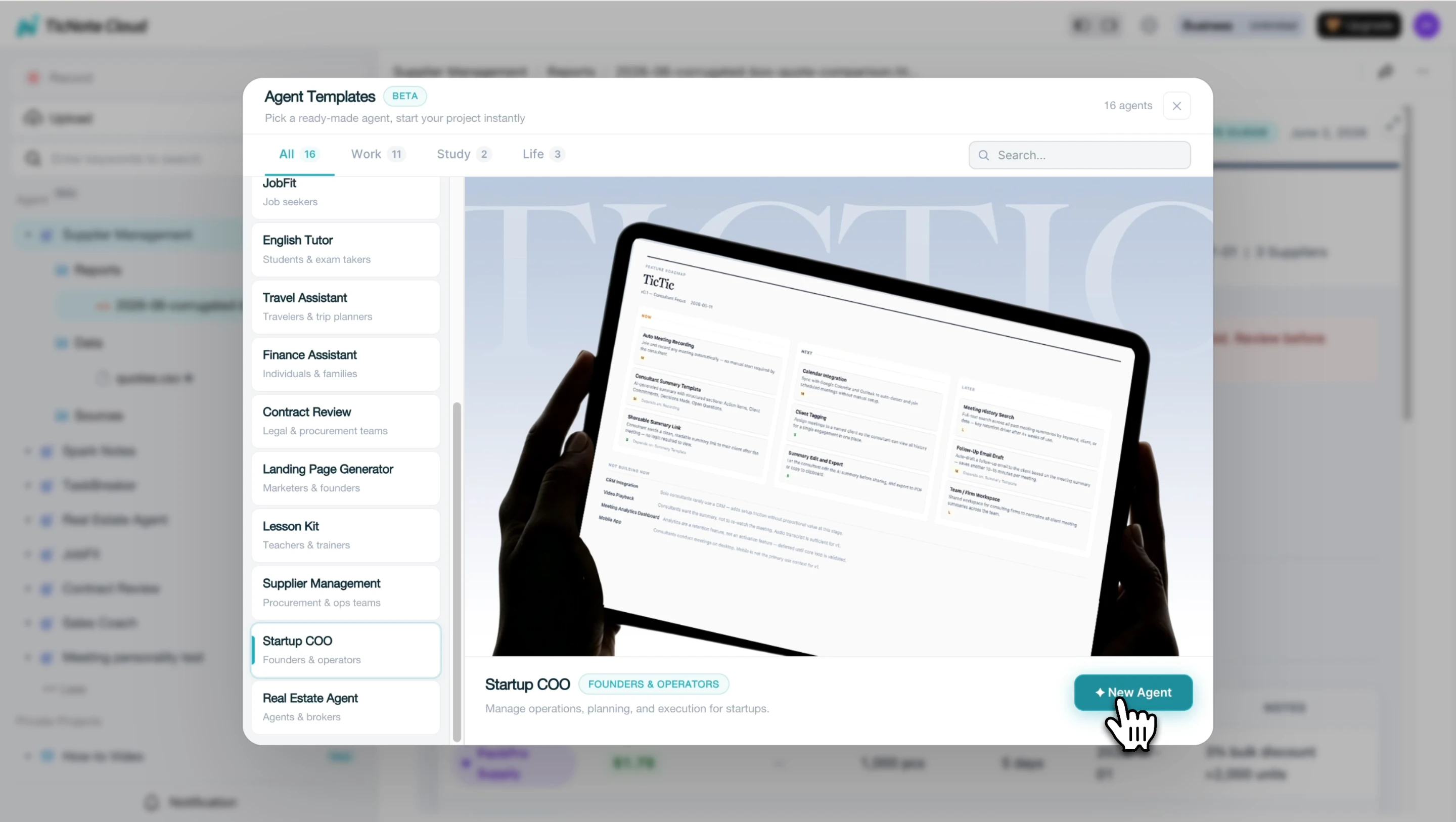
Step 2: Describe your company and ask for a one pager
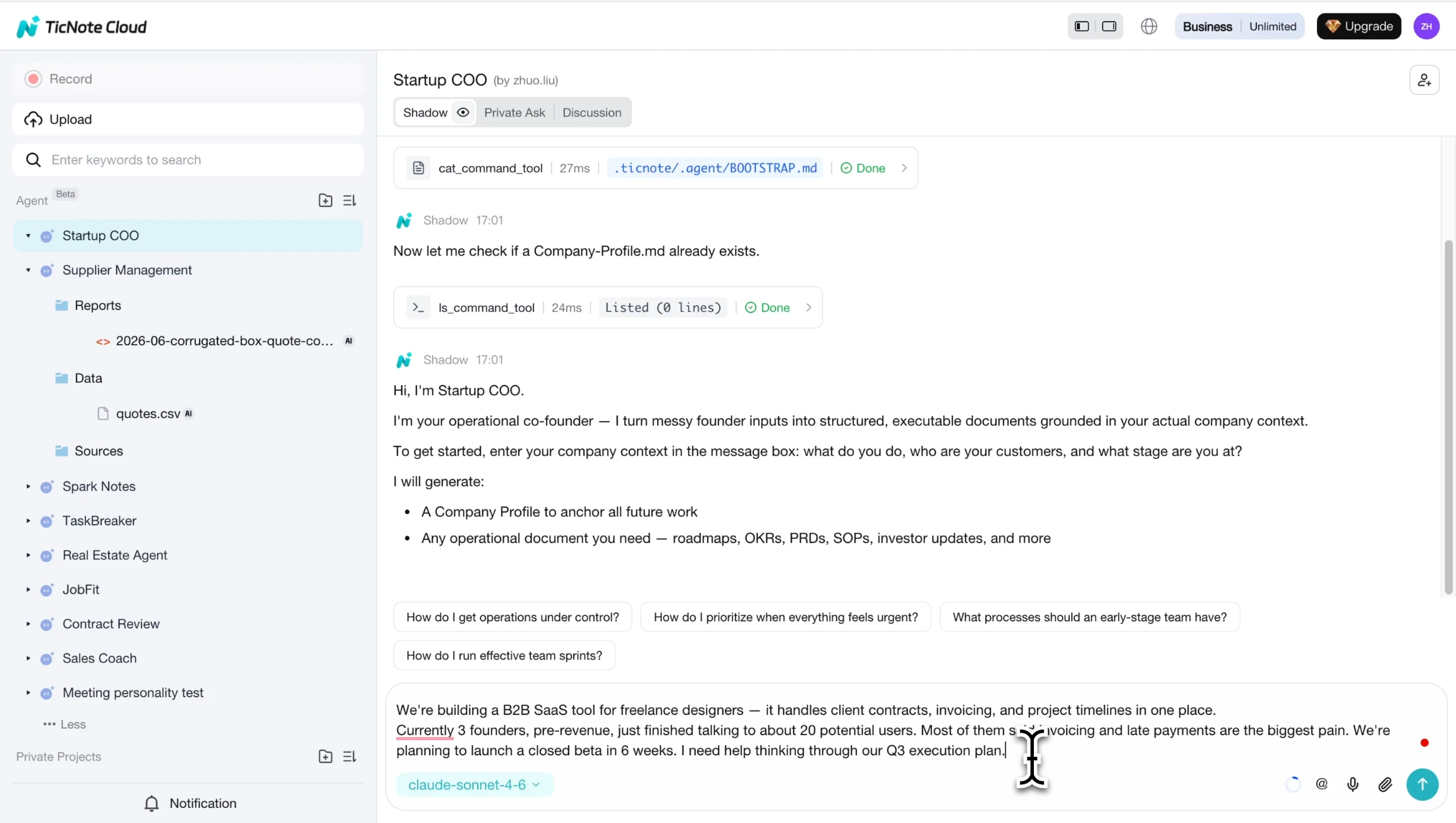
Tell the agent what your company does, who your customers are, and what stage you're at. The skill saves this as a Company Profile. Then say: "Generate a startup one pager." The agent uses your actual company context, not a blank template.
Step 3: Review the output and answer clarifying questions
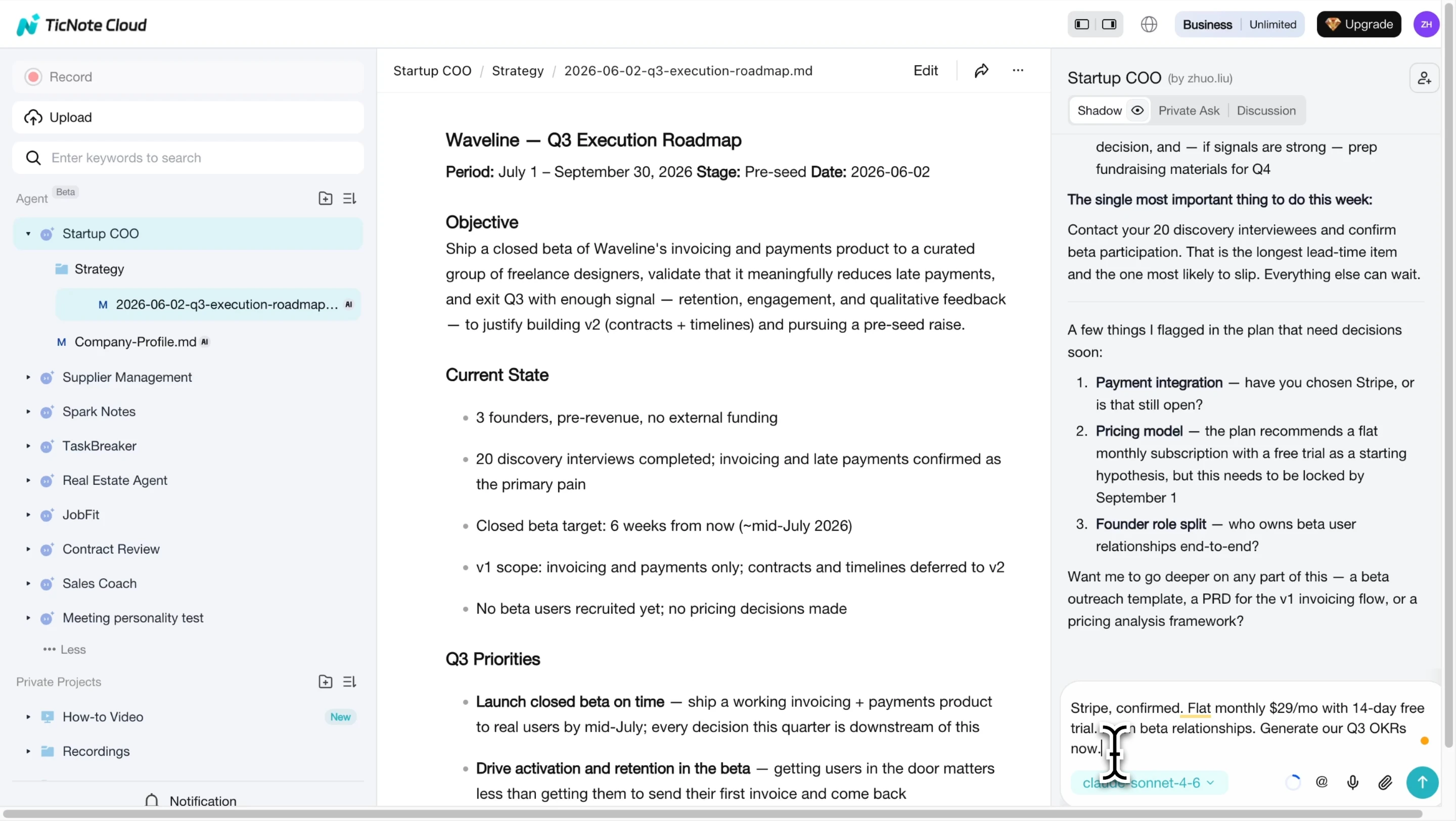
The Startup COO skill generates an initial one pager draft and may ask follow-up questions to sharpen it -- your funding ask, key traction metrics, or the specific investor audience. Answer each question to get a more accurate output.
Step 4: Export the visual HTML file
Once you've provided full context, the Startup COO skill renders the one pager as a visual HTML file, ready to share directly with investors or to copy into your preferred design tool.

App workflow: The same process is available on iOS and Android. Launch the Startup COO skill agent from the app, describe your company, and follow the same steps to receive a visual one pager.
How to Write a One Pager for Investors: 5 Practical Tips
The template gives you the structure. These five practices determine whether investors respond.
Lead with traction, not vision
Investors fund businesses, not ideas. If you have any signal: revenue, signed LOIs, live pilots, put it first. Vision is the frame; traction is the proof. A one pager that opens with a problem statement and buries the metrics at the bottom reads like a first-time founder move.
Keep it to one page, no exceptions
A two-page "one pager" signals poor judgment about what to prioritize -- which is exactly the judgment investors are evaluating. Pick your best six data points. Cut the rest.
Match the format to the channel
- PDF: email attachments, shared via link in cold outreach
- HTML or live link: warm intros where the recipient wants to click
- Printed: in-person events, demo days, introductory coffees
For a guide on how startup roadmaps can anchor your investor narrative, the roadmap article covers how to structure a 12-month view alongside your one pager.
Write for a 30-second scan
Use bold labels before each section so the reader never has to search for the funding ask or the traction number. Investors skim before they read. Give them the headlines first.
Update it every funding round
A one pager that still reads "pre-revenue" after you've closed your seed round hurts credibility. Update it at every meaningful milestone: first revenue, first enterprise customer, new hire, new round.
Common Startup One Pager Mistakes to Avoid
Most one pagers fail for the same four reasons. Here's how to avoid each one.
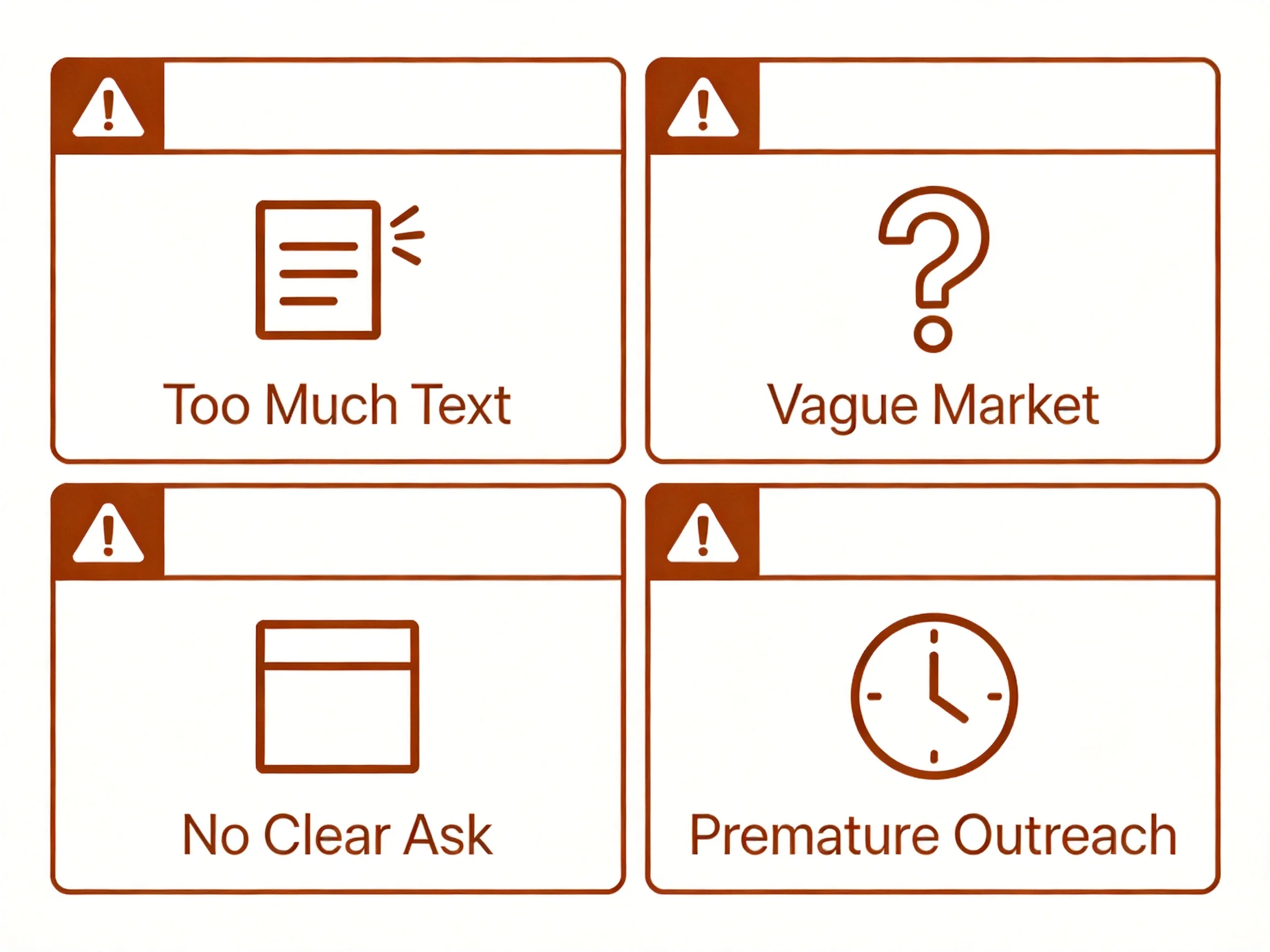
Too much text, too little signal
Founders try to explain everything. Investors want only the most compelling facts. If a sentence doesn't directly support your ask -- the funding amount, the traction, the team credibility -- cut it. Density is a liability, not a feature.
Vague market sizing
"Billion-dollar market" without a source reads as guesswork. Fix: either cite a specific research report or build a credible TAM from the bottom up (e.g., X target customers multiplied by Y average contract value). Numbers without backing lose the room.
Missing a clear ask
A one pager with no stated funding amount and no use-of-funds breakdown is a brochure, not a fundraising tool. Investors need to know exactly what they're being asked to do before they'll take the meeting. For reference, learning how to write OKRs can help founders align their funding ask with concrete quarterly goals.
Sending it before any traction
If there's nothing to prove, investors won't take the meeting. Fix: delay outreach until you have at least one concrete signal -- a paying customer, a signed pilot agreement, or a notable advisor joining the team. The goal is to send the one pager when it has something to show.
Conclusion
A startup one pager is the highest-leverage document in early fundraising. You don't need design skills or a template library -- you need the right content: a sharp problem, a credible solution, real traction, and a specific ask. Cover the six key sections -- company overview, problem, solution, market, traction, team, and ask -- and keep it to one page.
Try TicNote Cloud's Startup COO skill for free to generate your one pager from your actual company context in minutes.