


 Extension
TL;DR
A supplier scorecard template gives you a consistent, repeatable way to evaluate vendor performance: scoring delivery reliability, quality, pricing stability, and responsiveness on the same criteria every quarter, so you can compare suppliers fairly and make renewal decisions based on data.
Try TicNote Cloud for Free and generate a formatted supplier scorecard from your vendor data automatically, no manual scoring required.
Most small procurement teams review supplier performance informally: a general sense of whether a vendor is "good" or "difficult," with no data to back it up. When renewal time comes, you're negotiating blind. A supplier scorecard template fixes the measurement gap, and TicNote Cloud's Supplier Management skill generates the full performance report from your archived data on demand.
What should a supplier scorecard template measure?
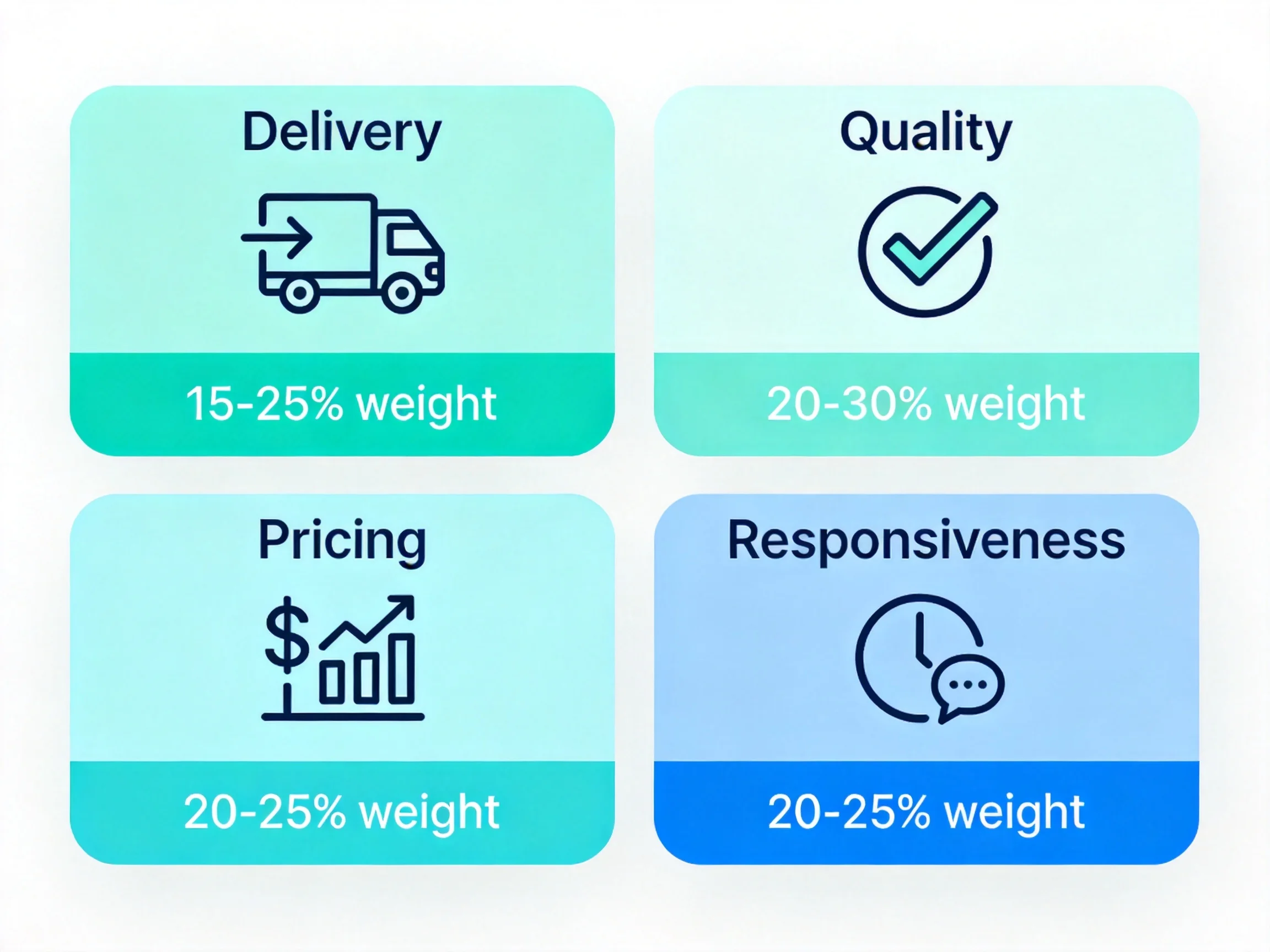
The four core performance categories cover the areas where supplier failures are most costly and most preventable.
According to Chartered Institute of Procurement & Supply (CIPS), How to Manage Supplier Performance, supplier performance directly affects the quality and efficiency of the whole supply chain, and supplier scorecards with defined KPIs are the recommended approach for monitoring and managing vendor performance systematically.
The four core performance categories
| Category | What it measures | Typical sub-criteria |
| Delivery | On-time delivery rate, lead time accuracy | % orders on time, average days early/late |
| Quality | Defect and rejection rate, spec compliance | Rejection rate %, return rate %, inspection pass rate |
| Pricing | Rate stability vs. quoted prices, market competitiveness | % variance vs. contract, % variance vs. market |
| Responsiveness | Query response time, issue resolution speed | Average hours to first response, % issues resolved within SLA |
How to weight the categories
Weighting depends on your business. Manufacturing teams typically weight quality and delivery most heavily: a late delivery or a batch of defective parts can halt production. Services procurement may weight responsiveness more. Retail procurement usually prioritizes pricing stability.
A practical starting point: equal weighting (25% each) for the first two review cycles. After two quarters of data, adjust the weights to reflect your actual cost of failure in each category.
What not to include
Avoid subjective criteria like "relationship quality" or "communication style" without specific, measurable indicators. Keep the scorecard to 8-12 criteria maximum. More than 12 dilutes the scores and makes it harder to act on the results.
Free supplier scorecard templates (with example values)
Three templates below, written in full with realistic example values. Copy, adapt, and use them immediately.
TicNote Cloud AI-Generated Supplier Scorecard
TicNote Cloud's Supplier Management skill generates a formatted supplier scorecard on demand from your existing vendor data. Here's how to get this output:
- Go to TicNote Cloud and open the Supplier Management skill
- Upload your supplier documents: quote sheets, delivery records, contracts, quality reports
- Ask the skill to generate a supplier scorecard: "Generate a supplier scorecard for Q2 2026"
- The AI outputs a formatted scorecard with composite scores, a scoring methodology table, and ranked supplier recommendations, ready to share
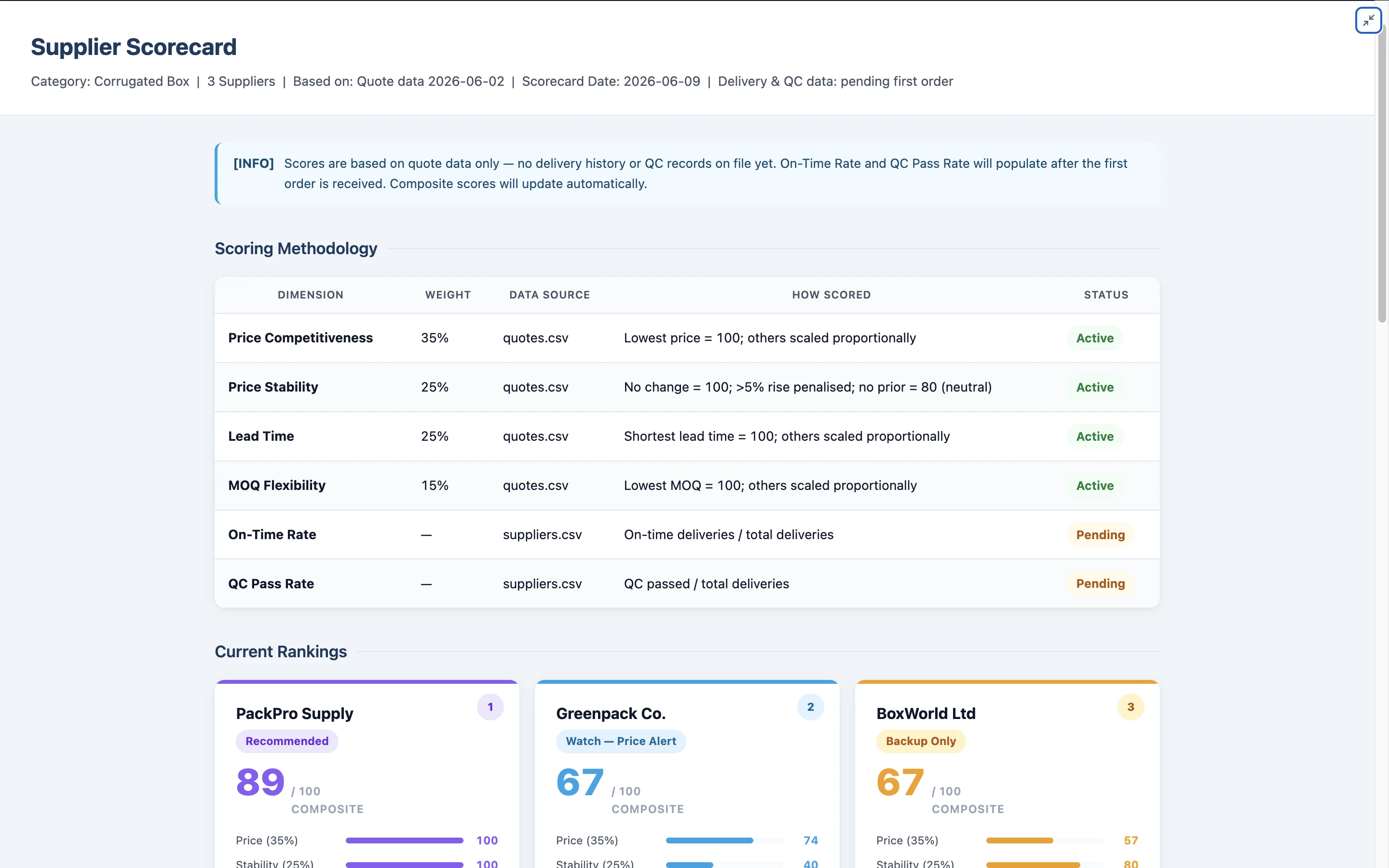
The scorecard includes ranked supplier cards with composite scores and recommended actions:
| Rank | Supplier | Status | Composite Score |
| #1 | PackPro Supply | Recommended | Top performer across all categories |
| #2 | Greenpack Co. | Watch: Price Alert | Strong delivery and quality, pricing trend upward |
| #3 | BoxWorld Ltd | Backup Only | Below threshold on delivery and responsiveness |
Below the rankings, a scoring methodology table shows the criteria weights used and how each supplier scored in each category, so the ranking is fully auditable.
The output is generated on demand from your existing supplier data: no manual scoring required.
Standard Supplier Scorecard Template
Use this template for a quick quarterly review across all active vendors.
Scoring guide: 90-100 = Preferred; 75-89 = Satisfactory; 60-74 = Improvement required; below 60 = At-risk
| Supplier | Review Period | Delivery (0-25) | Quality (0-25) | Pricing (0-25) | Responsiveness (0-25) | Total (0-100) | Recommended Action |
| PackPro Supply | Q2 2026 | 22 | 21 | 19 | 20 | 82 | Renew: strong performer |
| FastPack Co. | Q2 2026 | 18 | 23 | 22 | 15 | 78 | Renew: add communication SLA |
| [Your Supplier] | [Period] |
Scoring guidance per category:
- Delivery (0-25): 23-25 = >95% on-time; 18-22 = 85-95% on-time; 12-17 = 70-85%; below 12 = below 70%
- Quality (0-25): 23-25 = defect rate below 0.5%; 18-22 = 0.5-2%; 12-17 = 2-5%; below 12 = above 5%
- Pricing (0-25): 23-25 = within 2% of contracted rate; 18-22 = 2-5% variance; 12-17 = 5-10% variance; below 12 = above 10%
- Responsiveness (0-25): 23-25 = average response under 4h; 18-22 = 4-12h; 12-17 = 12-24h; below 12 = above 24h
Detailed Supplier Scorecard Template With Sub-Criteria
Use this template when you need a more granular evaluation with sub-criteria breakdowns. Each major category splits into two sub-criteria weighted to total the category score.
Sub-criteria structure:
- Delivery (25 pts): On-time rate ×15 + Lead time accuracy ×10
- Quality (25 pts): Defect/rejection rate ×15 + Spec compliance ×10
- Pricing (25 pts): Rate vs. contract ×15 + Rate vs. market ×10
- Responsiveness (25 pts): Issue resolution ×15 + Query response ×10
| Supplier | Period | On-time | Lead time | Defect rate | Spec comp. | Rate/contract | Rate/market | Resolution | Query resp. | Total | Action |
| Apex Packaging | Q2 2026 | 14/15 | 8月10日 | 13/15 | 9月10日 | 14/15 | 9月10日 | 12月15日 | 9月10日 | 88/100 | Preferred: renew early |
| Delta Supply | Q2 2026 | 12月15日 | 7月10日 | 14/15 | 10月10日 | 11月15日 | 8月10日 | 10月15日 | 8月10日 | 80/100 | Satisfactory: renew standard |
| [Your Supplier] | [Period] | /15 | /10 | /15 | /10 | /15 | /10 | /15 | /10 | /100 |
For a pre-built vendor list to track supplier information alongside your scorecard data, see our vendor list templates with example values.
How to run a quarterly supplier review
A consistent quarterly review process turns your scorecard from a one-time exercise into a real management tool.
According to McKinsey & Company, Risk, Resilience, and Rebalancing in Global Value Chains, supply chain disruptions lasting one month or longer now occur every 3.7 years on average. Suppliers that would have shown deteriorating performance scores before a disruption are often the ones at the center of it. A quarterly review cadence catches the pattern before it becomes a failure.
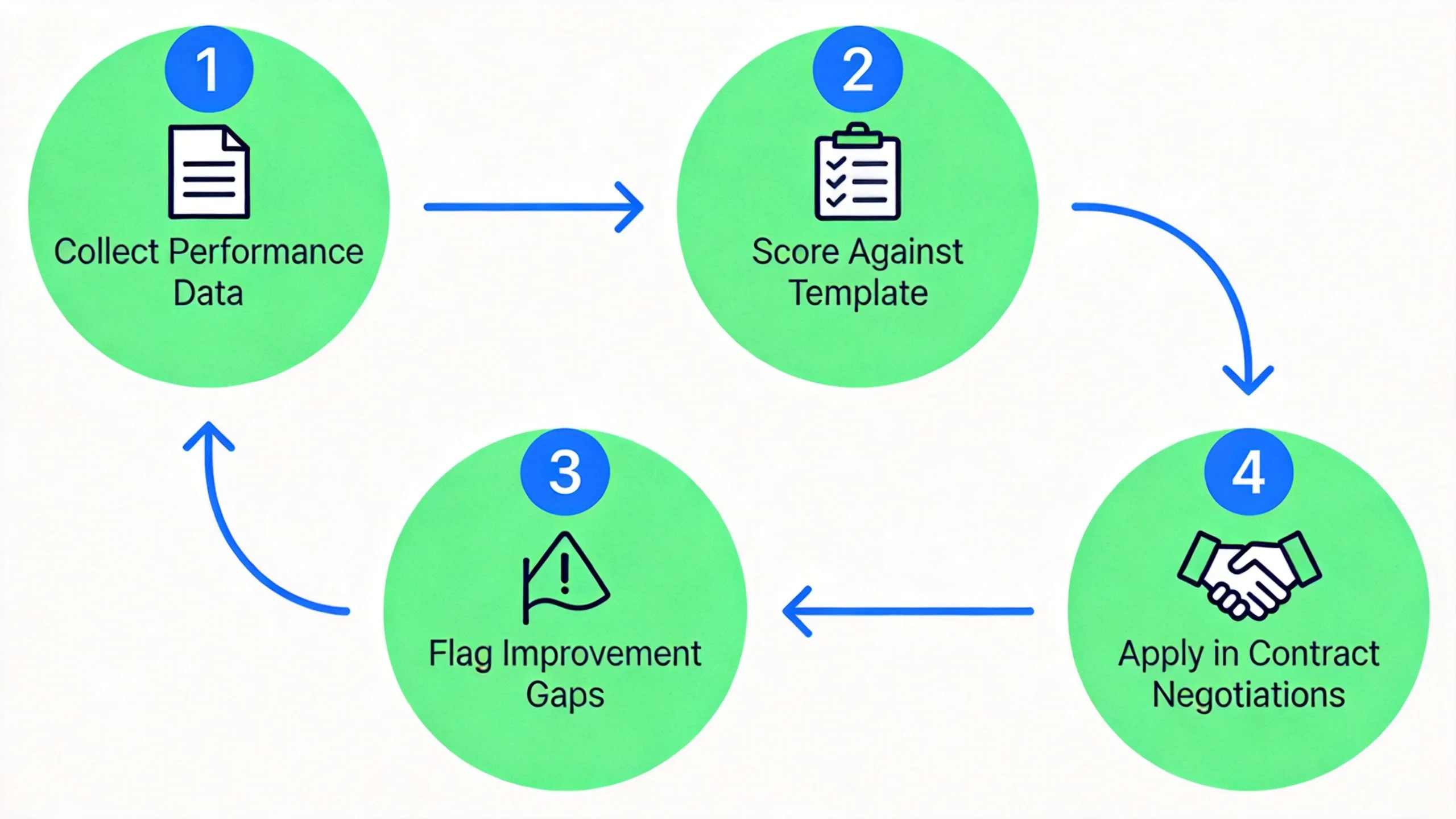
Step 1: Collect performance data for the period
Gather delivery confirmations, quality inspection reports, invoices versus quoted rates, and any logged disputes or issues. If you're using TicNote Cloud, this data is already archived from your uploaded documents: delivery notes, quote sheets, and contracts are parsed and stored automatically.
Step 2: Score each supplier against the template
Fill in the scorecard using the actual data. Calculate weighted totals. Flag any category where a supplier scored below threshold. The goal is consistency, not precision: the same scoring criteria applied the same way every quarter produces comparable results over time.
Step 3: Identify improvement conversations
Any supplier scoring below 75 overall, or below threshold on a critical category like delivery or quality, needs a structured conversation before the next review period. Document the discussion, the issues raised, and the agreed actions with dates. This creates accountability on both sides.
Step 4: Use the review in contract negotiations
Bring the last two quarters of scorecard data to renewal discussions. A supplier who knows you track performance closely tends to negotiate differently. Automating procurement reporting for the baseline metrics means the scorecard is ready before the renewal conversation, not assembled during it.
Conclusion
A supplier scorecard template turns informal impressions into measurable, comparable data: so every renewal decision, every pricing conversation, and every performance issue is handled with evidence instead of memory.
The three templates above cover the most common setups. Standard scoring works for most teams. Weighted sub-criteria templates are useful when one category, like delivery in manufacturing or quality in food service, carries a disproportionate cost of failure.
For a complete purchase order workflow that ties into your scorecard data, linking POs to vendor performance scores creates a clear audit trail from quote to delivery.
If you want the supplier scorecard generated automatically from your existing vendor data, TicNote Cloud's Supplier Management skill does it on demand.