


 Extension
TL;DR: Top AI agent picks for manufacturing teams
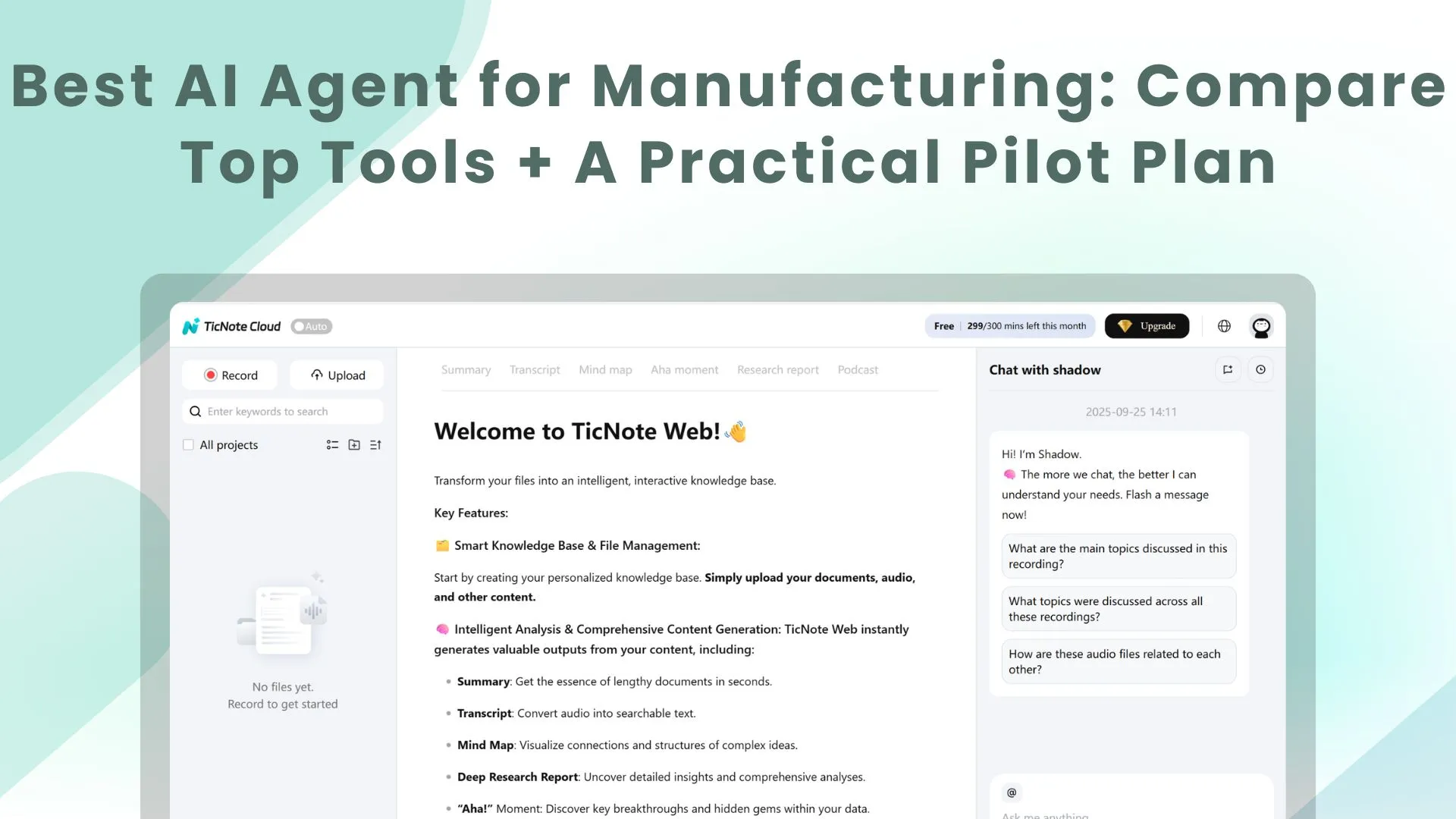
Start with Try TicNote Cloud for Free when your AI agent for manufacturing must capture decisions, cite sources, and generate usable deliverables.
Manufacturing knowledge gets buried in standups, supplier reviews, and quality investigations. That creates rework; TicNote Cloud turns those conversations into searchable project memory.
Top picks: TicNote Cloud for plant knowledge work; Salesforce Agentforce for service and commercial workflows; MindStudio for no-code agents; Siemens Industrial Copilot for engineering and automation; Augury for machine health; C3 AI Reliability for enterprise reliability.
Before a pilot, validate ERP, MES, SCADA, permissions, audit trails, and human-in-the-loop limits; then Try TicNote Cloud for Free.
What is an AI agent for manufacturing, and where do top tools fit?
An AI agent for manufacturing is software that can pursue a goal, use tools, read context, and adjust its next step. That's different from rules-based automation, which follows fixed if-this-then-that logic. Agents can draft, compare, recommend, and sometimes trigger actions through APIs, but factories usually start with human approval because safety, quality, and uptime carry real risk.
Place agents where decisions happen
Most teams should map agents to the systems they already trust:
- Shop floor and OT: interpret SCADA signals, alarm history, work instructions, and operator notes.
- MES and quality: summarize nonconformance records, spot SPC trend shifts, and draft 8D or CAPA content.
- EAM and CMMS: suggest work order priorities, preventive maintenance changes, and spare-parts checks.
- ERP and supply chain: flag MRP exceptions, supplier risk, late orders, and OTIF exposure.
- Service: summarize cases, triage RMAs, and prepare customer escalation briefs.
Here's the layer many comparison pages miss: knowledge-work agents. Manufacturing decisions often live in standups, supplier reviews, quality investigations, maintenance retros, and escalation calls. A workspace like TicNote Cloud can turn those conversations into project memory, so teams can ask cited questions across meetings instead of re-litigating the same issue. If you're comparing agents to simpler assistants, use this agent versus chatbot decision lens to separate drafting from true task execution.
Set autonomy by risk
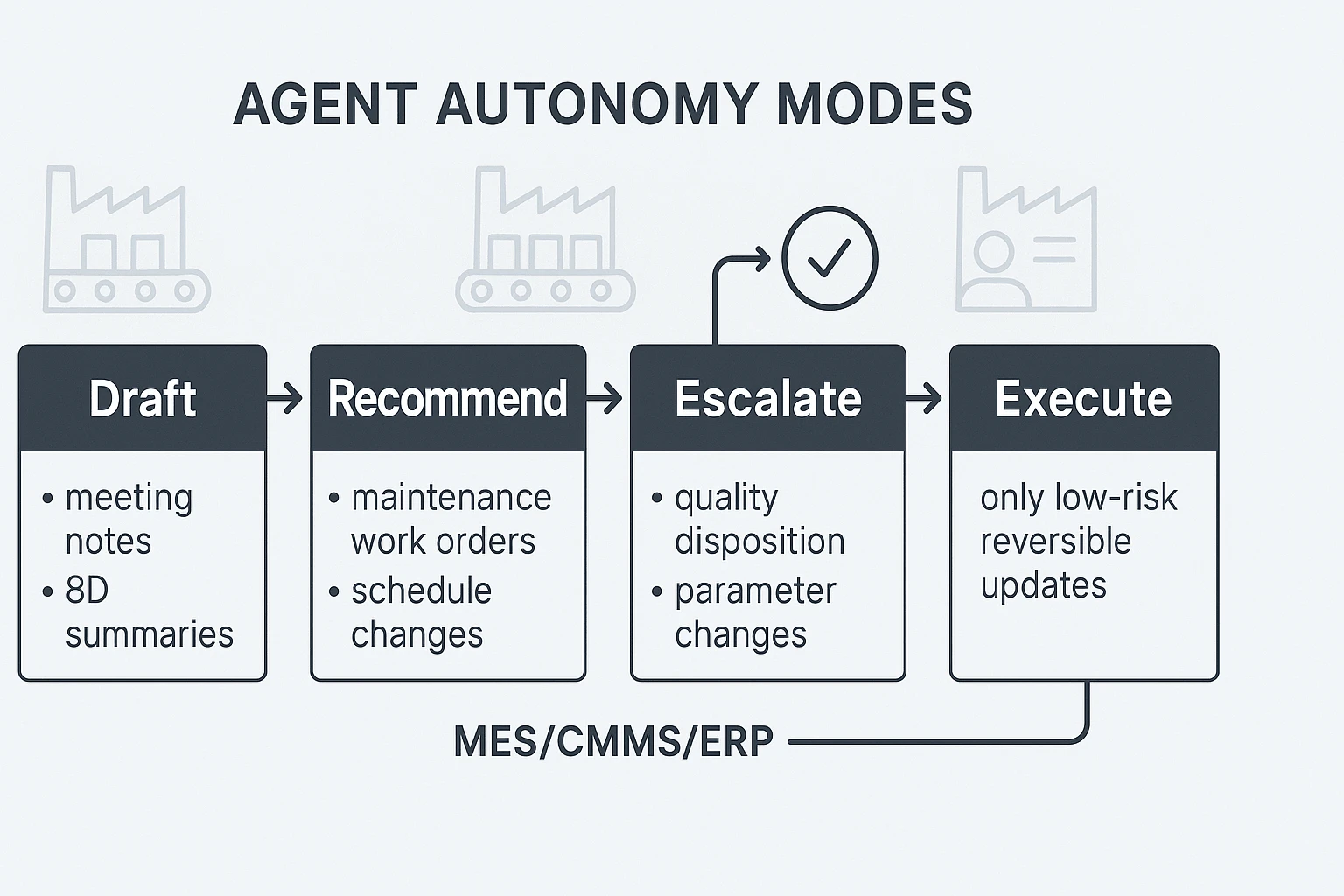
A practical autonomy model has four modes: draft, recommend, escalate, execute. Use draft for meeting notes and reports. Use recommend for maintenance plans or schedule changes. Use escalate when quality disposition, parameter changes, or customer commitments need review. Reserve auto-execute for low-risk, reversible tasks.
Non-negotiables include approval gates, segregation of duties, role-based permissions, audit trails, and cited answers. If an agent influences compliance, safety, or production flow, every action must be traceable.
Top AI agent options for manufacturing teams
The best AI agent for manufacturing is rarely one tool. It is a stack: one agent may watch machines, another may support service, and another may turn meetings into reusable plant knowledge. Use this list to map each option to the workflow it improves, the data it needs, and the handoff it should create.
Read this list as an agent stack
Categories overlap. A maintenance team may use a machine health agent for alerts, a CRM agent for customer cases, and a knowledge agent for decisions from standups, supplier reviews, and quality investigations. The practical rule is simple: assign each agent a job, define who approves its output, and connect the result to your KPI. For more examples, see these enterprise AI agent scenarios across functions, KPIs, and governance.
TicNote Cloud for manufacturing knowledge workflows
TicNote Cloud fits the knowledge-work layer of manufacturing. It captures meetings without a bot joining the call, creates editable transcripts, and groups recordings, files, videos, and documents into Projects. Shadow AI then searches across the Project, answers with citations, and turns source material into reports, web presentations, mind maps, and other deliverables.
That matters because many factory decisions still live in conversations. TicNote Cloud can help teams create:
- Shift handover summaries with risks, blockers, and owner names
- Weekly ops review notes with recurring downtime themes
- Supplier scorecard narratives based on review calls and documents
- 8D (eight disciplines) or CAPA (corrective and preventive action) drafts
- Maintenance RCA (root cause analysis) summaries from retrospectives
- Audit-ready decision logs tied back to original transcript sources
The trade-off: TicNote Cloud is not a sensor analytics platform. It works best beside MES, ERP, QMS, service, and machine health tools, where it preserves the "why" behind decisions.
Salesforce Agentforce for Manufacturing for service and commercial workflows
Salesforce Agentforce fits manufacturers that run sales, service, warranty, and dealer operations in Salesforce. It can support case triage, summarize customer interactions, surface entitlement or warranty context, and guide work order steps. It is strongest when customer demand signals need to flow back into operations through enterprise CRM data.
MindStudio for no-code manufacturing agents
MindStudio is a no-code agent builder. Use it when the workflow is clear enough to automate: routing exceptions, summarizing structured and unstructured data, building internal copilots for SOP or QMS knowledge, or orchestrating actions across SaaS tools. It rewards teams that document process rules before they automate.
Siemens Industrial Copilot for engineering and automation teams
Siemens Industrial Copilot is a strong fit for engineering, controls, and OT-adjacent work. It is useful when teams need help with engineering tasks, industrial automation context, and Siemens ecosystem integration. For plants standardized on Siemens tools, ecosystem fit can reduce friction.
Augury for predictive maintenance and machine health
Augury focuses on machine health. It uses vibration, acoustic, and sensor signals to support condition monitoring, anomaly detection, and reliability recommendations. It is best for teams that want earlier warning on asset failures and clearer maintenance priorities.
C3 AI Reliability for enterprise asset programs
C3 AI Reliability fits large reliability programs across plants, fleets, and asset classes. It supports asset performance management, cross-plant analytics, governance, and scaling. It needs strong data foundations, executive sponsorship, and clear ownership to reach value across sites.
How should manufacturers compare AI agents before a pilot?
Before buying an ai agent for manufacturing, compare tools with the same scorecard. The goal isn't to find the most autonomous system. It's to find the safest agent for one workflow, one plant context, and one measurable business result.
| Primary use case | Typical data sources | Autonomy level | Integration approach | Governance controls | Best-fit owner |
| Reliability triage | CMMS, SCADA, manuals, logs | Suggests actions | APIs, files | Audit trail, approvals | Reliability |
| Production optimization | MES, ERP, SCADA | Recommends setpoints | APIs, connectors | Role permissions | Ops |
| Quality investigation | QMS, MES, photos, specs | Drafts RCA, flags risk | Connectors, uploads | Citations, version history | Quality |
| Supply chain exception handling | ERP, supplier docs, email | Prioritizes expediting | APIs, files | Approval gates | Supply chain |
| Manufacturing knowledge work | Meetings, docs, RCA notes | Answers and drafts deliverables | Files, connectors | Citations, project scope | Ops, quality, service |
Compare KPIs against a baseline
Baseline first. Capture 30–90 days of "before" data, then track the same measures after launch. Reliability agents should be judged on MTBF, MTTR, and preventive maintenance compliance. Production agents should map to OEE drivers: availability, performance, and quality. Quality agents should improve FPY, scrap, rework, and nonconformance closure time. Supply chain agents should track OTIF and expedite rate. Knowledge agents should track time-to-publish minutes, repeated issue counts, and RCA narrative completion time.
Watch red flags before the plant test
Reject tools with black-box reasoning, no source citations, weak role-based access, vague data retention, fragile integrations, or no way to scope work by plant, line, product, or project. Also check whether the agent can act, only suggest, or must wait for approval.
Do a plant reality check too. Confirm latency, offline behavior, OT security boundaries, and read-only access where control systems are involved.
Use the table to select one pilot workflow with one KPI, one owner, and explicit approval gates before any agent touches live operations.
How to choose the right product
The right ai agent for manufacturing is the one closest to your costliest recurring decision. For many leadership teams, that decision is not only on the shop floor. It happens in production reviews, quality investigations, supplier calls, maintenance retrospectives, and customer escalation meetings.
Choose TicNote Cloud for meeting-heavy manufacturing knowledge
Choose TicNote Cloud as the default fit when decisions, context, and follow-ups are spread across meetings and documents. Its Project-level Shadow AI can search across related files, answer "why did we decide this?" with citations, and turn meeting knowledge into RCA drafts, CAPA notes, ops review decks, reports, mind maps, and HTML presentations.
This matters when one issue spans three plants, two suppliers, and 12 meetings. Instead of rebuilding context each week, teams can reuse permissioned knowledge and verify sources before acting. For broader buying criteria, compare this with a practical AI agent security and cost checklist.
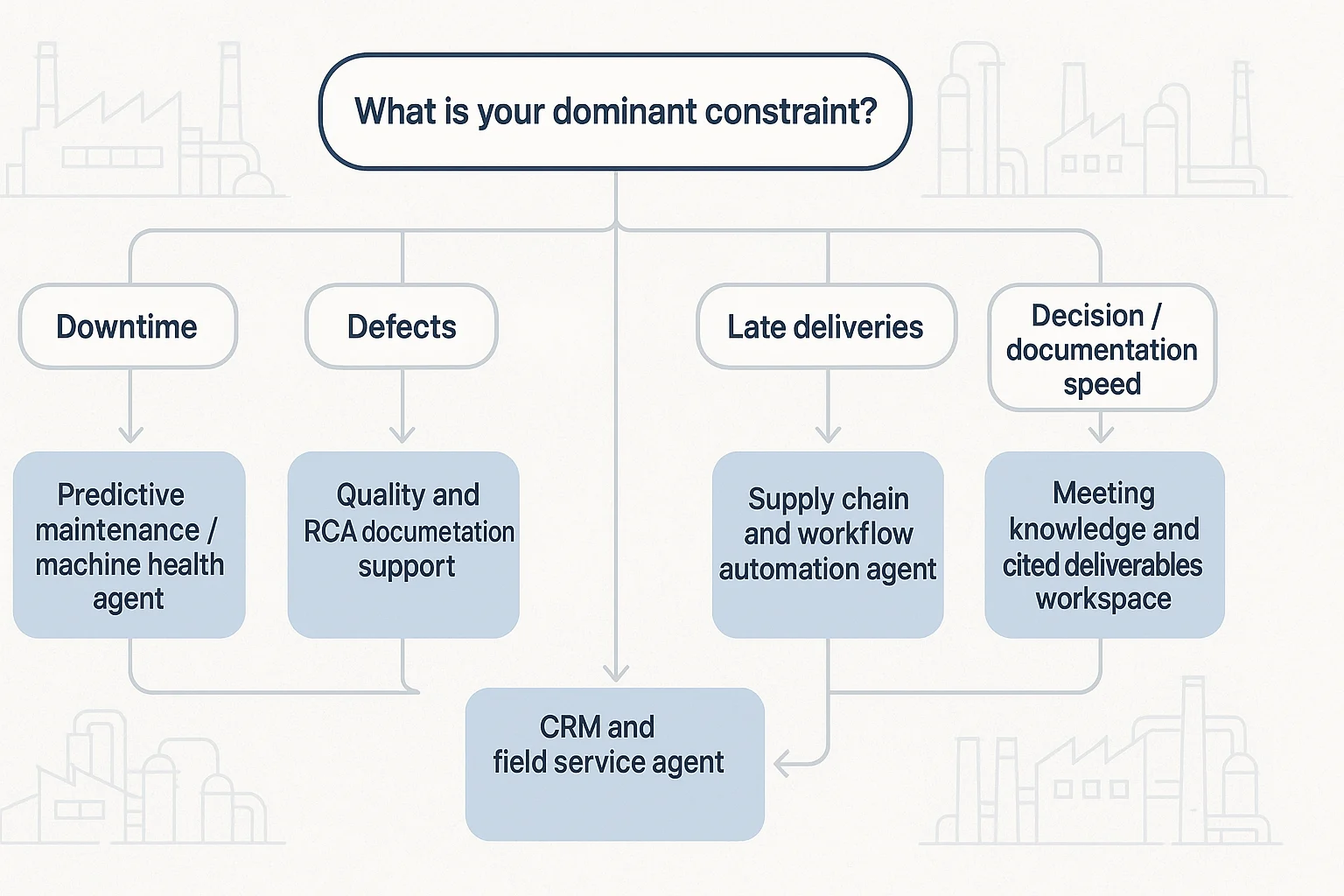
Match the agent to the operating bottleneck
Use this simple routing logic:
- Customer, service, and warranty load: Choose Salesforce Agentforce when service cases, entitlements, warranties, field service, and account workflows drive the business case. It fits best when teams already work in Salesforce every day.
- Fast no-code workflow agents: Choose MindStudio when operations excellence or IT needs lightweight agents for exception routing, SOP/QMS helpers, and cross-app automations with tight boundaries.
- Engineering and automation productivity: Choose Siemens Industrial Copilot when industrial automation, engineering tasks, and Siemens ecosystem alignment are the main constraints.
- Machine health and downtime prevention: Choose Augury when the core goal is asset-level monitoring, early fault detection, and predictive maintenance.
- Enterprise reliability transformation: Choose C3 AI Reliability when the program spans many sites, has centralized governance, and already has strong asset data foundations.
Use one decision rule
If you only do one thing, map your top 3 losses by cost: downtime, defects, late orders, service load, or slow documentation. Then pilot the agent that sits closest to the most frequent high-cost decision. That keeps scope tight, success measurable, and governance easier to enforce.
Project memory for manufacturing decisions: how to capture, reuse, and govern knowledge
The steps below use TicNote Cloud as the example because it's a practical way to add manufacturing knowledge management AI without rebuilding MES, ERP, SCADA, or core OT systems. For an ai agent for manufacturing, the goal is simple: turn daily decisions into searchable, cited records your team can reuse.
Web workflow: build one controlled project memory
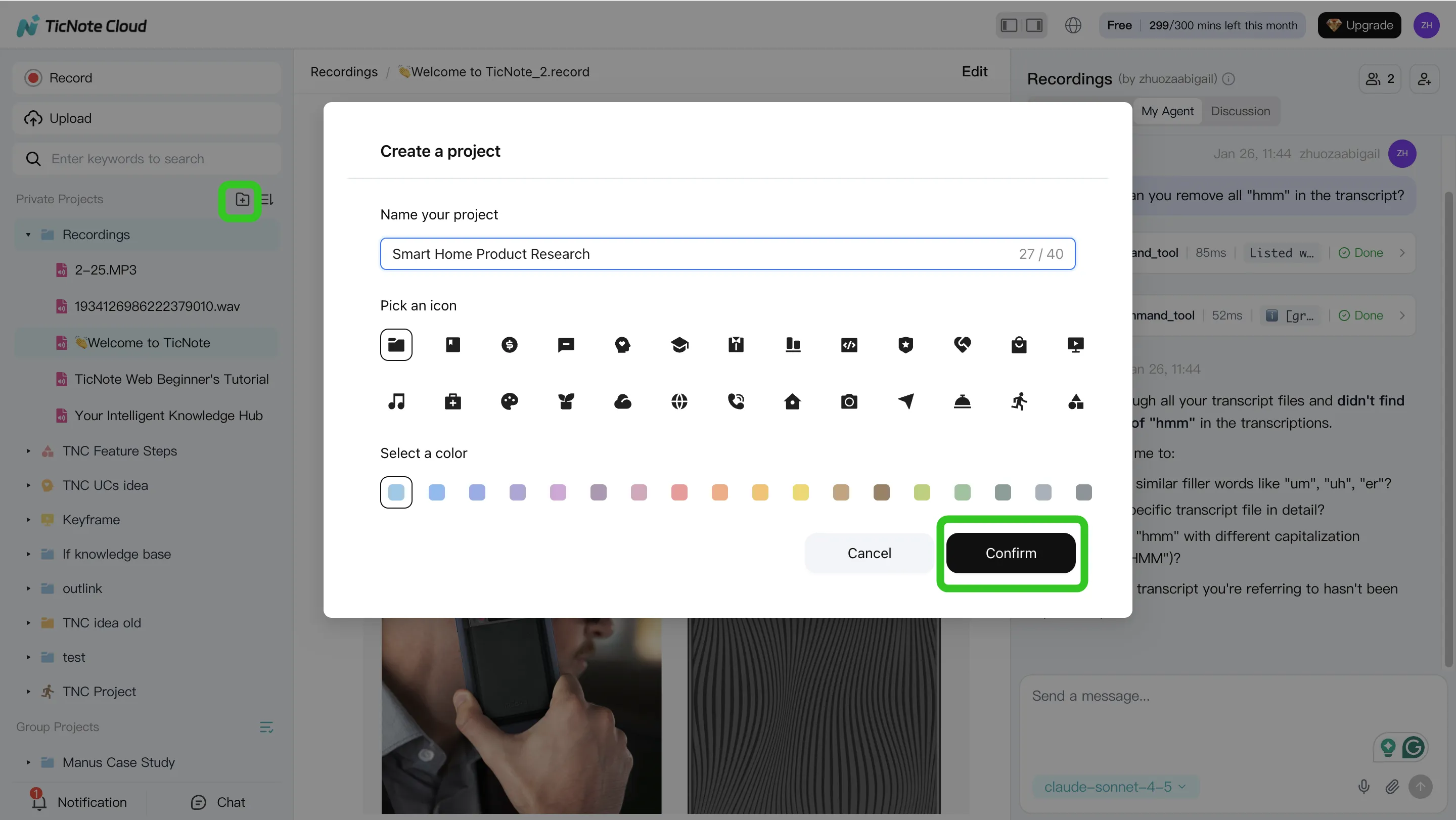
- Create a Project and add content. Structure Projects around how the plant works: Line 3, Press 12, a key customer, a supplier, or an initiative such as "Scrap reduction Q3." In TicNote Cloud Web Studio, create or open that Project, then add meeting recordings, SOP PDFs, 8D/CAPA files, maintenance reports, supplier emails, and review notes. Use direct upload from the file area, or attach files in the Shadow AI panel and ask Shadow to save them into the right folder. If you're comparing broader workspace options, this fits the same pattern as AI workspaces that centralize team knowledge.
- Search, analyze, edit, and organize content. Shadow AI stays on the right side of the Web Studio. Ask plant-specific questions such as, "What actions did we agree for Line 3 jams?" or "Which supplier issues repeat across the last 4 reviews?" Then cluster findings by quality, maintenance, supply, safety, or customer impact. Edit transcripts to correct part numbers, machine names, and shop-floor terms before the record becomes official.
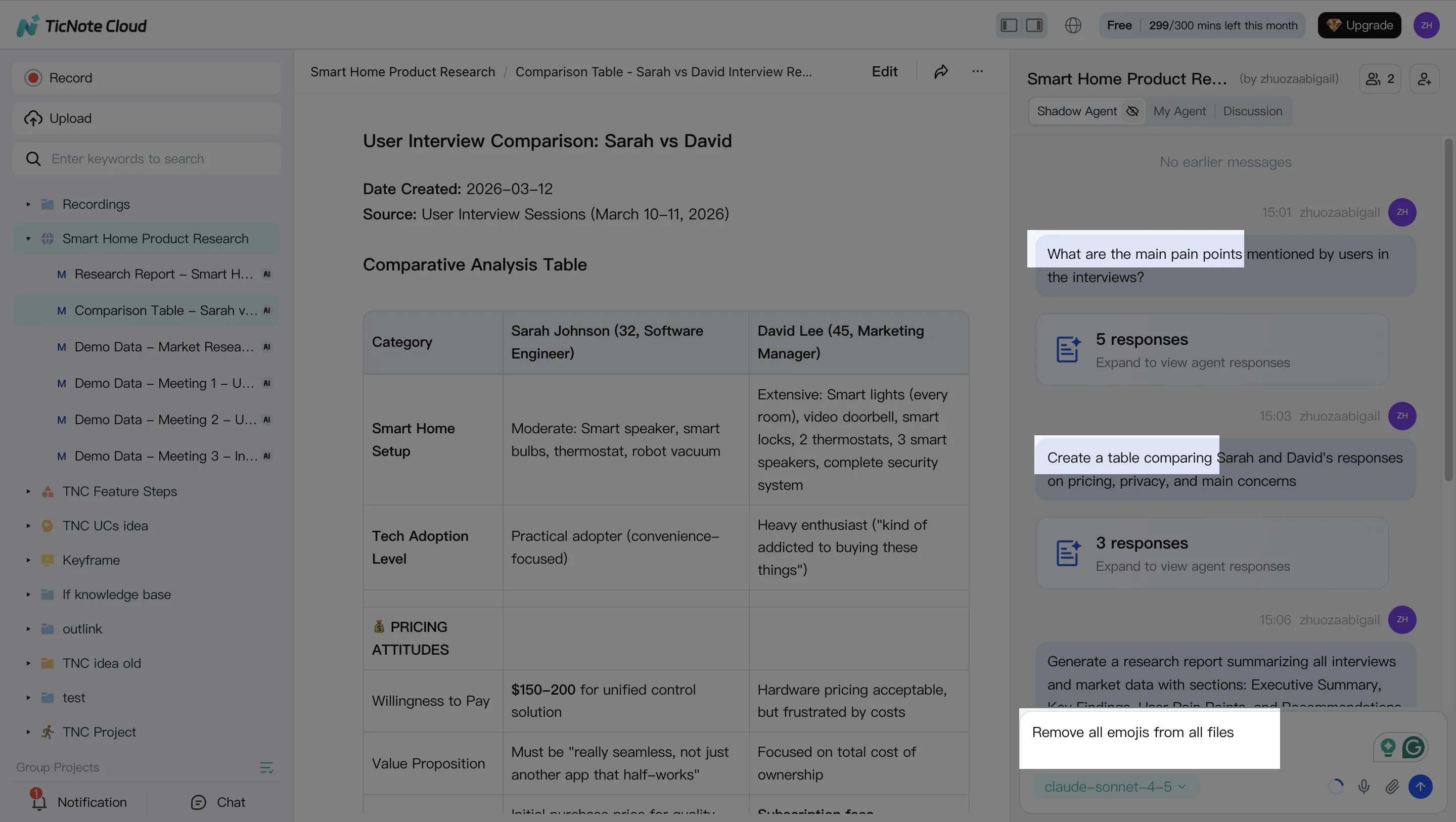
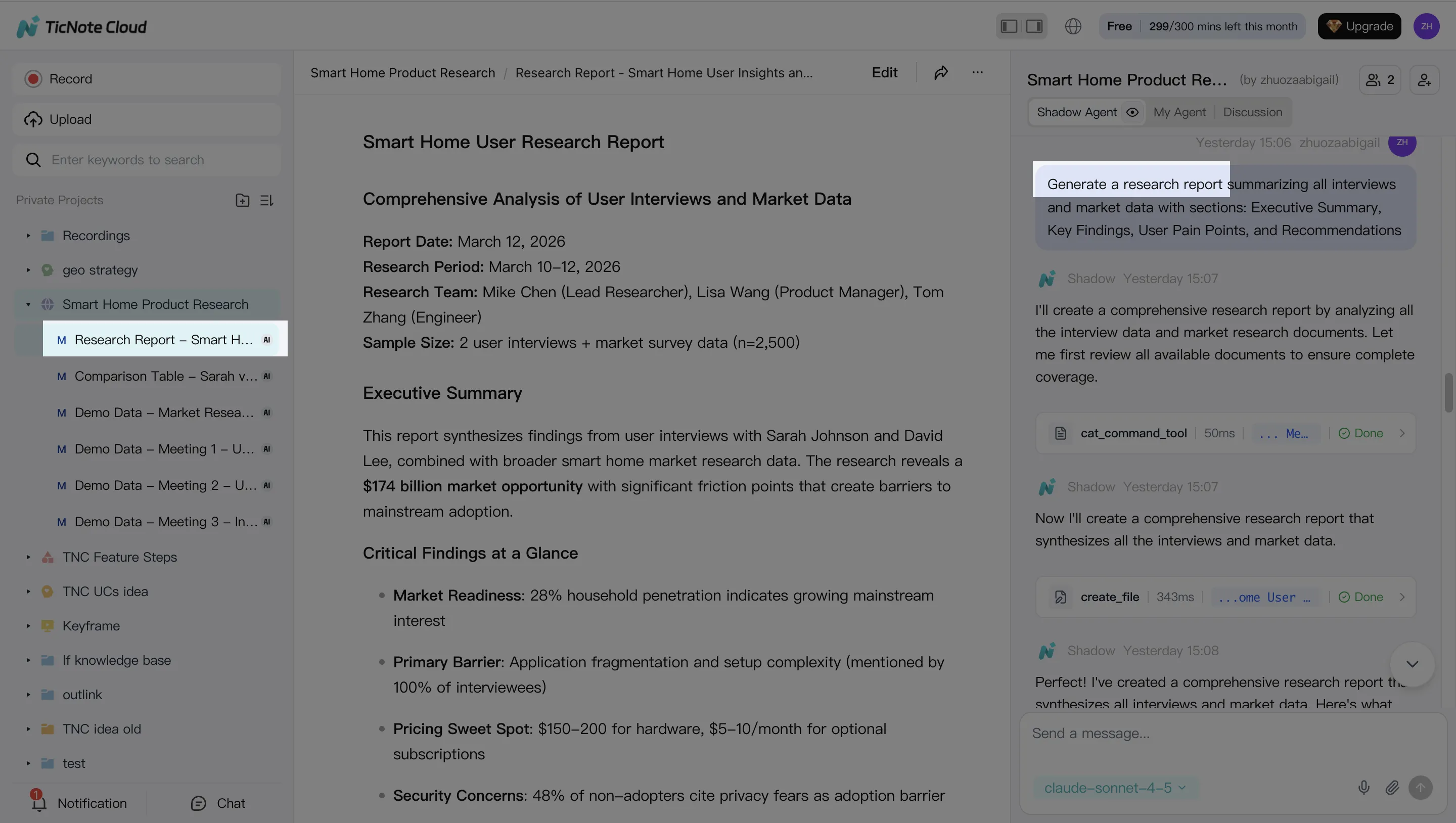
- Generate deliverables teams actually use. Ask Shadow AI to create a weekly plant ops recap, customer escalation timeline, supplier corrective action narrative, or structured maintenance RCA report. These outputs stay tied to the source material, so reviewers can verify claims before sharing.
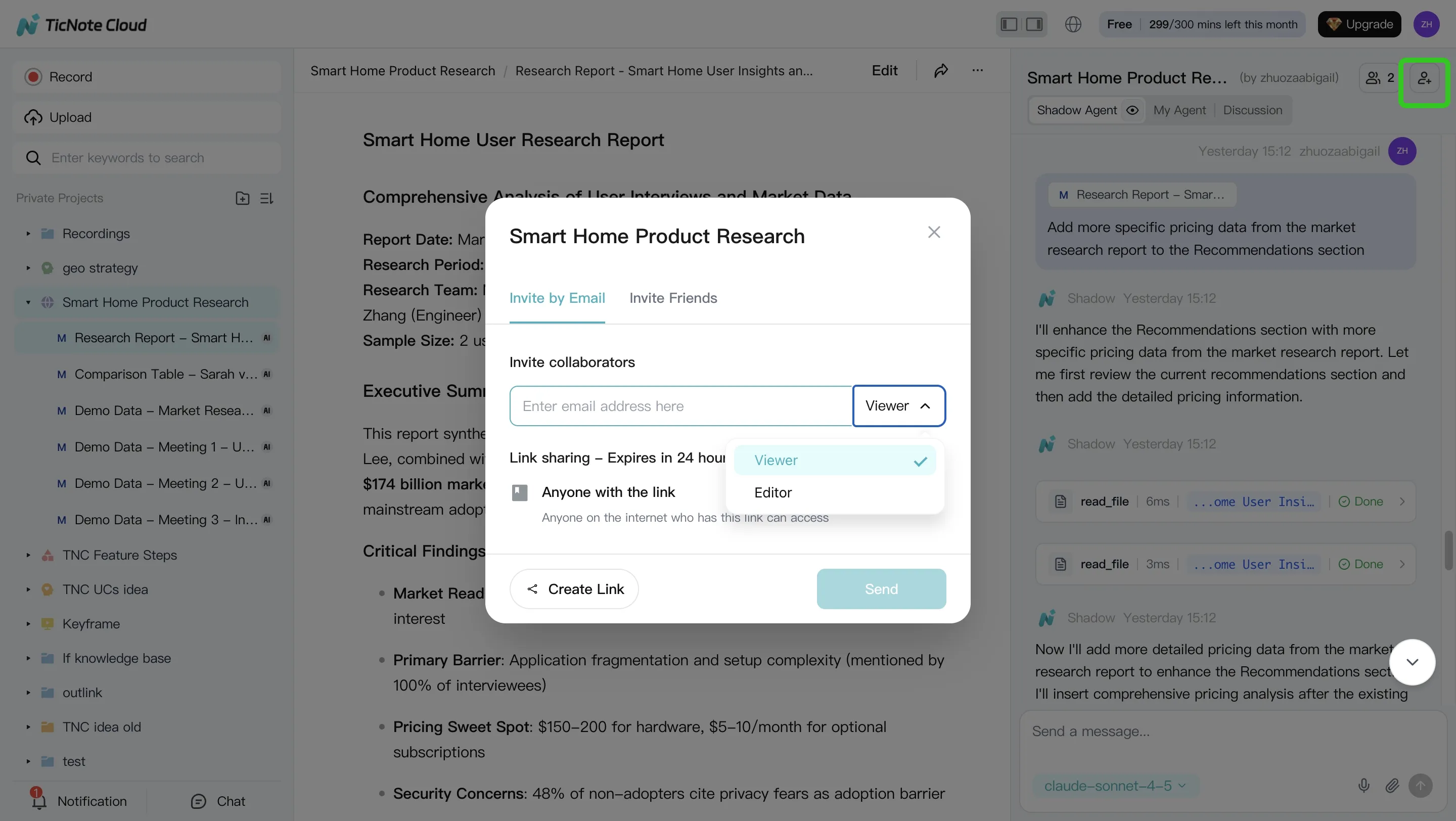
- Review, refine, and collaborate. Use review loops before publishing. Assign owners, tighten wording, add missing evidence, and confirm approvals. Team members can comment, ask follow-up questions, and work within Owner, Editor, or Viewer permissions. Shadow operations remain traceable.
App workflow: capture decisions before they disappear
On App, capture or upload recordings right after a Gemba walk, supplier call, maintenance handoff, or customer escalation. Add them to the same Project so mobile notes don't become a second silo.
Use quick searches for 现场 follow-ups: "What did maintenance promise before Friday?" or "Which defect code was mentioned?" You can also request a short summary or report draft to share immediately, then let the Web team refine it later.
Governance note: treat each Project as a controlled decision record. Set permissions, retention rules, and approval steps. Keep a clear boundary between drafting recommendations and executing actions in production systems.
Pilot roadmap, governance, and success metrics
An ai agent for manufacturing pilot needs a narrow scope, clean data, and clear approval gates. Treat the first 90 days as a controlled operating test, not a technology showcase.
Run a 30/60/90-day pilot
- Days 1–30: Pick one workflow, such as CAPA drafting, maintenance triage, or supplier review follow-up. Assign owners: operations lead for process fit, quality lead for records, reliability lead for CMMS data, IT/OT for systems, and security for access rules. Capture baselines.
- Days 31–60: Run the agent beside the current process. Compare outputs weekly, log errors, and require human review.
- Days 61–90: Standardize templates, approvals, naming rules, and audit logs. Then expand to a second line, value stream, or plant.
Prepare only the data the pilot needs
Start with exportable views, not a full data lake. Use stable names, version control, and role-based access for:
- Meeting audio, attendees, decisions, and action owners
- SOP revision history and effective dates
- NCR/CAPA records, defects, causes, and closures
- CMMS work orders, asset tags, downtime, and parts
- ERP/MES/SCADA exports for orders, lots, shifts, alarms, and yields
- Supplier files, scorecards, deviations, and commitments
Set action limits before go-live
| Agent action | Allowed examples | Approval rule |
| Draft | Summaries, RCA narratives, CAPA updates | Owner reviews |
| Recommend | Maintenance priority, document gaps | Lead approves |
| Escalate | Safety, quality, compliance risk | Immediate human review |
| Auto-execute | Process changes, dispositions, purchase commitments | Never without sign-off |
Use NIST AI RMF-style gates: govern, map, measure, and manage. Track a weekly scorecard: documentation cycle time, follow-up completion, RCAs closed on time, plus OEE drivers, MTTR, and scrap where linked. Example KPI callout: reduce CAPA narrative drafting from 2 hours to 20 minutes.
Final thoughts
The best ai agent for manufacturing is rarely one tool. It is a stack: shop-floor analytics that spot downtime, defects, and bottlenecks, plus a knowledge agent that preserves the "why" behind decisions, actions, and exceptions.
Use this rule of thumb:
- Start with one workflow, such as maintenance retrospectives or quality CAPA reviews.
- Set autonomy limits, including who approves work orders, supplier changes, and customer replies.
- Require citations, audit trails, and permission controls before scaling.
- Measure against a baseline for cycle time, repeat issues, scrap, rework, and follow-up speed.
For broader rollout planning, use this operations agent pilot guide to map owners, risks, and 60–90 day milestones.
Place an in-article signup banner after the pilot roadmap so readers can turn meeting knowledge into audit-ready outputs.