


 Extension
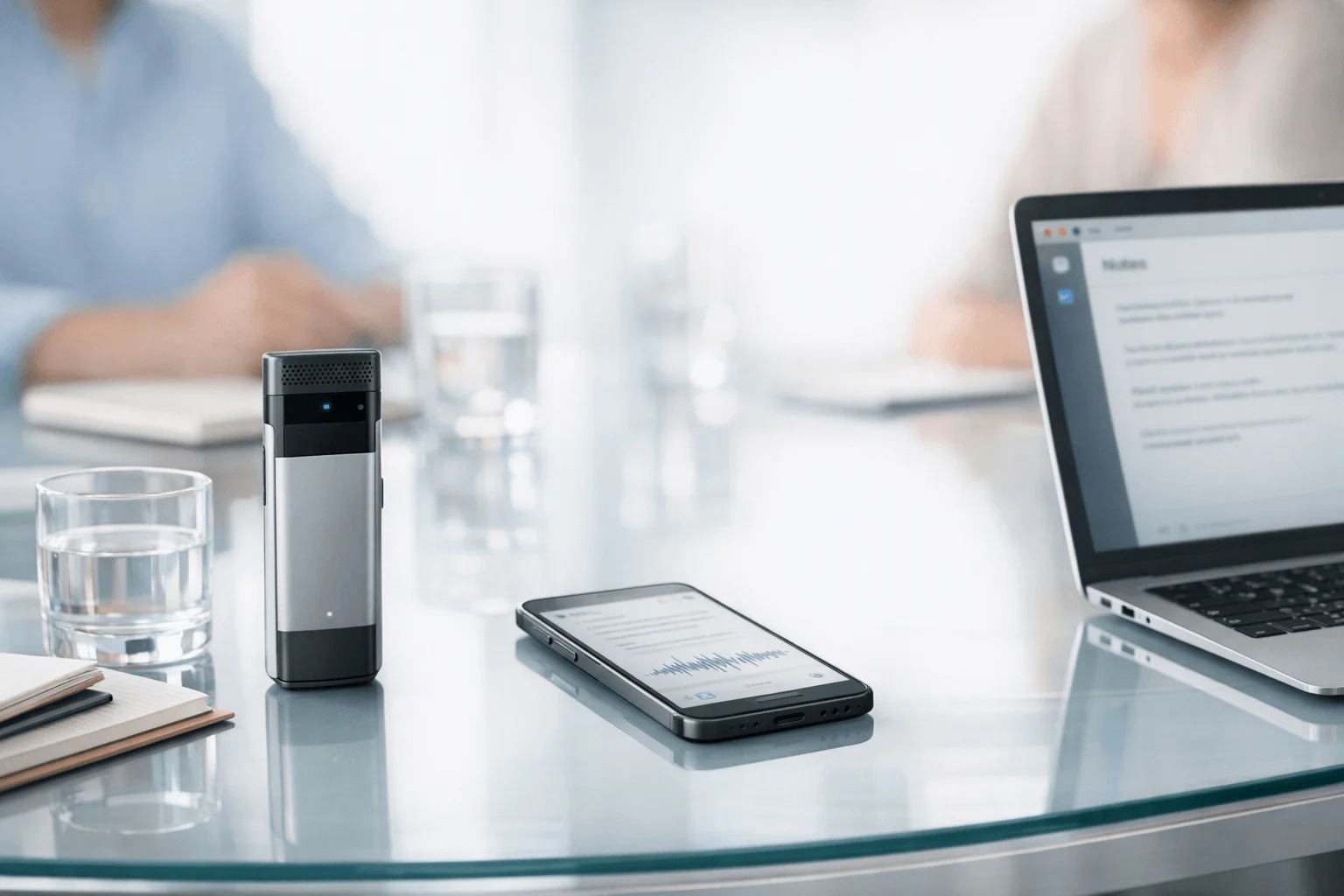
If you want a bot-free way to capture internal meetings, See the Device: we tested 6 AI note takers across a 6-week review window using internal standups, planning sessions, 1:1s, boardroom reviews, and cross-functional workshops. TicNote Card Lite is the clearest fit for managers who want a bot-free internal meeting note taker they can press once and leave on the table, while Fireflies.ai is the better fit for teams that live inside CRM and workflow automation after online meetings. The contrarian insight: for internal meetings, transcript quality is no longer the main separator; capture method, privacy posture, and long-run cost matter more.
What you'll learn:
- How to choose between hardware and software first: use the hardware-vs-software section to decide whether your internal meetings happen around a table, on a phone call, or inside Zoom.
- Which products charge once versus every month: compare device prices, free tiers, and subscription limits before your team adopts a tool.
- How the side-by-side table normalizes tradeoffs: scan pickup range, offline recording, integrations, and post-meeting automation in one place.
- Which tool fits each internal meeting format: see scenario guidance for standups, planning sessions, boardrooms, and 1:1s, especially if you need an in-person recorder instead of a meeting bot.
- How bot-free AI note takers compare with bot-based apps: understand when privacy, meeting etiquette, and blocked bots should change the buying decision.
What is an AI note taker for internal meetings, and why does everyone suddenly need one?
An AI note taker for internal meetings records the conversation, converts speech into text, and gives you summaries, action items, and searchable notes. More advanced tools now also add translation, speaker identification, workflow exports, and AI chat over past recordings.
The category now spans both dedicated hardware and software plans with free tiers, one-time device purchases, and paid subscriptions from $6.58 to $39.99 per month-equivalent or $119 to $299.99 upfront. What changed is that you can now choose between bot-based meeting software such as Otter, Fireflies.ai, and Notta, or bot-free hardware such as TicNote, PLAUD, and HiDock. That means internal meeting buyers are no longer deciding whether AI notes are possible; they are deciding which capture model creates the least friction for their workflow.
But here's what most articles won't tell you. Basic transcription is becoming commoditized across both hardware and software, so the real buying decision is less about who can transcribe and more about who fits internal team behavior.
- Capture method (hardware vs. bot vs. bot-free software)
- Cost structure (one-time device plus minute plan vs. seat-based subscription)
- Privacy posture (local/offline-first capture vs. full cloud pipeline)
How did we test these tools?
We tested these tools over 6 weeks across Zoom, Google Meet, Microsoft Teams, phone calls, and in-person conference rooms, using a mix of hardware recorders and software note takers. To keep the review grounded in real internal workflows, we used them in the same kinds of meetings most teams actually run and compared how each one handled capture, summaries, privacy, and day-to-day usability, including trade-offs similar to the ones you see in a recorder vs phone setup.
Meeting types tested:
- Daily standups (4-8 participants)
- Weekly planning sessions (6-10 participants)
- Manager 1:1s (2 participants)
- Boardroom-style reviews (8-14 participants)
- Cross-functional workshops (10-16 participants)
Evaluation criteria (weighted):
- In-person capture reliability (25% weight) -- measured how consistently each tool captured table discussion, side speakers, and non-link-based meetings that internal teams still run in person.
- Summary and action-item quality (20% weight) -- measured whether outputs turned internal discussion into usable recaps, owners, and next steps.
- Privacy and bot friction (15% weight) -- measured whether the tool required a visible bot, full cloud upload, or more discreet offline capture.
- Ease of start in real workdays (10% weight) -- measured how fast a manager or team lead could begin recording without setup overhead.
- Transcription limits and pricing value (10% weight) -- measured free minutes, paid plan thresholds, and long-run cost.
- Collaboration and integrations (10% weight) -- measured exports, CRM and workspace connections, and downstream workflow support.
- Battery, storage, and portability (10% weight) -- measured how well the tool handled back-to-back internal meetings without charging, deleting files, or switching devices.
TicNote, the author's own product, is included in this review. We were explicit about its real limitations, including that hardware products have upfront device cost and weaker native CRM-style automation than software-first tools. All other tools were evaluated independently.
Hardware vs. software: which approach fits you better?
The first real buying decision isn't brand but capture model. For an ai note taker for internal meetings, the split is simple: hardware is built to capture conversations wherever they happen, while software is strongest when the meeting already starts inside Zoom, Meet, or Teams.
| Factor | Hardware | Software |
| Phone call recording | ✅ Core feature | ❌ Not supported |
| Face-to-face meetings | ✅ Set on the table | ❌ Needs workarounds |
| Online meeting transcription | ⭐️ Depends on room audio | ⭐️⭐️⭐️ Direct platform feed |
| Speaker identification | ⭐️ Limited | ⭐️⭐️⭐️ Automatic |
| Hands-free start | ✅ Auto-records on answer | ❌ Open app every time |
| Privacy control | ✅ Local-first, encrypted | ❌ Full cloud pipeline |
| CRM / workflow automation | ❌ Not supported | ✅ Fireflies, Notta |
| Team collaboration | ❌ Not supported | ✅ Comments, search, share |
| Upfront cost | ❌ $119-$299.99 device | ✅ Free to start |
| Long-run cost | ✅ One-time purchase | ⭐️ Monthly fees add up |
Hardware wins when internal meetings include phone calls, boardrooms, or in-person sessions with no meeting link at all. TicNote Pods 4G can automatically record calls when you take a call wearing the earbuds and uploads through its built-in 4G eSIM without a phone nearby, while HiDock P1 uses bi-directional Bluetooth earphone recording for calls and room capture. Hardware also brings battery and privacy advantages because TicNote, for example, supports offline recording and syncs later.
Software wins when the meeting already lives online and the real value is what happens after the call. Otter is stronger for shared searchable transcripts and team collaboration, while Fireflies.ai is stronger for CRM and workflow integrations plus conversation analytics. If the internal meeting workflow starts in Zoom, Meet, or Teams and ends in a shared workspace, software has the cleaner handoff.
The honest answer for mixed workdays is both. But if internal meetings regularly happen on the phone or around a physical table, hardware covers the one part software still cannot replace.
How do these 6 tools compare side by side?
If you want the fastest shortlist, this side-by-side view shows where each tool wins on type, pricing, integrations, and post-meeting automation. For a broader look at top AI recorders, use this table to separate bot-free hardware from meeting bots before you commit.
| Tool | Type | Best For | Platforms | Free Tier | Paid From | Integrations | Post-Meeting Automation |
| TicNote Card Lite | Hardware | Bot-free internal standups and table meetings | Device + phone + desktop + browser via TicNote Cloud | Plus hardware plan included with 600 min/mo | $129.99 device; Pro with device $79/yr | Cross-platform workspace | Summaries, action items, AI chat, documents from recordings |
| TicNote Pods 4G | Hardware | Internal phone calls and hybrid in-person days | Earbuds + charging case + cloud sync | Plus hardware plan included with 600 min/mo | $299.99 device; Pro with device $79/yr | Cross-platform workspace | Live Summary during recording, Quick Summary after stop, call capture |
| PLAUD Note Pro | Hardware | Larger conference rooms and heavier hardware users | Device + app | Starter 300 min/mo | $189 device; Pro $8.33/mo annual | Google Calendar, Zapier, MCP | Templates, Ask Plaud, exports, team management |
| HiDock P1 | Hardware | Bluetooth earphone calls and desk-to-room flexibility | macOS, Windows, iPhone 15+, OTG Android | Unlimited free transcription | $169 device; Pro Membership pricing not fully disclosed | HiNotes sync | Transcription, summaries, sync |
| Otter | Bot | Shared team transcripts for online internal meetings | Web + app + Zoom + Teams + Google Meet | Free plan with 300 monthly transcription minutes | Pro/Business ladder from public pricing | Meeting platform capture | Search, share, edit, speaker ID, auto notes for supported platforms |
| Fireflies.ai | Bot | CRM-heavy internal meetings and follow-up workflows | Web + meeting platforms | Free at $0 | Pro $10/seat/mo annual | CRM and workflow integrations | AI notes, comments, bookmarks, analytics, sync to downstream tools |
The pattern is clear: TicNote Card Lite and TicNote Pods 4G fit teams that want hardware-first capture without a bot joining internal meetings, while Otter and Fireflies.ai are stronger when your workflow already lives inside Zoom, Teams, or CRM automation. PLAUD Note Pro and HiDock P1 sit in the middle, with dedicated hardware plus app-based workflows, but their pricing, platform fit, and automation depth differ more than they first appear.
The 6 best AI note takers for internal meetings in 2026
If you want the fastest shortlist, these six tools split into two clear camps: dedicated hardware for bot-free room capture and software for online collaboration or workflow automation. For most in-person internal meetings, TicNote leads because you can record offline, avoid meeting bots, and still get summaries and action items after sync.
1. TicNote Card Lite — Best for bot-free internal meetings on a budget
Best for: budget-conscious managers who want a simple internal meeting note taker for in-person team sessions
TicNote Card Lite is a dedicated AI voice recorder built for people who want to press once, leave the device on the table, and get transcripts, summaries, and action items after sync. Its positioning is straightforward: lower hardware cost than premium card recorders, no lever or mode switch, and the same TicNote Cloud workflow for summaries and searchable recordings. For internal meetings, it fits teams that care more about bot-free room capture and offline recording than CRM automation. If you're comparing a bot-free meeting recorder to app-based tools, this is the simplest low-cost starting point.
Standout features:
- $129.99 device price: lower entry price than many dedicated AI hardware alternatives in this set.
- Modeless recording: no lever or mode switch, so a manager can start recording with one button.
- 3-mic array with 10m pickup: designed for room capture in internal meetings.
- 25-hour battery: handles back-to-back workdays without frequent charging.
- TicNote Cloud outputs: summaries, to-do lists, AI chat, and document generation from recordings.
Pricing: $0 software plan with 300 min/mo and no hardware | Card Lite device at $129.99 with Plus hardware plan included at 600 min/mo and 1,500 monthly credits | Pro with device at $79/yr for 2,100 min/mo and 3,000 monthly credits
Pros:
- Bot-free table capture: works in internal meetings that have no meeting link.
- Offline recording: keeps working without a phone and syncs later.
- Simple setup: one-button start is easier than opening an app before every meeting.
- Strong value for hardware: lower upfront price than many premium recorder devices.
Cons:
- No deep CRM automation: it does not match software-first tools for downstream workflow integrations.
- Hardware still costs upfront: even the lower-priced model costs more than starting with a free software plan.
- 4GB storage: less onboard storage than TicNote Card and some competing recorders.
In our internal roundtable workflow, Card Lite was the easiest device to hand to a project lead before a 30-minute planning session: one press started capture, and the recording synced later into TicNote Cloud for summary and action items.
2. TicNote Pods 4G — Best for internal phone calls and hybrid field-to-office work
Best for: professionals who move between calls, hallway conversations, and room meetings in the same day
TicNote Pods 4G is not a generic earbud product; it is built for users who need a meeting recorder with action items across calls and in-person sessions. Its differentiator is the 4G eSIM in the charging case, which uploads audio in real time without the phone nearby and can push Live Summary while the meeting is still going. For internal-meeting-heavy operators, this is the SKU that makes the strongest case when phone calls matter as much as boardroom sessions.
Standout features:
- Built-in 4G eSIM: uploads without a phone nearby.
- Automatic call recording when wearing earbuds: captures phone conversations without manually opening an app.
- Live Summary: AI summary during the meeting, not only after it ends.
- Quick Summary: instant pushed summary when recording stops.
- 32GB case storage and around 2,150 hours: built for heavier capture volume.
Pricing: $0 software plan with 300 min/mo and no hardware | Pods 4G device at $299.99 with Plus hardware plan included at 600 min/mo and 1,500 monthly credits | Pro with device at $79/yr for 2,100 min/mo and 3,000 monthly credits
Pros:
- Handles calls and room meetings: broader capture coverage than most software tools.
- Phone-free upload: useful for field work and mobile professionals.
- Live and instant summaries: faster turnaround than many sync-later workflows.
- Auto-switch recording modes: earbuds for calls and case for room recording.
Cons:
- Highest upfront cost in this list: $299.99 is a real commitment.
- Battery drops with 4G on: around 13 hours with 4G active versus longer on simpler devices.
- Less relevant for desk-bound teams: overkill if all internal meetings already happen online.
3. PLAUD Note Pro — Best for larger internal rooms and premium recorder specs
Best for: teams that want stronger hardware specs for conference-room capture
PLAUD Note Pro is a dedicated hardware recorder aimed at heavier professional use, and its clearest internal-meeting advantage is the larger pickup range. At $189, it sits above many entry hardware options and adds 64GB storage, up to 16.4 ft pickup, 4 MEMS plus 1 VPU, and integrations such as Google Calendar, Zapier, and MCP. It fits internal meetings best when room size and premium device specs matter more than budget.
Standout features:
- Up to 16.4 ft pickup: longer room reach than many card-style recorders.
- 64GB storage: enough for heavier recording volume.
- 30h to 50h recording depending on mode: built for long sessions.
- Google Calendar, Zapier, and MCP: stronger automation story than many hardware-first rivals.
- Ask Plaud and export options: broader post-recording workflow tools.
Pricing: Starter free with 300 minutes/month | Note Pro device at $189 | Pro plan at $8.33/month billed annually or $17.99 monthly with 1,200 minutes
Pros:
- Longer pickup range: stronger fit for larger internal conference rooms.
- More mature hardware-plus-automation mix: broader integrations than some hardware-only products.
- Large storage and strong battery: built for frequent users.
- Multiple export and template options: helps structured recap workflows.
Cons:
- Costs more than several hardware alternatives: $189 before subscription upgrades.
- Still weaker than software bots for direct online-meeting ingestion: room audio is still an indirect input.
- More premium than some teams need: smaller internal meetings may not justify the spec jump.
4. HiDock P1 — Best for Bluetooth earphone calls plus room capture
Best for: professionals who spend internal meeting time on Bluetooth calls as much as around a table
HiDock P1 is a portable AI recorder that leans hard into Bluetooth earphone recording rather than only table capture. At $169, it is positioned between simpler card recorders and higher-end mobile hardware, with Call, Room, and Whisper modes, 64GB storage, and unlimited free transcription. For internal meetings, it is a fit when earphone-call capture is central and bot-free behavior matters.
Standout features:
- Bi-directional Bluetooth earphone recording: uncommon hardware mechanism for call-heavy users.
- Call, Room, and Whisper modes: distinct capture modes for different work contexts.
- Unlimited free transcription: removes one common ongoing cost.
- 75+ language transcription: useful for multilingual teams.
- Works across macOS, Windows, iPhone 15+, and OTG Android: flexible device support.
Pricing: core transcription is unlimited and free | P1 device at $169 | Pro Membership adds speaker identification, templates, and live transcription, but public pricing was not fully disclosed in the available product data
Pros:
- Strong fit for Bluetooth call workflows: better aligned to earphone-heavy workdays than standard table recorders.
- No required transcription subscription for core use: cost model is easier to predict.
- Portable hardware format: flexible between desk and mobile contexts.
Cons:
- Public Pro pricing is not fully disclosed: harder to model advanced-feature cost.
- Less decision clarity for buyers than cleaner plan matrices: teams may need extra validation before rollout.
- More niche workflow fit: strongest only if Bluetooth earphone recording is a real daily need.
5. Otter — Best for searchable shared notes in online internal meetings
Best for: teams that already run most internal meetings in Zoom, Teams, or Google Meet
Otter is a software-first AI meeting recorder for in-person meetings only in a limited sense; its real strength is online meeting capture, searchable transcripts, and shared notes. The product is built for business users, journalists, and students, and for internal team workflows it works best when the meeting already has a link and the team values collaboration over bot-free discretion. Otter fits internal meetings less well when the room is physical and there is no direct online feed.
Standout features:
- Search, edit, organize, and share transcripts: designed for collaborative note access.
- Speaker identification: stronger native transcript structure than many room-audio hardware tools.
- Automatic note capture for Zoom, Teams, and Google Meet: clean for scheduled online internal meetings.
- Inline photos and key phrases: adds context to meeting notes.
- Custom vocabulary on paid plans: helpful for internal team terminology.
Pricing: Free plan with 300 monthly transcription minutes | Pro plan in the public pricing ladder with 1,200 monthly minutes | Business pricing appears from public search results at $19.99/user/month
Pros:
- Strong collaboration workflow: teams can search and share notes easily.
- Good fit for recurring internal online meetings: direct platform capture is cleaner than recording room audio.
- Mature software experience: editing and organization are stronger than on hardware-first tools.
- Speaker identification and cloud history: useful for ongoing team knowledge.
Cons:
- Visible bot or platform dependency: not ideal for teams avoiding bots.
- Weak fit for offline in-person meetings: phone or room workarounds are inferior to dedicated hardware.
- Ongoing subscription cost grows by seat or plan: long-run cost is not as simple as one device purchase.
6. Fireflies.ai — Best for internal meetings that must flow into CRM and ops workflows
Best for: operations, sales-adjacent, and cross-functional teams that care about post-meeting automation
Fireflies.ai is less about the transcript itself and more about what happens after the meeting. It is a software-first conversation intelligence platform with 100+ languages, speaker recognition, AI notes, analytics, and a pricing ladder from Free to Pro at $10/seat/month annually and Business at $19/seat/month annually. For internal meetings, it is the better fit when notes need to move into CRM, ATS, Slack, or other operational systems.
Standout features:
- Strong integration story: built around CRM, ATS, Slack, and workflow sync.
- AI notes, comments, and bookmarks: useful for collaborative follow-up.
- Analytics and conversation intelligence: goes beyond raw recap.
- 100+ language support: broad language coverage.
- Enterprise-grade controls on higher tiers: includes security and admin capabilities.
Pricing: Free at $0 | Pro at $10/seat/month billed annually | Business at $19/seat/month billed annually; Enterprise at $39/seat/month billed annually
Pros:
- Best post-meeting workflow depth in this list: strongest when action must continue in downstream systems.
- Rich collaboration features: comments, bookmarks, and channels support team use.
- Clear paid pricing ladder: easier to forecast than tools with vague plan detail.
- Broad security and compliance messaging: useful for larger organizations.
Cons:
- Bot-based workflow is not welcome in every internal meeting: some teams dislike the meeting-bot presence.
- Less useful for phone calls and offline room capture: software cannot replace dedicated hardware there.
- Seat-based pricing can scale fast: heavier team use raises long-run cost.
Conclusion: how to decide
If phone calls or in-person meetings are part of your day, hardware is still the category software structurally cannot replace. TicNote Card Lite is the simplest lower-cost fit for bot-free internal meetings at $129.99, while PLAUD Note Pro is the better fit for larger rooms that need up to 16.4 ft pickup and more premium recorder specs; if you want a faster way to compare those trade-offs, this device comparison guide helps.
If calls matter as much as room meetings, TicNote Pods 4G stands out because it can automatically record when you take a call wearing the earbuds and upload through its 4G eSIM without the phone nearby. Software still wins for linked online meetings: Otter is stronger for shared transcripts and search, while Fireflies.ai is stronger for integrations and workflow automation.
But for heavy internal-meeting users, the final answer usually becomes both, because hardware covers the conversations software never will.