


 Extension
As AI agents move from flashy demos to real enterprise workflows, the biggest bottleneck is no longer generating text. It is giving AI enough context to act usefully inside messy, real-world systems. That shift is now shaping the productivity market in 2026, as startups like Trace attract fresh attention by tackling the "agent adoption problem" with a context-first approach. Against that backdrop, more professionals and teams are rethinking their workspace stack and looking beyond Notion AI for tools that do more than write. They want AI workspaces that can capture conversations, connect knowledge, preserve context, and turn raw inputs into action.
That is where this guide comes in. In this blog, we will explore the best AI workspace tools for smarter workflows in 2026, platforms that go beyond simple writing assistance to offer intelligent, connected, and creative ways to manage work. Whether you are a researcher synthesizing interviews, a manager running cross-functional projects, or a creator turning recordings into publishable content, these tools can help you work faster and think more clearly.
By the end of this article, you will know which tools deserve a place in your digital workflow, what makes an AI workspace truly useful, and how the top options compare in real use.
Quick Comparison Table
Here is a quick overview of the best AI workspace tools in 2026, each designed to improve productivity, creativity, and workflow efficiency in a different way.
| Tool Name | Best For | Key Features | Free Plan | Platforms |
| TicNote Cloud | Meeting-driven collaboration | Projects, Shadow Agent, 120+ languages, citations, mind maps, reports, decks | ✅ Yes | Web, device + cloud |
| MindMap AI | Visual workflow brainstorming | Turns text and PDFs into mind maps, AI summaries, collaboration, exports | ✅ Yes | Web, Android, iOS |
| Mem AI | Smart note recall | Contextual memory, AI writing, knowledge graph, task tracking | ✅ Yes | Web, macOS, iOS |
| Taskade | Team planning | AI chat, project templates, brainstorming, mind maps, collaboration | ✅ Yes | Web, Windows, macOS, Android, iOS |
| Reflect AI | Journaling and ideas | AI reflections, tagging, reminders, privacy-focused | ❌ No | Web, macOS, iOS |
| Coda AI | Doc workflow automation | AI for docs and data, formulas, templates, workflow integration | ✅ Yes | Web, Windows, macOS |
| NotionFlow | Minimal workspace | Simple task lists, AI suggestions, lightweight collaboration | ✅ Yes | Web, Android, iOS |
Why Look for AI Workspace Alternatives in 2026?
AI-powered productivity is no longer just about drafting text inside a document. In 2026, users expect an AI workspace to understand context, support collaboration, and help move work from conversation to completion. Traditional note-taking and page-based systems are still useful, but they are not always the best fit for how people actually work.
Many teams now deal with scattered meetings, fragmented documents, repeated manual organization, and too many tools that do not share context with each other. A summary alone is not enough when you need traceable decisions, reusable knowledge, multilingual collaboration, or fast outputs for clients and stakeholders.
At the same time, newer platforms are becoming more specialized. Some are better for visual thinking, some for task planning, and some for project-level knowledge management. This is why people are exploring the best AI workspace options in 2026. They want tools that are more actionable, more connected, more visual, and better aligned with real workflows, not just AI added on top of a notes app.
Top 7 AI Workspace Tools for Smarter Workflows (2026)
If you like the idea of AI helping you stay organized but want something more capable than a basic writing assistant, you are not alone. In 2026, several tools now offer smarter and more practical workspace experiences, whether you are managing projects, taking notes, brainstorming ideas, or turning conversations into polished output. Here are the top seven AI workspace tools worth exploring.
TicNote Cloud
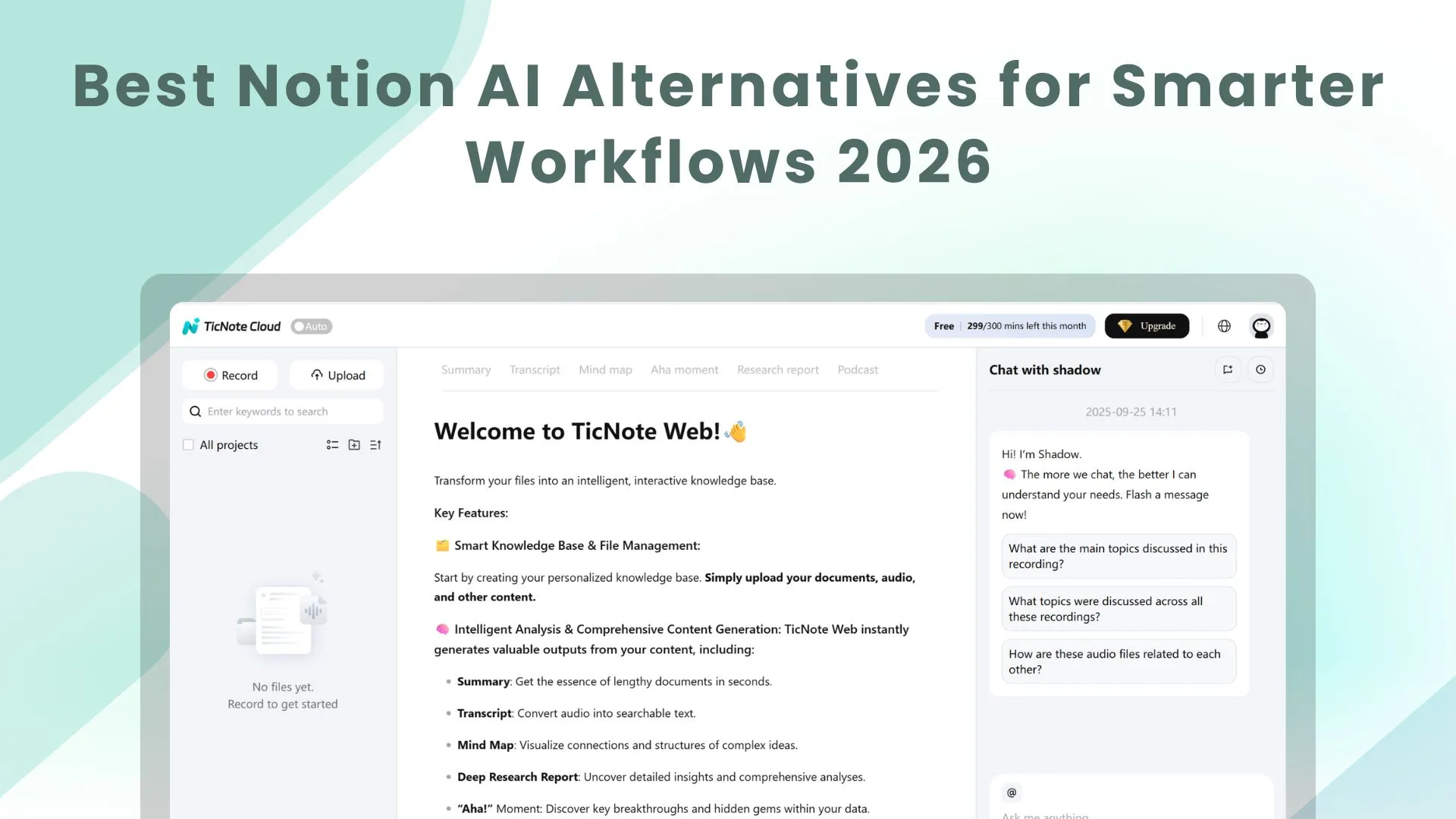
TicNote Cloud is an AI collaborative workspace designed to turn conversations into actionable deliverables. Instead of treating meetings, documents, and research as separate pieces of work, it brings them together inside a single Project where teams can capture content, edit it collaboratively, retrieve context across files, and use the Shadow Agent to generate outputs in multiple formats. This makes it especially useful for people whose work starts in conversation and ends in deliverables.
Key Features: Project-based workspace, Shadow Agent with project memory, real-time recording and uploads, multilingual transcription and translation in 120+ languages, multi-level summaries, transcript editing, traceable citations, mind maps, collaborative comments, version history, and multi-format outputs including reports, presentations, podcasts, and translated documents.
Why It is an Alternative: Unlike text-first AI tools, TicNote Cloud helps users move from raw discussion to finished work inside the same workspace. It is not just writing assistance. It is a true AI workspace for meetings, research, collaboration, and deliverable creation.
MindMap AI
MindMap AI transforms ideas, text, research papers, or PDFs into dynamic visual mind maps. It is ideal for students, creators, and teams who think visually. You can instantly turn written ideas into connected concepts, making brainstorming and project planning easier than ever.
Key Features: Text-to-mind map generator, AI summarizer, real-time collaboration, export to image/PDF formats, and theme customization.
Why It is an Alternative: Unlike traditional text-heavy workspaces, MindMap AI helps you see how your ideas connect, making it a strong fit for creative thinkers and strategic planners.
Mem AI
Mem AI uses contextual intelligence to help you remember what matters. It automatically organizes notes, links related ideas, and suggests insights based on your previous writing. It is like having a memory-boosting assistant built into your notes.
Key Features: Smart tagging, AI-based idea linking, search by context, private cloud storage.
Why It is an Alternative: While many AI workspaces organize information in folders or databases, Mem AI helps you think faster by surfacing what is relevant in the moment.
Taskade
Taskade is a powerful collaboration tool that combines tasks, notes, and chat into one platform. Its AI helps teams plan projects, write content, and create workflows in real time. It is fast, visually organized, and easy to use across devices.
Key Features: AI chat, smart task lists, project templates, mind mapping, real-time collaboration.
Why It is an Alternative: Taskade replaces rigid document structures with an intuitive, all-in-one workspace where teamwork feels natural and productive.
Reflect AI
Reflect AI is built for thinkers, writers, and professionals who value privacy and focus. It uses AI to help you capture thoughts, summarize daily reflections, and find insights in your notes. Its minimalist design makes it perfect for journaling and deep work.
Key Features: Private note storage, AI insights, tagging, and reminders.
Why It is an Alternative: Unlike larger all-in-one systems, Reflect AI is distraction-free and focused on clarity over complexity.
Coda AI
Coda AI turns documents into intelligent, automated workspaces. You can use it to write reports, analyze data, or automate workflows, all inside customizable docs. It is ideal for teams who want both structure and flexibility.
Key Features: AI for writing and data, formula-based automation, customizable templates, workflow integration.
Why It is an Alternative: Coda AI offers the versatility of a document workspace while adding real automation and database-level intelligence.
NotionFlow
NotionFlow keeps things simple. It is a lightweight tool designed for those who want to organize their thoughts, write notes, and plan tasks with AI guidance, without the clutter of complex databases or integrations.
Key Features: AI-generated task suggestions, simple lists, cross-device sync, clean interface.
Why It is an Alternative: Perfect for users who want a more minimal, faster, and easier workspace.
How to Choose the Right AI Workspace
Choosing the right AI workspace in 2026 is not just about switching tools. It is about finding the one that matches how you naturally think, plan, and create. Every person and team works differently, so the best platform is the one that complements your workflow instead of forcing you to adapt to it.
Start by identifying your main purpose. Ask yourself what kind of work you need the platform to support most. Do you need note-taking, project planning, brainstorming, meeting capture, research synthesis, or output generation? If your work starts with calls, interviews, or team rituals and ends with reports, decks, and action items, a workspace like TicNote Cloud makes a lot of sense because it keeps capture, context, and output in one place. If your focus is visual ideation, MindMap AI may feel more natural. If you manage collaborative plans and tasks, Taskade or Coda AI may be better fits.
It is also important to think about your preferred working style. Some people like highly structured pages and databases. Others think better in diagrams, conversations, or linked notes. The best AI workspace should feel intuitive. If the interface fights your brain, productivity starts leaking out in strange and expensive ways.
Another key factor is the quality of the AI itself. Many tools now advertise AI features, but not all of them use AI in a meaningful way. Some mainly help with writing. Others help with retrieval, task generation, summarization, knowledge linking, or deliverable creation. If you want more than text generation, choose a workspace where AI works as a practical co-pilot for your workflow.
Collaboration is another major consideration. A strong AI workspace should make it easy for multiple people to work from the same context, comment on content, share permissions, and produce outputs without jumping between disconnected apps. This matters even more for small knowledge teams, client-facing work, and cross-functional projects.
You should also look at output flexibility. Some tools help you capture information, but stop there. Others help you turn information into usable assets. If you regularly create decision memos, research summaries, presentations, translated documents, podcasts, or follow-up kits, choose a platform that supports those outcomes directly.
Privacy, multilingual support, and integration quality also matter. The more sensitive or global your work is, the more important it becomes to understand how the platform handles user data, permissions, and language workflows. And of course, pricing should match value. The best AI workspace is not the one with the most features on paper. It is the one that saves meaningful time inside your real process.
The best way to decide is to try before you commit. Most of these platforms offer free plans or trials, allowing you to test how the workspace fits your daily routine. Create a small project, run a real workflow, and see which tool feels the most natural and useful.
In the end, choosing the right AI workspace is about more than replacing a note-taking app. It is about finding a smarter system that helps you think clearly, stay organized, and turn information into action.
Conclusion
As AI productivity tools continue to evolve in 2026, it is clear that there is no single perfect platform for everyone. Different people need different strengths. Some want visual planning, some want task automation, and some want a private space for reflection. But the best AI workspace tools all share one thing in common: they help users move from information to action with less friction.
If you are looking for the best Notion AI alternative for smarter workflows, the real question in 2026 is not which tool sounds the smartest in a demo. It is the workspace can provide the right context at the right time so AI can actually be adopted across real work. In a market increasingly defined by the agent adoption problem and the rise of context engineering, TicNote Cloud stands out by turning meetings, research, and shared knowledge into usable outputs inside one collaborative system.
In the end, productivity in 2026 is not just about storing notes or generating paragraphs. It is about working inside a system that understands context, supports collaboration, and helps you produce meaningful outcomes. If you are looking for the best AI workspace for smarter workflows, TicNote Cloud deserves a serious look.