


 Extension
TL;DR: skill agent workflow for faster positioning decisions
If you need faster competitive positioning decisions, the simplest path is to use a structured research workflow inside a shared workspace like TicNote Cloud: define your market position, gather customer and competitor evidence, turn that evidence into a competitive positioning map and matrix, write a clear positioning statement, and track whether sales calls and market messaging get sharper over time.
Scattered interview notes create slow, opinion-based decisions. That usually leads to weak competitor positioning, mixed messaging, and repeated debates. A workspace like TicNote Cloud helps teams keep transcripts, win-loss notes, reviews, and competitor claims in one place so they can turn raw input into a usable narrative and action plan.
This process is built for product marketers, founders, PMMs, SaaS growth teams, competitive intelligence practitioners, and cross-functional teams that need one repeatable method. The goal is simple: build a defendable position based on customer evidence, then measure if it improves sales conversations, differentiation, and market clarity.
How does competitive positioning shape product growth?
Competitive positioning shapes growth because buyers compare every product against an alternative, even when you think your offer is new. In practice, that means your competitive positioning is the evidence-based choice of where you can win in the buyer's frame of reference. It is not the same as brand positioning or messaging, and that difference matters when teams want clearer demand generation, better sales conversations, and stronger win rates.
Separate positioning from messaging
These three ideas work together, but they do different jobs:
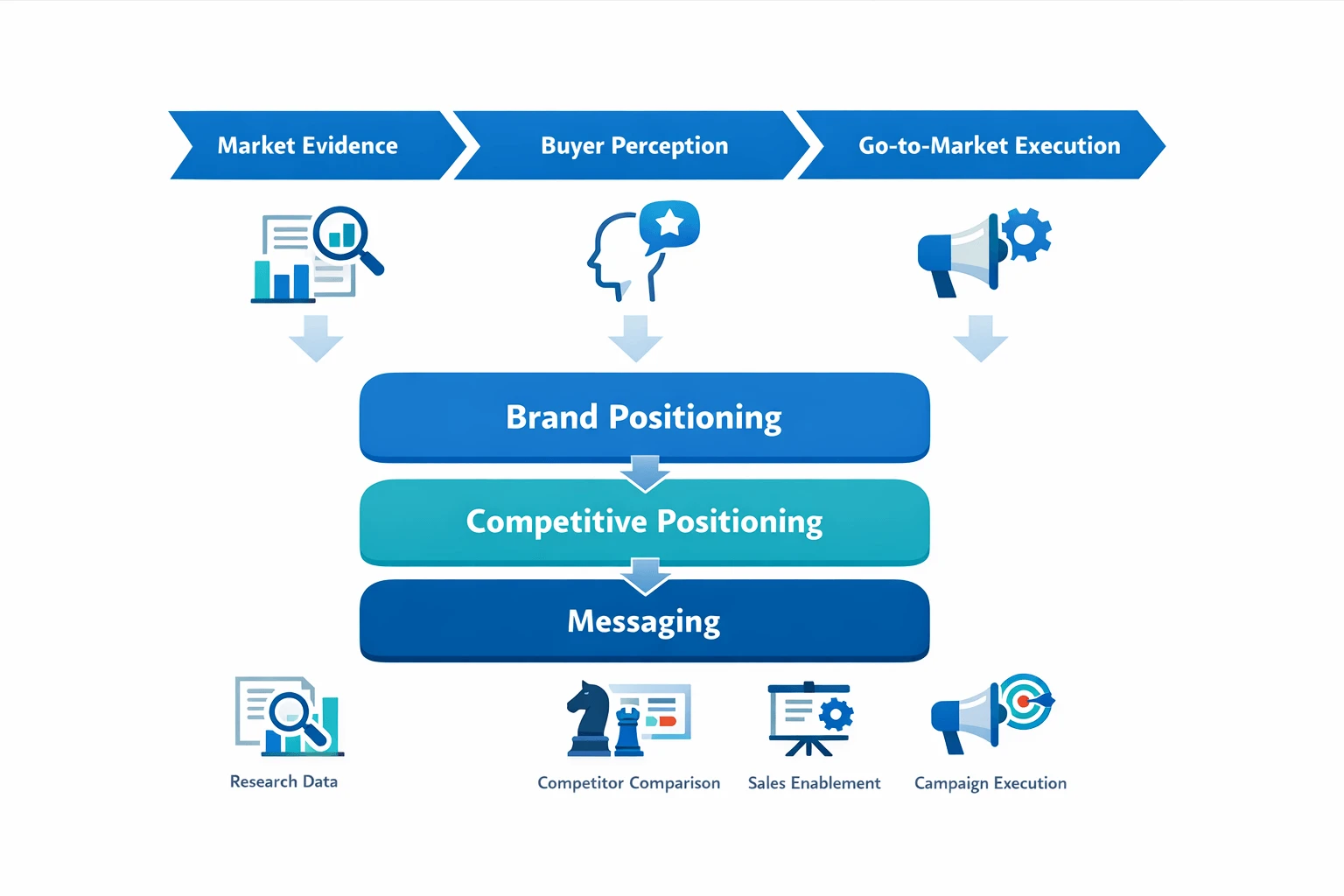
- Brand positioning is the broad perception your company wants to own in the market.
- Competitive positioning is the specific place you aim to win relative to other options buyers may choose.
- Messaging is the language you use to express that position on your homepage, in sales decks, and in campaigns.
Put simply: brand sets the bigger story, competitive positioning sets the comparison, and messaging turns both into words customers can understand fast.
Distinguish visible differentiation from durable advantage
Competitive differentiation is what customers can notice and value now. That could be faster onboarding, clearer reporting, lower total cost, or a simpler workflow. Competitive advantage analysis goes deeper. It tests whether that difference is meaningful, defensible, and linked to capabilities your business can sustain over time.
That is why vague claims like "best-in-class" usually fail. If a team cannot prove the claim with product evidence, customer outcomes, or operational strengths, buyers treat it like filler.
Shape the comparison before the comparison starts
Strong competitor positioning matters before a buyer opens a side-by-side tab. It influences category fit, homepage clarity, sales enablement, roadmap priorities, pricing logic, and win-loss performance. A useful way to think about this is in terms of value zones: distinct market spaces where buyers reward certain strengths more than others.
When you define your position early, you help buyers use your criteria to judge the market. That changes what they notice, what sales reinforces, and what product teams prioritize next. It also gives the company one shared narrative before launches, campaigns, or pricing changes begin. Without that alignment, teams often create noise instead of preference.
Build the research base before you map the market
A useful competitive positioning exercise starts before you draw a single axis. If your inputs are vague, your map will be vague too. The goal here is simple: define the market the way buyers see it, collect proof from real conversations, and build a competitor list based on actual decision patterns rather than assumptions.
Define your ICP, segment, and buying context
Start by narrowing the market. Most teams go too broad, which makes every competitor look relevant. Instead, define your ideal customer profile (ICP), core segment, and buying context in plain terms.
Document these variables in one short research brief:
- buyer role
- company size and stage
- main use case
- urgency level
- switching trigger
- must-have buying criteria
- clear disqualifiers
This matters because competitor positioning changes by context. A seed-stage startup buying for speed will compare options differently than an enterprise team buying for control and compliance. When you capture assumptions, buying criteria, and deal-breakers in one place, your later competitive positioning map reflects how customers actually choose.
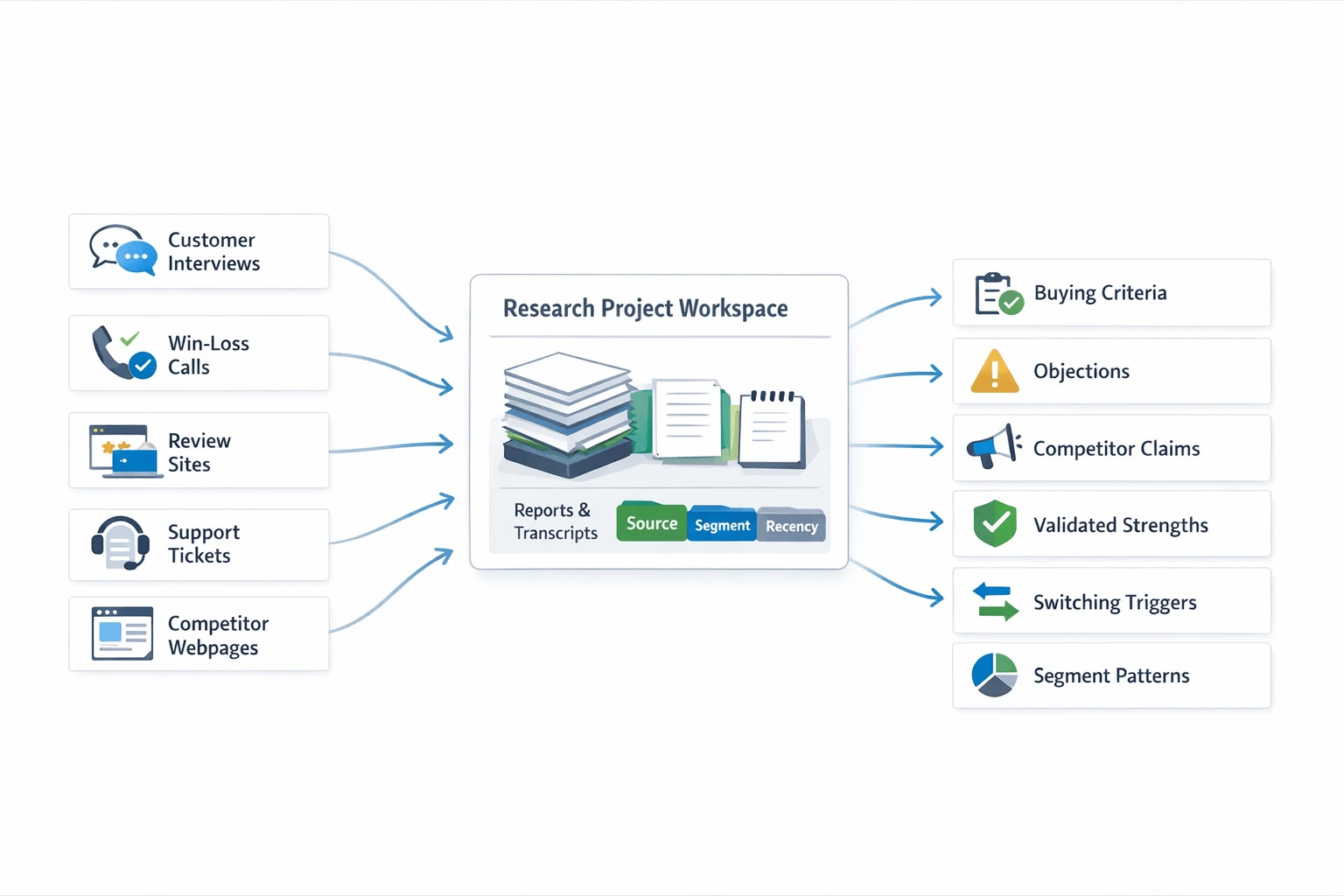
Collect interviews, win-loss notes, and review themes
Next, gather evidence from every customer-facing source you already have. That usually includes:
- customer interview transcripts
- sales call notes
- win-loss interviews
- demo feedback
- objection handling notes
- product reviews
- support tickets
- analyst, forum, or community mentions
Tag each input by source, segment, and recency. That small step makes patterns easier to trust. A quote from last week's enterprise loss should not carry the same weight as a two-year-old review from a different segment.
This is where a centralized workspace helps. Instead of pasting quotes into scattered sheets, teams can store meeting transcripts, uploaded documents, and notes in one TicNote Cloud Project. Then they can search across files later, compare themes, and trace claims back to the original source with less manual work. If you want a deeper method, this guide on turning competitor research into an action scorecard pairs well with this step.
Tier direct, indirect, and substitute competitors
Now build the competitive set. Separate vendors into three groups:
- primary: direct alternatives buyers compare in active deals
- secondary: adjacent tools that solve part of the problem
- substitutes: internal workflows, agencies, spreadsheets, or doing nothing
Track a few fields for each: target segment, pricing model, core message claims, top use cases, proof points, and repeated customer mentions. Most important, separate what a company says from what customers validate. Homepage copy may claim speed, quality, or ease of use. Your research should confirm whether buyers repeat those strengths without prompting.
That research base is what makes a competitive positioning matrix reliable. Without it, the final map is just opinion.
How to create a competitive positioning map and matrix
A strong competitive positioning system does two jobs at once: it shows the market visually, and it helps your team make better choices. The map helps you see patterns fast. The matrix helps you compare vendors in a more structured way. Used together, they turn scattered opinions into an evidence-based view of where you can win.
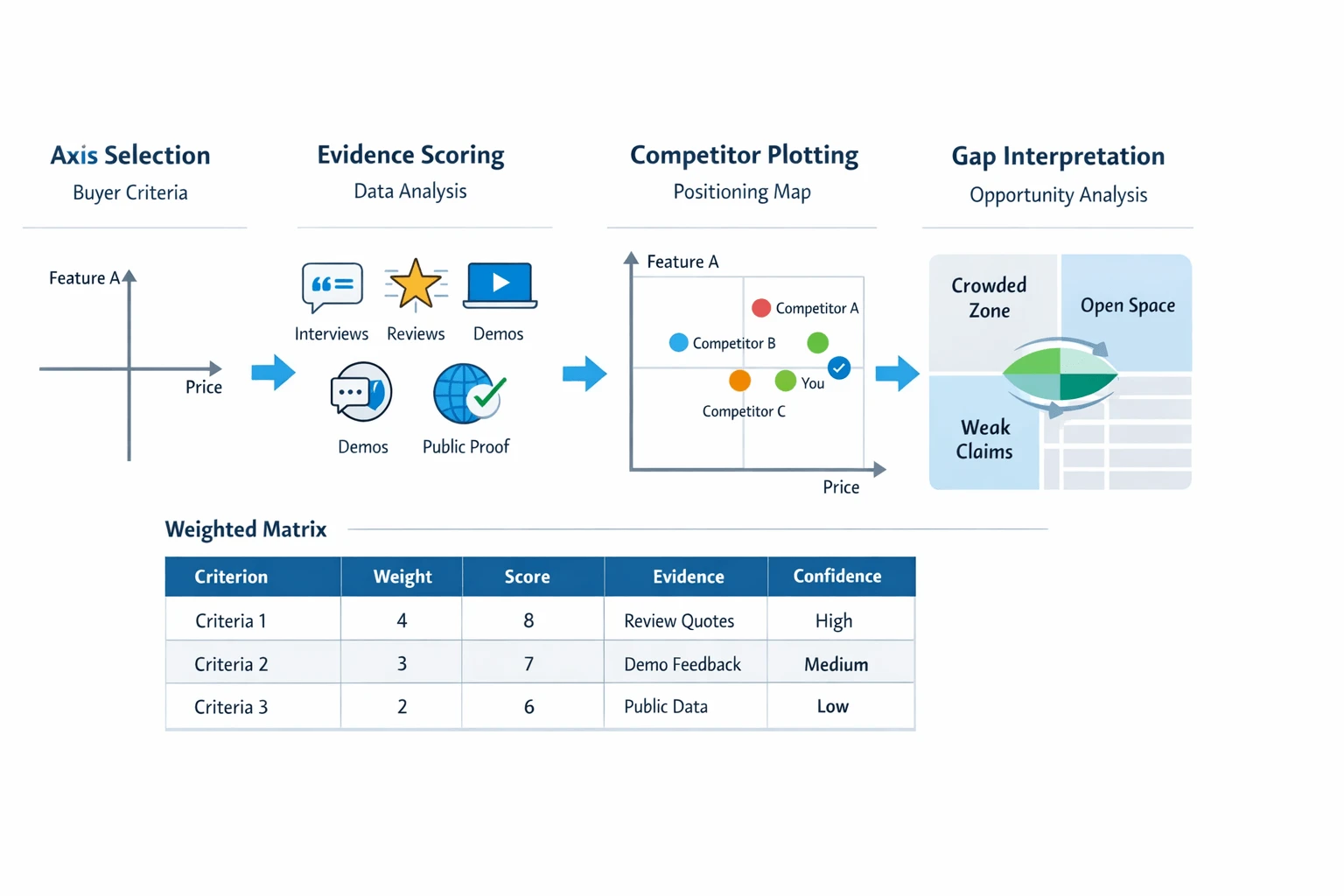
Pick axes buyers actually use
Start with the buyer, not your internal roadmap. Your axes should reflect real decision criteria that shape shortlists, demos, and final selection.
Good axis pairs often include:
- speed to value vs customization
- ease of use vs depth
- strategic control vs automation
- price transparency vs enterprise flexibility
Avoid vague axes like "quality" or "innovation" unless you define them in plain terms. For example, "innovation" becomes useful only when you break it into observable signals such as release speed, workflow automation, or breadth of integrations.
Use a competitive positioning map when you want to show market patterns in one view. Use a competitive positioning matrix when you need to compare more variables such as pricing model, onboarding effort, AI features, support level, compliance, or deployment fit. In practice, most teams need both.
Score competitors with evidence, not assumptions
This is where many teams go wrong. They place competitors based on opinion, not proof. A better method is simple: collect evidence, score it, then note how confident you are.
Build each score from:
- interview quotes from prospects and customers
- product evidence from free trials or demos
- review language from public sites
- sales call and win-loss notes
- public proof points such as pricing pages, case studies, and documentation
Then assign a weighted score based on what matters most to your ideal customer profile (ICP). A startup buyer may care more about fast setup. An enterprise team may care more about admin control and security. Weighting keeps your competitive positioning strategy tied to revenue reality, not equal-value checklists.
A simple matrix can include criterion, weight, score, evidence, and confidence level. Confidence matters because not all claims are equally proven. SWOT-style thinking also helps here. It shows where a strength matters in real buying situations and where a polished claim falls apart. If you want a deeper method, this guide to weighted competitor SWOT scoring fits well before plotting the final view.
Read the map for gaps, crowding, and weak claims
Once you plot competitors, look for three things:
- crowded zones
- open spaces
- weak claims
Crowded zones usually signal message parity. Everyone says the same thing, so buyers see little separation. Open spaces can mean opportunity, but they can also mean low demand. Don't assume an empty quadrant is attractive.
Weak claims show up when vendor messaging is not supported by customer evidence. If a company says it is "easy to use" but reviews mention long setup and heavy training, that claim is weak.
A practical mini-example: imagine three tools in meeting intelligence. Two sit in the "easy but shallow" area. One sits in the "powerful but complex" area. That may reveal a real opening around "fast setup with usable depth." Then your matrix can test whether that opening is real by scoring setup time, search quality, editable outputs, and team collaboration.
To make this section useful, include three assets in the final article: a comparison table, a simple weighted matrix, and a workflow diagram. You can even centralize interview notes, editable transcripts, and cross-file evidence in a TicNote Cloud Project so your team can trace each score back to source material instead of debating from memory. The key rule: never choose a position customers don't value, even if no competitor owns it.
Try TicNote Cloud for free and turn interview evidence into a usable positioning workflow.
Turn insight into a competitive positioning strategy
A strong competitive positioning strategy turns research into a market story your team can actually use. The goal isn't to list every strength. It's to choose the few differences customers care about most, prove them with evidence, and repeat them across product, sales, and leadership.
Choose differentiators customers will value
Start with all possible advantages from your interviews, win-loss notes, positioning map, and competitive positioning matrix. Then filter each one through three tests:
- Customer relevance: does this solve a real pain point or job to be done?
- Competitive contrast: is it meaningfully different from common alternatives?
- Business credibility: can your team prove it with product truth, results, or clear evidence?
If a claim fails one test, don't lead with it. Not every strength belongs in your position. For example, "more features" is weak unless buyers link those features to a faster outcome, lower risk, or less manual work. Strong positioning reflects unmet needs, real buyer language, and proof from market evidence.
Write the positioning statement and message pillars
Use a simple structure:
- For [ideal customer profile]
- Who need [problem, goal, or job]
- Our product is [category or alternative frame]
- That delivers [core differentiated value]
- Because [reasons to believe]
That gives you a copy-ready draft for homepage copy, sales talk tracks, and product messaging. Then turn it into three message pillars. Each pillar should include one promise, two to three proof points, and one objection response.
A practical set might look like this:
- Better workflow speed
- More trustworthy evidence
- Easier team adoption
Notice what's missing: price-led positioning. If you want to know how to turn research into an action-focused competitor report, this is where that work pays off. In many SaaS markets, buyers will pay more for lower risk, faster setup, stronger support, or better fit. That's often a better path than trying to undercut competitors.
Align sales, product, and leadership around one narrative
Once the strategy is set, roll it out everywhere:
- Update sales talk tracks and call notes.
- Refresh homepage headlines and core pages.
- Rewrite battlecards around the new contrast.
- Share launch notes with examples and do-not-say language.
- Get leadership sign-off on final claims and proof.
Watch for four rollout risks: overclaiming, choosing too many differentiators, using terms customers never use, and failing to revisit the strategy as the market shifts. The fix is simple: keep one source of truth. Record the positioning, assumptions, evidence, approved messaging, and next experiments in a shared document so the whole team works from the same version.
How to run a competitive positioning research workflow
To make this practical, the steps below use TicNote Cloud as the example system, but the workflow works for any team building a repeatable competitive positioning process. The goal is simple: turn raw interviews, win-loss notes, and public competitor inputs into a usable report, a comparison-ready view, and a clear competitive positioning matrix.
Set up the research workspace first
Start by adding the Competitor Analysis skill agent in TicNote Cloud. This gives your team one place to run market scans and organize findings without jumping across tabs.
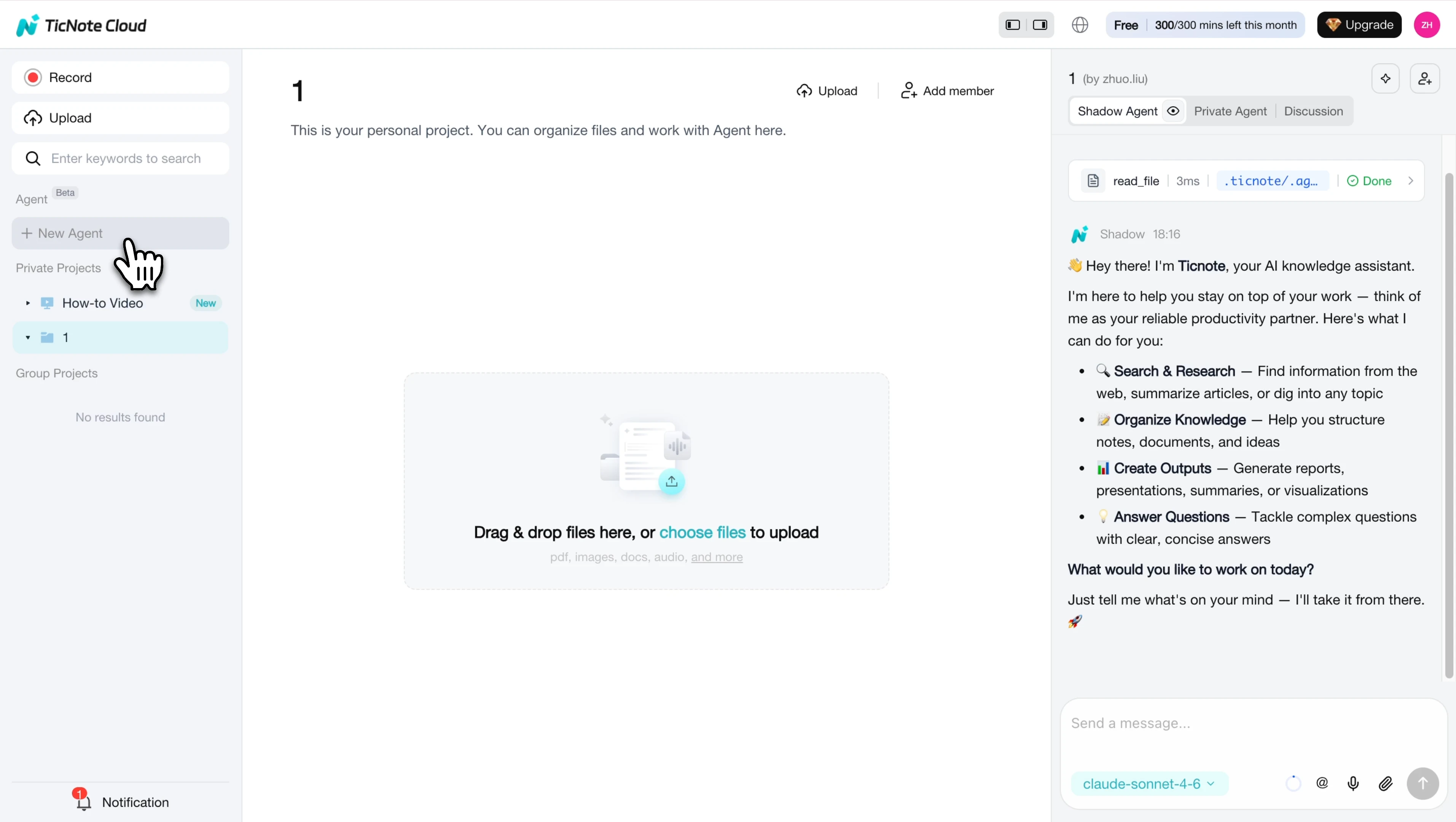
After that, select the competitor analysis agent from the library so it's ready inside your workspace.
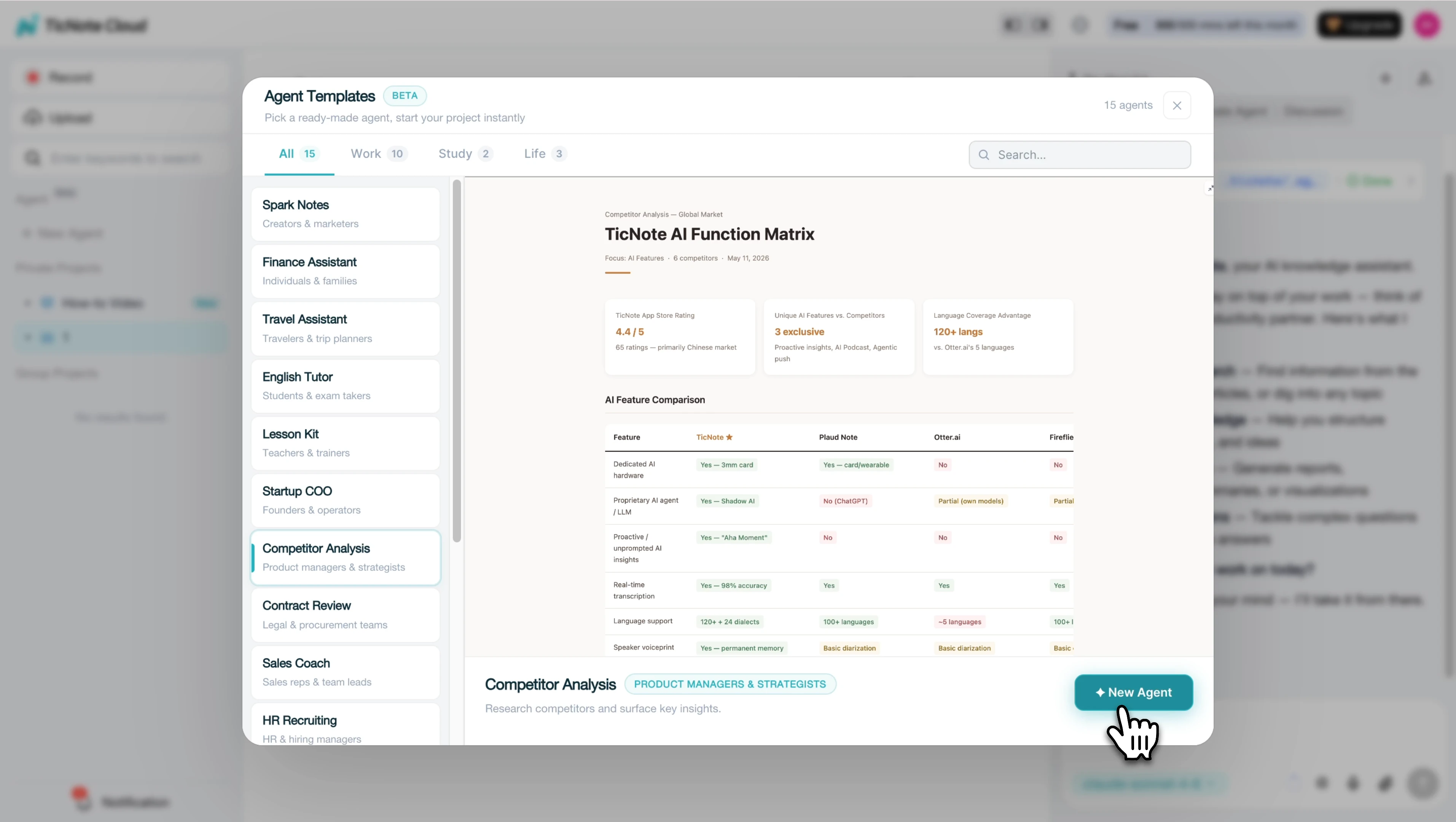
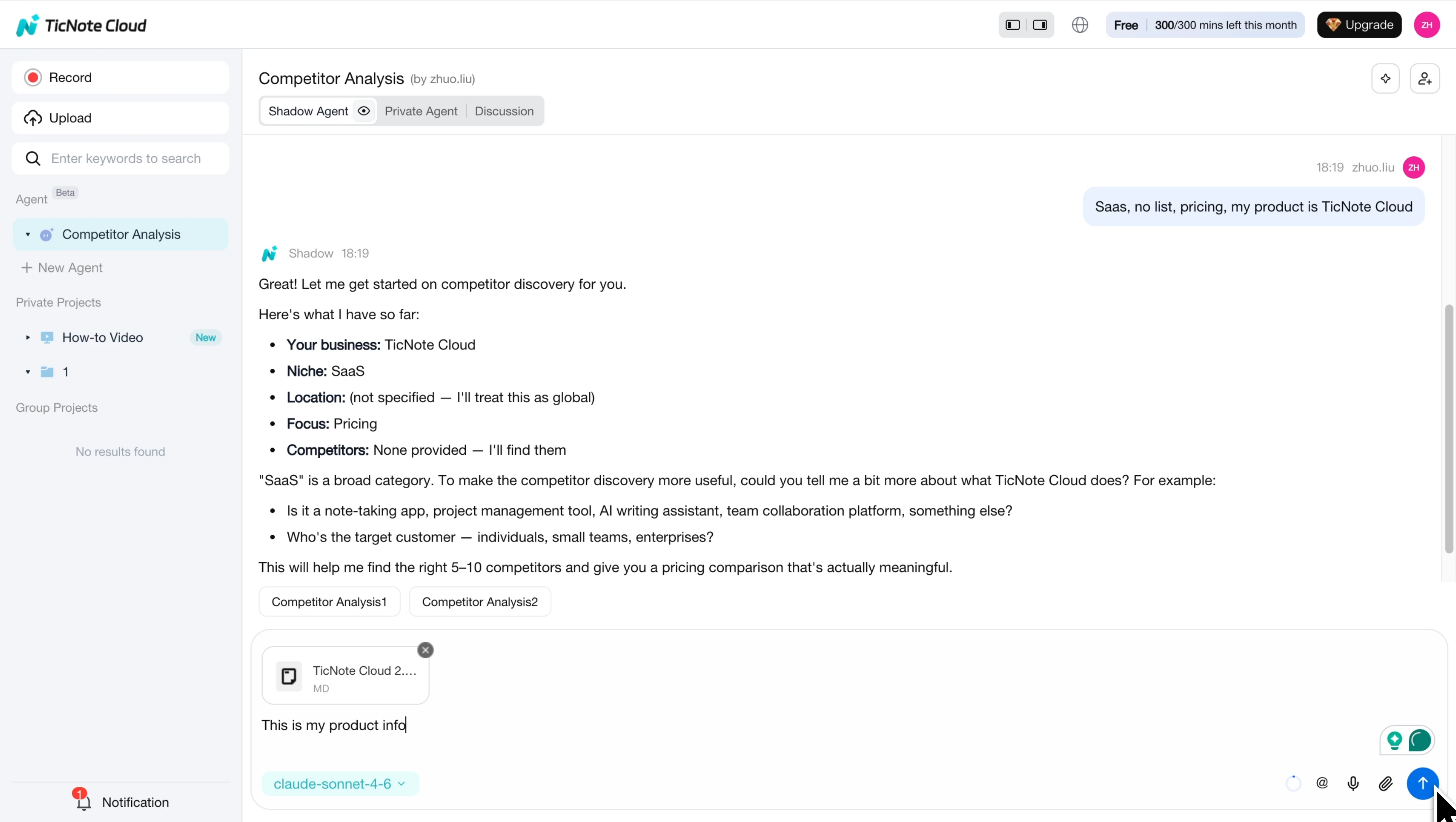
Next, create a Project for the market, segment, or use case you want to analyze. Then add the basics the workflow needs:
- your niche or category
- target location or market scope
- 5 to 10 competitor names or URLs
- an optional focus such as pricing, reviews, social media, or product range
That structure keeps the research scoped. It also makes later outputs easier to compare side by side.
Add source material and clean the signal
Now feed the Project with real inputs. Upload or capture customer interviews, sales calls, support conversations, and internal win-loss discussions. If you also want a stronger public-market view, this is a good point to review related competitor research tools before expanding your source list.
This is where editable transcripts matter. Teams can fix company names, standardize product terms, tag objections, and keep the original context attached to every note. Instead of pasting fragments into a doc, you preserve source-level evidence. Over time, project memory compounds these insights across meetings and files, which makes competitor positioning patterns easier to spot.
Generate the report and comparison output
Once the inputs are loaded, prompt Shadow AI to synthesize cross-file patterns into:
- an executive summary
- competitor profiles
- market gaps
- recommended actions
- a comparison-ready output for a competitive positioning map or matrix
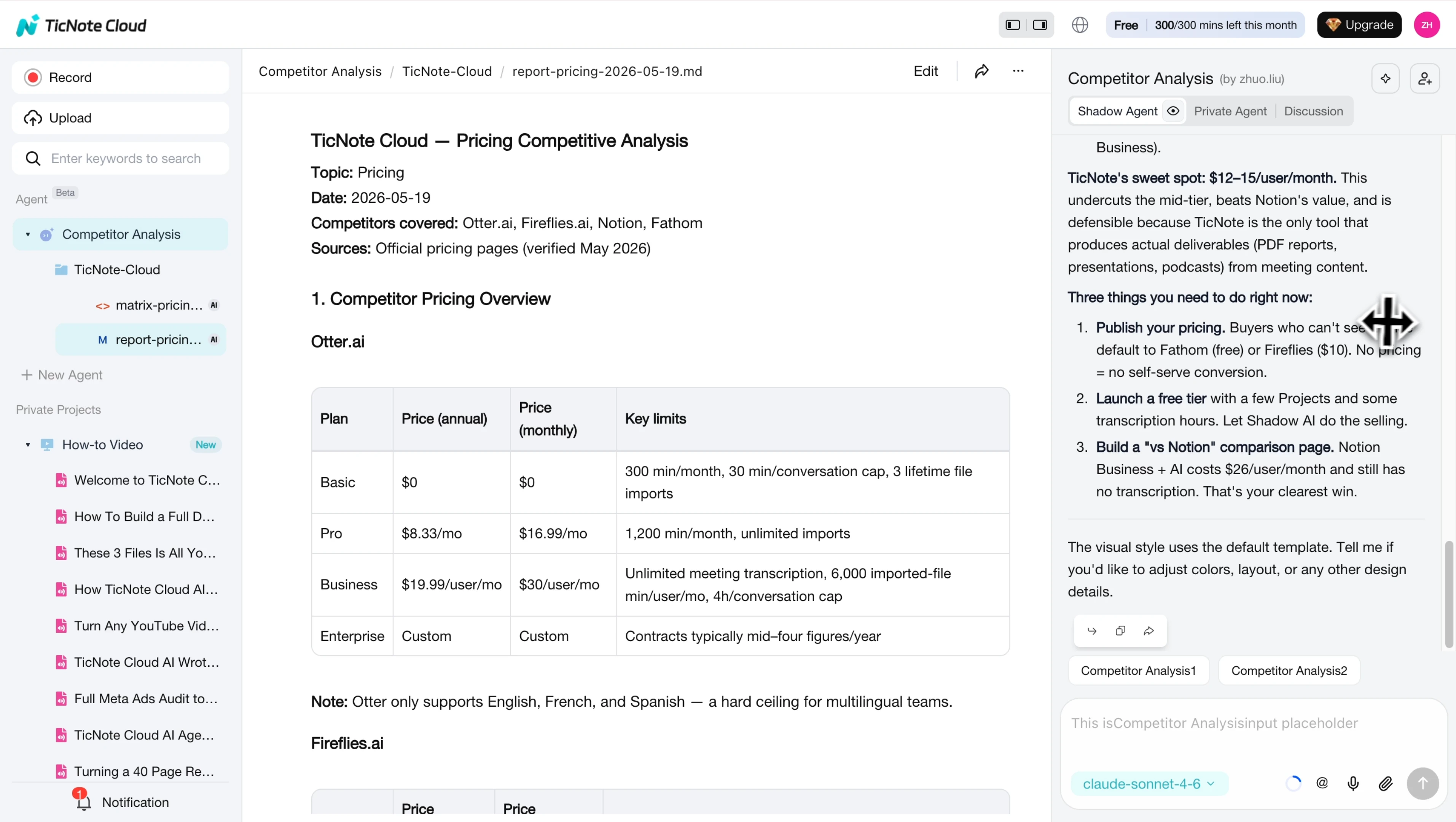
The result can be reviewed as a structured report, then translated into a visual matrix for decision-making.
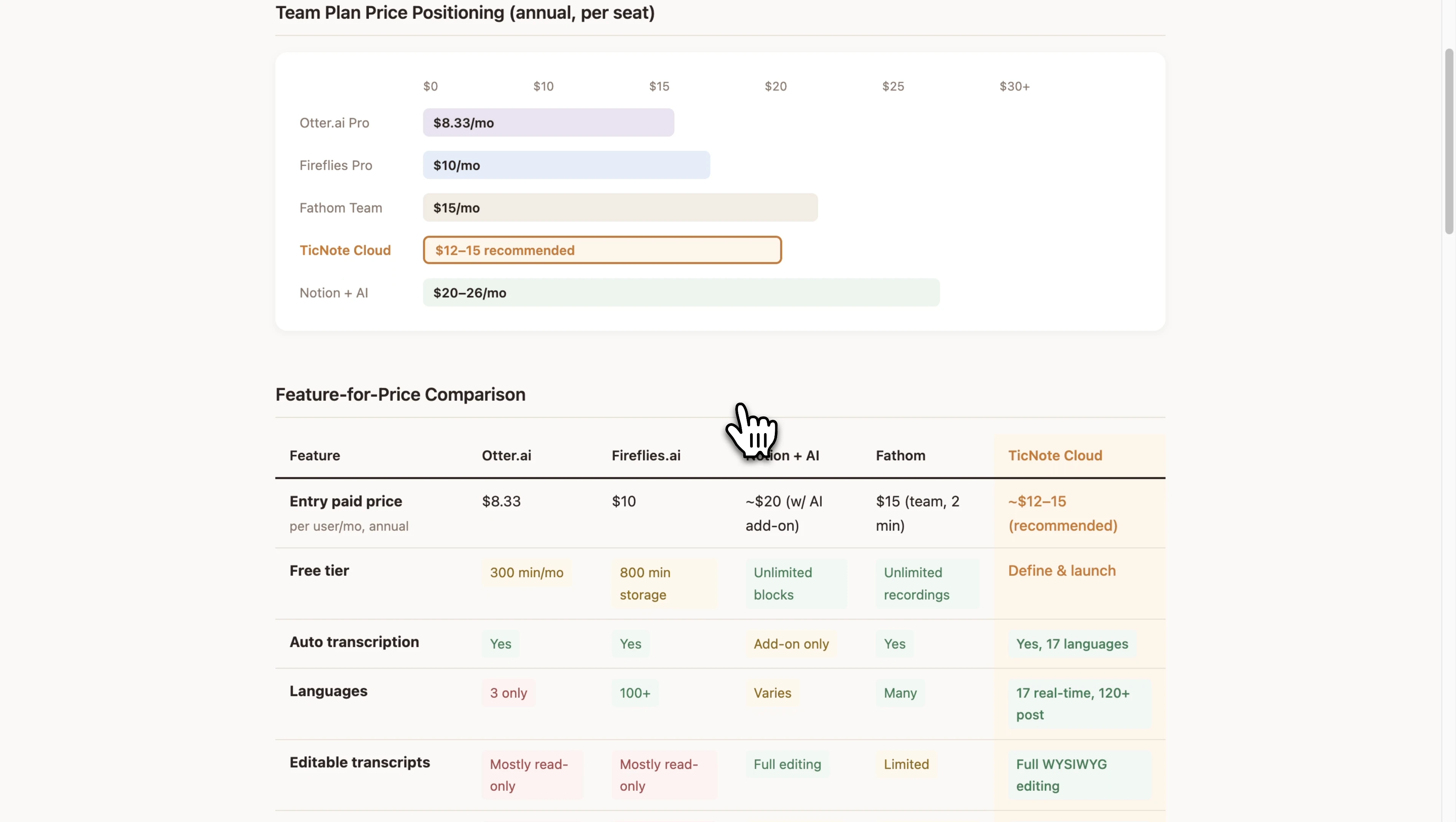
When documenting this workflow on the page, include real screenshots for Project setup, source ingestion, editable transcripts, prompt entry, cited answers, and final report outputs. That makes the process easier to trust and repeat.
Mobile workflow: capture now, synthesize later
On mobile, the flow is lighter: record or upload conversations, review transcripts, and route them into the same Project. Later, your team can synthesize everything together on the web app, so field research and desk research stay in one system.
Try TicNote Cloud for free and build your first positioning report from real customer conversations.
Measure whether your positioning is working
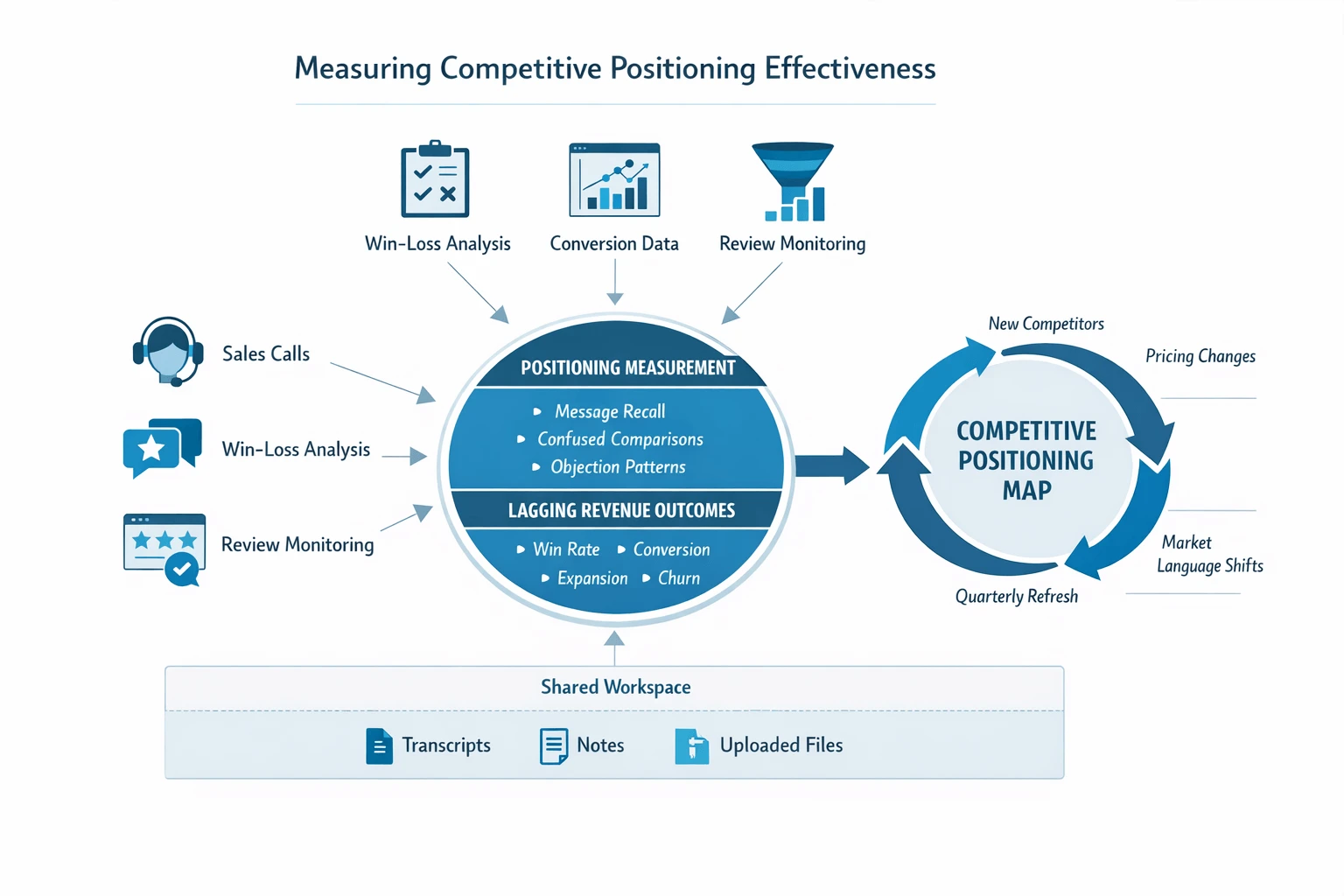
A strong competitive positioning strategy should change what prospects say, what sales teams hear, and what deals do over time. Start with fast signals first, then track business outcomes, then review the market on a fixed cadence so your positioning map stays useful instead of going stale.
Track early signals before revenue moves
Leading indicators tell you if the message is landing. In the first 30 to 60 days after rollout, listen for whether prospects repeat your intended differentiated value in their own words.
Watch for changes like these:
- more demo requests tied to the problem you want to own
- fewer confused comparisons with the wrong competitor positioning set
- clearer recall of your core benefit in sales calls and discovery notes
- shifts in objections, such as fewer price-only pushbacks and more feature-fit questions
- sales feedback that your talk track feels easier to use
Message testing also matters. Review call recordings, win-loss notes, and email replies to see whether buyers describe your offer the way you framed it.
Separate early metrics from lagging business results
Don't blend all KPIs into one dashboard. Split fast feedback from lagging revenue metrics so teams can see what changed first.
| KPI group | Metric | What to look for |
| Early signal | Message recall | Prospects repeat the main value point |
| Early signal | Confused comparisons | Fewer mentions of mismatched competitors |
| Early signal | Objection pattern | New objections show sharper understanding |
| Revenue outcome | Win rate | Better close rate versus target rivals |
| Revenue outcome | Conversion rate | Higher movement by stage and segment |
| Revenue outcome | Expansion quality | More upsell fit and broader adoption |
| Revenue outcome | Churn | Lower loss from poor-fit expectations |
Compare results by segment, named competitor, and deal type. That makes competitive advantage analysis more precise because SMB deals, enterprise evaluations, and replacement deals often respond to different messages.
Review the market on a fixed cadence
Use a monthly light review and a quarterly deep refresh. Monthly, scan sales calls, review sites, pricing pages, and lost-deal reasons. Quarterly, update the competitive positioning matrix for new entrants, launches, packaging changes, and shifts in market language.
A shared workspace helps here. Teams using TicNote Cloud can re-query old transcripts, win-loss interviews, and uploaded notes over time instead of rebuilding the research base from scratch. That makes competitor tracking and message refinement easier to maintain.
Conclusion: turn market noise into a defendable position
A strong competitive positioning process follows a clear order: define the market and buying context, collect evidence from customers and competitors, build a competitive positioning map and matrix, choose the few differentiators buyers actually value, turn them into a positioning statement, and review results on a set cadence. That's how competitive positioning becomes useful in real decisions, not just a slide.
The goal isn't to sound different for its own sake. It's to make the buyer's choice easier, clearer, and more credible. If you need a stronger research foundation first, this guide on turning analysis into strategy can help.
A structured workspace can also shorten the path from raw calls, win-loss notes, and competitor research to a usable strategy. Tools like TicNote Cloud help teams keep transcripts, notes, and synthesis in one place so insights are easier to verify and reuse. Try TicNote Cloud for Free