


 Extension
TL;DR: skill agent playbook for faster competitive analysis
To do faster, cleaner competitor research, try TicNote Cloud for Free and run your competitive analysis framework from one searchable workspace: start with the decision you need to make, define the market and competitor set, pick the right model, gather evidence, then turn patterns into clear strategic moves. The goal is simple: less note sprawl, better evidence, and outputs your team can actually use.
Teams often lose hours across scattered call notes, interview docs, and tabs, which makes competitor insights hard to trust and even harder to reuse. That chaos slows decisions and weakens synthesis. With one workspace that stores transcripts, research files, and cited AI summaries, you can keep findings connected over time and generate decision-ready reports faster.
Use this playbook: define the business question, map direct and indirect rivals, choose a fit-for-purpose competitive analysis model, collect secondary and primary research, synthesize recurring themes, and convert them into pricing, positioning, product, or go-to-market decisions. Modern teams move faster when every interview, call, and research file stays searchable and reusable.
How to build a competitive analysis framework that teams can actually use
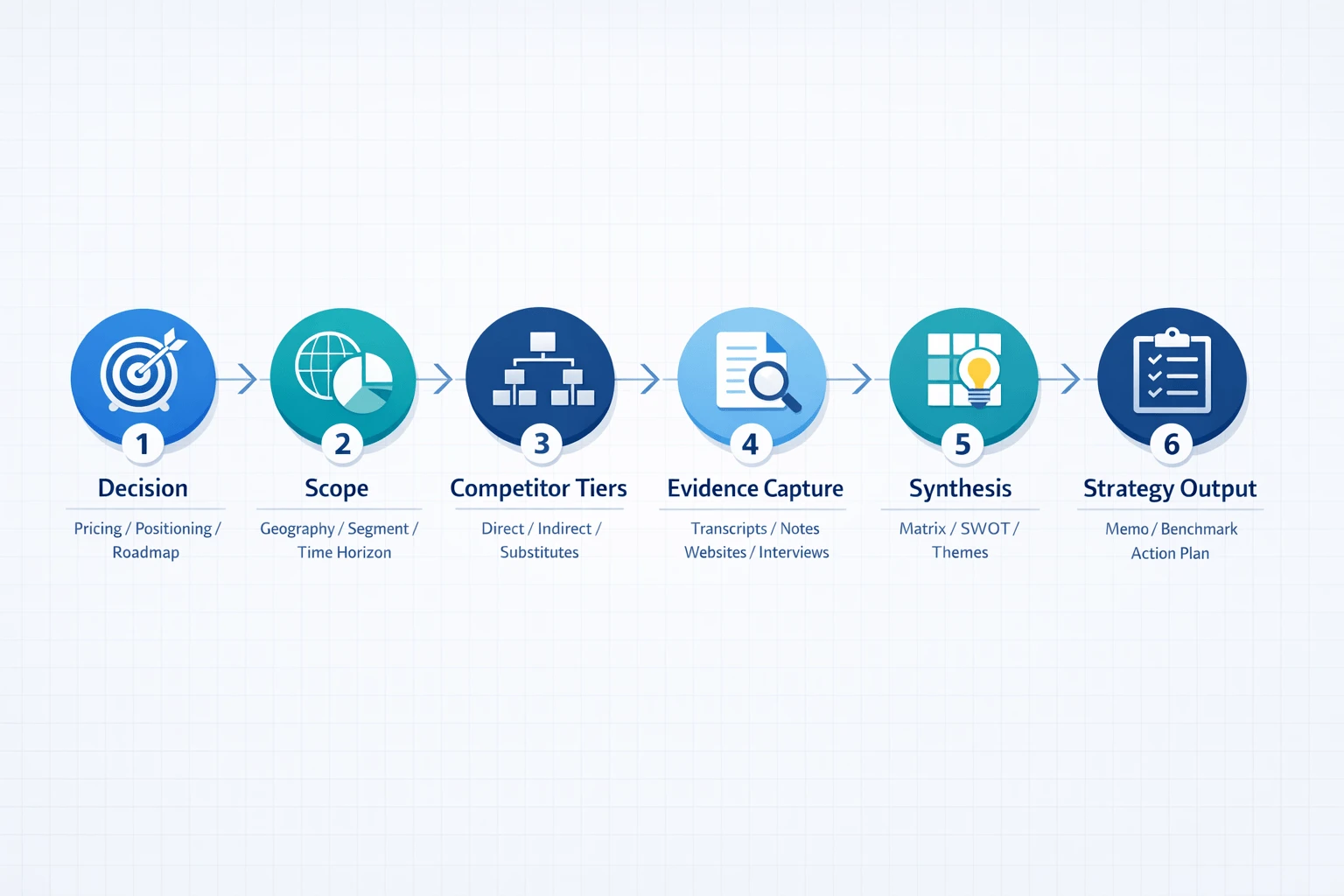
A useful competitive analysis framework starts before research begins. The goal is not to collect everything. The goal is to help a team make one clear business decision, define the right scope, rank the competitors that matter, and choose outputs that people will actually use.
When teams skip those setup steps, analysis turns into a vague market scan. Notes pile up. Opinions creep in. And the final document rarely changes strategy. If you need a repeatable process after this section, this competitor scorecard workflow is a practical next step.
Define the business decision first
Start with the decision, not the data. A strong framework begins with a concrete choice such as:
- pricing changes
- product positioning
- roadmap priorities
- market entry
- sales enablement
Why does this matter? Because the decision determines what evidence counts. If you're reviewing pricing, packaging, discounting, and contract terms matter most. If you're refining positioning, homepage messaging, use cases, proof points, and category language matter more.
This simple question keeps the work focused: what decision should this analysis improve within the next quarter?
Set scope by segment and time horizon
Next, narrow the field. Without scope, the project becomes too broad to act on.
Define the boundaries across a few variables:
- geography: local, regional, national, or global
- customer segment: SMB, mid-market, enterprise, or a vertical
- product line: one feature set, one plan tier, or one solution area
- buying stage: awareness, evaluation, procurement, or renewal
- planning horizon: 30 days, 2 quarters, or 12 months
This turns a generic research project into a decision-ready one. For example, "enterprise analytics tools in North America for 2025 renewal conversations" is far more useful than "analytics competitors."
Separate direct competitors, indirect competitors, and substitutes
Not every rival deserves equal time. Classify competitors from the customer's point of view:
- Direct competitors solve the same problem for the same buyer.
- Indirect competitors solve a related problem or target a nearby segment.
- Substitutes are the alternatives customers use instead, including internal workflows, agencies, spreadsheets, or bundled tools.
Then create tiers. A practical model is 3 to 5 direct rivals in Tier 1, 3 to 5 adjacent players in Tier 2, and a short list of substitutes in Tier 3. That structure helps teams go deep where it matters and stay light elsewhere.
Choose outputs before you gather data
Decide the final format in advance. Common outputs include:
- a competitive analysis framework template
- executive memo
- benchmark table
- positioning map
- SWOT summary
- action plan
This choice shapes the fields you capture. A benchmark table needs standardized columns. A positioning map needs consistent axes. A sales brief needs objection handling, proof points, and comparison claims. When outputs are defined early, teams avoid rework.
The best framework is simple enough for cross-functional adoption and structured enough for repeat updates. If your team can revisit it every month or quarter without rebuilding the system, it will support strategy instead of sitting in a folder.
Which competitive analysis models fit different business questions?
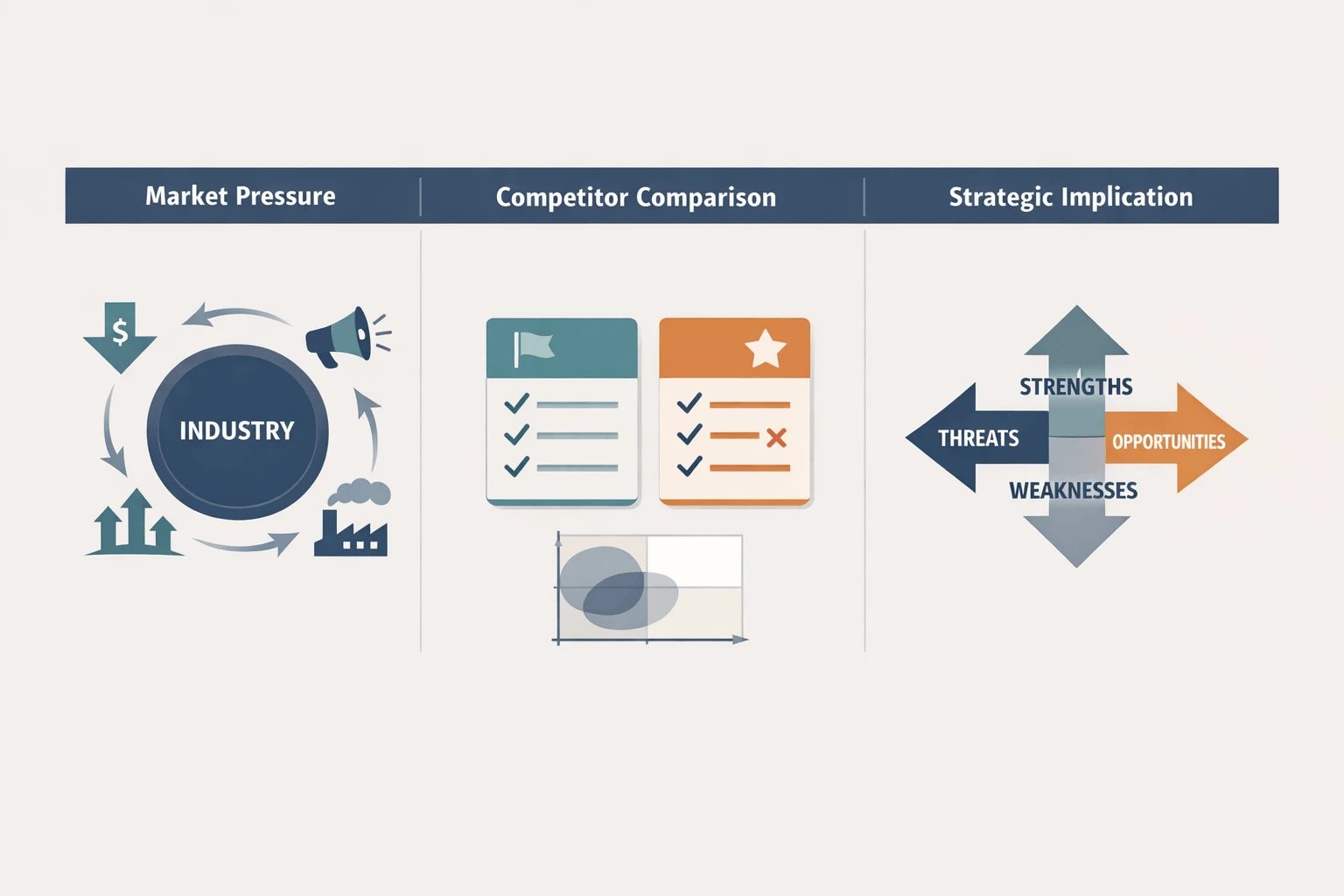
A strong competitive analysis framework gets more useful when you match the model to the decision. In practice, most teams need five options: SWOT for relative strengths and weaknesses, porter competitive analysis for market pressure and profitability, positioning maps for overlap and whitespace, benchmarking tables for product and go-to-market comparison, and a combined view that links research to action. The goal isn't to use every model. It's to pick the one that answers the business question fastest.
Use SWOT to compare relative strengths and weaknesses
SWOT works best after the research is done, not before. If you start with a blank-page brainstorm, you usually get generic claims like "better service" or "strong brand." That's not analysis.
Instead, compare your company against named competitors across evidence you already collected:
- product depth
- pricing logic
- customer proof
- sales motion
- channel reach
- onboarding and support
This makes SWOT relative, not abstract. A "strength" only matters if it is stronger than a real alternative in the market. If you want to go deeper, this guide to weighted competitor SWOT scoring shows how to turn observations into a clearer decision tool.
Use Porter to test market pressure and profit potential
Porter's Five Forces helps when the question is about market attractiveness, margin pressure, or whether growth will be hard to defend. As Harvard Business School Online: The Five Forces (2023) explains, the Five Forces are: the threat of new entrants, the power of suppliers, the power of buyers, the threat of substitutes, and rivalry among existing competitors.
Use this model when leadership asks:
- Is this category structurally profitable?
- Are buyers pushing prices down?
- Are substitutes likely to cap demand?
- Will new entrants erode advantage quickly?
This is less about one competitor's homepage and more about the economics of the market.
Use positioning maps to spot overlap and whitespace
A positioning map shows where brands cluster and where gaps exist. Teams usually plot two value drivers that buyers care about, such as price vs capability, enterprise depth vs ease of use, or breadth vs specialization.
That visual helps you answer simple but strategic questions:
- Are we too close to a dominant rival?
- Is there an underserved segment?
- Do we win on simplicity, depth, or both?
Keep the axes tied to buying criteria, not vanity labels. Otherwise the map looks polished but says very little.
Use benchmarking tables to make the model practical
A competitive analysis model becomes actionable when facts sit in one matrix. Benchmarking tables are often the most useful format for operating teams because they compare:
- features and packaging
- pricing logic and contract terms
- messaging themes
- acquisition channels
- proof points and case studies
- service and support motions
| Model | Best question | Main output |
| SWOT | What do our findings mean for us? | Strategic implications |
| Porter | Is this market attractive and pressured? | Industry pressure view |
| Positioning map | Where do brands overlap or leave gaps? | Visual whitespace scan |
| Benchmarking table | How do competitors differ in market-facing execution? | Evidence matrix |
Combine models when one view isn't enough
The best competitive analysis strategy usually blends models instead of forcing one to do everything. A practical sequence is simple: use Porter for industry pressure, benchmarking for factual comparison, and SWOT for decision implications.
That combination keeps the work grounded. It also prevents overcomplication. A framework selection matrix in this article should help teams match each model to the question they need answered, then move from research to strategy with less guesswork.
A step-by-step competitive analysis methodology for reliable research
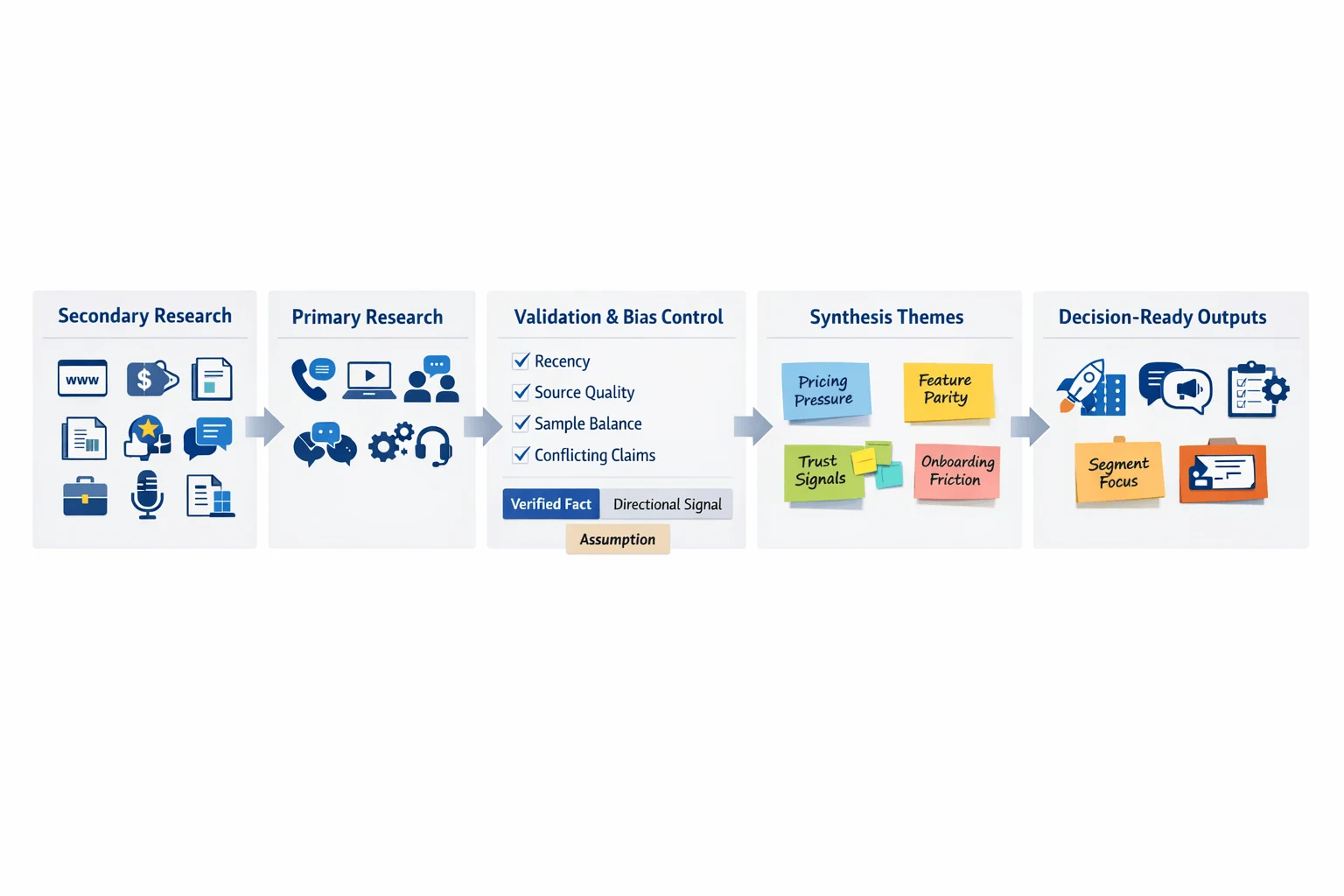
A strong competitive analysis framework depends less on collecting more data and more on following a clean method. The most reliable flow is simple: gather secondary research without creating noise, add primary research from real market conversations, validate the evidence to reduce bias, and then organize findings into themes that lead to decisions.
Collect secondary research without adding noise
Start with public sources, but use a fixed collection list so your team doesn't chase random details. For each competitor, review the same categories:
- company website and homepage messaging
- pricing pages and packaging details
- product documentation and help centers
- analyst notes or market summaries
- review platforms such as G2 or Capterra
- press releases and launch announcements
- job posts that reveal hiring priorities
- leadership interviews, webinars, or podcasts
- public filings, if the company is public
This step works best when you capture exact evidence, not loose summaries. Save the page title, date, link, market segment, and the claim you observed. If a competitor says it has "best-in-class onboarding," don't paste that line into your analysis as fact. Mark it as a self-reported claim until you find support elsewhere.
A simple comparison table in the final article helps readers see this collection method fast. Include columns for source type, what to capture, why it matters, and common risk.
Add primary research from real conversations
Secondary research shows what competitors say. Primary research shows what buyers, users, and partners experience.
Useful inputs include:
- win-loss calls
- sales demos and objection notes
- customer interviews
- implementation feedback
- partner or reseller conversations
- support tickets and recurring complaint themes
The key is normalization. Use the same fields for every insight so anecdotal comments become comparable evidence. Good fields include competitor name, segment, buyer type, funnel stage, quote or summary, issue type, impact level, source date, and confidence score.
For example, "prospect said Competitor A was cheaper" is too vague. "Mid-market buyer in April win-loss review said Competitor A was 18% cheaper on annual contract and easier to pilot" is usable.
If your team runs many interviews and call reviews, keeping transcripts, notes, uploaded documents, and summaries in one shared workspace makes this easier. A project-based system like TicNote Cloud can help teams search across prior calls, compare patterns, and pull cited evidence instead of starting from scratch each quarter. It's also useful when teams need better meeting workflows before and after interviews.
Validate evidence and control bias
Bad analysis usually fails here. Teams overtrust recent calls, repeat the loudest sales anecdote, or confuse opinion with proof.
Use four checks before you synthesize:
- Check recency: old pricing and positioning data ages fast.
- Check source quality: direct customer evidence beats social posts.
- Check sample balance: don't rely only on lost deals or only on happy customers.
- Check conflicts: when claims disagree, flag them and investigate.
A useful rule is to label each item as verified fact, directional signal, or assumption. That one habit improves synthesis quality fast. The interview quality standard in COREQ (2007) also shows why structured reporting matters in interview-based research.
Organize findings into themes and decision-ready insights
Once the evidence is clean, group it into themes. Most teams see patterns such as:
- pricing pressure
- feature parity
- trust signals
- onboarding friction
- segment focus
- service quality gaps
Then translate each theme into action. Pricing pressure may affect packaging. Feature parity may shift roadmap priority. Trust concerns often change proof points, case studies, and sales talk tracks. Onboarding friction may point to implementation fixes or partner training.
In the final article, add a workflow diagram that shows secondary research and primary research feeding into validation, then into synthesis themes, then into outputs for product, messaging, sales, and planning. That's what turns research into a competitive analysis strategy teams can actually use.
How do you turn competitive analysis techniques into strategy decisions?
A competitive analysis framework only matters if it changes what your team does next. The goal is not to track every rival move. It's to choose where to compete, where to defend, and where to stop wasting effort. That means turning research into clear calls on positioning, pricing, product focus, and execution.
Find the battles you can win
Start with winnable arenas, not broad market share dreams. Look at four filters:
- customer value: which problems matter most to buyers now
- differentiation strength: where your offer is clearly better or easier to trust
- segment economics: which customer groups have healthy deal size, retention, or expansion potential
- competitor weakness: where rivals are slow, overpriced, generic, or poorly reviewed
This is the core of a useful competitive analysis strategy. If a rival is stronger in enterprise procurement, don't mirror them by default. You may have a better opening in mid-market speed, service quality, or simpler onboarding. Focus creates leverage.
Spot capability gaps and risk areas
Next, compare your chosen position with the assets needed to defend it. Most strategy breaks here.
Check for gaps such as:
- thin product depth in a priority use case
- weak proof points like case studies, reviews, or ROI claims
- missing sales collateral or battlecards
- poor onboarding and activation flows
- limited partner reach
- delivery or support capacity constraints
Also flag structural risks. Common ones include overreliance on one customer segment, heavy discounting to win deals, or exposure to price compression when competitors bundle more value. A good competitive analysis methodology doesn't just map rivals. It shows what could block your response.
Translate insights into pricing, product, messaging, and channels
Insights become strategy only when they change decisions. Use your findings to adjust:
- pricing architecture and packaging
- roadmap priorities and feature sequencing
- message hierarchy by segment
- sales battlecards and objection handling
- campaign targeting and channel mix
- market-entry order by region, vertical, or buyer type
For example, if competitors all lead with feature breadth, you might win by leading with time-to-value, services, and lower rollout risk. If a segment keeps asking for proof, messaging should shift from claims to evidence. After that, tie the plan into a simple execution roadmap so owners, timing, and milestones are clear.
Set metrics and a review cadence
Review monthly for signals and quarterly for bigger resets. Track leading indicators before revenue moves show up:
- win-rate themes by competitor
- feature-request drift by segment
- pricing exceptions and discount pressure
- message resonance in calls and campaigns
- channel efficiency by audience
Once the choices are set, tools like TicNote Cloud can help teams turn interviews, call notes, and desk research into briefs, presentations, and action plans faster without losing source context.
How to generate a competitive analysis report and visual matrix
This workflow uses TicNote Cloud as the example, but the goal here is practical process, not product review. If you want a repeatable way to build a competitive analysis framework without scattered notes, this is a simple path: define the question, narrow the scope, then generate a report your team can actually use and share.
Start with the business question
First, add the Competitor Analysis skill agent inside the workspace. In TicNote Cloud, you click Add Agent, open the Skill Agent library, and choose the competitor analysis option.
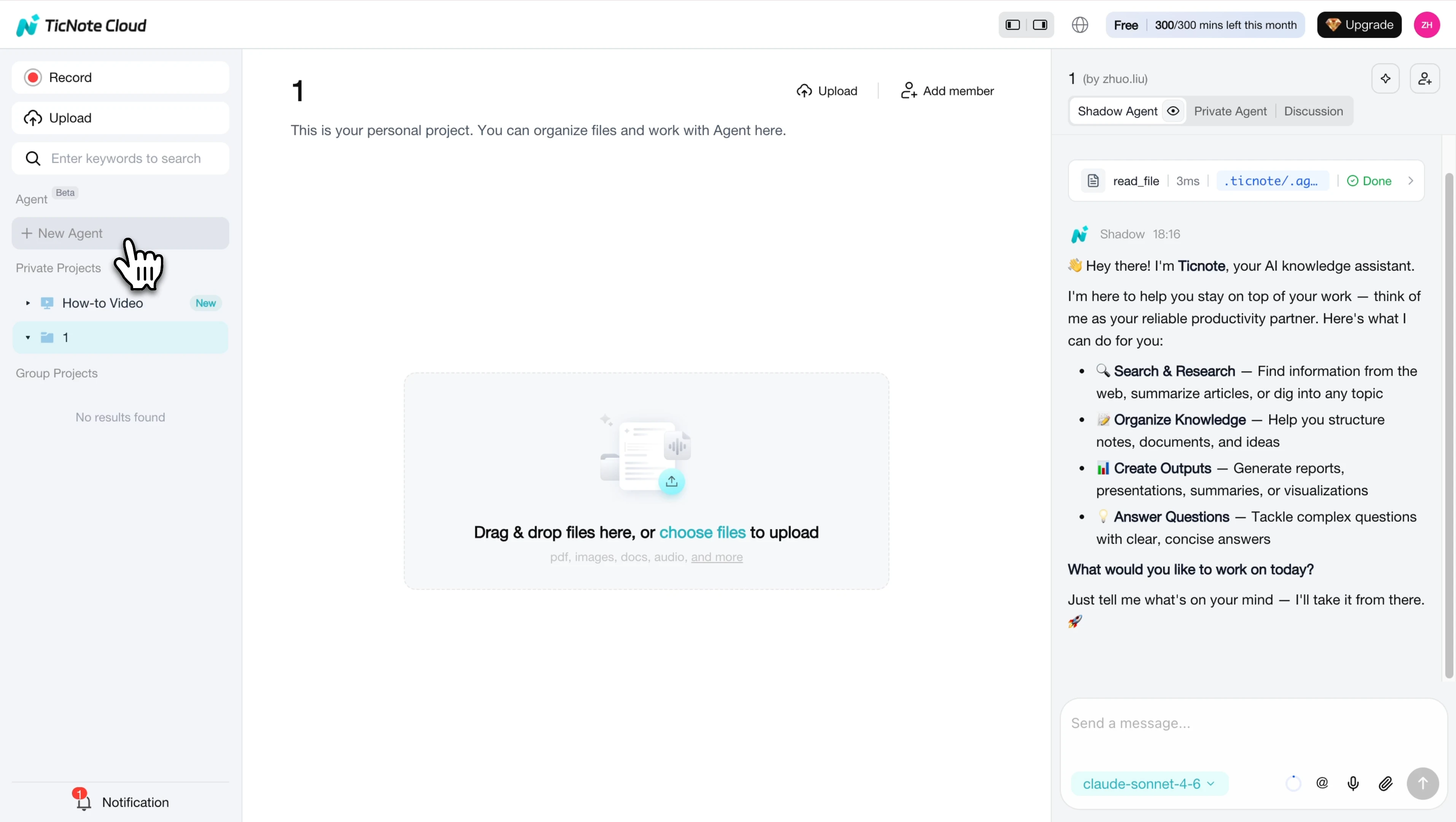
Once it's added, the agent is available right away in your workspace.
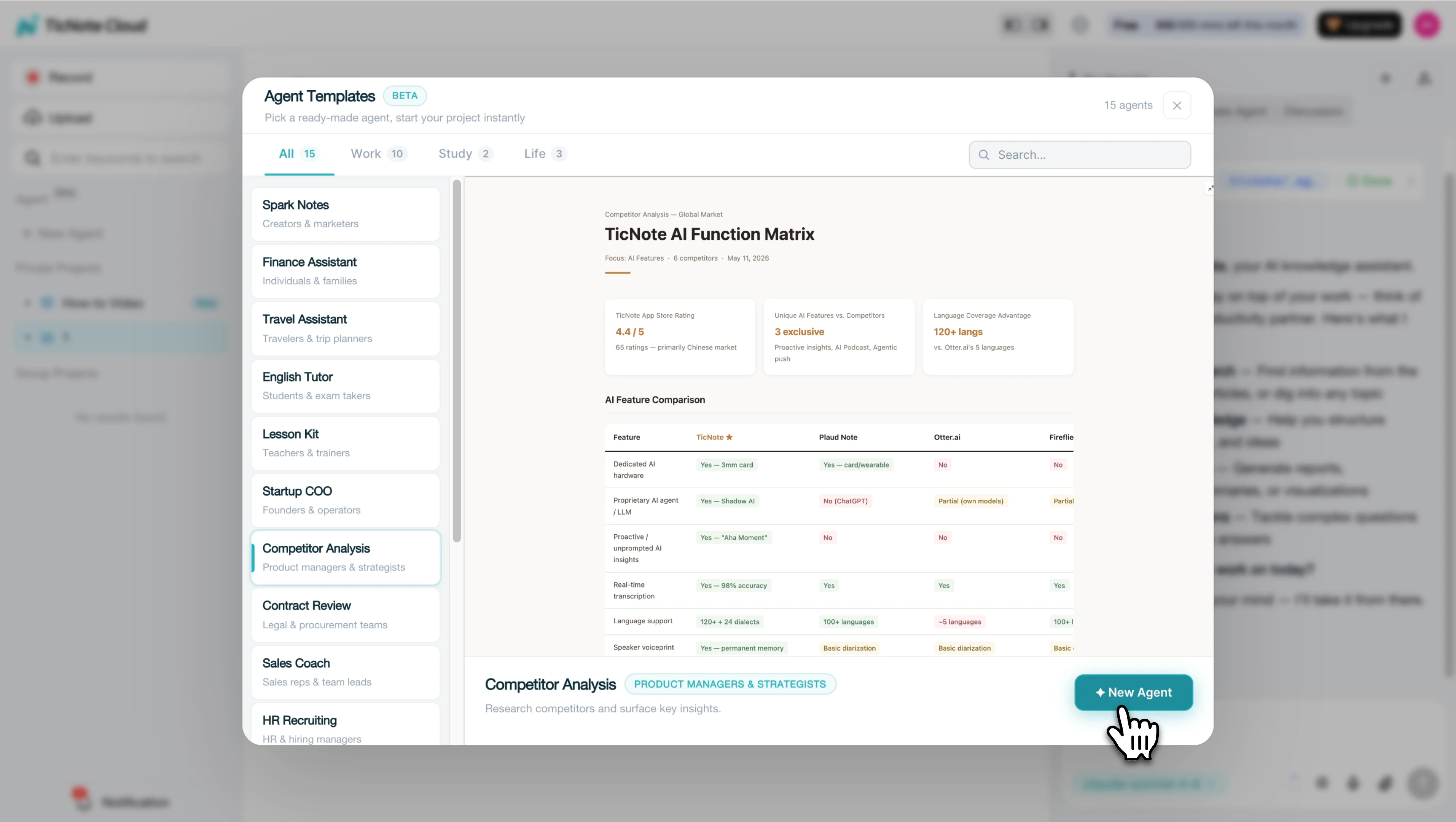
Then give it the essentials:
- your niche or industry
- your market location, such as a city, region, or online/global
- five to ten competitor names or URLs
- the exact question the report should answer
That last part matters most. A vague request creates a vague report. A focused prompt like "Which competitors are winning on price transparency in the U.S. SaaS market?" gives you a stronger competitive analysis framework template from the start.
Set the focus before research starts
Next, add optional focus settings so the output matches the decision in front of you. You might want the analysis to center on pricing, reviews, social media presence, or product range.
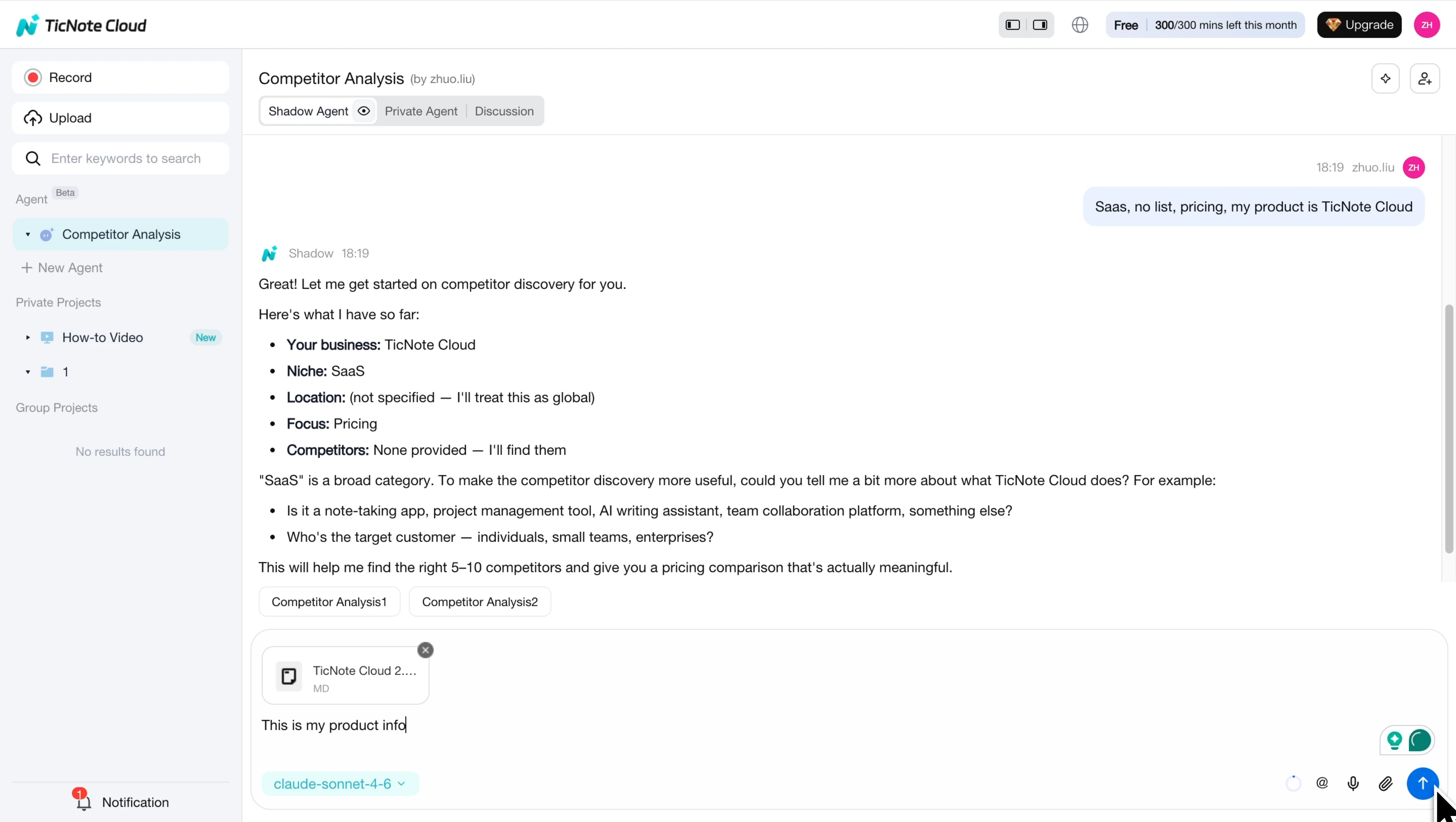
This step keeps the research useful. If your team is deciding messaging, review themes and social proof may matter more than feature depth. If you're revisiting packaging, pricing and plan structure should lead. For more options, this guide to competitor analysis tools can help you compare workflows.
Review the report and matrix
The output should come back as a structured report plus a visual HTML matrix. In this example, the files are saved as a markdown report and an HTML comparison view.
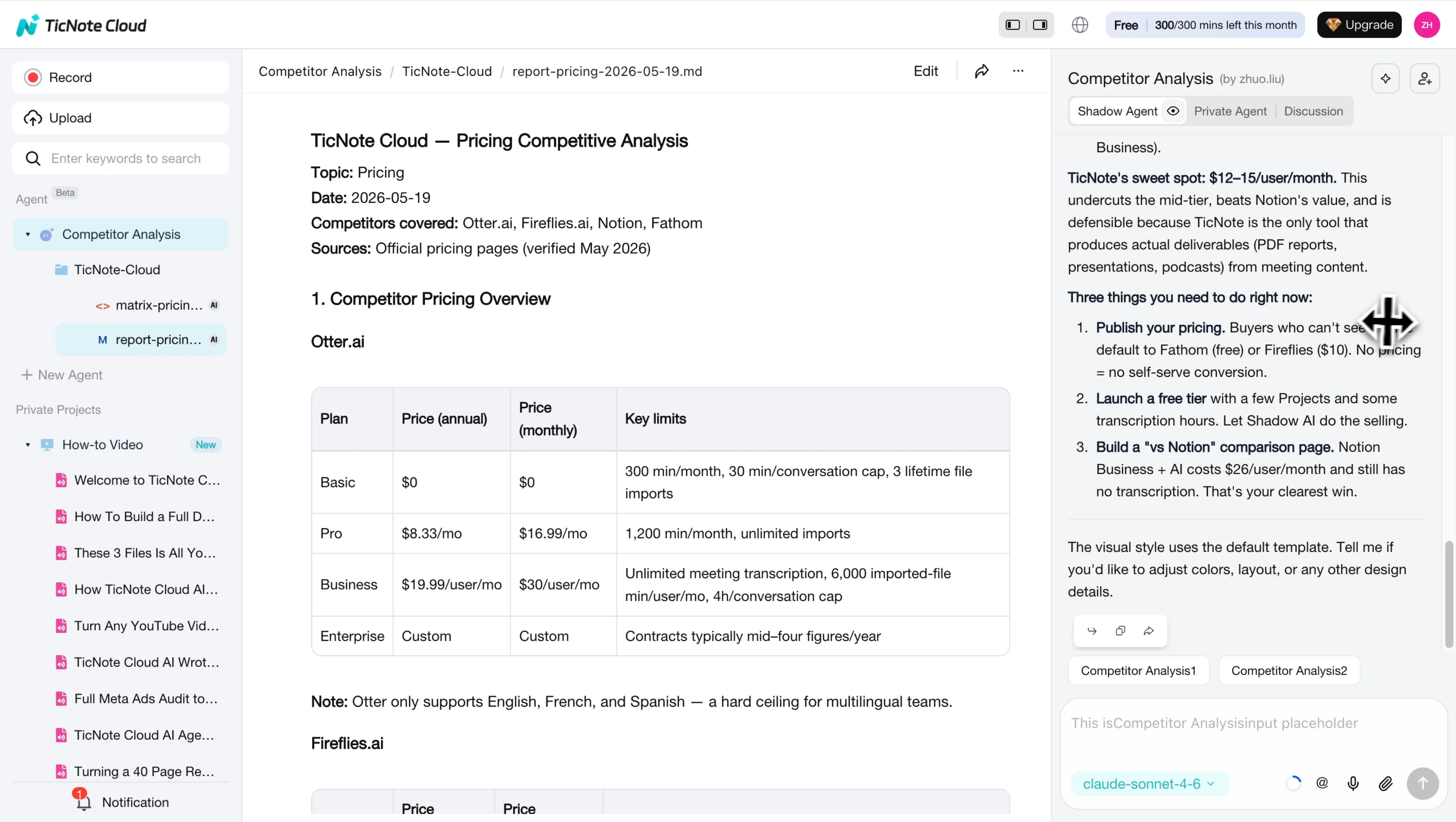
A solid report includes:
- executive summary
- competitor profiles
- side-by-side comparison fields
- market gaps
- recommended actions
The visual matrix makes the findings easier to scan and share across teams. Instead of reading long notes, people can compare strengths, weaknesses, and gaps in one place.
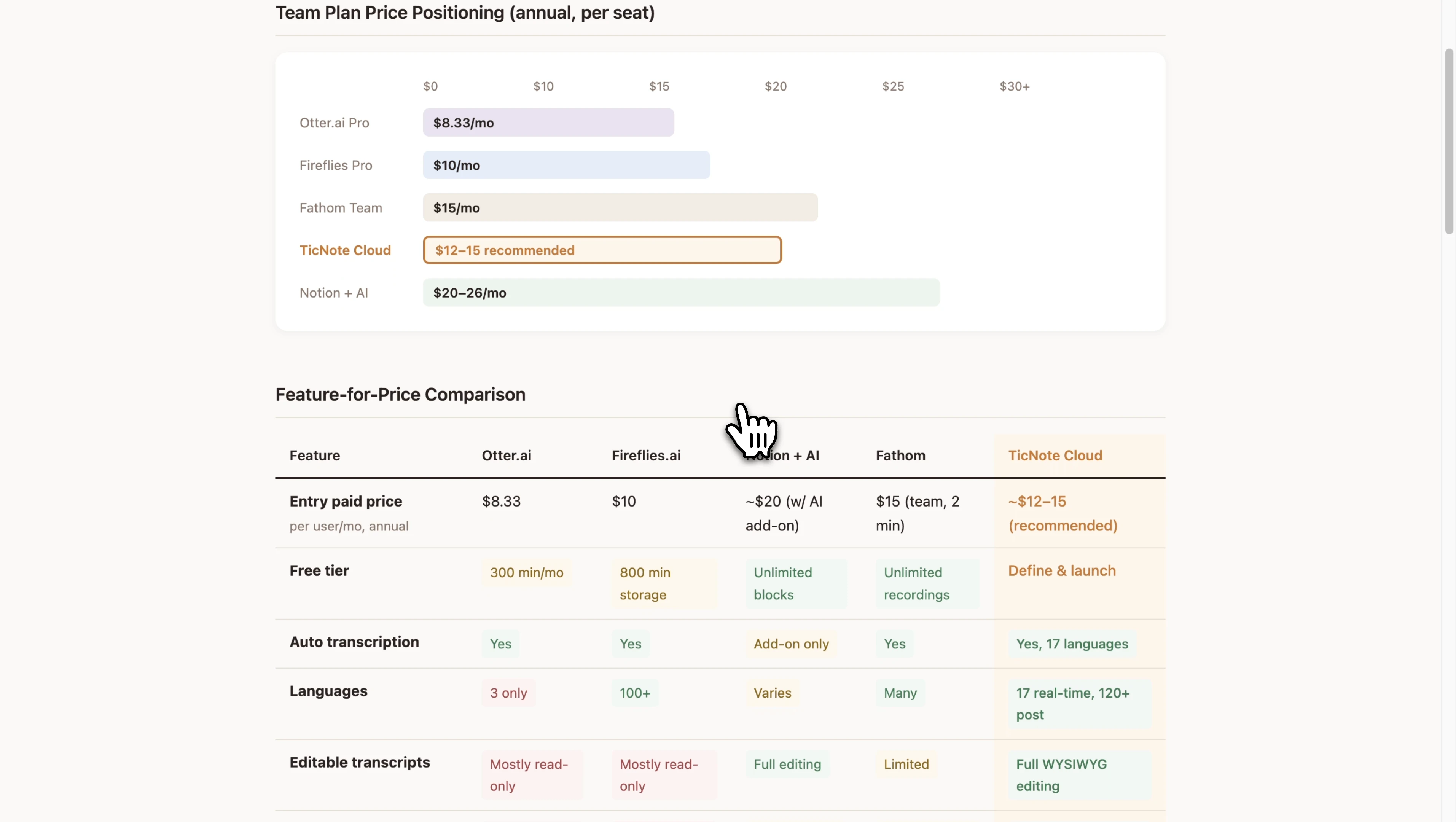
Keep the evidence in one workspace
The biggest advantage of this kind of setup is continuity. On the web app, teams can keep research files, meeting transcripts, uploaded decks, and generated outputs in one project. That means you can edit source evidence, ask follow-up questions, and get cited answers through Shadow AI without moving content across tools. You can also export reports or presentations when the work is ready for stakeholders.
The mobile app is useful for capturing and reviewing inputs on the go. But for setup, synthesis, and report generation, the web workflow is the clearest main path.
Try TicNote Cloud for Free and generate your first competitor report in minutes.
Competitive analysis framework example for a B2B team
A practical competitive analysis framework matters most when a team has to make a hard choice fast. Imagine a B2B SaaS company moving upmarket from SMB to mid-market accounts. It keeps losing deals to larger all-in-one suites, so the team needs to decide whether to compete on faster implementation and service quality or chase broader feature coverage.
Scenario and objective
In this example, the objective is simple: find a clear wedge for the next two quarters. The team reviews three direct rivals and two broader suite competitors. Instead of guessing, it uses one shared template to turn sales notes, demo observations, review sites, win-loss interviews, and pricing pages into comparable evidence.
That template should answer:
- Which segment each competitor serves best
- Where enterprise depth beats speed
- Which claims show up in real buyer conversations
- What pattern explains lost deals most often
Sample competitor comparison fields
The example table in this section should include these columns:
- Target segment
- Pricing model
- Deployment fit
- Feature depth
- Implementation effort
- Proof points
- Sales motion
- Messaging themes
- Review patterns
- Known weaknesses
The goal is not to create a perfect score. It's to show how a competitive analysis framework template converts messy inputs into evidence a team can compare side by side. If you want a copy-ready competitor table and report format, this is the kind of structure to use.
Strategic implication and next action
Once the comparison is filled in, the team can usually spot three things quickly: one strong wedge, one capability gap, and one immediate action. In this case, the wedge may be "go live in weeks, not months." The gap may be weaker admin controls for larger buyers. The next action could be narrowing homepage messaging, refining packaging around implementation speed, and giving sales a short battlecard for suite-versus-specialist deals.
The final article should include a copy-ready competitor analysis table example and a short decision-memo takeaway so readers can move from research to action without extra formatting work.
Final thoughts
A competitive analysis framework only creates value when teams can repeat it, trust the evidence, and use it to make real choices. The strongest process isn't the one with the most tabs, notes, or charts. It's the one with clear scope, consistent criteria, and a review rhythm that keeps insights current as markets shift.
Use your research to answer a few decisions well: where to position, what to improve, and which threats matter now. Better synthesis beats more raw data every time.