


 Extension
TL;DR: skill agent playbook for faster startup competitor research
Start with TicNote Cloud if you want competitor analysis for startups to move faster: define the customer, identify the real buying alternative, gather proof from search results, reviews, LinkedIn, customer calls, and pricing pages, then score a short list of direct, indirect, substitute, and emerging rivals to guide product, pricing, positioning, and GTM choices.
Research usually breaks because notes live in five places and raw interview takeaways get lost. That leads to slow decisions and weak follow-up. With one project for transcripts, competitor pages, and cited summaries, teams can keep evidence together and turn it into usable reports without extra copy-paste.
In this guide, you'll get a practical 6-step process, a worked startup example, a simple competitor matrix, and a clear refresh cadence so findings stay useful as the market changes.
How competitor analysis for startups shapes better product and go-to-market decisions
Competitor analysis for startups is not a big-company exercise. It's an early decision tool that helps founders reduce bad bets, sharpen positioning, and choose a go-to-market path that fits real buyer behavior. If you're still forming your angle, this is where better competitor research starts paying off.
Start earlier to cut risk
Startups have very little room for wasted roadmap bets, vague messaging, or broad channel testing. A large company can absorb a weak launch. An early-stage team usually can't. That's why competitive learning matters from idea stage through early traction.
In practice, this means pressure-testing founder assumptions against what buyers already use, trust, and pay for. If customers already have a workaround, a direct tool, or a service option, that is your real market context. Good analysis helps you find a sharper wedge instead of building a slightly different version of an existing offer.
Separate research from analysis
Competitor research is the evidence layer. You collect facts from websites, pricing pages, reviews, sales calls, case studies, social proof, job posts, and customer interviews.
Competitor analysis is the meaning layer. You interpret the signals and answer questions like:
- Where are rivals clearly strong?
- Where are buyers over-served or under-served?
- Which claims show up everywhere?
- What gap is still open for a startup?
That distinction matters. Data alone doesn't drive action. Interpretation does.
Use the output to make decisions
A useful competitive analysis for startups should help you decide:
- which customer segment to prioritize
- which problem framing to lead with
- which features matter now versus later
- whether to go premium or start entry-level
- which channels competitors overuse
- where your messaging can sound meaningfully different
The final output should not be a static slide. It should be a living decision tool tied to evidence. Storing interviews, transcripts, and market notes in a shared workspace like TicNote Cloud makes that easier, because teams can trace conclusions back to source material instead of relying on memory.
Which competitors should a startup actually track?
A strong competitor analysis for startups starts with the right comparison set, not the biggest brand names in your market. Most founders over-track visible incumbents and under-track the real options buyers compare side by side. In practice, that usually includes direct rivals, indirect tools, workarounds, and newer entrants.
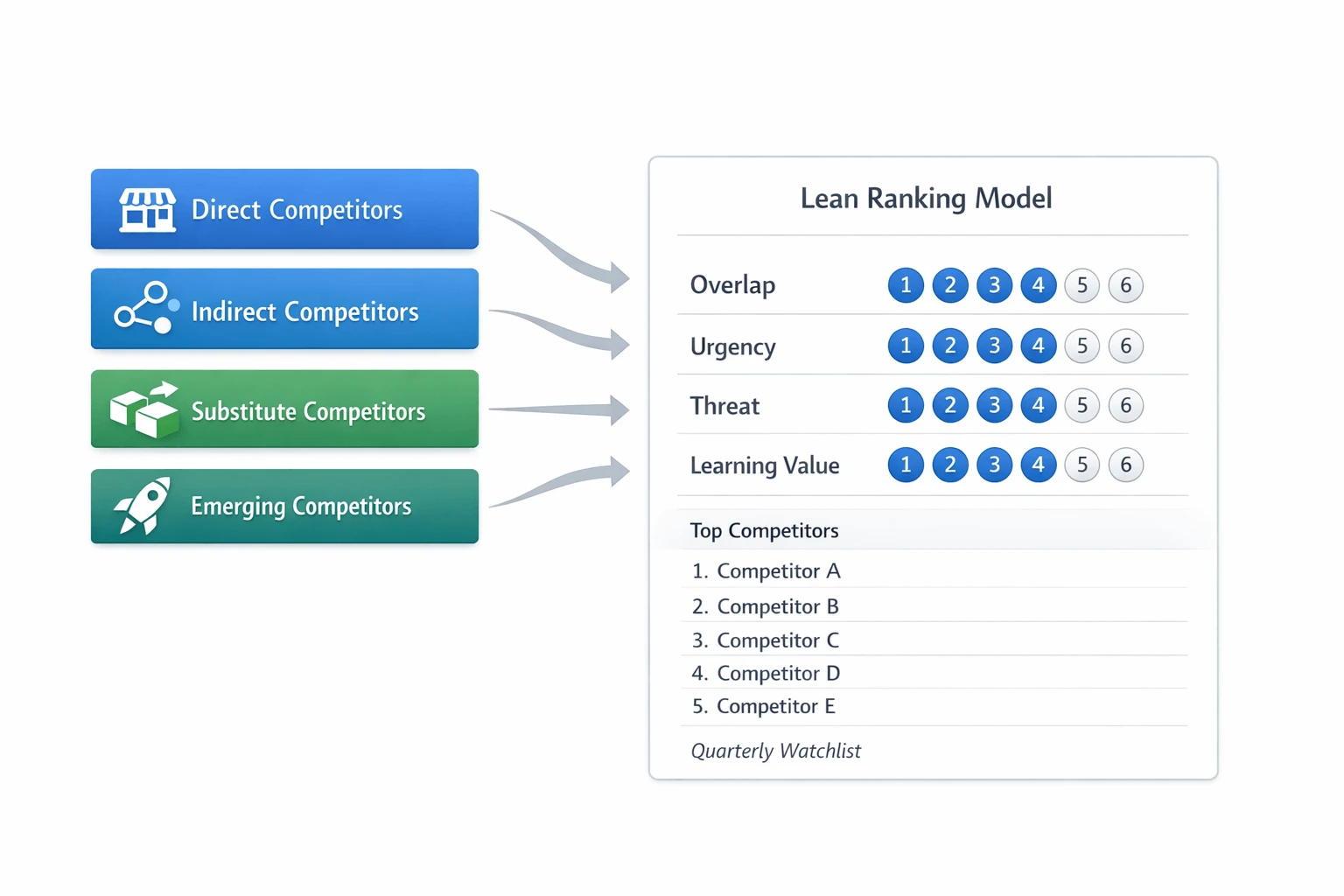
Separate the four competitor types first
Use these four buckets before you build a matrix:
- Direct competitors: they sell to a similar buyer with a similar promise.
- Indirect competitors: they solve a related problem, but in a different way.
- Substitute competitors: they are the current workaround or status quo, like spreadsheets, agencies, internal ops, or doing nothing.
- Emerging competitors: they are newer entrants or adjacent products moving into your category.
This matters because buyers rarely compare only obvious SaaS rivals. They compare outcomes. If your product replaces manual tracking, then a spreadsheet may be a bigger real-world competitor than a famous platform.
Score competitors with a simple ranking model
Once you have a long list, rank each option on four dimensions using a basic 1-to-5 score:
- Overlap: How closely does it match your target customer and use case?
- Urgency: How often does it appear in active evaluation or sales conversations?
- Threat: How likely is it to win the deal or set buyer expectations?
- Learnings: How much can you learn from it for product, pricing, positioning, or channels?
Add the scores and rank the list. That gives you a lean, usable view of who deserves deeper analysis. If you want a next step, this guide to building sharper competitor profiles helps turn raw findings into decisions.
Keep the core set lean
For most startups, 5 to 8 competitors is enough. A smart mix often looks like this:
- 2 to 3 direct competitors
- 1 to 2 indirect competitors
- 1 to 2 substitutes
- 1 emerging player
More than that usually creates noise, slows updates, and leaves you with a stale document nobody uses. Keep a broader watchlist outside the core set and review it quarterly. A shared project workspace like TicNote Cloud can also help founders capture interview mentions, save evidence, and keep competitor context tied to transcripts, notes, and research instead of scattering it across docs.
Build your startup competitor analysis in 6 practical steps
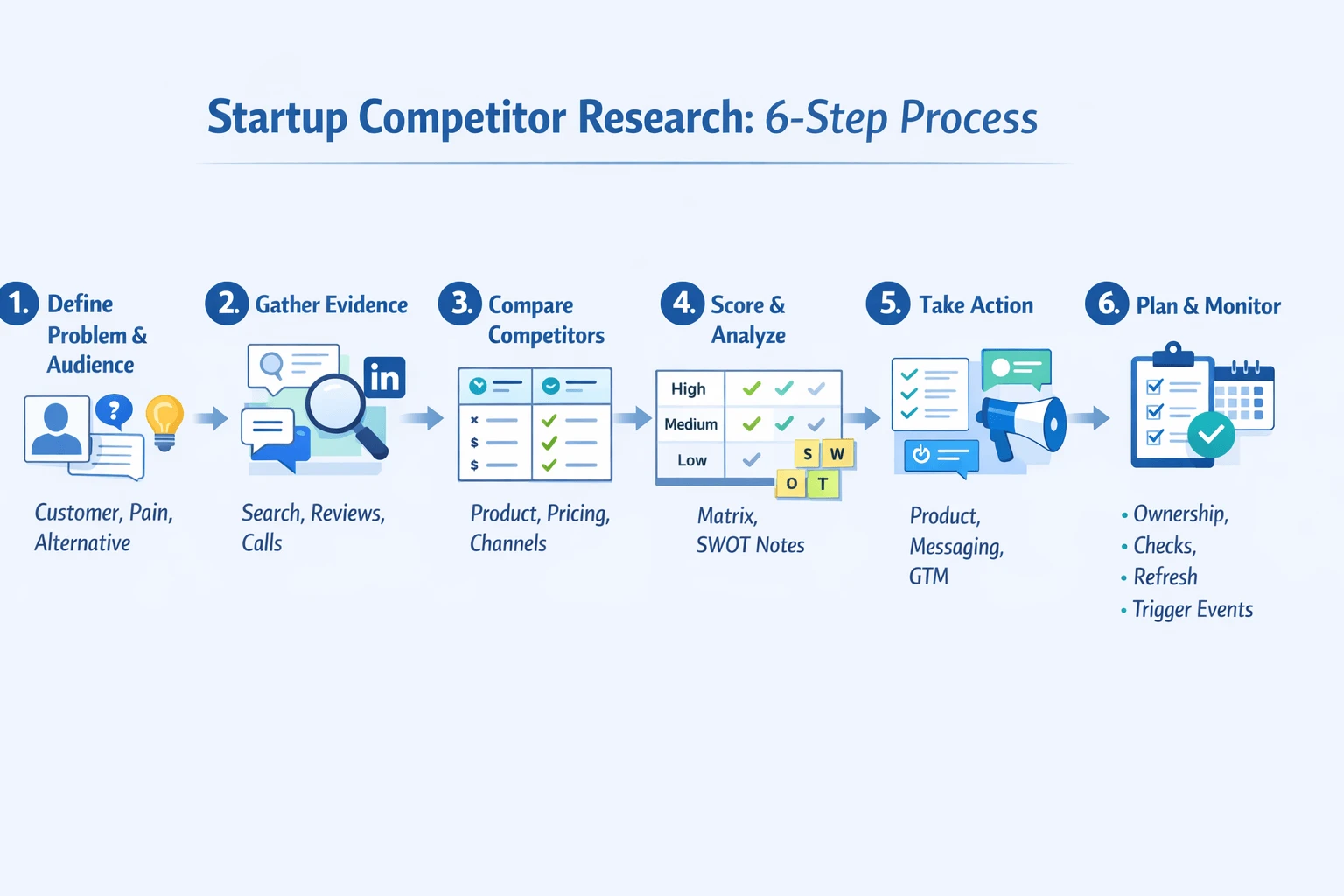
A strong competitor analysis for startups should help you make decisions, not just fill a spreadsheet. The simplest approach is to define the market clearly, collect evidence from a few reliable sources, score competitors with the same logic, and turn what you learn into product and go-to-market actions.
Step 1: Define the customer, problem, and buying alternative
Start with the customer, not the competitor list. Write down four things:
- Who you serve
- The job to be done (the task they need completed)
- The painful moment that pushes them to look for help
- The current alternative they already use
That last point matters more than most founders think. Your real rival may not be the startup that looks most like you. It may be spreadsheets, agencies, internal ops staff, or a patchwork of tools.
Use a one-line problem statement to stay focused. For example: "Seed-stage B2B founders need a fast way to turn customer calls into usable market insight without hiring a research team." Then list 4–6 buying criteria, such as speed, price, ease of setup, integrations, reporting, or team collaboration. This prevents you from comparing yourself against the wrong market.
Step 2: Gather evidence from real signals
Next, collect evidence from multiple sources. Don't rely on memory. Capture exact wording, screenshots, transcript snippets, and links to source pages when possible.
Useful signals include:
- Branded and non-branded search results
- Review sites and customer comments
- LinkedIn company pages, hiring patterns, and team growth
- Homepage and product page messaging
- Demo videos and sales materials
- Pricing pages and packaging details
- Trial, signup, and onboarding flows
- Support docs and help centers
- Customer interviews and lost-deal notes
Customer calls are often the highest-value source because they reveal what buyers compare in the real world. If three prospects mention the same vendor in one month, that's a market signal. This is also where a documented workflow helps. If you need a repeatable format, this competitor scorecard workflow makes research easier to compare over time.
Step 3: Compare the things that change buying decisions
You do not need to compare every tiny feature. Compare the factors that actually affect selection, conversion, and retention.
Focus on categories like:
- Product scope
- Feature depth
- Pricing model
- Packaging and plan limits
- Positioning and target customer
- Proof, case studies, and testimonials
- Sales motion (self-serve, sales-led, hybrid)
- Acquisition channels
- Onboarding experience
- Support quality
- Customer sentiment
This is how to do competitor analysis for a startup without wasting time. Keep the comparison lean and decision-oriented. If a detail won't shape roadmap, messaging, pricing, or sales rebuttals, leave it out.
Step 4: Score competitors with a simple matrix
Once the evidence is collected, score each competitor against the same weighted dimensions. For example, you might assign 30% to product fit, 20% to pricing, 20% to positioning clarity, 15% to onboarding, and 15% to proof and sentiment.
Keep it simple:
- Use a 1–5 scale
- Add weights based on category importance
- Mark confidence as high, medium, or low
- Add one short SWOT-style note per competitor
The goal is consistency, not fake precision. A clean matrix makes trade-offs visible fast. A startup doing competitive analysis for startups should be able to explain every score with evidence in one sentence.
Step 5: Turn findings into product, messaging, and GTM actions
Research only matters if it changes what you do next. Turn each major finding into an action.
Common outputs include:
- Roadmap changes to close key gaps
- Pricing tests or package redesigns
- Messaging updates on landing pages
- Sales rebuttals for common objections
- Segment choices to pursue or avoid
- New proof points to collect in customer stories
This is where TicNote Cloud fits naturally. You can keep interview transcripts, meeting notes, pricing captures, and research files in one project, then use cited summaries to turn raw evidence into matrices, briefs, and action docs without copy-paste. That makes how to do competitor analysis for a small business much more practical when time is tight.
Step 6: Assign ownership and set a refresh cadence
A one-time analysis goes stale quickly. Sustainable startup research needs an owner and a light process.
Use this cadence:
- Monthly: quick check on pricing, messaging, launches, and hiring
- Quarterly: deeper refresh of the full matrix and action plan
- Event-based: update when a rival raises funding, launches a major feature, changes pricing, enters your segment, or keeps showing up in customer calls
Assign one owner, even if several people contribute inputs. Usually that is a founder, PM, or growth lead. The owner doesn't need to do all the research. They need to keep the system current.
When the workflow stays lightweight and repeatable, competitor analysis becomes part of normal operating rhythm instead of a one-off project.
A worked example of competitive analysis for startups
To make competitor analysis for startups practical, start with one clear scenario and force every score to connect to a real buying decision. Below is a lean example a founder could use this week, from target customer definition to a simple matrix and the next moves that follow from it.
Example startup scenario and target customer
Imagine an early-stage AI note and research tool built for product teams that run customer interviews every week. The core user is a product manager or founder doing 5 to 20 interviews a month. Their problem isn't just recording calls. It's turning messy transcripts, scattered notes, and team comments into decisions the team can actually use.
The buying trigger is usually one of three moments:
- interview volume starts rising
- research notes are spread across docs and tools
- the team needs faster synthesis for roadmap or messaging decisions
Current alternatives are familiar:
- direct tools for meeting transcription and AI notes
- indirect tools like general docs or project workspaces
- substitutes such as manual notes, spreadsheets, and ChatGPT prompts pasted across files
Sample competitor matrix with scoring logic
A founder-friendly matrix should compare competitor types first, then scores second.
- Direct competitors: AI meeting and note tools serving research teams
- Indirect competitors: docs, knowledge bases, or project tools with light AI support
- Substitutes: spreadsheets, manual summaries, generic chatbots
- Emerging competitors: newer agents that promise automated research synthesis
Use a 1 to 5 score across six dimensions:
- problem fit
- workflow depth
- proof
- switching friction
- pricing clarity
- team usability
For example, a direct rival may score high on problem fit but lower on workflow depth if it stops at summaries. A substitute like ChatGPT may score well on flexibility but low on proof and traceability because teams still have to move context by hand. TicNote Cloud would score well where teams need project memory, cited synthesis, editable transcripts, and reusable research inside one workspace.
The filled matrix should include a short note beside each score so the logic is visible, not magical. If you want a copy-ready format, this startup competitor matrix template helps turn rough notes into a report founders can actually share.
What the founder should do next based on the analysis
Use the matrix to choose a message before you choose more features. If most rivals promise "AI meeting notes," lead with the stronger outcome: turning interviews into cited insights and team-ready decisions.
Then separate gaps into now versus later:
- Fix gaps that block adoption, such as pricing confusion or weak collaboration.
- Delay features that matter only after scale.
- Start with a narrower segment if one group shows sharper pain, such as PMs doing weekly user research.
- Prepare battlecards only for the top 3 competitors prospects mention most.
This is also where TicNote Cloud can reduce manual synthesis work. Instead of pulling quotes from separate calls by hand, teams can turn raw interviews into cited summaries, comparison notes, and reusable project memory faster.
A smart visual here is a downloadable competitor matrix chart with score columns, notes, and next-action prompts.
How to run a competitor research workflow with AI
This section uses TicNote Cloud as the example tool, but the workflow works for any founder who wants faster, cleaner competitor analysis for startups. The goal here is practical execution: how to go from a rough competitor list to a usable report you can act on.
Start with the web workflow
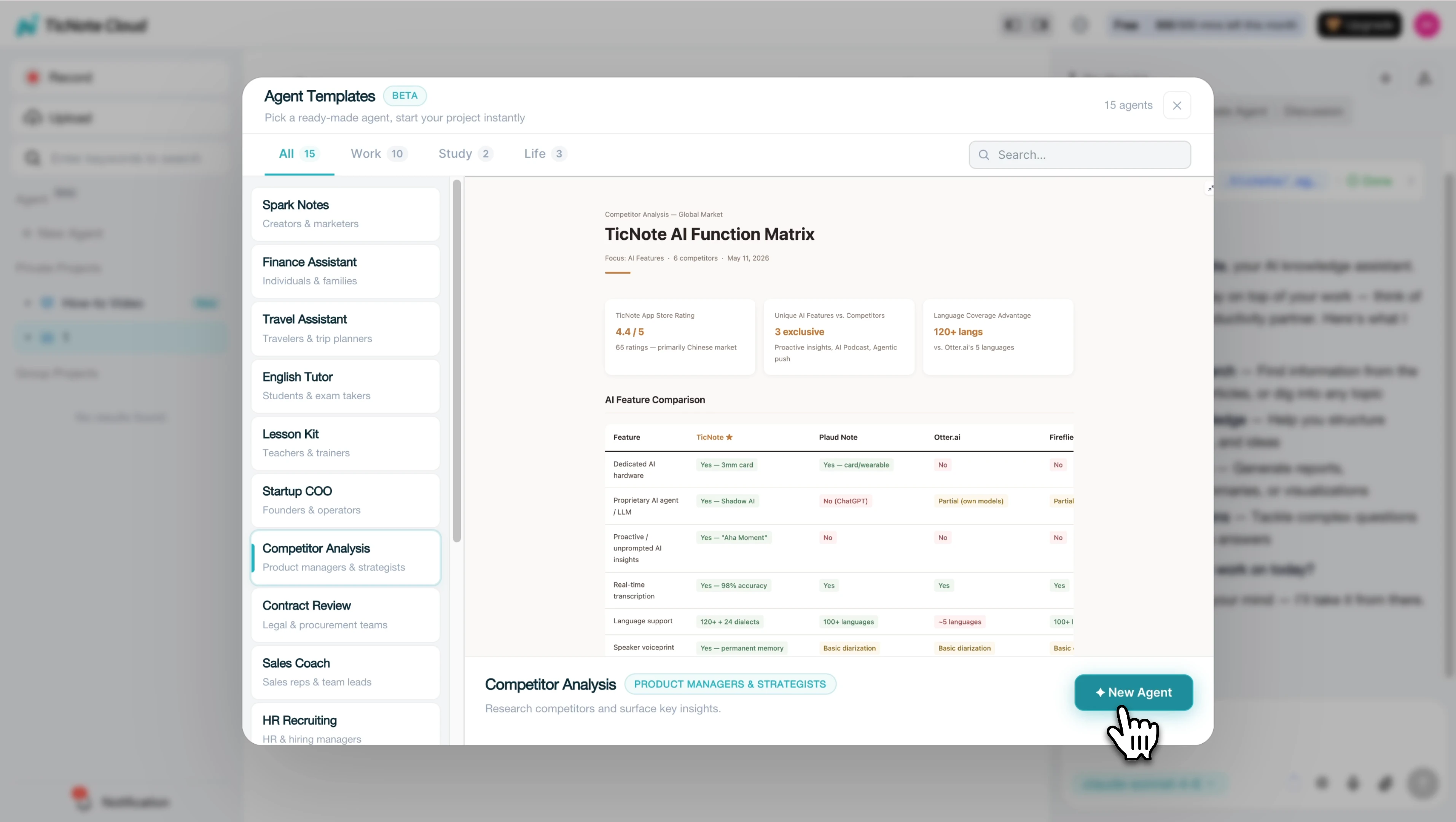
First, add the Competitor Analysis skill agent inside TicNote Cloud. In the workspace, click Add Agent, open the skill library, and choose the competitor analysis agent. It appears in your list right away, so there is no setup delay.
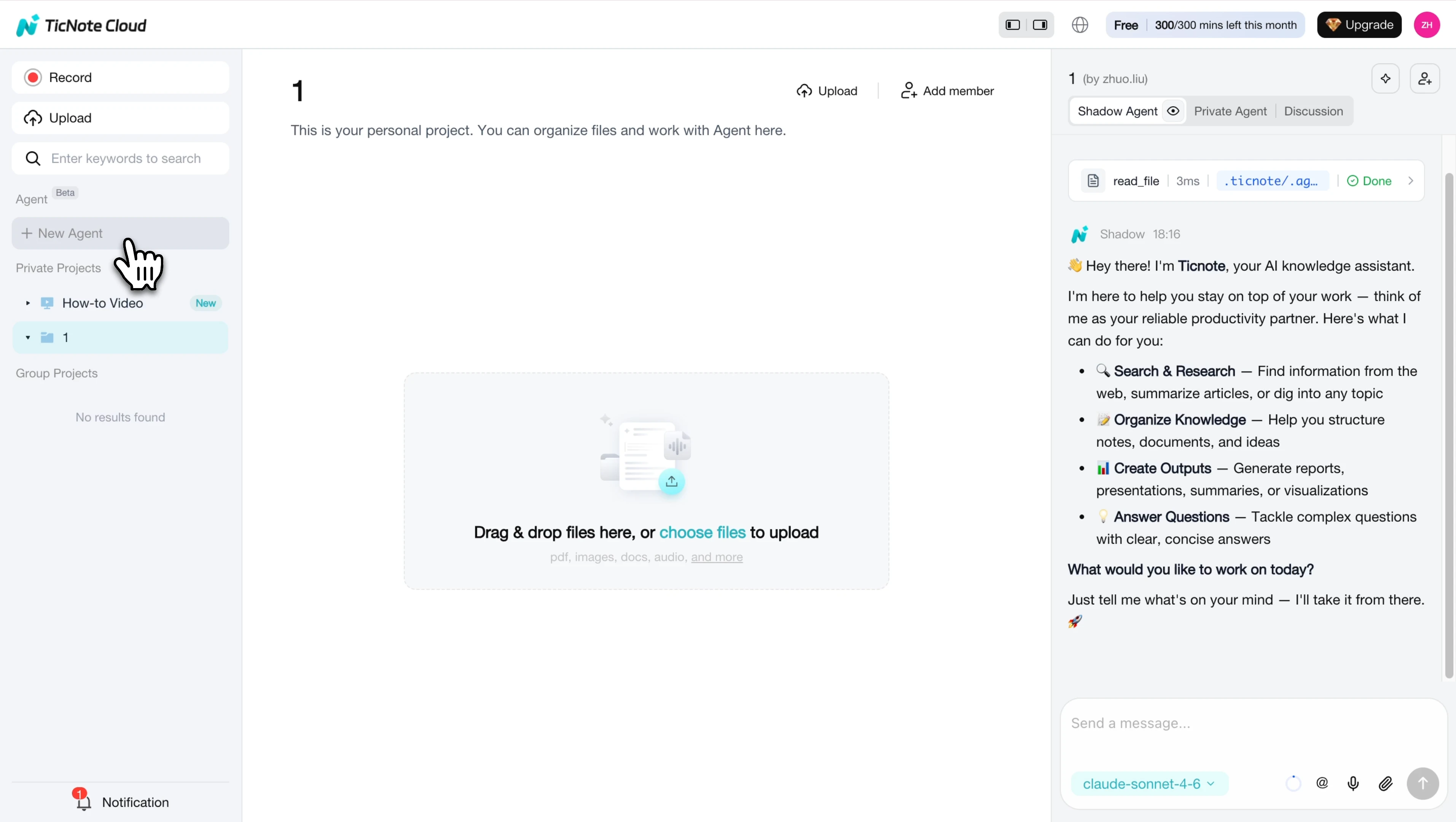
Once the agent is available, select it and move into the research request screen.
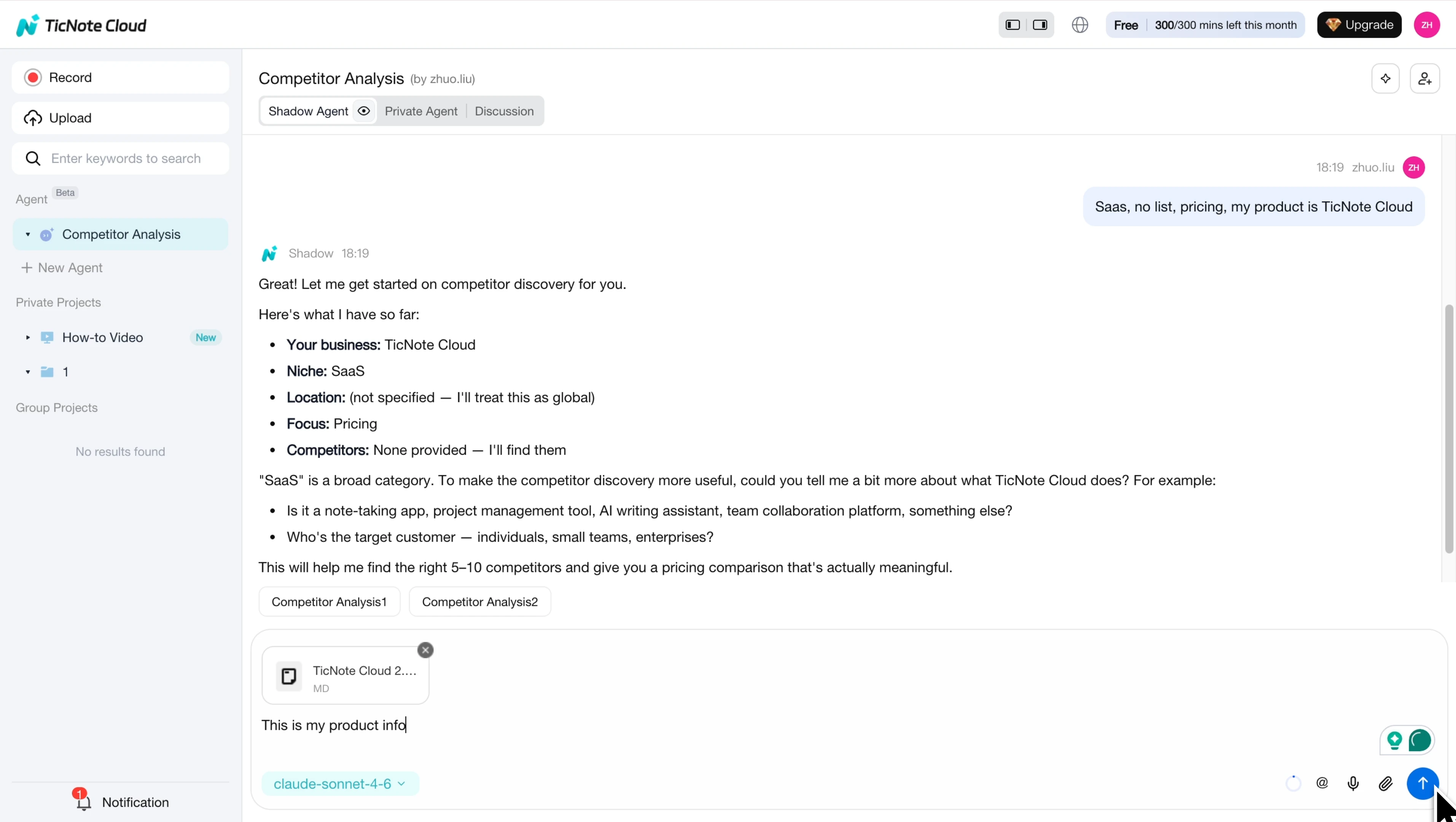
Next, enter the core inputs: your startup niche, target market or location, and 5 to 10 competitor names or URLs. Then add an optional focus area such as pricing, reviews, social media, or product range. This is where you shape the output around an immediate decision, like messaging, packaging, or feature gaps.
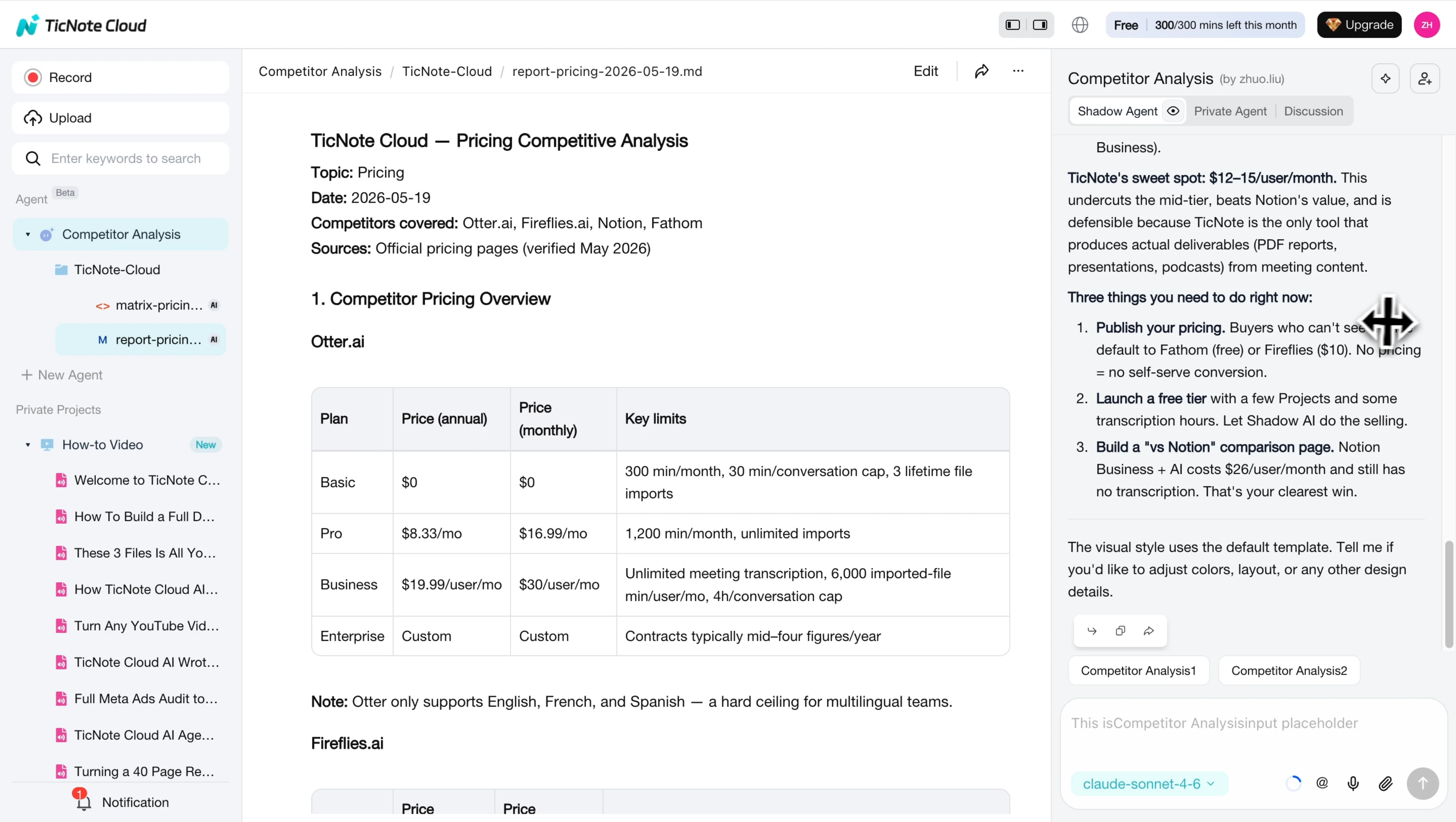
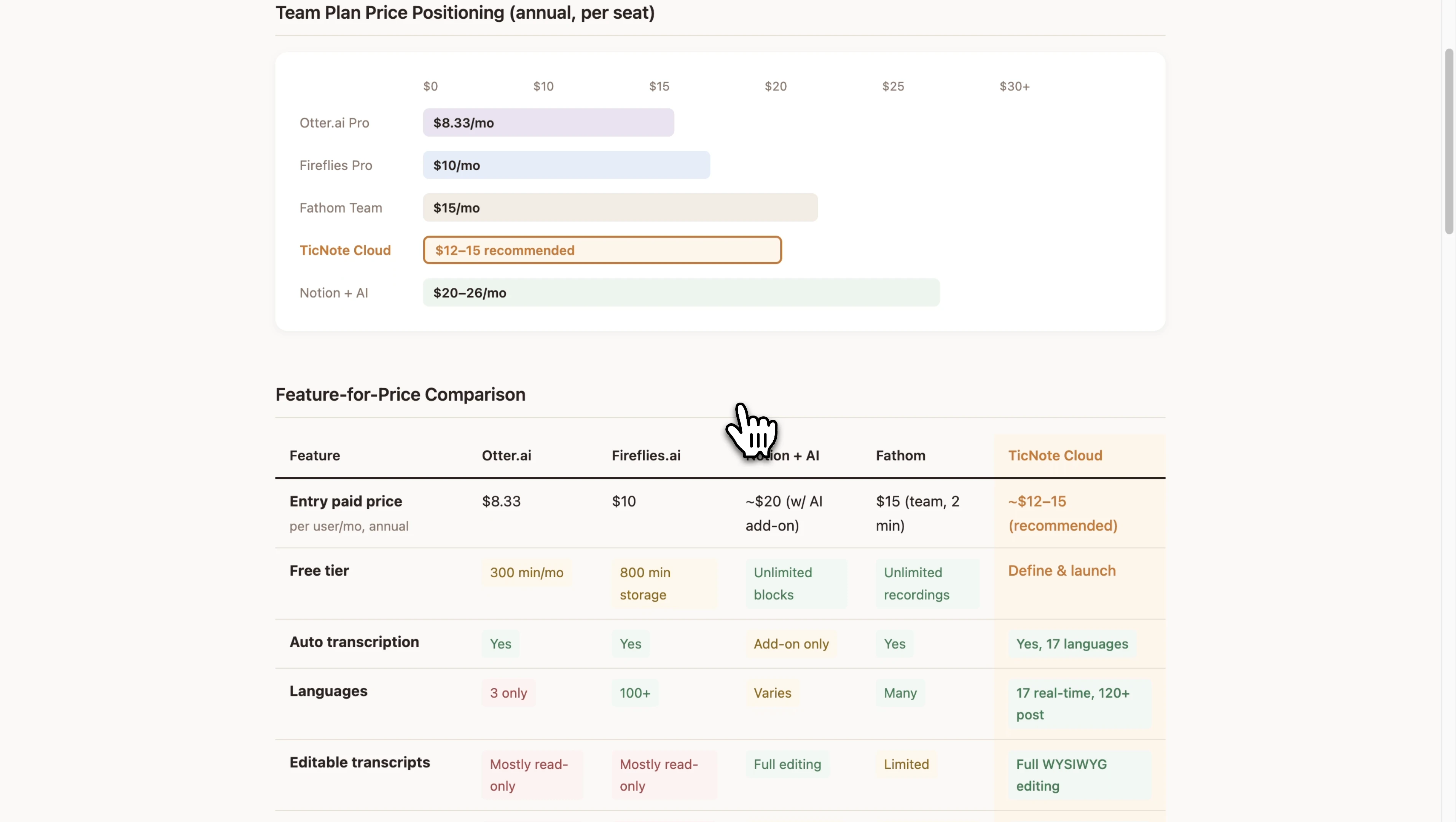
After you submit the request, the agent returns a structured report with an executive summary, competitor profiles, market gaps, recommended actions, and a visual comparison matrix. The report is saved for review, which makes it easier to turn raw findings into team discussion and next steps.
Open the visual output to scan the head-to-head comparison, SWOT-style cards, and priority actions.
If you want more options before you start, this guide to free competitor analysis tools is a useful next read.
Use the app when you're away from your desk
On mobile, founders can submit the same basic inputs when a new rival comes up in a call, at an event, or during customer research. You can review the report later and share the findings with teammates when you're back in planning mode.
This kind of workflow helps operationalize competitive analysis for startups faster because it turns scattered notes into a repeatable research system. Instead of collecting data in five different places, you get one organized output that supports product, pricing, and go-to-market decisions.
Try TicNote Cloud for free and build your first competitor report in minutes.
Common mistakes when doing competitor analysis for a startup
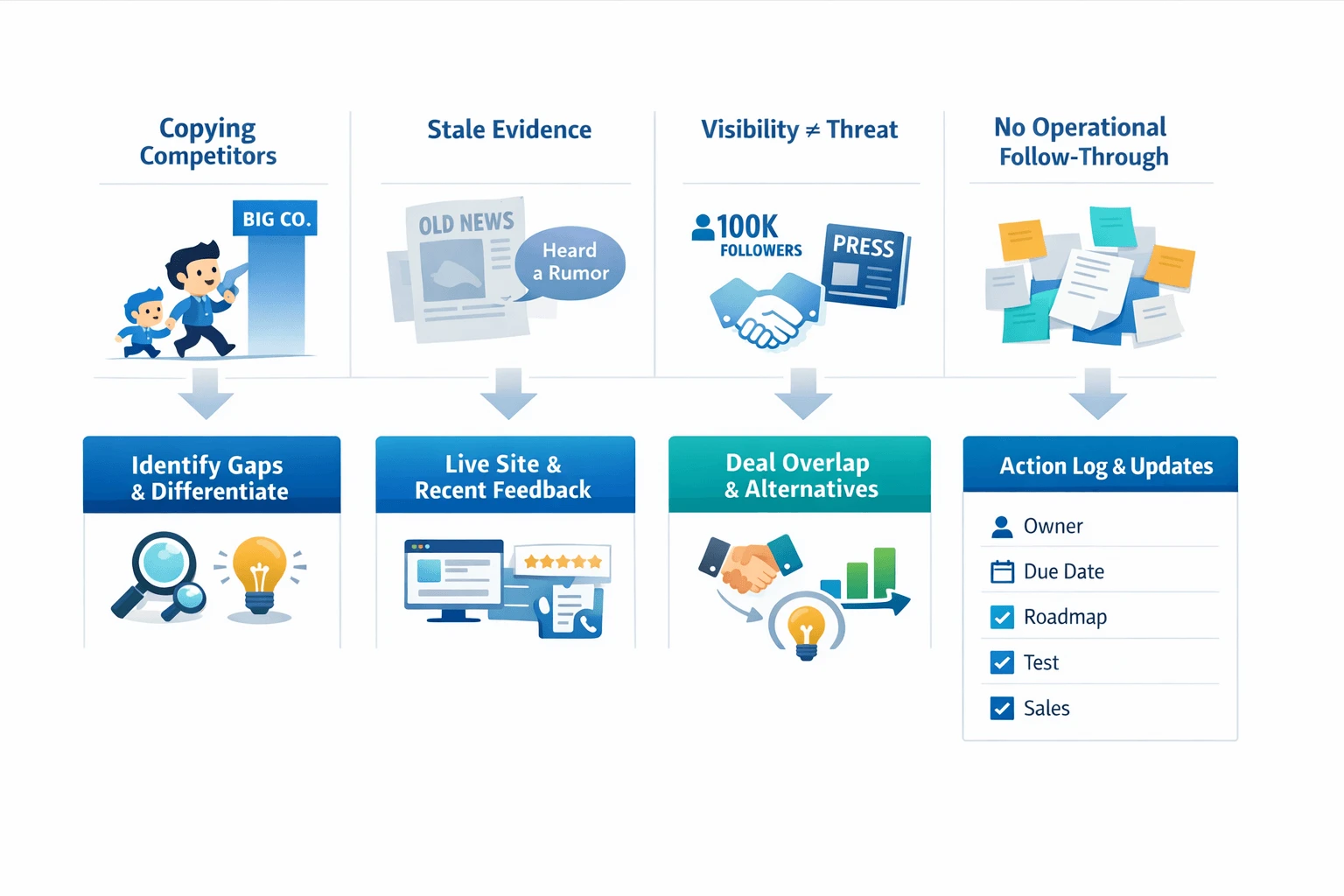
Good competitor analysis for startups should sharpen decisions, not create noise. Most teams don't fail because they skip research. They fail because they copy the wrong signals, trust weak evidence, and never turn findings into action.
Don't copy competitors too closely
A better-funded rival can outbuild, outspend, and outlast you. If you mirror its product scope, pricing, or brand tone, you usually lose the one edge a startup has: clear differentiation. Study patterns instead. Ask what customers value, where the rival is weak, and which gaps fit your strategy.
Use fresh evidence, not polished stories
Old screenshots, founder hearsay, and one-source assumptions lead to bad calls. Use live pricing pages, current reviews, onboarding flows, and recent customer interviews. Fresh evidence beats a polished narrative every time because markets shift fast.
Judge threat by buying behavior
Visibility is not the same as competitive pressure. A loud brand may dominate social reach while a niche tool, spreadsheet, or agency wins real deals. Rate threat by audience overlap, use case overlap, and how often buyers compare the options side by side.
Turn insight into owned actions
Many teams collect notes and stop there. Instead, keep a simple action log:
- insight
- decision
- owner
- due date
- next review date
That turns research into roadmap changes, messaging tests, and sales talk tracks. If you want a repeatable system, this guide on building a usable competitive intelligence workflow shows how to keep updates tied to decisions. Add a simple workflow diagram too, so everyone sees how evidence flows into action.
Final thoughts
Competitor analysis for startups works best when it stays narrow, evidence-based, and tied to real decisions. The goal is not to monitor every rival. It's to learn what customers actually compare, where the market still has gaps, and where your startup can win with a clearer promise, better product choices, or a smarter go-to-market motion.
A simple rule helps: track only the competitors that change your roadmap, pricing, messaging, or sales approach. If a finding won't shape action, it's noise. Keep your research lean, refresh it when the market shifts, and turn every interview, note, and comparison into next steps your team can use.