


 Extension
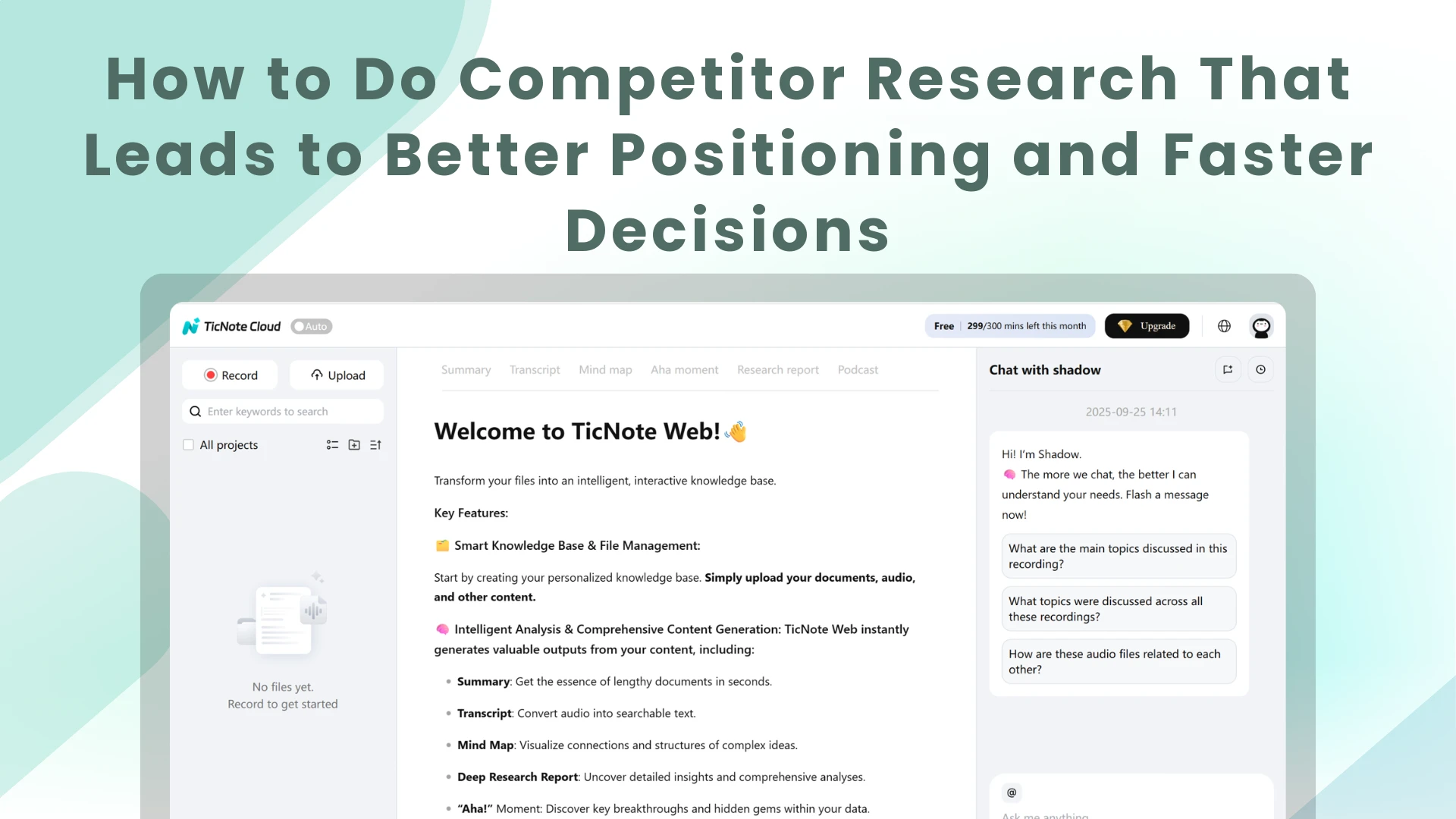
TL;DR: skill agent workflow for competitor research
For fast competitor research, try TicNote Cloud for Free and start with one decision: who you need to beat, where you can win, or what to change next. Then identify direct, indirect, and substitute competitors, capture proof in a simple scorecard, and review the same five areas every time: website, SEO, pricing, reviews, and positioning. This guide is for founders, solo marketers, small teams, and product marketers who need a practical workflow instead of a theory-heavy model.
Most teams don't struggle to find data. They struggle to keep interviews, call notes, and market evidence in one place without losing the source behind each insight. That mess slows decisions and makes patterns easy to miss, which is why TicNote Cloud helps organize meeting transcripts, research notes, and files into project-based outputs with source context intact.
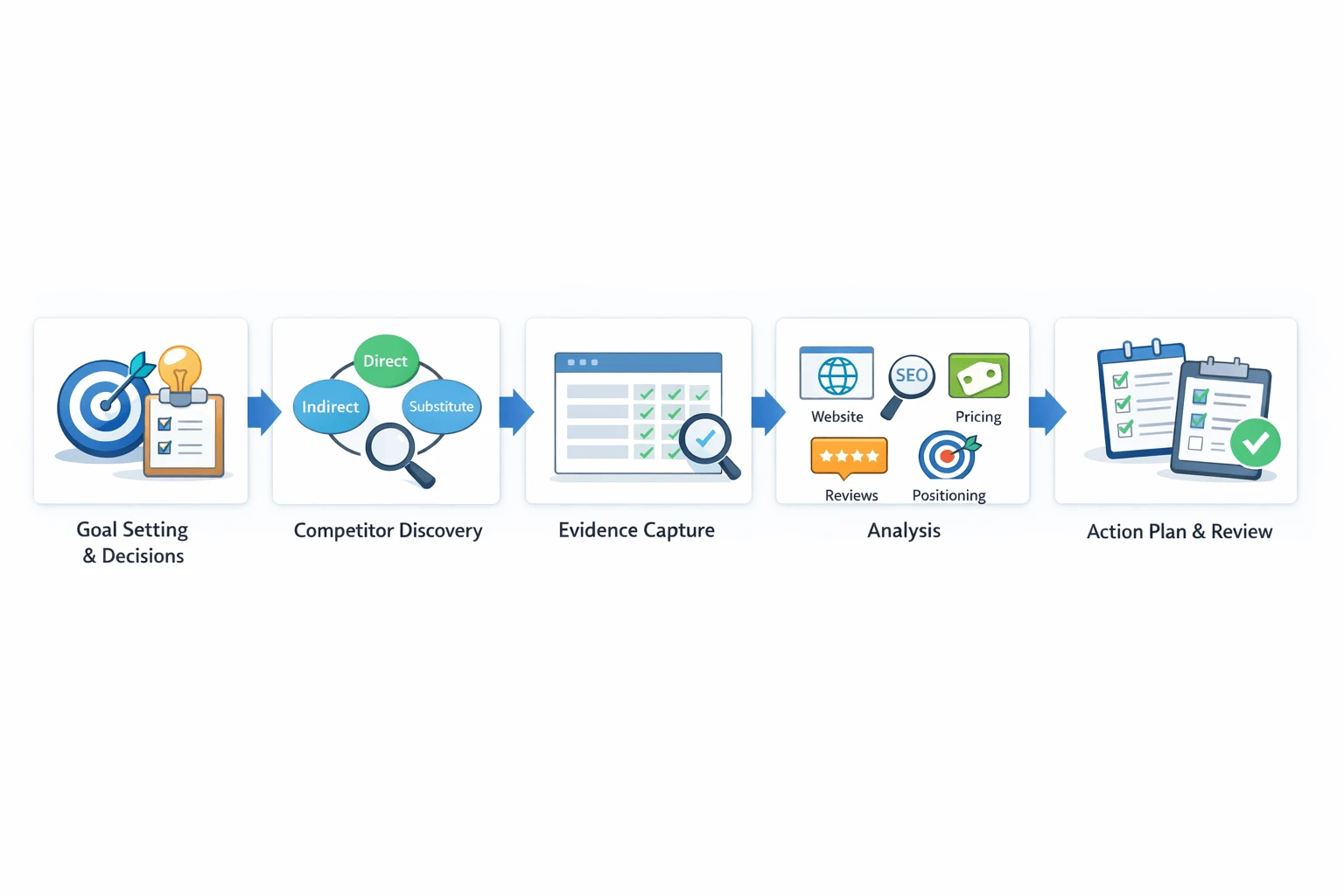
By the end, you'll have a repeatable workflow to find competitors, a lightweight template to score them, and a clear way to turn patterns into actions and a review cadence.
How competitor research fits market strategy
Competitor research helps you see who you're up against, how they position themselves, and where you can win. In practice, founders need two lenses: close-up analysis of rival companies and wider market context about buyers, demand, and category trends. This guide focuses on the practical side of researching competitors, then using market signals to make faster, better strategy calls.
Know the difference between competitor research and competitor market research
Competitor research looks at specific companies. You review their website, pricing, offers, messaging, reviews, and go-to-market moves.
Competitor market research goes broader. It adds customer needs, market size, demographics, buying behavior, and shifts in demand. Put simply:
- Competitor research = what rival brands are doing
- Competitor market research = what the market around those brands is doing
You usually need both. One shows the players. The other explains why their moves may or may not work.
Include direct, indirect, and substitute rivals
Most teams identify competitors too narrowly. They track only same-category brands and miss what customers really compare.
- Direct competitors sell a similar product to the same audience
- Indirect competitors solve the same problem in a different way
- Substitute competitors replace the need entirely
For example, a note-taking app may compete directly with another app, indirectly with a project management tool, and as a substitute with spreadsheets, an assistant, or doing nothing at all. That last option matters more than many teams think.
Use research to make decisions, not just collect facts
Good competitive research should help you decide:
- how to position your product
- where pricing should sit
- which content topics to prioritize
- which product gaps matter most
- which sales objections to address
- where not to compete
That's the real goal. Don't copy rivals. Use the analysis to find a defendable angle, sharpen your message, and move faster with more confidence.
How to find competitors in your market
Good competitor research starts before you open a spreadsheet. First, figure out what customers are trying to get done, then trace the options they already consider. That approach helps you find real rivals, not just brands that rank for the same keyword.
Start with customer alternatives and search results
Begin with the job the buyer needs done. Ask: what are they using now, and what would they switch from? List current tools, manual workarounds, agencies, freelancers, and in-house processes. Then expand your search using a few simple query types:
- product category + location
- problem-aware keywords
- comparison terms like "X vs Y"
- "best" and "alternatives" searches
- marketplace, directory, and review-site searches
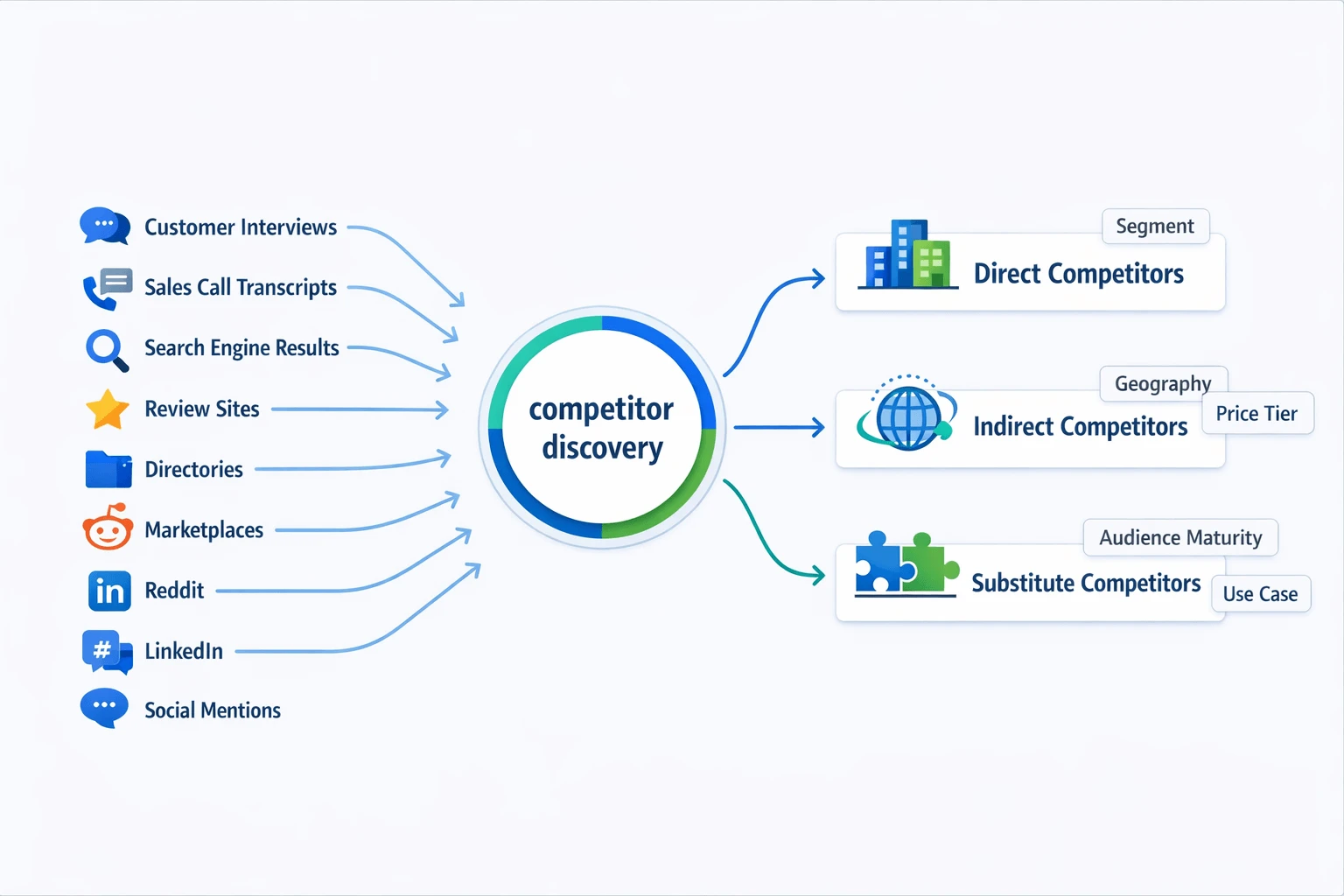
Next, review page one carefully. Check organic results, ads, local packs, software directories, app marketplaces, Reddit threads, LinkedIn posts, YouTube reviews, and G2-style review sites. This is often how you find competitors that don't describe themselves the same way you do.
Also, don't skip your own data. Customer interviews, win/loss notes, demo calls, and sales transcripts often reveal hidden competitors that keyword tools miss. If you want a next step after discovery, this competitor analysis scorecard helps turn raw findings into a usable comparison.
Identify competitors by segment, geography, and use case
Once you have a long list, tag each company so you can compare like with like. Use five tags:
- segment
- geography
- price tier
- audience maturity
- primary use case
Then sort each rival into one of three buckets:
- Direct: same audience, similar product, same problem
- Indirect: similar problem, different approach
- Substitute: different category, same outcome
This step matters because false comparisons lead to bad positioning decisions. A premium enterprise platform should not be benchmarked against a low-cost tool for freelancers. Simple tags like "SMB / US / mid-price / beginner / reporting" make grouping easier later.
Start with 5–10 competitors first
If you're new to how to research competitors, start small. Analyze 5 to 10 companies: usually 3 to 5 direct rivals, plus 2 to 5 indirect or substitute options.
In crowded markets, shortlist based on four filters:
- audience overlap
- geography
- messaging similarity
- buying triggers
Finally, write one line on why each company made the list. That keeps the work tied to decisions, not data collection for its own sake.
Build a competitor research template that surfaces useful patterns
A good template turns competitor research from a pile of tabs into a decision tool. The goal isn't to collect everything. It's to track the same fields for every company so patterns show up fast: who targets the same buyer, who wins on pricing, and who owns a channel or message. If you want a reusable format, this competitive analysis template with scoring ideas can help you standardize the work.
Track the same core fields for every competitor
Start with a simple sheet or database. Give each competitor one row, then add columns for:
- company name
- URL
- segment
- geography
- target audience
- core promise
- key features
- use cases
- pricing model
- free trial or demo
- messaging themes
- content topics
- SEO visibility clues
- social channels
- proof points
- reviews
- complaints
- notable differentiators
Add one more field that matters just as much: notes. Use it to store source links, capture quotes, and mark a confidence level such as high, medium, or low. That helps your team separate observed facts from assumptions.
Use a simple scorecard to spot patterns
After you fill in the template, score each competitor on six basics:
- pricing clarity
- positioning strength
- channel presence
- review sentiment
- product depth
- conversion experience
A red-yellow-green system works well for beginner teams. A 1-5 scale works too. Neither is perfectly scientific, and that's fine. The point is to reveal useful patterns fast. For example, if 4 out of 5 rivals have strong review sentiment but weak pricing clarity, that's a positioning gap worth testing. In the finished article, include a sample filled analysis table and a side-by-side comparison matrix so readers can see the method in action.
Validate public data and stay within ethical limits
Public-source research still needs verification. Cross-check claims across official websites, review platforms, search results, and recent page timestamps before you treat them as facts. Mark anything old, conflicting, or incomplete as unverified.
Stay inside clear ethical limits:
- use public information
- don't misrepresent your identity
- don't access private systems
- label uncertain findings as unverified
As Justice Manual 1030. Unauthorized Access to Computers (2022) states, "In many circumstances, it is not a crime to violate a public website's terms of service." That doesn't remove your duty to document sources carefully. In a repeatable workflow, evidence quality matters as much as quantity.
What should you analyze after you identify competitors?
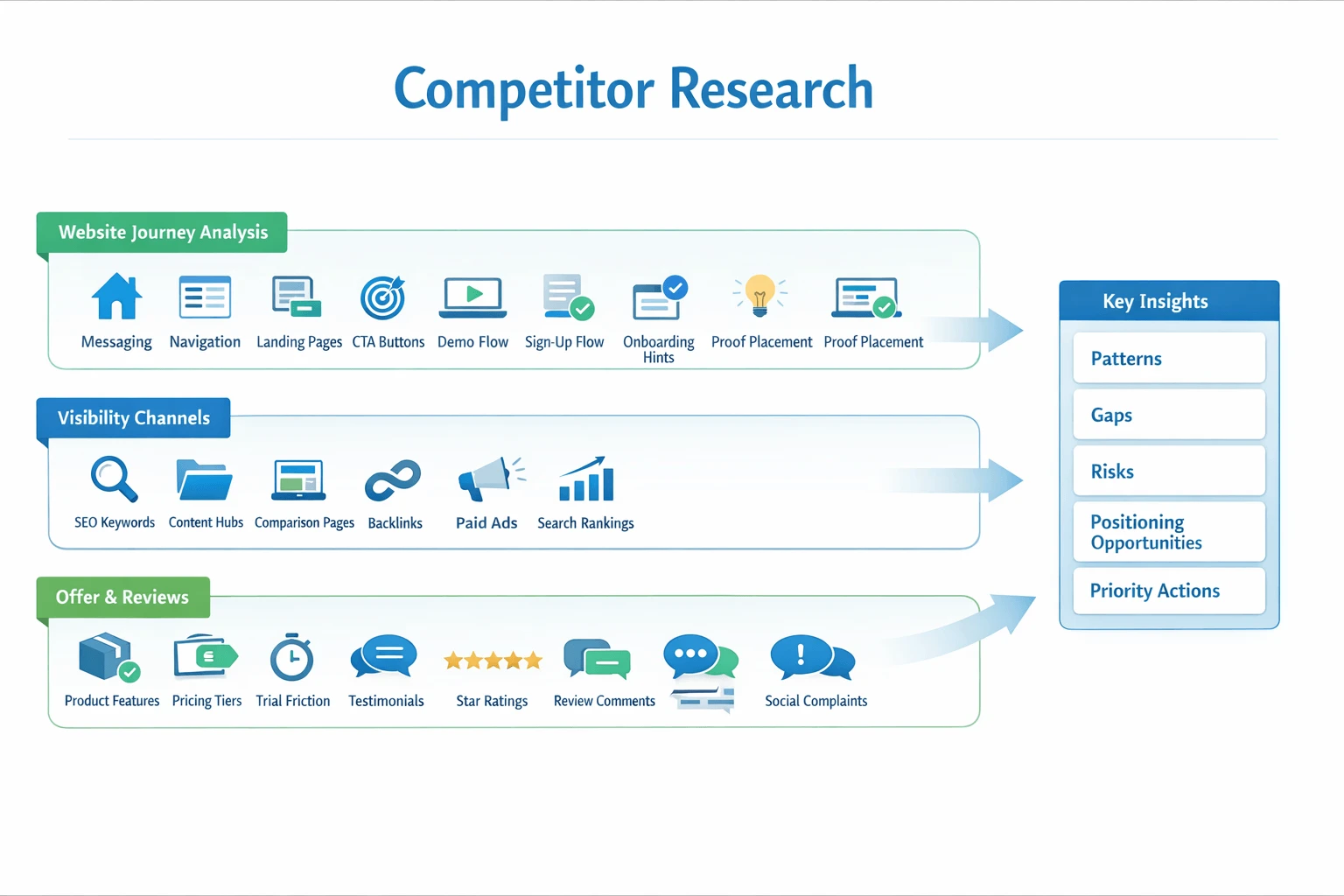
Once you identify competitors, the next step in competitor research is simple: study how they attract attention, move buyers through the journey, and turn interest into revenue. Focus on three lanes that reveal the clearest patterns: website experience, search visibility, and the offer itself. If you want a faster starting point, this guide to free competitor analysis tools can help you collect the raw inputs.
Review website messaging and the conversion journey
Start on the homepage. Ask basic but important questions:
- Who is this for?
- What problem do they claim to solve?
- Why should a buyer trust them?
- What action do they want next?
Then trace the full path like a normal buyer. Click the main navigation. Open landing pages. Test the primary call to action. Request a demo if that is the main route. Start a sign-up flow if self-serve is available. Look for onboarding clues, empty-state guidance, email prompts, and where proof appears.
For each competitor, write down what they want the visitor to believe, feel, and do:
- Believe: the product is credible, different, or easier
- Feel: urgency, relief, confidence, curiosity
- Do: book a demo, start free, contact sales, compare plans
This keeps your notes practical instead of vague.
Inspect SEO content and paid visibility
Next, review where competitors win attention in search. You do not need to reverse-engineer every metric. The goal is to see which topics they own and how they capture demand.
Check these areas:
- target keywords and topic clusters
- blog categories and resource hubs
- comparison pages and alternative pages
- product-led pages built to convert
- backlink cues from partner pages, guest posts, or directories
- ad presence on brand and nonbrand queries
- search result positioning for educational, comparison, and bottom-funnel terms
A useful question is this: do they educate better, compare better, or convert better? Also note content gaps. If rivals rank for broad awareness terms but ignore pain-point searches, that may be your opening.
Compare product, pricing, proof, and complaints
Now compare the offer itself. Look at feature packaging, pricing model, plan limits, upgrade paths, and trial friction. A product with a low entry price but a confusing upgrade path sends a very different signal than one with transparent pricing and a generous free plan.
Then study proof and complaints side by side. Review testimonials for specificity. Check ratings and written feedback across review sites, Reddit threads, app stores, LinkedIn comments, and support discussions. Repeated complaints often expose unmet demand. If buyers keep mentioning weak onboarding, hidden limits, or poor support, you may have a positioning opening.
A simple analysis table should capture:
- core promise
- audience segment
- top keywords or themes
- CTA path
- pricing model
- strongest proof
- recurring complaint
- likely opportunity
Later in the article, include a sample filled table plus prompts for a comparison table and a prioritization matrix so you can turn observations into decisions, not just notes.
How to organize competitive research in a repeatable workflow
To make this process concrete, the steps below use TicNote Cloud as an example for organizing competitor research, not as the keyword target of this article. The goal is simple: keep interviews, notes, documents, and updates in one place so your team can move from raw inputs to decisions faster.
Start with one project per market
On the web platform, begin by adding the Competitor Analysis skill agent to your workspace. In TicNote Cloud, click Add Agent, open the Skill Agent library, and select the Competitor Analysis skill.
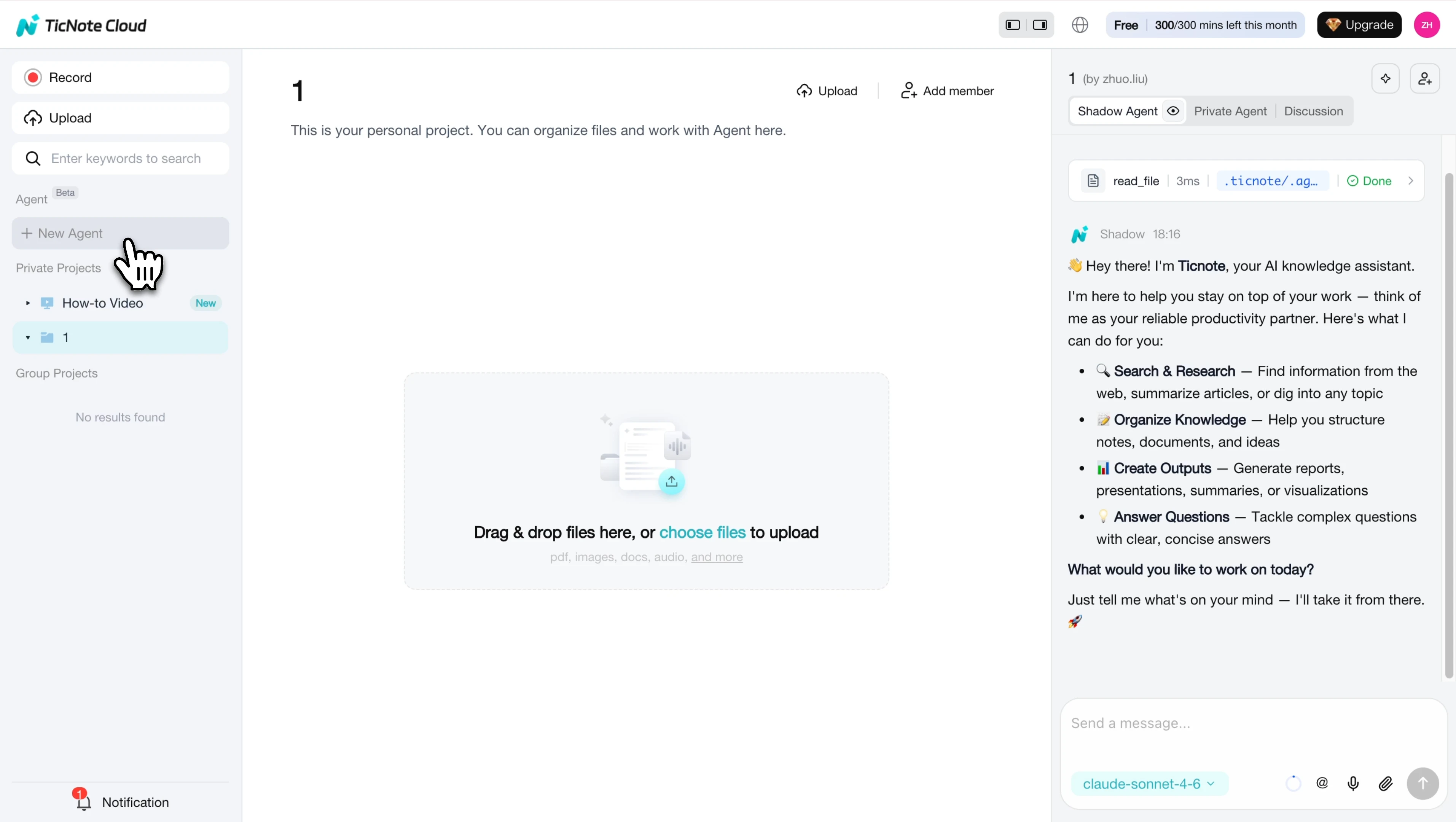
Once it's added, you'll see it in your agent list and can use it right away.
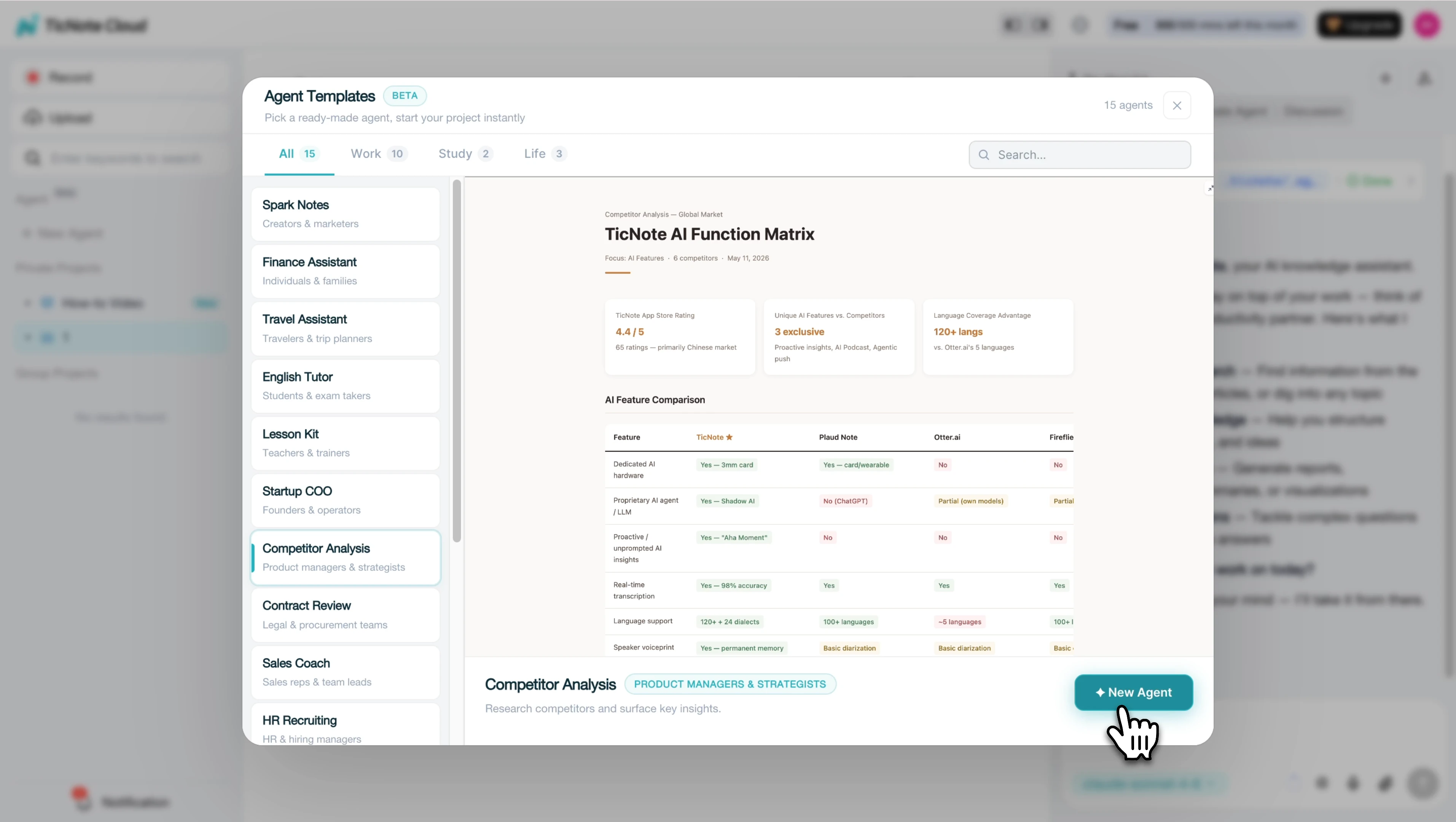
Next, create a project for the market, category, or segment you want to study. Then enter your niche, your location, and 5–10 competitor names or URLs. If your decision is narrow, add a focus such as pricing, reviews, social media, or product range so the report matches the question you need answered.
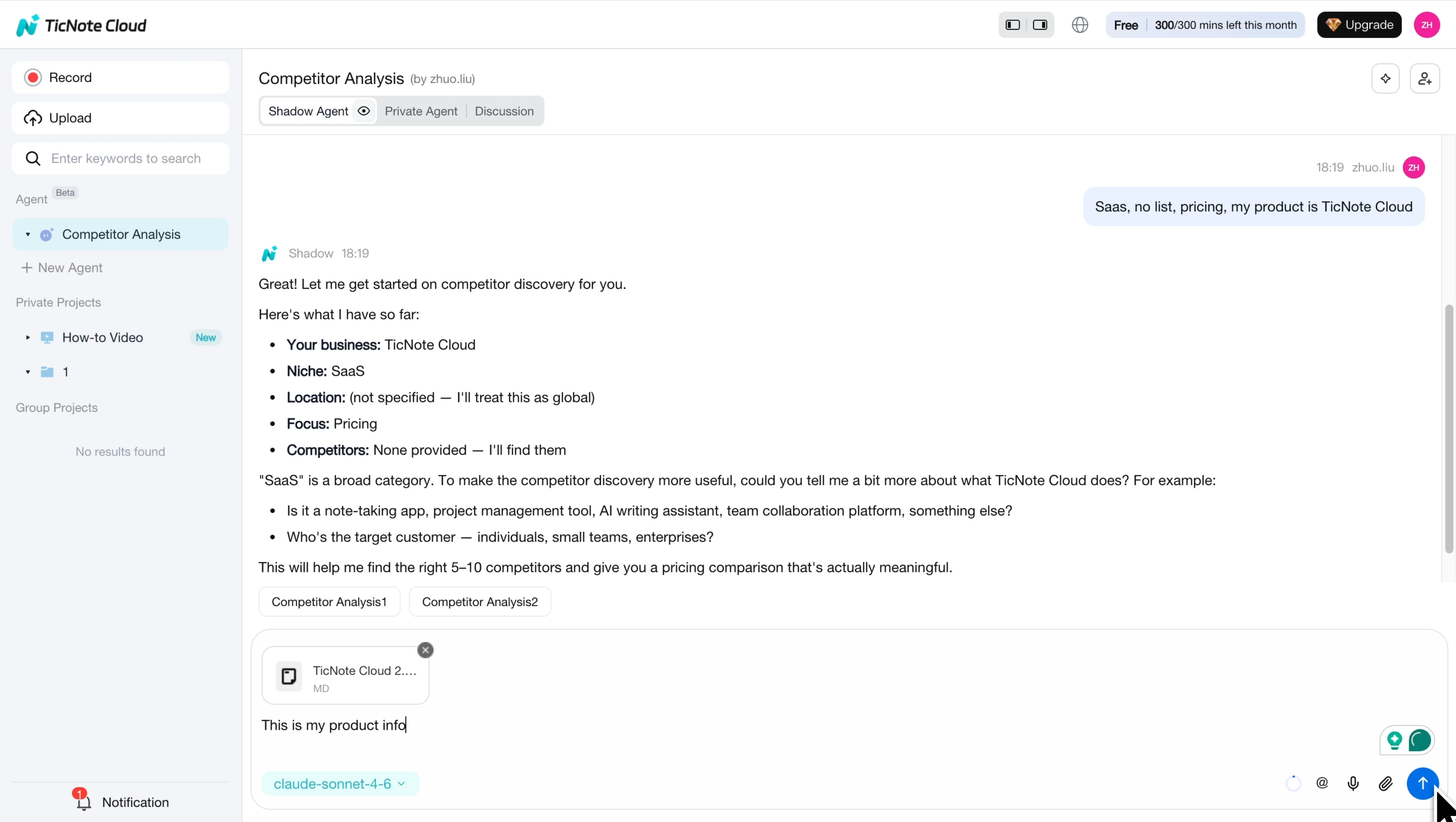
Add inputs, then generate one structured report
After that, collect your public-source inputs into the same project: interview notes, meeting transcripts, PDFs, spreadsheets, and market findings. This is where repeatable competitive research gets easier. Instead of copying notes between tools, you can ask for one structured intelligence report across all files.
The output can include:
- an executive summary
- competitor profiles
- SWOT-style patterns
- a positioning map
- recommended actions
- a visual comparison matrix
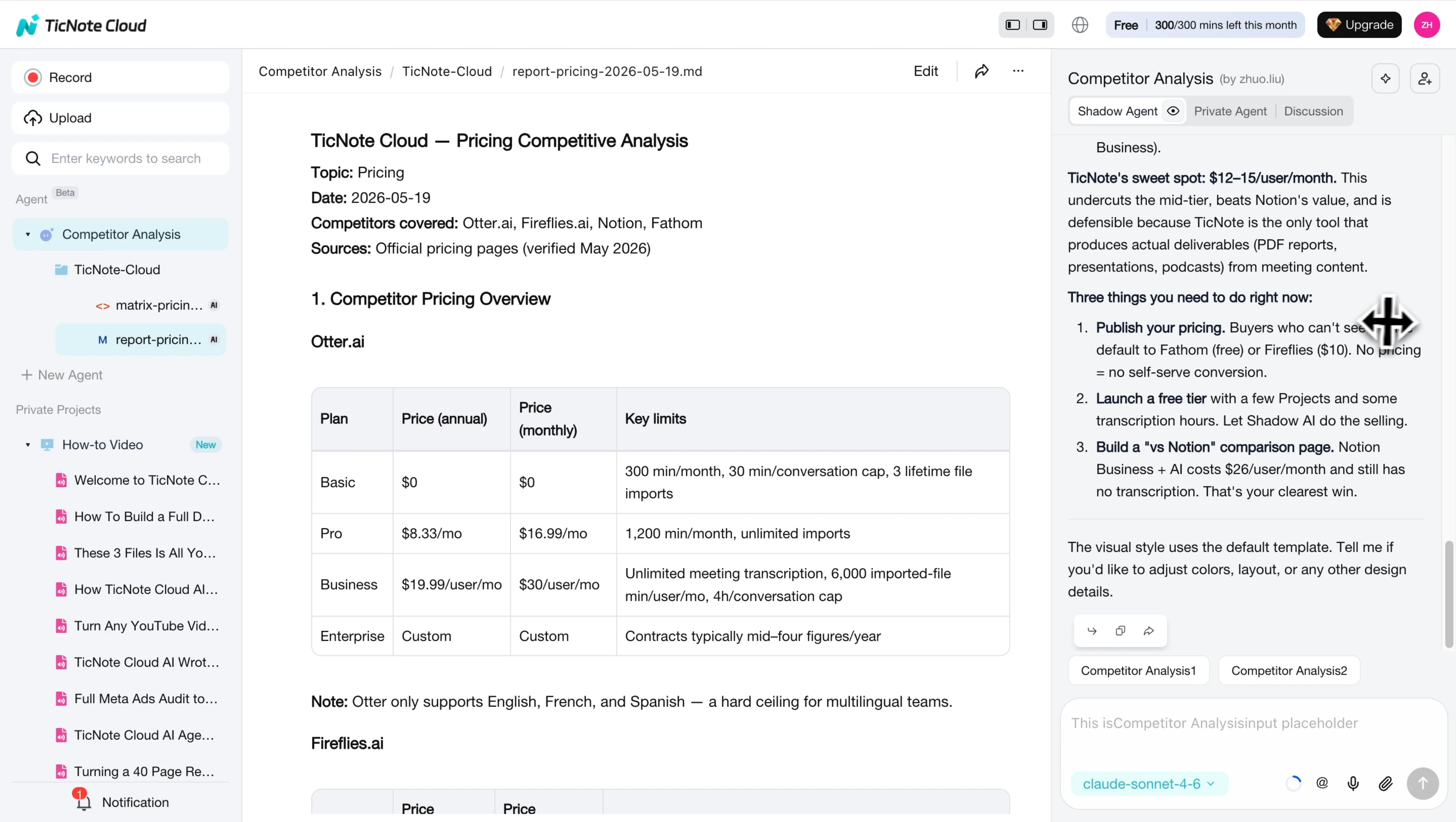
Because the project keeps memory across files, your team can ask follow-up questions and get cited answers tied back to source material. That makes it easier to verify claims, update reports, and keep everyone aligned. You can also review the visual matrix for faster side-by-side analysis.
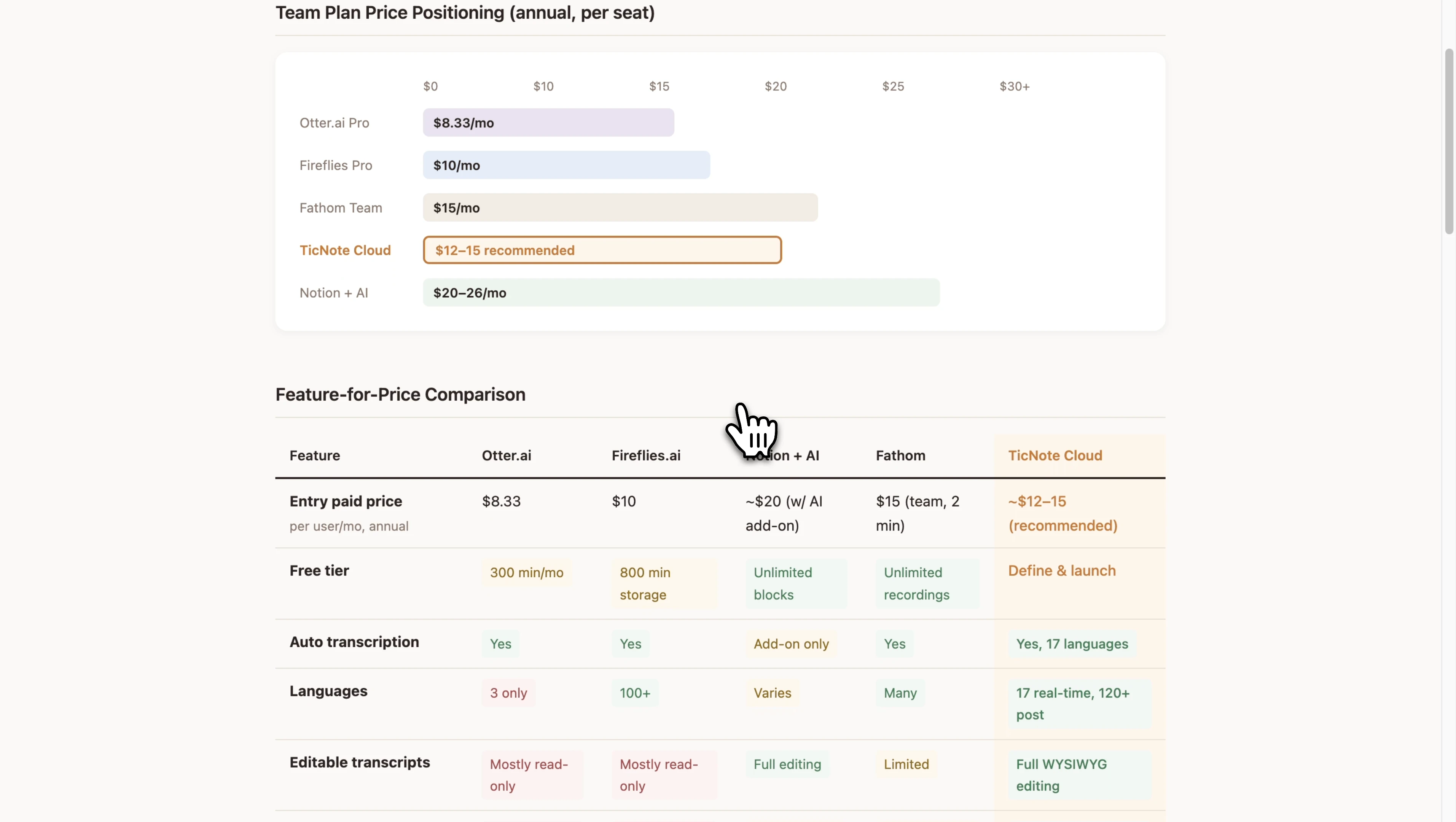
If you also run interviews or internal review calls, it helps to use the same workspace that can manage meeting notes and follow-ups instead of starting from scratch each time.
On mobile, the workflow is lighter: capture interviews, voice notes, or field observations on the go, then sync them back to the same project for later analysis. That's useful because competitor research usually spans calls, notes, documents, and recurring updates. One searchable workspace reduces context loss and speeds report creation.
Try TicNote Cloud for free and turn scattered research notes into a reusable workspace.
Turn competitor market analysis into action
Competitor research only matters if it changes what you do next. The fastest way to turn raw notes into decisions is to convert them into a few shared tools your team can review in minutes, not a 40-slide deck.
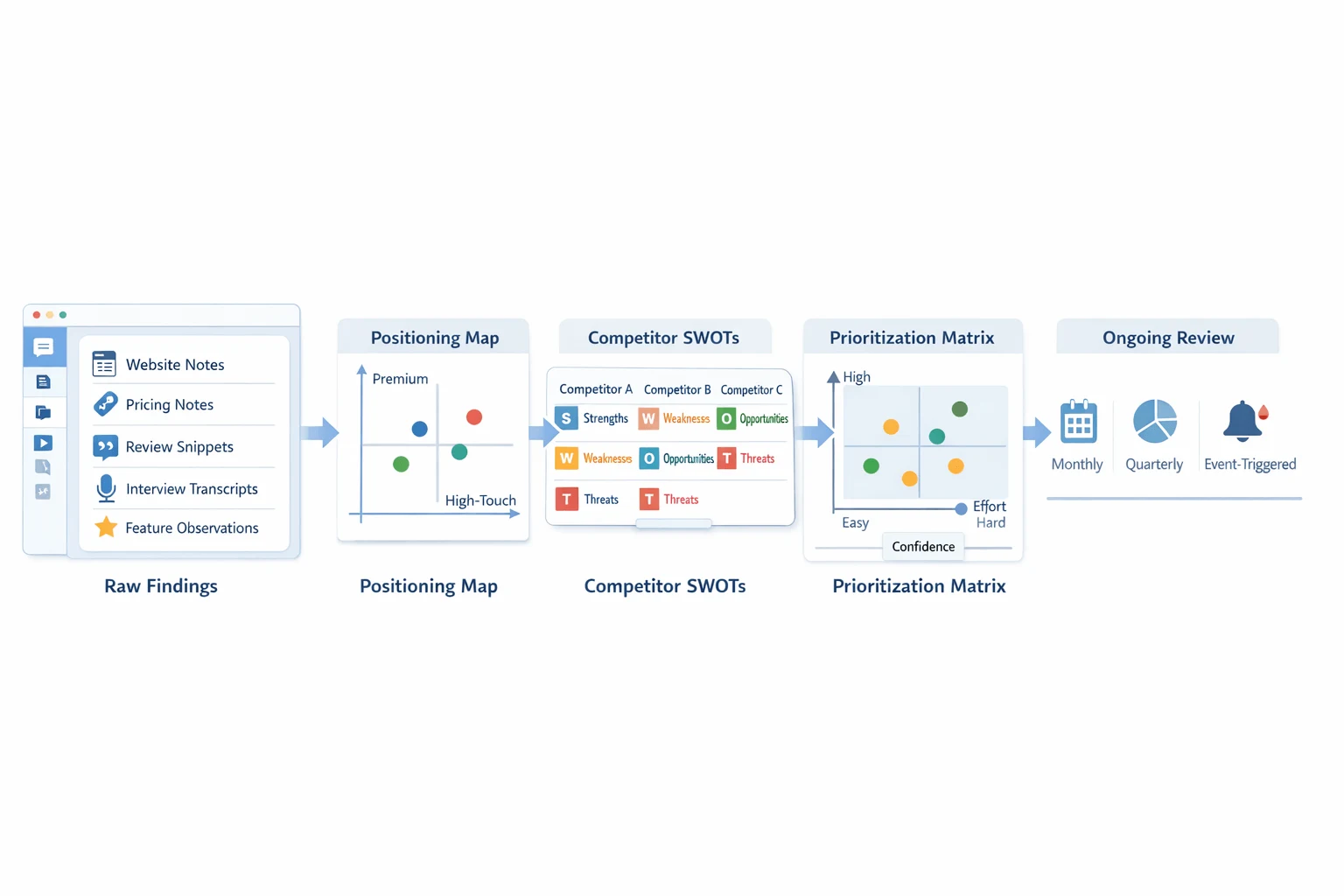
Build a positioning map and SWOT-lite summary
Start with a simple two-axis map. Use axes that matter to buyers, such as premium vs. accessible pricing or self-serve vs. high-touch support. Then place your brand and top rivals on the same chart. This makes gaps easier to spot.
Next, create a SWOT-lite for each priority competitor:
- Strengths: clear proof points, strong reviews, wide integrations
- Weaknesses: confusing pricing, slow onboarding, thin content
- Opportunities: underserved segments, weak comparison pages, poor trial flow
- Threats: new launches, discounting, strong brand awareness
Keep it short and evidence-based. Speed and comparability matter more than polish. If you want a stronger framework, this guide on competitive positioning maps and differentiation can help.
Prioritize moves instead of reacting to everything
Group findings into five buckets:
- pricing moves
- messaging shifts
- content opportunities
- product gaps
- sales enablement updates
Then score each idea by impact, effort, and confidence on a 1 to 5 scale. High-impact, low-effort, high-confidence ideas go first. Most teams should pick only two or three moves per cycle. That prevents noise from driving strategy.
Set a review cadence that compounds over time
Use a simple rhythm:
- monthly: light scans of websites, pricing, and reviews
- quarterly: deeper market reviews and updated scoring
- event-triggered: refresh analysis after launches, funding news, major pricing changes, or review spikes
Store interview transcripts, competitor notes, and reports in one TicNote Cloud project so each round builds on the last. Shadow AI can search across files, pull cited answers, and generate fresh summaries without copy-paste. Try TicNote Cloud for Free and turn recurring competitor research into a repeatable workflow.
Conclusion: a smarter skill agent process for ongoing research
Good competitor research works best when it follows the same order every time: define the question, find the right competitors, capture evidence in a simple template, review the signals that matter, and turn the result into a short list of actions. That process helps you make faster decisions with better evidence instead of collecting random screenshots, notes, and opinions.
The goal is not to copy rivals or build an endless spreadsheet. It's to spot patterns, sharpen your positioning, and decide what to change next in messaging, pricing, product, or sales. If you need help turning findings into a usable write-up, this guide on turning analysis into clear actions is a useful next step.
Make the system repeatable. When each interview, meeting note, review, and market update lands in one workspace, the next round gets easier. Tools like TicNote Cloud can help teams store research inside projects, ask cross-file questions with citations, and turn raw notes into reports without starting from zero each time.