


 Extension
TL;DR: A skill agent approach to objective resume scoring
Start with a shared workspace and score resumes by turning intake notes into observable evidence, not by trusting gut feel or a generic resume score checker. Use a weighted 1–5 resume scoring rubric, define each score level, then calibrate reviewers on 3–5 sample resumes before screening at scale.
Scattered intake notes create uneven decisions. That gets worse when each reviewer reads for different signals and records weak rationale. A meeting-centered AI workspace helps teams capture role context, align resume scoring criteria, and document why each resume score was assigned.
How to score resumes with a structured rubric
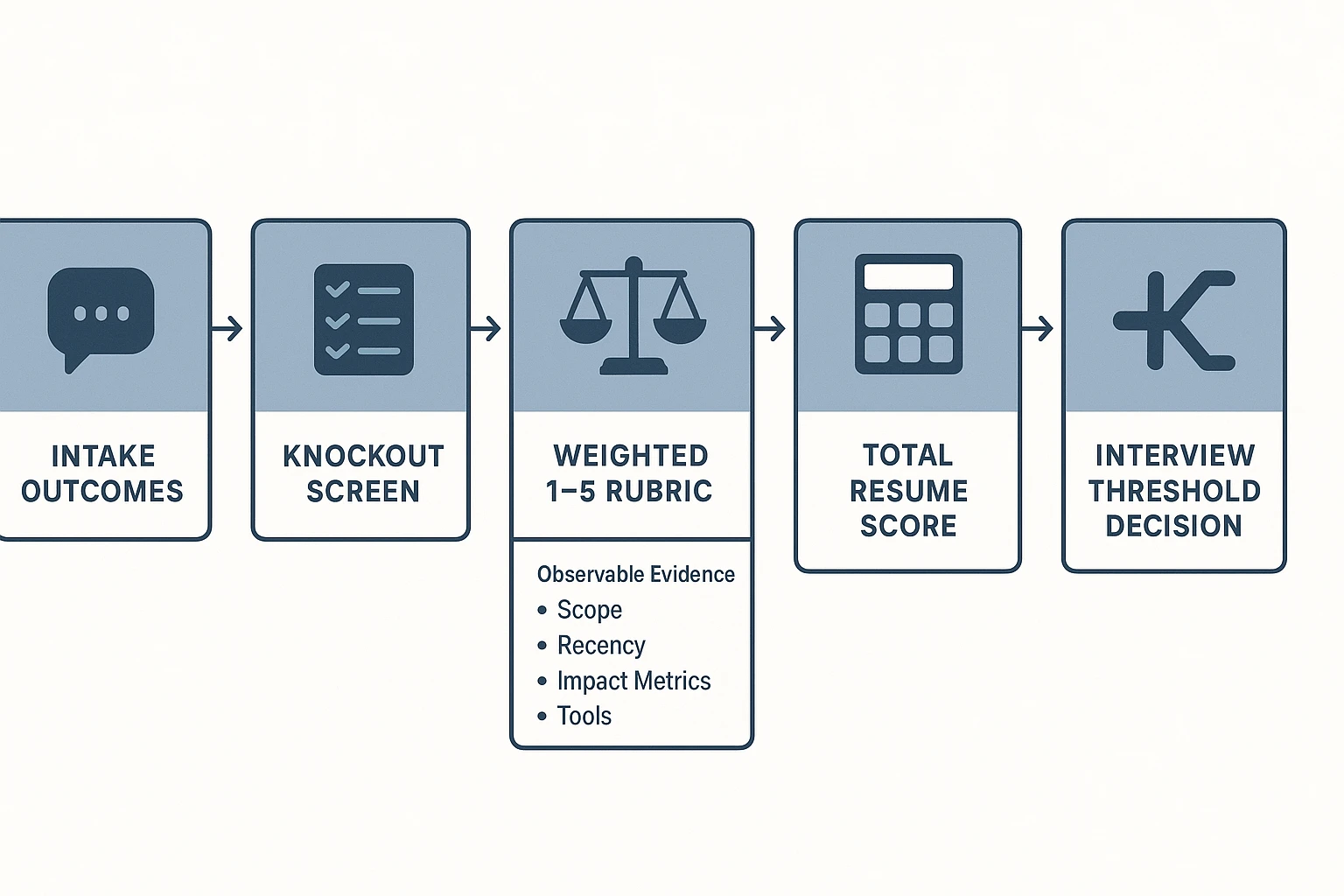
The simplest way to learn how to score resumes is to stop judging the whole resume at once. Build a rubric that turns the job into observable evidence, then score every candidate against the same rules. This creates a resume scoring system reviewers can explain, audit, and improve.
Start with the role outcome
Before you list skills, define the job's "north star" outcomes. Ask: what must this person deliver in the first 3–6 months? For a backend engineer, that might be "ship production changes safely" or "reduce incident risk," not "knows Kubernetes."
Turn those outcomes into 3–5 capability statements. Then decide what can fairly appear on a resume: projects, scale, tools, metrics, scope, and recency. Keep interview-only topics out of the resume scoring rubric, such as communication style or live problem solving.
Split knockouts from scored criteria
Use two lanes:
- Knockouts: binary must-haves, such as a required license or legally required work authorization.
- Scored criteria: quality signals that vary by strength, such as depth of experience or evidence of impact.
Keep knockouts small. If a requirement is missing, decide the rule before review: pause for clarification, request more information, or mark it not met. Apply that rule to every candidate.
Convert criteria into evidence
For each criterion, define observable signals. Keywords alone are weak evidence. Look for scope, level, recency, outcomes, and comparable work.
Example: "CRM migration experience" could include Salesforce, HubSpot, or another enterprise CRM if the resume shows data cleanup, stakeholder coordination, and launch ownership. Add a notes field for "where found" and "why it matters." This mirrors a repeatable scorecard workflow: define criteria first, then compare evidence consistently.
Rate, weight, and calculate the resume score
Use a 1–5 scale:
- 1 = little or no relevant evidence
- 3 = meets the bar with clear examples
- 5 = strong, recent, high-scope evidence
- 2 and 4 = in-between scores
Weight criteria by business impact and ramp risk, not personal preference. A simple formula works:
Total resume score = (criterion score × weight) ÷ total weight
Use the same weights for every candidate in the same role.
Set thresholds before review
Set pass rules before opening resumes. For example: total score of 3.5+ and at least 3 on critical criteria. Add tie-breakers, such as recent similar scope or stronger outcome metrics.
If a resume is unclear, don't force a score. Pause it, request clarification, and record the same action every time.
Mini-checklist: build a rubric in under 30 minutes
- Define 1 north star outcome.
- Write 3–5 capability statements.
- Separate knockouts from scored criteria.
- Add observable evidence for each criterion.
- Define 1/3/5 rating anchors.
- Assign weights that total 100%.
- Set interview thresholds and tie-breakers.
- Add a notes field for audit-ready decisions.
Which resume scoring criteria belong in your rubric?
When deciding how to score resumes, build criteria from the job, not from the stack of applicants. Each item should point to observable evidence: a license, a system used, a project owned, a stakeholder group supported, or a work condition that truly affects performance.
Start with compliant knockouts
Use minimum qualifications only when they are job-related and applied to every candidate. Safe knockouts include required licensure, a mandated credential, specific shift coverage, or ability to perform essential functions. Don't add informal "must-haves" after resumes arrive.
Score evidence, not shortcuts
For experience, look beyond years. Score scope, complexity, ownership, outcomes, and recency. For education, ask whether the degree is legally or technically required. If not, allow equivalent experience. Certifications should carry more weight for regulated or safety-critical work, and less weight when they only signal interest.
Soft skills need resume-visible proof:
- Collaboration: cross-functional launches, customer handoffs, shared roadmaps.
- Leadership: mentoring, incident ownership, hiring panels, process design.
- Communication: documentation, executive updates, training materials, proposals.
Keep logistics factual
Location, time zone, availability, and work authorization belong in resume scoring criteria only when they affect the work. Treat them as pass/fail requirements or later verification steps, based on local law and company policy.
Audit your rubric fast
The Uniform Guidelines on Employee Selection Procedures (1978) state: "A selection rate for any group which is less than four-fifths (4/5) (or 80%) of the rate for the group with the highest rate will generally be regarded by the Federal enforcement agencies as evidence of adverse impact."
Do:
- Use job-related, pre-approved criteria.
- Define each score level before screening.
- Document rationale for close calls.
Don't:
- Score photos, age clues, graduation dates, or protected-characteristic proxies.
- Use vague "culture fit."
- Let automation make final decisions without human review.
Resume scoring rubric example with weights and candidate scores
A good resume scoring rubric turns "I liked this person" into evidence you can compare. If you're learning how to score resumes, start with 6 weighted criteria, score each from 1 to 5, and keep knockouts separate from the total.
| Criteria | Weight | Candidate A | Candidate B | Candidate C |
| Role-relevant experience | 25% | 4 | 3 | 5 |
| Technical skills/tools | 20% | 5 | 3 | 2 |
| Problem scope/impact | 20% | 3 | 5 | 2 |
| Communication artifacts | 15% | 3 | 4 | 2 |
| Domain exposure | 10% | 2 | 5 | 3 |
| Learning/ramp evidence | 10% | 4 | 3 | 5 |
| Weighted resume score | 100% | 73 | 75 | 63 |
| Knockouts: work authorization, required license, location, minimum credential | Pass/fail only | Pass | Pass | Needs clarification |
Define the 1, 3, and 5 before scoring
| Criterion | Score 1 | Score 3 | Score 5 |
| Role experience | Similar tasks missing | 2–3 related duties | Same role, same level |
| Technical skills | Few required tools | Adjacent tools or partial stack | Required tools used recently |
| Scope/impact | Tasks only | Team-level results | Measured business outcomes |
| Communication | No artifacts | Some docs, reports, decks | Clear portfolio, specs, writing samples |
| Domain exposure | Unrelated field | Adjacent industry | Same customer, market, or regulation |
| Ramp evidence | No learning signal | Course or certification | Fast promotion, shipped new skill, cross-functional move |
Equivalency rule: accept adjacent tools when the workflow is similar, such as HubSpot for Salesforce or Tableau for Power BI. Recency rule: full credit goes to evidence from the last 3 years; older experience drops 1 point unless the candidate shows recent refresh work.
If you use a Project-based workspace such as TicNote Cloud, store the job description, intake transcript, rubric, and scoring notes together. Shadow AI can later answer cross-file questions with citations, so totals and rationale stay traceable as the hiring process changes.
Apply the same evidence standard to all three candidates
Candidate A scores high on tools because the resume names the exact stack and recent projects. The lower domain score reflects limited industry match, not a weaker profile.
Candidate B wins on impact and domain. Their resume shows revenue metrics, customer segment match, and clear writing samples, even though the tool stack is only partial.
Candidate C has the closest title match and strong ramp signals. But the resume lacks current required tools and measurable scope, so the total stays in hold range.
Use thresholds before reading names: under 60 = reject, 60–69 = hold, 70–79 = phone screen, 80+ = interview. Tie-breakers should be: minimum score of 3 on critical criteria, strongest outcome evidence, then most recent comparable scope. This mirrors the discipline used in weighted scoring for business analysis: decide the rules first, then compare.
Pause instead of forcing a score when evidence is missing. Mark "needs clarification," request the portfolio link, or use a neutral 3 if the resume is silent but not negative. Red flags like unexplained credential claims, copied project language, or major timeline conflicts should trigger a second reviewer, not an automatic harsher score.
Make scoring consistent across reviewers
A resume scoring rubric only works if reviewers apply it the same way. When teams ask how to score resumes fairly, the answer is not "more reviewers." It's shared evidence, shared definitions, and a repeatable calibration step before full screening begins.
Run a short calibration round
Before you score the full candidate pool, choose 5–10 sample resumes. Each reviewer should score them alone, using the same resume scoring criteria and the same source limits.
Set the rules upfront:
- Resume only, or resume plus portfolio?
- How much time per resume?
- Are LinkedIn profiles allowed?
- What counts as equivalent experience?
Then compare scores by criterion, not just total resume score. A large spread usually means the definition is too vague.
Discuss evidence, not opinions
Use one question in calibration: "What evidence did you use?" That keeps the conversation job-related. If two reviewers read the same line differently, rewrite the rubric. If your team documents other business decisions with ready-to-use research tools, use the same evidence trail here.
Notes should state what was observed, where it appears, and why it maps to the criterion. Avoid comments about age, background, identity, tone, or "culture fit" unless the note ties to a defined job behavior.
Check outcomes and update between cycles
Periodically review pass-through rates where data is available and lawful to use. 29 CFR Part 1607 — Uniform Guidelines on Employee Selection Procedures (1978) states, "A selection rate for any race, sex, or ethnic group which is less than four-fifths (4/5) (80%) of the rate for the group with the highest rate will generally be regarded by the Federal enforcement agencies as evidence of adverse impact."
Reviewer calibration checklist:
- Score 5–10 sample resumes independently.
- Use the same resume scoring rubric and source limits.
- Compare variance by criterion.
- Ask for evidence, not personal preference.
- Rewrite unclear criterion language.
- Require plain-language scoring notes.
- Review pass-through rates for adverse impact.
- Version the rubric after the hiring cycle, not mid-funnel.
Where a skill-agent resume evaluation report fits in the workflow
The steps below use TicNote Cloud as an example tool for how to score resumes with a repeatable process. It's not an ATS, and it shouldn't make final decisions. Your team still owns the rubric, reviewer notes, and hiring outcomes.
Web workflow: from job context to scored report
- Add the HR Recruiting skill agent. In the web workspace, click Add Agent, open the Skill Agent library, and add HR Recruiting to your hiring Project.
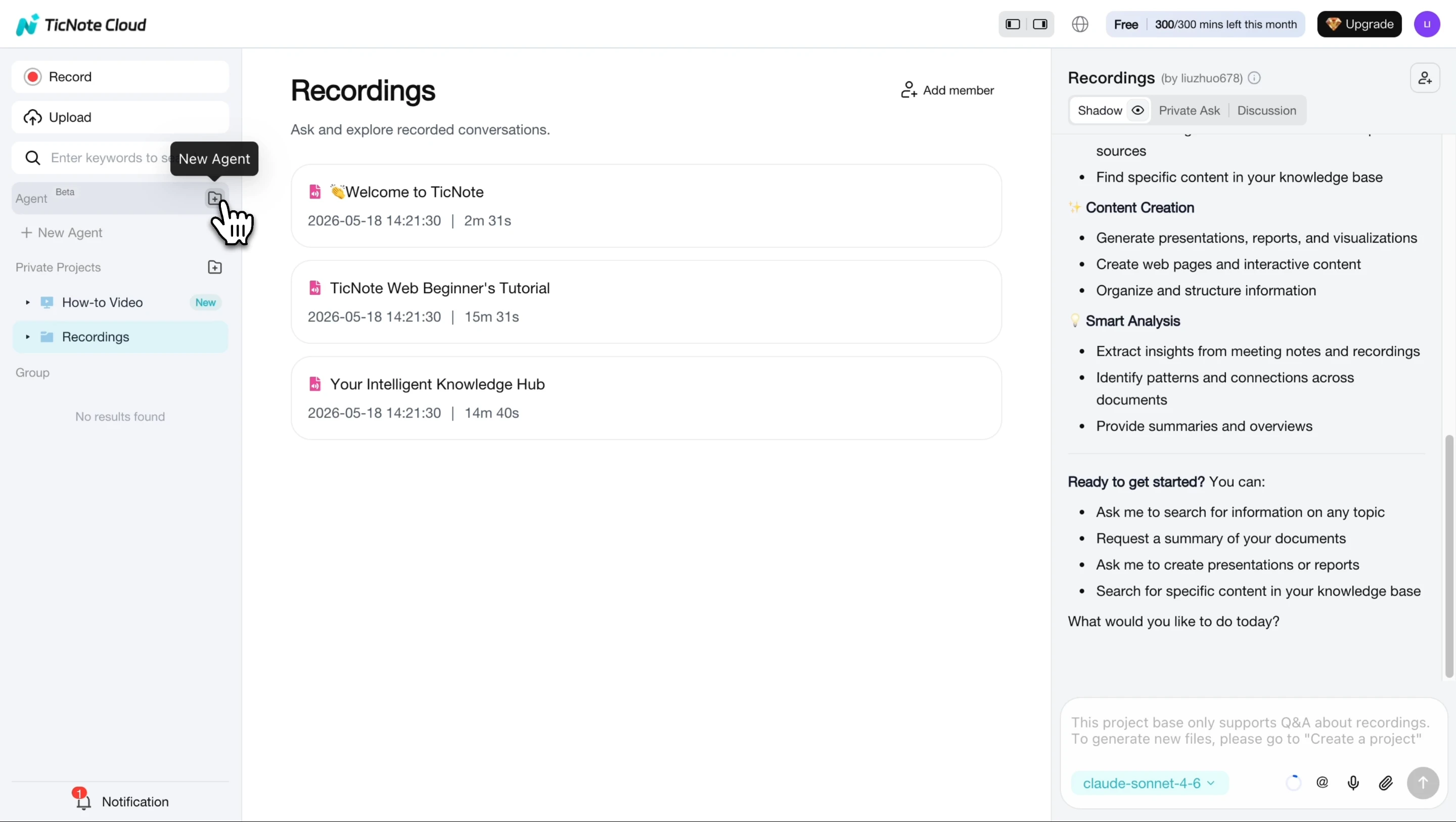
Once added, confirm the agent appears in your list and is ready for that job.
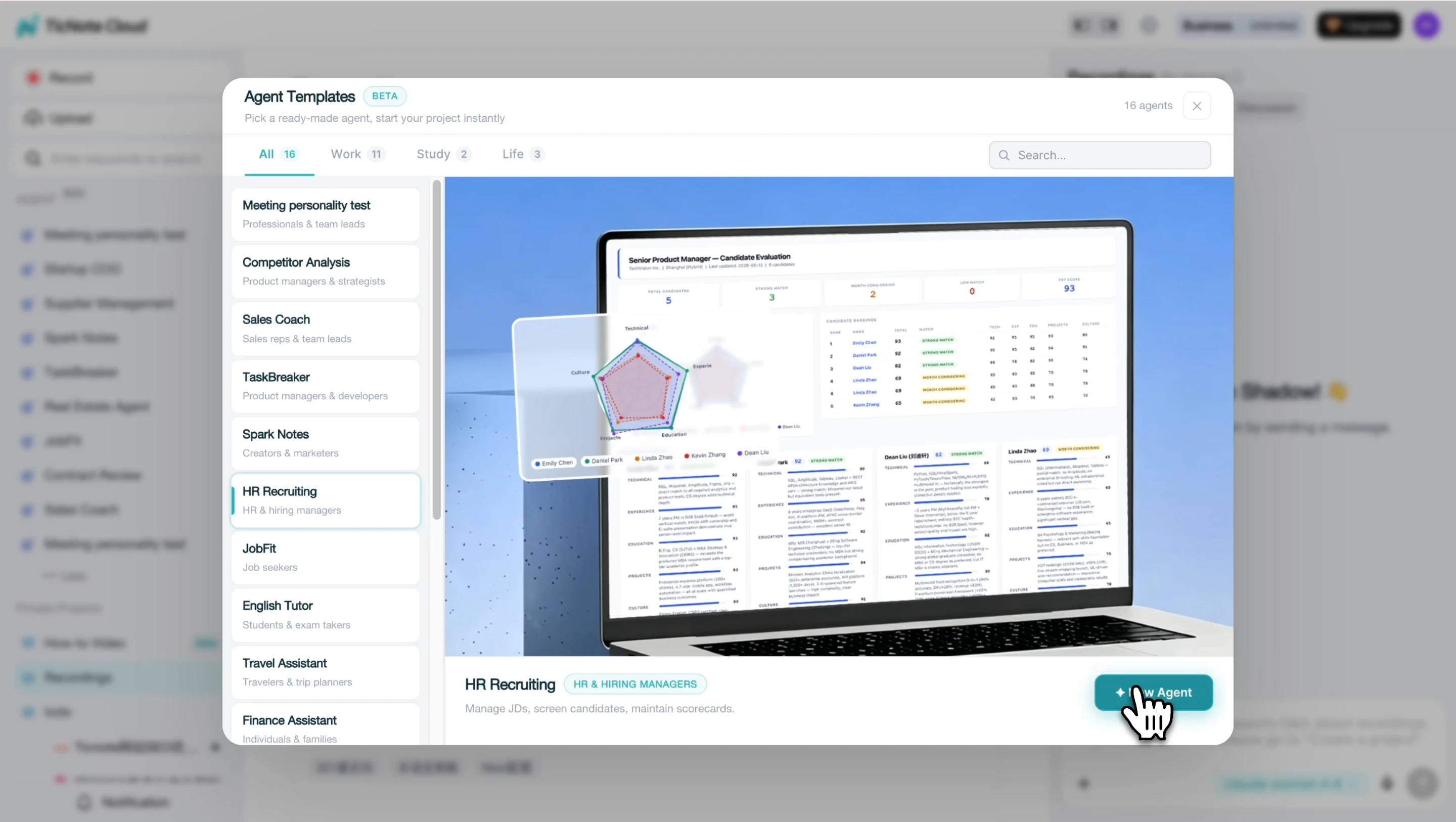
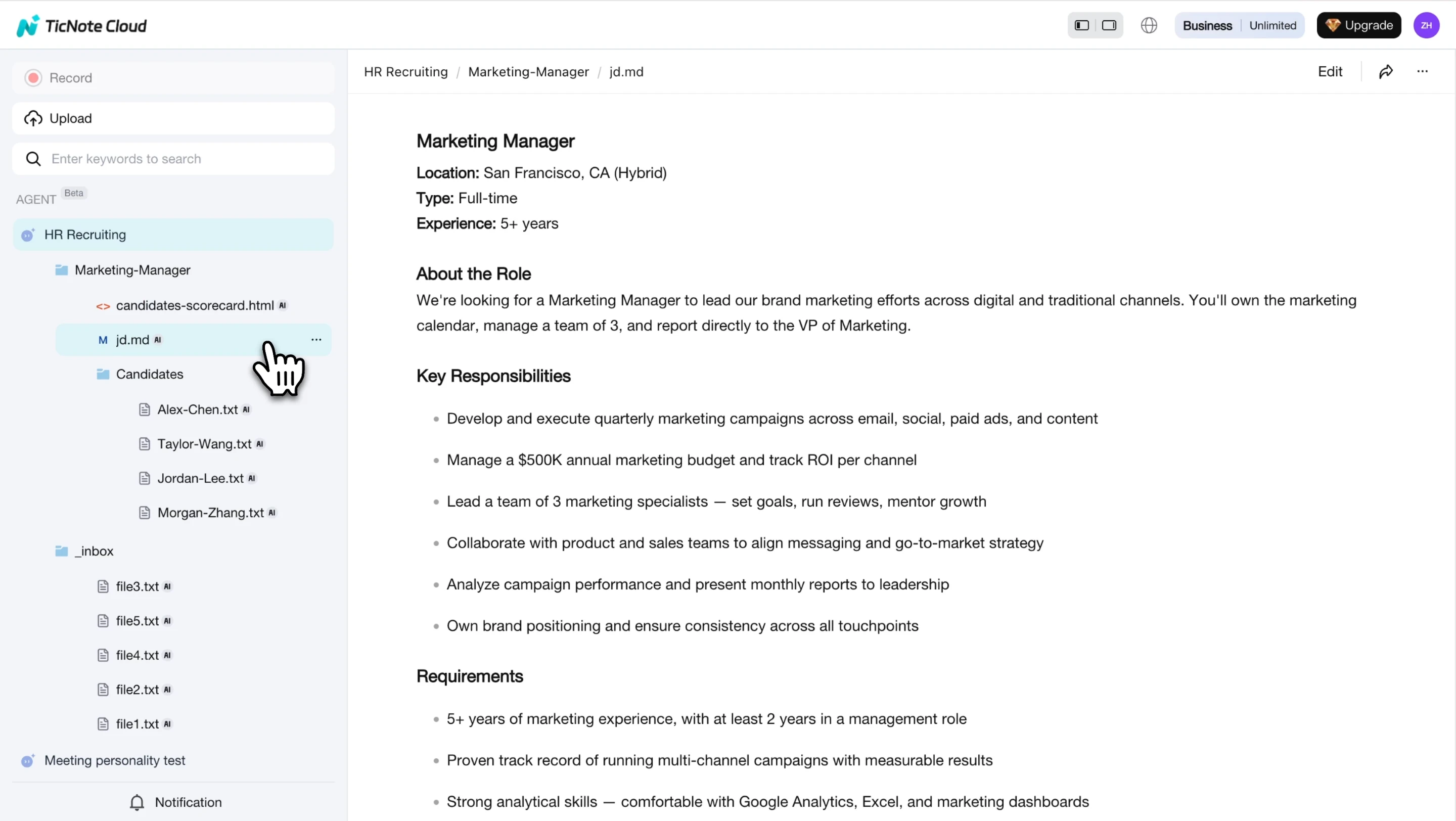
- Create the job space and paste the job description. Paste the JD into the chat. The agent extracts the role, creates a dedicated folder, and saves the JD as the reference point.
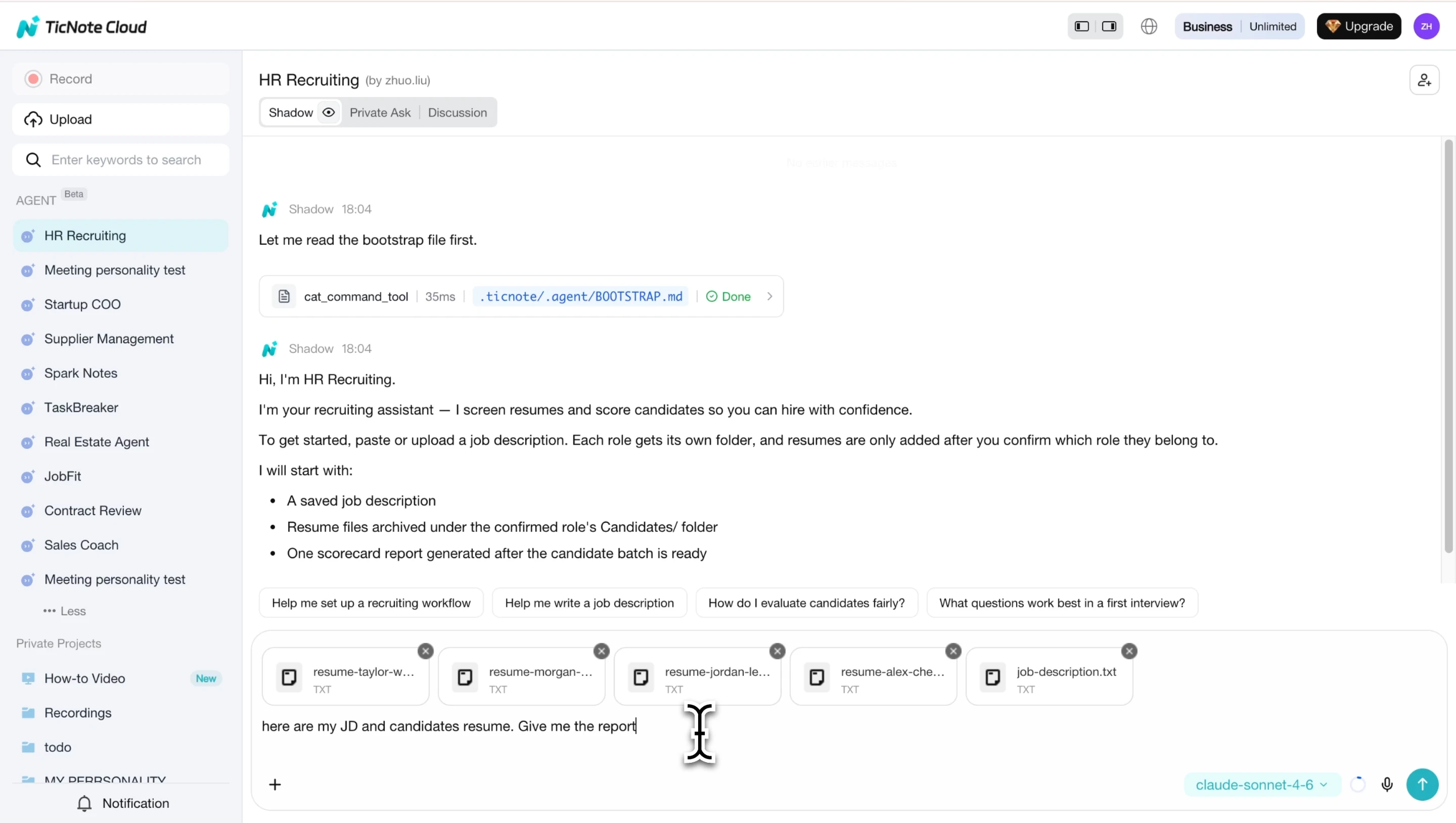
- Send or upload resumes to the same job. Add PDFs, pasted text, or dropped files. Each evaluated resume is archived in that job folder, keeping the resume score tied to the right role.
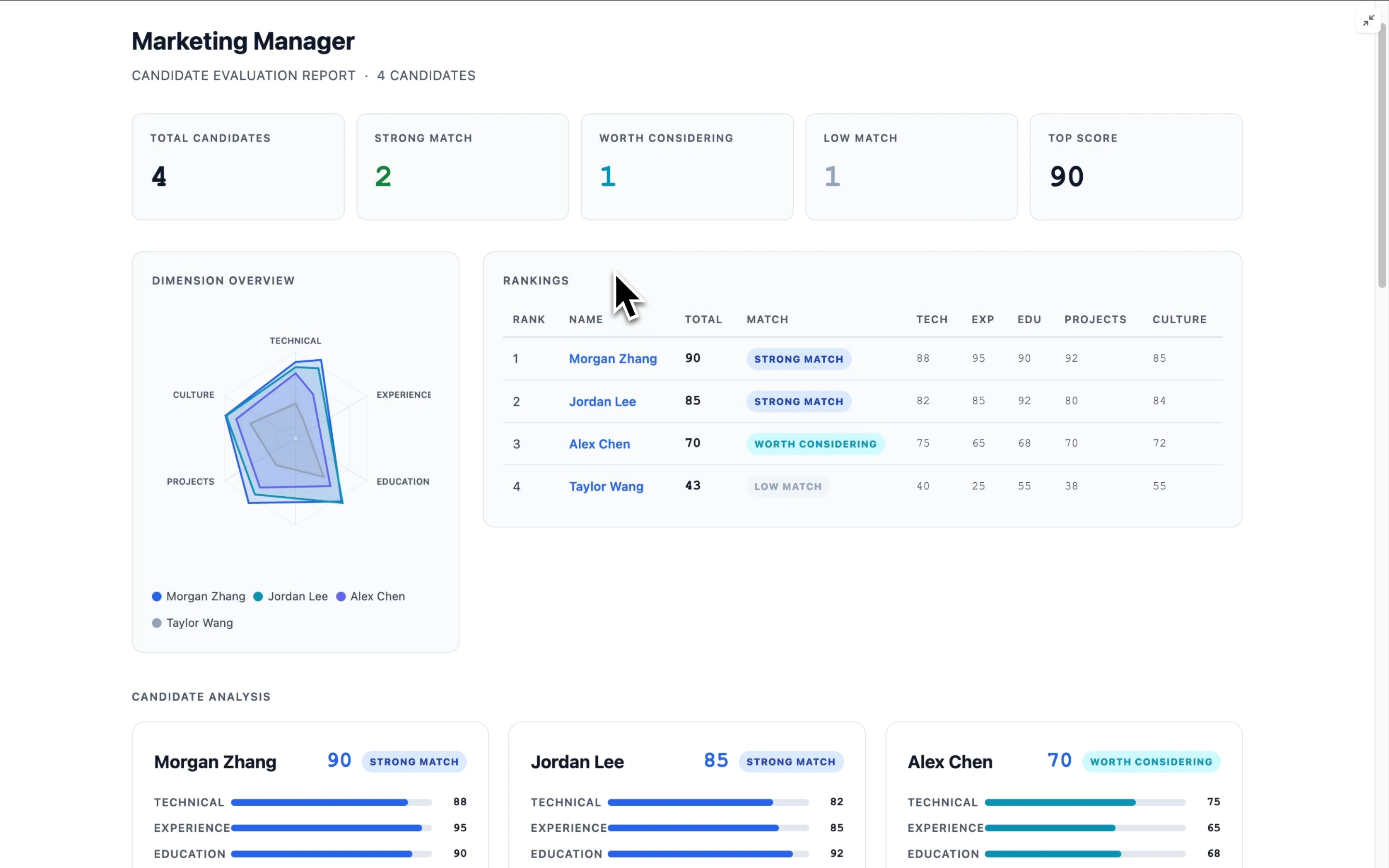
- Open the interactive evaluation report. Review the HTML report with five dimensions: Technical, Experience, Education, Projects, and Culture. Each score includes a one-line justification.
Use the ranking table, radar charts, and color-coded recommendations as inputs for discussion, not automatic decisions.
- Refresh as the pool changes. Add new resumes anytime, then use re-evaluate all after changing the pool or JD reference.
- Translate outputs into your human rubric. Map the five dimensions to your internal resume scoring criteria and weights. Then record the rationale in reviewer notes. This also fits a broader meeting-to-workflow system for intake alignment.
On iOS or Android, capture resumes and role notes while away from your desk, then review the consolidated report later on web.
Turn your next hiring intake meeting into a structured rubric with TicNote Cloud.
TicNote Cloud features that make this workflow hard to copy elsewhere
When teams ask how to score resumes consistently, the hard part isn't math. It's keeping the hiring context visible after intake and calibration meetings. TicNote Cloud turns that context into a reusable workspace.
Keep evidence connected
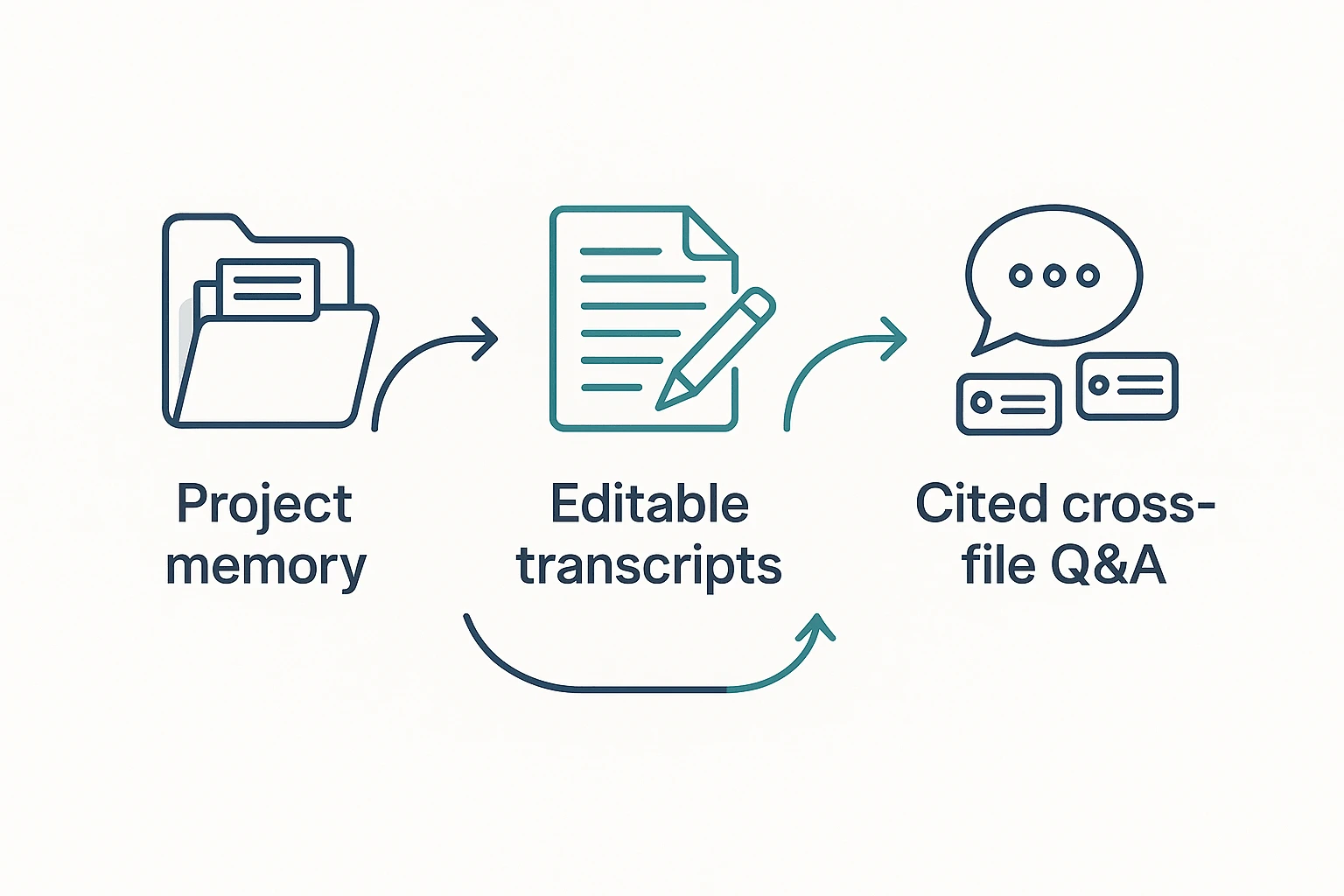
Projects store intake recordings, job description versions, rubric drafts, reviewer notes, and rationale together. That makes a resume scoring system repeatable when a role reopens or changes hands.
Editable transcripts let teams correct role terms, seniority language, and criteria after intake. As the role clarifies, you update the source record instead of rebuilding the rubric.
Shadow AI answers cross-file questions with citations: "Where did we agree this requirement mattered?" and "Which doc defines must-haves?" Cited answers reduce ambiguity before scoring starts.
Reports and mind maps summarize criteria, calibration outcomes, and rationale for stakeholders. The same evidence-first approach fits risk-first document review. Private-by-default workspaces, permissions, and traceable operations control who can view or edit hiring materials. If this setup fits, the conclusion points to "Try TicNote Cloud for Free."
Final thoughts: choose consistency over speed
Learning how to score resumes isn't about building a perfect predictor. It's about using the same job-related resume scoring criteria for every applicant, so your team can triage fairly, compare evidence, and explain why one candidate moved forward while another did not.
Keep the system simple:
- Limit the rubric to 5–7 criteria.
- Calibrate reviewers before the first screening batch.
- Record resume evidence, not impressions.
- Review outcomes after each hiring cycle and adjust weights only between cycles.
Speed matters, but consistency protects quality. A clear resume scoring rubric gives recruiters a shared language, reduces rework, and leaves a documented trail for better decisions next time.