


 Extension
TL;DR
Plaud One is worth it only if you want its agent to act on your conversations and you are willing to wait for Q4 2026 shipping. If your need is plain recording, transcription, and summaries, cheaper options ship today. This article gives you the full picture so you can decide for yourself.
By the way, if you want a 4G AI note-taker you can use now, the TicNote Pods 4G is in stock today.
Compare the 4G AI note-taking option you can use today
What you get for $249.99
Hardware bundle
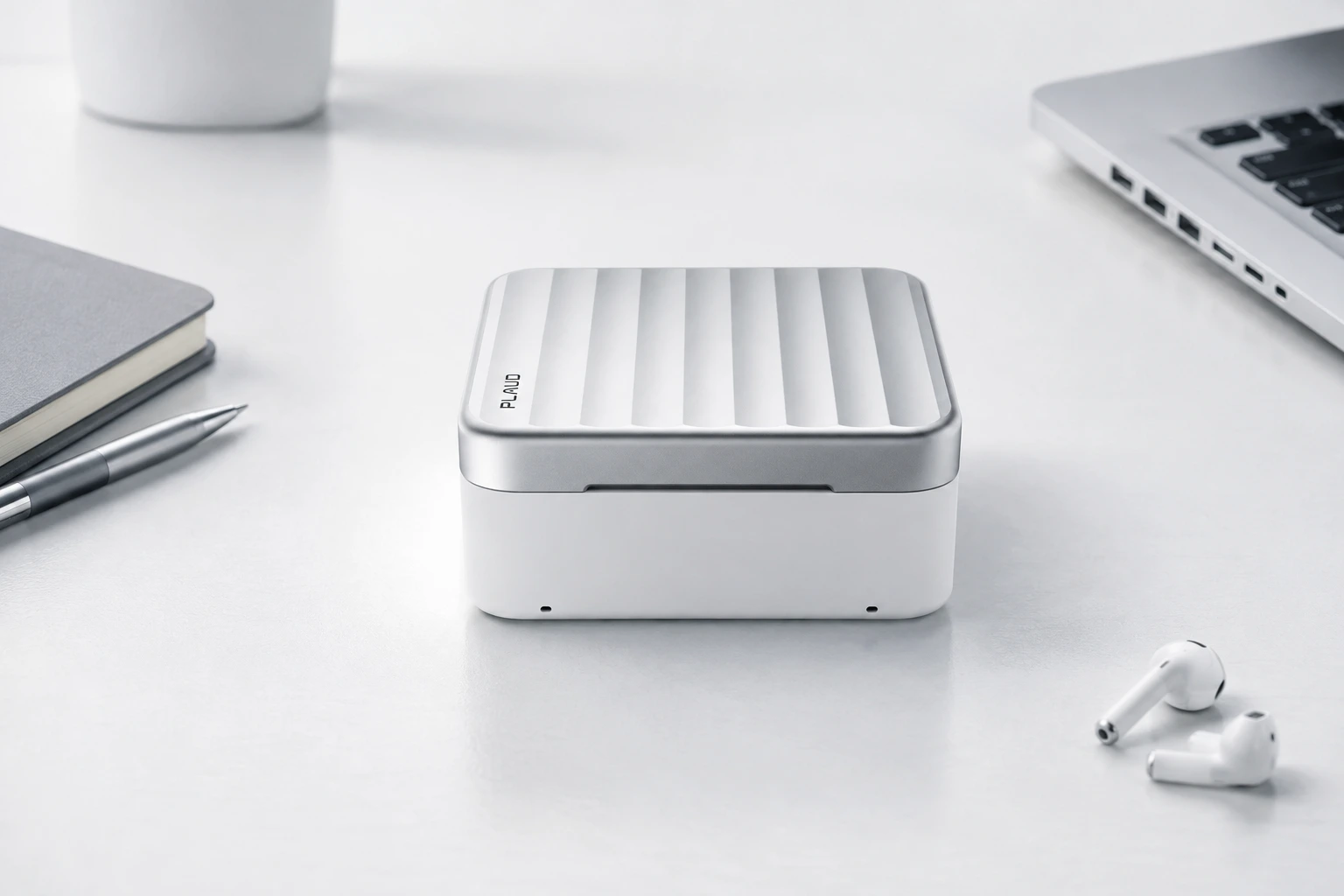
For $249.99 you get the pair of half in-ear earbuds and the 4G eSIM charging case. Each earbud weighs 4.5g with adaptive ANC up to 40dB and a 12mm driver supporting LDAC. The case carries four MEMS microphones with a 5-meter pickup range, an 830mAh battery that stretches recording toward 25 hours, and a 4G LTE radio so both earbuds and case work without a phone. The earbuds are rated IP54, the case IP52.
Software and credits bundle
The price also includes the Starter Plan with 300 transcription minutes per month, plus $200 in Plaud Credits for the Plaud Intelligence and Plaud Agent features. The credits are not cash; they are a prepaid pool you spend down as you use the agent. You also get the full multi-model backend (GPT-5.1, Claude Sonnet, Gemini 3 Pro) and the five-component Plaud Intelligence stack: Agent, Artifacts, Connectors, Skills, and Routines.
Where Plaud One delivers value
Hardware value
The hardware is genuinely category-defining. No other shipped device combines half in-ear earbuds, adaptive ANC up to 40dB, an LDAC codec, a 4G eSIM charging case with a 5-meter pickup, and a battery that lasts a workday. As a piece of hardware alone, $249.99 is a defensible price against other premium AI recorders and earbuds.
Software and AI value
On the software side, "Hey Plaud" and the Agent Button give you an always-available conversational agent. The Artifacts system turns a conversation into a report, deck, or spreadsheet. The multi-model backend picks the right AI for the task. And Plaud's context memory compounds: the longer you use it, the more it learns about who you work with and what matters to you. That is the long-term value that a one-week demo cannot show.
Where Plaud One falls short
Availability constraints
The most concrete problem is availability. Plaud One is not shipping today. It is an Explorer Edition capped at 2,000 units, the US pre-order sold out in one day, and it now sits on a waitlist. Shipping starts in Q4 2026, but there is no confirmed date for a second batch. If you want a device now, Plaud One is not an option this week.
Unclear or maturing capabilities
Several specs are still unconfirmed, including local storage capacity and multi-speaker recognition independence. The agent capabilities are still arriving via firmware updates rather than being present at launch. The $200 in Plaud Credits has undisclosed consumption rules. And the agent maturity is uneven: recording, transcription, and summaries are solid, but Skills, Routines, and deep automation are early. Buyers are committing partly to promises.
Cost of ownership over 2 years
2-year cost table
Over two years, the total picture depends on which plan you pick and how heavily you use the agent.
| Option | Hardware | 2-year subscription | Approx. total |
| Plaud One (moderate) | $249.99 | ~$200 | ~$450 |
| Plaud One (heavy) | $249.99 | $200+ credits | ~$600 |
| TicNote Pods 4G (light) | $249.99 | $0 | ~$250 |
| TicNote Pods 4G (Pro) | $249.99 | ~$238 | ~$488 |
| Plaud Note Pro | $189 | variable | ~$189+ |
Free-minutes math
The free tier matters more than it first appears. TicNote Pods 4G includes 600 free transcription minutes per month, double Plaud One's 300. For a light-to-moderate user, that extra headroom means a TicNote user can stay on the free tier indefinitely, while a Plaud One user may cross into paid territory sooner, which is the biggest swing in the 2-year comparison.
For a concrete example, take someone who records ten hours of meetings a month (600 minutes). A Plaud One user maxes out the 300-minute Starter Plan halfway through, then either pays for a tier or relies on the bundled credits. A TicNote Pods 4G user stays within the 600 free minutes and pays nothing for transcription, reserving any paid plan for extra AI features rather than for basic capture. Over a year, that difference is worth well over $100 for a heavy recorder, which reshapes the "same price" headline considerably.
When Plaud One is worth it
Outbound agent users
Plaud One is worth it if you want the conversation itself to trigger the next steps in Gmail, Calendar, Slack, and Notion. If you already live in those apps and your pain point is the manual follow-up after every meeting, the agent layer is the whole point. The hardware, the 4G case, and the transcription are supporting cast; the agent is why you pay $249.99.
To make this concrete: imagine leaving a client call where you agreed to send the proposal, schedule a follow-up, and drop a status note in the team Slack channel. Without the agent, that is three separate manual tasks across three apps after the call ends. With Plaud Agent and its connectors, the same work should flow from the conversation directly into those tools, which is exactly the workflow Plaud One is built to compress. If that scenario describes your week, Plaud One's agent justifies the premium.
Early adopters
It is also worth it if you are an early adopter who wants the "conversation as interface" vision and can absorb the risk of a maturing product. You are effectively buying into Plaud's roadmap, accepting that some features arrive later. For that group, the value is in being part of the exploration, not in having every feature work on day one. That is a fair trade if you understand it going in, and it is a bad surprise only if you expected a finished product at unboxing.
When Plaud One is NOT worth it
Recording-only users
If you only need recording, transcription, and summaries, Plaud One is overkill. The NotePin (~$$139), Note Pro $$189), or the TicNote Pods 4G covers that use case, and the cheaper options ship today. Paying for an agent you will not use is the most common way to overspend here.
Knowledge/research users
If your priority is knowledge management and research, Plaud One's outbound model does not fit as well. The TicNote approach, with Deep Research, Aha Moments, and a shared knowledge base, is oriented around inbound knowledge work. For someone who wants to revisit and mine past conversations, the alternative fits better than Plaud's action-first model.
Multilingual users
If you need real-time translation across many languages, you have a cleaner match in TicNote's Shadow AI, which supports 120+ language transcription and translation. Plaud's translation story is less defined, so multilingual users will get a more complete tool elsewhere.
The alternative to consider
If your "worth it" test includes availability now and proven features, the TicNote Pods 4G is the practical alternative. It ships today at the same $249.99 price, in the same 4G earbuds-plus-case form factor. It includes real-time summary, real-time and 120+ language translation, Shadow AI 2.0 with 16 built-in Skill Agents, an API Skill for connecting recordings to external AI tools like Codex, and 600 free transcription minutes a month. The Skill Agents run by dragging a recording into an agent folder, which is a different automation model from Plaud's outbound connectors but a working one today.
Why TicNote is the practical alternative
If you want a working AI note-taking wearable, the phone-free recording, real-time summary, and 600 free minutes mean you get a full-featured device without a subscription for most use. The feature set is already on the market and reviewed, not promised in a launch deck. The Skill Agents handle recurring workflows like meeting analysis and research by drag-and-drop, and the API Skill connects your recordings to tools you already use, so the automation story does not stop at the device itself.
When it is the better choice
Choose the alternative if you need a device now, if your work is more about knowledge and research than outbound task execution, or if you want proven features over a promising roadmap. Choose Plaud One instead if the outbound agent across Gmail, Calendar, Slack, and Notion is the one feature you cannot live without.
For many buyers, the deciding factor is simply the timeline. If Plaud One were shipping today with every connector working, the choice would be closer, because the outbound agent model is genuinely compelling. But between the Q4 2026 wait, the 2,000-unit cap, and agent features that arrive over firmware updates, the alternative offers a device you can open today, pair, and start recording meetings with real-time summary and translation working out of the box. That difference, availability plus proven features, is why the alternative is the practical recommendation for anyone whose "worth it" test includes using the device this month rather than hoping for it.
The bottom line
Plaud One is worth $249.99 to exactly one kind of buyer: someone who wants an AI agent that acts on their conversations across Gmail, Calendar, Slack, and Notion, and who can wait for the Q4 2026 waitlist. For everyone else, cheaper and available-now options cover recording, transcription, and summaries just as well. Weigh the agent promise against the wait and the maturing features. And if you would rather have that experience today, the TicNote Pods 4G is the in-stock 4G option at the same price.