


 Extension
TL;DR
Supplier management is the ongoing process of tracking, evaluating, and improving your suppliers' performance across price, delivery, quality, and risk, so procurement decisions are based on data rather than memory or habit.
Try TicNote Cloud for Free and build a searchable supplier database with automated price alerts and on-demand performance reports from your uploaded documents.
Supplier data typically lives across inboxes, spreadsheets, and shared drives, which makes tracking performance and catching issues reactive rather than proactive. By the time a supplier problem surfaces, it's usually already affected a deadline or a budget. A structured supplier management process centralizes that data and turns it into decisions you can act on before problems escalate.
What is supplier management?
Supplier management is the systematic process of identifying, evaluating, tracking, and improving the suppliers a business relies on. It sits in the middle of the procurement cycle: downstream from sourcing (you've already selected your suppliers) and upstream from purchase orders (you're managing the ongoing relationships).
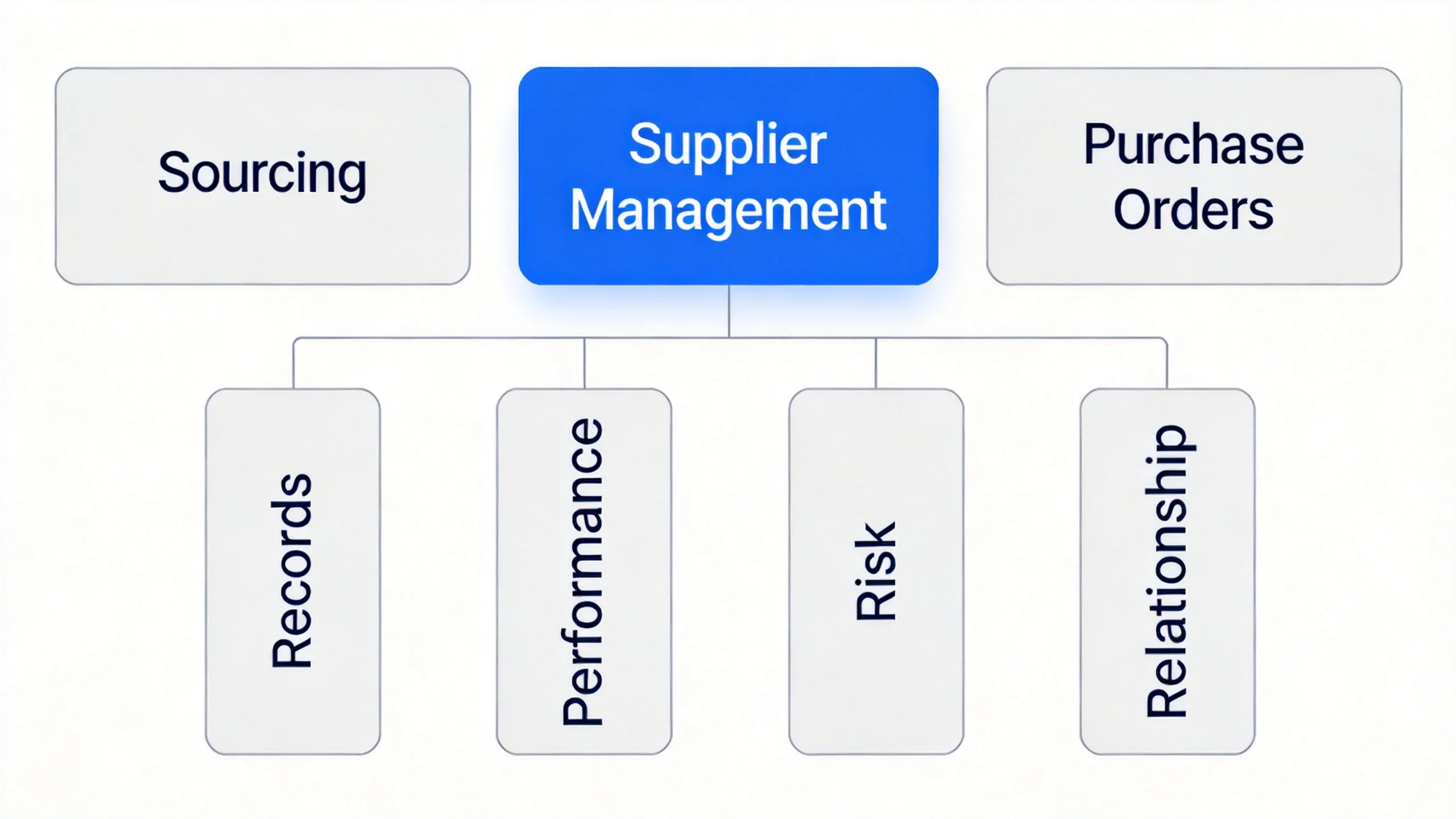
It's worth separating from two related terms. Supplier relationship management (SRM) is a strategic subset focused on building collaborative, long-term partnerships with key suppliers. Supplier management is the broader operational discipline that covers all suppliers, including commodity vendors, not just strategic ones.
Vendor management is often used interchangeably with supplier management. The difference is mainly industry convention: "vendor" is more common in IT and services contexts, while "supplier" is more common in manufacturing and goods procurement. The underlying practices are the same.
Most practitioners organize supplier management around four pillars: supplier records, performance monitoring, risk management, and relationship governance. A gap in any one of them tends to create the kind of problems, missed deliveries, surprise price increases, contract disputes, that procurement teams spend most of their time reacting to.
What does good supplier management include?
Good supplier management isn't a single task. It's a set of systems that run in parallel, each covering a different dimension of the supplier relationship. Here's what each one looks like in practice.
Supplier records and document management
A central record for each supplier: contact details, certifications, contract terms, quote history, and communication log. When someone asks "what did PackPro quote us last quarter?" or "does Supplier B still hold ISO 9001?", the answer should take seconds, not a search through email threads.
Quote and price tracking
A consistent way to compare quotes across suppliers and flag price changes against previous periods. Price drift is one of the earliest signals of a supplier relationship under strain, and it's invisible without a baseline.
Performance monitoring
Regular measurement of on-time delivery, defect rate, responsiveness, and contract compliance. You don't need a sophisticated platform for this: a shared spreadsheet reviewed monthly works for most small teams.
Deadline and renewal visibility
A calendar of contract expiry dates, payment deadlines, and certification renewal dates, with a named owner for each. Missed deadlines show up as unexpected costs. A visible calendar prevents most of them.
Review cadence
A scheduled review cycle where performance data drives decisions. Monthly reviews for critical suppliers, quarterly for standard ones. The review is only valuable if there's data to review, which is why the other four systems have to exist first.
How to manage suppliers step by step
The steps below are demonstrated using TicNote Cloud's Supplier Management skill agent as an example. The Web platform is the primary workflow; App steps follow the same structure.
Step 1: Add the Supplier Management skill agent on TicNote Cloud
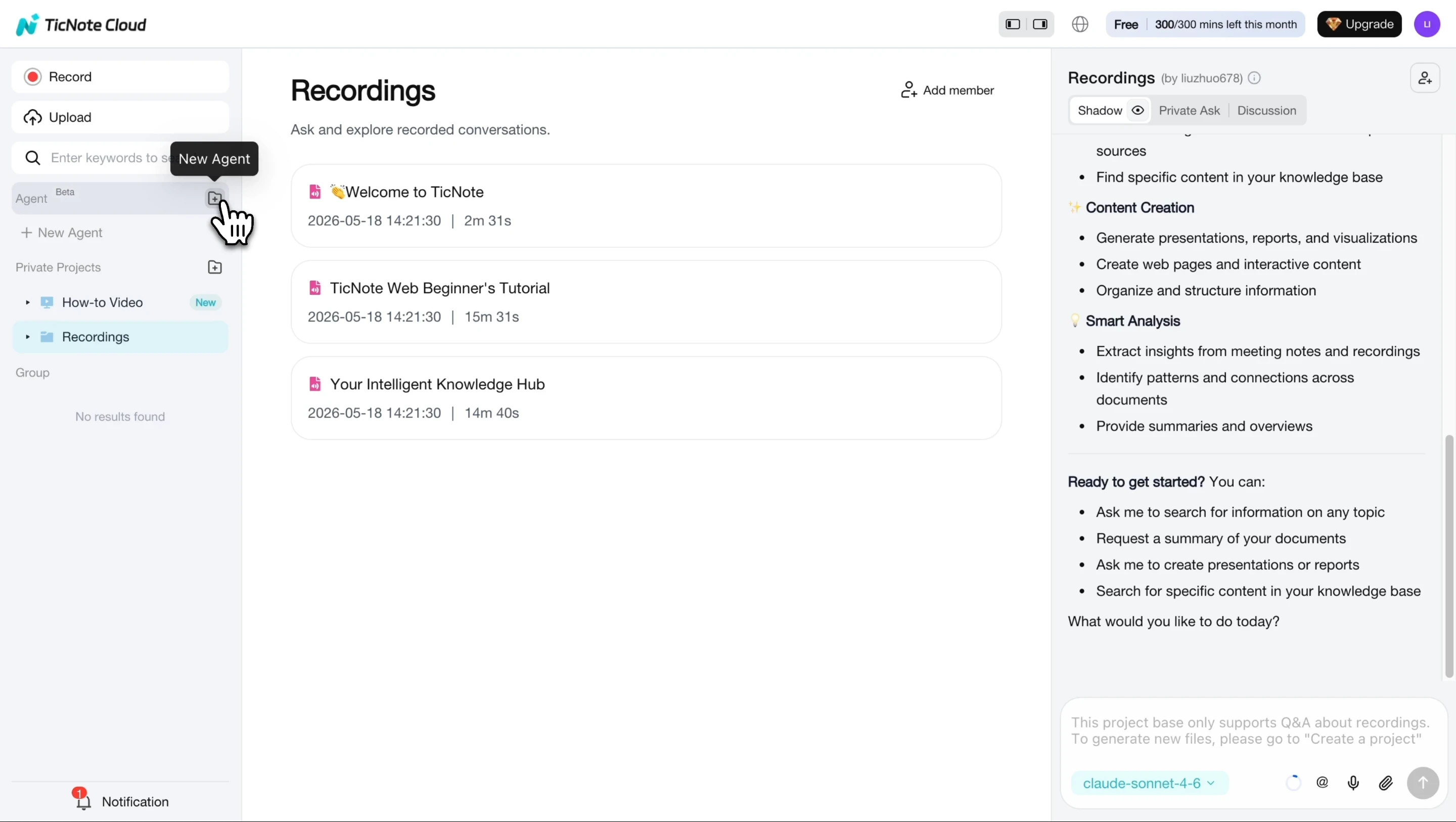
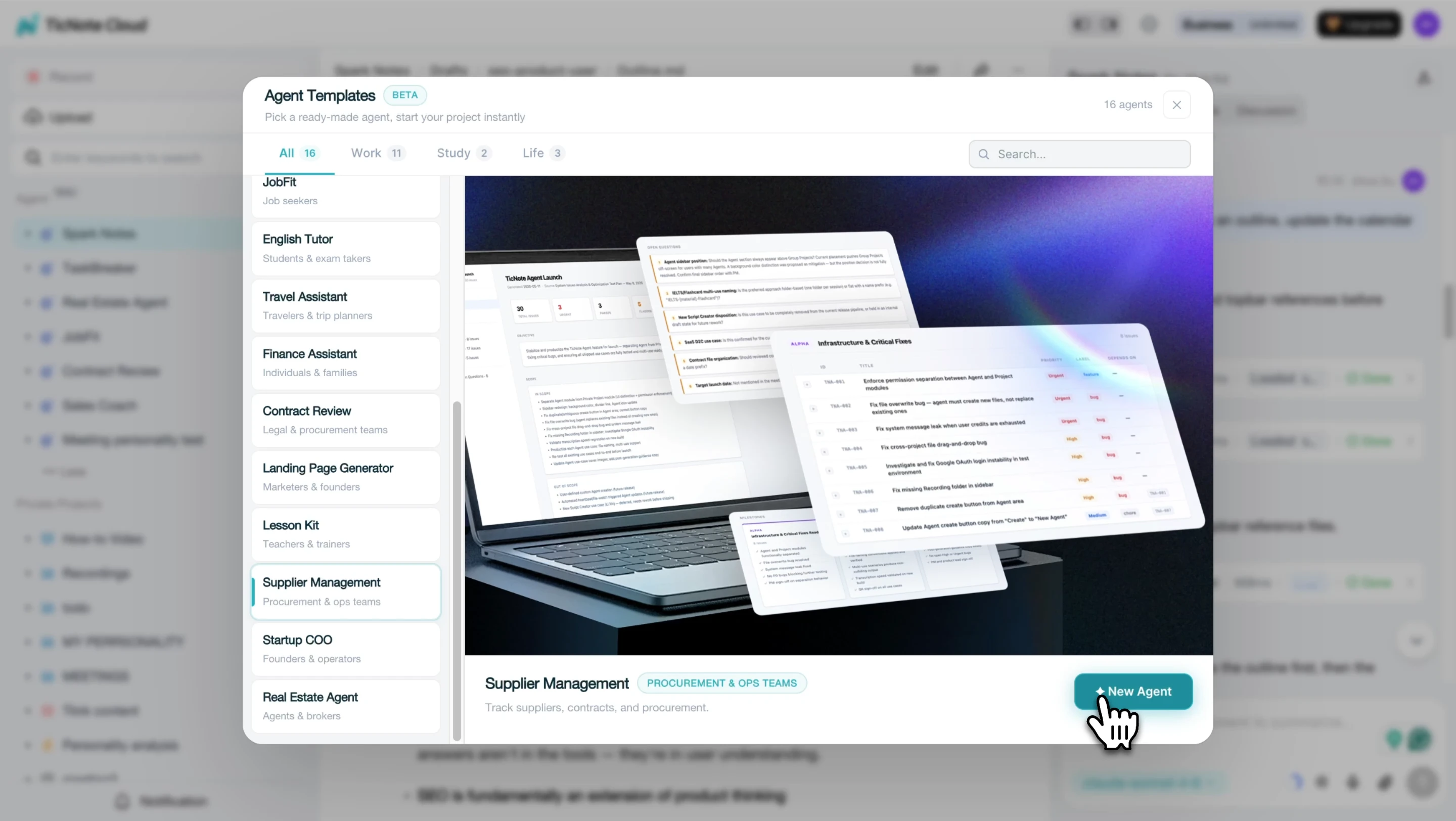
In TicNote Cloud, click Add Agent and browse the Skill Agent library. Select Supplier Management and add it to your workspace. No configuration is required; the agent appears in your agent list and is ready to use immediately.
Step 2: Upload a supplier quote or contract document
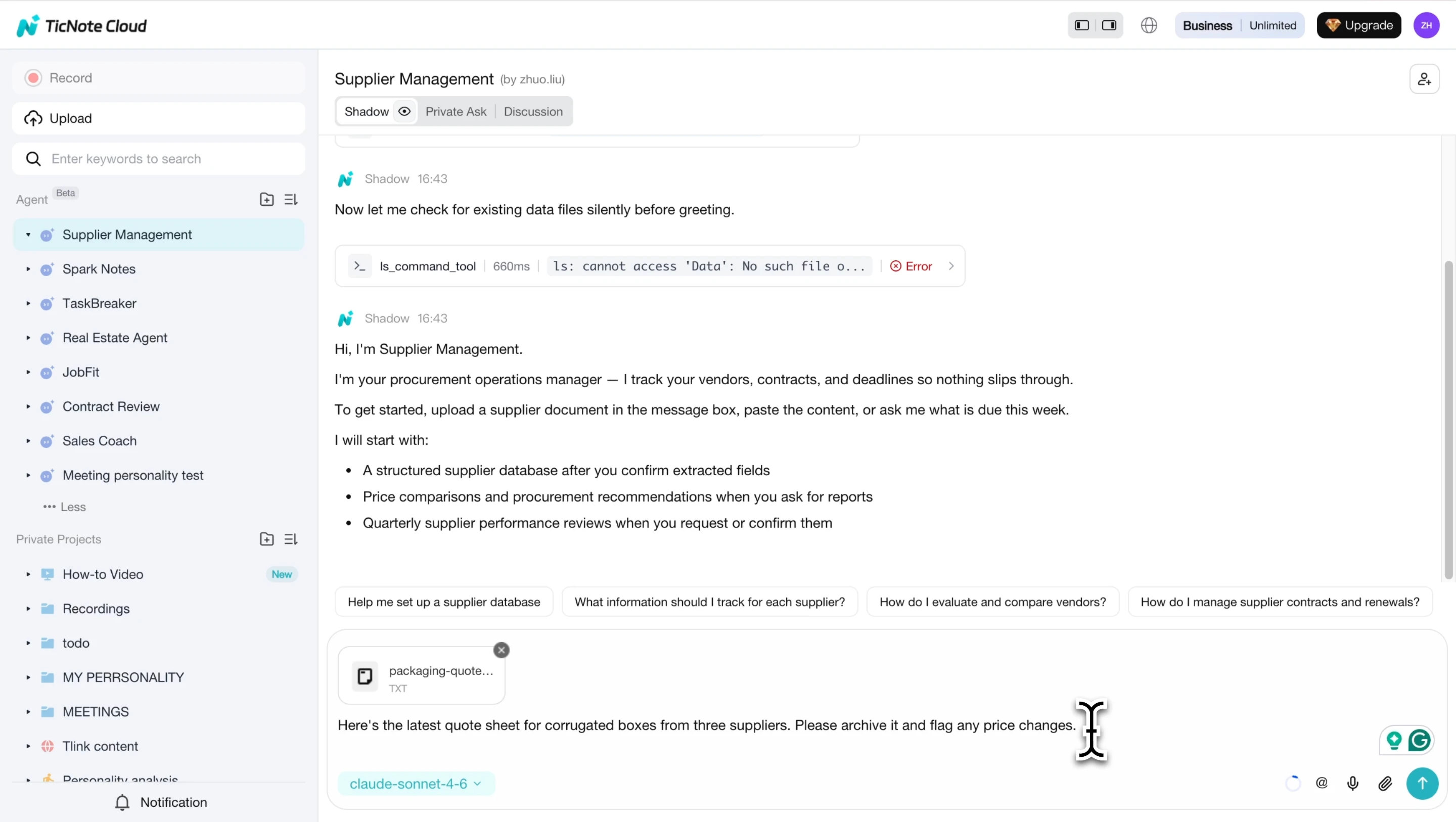
Attach any supplier document, whether a quote sheet, contract, or delivery note, to the agent chat. The agent parses and normalizes every field into your supplier database automatically. If a new quote shows a price change greater than 5% versus the previous record for that supplier, you'll see an alert in chat before anything else.
Step 3: Generate a purchase order from an archived quote
Type a prompt like "generate purchase order of [supplier name]." The AI identifies any missing fields (order quantity, delivery address, payment terms) and asks you to confirm them before building the document.
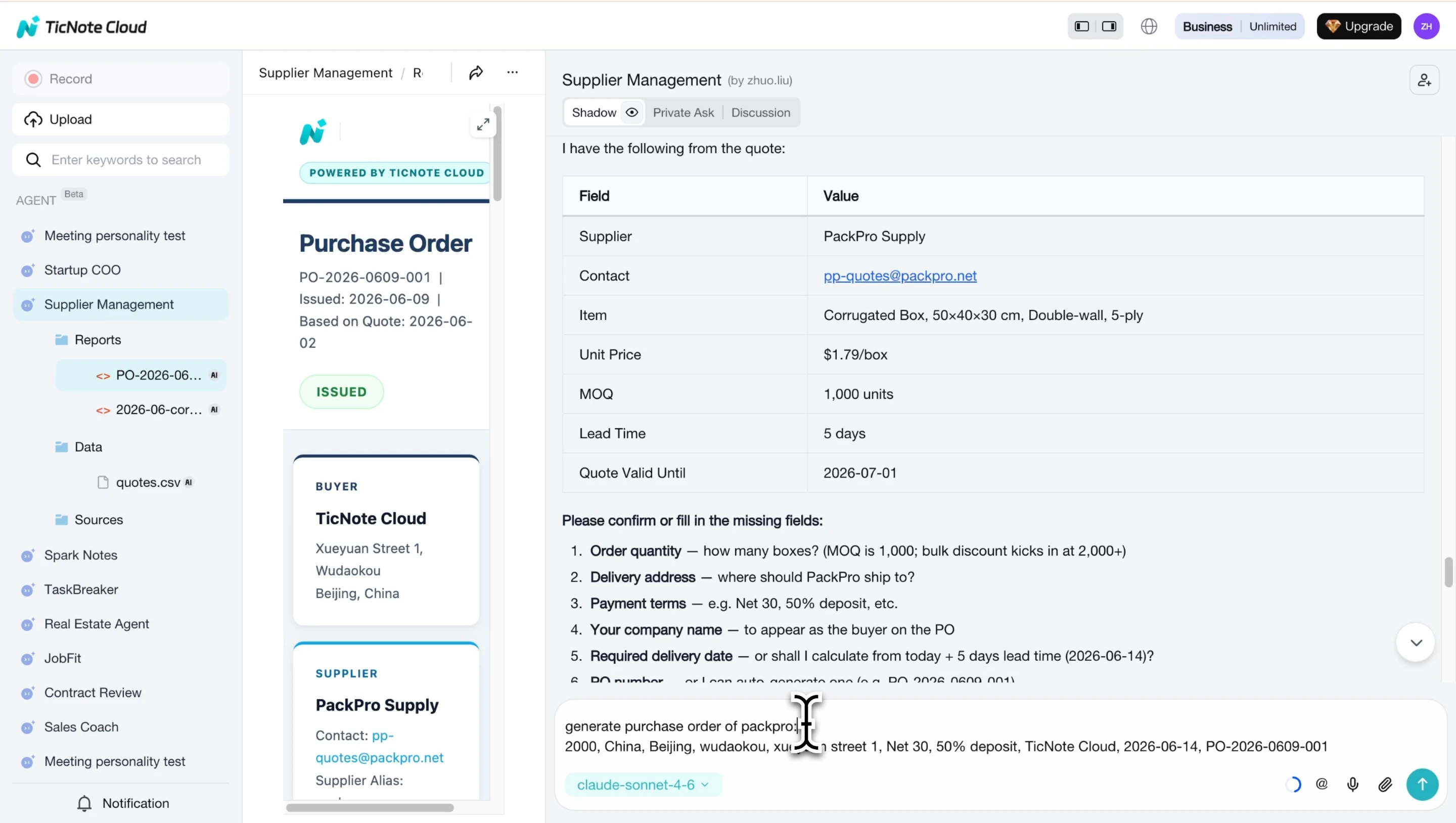
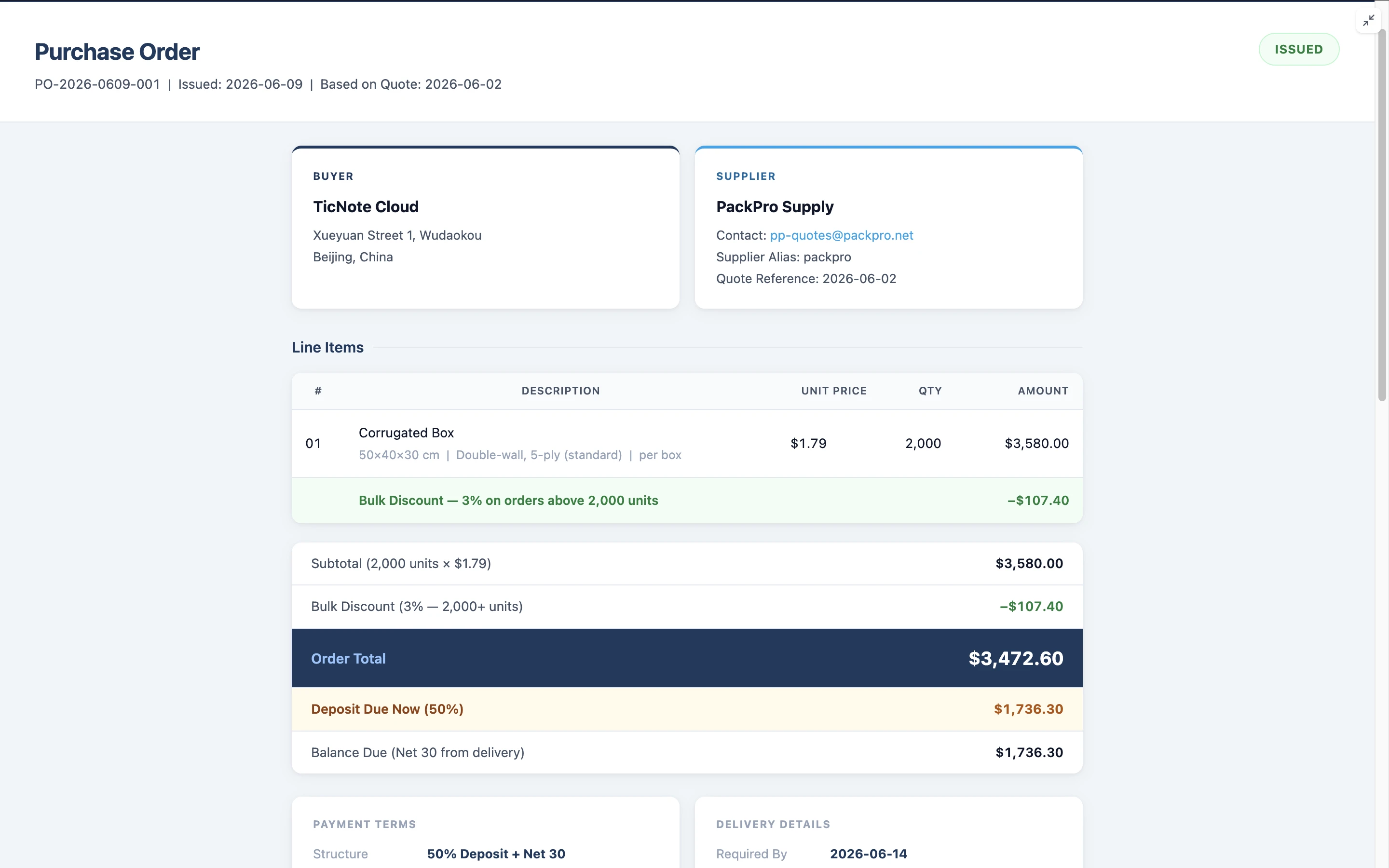
Once you confirm, the agent generates a complete formatted purchase order with buyer and supplier details, line items, bulk discount calculation, order total, and deposit breakdown, ready to share or export.
Step 4: Generate a supplier scorecard
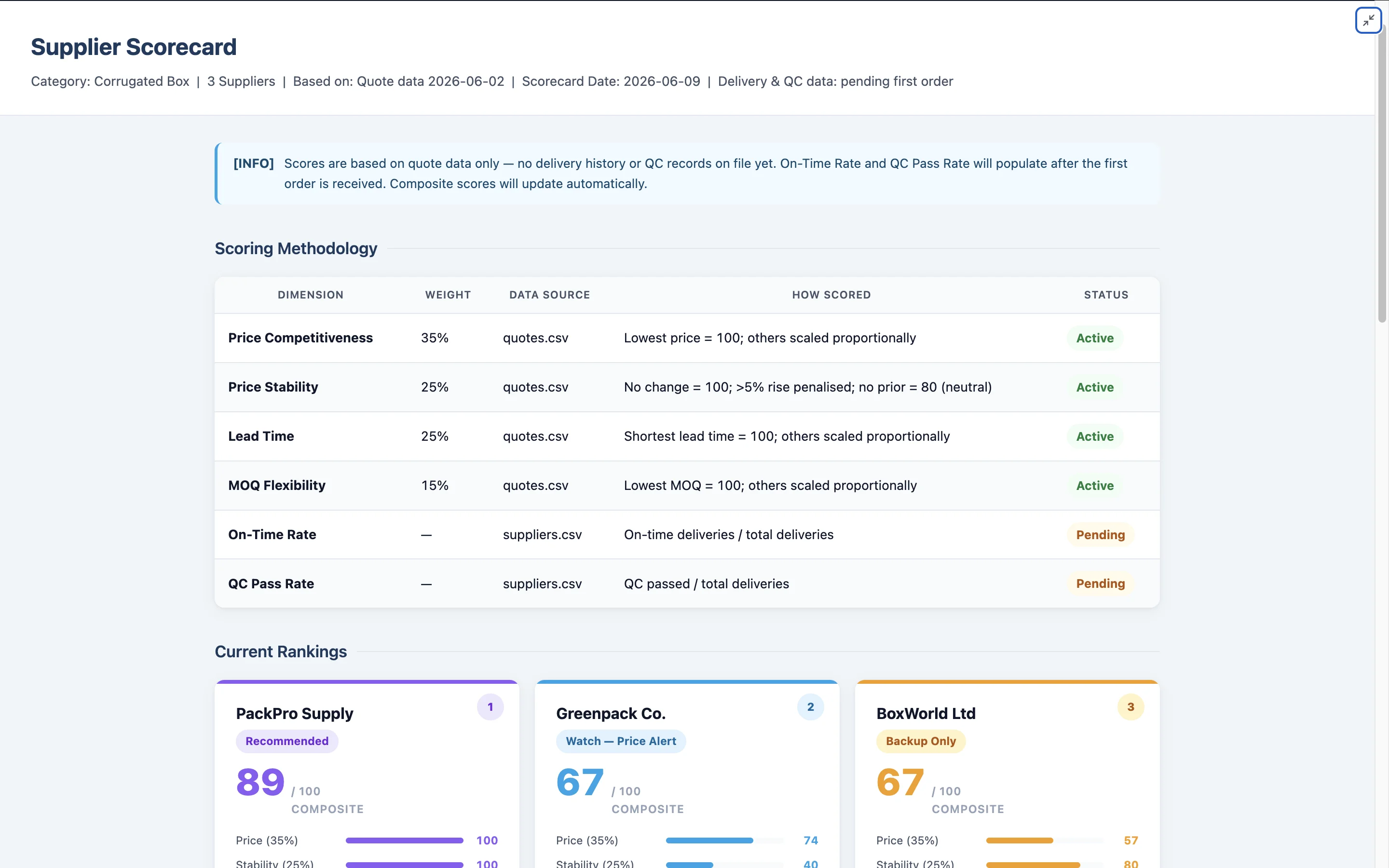
After archiving supplier data, ask the agent to generate a quarterly scorecard. The AI compiles composite scores, a scoring methodology table, and ranked supplier recommendations. Use a supplier scorecard template as a reference for the criteria you want to include.
Step 5: Review archived data and request a comparison report
Open the archived data file to review normalized fields across all suppliers: unit prices, MOQs, and lead times all in one table. Ask the agent for a comparison report. The output is a self-contained HTML file with an alert banner, metric summary cards, and a full side-by-side price table across all your suppliers.

Step 6: Set a review cadence
Schedule monthly reviews for critical suppliers and quarterly reviews for standard ones. Use the comparison reports to track whether performance is improving or declining over time. Update supplier records after each review so the next cycle starts with current data, not stale information.
Common supplier management mistakes
Most supplier management failures share the same root cause: no system, only memory. Here are the five patterns that come up repeatedly.
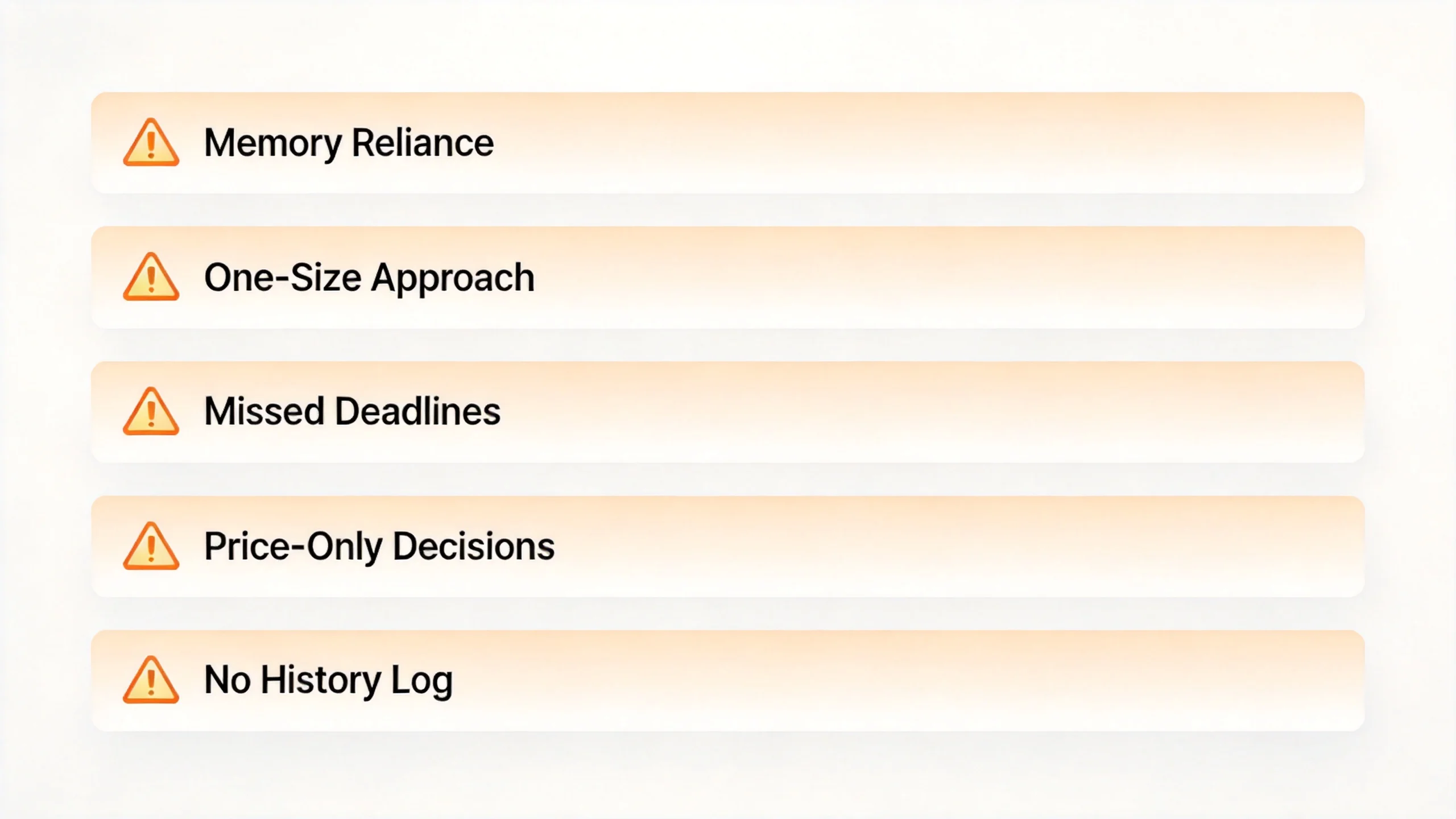
Relying on memory and informal relationships
When key supplier knowledge lives in one person's head, it disappears when they leave or go on leave. The next person starts from scratch with no quote history, no performance record, and no awareness of past issues.
Treating all suppliers the same
Critical suppliers and commodity suppliers need different levels of attention. Applying a one-size-fits-all review cadence wastes time on low-risk vendors and under-serves the high-risk ones who actually affect your operations. A structured vendor management process starts with segmenting suppliers by risk and spend before setting review frequency.
Missing renewal and expiry dates
Without a calendar and a named owner for every contract and certification, renewals get caught too late to negotiate better terms. Auto-renewals lock in yesterday's pricing, and lapsed certifications create compliance gaps.
Choosing lowest price without context
Unit price alone ignores lead time risk, MOQ constraints, quality failure rate, and total landed cost. A supplier quoting 10% cheaper but with a 30-day longer lead time may cost more in inventory carrying costs than the price difference saves.
Not recording supplier history
Without a log of past performance, price changes, and issues, every review starts from scratch. The same supplier problems get discovered repeatedly because there's no record that they happened before.
What metrics should you track for each supplier?
You need five to six metrics per supplier to make informed decisions. More creates noise; fewer misses issues before they escalate. APQC's Open Standards Benchmarking defines on-time delivery rate as a standard procurement KPI and provides cross-industry benchmark data for comparison.
| Metric | What to measure | When to flag |
| On-time delivery rate | % of orders delivered on or before committed date | Below 90% |
| Defect / rejection rate | % of delivered units that fail quality inspection | Above 2-3% |
| Price consistency | Unit price change vs. previous quote period | Increase >5% |
| Responsiveness | Avg. time to respond to RFQs, queries, issues | Trending upward |
| Contract compliance | Meeting SLAs, reporting requirements, certifications | Any open breach |
| Open issue count | Unresolved claims, disputes, quality incidents | Growing backlog |
On-time delivery rate
The most actionable metric for day-to-day operations. A supplier below 90% on-time delivery is either over-committed or structurally unable to meet your lead times. Neither is acceptable without a conversation.
Defect or rejection rate
Anything above 2 to 3% signals a recurring quality issue, not a one-off. Track defect rates per supplier per quarter to catch trends before they affect your operations or customers.
Price consistency
Track unit price over time and flag increases greater than 5% versus the previous quote period. This is the metric TicNote Cloud's Supplier Management agent monitors automatically at every upload, surfacing alerts before you've even asked the question.
Responsiveness
Average time to respond to RFQs, queries, and issue reports. Slow response is one of the earliest signals of a supplier relationship under strain. It's easy to overlook when everything else seems fine.
Contract compliance
Whether the supplier is meeting SLAs, reporting requirements, and certification obligations defined in the agreement. This metric requires you to have a contract management system; if obligations aren't tracked, compliance can't be measured.
Open issue count
The number of unresolved claims, disputes, or quality incidents. A growing backlog signals a supplier relationship that needs a direct conversation, not just another email.
Conclusion
Supplier management works best when supplier records, quote history, deadlines, and performance data are connected in one place rather than scattered across tools and inboxes. When that data is accessible, procurement decisions get faster and more defensible. When it isn't, the same problems recur because there's no record they happened before.
TicNote Cloud's Supplier Management skill agent builds that database from your actual documents: upload supplier quotes, contracts, or delivery notes, and the agent parses and normalizes everything into a searchable record with automatic price alerts and on-demand comparison reports, no manual data entry required. Pair it with automated procurement workflows to close the loop from supplier records through to purchase orders.