


 Extension
TL;DR
Workplace personality types are frameworks that categorize how people communicate, collaborate, and make decisions at work. Popular models include DISC, the Big Five (OCEAN), Myers-Briggs, and AI-based meeting analysis, each revealing a different layer of how someone operates professionally.
Try TicNote Cloud for Free and discover your meeting personality from a real transcript in minutes.
Most people guess at their work personality based on how they feel in meetings, but self-perception is unreliable. Colleague feedback is vague. Traditional tests ask how you think you behave, not how you actually do. TicNote Cloud analyzes your real meeting transcripts to surface concrete behavioral patterns: talk share, question frequency, collaboration signals, and more, giving you an objective mirror instead of a guess.
What Are Workplace Personality Types?
Workplace personality types are classification systems that group people by their behavioral preferences, communication styles, and decision-making tendencies at work. They don't describe who you are as a person; they describe how you tend to show up professionally.
The key word is "tend." No model expects you to fit one box perfectly. Most people blend traits from multiple types, and context changes behavior: you might be analytical in project planning but more collaborative in brainstorming sessions.
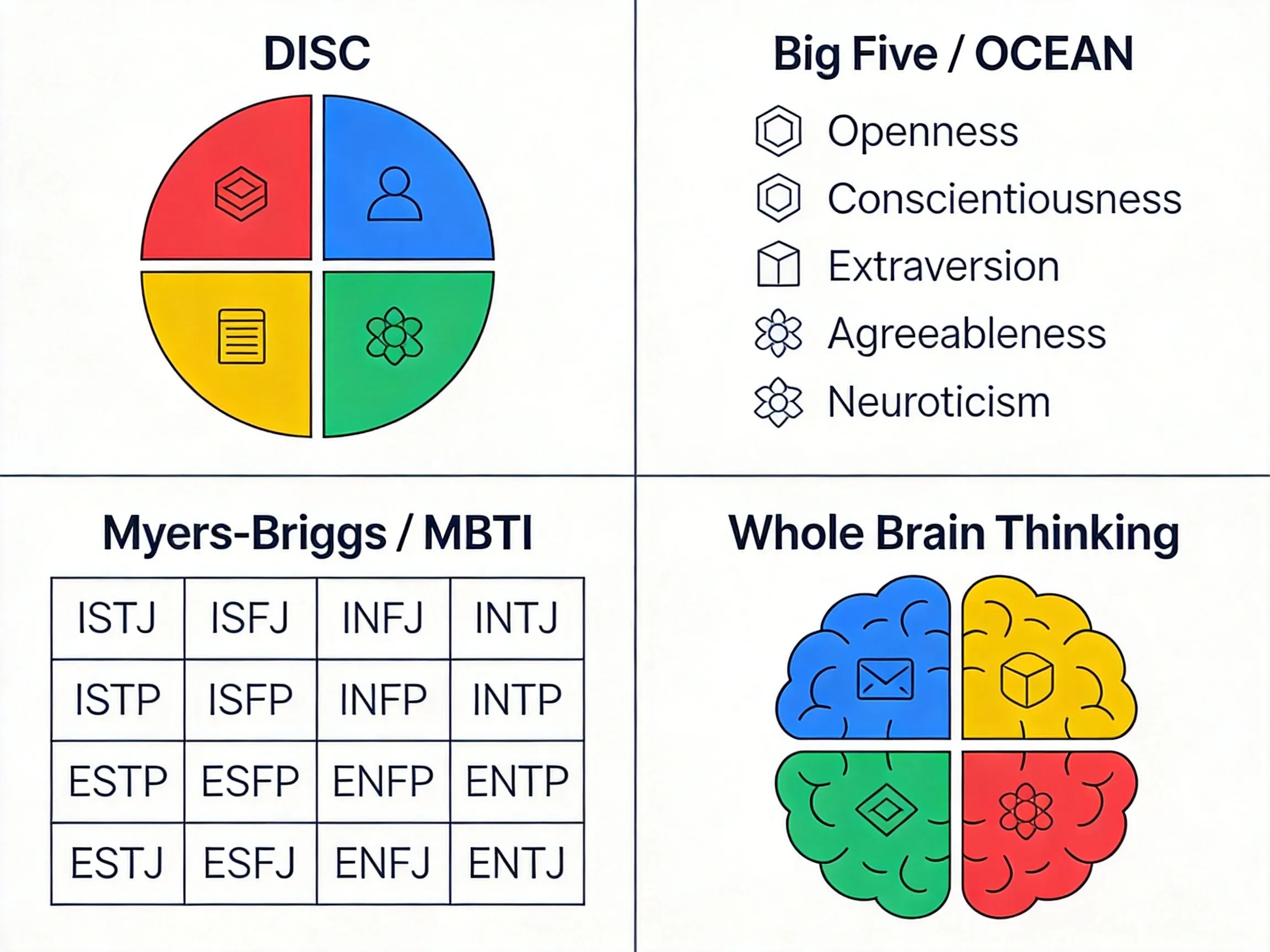
The four major frameworks
DISC groups people into four behavioral styles: Dominance (direct, results-driven), Influence (persuasive, energetic), Steadiness (reliable, patient), and Conscientiousness (analytical, detail-focused). It's practical, fast to administer, and widely used in corporate settings.
The Big Five (OCEAN) measures five spectrum-based traits: Openness, Conscientiousness, Extraversion, Agreeableness, and Neuroticism. Unlike DISC's four boxes, Big Five places you on a scale for each trait. It's the most scientifically validated model, and research shows that Conscientiousness predicts job performance consistently across occupational groups, with a true-score correlation of .26 for subjective performance ratings.
Myers-Briggs (MBTI) assigns one of 16 types based on four dichotomies: Extraversion/Introversion, Sensing/Intuition, Thinking/Feeling, Judging/Perceiving. It's the most recognized framework and useful for team conversations, though its scientific validity is debated.
Whole Brain Thinking divides cognitive preferences into four quadrants: Analytical (blue), Practical (green), Relational (red), and Experimental (yellow). It focuses on how you process information rather than personality traits.
Why they matter at work
Understanding work personality types helps you tailor communication, reduce friction, and assign roles that align with natural strengths. Teams that recognize style differences resolve conflict faster and collaborate more effectively. For individuals, it's the starting point for self-awareness: knowing your defaults helps you adapt when the situation calls for it.
7 Common Workplace Personality Types
Most teams contain a predictable mix of personalities. Here are seven types you'll recognize, along with the situations where each thrives and where friction tends to appear.
The Analyst
Organized, data-driven, and process-oriented. Analysts work best with clear structure, defined roles, and advance notice before anything changes. They produce high-quality work and catch errors others miss.
Where they thrive: research, compliance, quality assurance, financial modeling.
Friction point: unannounced changes or ambiguous requirements throw them off. Give them lead time and clear specs.
The Driver
Direct, decisive, and results-focused. Drivers communicate in headlines: they want the conclusion first, context second. They're energized by challenges and tend to move fast.
Where they thrive: leadership, crisis management, competitive sales, turnaround projects.
Friction point: they can come across as blunt or impatient. Other team members may feel steamrolled if their pace isn't matched.
The Collaborator
Consensus-oriented and relationship-focused. Collaborators invest in team harmony and are often the ones building bridges between conflicting personalities. They listen well and remember personal details.
Where they thrive: cross-functional projects, stakeholder management, team facilitation.
Friction point: they may delay decisions waiting for consensus, or avoid surfacing bad news to protect relationships.
The Individualist
Self-directed and internally motivated. Individualists prefer to own their work end-to-end with minimal supervision. They're often specialists who go deep rather than broad.
Where they thrive: independent research, technical specialization, deep-focus work.
Friction point: they can appear disengaged in group settings. They contribute best when given autonomy and judged on outputs.
The Motivator
High-energy, enthusiastic, and people-oriented. Motivators raise the room's energy and are often the first to volunteer. They're natural champions for new initiatives.
Where they thrive: sales, team building, culture initiatives, change management.
Friction point: they can overpromise, push others too hard, or lose interest once the initial excitement fades.
The People-Pleaser
Harmony-seeking and helpful. People-pleasers pick up slack readily and keep the social temperature comfortable. They're often well-liked and relied upon across the team.
Where they thrive: customer service, support roles, HR, team coordination.
Friction point: they struggle to say no, avoid conflict, and may let problems fester rather than raise them directly.
The Perfectionist
Meticulous, high-standards, and detail-obsessed. Perfectionists deliver polished work and hold themselves to rigorous benchmarks. When something isn't right, they'll say so.
Where they thrive: editing, legal review, design, compliance, audit.
Friction point: delivery delays are common. They need explicit permission to ship "good enough" and clear deadline pressure to prevent over-refinement.
How to Choose the Right Personality Assessment Method
Not every personality assessment is the right tool for every situation. The method you choose should match what you're actually trying to learn.
Traditional self-report tests
DISC, MBTI, and the Big Five are all questionnaire-based: you answer how you think you behave, and the test maps your answers onto a framework. They're easy to administer, widely recognized, and come with rich interpretive resources.
The limitation is built in. In personnel selection, self-reports are often biased by social desirability; applicants may overstate knowledge or traits to make a favorable impression. The same dynamic applies to self-assessment: people tend to answer how they want to see themselves, not always how they act under pressure.
| Method | Time | Objectivity | Work-specific |
| DISC / MBTI | 20-40 min | Low (self-report) | Medium |
| Big Five | 15-30 min | Low (self-report) | Medium |
| 360 Feedback | 2-4 weeks | Medium | High |
| AI transcript analysis | 5 min | High | Very high |
360-degree feedback
Peers, managers, and direct reports each share observations about how you work. This multi-perspective approach catches blind spots that self-assessment misses. The tradeoff: it's time-consuming, requires trust, and results can be influenced by relationships.
AI behavioral analysis
AI meeting transcript analysis measures what you actually do in conversations, not what you report doing. Tools like TicNote Cloud's Meeting Personality Test read your transcript and surface behavioral patterns: talk share, how often you ask questions, how frequently you acknowledge others' ideas.
When to use each:
- DISC or MBTI: team-building workshops, onboarding conversation starters
- Big Five: hiring contexts where predictive validity matters
- 360 feedback: leadership development, annual review cycles
- AI analysis: immediate, objective self-awareness without scheduling or questionnaire fatigue
How to Identify Your Work Personality Type Without Answering Questions
There's no single best method. The most accurate picture comes from combining approaches — but for behavior that's grounded in what actually happens, TicNote Cloud's Meeting Personality Test is the fastest and most objective starting point.
Start with self-reflection. Ask: Do I prefer working solo or in groups? How do I respond to ambiguity? What frustrates me most in team settings? When do I feel most effective? Your answers reveal baseline tendencies before any test shapes your framing.
Take a formal assessment. DISC is fastest for practical insight. Big Five is best if you want scientific backing. MBTI is useful if your team already uses it, since the shared vocabulary helps. Most paid assessments take 15 to 45 minutes.
Gather feedback from colleagues. Ask two or three trusted coworkers how they'd describe your communication style. The gaps between their description and your self-perception are often the most useful data points.
Analyze your meeting behavior with TicNote Cloud. This is where conversational patterns across meetings become actionable. Here's how to run it step by step:
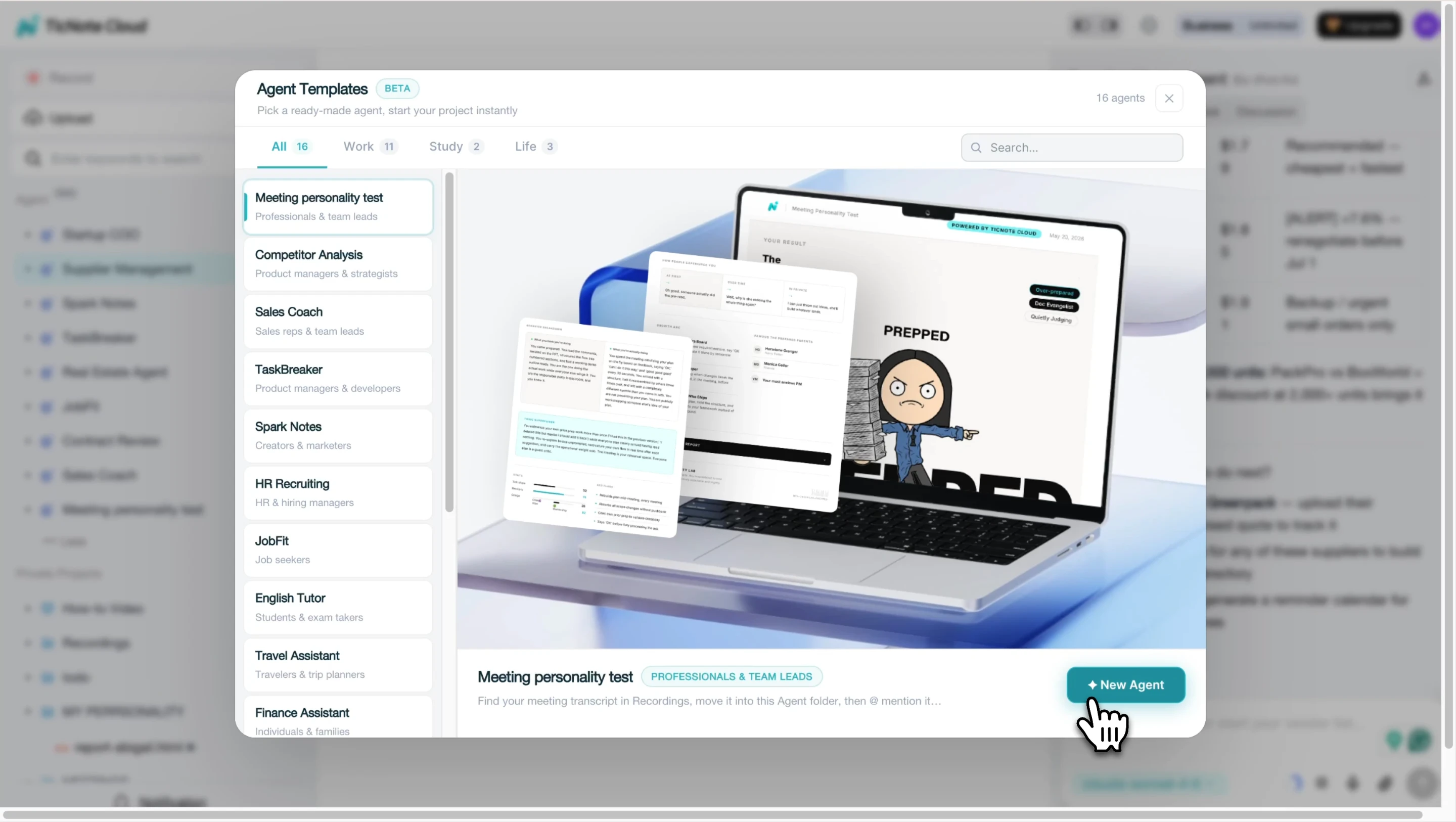
Step 1. Add the Meeting Personality Test skill agent on TicNote Cloud
In TicNote Cloud, click Add Agent and browse the Skill Agent library. Select the Meeting Personality Test skill to add it to your workspace — no configuration required.
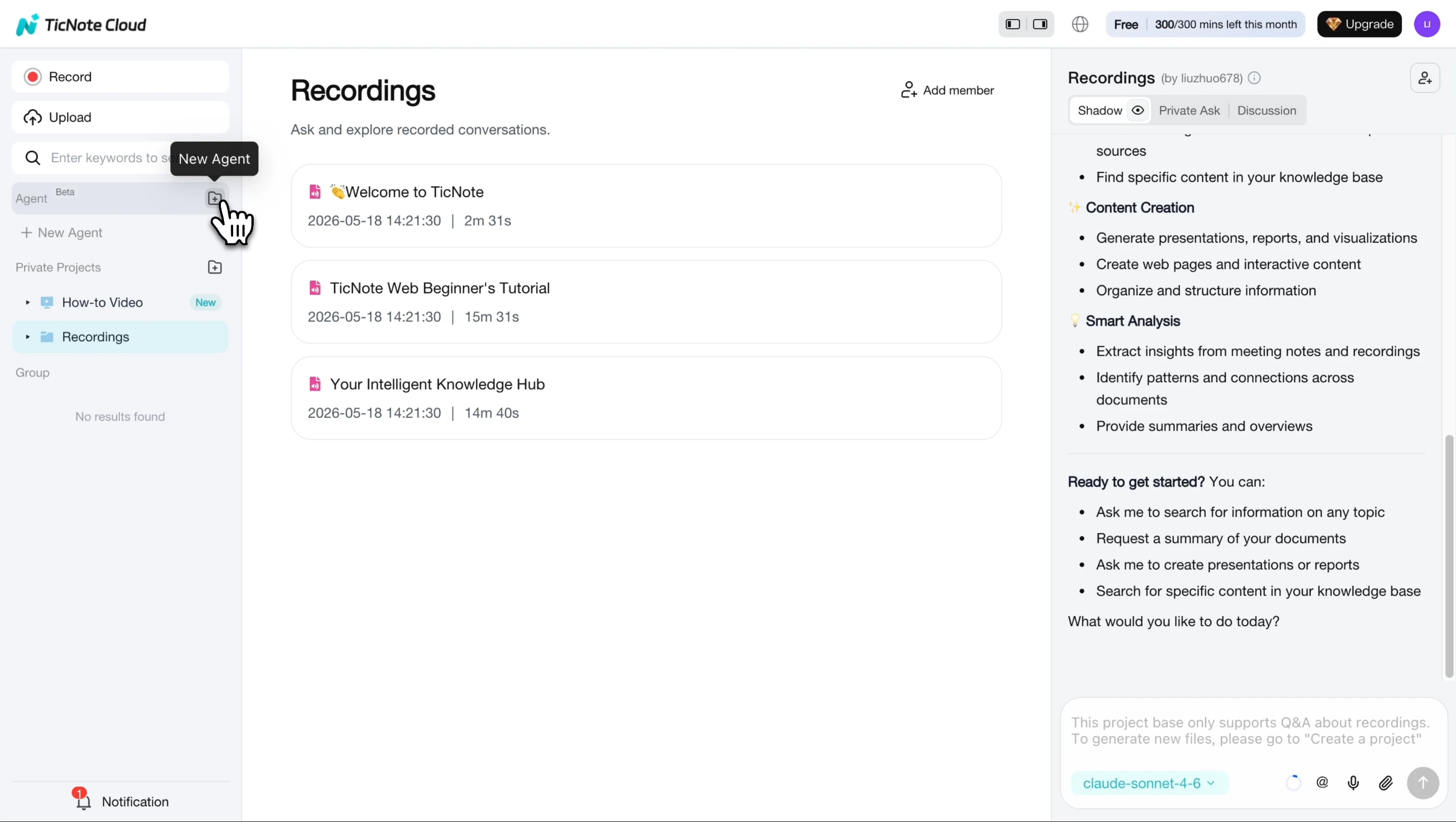
Once added, the skill agent appears in your agent list and is ready to use immediately.
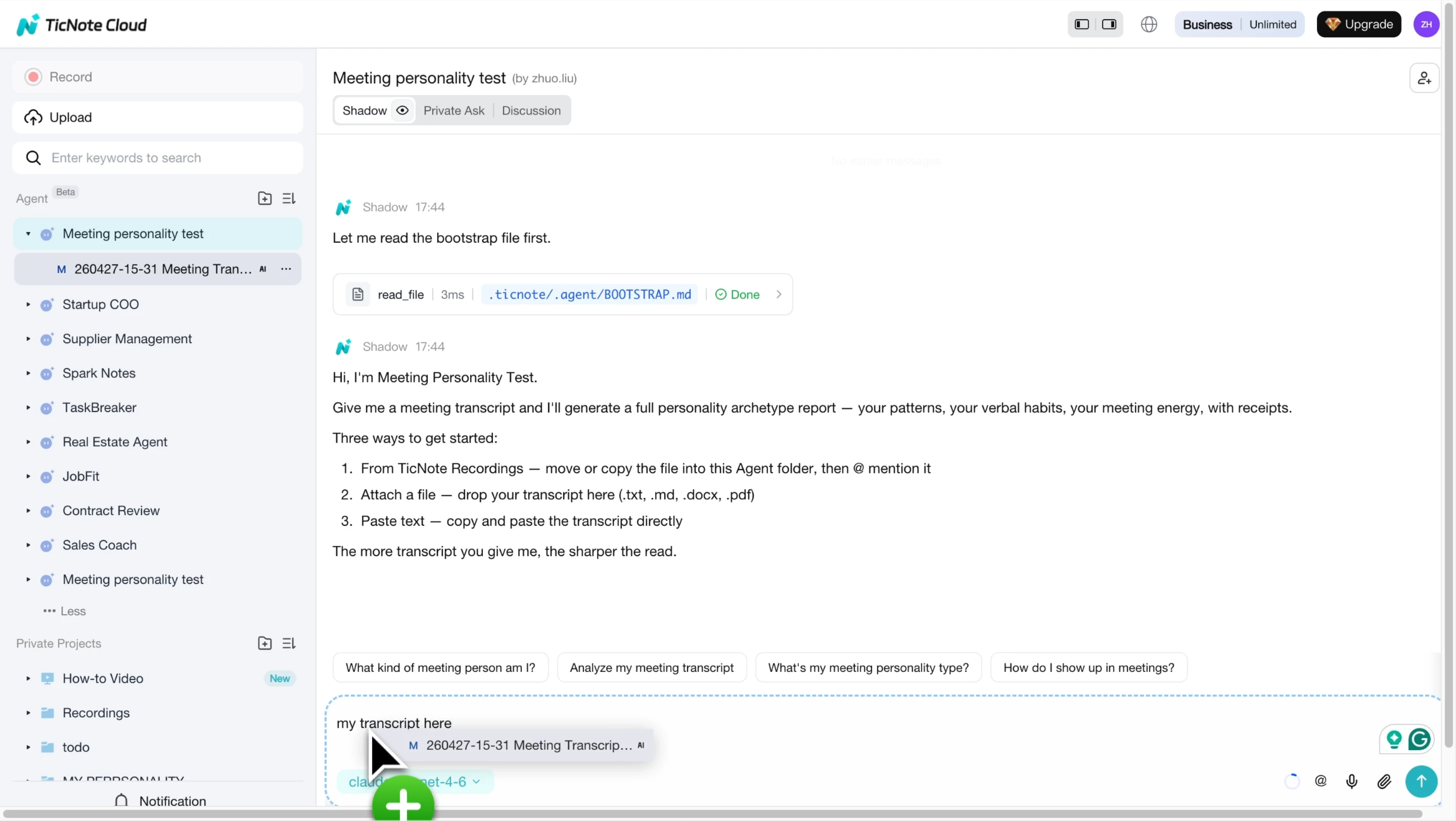
Step 2. Upload your meeting recording, audio, or transcript
Attach a meeting recording, audio file, or transcript to the chat. Tell the agent the names and genders of the participants so it can attribute behaviors accurately. The skill will read who said what and how — the more transcript you give it, the sharper the analysis.
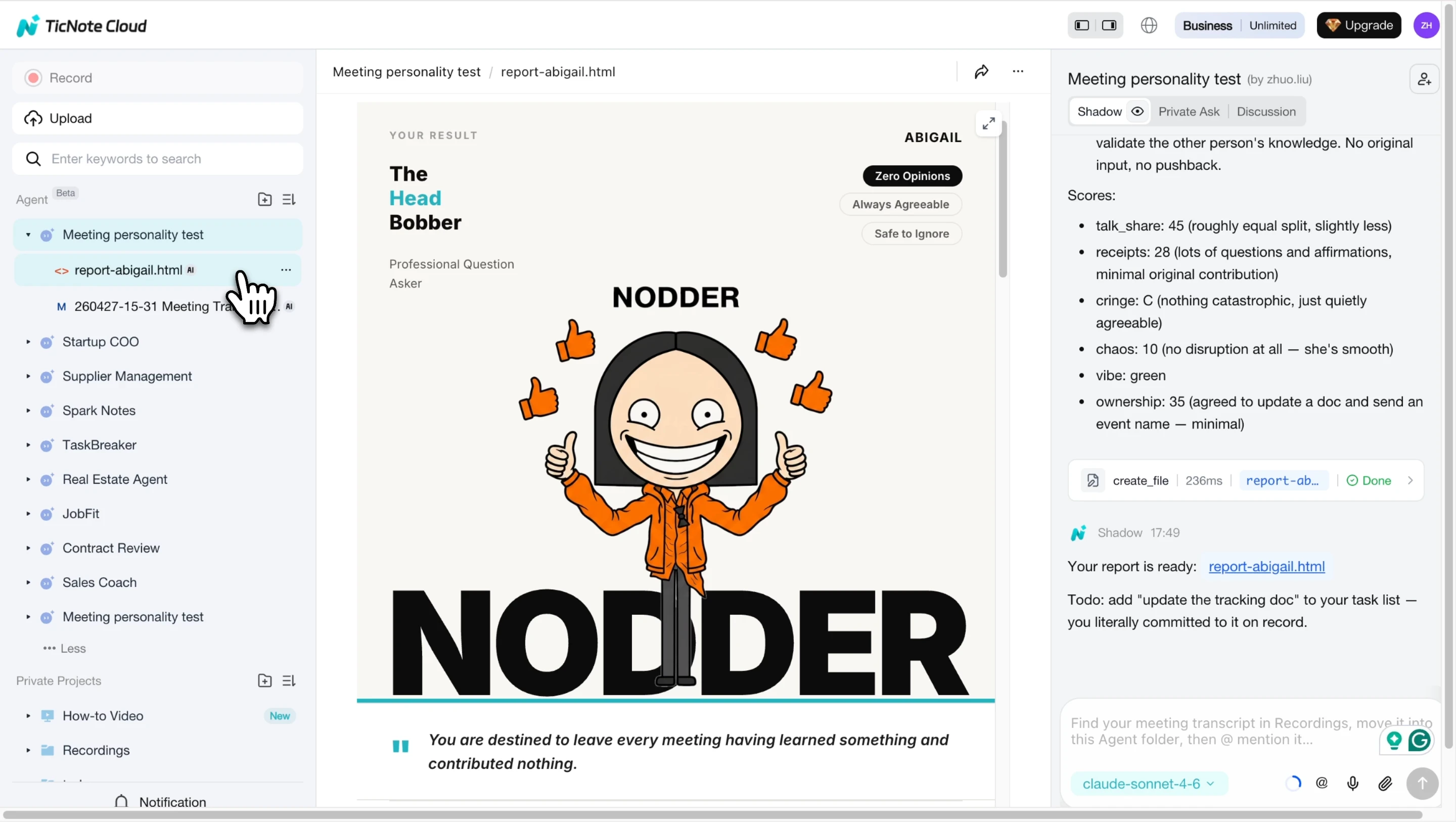
Step 3. Review the personality category result
The skill generates an HTML report and names your personality archetype. Open it to see your type — complete with a mascot illustration, archetype title, and tag labels summarizing your meeting presence at a glance.
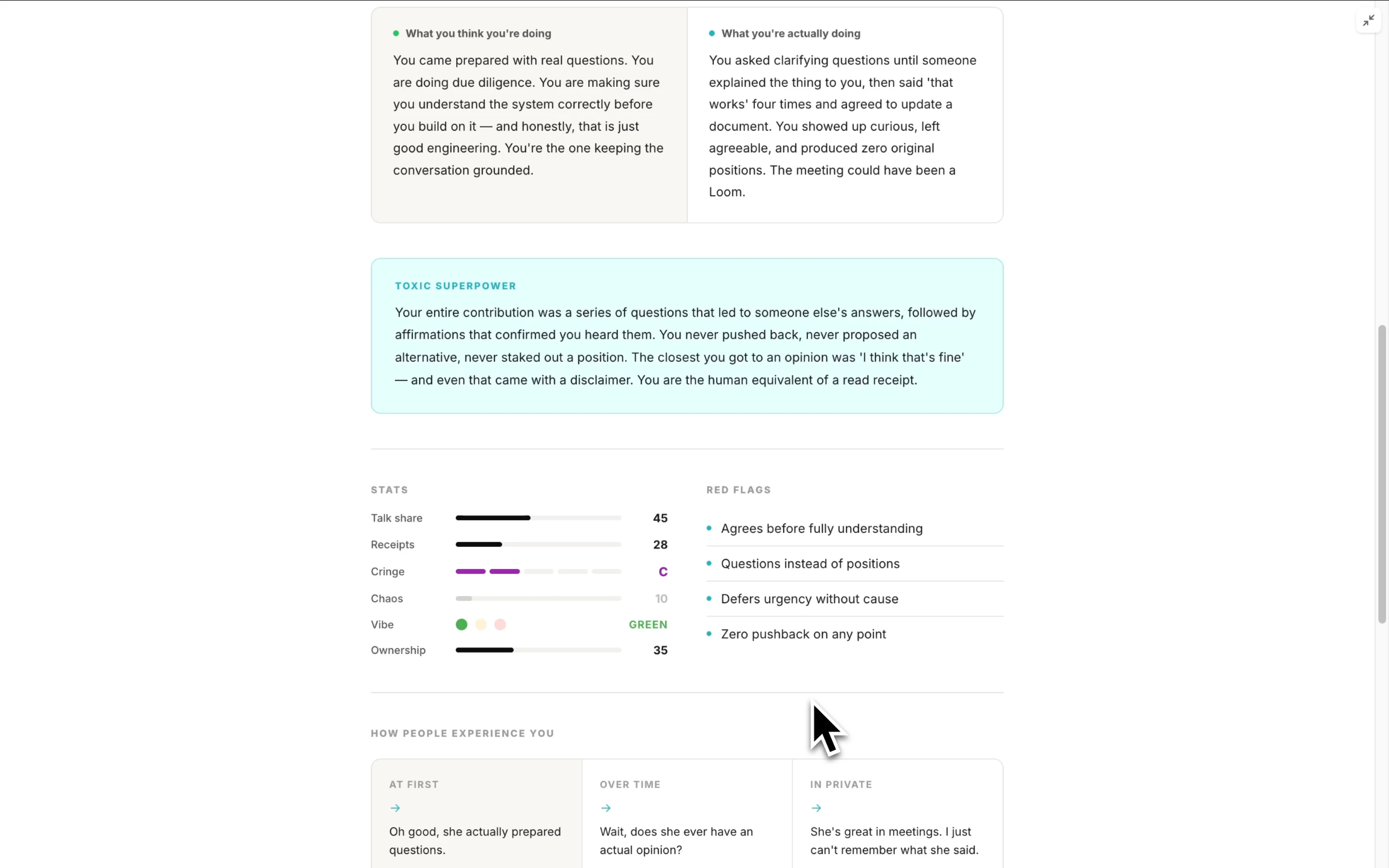
Step 4. Read the full personality analysis
Scroll through the report for the full breakdown: your toxic superpower, behavior stats with bar indicators, red flag checklist, and how people experience you across three timeframes. Each section is grounded in actual transcript moments — no generic feedback.
The combination of self-reflection, a validated assessment, peer feedback, and behavioral analysis gives you a far more complete picture than any single method alone.
Why Understanding Personality Types Improves Workplace Dynamics
Teams that understand each other's office personality types don't just get along better: they produce better work. Research on team composition found that higher conscientiousness elevation in teams positively predicts performance, with a corrected correlation of .27 for professional teams. The mechanism is practical: when people know how their teammates prefer to communicate and make decisions, coordination costs drop.
Better communication
Knowing someone is analytical means you lead with data. Knowing someone is a Driver means you get to the point. Meeting effectiveness correlates directly with how well participants adapt their communication style to the room, rather than defaulting to their own preferred mode.
Fewer conflicts
Most workplace friction isn't about disagreement on substance; it's about style clash. An Analyst's thoroughness looks like stonewalling to a Driver. A People-Pleaser's diplomacy looks like indecisiveness to a Perfectionist. When teams name these patterns, the friction loses its charge. It becomes: "that's your style, here's mine, here's how we bridge it."
Better role fit
Putting a Perfectionist on a fast-turnaround project creates stress for everyone. Assigning deep research to a Motivator who craves variety leads to shallow output. Personality type awareness isn't about limiting people; it's about starting assignments from a position of strength.
Common Mistakes When Using Personality Frameworks
Personality frameworks are tools. Like any tool, the problem isn't the tool itself: it's misapplication.
Treating types as fixed. Personality describes tendencies, not destiny. People adapt. A natural Individualist can become highly collaborative under the right manager. A People-Pleaser can develop direct communication skills over time. Don't use someone's type to explain away behavior that actually needs to change.
Using tests as hiring gatekeepers. Filtering candidates by personality type introduces bias and, in some jurisdictions, legal risk. Tests can inform conversation and flag fit considerations, but they should never be the deciding factor in a hire. Use them alongside structured interviews, work samples, and reference checks.
Over-relying on self-report. People answer personality tests the way they want to be seen, especially in high-stakes contexts like performance reviews or hiring. What Is an AI Meeting Assistant tools show a different path: behavior measured directly from real interactions, not self-description.
Ignoring cultural context. Most personality frameworks were developed in Western, individualist contexts. Extraversion is celebrated in DISC and MBTI, but many high-performing cultures prize thoughtful restraint. Calibrate your interpretations to your team's actual context, not the model's default assumptions.
Conclusion
Understanding workplace personality types gives you a practical lens for better communication, smarter collaboration, and more honest self-awareness. Whether you start with a DISC assessment, a Big Five questionnaire, or a peer conversation, the goal is the same: close the gap between how you think you show up and how you actually do.
Start with TicNote Cloud's free Meeting Personality Test to see your real communication patterns from an actual transcript, not a questionnaire.