


 Extension
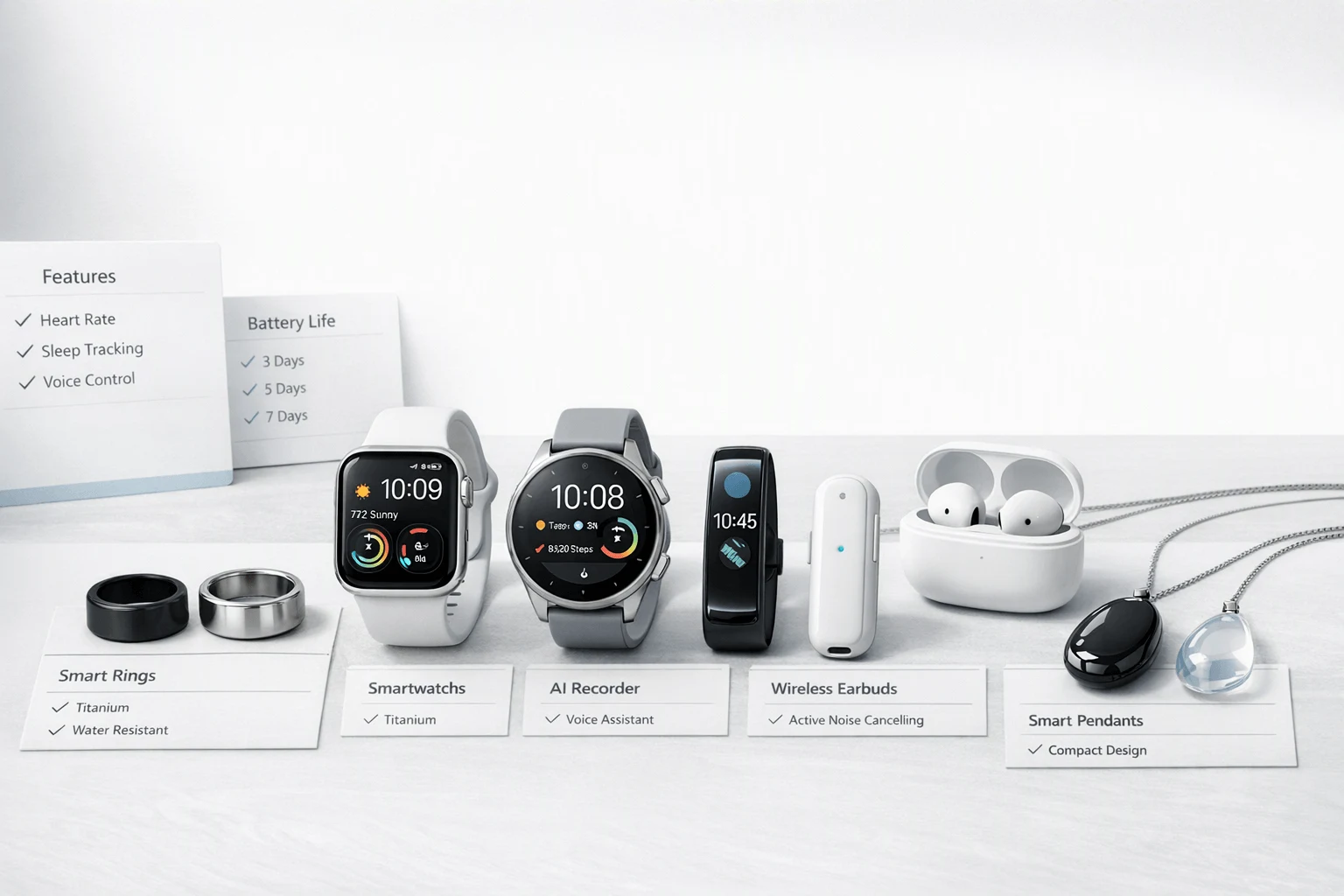
TL;DR: Wearable Tech picks for 2026
If you want a wearable device that does more than count steps, Buy TicNote Device is the clearest productivity pick: smartwatches still win for mainstream everyday use, rings are best for low-friction health tracking, rugged watches fit hard training, and smart glasses remain the most interesting emerging category. For work output, AI recording wearables now matter just as much as fitness gear.
Best fits by use case:
- Productivity and meeting capture: TicNote Pods 4G for phone-free recording and live summaries
- Global everyday use: TicNote Pods Wi-Fi
- Discreet note capture: TicNote Card or Card Lite
- Fitness and health: smartwatch
- Discreet wellness: smart ring
- Rugged training: multisport watch
- Emerging category: smart glasses
The full guide includes a normalized comparison table, privacy guidance, and a decision path to help you choose fast. See the Device.
Which wearable device types matter most today?
A wearable device is any body-worn electronic tool that helps with health tracking, alerts, communication, navigation, or work. Today, the category matters less for novelty and more for output: does it save time, improve awareness, or capture useful information you can act on later?
Start with watches and bands
Smartwatches and fitness bands still lead the market because they do many jobs well enough in one place. They handle notifications, heart rate tracking, sleep data, step counts, workouts, and often built-in GPS. For most buyers, that mix of sensors, app support, and daily convenience is hard to beat.
Their strength is clear:
- Fast access to alerts
- Solid health and fitness tracking
- Good support for calls, payments, and navigation
- Broad app ecosystems
But they also have limits. They can tell you how long a meeting raised your stress level. They usually can't turn that meeting into a transcript, summary, and action list.
Use rings and jewelry for passive tracking
Smart rings and smart jewelry matter because they're discreet and low-friction. You wear them, forget about them, and still get sleep, recovery, readiness, and stress data. That's useful for people who want fewer screens and less interruption.
The trade-off is a narrower feature set versus a watch. Most rings don't offer rich app control, long text interactions, or strong productivity tools. They're excellent passive trackers, but not the most versatile wearable tech option.
Look at audio wearables for work output
Audio wearables are now one of the most important shifts in the category. Open-ear buds, wearable recorders, and smart earbud recorder formats support meetings, lectures, field notes, interviews, and calls. Their value comes from what happens after capture: transcripts, summaries, speaker labels, action items, and searchable knowledge.
That's where devices like TicNote stand out. Instead of focusing only on wellness metrics, TicNote is built for conversation capture and AI note-taking. In practice, that means a wearable can help produce work, not just measure your body.
Don't ignore specialty wearables
Head-mounted and niche devices still matter in specific settings. Smart glasses help with hands-free visuals and remote guidance. Smart clothing and connected shirts fit athlete monitoring, rehab, and industrial safety. These tools can be powerful, but they usually serve narrower use cases.
For that reason, the best reviews should judge every category with the same filters:
- Privacy
- Battery practicality
- Reliability
- Real-world usefulness
Those four criteria separate impressive demos from devices people actually keep using.
Top 10 wearable devices reviewed
The best wearable device isn't always the one with the most sensors. In real work, usefulness comes down to what the device actually helps you finish: notes captured, calls logged, tasks surfaced, and details you can find later. That's why this list mixes mainstream wearables with a newer class of recording-first tools built for meetings, fieldwork, and study.
1) TicNote Pods 4G
TicNote Pods 4G is the strongest pick here for professionals who need phone-free capture. The case has built-in 4G eSIM support, so it can upload audio in real time without your phone nearby. That matters for consultants, sales teams, legal users, clinicians, and field staff who move between calls, site visits, and in-person meetings all day.
What makes it different is speed after the conversation ends. You get live summary during recording, then a quick summary, transcript, and action items right after. It also supports call capture when you're wearing the earbuds, plus real-time transcription and translation features. At $299.99, it's the most powerful option in the TicNote lineup, but there is a battery trade-off: about 13 hours with 4G on, or about 22 hours with 4G off. If your main goal is meeting output, not just notifications, it stands out.
2) TicNote Pods Wi-Fi
TicNote Pods Wi-Fi is the better value choice for people who usually keep a phone nearby. It keeps the same core idea—record, sync, transcribe, summarize, and generate follow-ups—but uses a sync-based workflow instead of constant cellular upload. That makes it simpler, lighter, and better for daily office use or international travel.
At $249.99, it costs $50 less than the 4G version. You also get a lighter case and no region lock, which is a real advantage for global users. It won't give you phone-free live upload, but many buyers won't need that. For office workers, students, and frequent travelers, it hits a strong balance of portability and AI note-taking value.
3) TicNote Card
TicNote Card is the discreet option. It's a credit card-sized recorder that fits in a wallet, measures just 3 mm thin, and offers one-press capture with up to 25 hours of battery life. The 64 GB storage and 10 m pickup range make it practical for lectures, client meetings, and room conversations.
This is a premium-feeling device, with an aluminum alloy body and included leather case. It syncs later for transcripts, summaries, and action items, so it's less instant than the Pods 4G. But if you want a recorder that disappears into daily carry, few products are this clean or portable.
4) TicNote Card Lite
TicNote Card Lite is the budget-friendly version of the Card. At $129.99, it is $30 cheaper, thicker at 5.8 mm, and simpler to use because there's no lever or mode switch—just press and record. It keeps the same 25-hour battery and 10 m pickup, with the same post-sync AI workflow.
The main trade-offs are build and storage. Card Lite uses a simpler design and has 4 GB storage instead of 64 GB. Still, for buyers who care more about convenience and price than premium materials, it's the smarter buy.
5) Apple Watch
Apple Watch remains the most recognizable all-purpose smartwatch. It handles messaging, notifications, wellness tracking, and a huge app ecosystem better than most rivals. According to Apple Watch Series 10 Tech Specs, Apple Watch Series 10 has up to 18 hours of normal use battery life.
That said, it is not built for long-form meeting capture. It's excellent for everyday convenience, quick replies, and health features, but weak as a dedicated conversation recorder or AI note device.
6) Samsung Galaxy Ring
Samsung Galaxy Ring fits buyers who want discreet sleep, recovery, and readiness tracking without wearing a watch. A smart ring is comfortable overnight and less distracting during the day.
But a ring can't replace a note-taking workflow. It can tell you about sleep quality and recovery trends, not capture meetings, dictation, or action items.
7) Fitbit Charge
Fitbit Charge still makes sense for value-focused buyers. It gives you a slim band, solid health metrics, and less screen distraction than a full smartwatch. For people who mainly want steps, heart rate, sleep, and basic phone alerts, that's a good trade.
Its limits are clear, though. It's a fitness band first, not a productivity tool.
8) Garmin wearable
Garmin devices are the top fit for serious training, GPS-heavy use, and outdoor battery life. If you run, cycle, hike, or train with structure, Garmin's utility is hard to beat.
For meeting productivity, though, the value is indirect. Great for athletes. Less useful for recording conversations or turning spoken work into searchable output.
9) Meta smart glasses
Meta smart glasses are interesting because they bring hands-free capture into a wearable form. They work well for casual media, voice prompts, and emerging spatial use cases.
The issue is privacy. Cameras on your face can create friction in public, at work, or in regulated settings. That makes them less suitable for many professional recording situations, even when the hardware is convenient.
10) Hexoskin smart shirt
Hexoskin smart shirt is a specialty biometric wearable. It tracks advanced physiology and suits research, performance labs, and professional monitoring more than mainstream buyers.
That focus is also its limit. It serves a narrow audience and does little for everyday communication, meetings, or note capture.
Quick takeaway before the full comparison table
If you want the best tool for meeting output, TicNote Pods 4G leads. If you want global flexibility and lower cost, Pods Wi-Fi is easier to recommend. For discreet carry, Card and Card Lite make more sense than a watch, ring, or fitness band.
Here's the short version:
- Best for phone-free AI meeting capture: TicNote Pods 4G
- Best value for daily office use: TicNote Pods Wi-Fi
- Best wallet-ready recorder: TicNote Card
- Best affordable card-style recorder: TicNote Card Lite
- Best all-purpose smartwatch: Apple Watch
- Best smart ring for sleep tracking: Samsung Galaxy Ring
- Best value fitness band: Fitbit Charge
- Best for endurance and GPS training: Garmin
- Best for hands-free media capture: Meta smart glasses
- Best specialty biometric wearable: Hexoskin
In the next section, we'll compare privacy, battery, and practical usefulness side by side. If you want updates on new wearables and AI recording tools, join our newsletter for future reviews and comparison charts.
How to choose the right product
The right wearable device depends on the job you need it to do. If your main goal is capturing meetings, calls, lectures, and field conversations without losing details, TicNote makes the clearest case because it turns audio into transcripts, summaries, and action items instead of just storing recordings. If you want a broader framework first, this guide on wearable types and work use cases helps map the category fast.
Pick TicNote Pods 4G if your phone isn't always available
Choose TicNote Pods 4G if you move between client sites, hospital floors, job sites, or back-to-back meetings where pulling out a phone is awkward or impossible. Its biggest advantage is simple: the case can upload in real time over 4G, so you can get Live Summary while the conversation is still happening.
It's the strongest fit for:
- field teams and consultants
- sales reps on the road
- healthcare and legal users who need fast recap
- anyone who takes calls and wants them captured automatically
The productivity upside is real. You can finish a meeting with summary, key points, and next steps already waiting instead of doing a second round of admin later.
Pick TicNote Pods Wi-Fi for global everyday use
Pods Wi-Fi are the best choice for buyers who want smart-earbud convenience but usually have their phone nearby. You get the same core workflow—record, upload, transcribe, summarize—but in a lighter setup with no region lock, which makes it a better fit for international users and frequent travelers.
This model suits:
- office workers
- hybrid teams
- students who record classes and review later
- users who want wearable convenience without paying for 4G
If your day is mostly desk work, commuting, and standard meetings, this is often the most balanced option.
Pick TicNote Card for discreet, wallet-ready recording
The premium Card is for professionals who want a recorder that disappears into daily carry. At 3 mm thin, it slips into a wallet and stays with you, which matters because the best note-taking tool is the one you actually have when a meeting starts.
Choose it if you want:
- a slim, discreet form factor
- simple in-person meeting capture
- lecture recording with minimal setup
- a premium build and 25-hour battery life
It's especially strong for consultants, managers, and professors who want low friction without wearing earbuds all day.
Pick TicNote Card Lite for lower-cost AI capture
Card Lite is the value pick. It keeps the core benefit—one-button recording plus AI transcription and summaries—while lowering the price to $129.99.
It's best for:
- students
- first-time buyers
- budget-conscious teams
- anyone who wants fewer controls and faster start
The modeless design is the key benefit here. Press once, record, and sort everything later in the app.
Pick a smartwatch, ring, or fitness tracker for health-first needs
If your real goal is sleep scores, step tracking, GPS runs, heart data, recovery trends, or coaching, buy the category built for that purpose. An audio-first recorder shouldn't replace a wellness device.
| Main goal | Best category | Why |
| Phone-free meeting capture | TicNote Pods 4G | Real-time upload, live summary, call recording |
| Everyday smart recording | TicNote Pods Wi-Fi | Earbud convenience, lighter carry, global use |
| Discreet recorder in wallet | TicNote Card | Slim form, always with you |
| Lowest-cost AI notes | TicNote Card Lite | Core workflow at lower cost |
| Sleep, steps, workouts, GPS | Smartwatch, ring, or tracker | Built for sensors, recovery, and health metrics |
See the Device if you want to compare the card and earbud form factors side by side before choosing.
How do the best wearable devices compare on privacy, battery, and usefulness?
The best wearable device isn't always the one with the most sensors or the loudest marketing. For most buyers, the better test is simple: does it work reliably, last through a real day, respect sensitive data, and produce useful output? That's why this comparison normalizes mixed categories by practical use, not hype alone.
Compare categories on real-world value
| Product | Form factor | Core purpose | Reliability in use | Battery practical use | Phone dependency | Privacy posture | Best use case | Price band |
| Apple Watch Ultra 2 | Smartwatch | Health, notifications, fitness | Strong sensors, app-dependent value | 1–2 days | Partial | Broad cloud ecosystem | Daily tracking + smartwatch use | Premium |
| Oura Ring 4 | Smart ring | Sleep and recovery | High wear adherence, passive tracking | 5–8 days | High | Health data platform model | Sleep-focused users | Premium |
| Whoop 5.0 | Band | Recovery and strain coaching | Strong trend tracking, no screen | 4–5 days | High | Ongoing account-based data model | Athletes and coaching | Premium subscription |
| TicNote Card / Pods | Recorder or earbuds | Conversation capture, transcription, AI notes | Depends on mic placement and room noise, but strong output utility | Up to 25 hours on Card; about 22 hours on Pods Wi-Fi | Varies by model | Private by default, encrypted, GDPR-aligned claim | Meetings, lectures, field notes | Mid to premium |
Privacy matters more when a device captures people, not just steps. In the EU, Regulation (EU) 2016/679 (GDPR), Article 4 defines biometric data as "personal data resulting from specific technical processing relating to the physical, physiological or behavioural characteristics of a natural person, which allow or confirm the unique identification of that natural person." In practice, buyers should review consent laws for recording, internal workplace policy, healthcare or legal handling rules, encryption, cloud storage location, and vendor access controls. TicNote says its system is private by default, encrypted, and GDPR-aligned, but teams in regulated settings should still validate those claims during procurement.
Weigh battery, comfort, and output quality
Always-on connectivity drains battery faster. So do live uploads, cellular links, and bright displays. Comfort also drives adherence: a great tracker fails if you stop wearing it, and a recording wearable fails if mic pickup is poor in noisy rooms. The most useful products are the ones that turn capture into a reliable result, whether that's stable health trends or accurate transcripts, summaries, and action items.
Use a side-by-side comparison table before you buy, especially if you're deciding between a wellness wearable and a conversation-first device like TicNote.
What makes TicNote a unique wearable tech option?
TicNote stands out because it turns a wearable device into a full capture-to-output system, not just a place to store audio. Instead of stopping at recording, it helps you transcribe conversations in real time, translate across 120+ languages, mark key moments, sync photos to exact transcript points, and generate summaries plus action items right after a meeting ends. That makes it far more useful for buyers who need real work done, not just data collected.
Turn conversations into usable work
What makes TicNote different is the workflow layer:
- real-time transcription during meetings, calls, and lectures
- live translation with bilingual subtitles
- highlight and annotate while recording
- photo-to-transcript sync for visual context
- instant summaries and to-do lists
- ask-AI search across recordings
- speaker identification for multi-person sessions
- document generation for notes, reports, and formatted drafts
- project knowledge base tools for cross-meeting search and reuse
In practice, that means less manual cleanup and faster follow-through. A project manager gets a recap and task list. A consultant gets searchable workshop records. A student gets lecture summaries. Healthcare and legal users get stronger documentation support. Field teams can turn spoken updates into structured reports.
This is also where TicNote expands the meaning of wearable tech: it doesn't just track activity, it captures decisions and turns them into output you can use the same day. Check the comparison table above to see how it stacks up by battery, privacy, and everyday usefulness, then use the product embed here to compare the Card, Card Lite, Pods 4G, and Pods Wi-Fi.
Final thoughts
The wearable device market is much broader now than smartwatches and fitness bands. Some products are best for heart rate, sleep, and passive wellness data. Others help you capture real work output. That difference matters. If your goal is better workouts, buy for sensors. If your goal is better meetings, lectures, calls, and searchable notes, buy for recording reliability, transcription quality, privacy controls, and battery life.
Match the device to the job
- Choose watches and bands for health tracking
- Choose rings for low-friction wellness data
- Choose smart audio tools for conversations and documentation
- Choose TicNote if you want the strongest fit for recording, transcription, summaries, and action items in one workflow
Use the comparison table and buying guide to narrow your shortlist fast. And if productivity is your priority, TicNote stands out among the smart wearable devices reviewed here because it turns spoken information into usable transcripts, summaries, and follow-ups instead of just collecting data.
Buy TicNote Device or see the device to compare the best-fit model for your workflow.