


 Extension
TL;DR: skill agent workflow for competitor benchmarking
For fast, repeatable competitive benchmarking, try a shared research workspace that helps you define the business question, limit the field to 3-5 real competitors, choose fair KPIs, capture public and internal evidence, normalize the numbers, find gaps, and turn findings into actions. This article also gives you a clear benchmarking-vs.-analysis table, KPI ideas by channel, common data-quality pitfalls to avoid, and a simple template you can reuse.
Research gets messy fast. Notes sit in docs, interview takeaways live in chat, and source links disappear when you need them most. A central place for transcripts, notes, and cited source files fixes that by keeping the evidence together, so your team can move from raw inputs to a clean benchmark report without rebuilding context each time.
How does competitive benchmarking help you track market performance?
Competitive benchmarking helps you track market performance by comparing your results against rivals on the same metrics over time. That's the key difference: it creates a repeatable scoreboard, not a one-time set of observations. In practice, competitive benchmarking can cover performance metrics, process indicators, and strategic signals such as pricing shifts, review growth, or content velocity.
What competitive benchmarking measures
At its core, benchmarking measures relative performance. That can include:
- Share of search
- Review volume and average rating
- Publishing frequency and content reach
- Social engagement rate
- Conversion friction on key pages
- Pricing movement and promo intensity
As the APQC Process Classification Framework states, benchmarking is "the process of identifying, understanding, and adapting outstanding practices and processes from organizations anywhere in the world to help your organization improve its performance." That definition matters because it goes beyond vanity metrics and focuses on improvement.
Competitive benchmarking vs. competitive analysis
Benchmarking and analysis work together, but they answer different questions. Benchmarking tells you who is ahead, by how much, and whether the gap is widening or shrinking. Competitive analysis goes deeper into why that gap exists, including messaging, positioning, product detail, and market narrative. If you need a deeper breakdown, this guide to turning research into a competitive analysis framework is a useful next step.
| Area | Competitive benchmarking | Competitive analysis |
| Purpose | Track relative performance | Explain competitor strategy |
| Data sources | KPI dashboards, SERPs, reviews, pricing pages, social data | Websites, sales calls, product docs, campaign assets |
| Frequency | Ongoing, monthly or quarterly | Periodic, project-based |
| Outputs | Scorecards, trend lines, KPI comparisons | Profiles, narratives, strategic recommendations |
| Decision use cases | Cadence reviews, target setting, channel prioritization | Positioning, messaging, product strategy |
When to use each approach
Use benchmarking first when you need a clear review cadence and an apples-to-apples scoreboard. Use broader analysis first when you don't yet know who your true competitors are or why one competitor keeps winning. For marketing managers, ecommerce teams, consultants, and product marketers, benchmarking is less a one-off project and more a practical management habit.
What should you benchmark first? Goals, KPIs, and competitor selection
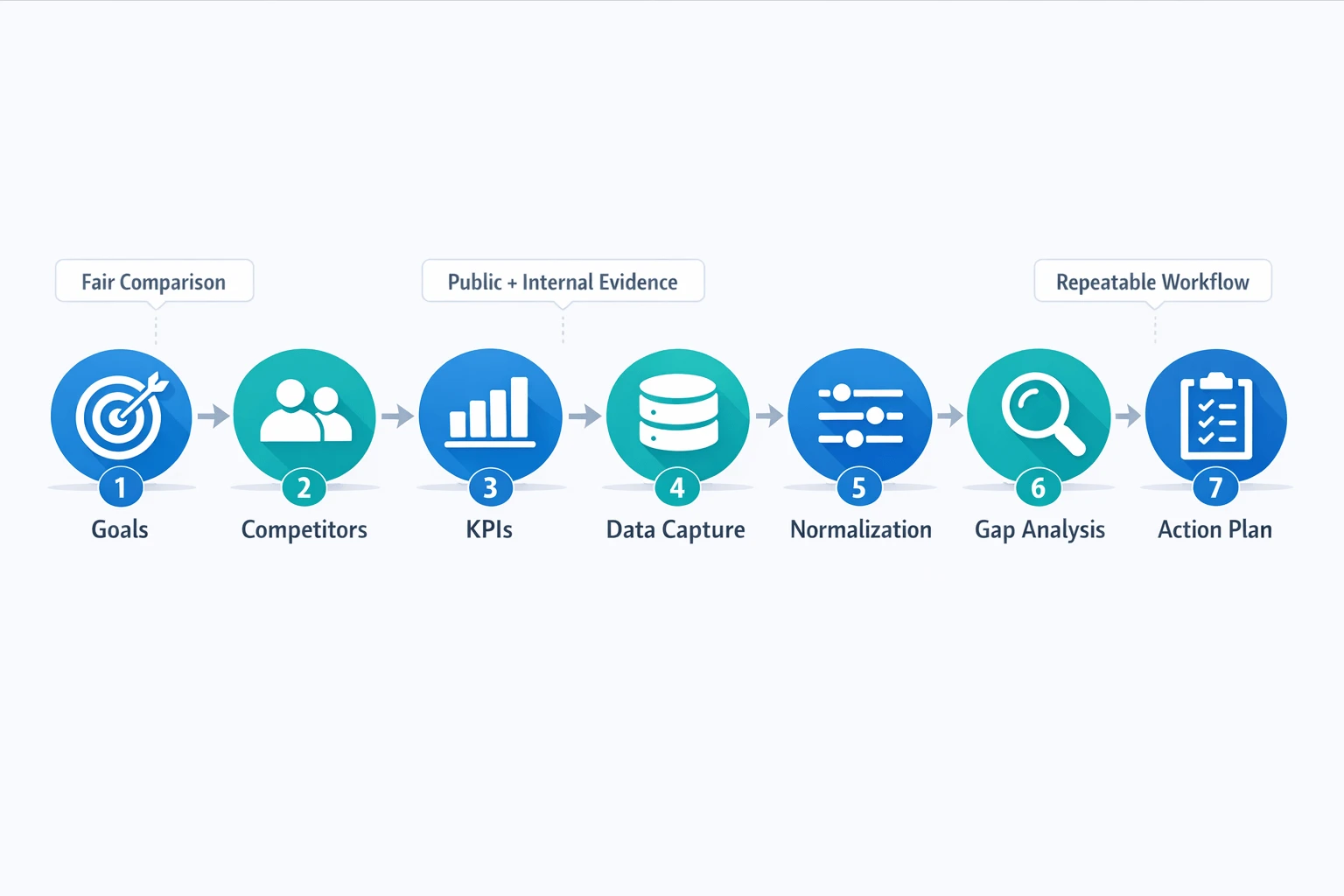
Good competitive benchmarking starts with one choice: the business goal. If you skip that step, you'll collect too much data and miss the signals that matter. A team trying to grow organic visibility should not benchmark the same things as a team focused on pricing confidence, review sentiment, category share, retention signals, or conversion support.
Pick a business goal before metrics
Start with the outcome you need to improve. Then choose the few metrics that can show movement.
For example:
- Organic growth: non-brand keyword visibility, content coverage, SERP feature presence
- Pricing strategy: entry price, discount frequency, bundle structure, free trial or demo friction
- Reputation: review volume, average rating, recurring complaints
- Product marketing: launch cadence, feature page clarity, proof points, comparison page strength
- Ecommerce performance: shipping offers, promo behavior, bundles, returns language
This is where many teams go wrong. They benchmark everything at once, then can't explain what changed or why.
Choose direct, indirect, and aspirational competitors
Build a short list with three tiers:
- Direct competitors: companies selling a similar offer to the same audience
- Indirect competitors: adjacent alternatives that solve the same problem differently
- Aspirational brands: one or two leaders worth studying for process or positioning
Keep the list focused. In most cases, 5 to 8 companies is enough for a useful competitor benchmarking analysis. More than that usually lowers data quality and slows decisions.
If you need help narrowing the field, this guide to free competitor research tools can speed up the first pass.
Select fair KPIs by channel and business model
Fair comparison matters more than volume. Compare percentages, per-page averages, or indexed scores instead of raw totals.
Use rules like these:
- SEO: compare non-brand visibility and topic coverage, not total indexed pages
- Paid media: compare offer angles, ad themes, and pricing cues, not just ad count
- Social: use engagement rate, not follower totals; IAB/MRC/SMMF Global Definitions and Measurement Guidelines (Version 1.0) defines Engagement Rate by Followers as: Total engagements on a piece of content / Followers * 100.
- Reviews: compare rating average, review velocity, and complaint themes
- Ecommerce: compare shipping thresholds, bundle logic, and promo frequency
A solid competitive benchmarking template should track the goal, segment, timeframe, source, metric definition, and confidence notes for every data point. That structure makes the later scorecard and workflow much easier to trust.
A 7-step method for how to benchmark competitors
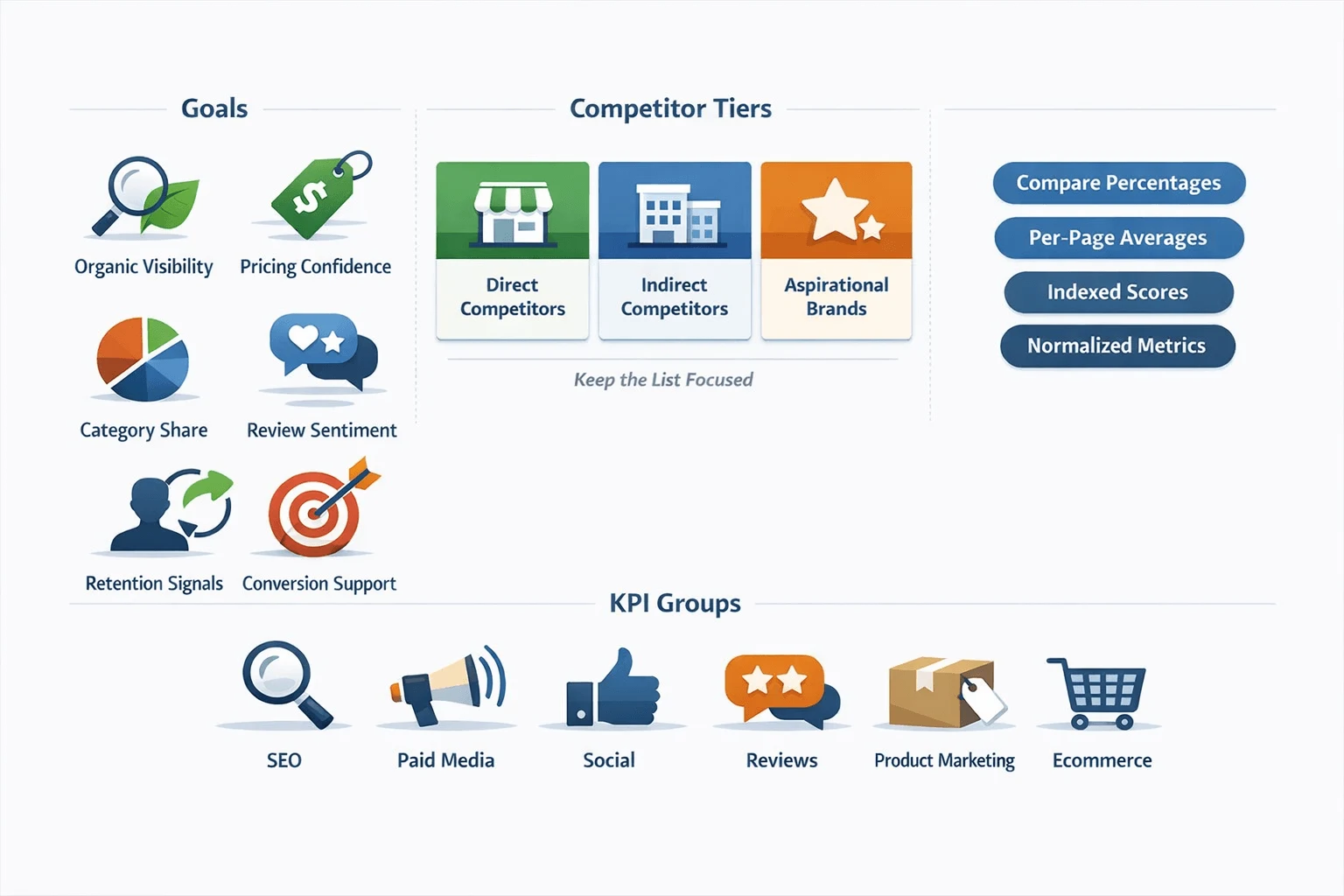
A simple competitive benchmarking process beats random research every time. If you define the market, compare the same metrics the same way, and review results on a schedule, you get clearer KPI comparisons and better decisions. Here's a beginner-friendly system you can repeat without rebuilding the project from zero each quarter.
1. Set scope and timeframe
Start by defining four things:
- market category
- region or country
- customer segment
- review period
For example: "US skincare brands for DTC shoppers, reviewed over the last 90 days." This keeps your competitor benchmarking focused. It also stops teams from mixing global brands, local players, and different buyer groups in one sheet.
2. Build a competitor list
Use a short, useful list:
- 3 to 5 direct competitors
- 1 to 2 aspirational comparators
Direct competitors sell to the same audience. Aspirational comparators may be bigger brands with stronger execution worth learning from. Don't track 15 companies at once. Most teams collect more data but learn less.
3. Gather public and internal data
Pull from both outside and inside sources.
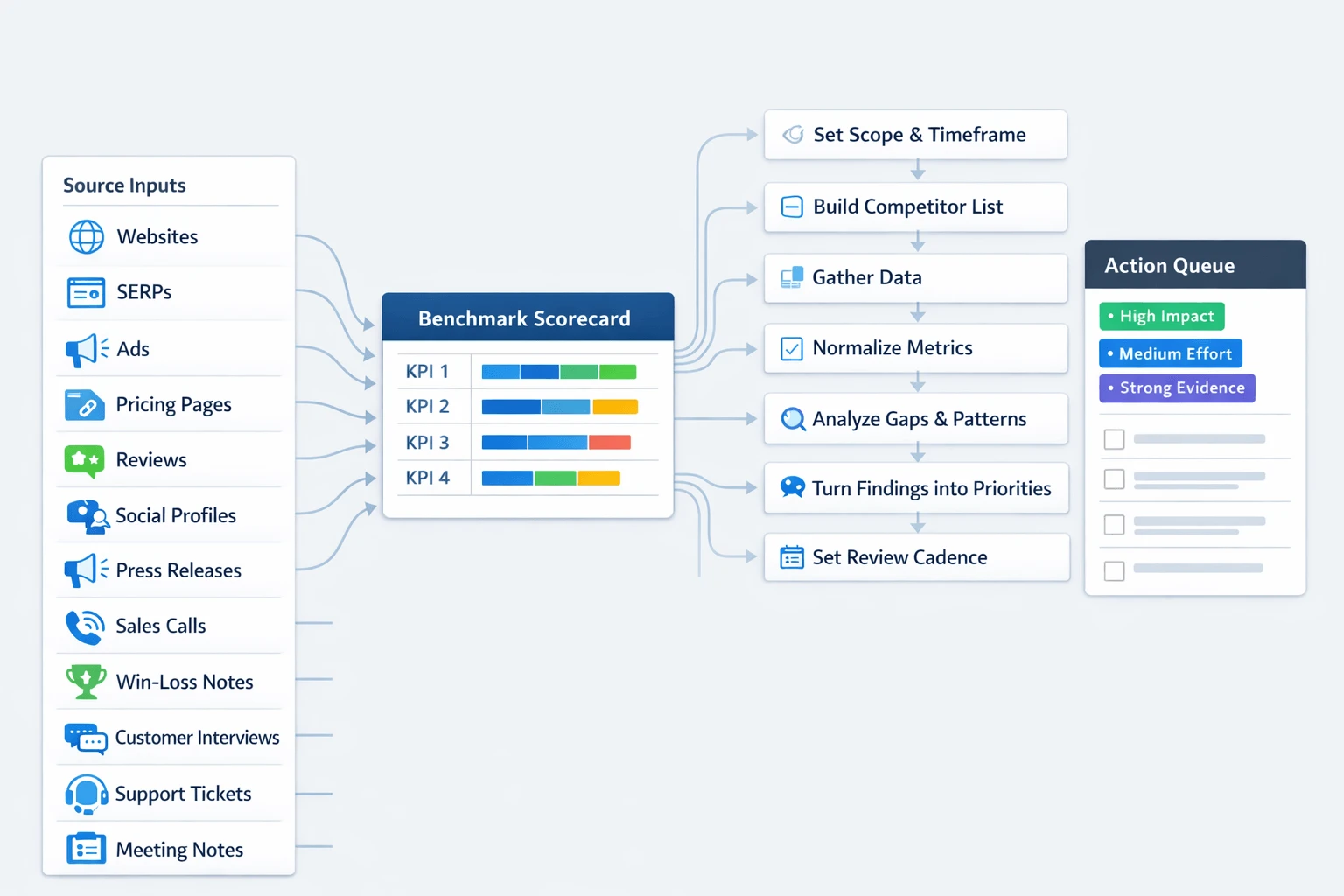
Public sources include:
- websites
- SERPs (search engine results pages)
- ads
- pricing pages
- review platforms
- social profiles
- press releases
Internal sources include:
- sales calls
- win-loss notes
- customer interviews
- support tickets
- meeting notes
This is where shared research systems help. Teams using a common workspace can keep transcripts, notes, documents, and source links together so each benchmark cycle builds on the last one.
4. Normalize metrics for fair comparison
Now make the data comparable. Set apples-to-apples rules before analysis:
- compare the same time period
- separate branded and non-branded search when possible
- note channel differences such as paid vs organic
- adjust for seasonality
- score source confidence, such as high, medium, or low
If one brand runs holiday-heavy promotions and another does not, raw numbers can mislead you. Normalization is what makes competitor benchmarking analysis credible.
5. Analyze gaps and patterns
Don't collect random facts. Look for:
- repeated strengths across channels
- weak spots competitors ignore
- outliers that need verification
- mismatches between message and customer feedback
For a deeper breakdown, this guide on turning competitor research into an action scorecard pairs well with benchmarking work.
6. Turn findings into priorities
Convert insights into actions using three filters:
- impact
- effort
- evidence strength
A high-impact, low-effort fix with strong evidence should move first. Example actions might include rewriting comparison pages, improving pricing-page clarity, or updating sales talk tracks.
7. Set a review cadence
Use two rhythms:
- monthly light reviews for major changes
- quarterly deep updates for full KPI comparison
That cadence is usually enough to catch pricing shifts, message changes, and review trends without wasting time.
Here's a practical example. A team benchmarks four competitors across SEO, review sentiment, and homepage messaging. They find two rivals rank better for comparison keywords, one explains pricing more clearly, and review complaints cluster around setup friction. The action list becomes clear: publish new bottom-funnel content, tighten pricing communication, and give sales a one-page objection sheet. If the team stores calls, transcripts, source pages, and notes in one workspace such as TicNote Cloud, the next review goes faster because the evidence is already organized and searchable.
Try TicNote Cloud for free and keep every benchmark source, transcript, and report in one place.
Which data sources and benchmarks produce reliable competitor benchmarking analysis?
Reliable competitor benchmarking analysis starts with source quality, not tool quantity. Public web data is useful for patterns. Internal research explains causes. The best competitive benchmarking setups combine both, then label each metric as observed, estimated, or directional so teams don't mistake modeled data for fact.
Use SEO and web visibility data for observable market patterns
SEO and web visibility sources are strong for tracking what competitors publish and where they appear. Start with search results, keyword visibility tools, content libraries, backlink patterns, and landing page comparisons. These help you compare:
- ranking coverage by topic
- estimated traffic by page group
- content depth and update pace
- backlink quality and referring domain trends
- page structure, offers, and conversion paths
These sources are best for trend spotting, not exact revenue or lead volume. Third-party traffic and keyword datasets are usually modeled from samples, so treat them as directional.
Read social, brand, and review signals with caution
Social and brand signals show momentum, message fit, and audience response. Useful inputs include engagement rate, posting consistency, sentiment patterns, review themes, and share-of-voice style metrics. They can reveal whether a competitor is winning attention or trust.
But there is a catch: many social and visibility datasets are sampled, delayed, or inferred. A spike in likes may mean stronger creative, paid amplification, or a temporary campaign. Reviews are more reliable when you code repeated themes across dozens of entries instead of quoting one angry post.
Add interviews, calls, and internal notes to explain why competitors win
Public data shows what a competitor says. Customer evidence shows why buyers respond. That makes interviews, win-loss calls, support logs, and sales notes essential research inputs. They often uncover pricing objections, feature gaps, onboarding friction, or trust signals that never appear on a landing page.
This is also where evidence handling matters. ISO 8000-61:2016 Data quality — Part 61: Data quality management: Process reference model specifies that data quality management requires measuring dimensions including completeness, validity, consistency, accuracy, precision and timeliness.
Avoid the data-quality mistakes that break comparisons
The most common errors are simple:
- mixing different time windows
- comparing different business models
- treating estimates as exact truth
- relying on vanity metrics like raw follower count
- ignoring confidence levels and sample size
- failing to keep source citations
If you want a repeatable scorecard, preserve transcripts, notes, and source links in one place. That makes every benchmark easier to verify, update, and reuse in the next report.
How to turn research into a competitive benchmarking report faster
This section uses TicNote Cloud as the example, but the workflow itself is tool-agnostic. The goal is simple: move from scattered notes, call transcripts, and public market data to a usable competitive benchmarking report faster, with less copy-paste and fewer gaps.
Start with a structured input
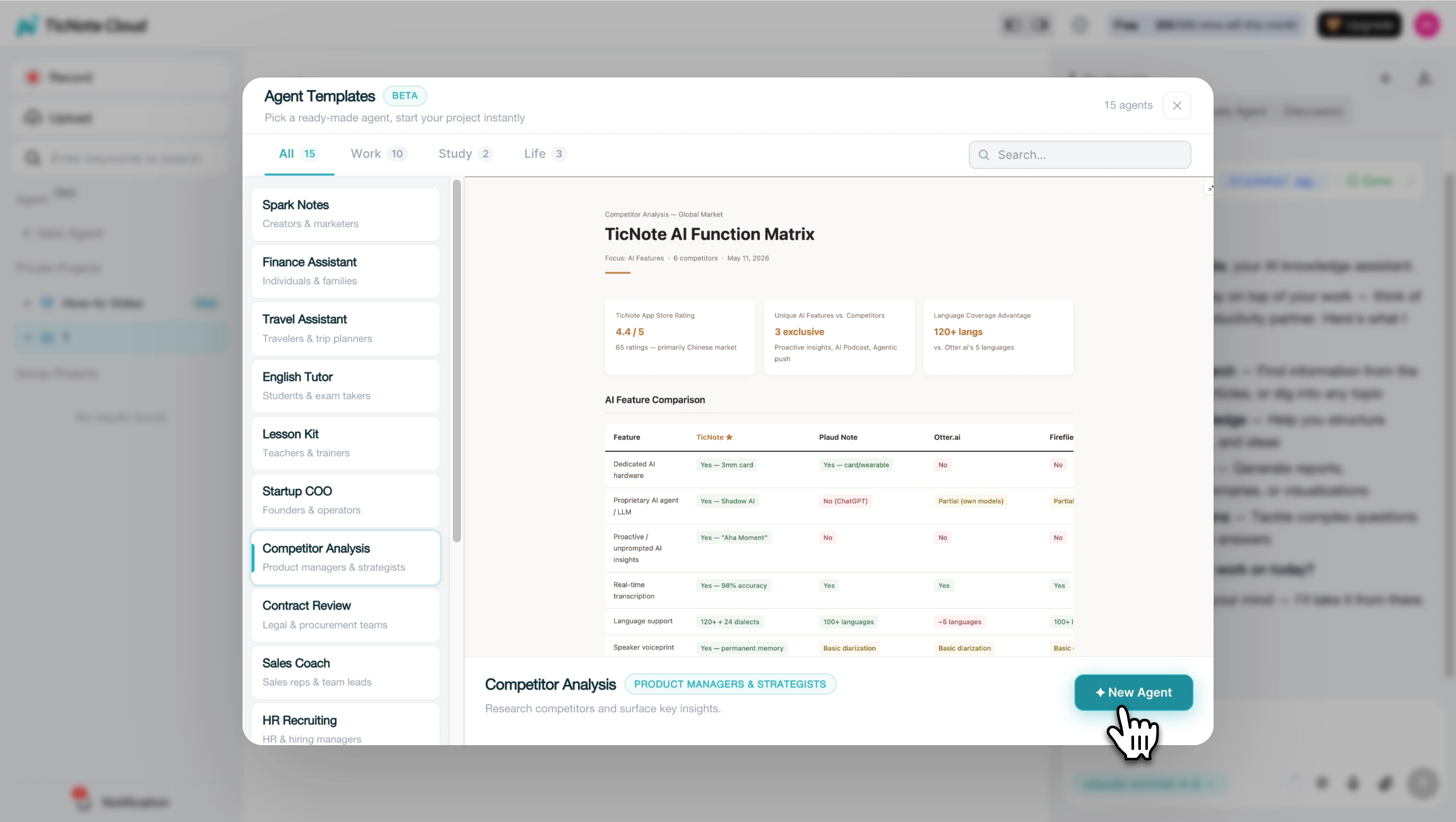
On the web platform, the fastest path is to use the Competitor Analysis skill agent as your starting point. In TicNote Cloud, click Add Agent, open the skill library, and add the competitor analysis agent to your workspace.
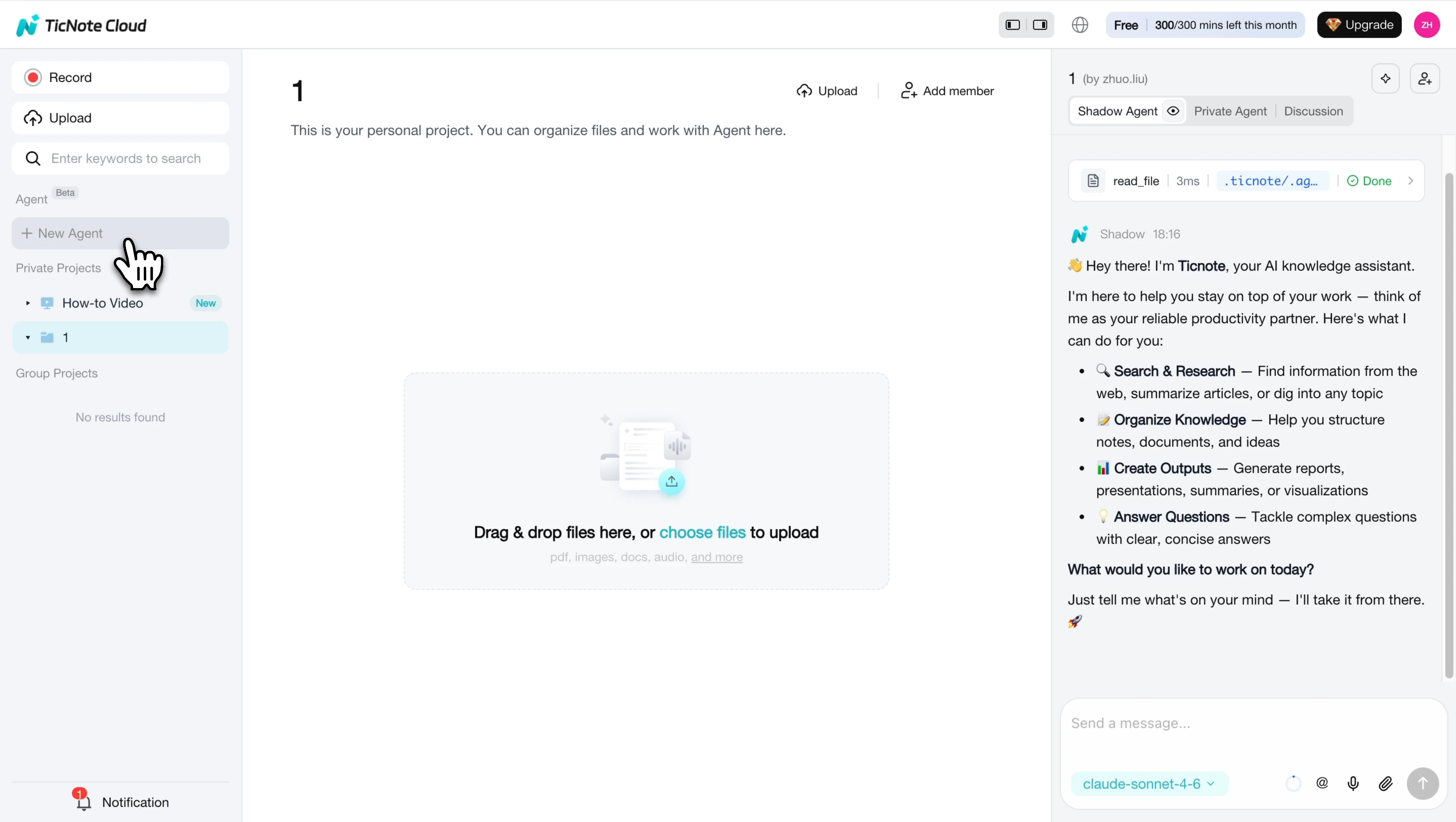
After that, the agent appears in your list and is ready to run.
Then give it the core inputs your report needs:
- your niche or industry
- your location, such as a city, region, or Online/Global
- 5 to 10 competitor names or URLs
- an optional focus like pricing, reviews, social media, or product range
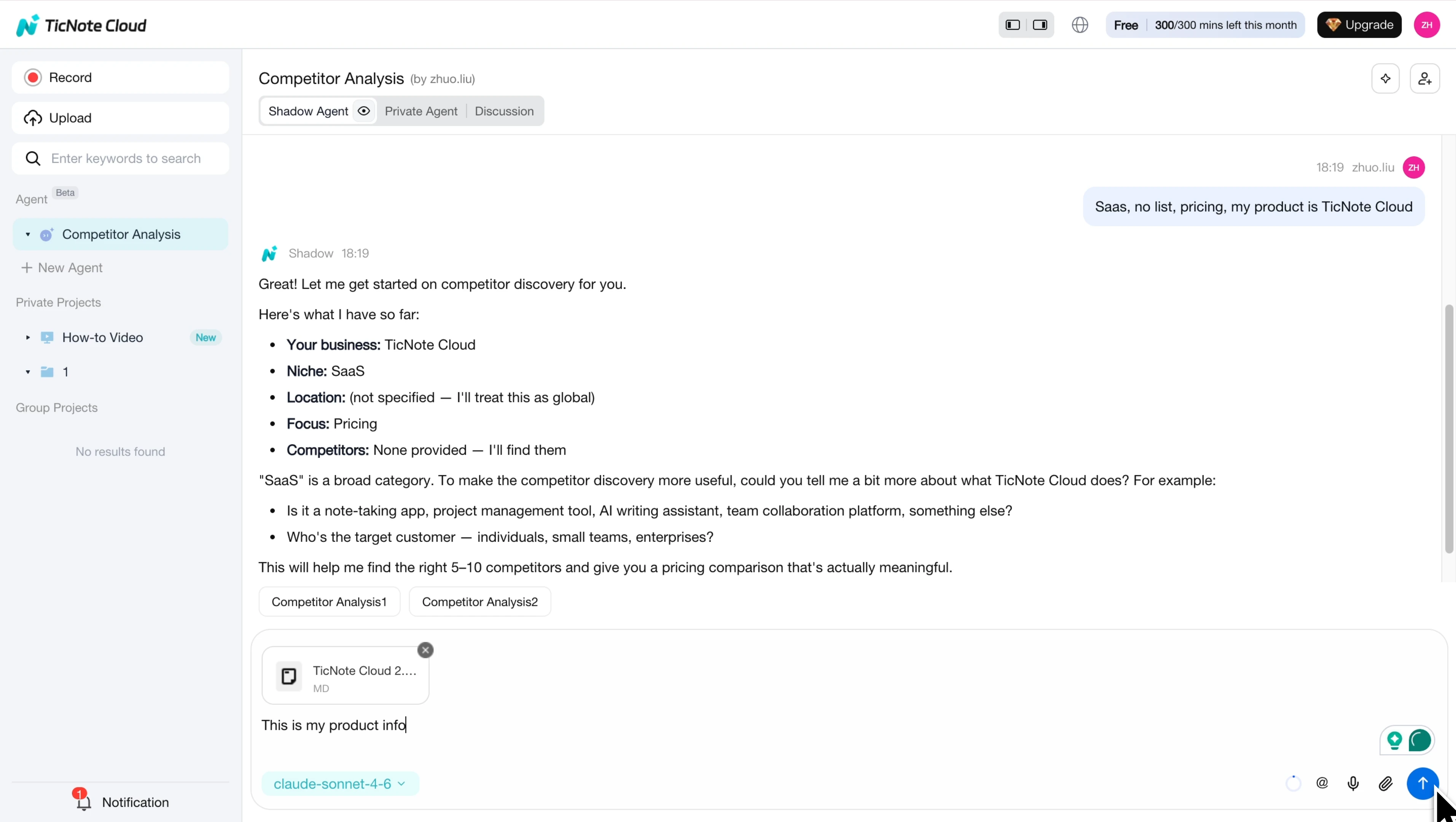
Turn inputs into a report you can use
Once submitted, the agent builds a structured output you can review and refine. That usually includes an executive summary, a comparison matrix, competitor profiles, market gaps, and recommended actions.
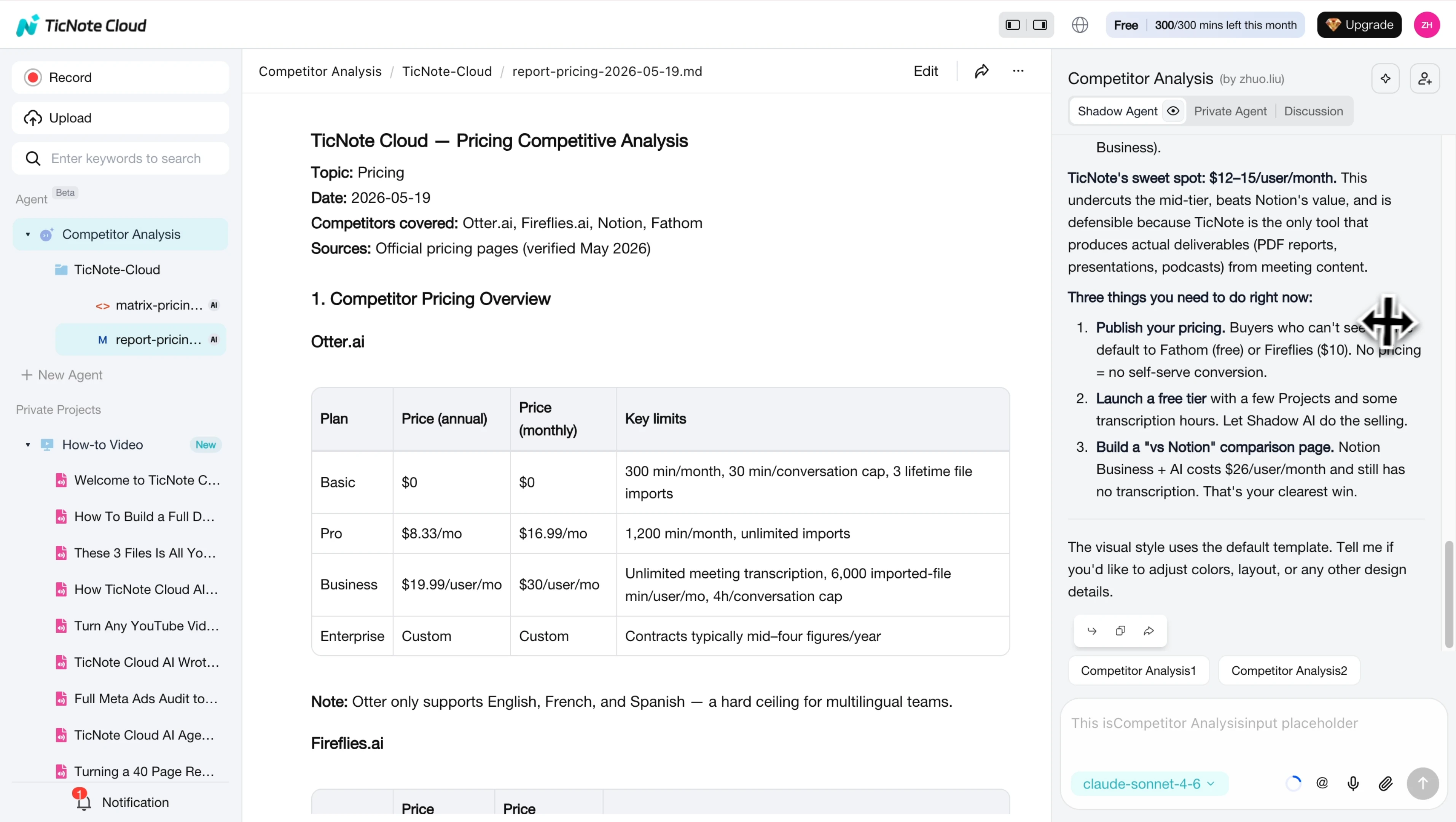
Open the generated files and review the visual matrix for patterns that matter to your team.
This is where speed comes from. Instead of rebuilding a report by hand, you start with a draft based on consistent inputs, then improve it with your own judgment.
Keep the evidence in one searchable project
To make the analysis stronger, attach related materials to the same project: customer call transcripts, internal notes, PDFs, spreadsheets, and source links. That gives your team one place to search, verify, and reuse findings. TicNote Cloud helps here with editable transcripts, project-based research memory, searchable citations, Shadow AI cross-file Q&A, and one-click drafting. If you also need the narrative layer, this guide on turning findings into an action-focused report pairs well with the benchmarking workflow.
On mobile, the app works as a lighter review layer. You can open project files, check prior research, and continue analysis away from your desk.
Competitive benchmarking template: a simple scorecard you can reuse
A reusable scorecard makes competitive benchmarking easier to repeat, update, and defend. Instead of collecting random notes, track each metric in one row with a clear source, a scoring rule, and the next action your team should take.
Core fields to include
Copy these columns into a spreadsheet, doc, or research workspace:
- Goal
- Competitor tier
- Timeframe
- Metric
- Source
- Metric definition
- Normalization rule
- Score
- Confidence level
- Evidence link
- Insight
- Recommended action
This structure matters because raw numbers can mislead. A metric definition explains what you measured. A normalization rule shows how you made unlike data comparable, such as reviews per 1,000 orders or traffic by branded vs. non-branded search.
Simple scoring model
Use either a 1 to 5 scale or a simple below / at / above benchmark label. Weight metrics based on channel impact:
- Ecommerce: pricing clarity, review volume, promo cadence, shipping promises
- Product marketing: positioning, feature proof, use-case coverage, messaging consistency
- SEO: rankings, content depth, backlink quality, SERP feature visibility
Build a KPI comparison table across search, content, reviews, social, and pricing communication. If you need more formats, this competitive research template guide gives useful scoring ideas.
How to turn the template into action
Group findings into four buckets:
- Defend: keep strengths competitors still trail
- Fix: close clear gaps hurting conversion or visibility
- Test: try ideas with promise but limited proof
- Monitor: track changes quarterly
A competitor benchmarking template works best when every score links back to a source, transcript excerpt, or note. That way, your team can defend decisions, revisit assumptions, and update the scorecard without redoing the research.
Final thoughts
Competitive benchmarking works best when it becomes a repeatable habit, not a one-time research dump. Start small. Pick a few fair KPIs, compare like with like, and tie every finding to a real decision such as pricing, channel mix, or product positioning. That's how competitive benchmarking analysis stays useful instead of turning into a slide deck no one revisits.
Just as important, keep the evidence attached to each takeaway and review results on a steady cadence. The workflow, tables, and reusable template in this guide give you a practical starting point, and if you also need a clearer way to turn research into action, this simple action plan framework can help. A central workspace like TicNote Cloud can also cut manual synthesis time and make each future benchmarking cycle easier.