


 Extension
TL;DR: skill agent workflow for faster competitive research
Start your product competitive analysis as a decision system, not a note pile. This guide is for product managers, founders, marketers, researchers, and strategy teams who need a repeatable way to set scope, pick the right competitors, compare features, gather proof, normalize findings in a competitor feature matrix, and turn insights into owners, timelines, and KPIs.
Competitive research often breaks down when evidence lives in scattered tabs, docs, and meeting notes. That slows decisions and makes follow-through weak. A workspace like TicNote Cloud helps teams capture source evidence, organize competitor findings, and keep outputs shareable without losing context.
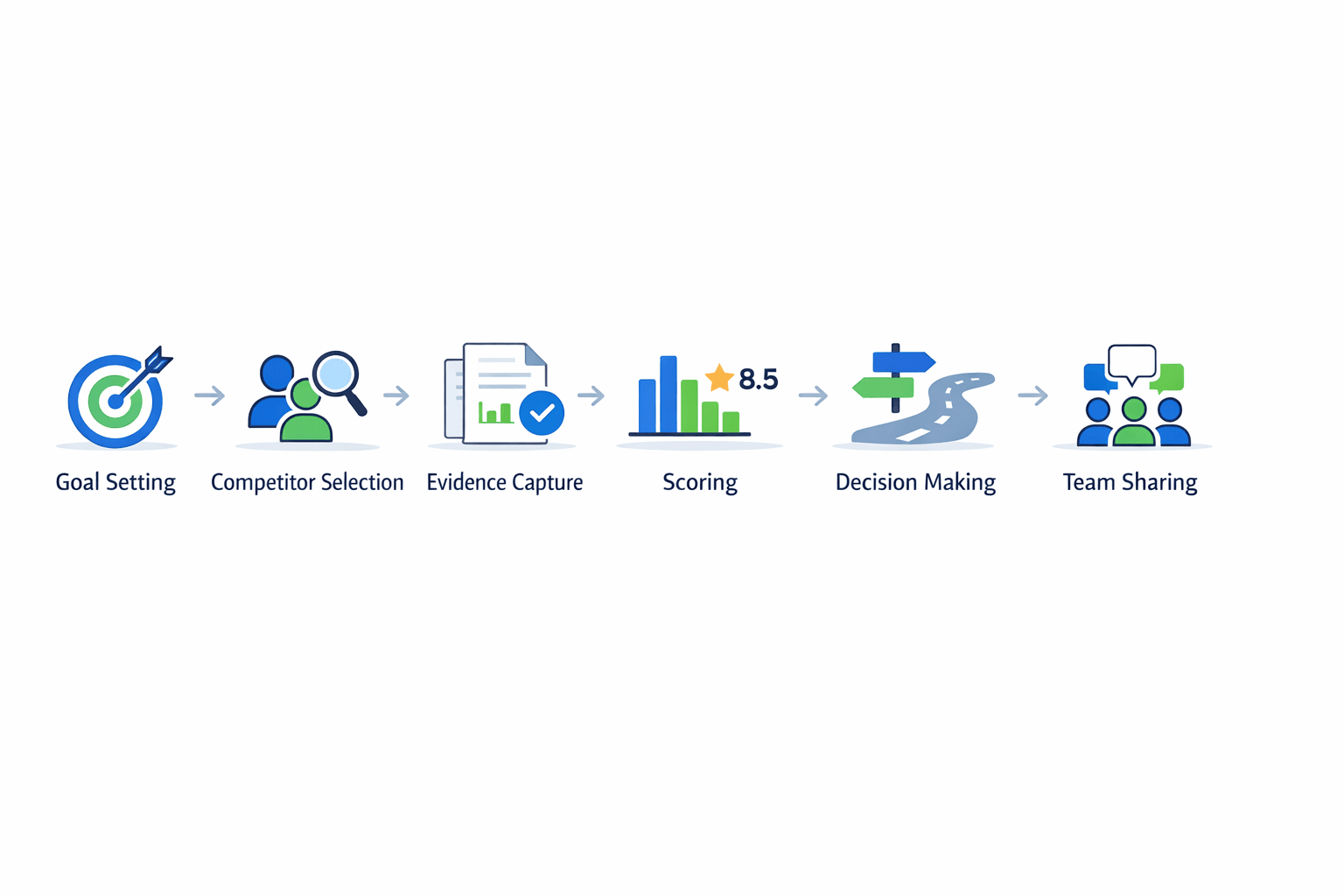
The result is a lightweight workflow: define the question, choose the analysis set, collect evidence, score what matters, and turn gaps into prioritized actions. Instead of ending with observations, you leave with a clear next move.
How to run product competitive analysis without getting lost in data
A strong product competitive analysis starts with a decision, not a spreadsheet. If you define the decision, scope, and audience first, you collect less noise and find more signal. That's also what makes the work usable later, whether you're updating a roadmap, reviewing pricing, or refining positioning.
Set the decision and timeframe first
Start with one live question. For example:
- Which feature should we prioritize this quarter?
- Should we change packaging or pricing?
- Where does onboarding fall behind competitors?
- Is our positioning still clear in the market?
This keeps the analysis tied to action. Without a decision, teams drift into endless collection. Define three things up front: the product area, the review period, and the depth required. A two-week onboarding review needs a different level of detail than a 12-month platform comparison.
Narrow the market slice
Don't study the whole category. Focus on the market slice your buyer actually sees. Narrow by:
- User segment
- Use case
- Geography
- Buying context
That prevents false comparisons. In many cases, your real alternatives are not just direct vendors. They may be spreadsheets, internal tools, agencies, or doing nothing at all. A useful competitor product analysis compares the options customers actually weigh.
Match outputs to stakeholder needs
Different teams need different views of the same facts:
- Product needs feature gaps, trade-offs, and priority signals
- Marketing needs positioning, claims, and messaging shifts
- Sales needs objection handling and deal-level comparisons
- Design needs workflow patterns and UX benchmarks
- Leadership needs market risk, timing, and strategic impact
Use one source of truth, then create tailored summaries from it. If you need a repeatable structure, this competitive analysis framework helps turn raw findings into strategy. The best competitive product analysis is proactive, refreshed on a regular cadence, and used to challenge stale assumptions before a rival launch forces a reaction.
Which competitors belong in your analysis set?
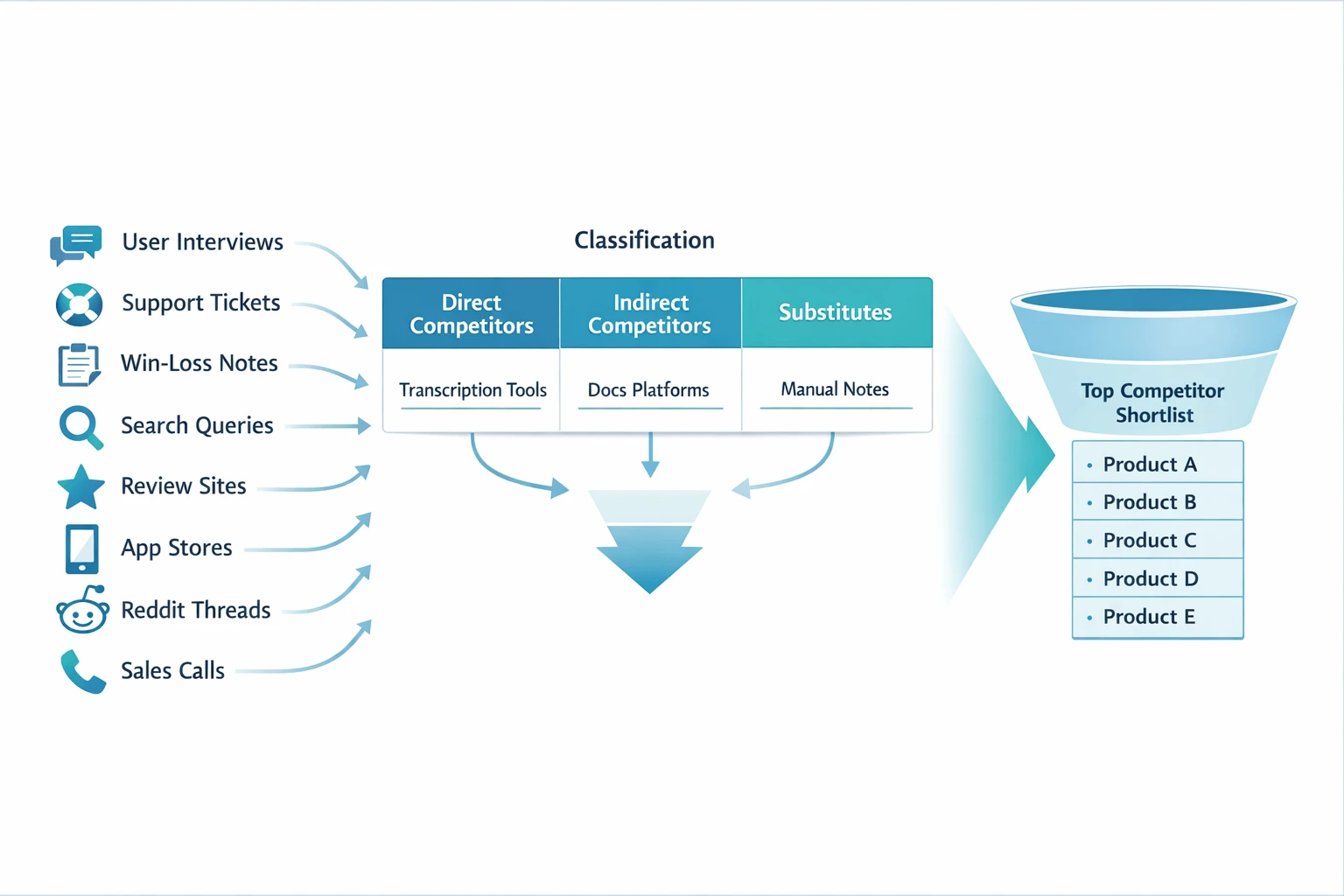
A strong product competitive analysis starts with the buyer's point of view, not your org chart. Customers don't sort options by software category. They compare anything that solves the same job, saves the same time, or replaces the same workflow. That's why your analysis set should include direct competitors, indirect competitors, and substitutes.
Split the market into three competitor types
Use this simple structure:
- Direct competitors: similar product, similar buyer, similar use case
- Indirect competitors: related product solving an adjacent problem
- Substitutes: manual workflows, spreadsheets, docs, email, or internal tools
For example, a meeting workspace may compete directly with transcription tools, indirectly with docs platforms, and as a substitute against a team's manual notes process. In practice, the user may compare all three in the same buying journey.
Build the list from customer language
The best inputs usually come from places where people explain trade-offs in plain words:
- user interviews
- support tickets
- win-loss notes
- search queries
- review sites and app stores
- Reddit threads and communities
- sales calls and demos
These sources show how buyers frame the problem. If prospects keep saying, "We also looked at Otter, Notion, and just using Google Docs," all three belong in your competitor product analysis.
Prioritize only 5 to 7 products
Don't track 20 companies at once. Use a short filter and keep the active set tight:
- market relevance
- overlap in core workflow
- threat level
- frequency of mention
A practical SaaS shortlist might include three direct rivals, two indirect tools, and one or two substitutes. If your category is still emerging, add one benchmark from an adjacent market. That gives you a clearer competitor feature comparison without drowning in noise. If you need a repeatable way to document each player, this guide to building useful competitor profiles can help.
Build a competitor feature comparison that reveals real gaps
A strong product competitive analysis does more than list features. It uses the right comparison framework for the decision in front of you, scores what users actually care about, and turns messy notes into a matrix your team can act on. The goal is not false precision. The goal is pattern recognition that leads to better product choices.
Pick the framework that fits the decision
Use different tools for different questions:
- SWOT analysis works best when you need a broad view of strengths, weaknesses, opportunities, and threats.
- A positioning map helps you spot whitespace in the market and see how brands frame themselves.
- A competitor feature matrix is best for side-by-side product comparison when roadmap or packaging decisions are on the line.
If you're deciding whether to build, improve, bundle, or ignore a capability, the matrix is usually the clearest option.
Create a weighted comparison template
Your competitor feature comparison template should include:
- comparison categories
- scoring definitions
- weights by importance
- evidence links or source notes
- confidence level
- notes on what matters most to the target user
This keeps teams from overvaluing flashy features while missing onboarding friction, weak support, or low trust. A simple weighted model works well: score each item from 1 to 5, then multiply by its weight. For example, onboarding might be worth 20%, core workflow 30%, pricing and paywalls 15%, integrations 15%, UX clarity 10%, and trust signals 10%.
Score the full user experience, not just features
A useful competitor product analysis compares more than checkboxes. Score each competitor on:
- core features
- pricing model and packaging
- paywalls and trial limits
- time to value
- integrations
- UX clarity
- performance signals
- support depth
- positioning claims
Keep the scoring plain. A 1 to 5 or 1 to 10 scale is enough if every score has a short evidence note.
Normalize the data into a clean matrix
Raw observations vary. One product says "AI-powered." Another hides limits behind a paywall. Normalize that input into separate rows for:
- must-have features
- differentiators
- weak spots
A SaaS example might compare three note-taking tools. Tool A has rich recording but weak exports. Tool B has lower pricing but slow setup. TicNote Cloud stands out when teams need editable transcripts, cited AI outputs, project memory, and one-click reports in one place. Inside a Project, you can store transcripts, competitor notes, and decision logs together so the evidence stays attached to the conclusions.
Here is a simple text-based competitor feature matrix format:
- Recording: A 5 | B 4 | TicNote Cloud 5
- Editable transcripts: A 2 | B 1 | TicNote Cloud 5
- Integrations: A 4 | B 3 | TicNote Cloud 4
- Time to value: A 3 | B 2 | TicNote Cloud 4
- Report generation: A 2 | B 2 | TicNote Cloud 5
If you want a reusable structure, start with this competitive analysis template and scoring workflow and adapt the weights to your market. Then prompt your workspace: "Create a competitor feature matrix from these notes, group rows by must-haves, differentiators, and weaknesses, and show weighted scores with evidence." That gives you a competitive product analysis that is consistent, transparent, and decision-ready.
Where should you collect evidence for a competitive product analysis?
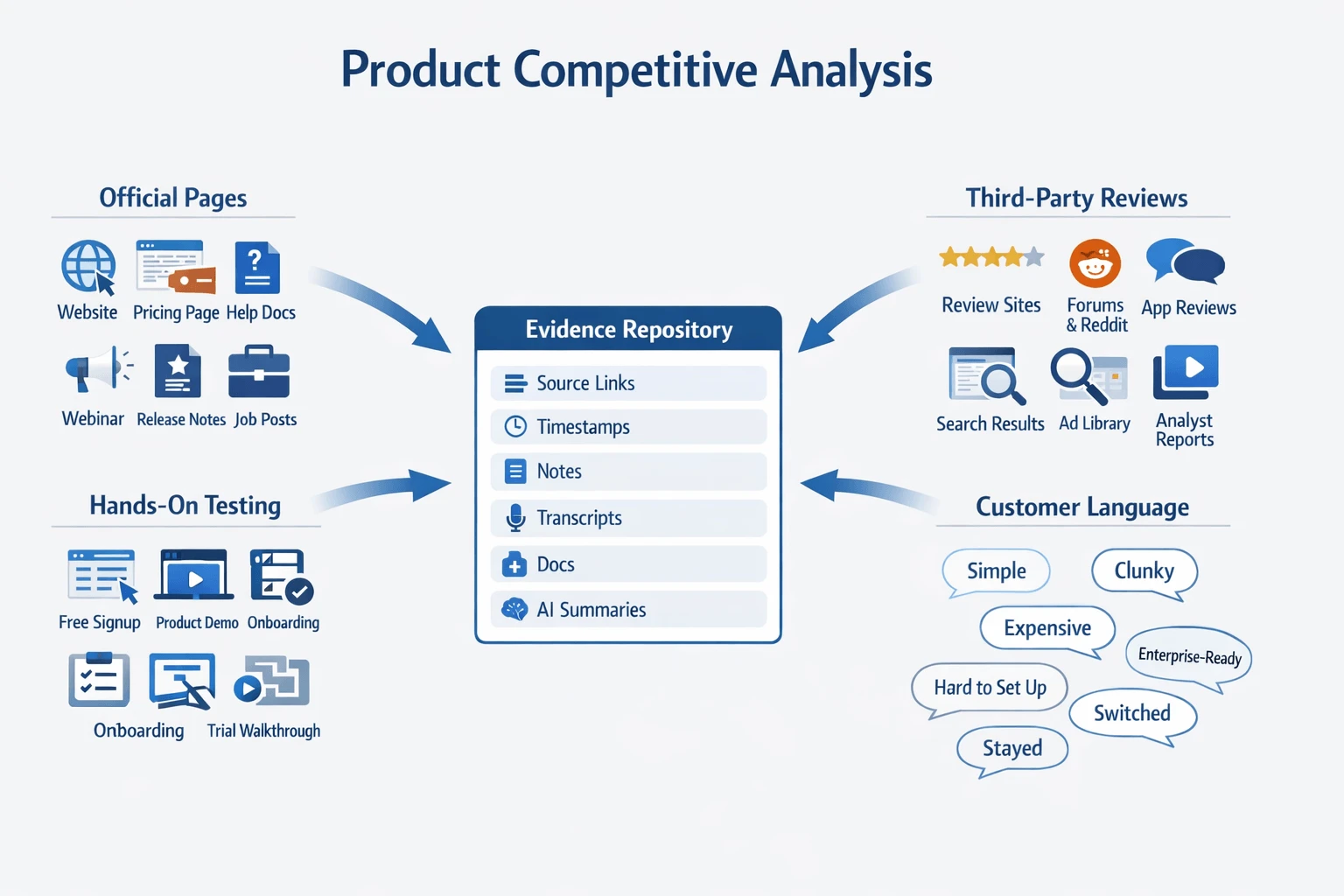
A strong product competitive analysis starts with evidence from four places: official company materials, hands-on testing, third-party sources, and customer language. When you combine all four, you get a clearer view of what a competitor says, what the product actually does, how the market reacts, and why users switch, stay, or complain.
Review official sources first
Start with assets the company controls. These pages reveal positioning, pricing logic, product maturity, and strategic direction:
- Website homepage and product pages
- Pricing pages and plan limits
- Help docs and knowledge bases
- Release notes or changelogs
- Webinars, product tours, and demo videos
- Job posts and hiring pages
A pricing page shows monetization. Help docs show complexity. Changelogs show shipping speed. Job posts often reveal strategic bets, such as enterprise expansion, AI investment, or new integrations.
Test the product yourself
Next, run a hands-on competitor product analysis. Sign up for the free plan, request a demo, or walk through the trial and onboarding flow. This is where you spot time to value, hidden setup friction, and the activation moment (the point where the product first delivers value).
Track what happens in the first 5, 10, and 30 minutes. Note what is easy, what feels clunky, and what is blocked behind sales calls or upgrades.
Use third-party signals to balance the story
Official pages never tell the full story. Add external evidence from:
- G2 and Capterra reviews
- Reddit and niche communities
- App store reviews
- Search engine results pages
- Ad libraries and paid search copy
- Analyst pages or market overviews
These sources show the gap between brand messaging and customer perception. They also help validate a competitor feature comparison with patterns, not just claims.
Capture emotional drivers, not just features
The best competitive product analysis tracks repeated words and phrases. Watch for terms like "simple," "expensive," "enterprise-ready," "hard to set up," or "clunky." Also log why customers switch, why they stay, and what keeps coming up in complaints.
For every finding, save the source link, timestamp, and a short note so each claim stays verifiable. TicNote Cloud is useful here because teams can store review excerpts, transcripts, call notes, uploaded docs, and AI summaries in one Project, which makes it easier to defend a score later or refresh the analysis without starting over.
How do you turn competitor product analysis into roadmap decisions?
A product competitive analysis only matters when it changes what your team does next. The goal is not to collect more notes. It's to turn evidence into clear bets, owners, and measures of success. If you need a format for sharing decisions, this guide on turning research into action plans can help.
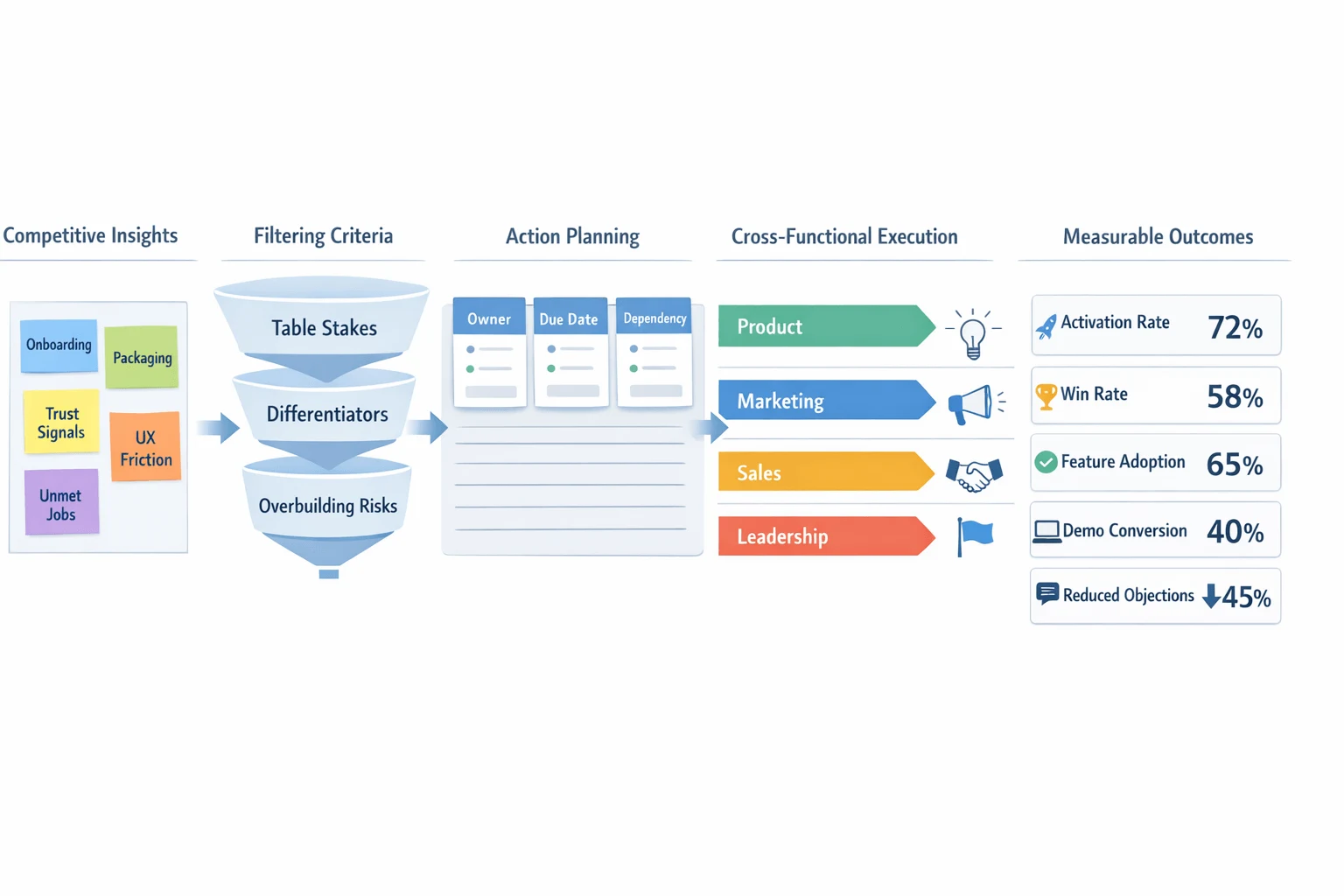
Find patterns, not isolated feature gaps
Start with clusters, not single requests. If three competitors reduce friction in onboarding, explain pricing better, and show stronger trust signals, that pattern matters more than one missing feature on your roadmap.
Look for repeated themes such as:
- onboarding drop-off points
- weak packaging or confusing pricing
- missing trust elements like proof, security, or case studies
- UX friction in core flows
- unmet jobs to be done (the real task users hire the product to solve)
Then separate table stakes from differentiators:
- Table stakes are features buyers expect to see.
- Differentiators create a reason to switch or buy.
- Overbuilding is a risk when a competitor feature adds complexity but little customer value.
Assign owners, timelines, and measurable KPIs
Every insight should become one action. That action needs four fields:
- accountable owner
- due date
- dependency note
- KPI
Useful KPIs include activation rate, win rate, feature adoption, demo conversion, or lower objection frequency. This turns competitor product analysis into operating work, not a slide deck that dies after the meeting.
Align teams around trade-offs
Different teams own different responses:
- Product owns feature, UX, or packaging changes.
- Marketing sharpens positioning and proof.
- Sales updates battlecards and objection handling.
- Leadership decides which trade-offs fit strategy.
Present findings as options with evidence, confidence, and likely impact. Don't drop a long research dump on the room. A strong competitor feature comparison becomes valuable only when it changes roadmap priorities, messaging, or go-to-market choices in a measurable way.
How to generate a competitive research report and matrix step by step
This workflow uses TicNote Cloud as the example, but the process works for any team that needs a repeatable product competitive analysis system. The goal is simple: collect public evidence, keep it organized in one place, and turn it into a report your team can review, edit, and use in roadmap discussions.
Start with one project for one market
On the Web platform, begin by creating a Project for the market, segment, or product line you want to study. Keeping one analysis inside one project matters because research compounds over time. New files, notes, and outputs stay connected instead of getting buried across docs and chat threads.
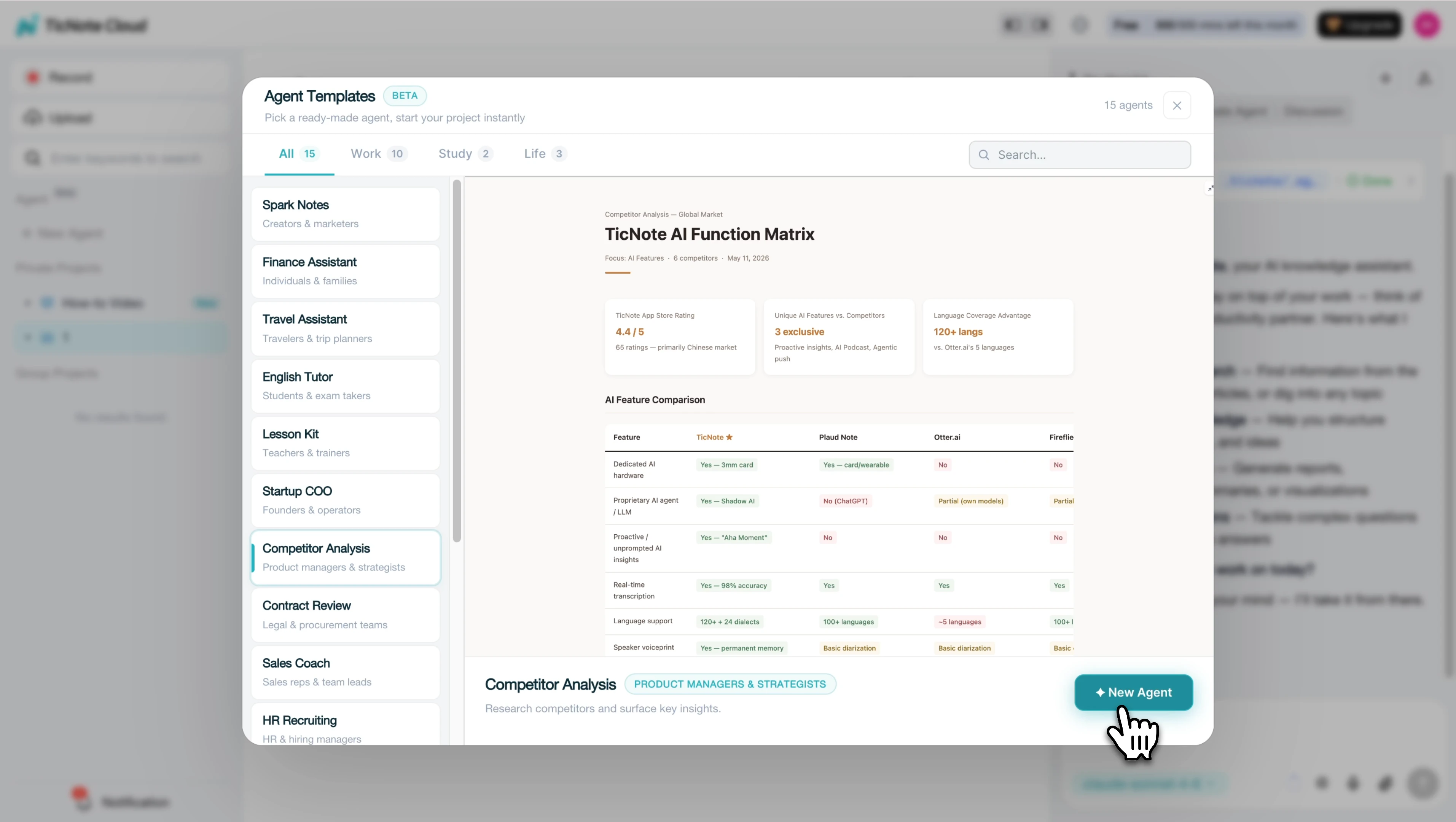
First, add the Competitor Analysis skill agent from the agent library.
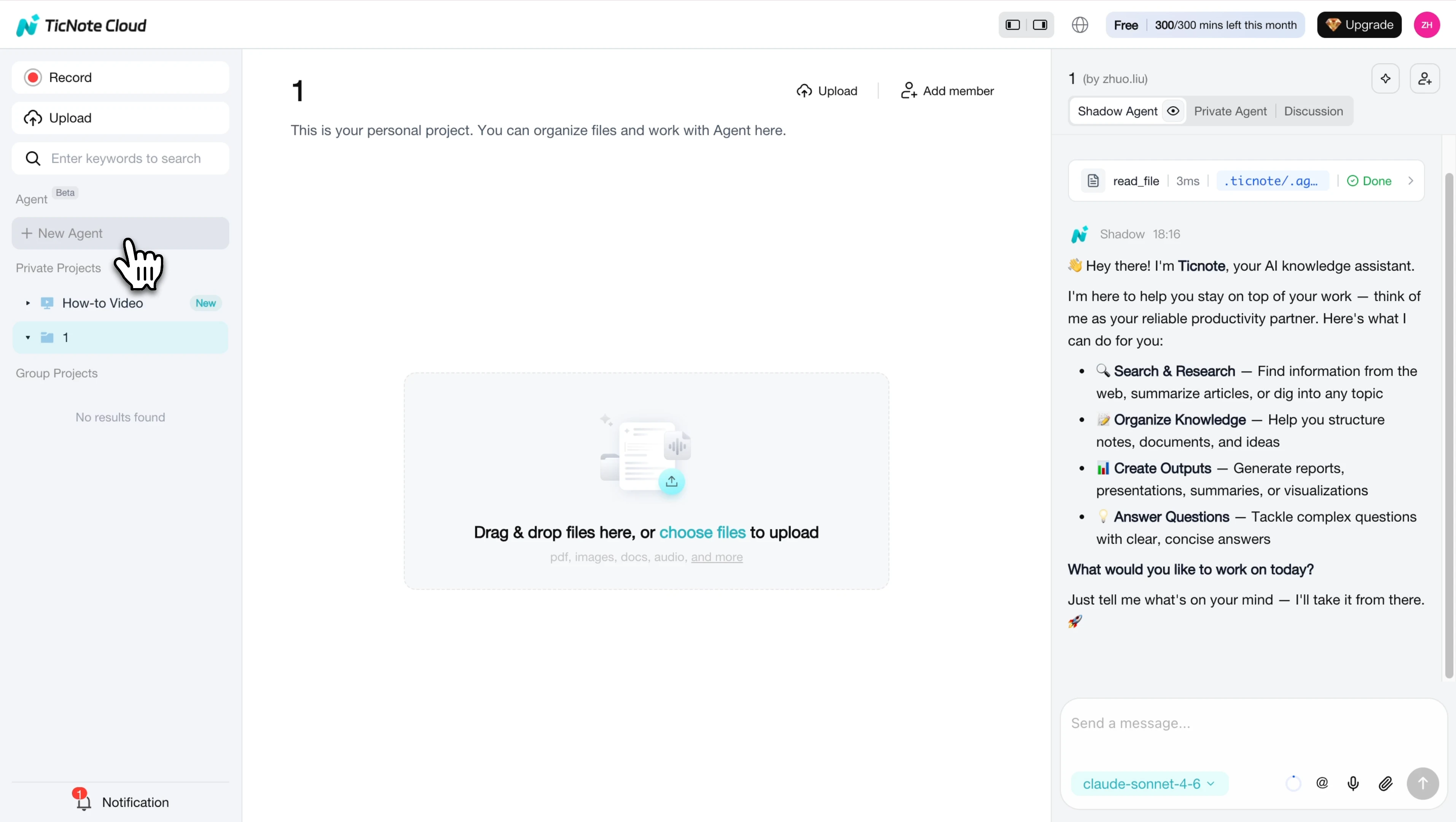
Once it's available in your workspace, select it and move into setup.
Define the analysis scope clearly
Next, enter the niche or industry, your target location, and five to ten competitor names or URLs. That gives the system a clean comparison set and reduces noisy results.
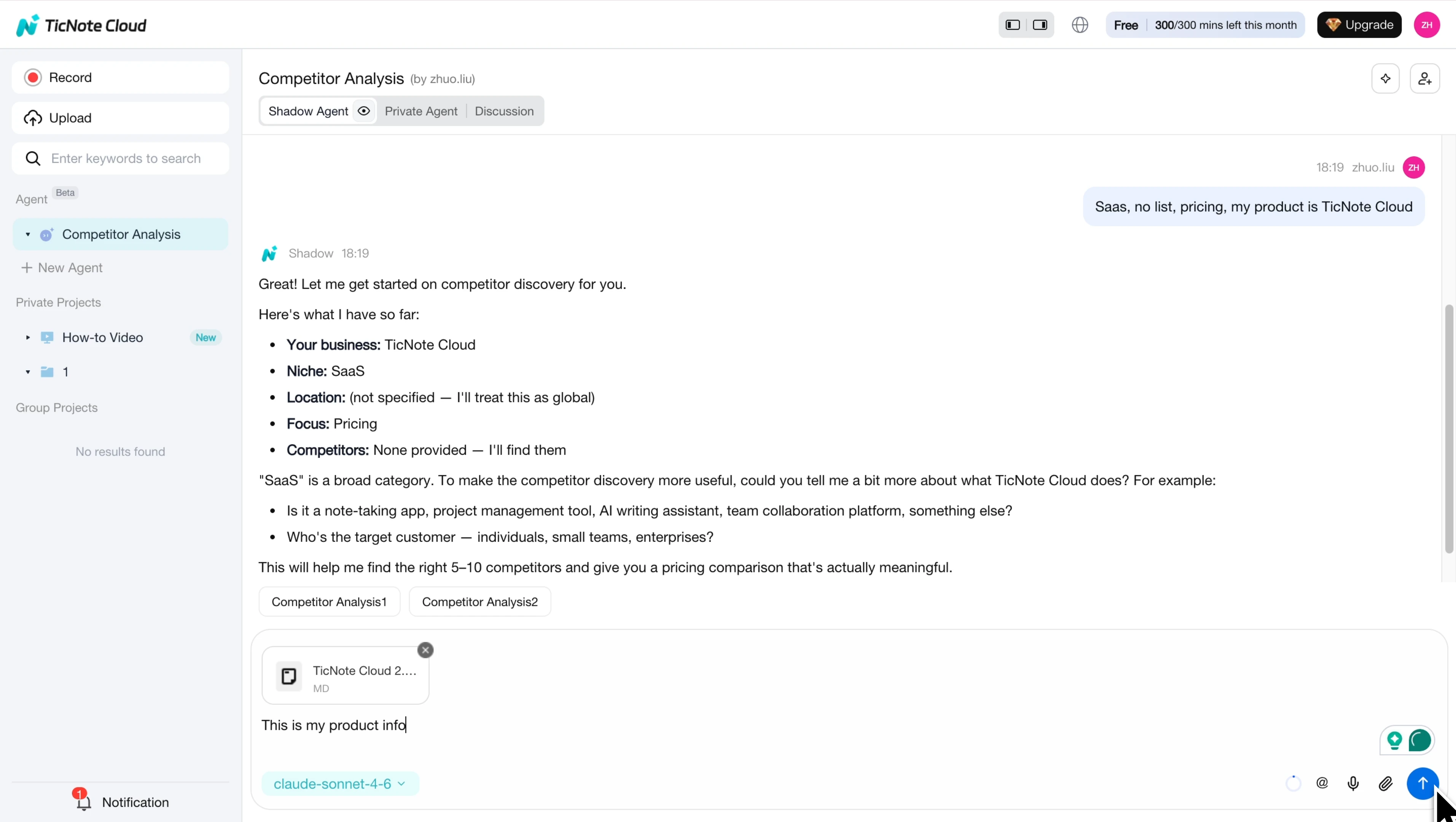
You can also narrow the brief with a focus area, such as:
- pricing
- customer reviews
- social media presence
- product range
That one choice keeps the competitor product analysis tied to the decision you actually need to make.
Review the outputs and turn them into briefs
After processing, the agent returns a structured report and a visual HTML competitor feature matrix. The written file typically includes an executive summary, comparison table, competitor profiles, market gaps, and recommended actions.
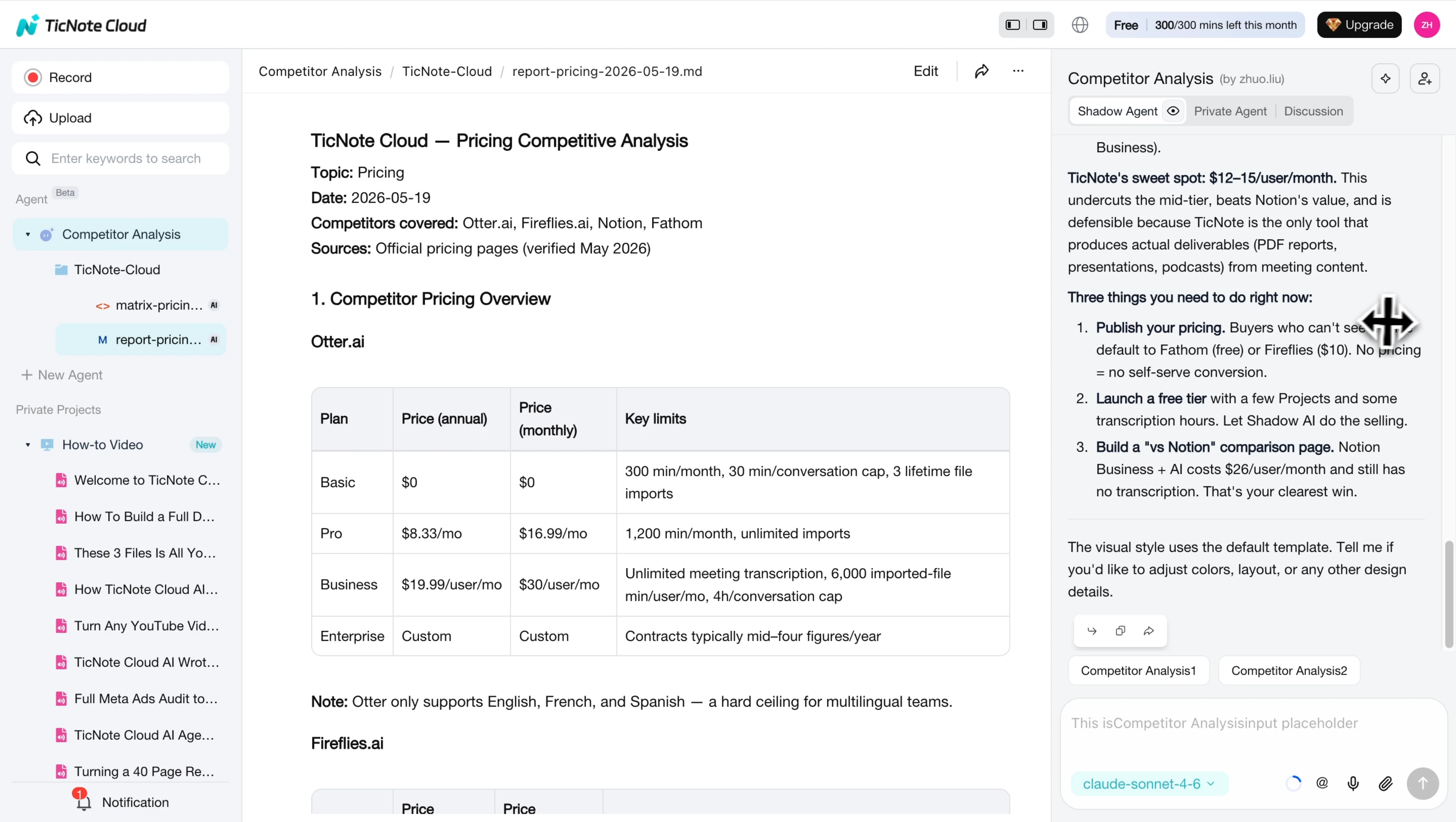
Open the report to check claims, refine wording, and align the conclusions with your team's priorities. Because the content is editable, you're not stuck with static exports. Cited AI outputs also make verification easier when someone asks, "Where did this come from?"
Then review the visual matrix for faster discussion in meetings.
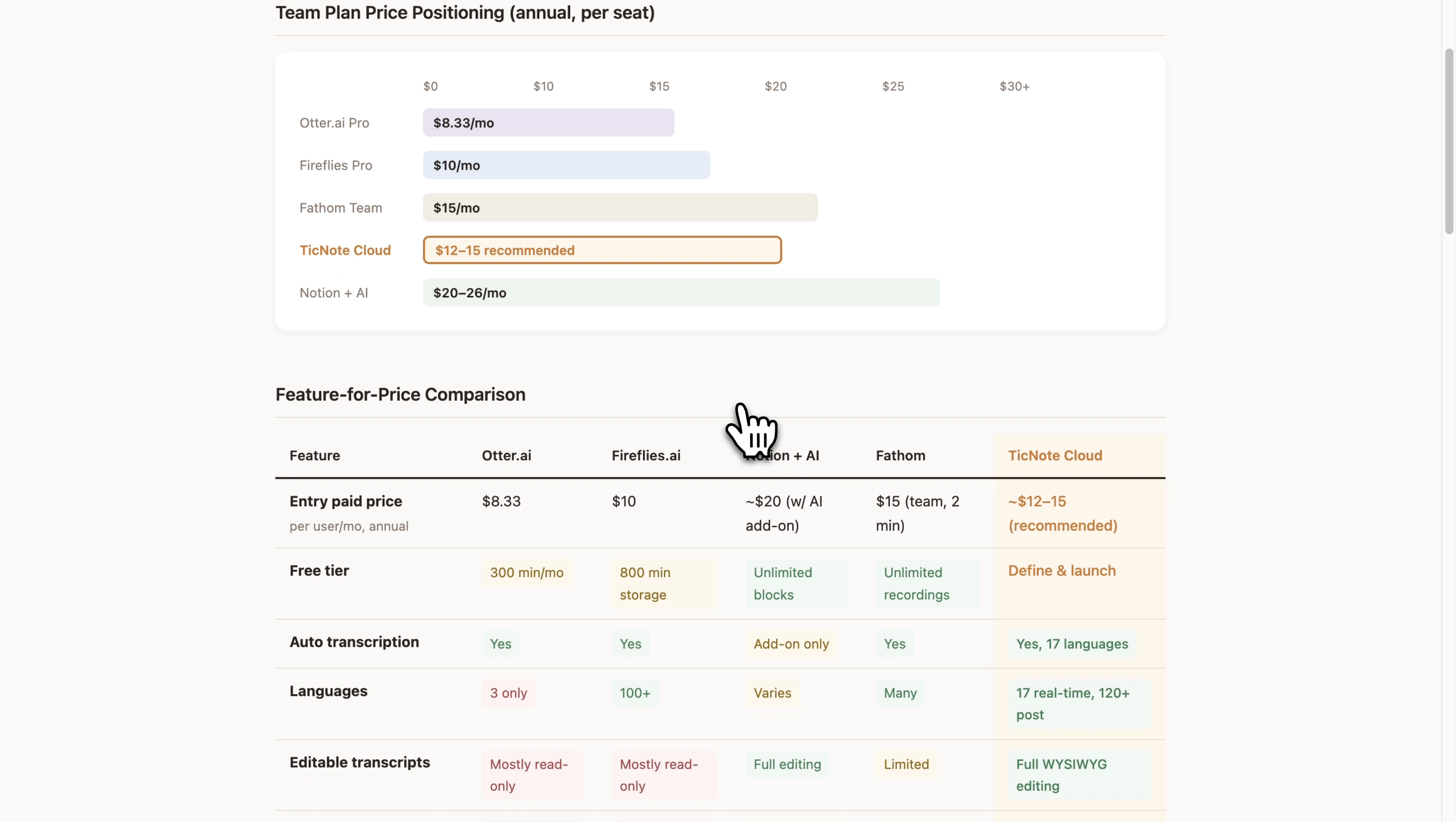
This is where teams can turn findings into a shareable brief for leadership, product, or marketing. If you want more ideas on setup, this guide to free competitor analysis tools is a useful next read. The mobile App works well for light capture or quick review, but Web is the main place to build and generate the full report.
A system like this works best when your team wants evidence, organization, and one-click outputs instead of scattered notes and separate AI tools.
Try TicNote Cloud for free and generate your first competitive research report in minutes.
Final thoughts
A strong product competitive analysis works best when it becomes a team habit, not a one-time deck. Start with the decision you need to make. Then keep your competitor set tight, use a weighted competitor feature comparison template, collect proof from multiple sources, and turn findings into owners, timelines, and KPIs.
That approach helps you avoid the trap of copying rivals or chasing feature parity. Instead, you learn what buyers actually compare, where the market is moving, and how your team should respond with sharper product choices and clearer positioning. If you want a simple way to build a repeatable competitive intelligence process, TicNote Cloud can help you capture evidence, maintain a living competitor feature matrix, and share reports from one workspace.
Try TicNote Cloud for Free to keep your competitive research organized and shareable.