


 Extension
TL;DR
A meeting coach helps you improve how you show up in meetings: your communication patterns, facilitation skills, and leadership presence. Traditional meeting coaching means hiring a professional at $150 to $500 per hour. But AI is creating a new category: tools that read your meeting transcript and give you behavioral analysis instantly.
Try TicNote Cloud for Free and add the Meeting Personality Test skill to get a full behavioral report from any meeting recording.
Human meeting coaches are expensive, scheduling is a hassle, and feedback comes days after the meeting. AI meeting coaching gives you immediate, transcript-based analysis whenever you want it. Try TicNote Cloud for Free and run your first AI-powered meeting personality analysis today.
What Is a Meeting Coach and What Do They Actually Do?
A meeting coach is a professional who helps you improve how you communicate and perform in meeting settings. Unlike a general executive coach, a meeting coach focuses specifically on what happens inside the room: your talk patterns, facilitation style, question quality, and how you handle group dynamics.
The Core Role of a Meeting Coach
The fundamental job is observation and feedback. A meeting coach watches you in real meetings, either live or via recording, and identifies the behavioral patterns you can't see from the inside.
You may know you talk a lot in meetings. A meeting coach can tell you exactly how much, which moments triggered it, and how your colleagues responded each time. That specificity is what turns vague feedback into actionable change.
Most meeting coaches work on a short list of recurring problems: reducing over-talking or chronic under-participation, improving facilitation so discussions stay on track without the leader dominating, building executive presence for high-stakes presentations, and handling pushback without either caving or escalating.
The overlap between meeting coaching and AI meeting assistant tools is growing. Both aim to surface what's actually happening in your meetings, rather than what you remember happening.
What Meeting Coaches Typically Work On
A session with a meeting coach usually starts by reviewing a recording together. The coach narrates what they observe: who spoke first, who deferred, how your tone shifted when challenged, and what body language signaled about your engagement.
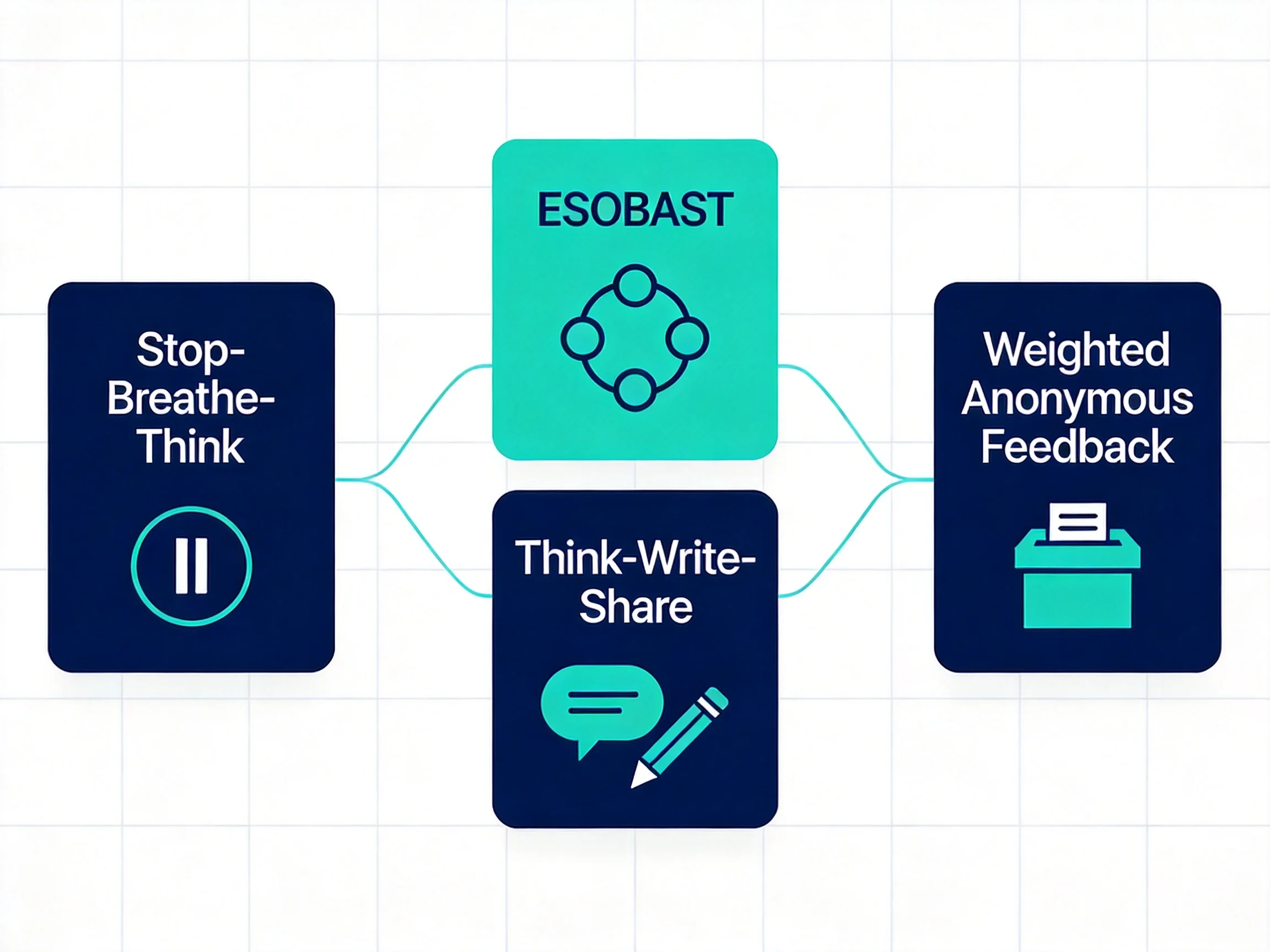
From there, the coaching turns practical. Techniques like Stop-Breathe-Think, ESOBAST (Everyone Speaks Once Before Anyone Speaks Twice), and Think-Write-Share are common tools. The goal is to replace unconscious habits with intentional choices.
The Traditional Model: What It Costs and What It Misses
Most meeting coaches charge per session and require scheduling weeks in advance. By the time you sit down to review a meeting, the specifics have faded. You're working from impressions, not evidence. And measuring improvement is difficult: progress is subjective, slow, and dependent on your coach's ability to observe you across a meaningful sample of meetings.
That's not a criticism of the approach. It's the honest trade-off of any human-led coaching: high quality, high cost, low frequency.
Who Needs a Meeting Coach?
Not everyone needs formal meeting coaching. But a surprisingly large number of professionals would benefit from it , they just don't know it yet, because nobody tells them.
Professionals Who Benefit Most
New managers are the most obvious group. The transition from individual contributor to team leader changes everything about how you show up in meetings: you're now responsible for the energy and direction of the group, not just your own contribution. Most people get no training for this shift.
Executives preparing for board presentations, investor meetings, or all-hands sessions have a different need: they know how to perform, but they want to refine the edges. A meeting coach helps them close the gap between competent and commanding.
Team leads who want to run more inclusive meetings also benefit significantly. If the same three people speak in every meeting while the rest disengage, that's a facilitation problem, and it's fixable.
Finally, anyone who has received vague feedback like "you talk too much" or "you need to speak up more" needs coaching. Not because the feedback is wrong, but because without specifics, it's nearly impossible to act on.
Signs You Could Use Meeting Coaching
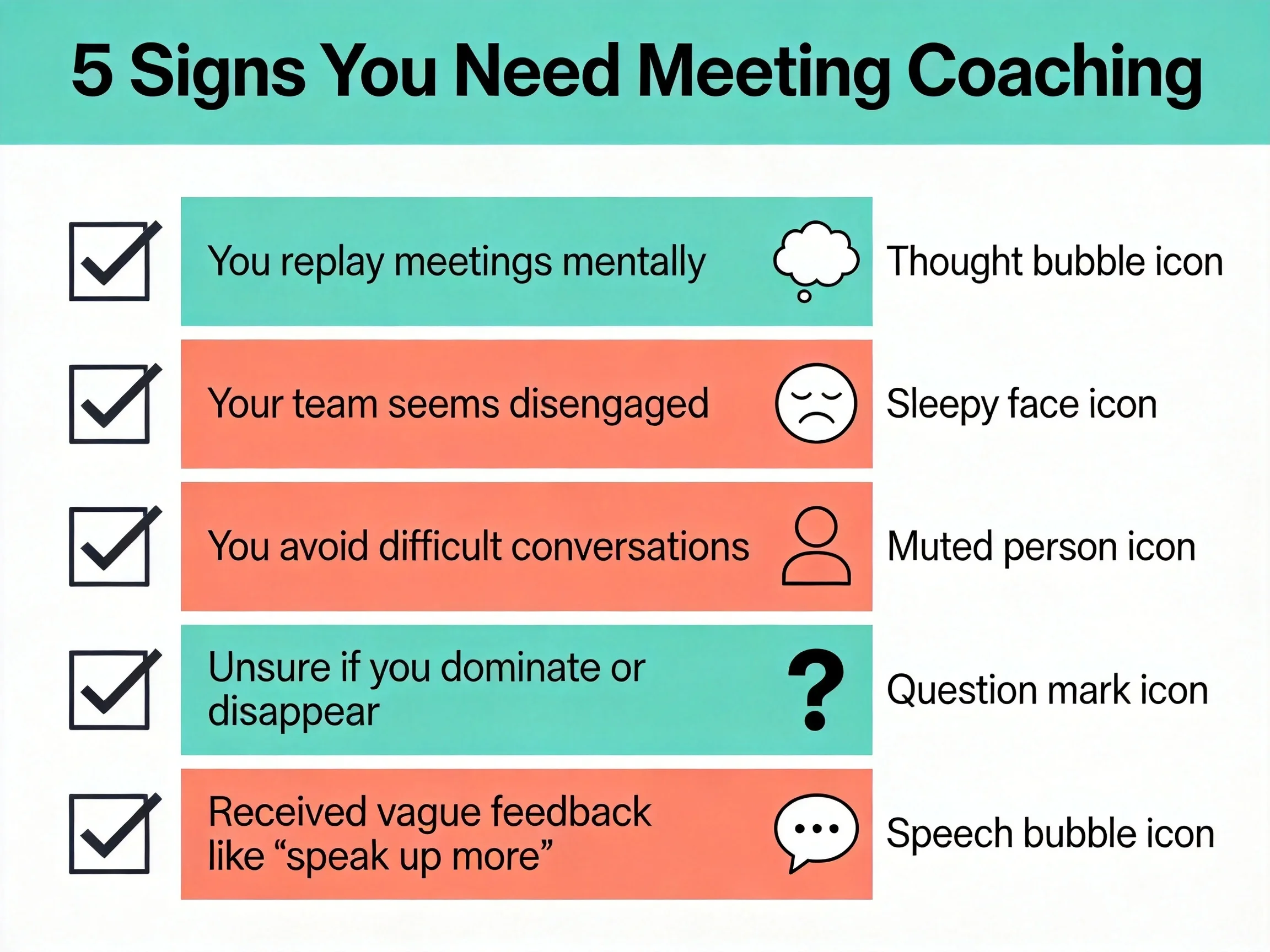
- You replay meetings afterward thinking "I should have said that differently"
- Your team seems disengaged during meetings you lead
- You avoid difficult conversations or let issues slide rather than address them live
- You're genuinely unsure whether you dominate or disappear in group settings
- You've been told your communication style is "strong" in a way that felt more like a warning than a compliment
Traditional Meeting Coaching vs AI Meeting Coaching
Both approaches aim for the same outcome: better meeting behavior. But they get there differently, and they're best suited to different situations.
Human Meeting Coach
A human coach brings genuine advantages. The relationship is personal, the feedback is contextualized, and a skilled coach can adapt to nuances that no algorithm captures: your industry, your team culture, your career trajectory.
The trade-offs are real:
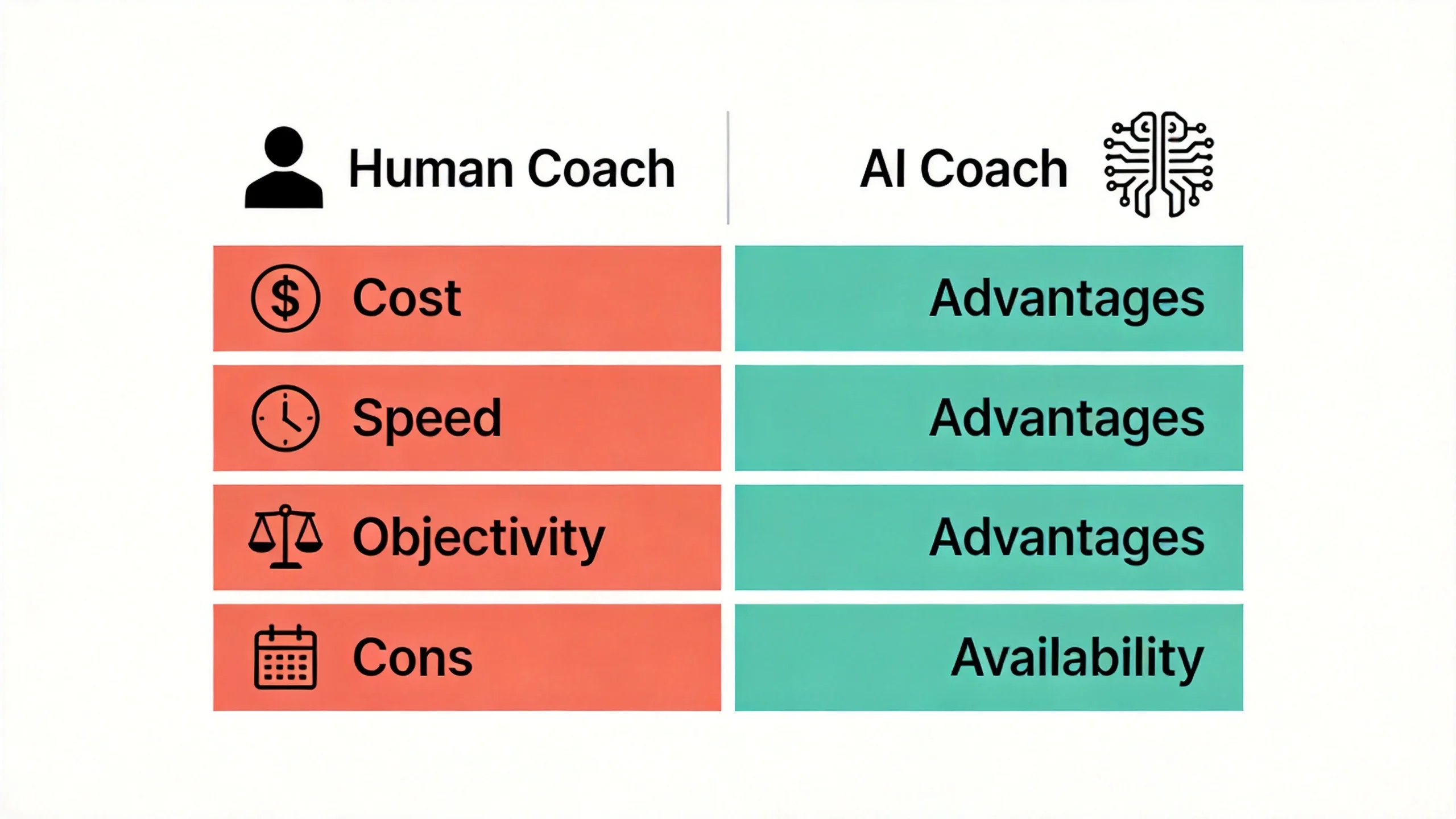
| Dimension | Human Coach | AI Coach |
| Cost | $150-500/hr | Free to low cost |
| Turnaround | Days to weeks | Minutes |
| Objectivity | Subjective | Data-driven |
| Availability | Scheduled only | On-demand |
| Evidence | Memory and notes | Transcript-based |
AI Meeting Coach
AI meeting coaching tools analyze your actual transcript and return behavioral metrics: talk share, interruption frequency, tone patterns, and engagement dynamics. There's no memory filter, no politeness softening, and no scheduling delay.
The limitation is equally clear: AI doesn't offer career guidance, doesn't understand your company politics, and can't help you navigate the emotional texture of a difficult relationship with a colleague.
When to Use Each
Use AI for frequent, objective check-ins on your meeting patterns. It's especially useful when you want to track improvement over time, measure the effect of a new technique, or get a baseline before starting human coaching.
Use a human coach for deep career transitions, developing leadership presence, and navigating interpersonal dynamics that require judgment and experience.
The most effective approach combines both. Use AI data to identify patterns, then bring specific insights to your human coaching sessions. Instead of arriving with "I think I talk too much," you arrive with "my talk share was 58% in my last three team meetings."
Start with a Personality Test
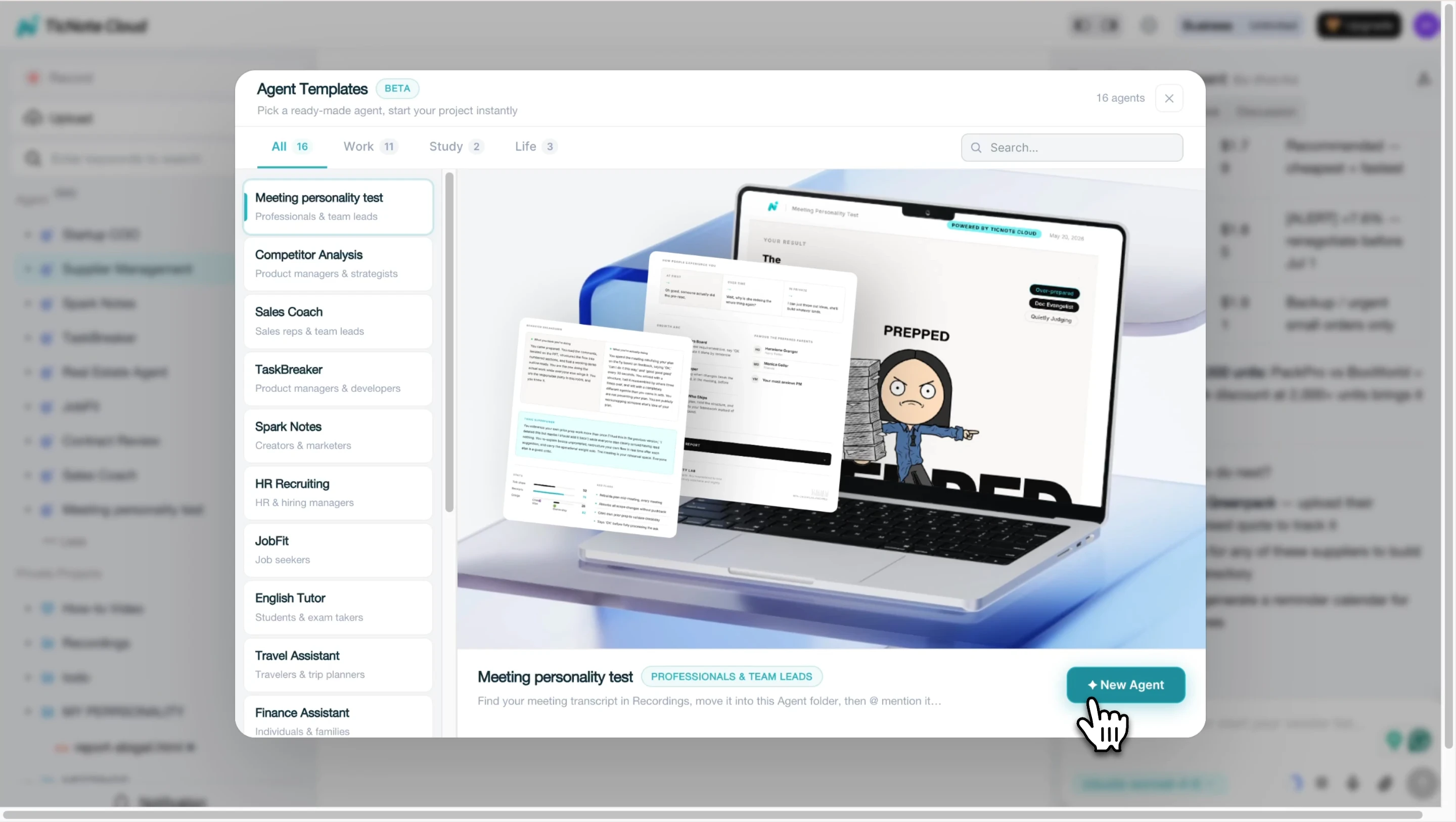
TicNote Cloud's Meeting Personality Test skill reads your meeting transcript and generates a full personality archetype report: your behavioral metrics, your patterns, your blind spots, and your "toxic superpower." Here's how to use it.
Step 1. Open TicNote Cloud, click "Add Agent," and browse the Skill Agent library. Select the Meeting Personality Test skill to add it to your workspace. No configuration is needed.
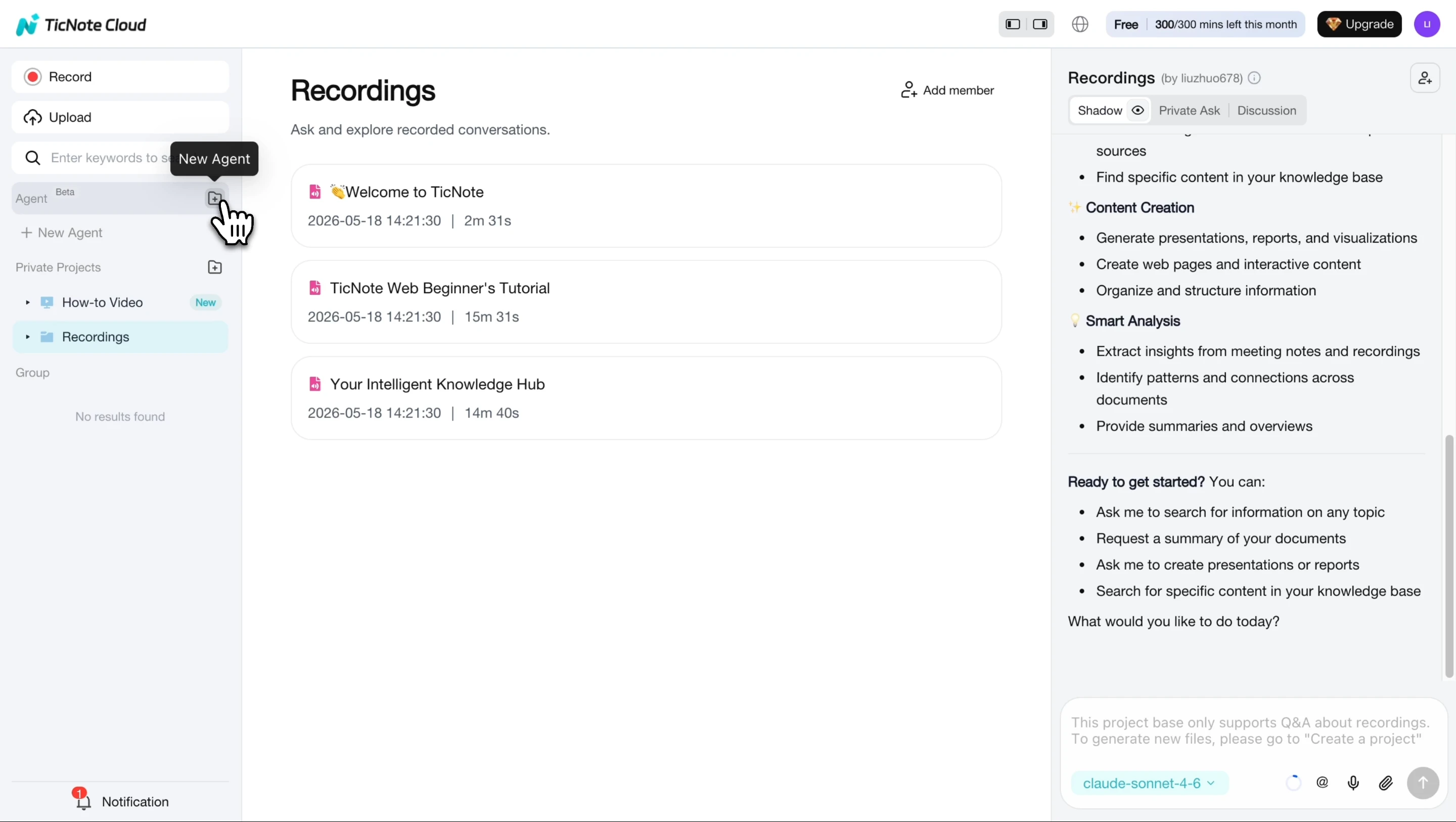
Once added, the skill appears in your agent list and is ready to use immediately.
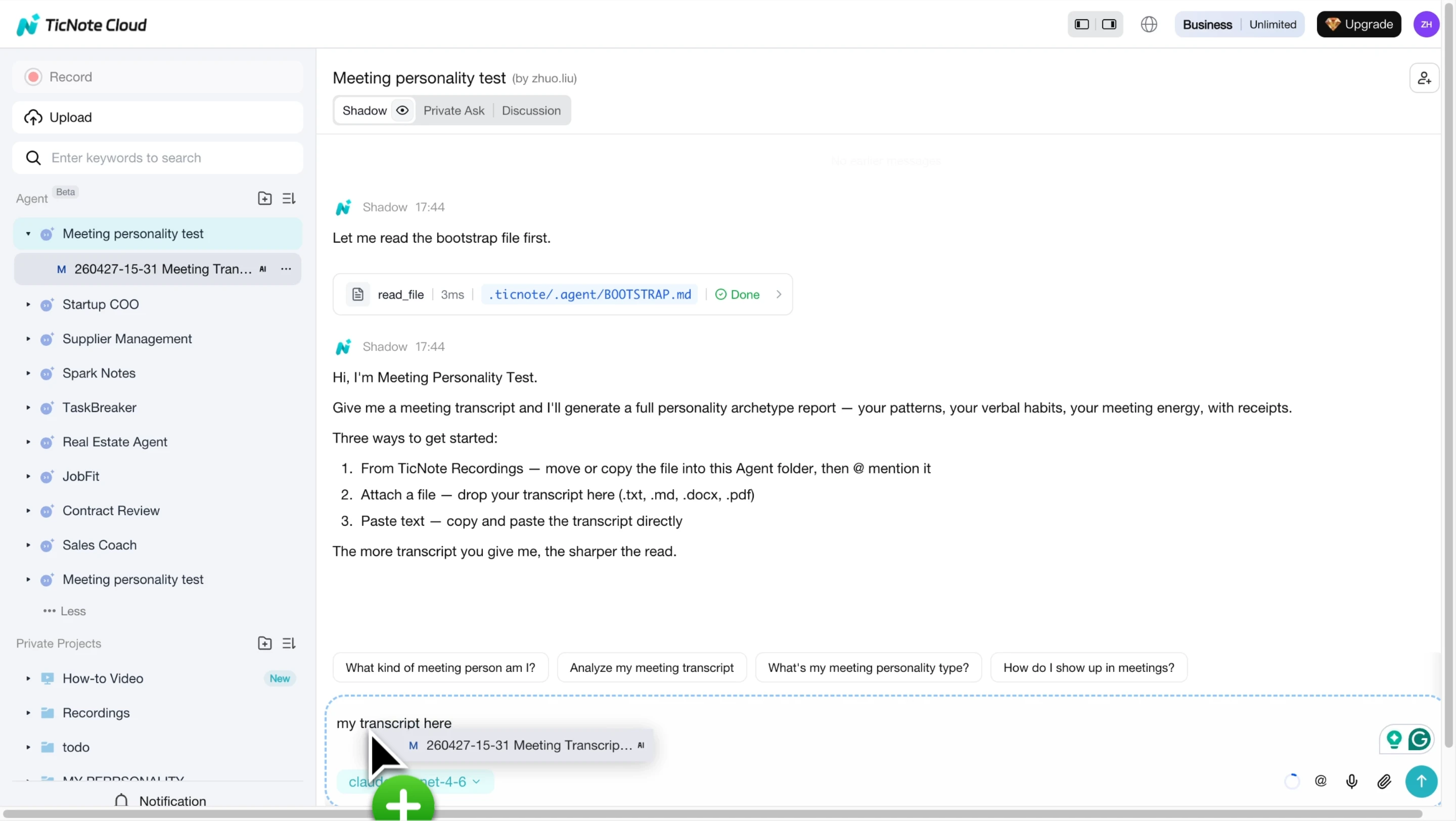
Step 2. Attach a meeting recording, audio file, or transcript to the chat. Tell the skill the names and genders of the participants so it can attribute behaviors accurately. The more content you provide, the sharper the analysis.
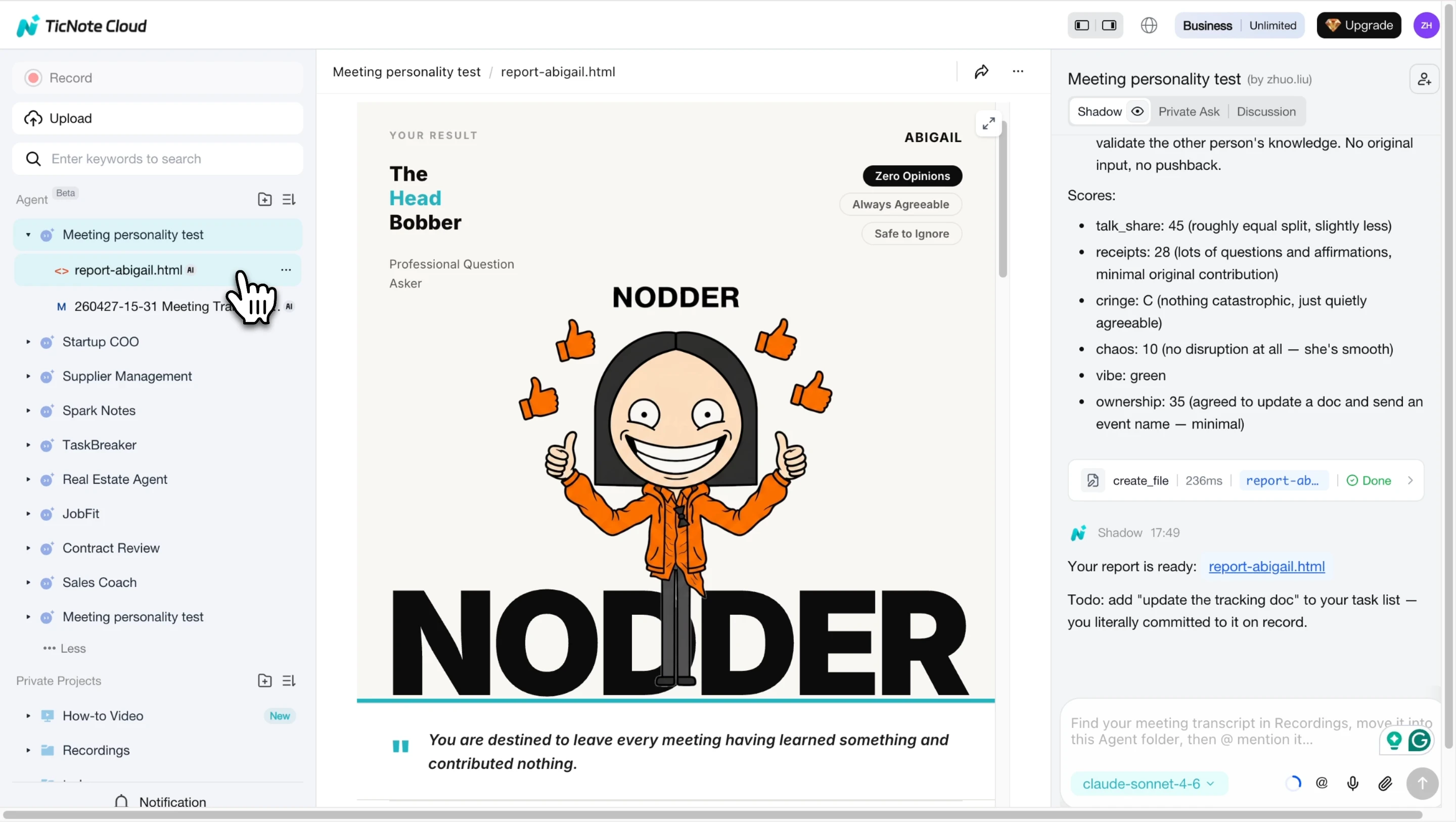
Step 3. The skill generates an HTML report naming your personality archetype. Open it to see your archetype title, mascot illustration, and tag labels summarizing your meeting presence at a glance.
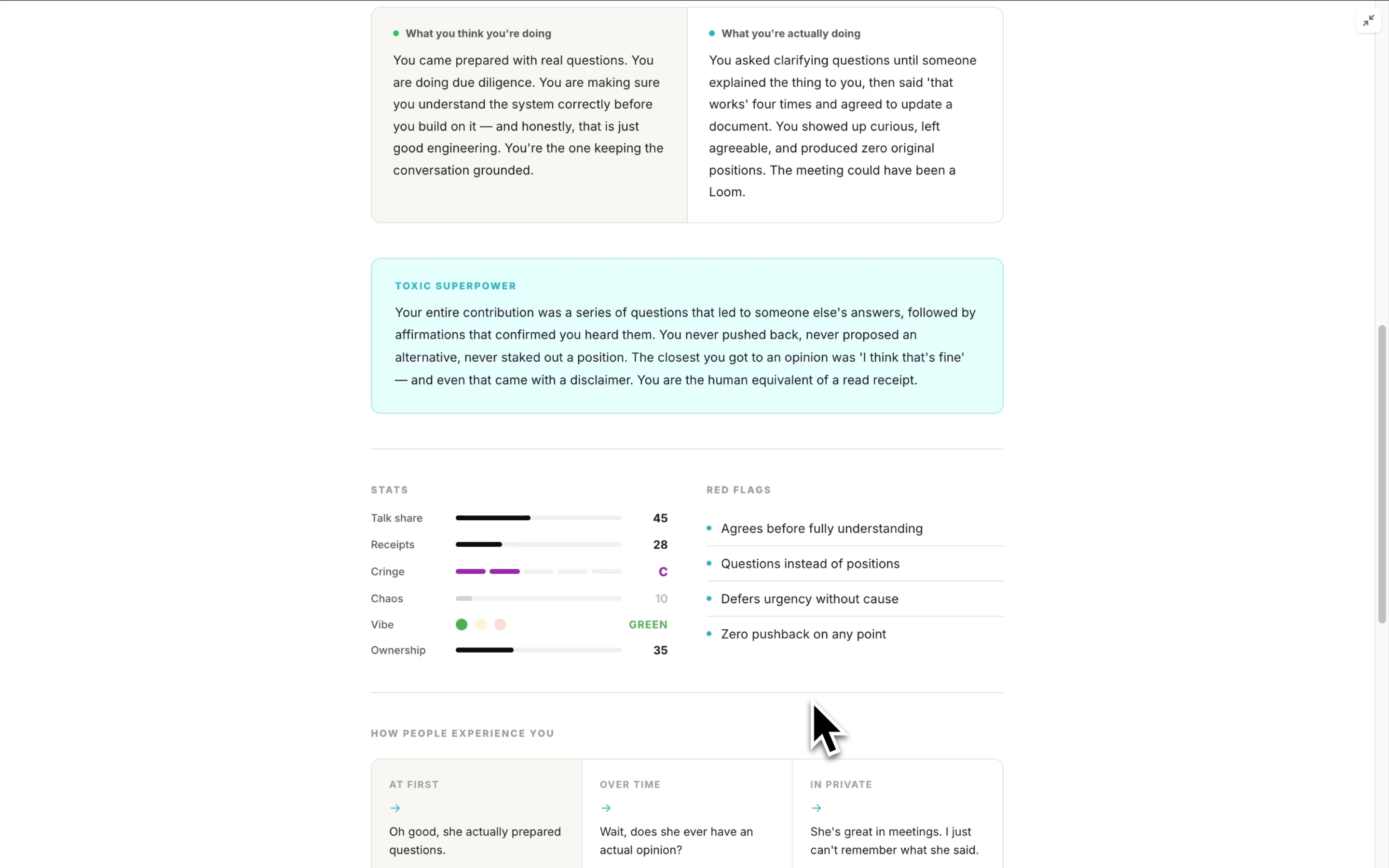
Step 4. Scroll through the full report for your behavior stats, toxic superpower, red flag checklist, and how people experience you across three timeframes. Every finding is grounded in specific transcript moments, not generic feedback.
For teams that use structured project documents and templates, TicNote Cloud keeps your personality analyses organized alongside everything else in your workspace.
Generate your first report from a meeting in minutes
Key Meeting Coaching Techniques You Can Start Using Today
You don't need to wait for a coaching session to start improving. These four techniques come from professional meeting coaches and are directly applicable to your next meeting.
Stop-Breathe-Think
Before responding to anything in a meeting, pause for one to two seconds. Breathe. Then respond. This simple habit breaks the reactive loop that leads to interrupting, over-explaining, or saying something you'll want to take back. It's most useful in high-pressure moments when a colleague challenges your idea or the conversation starts to go sideways.
ESOBAST (Everyone Speaks Once Before Anyone Speaks Twice)
This facilitation rule ensures that every voice is heard before anyone adds a second comment. As a team lead, enforce it explicitly: "Let's hear from everyone before we go back for seconds." It reduces the natural tendency for extroverts and senior voices to dominate and gives quieter team members a structured opening to contribute.
Think-Write-Share
Before opening any discussion, give participants two to three minutes to privately write down their thoughts. Then invite sharing. This levels the playing field between extroverts, who process out loud, and introverts, who need time to formulate. It also produces better ideas, since people are sharing their considered view rather than their first reaction.
Weighted Anonymous Feedback
Use anonymous voting tools to surface honest opinions on contested decisions. When people vote without knowing who else voted, the outcome reflects genuine preferences rather than social pressure. The best ideas win, not the loudest voices.
Track Progress with Data
These techniques only work if you measure their effect. Run TicNote Cloud's Meeting Personality Test on recordings before and after you start practicing. Watch for changes in your talk share percentage, interruption count, and vibe score. Improvement becomes visible before anyone thinks to tell you about it.
Conclusion
A meeting coach helps you see what you can't see about yourself. You don't need to hire one at $300 an hour to get started. Upload a meeting recording to TicNote Cloud, run the Meeting Personality Test, and get your first behavioral report in minutes. The data is waiting in your transcripts. Use it.
See how others use structured performance tools to build accountability into regular workflows.