


 Extension
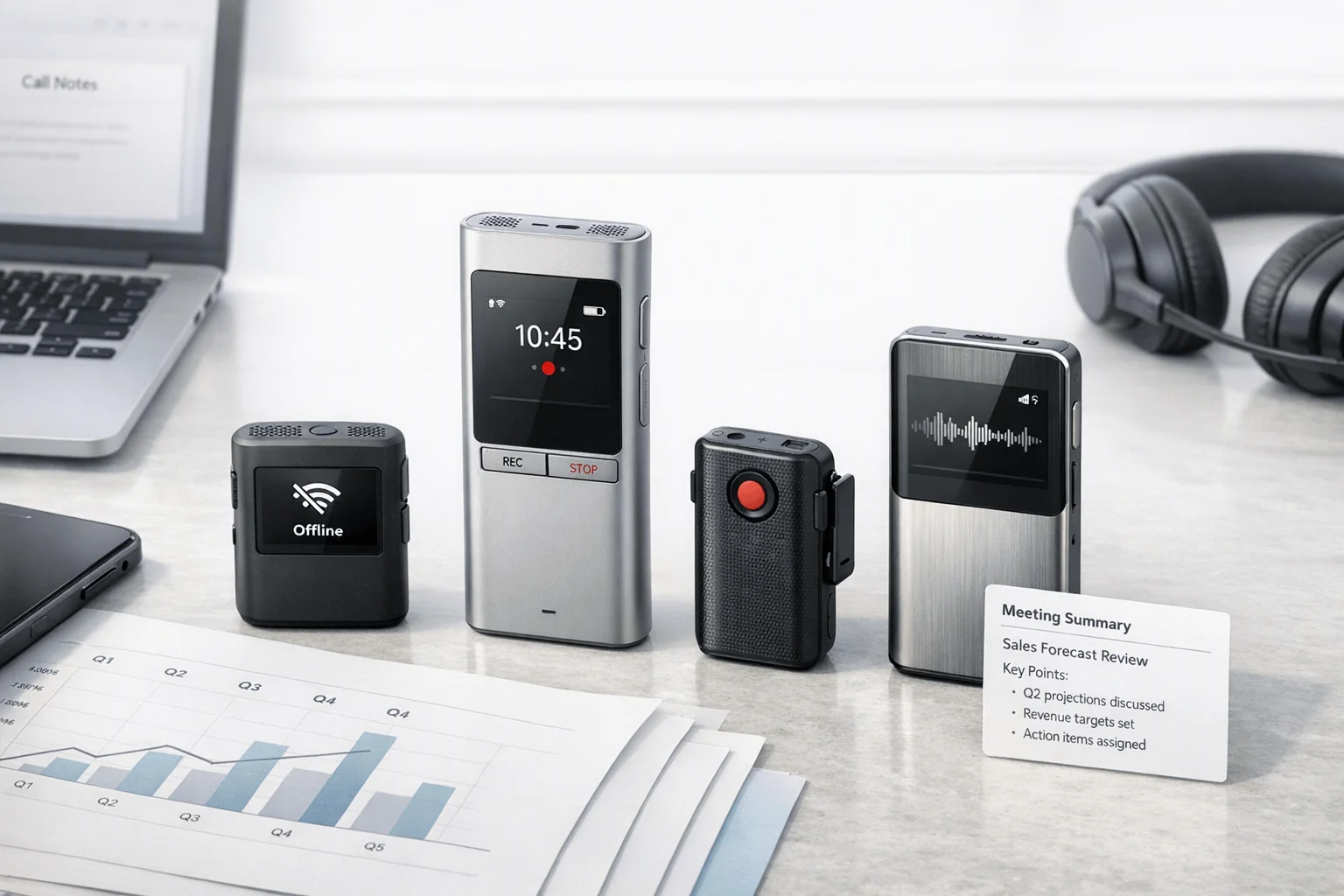
TL;DR: Best Voice Recorders and AI Note Takers for Forecast Calls
If forecast truth shows up in hallway chats, rep 1:1s, and phone updates, the best AI note taker for forecast call workflows is a dedicated capture tool first, not just meeting software; that's why many teams later decide to see the TicNote after comparing options. In testing, Gong is best for forecast intelligence in formal virtual reviews, Chorus by ZoomInfo fits enterprise RevOps teams that need wider pipeline and competitive context, Fireflies.ai works for lighter CRM-ready notes, and Otter.ai is the budget pick for simple transcription.
The key lesson is simple: separate capture quality from forecast intelligence. A tool can be strong at dashboards and still miss the informal conversations where deal risk, next steps, and real commit changes actually get said. TicNote stands out when those moments happen offline, on phone calls, in person, or while traveling.
- Best for formal virtual forecast reviews: Gong
- Best for enterprise RevOps context: Chorus by ZoomInfo
- Best for lightweight workflow notes: Fireflies.ai
- Best low-cost transcription option: Otter.ai
- Best for offline and hybrid forecast capture: TicNote
The rest of this guide includes a scoring rubric, comparison table, feature matrix, compliance checklist, and direct use-case recommendations.
What makes an AI note taker for forecast call workflows actually useful?
A useful AI note taker for forecast call work does more than turn speech into text. Forecast calls are accountability conversations where reps make verbal commitments on deal amount, close date, stage, risk, and next step. A raw transcript creates a record, but it does not tell you if a deal slipped from March to April, if a 240K commit became a 200K best case, or if the CRM matches what the rep actually said.
That gap matters because forecast reviews drive coaching, board prep, and weekly inspection. And the cost of messy records is real: Salesforce State of Sales, 6th edition, 2024 found that sales professionals spend only 28 percent of their week actually selling. Sales leaders do not need more notes. They need verifiable history they can trust.
Separate the workflow into three layers
The best way to compare tools is to split the job into three parts:
- Capture quality: Can it record in-person, phone, and online forecast conversations reliably?
- Retrieval quality: Can you search past reviews, rep one-on-ones, and deal updates fast?
- Forecast intelligence: Can it surface commitment changes, risk language, competitor mentions, and patterns over time?
This is why a voice recorder for forecast calls can complement a revenue intelligence platform instead of replacing it. TicNote is strongest in the first two layers for hybrid teams, especially when forecast truth gets spoken in hallways, cars, field meetings, or phone calls that never touch Zoom.
Use a rubric that matches forecast reality
This review scores products with a simple weighted rubric:
- capture coverage
- number and commitment accuracy
- change tracking over time
- CRM readiness
- admin burden
- multilingual support
- governance and privacy
Later sections include a normalized scoring chart and a workflow view of formal versus informal forecast conversations. That is the only fair way to compare transcript tools, meeting bots, and dedicated recorders in one buying guide.
How this review compares the top tools fairly
A useful review of an AI note taker for forecast call work can't focus only on Zoom summaries. Forecast truth often shows up in rep 1:1s, hallway updates, customer phone calls, and last-minute board-prep discussions. So this framework tests both software platforms and dedicated recorders, because that mix better reflects how sales leaders actually work in the field.
Test real forecast moments, not just scheduled meetings
We compare tools across four common scenarios:
- weekly pipeline and forecast reviews
- manager-rep forecast check-ins
- executive board-prep conversations
- informal phone-based or in-person deal updates
That matters because a tool can perform well in a calendar-based meeting, then fail when the key update happens offline. We also consider whether a product supports bot-free capture for sensitive conversations, especially in workflows discussed in this guide to bot-free note taking for calls and meetings.
Score capture and intelligence separately
Our scoring does not treat all products as if they solve the same problem. We evaluate:
- accuracy for dollar amounts, dates, and next steps
- retrieval of full deal history across past conversations
- support for phone and meeting transcription
- summary quality and action-item extraction
- CRM-ready notes for forecast reviews
- setup friction and admin effort
- consent, retention, and governance controls
- multilingual support for global teams
Most important, we separate documentation value from forecast intelligence. In plain English: some tools are great at capturing what was said, while others are better at spotting deal risk, pipeline trends, and coaching signals.
Compare hardware and software on their real strengths
Meeting bots and revenue intelligence platforms are usually strongest in scheduled online meetings and structured analytics. Hardware recorders are different. They can cover in-person reviews, mobile calls, and offline moments where no bot can join. That makes devices like TicNote especially relevant for hybrid forecast workflows, while enterprise software may still win when teams need deeper analytics, dashboards, and formal system integrations.
The result is a balanced method, not a one-size-fits-all winner. Each tool is judged in a comparison table and feature matrix based on where forecast truth actually gets spoken.
Best AI note takers and voice recorders for forecast calls
The best AI note taker for forecast call work depends on where forecast truth actually gets said. If your team updates commit risk in Zoom, one class of tool wins. If your managers hear the real story in hallway check-ins, rep 1:1s, car calls, and field conversations, you need reliable capture first and analytics second.
Pick TicNote when forecast updates happen beyond scheduled meetings
TicNote is the best fit here for offline, phone, and hybrid forecast workflows. That matters because many forecast reviews do not happen in clean virtual meetings. They happen before the QBR, after a customer visit, during a manager ride-along, or in a quick phone debrief between meetings.
In buyer terms, the lineup is easy to map:
- TicNote Card fits leaders who want a wallet-size recorder for in-person reviews, hallway updates, and executive prep.
- TicNote Card Lite is the simpler, lower-cost option for teams that want one-button capture without extra setup.
- TicNote Pods 4G is the strongest option for phone calls and mobile work because it can capture calls while worn, upload without a phone nearby, and deliver live or near-instant summaries.
- TicNote Pods Wi-Fi works well for global teams that want the earbud format and post-sync processing without the 4G dependency.
Across the range, the value is not just recording. It is the full loop: offline capture, transcription, AI summaries, action items, searchable history, multilingual support, and cross-project Q&A across past conversations. For a sales leader, that means you can stop asking, "Did the rep really say legal pushed the close date?" and start retrieving the exact moment.
This is where TicNote stands out versus software-only tools. It works well when forecast updates happen outside Zoom. It is especially useful for:
- hallway forecast updates after customer meetings
- rep 1:1s and coaching reviews
- field conversations and on-site debriefs
- executive prep before board or pipeline meetings
- phone-based deal reviews that never hit a meeting bot
The trade-off is clear: TicNote is not a full revenue intelligence suite. It does not replace Gong-style deal risk scoring, CRM inspection, or large-scale coaching dashboards. It is strongest as a meeting recorder for sales leaders who need dependable evidence from real-world conversations.
If you want a wider hardware comparison before deciding, this voice recorder alternatives guide gives useful context.
Choose Gong for CRM-linked forecast accountability
Gong is the strongest software option for large teams that need forecast verification across a high volume of virtual calls. It is built for longitudinal tracking over time, not just note capture. That means managers can inspect slippage, confidence changes, next-step gaps, and risk signals across accounts and reps.
Its edge is workflow depth. Gong connects conversation data to CRM behavior and pipeline inspection. For enterprise forecast calls, that is powerful.
Its drawbacks are just as clear:
- likely enterprise-level pricing
- more implementation and admin work
- weaker fit for offline, in-person, or phone-side capture outside formal systems
If your forecast process lives inside virtual selling and CRM discipline, Gong is hard to beat. If your truth often surfaces off-platform, it leaves a gap.
Use Chorus when RevOps wants broader GTM context
Chorus by ZoomInfo is strong for enterprise pipeline analytics, competitive mentions, and benchmarking. It helps teams connect call content to broader go-to-market context, which can be useful when forecast confidence depends on market signals and rep behavior across a large org.
This makes Chorus a good fit for RevOps-heavy environments. But it can be heavier than many teams need, and it is less compelling for smaller groups, multilingual edge cases, and non-virtual discussions.
Try Fireflies.ai for affordable meeting documentation
Fireflies.ai is a practical middle ground for teams that mainly want documentation, summaries, and follow-up support. It covers transcription, search, integrations, and keyword tracking well enough for many forecast review workflows.
It is also more budget-friendly than enterprise revenue platforms, with paid plans starting around $10 to $19 per seat per month in common tiers. The limitation: deeper forecast intelligence still depends on manager judgment and process discipline. Fireflies captures the meeting well, but it usually does not turn that data into a forecast system by itself.
Use Otter.ai for basic notes and search
Otter.ai is the budget pick for small teams that need easy transcription and simple retrieval. It is fast to adopt, familiar to many users, and useful for summaries and searchable notes.
But compared with the rest of this list, it has lighter analytics, less CRM depth, and no strong answer for in-person or phone-based forecast capture. For teams with informal forecast workflows, that becomes a real limitation.
Compare the tools side by side
| Tool | Best fit | Offline or in-person capture | Phone call support | Forecast intelligence depth | Admin burden | Best team size |
| TicNote | Hybrid forecast workflows | Strong | Strong on Pods 4G | Moderate | Low to medium | SMB to mid-market |
| Gong | Enterprise forecast governance | Weak | Limited outside platform flow | Very strong | High | Mid-market to enterprise |
| Chorus | RevOps-led pipeline analysis | Weak | Limited | Strong | High | Mid-market to enterprise |
| Fireflies.ai | Affordable meeting notes | Limited | Limited | Moderate | Low | SMB to mid-market |
| Otter.ai | Basic transcription and search | Weak | Weak | Basic | Low | Small teams |
| Feature | TicNote | Gong | Chorus | Fireflies.ai | Otter.ai | |
| Offline recording | Yes | No | No | No | No | |
| Real-time transcription | Yes | Yes | Yes | Yes | Yes | |
| AI summaries | Yes | Yes | Yes | Yes | Yes | |
| Searchable history | Yes | Yes | Yes | Yes | Yes | |
| Cross-project Q&A | Yes | Limited by workflow | Limited by workflow | Limited | Limited | |
| Multilingual support | Strong | Varies by deployment | Varies | Strong | Moderate | |
| Native deal-risk scoring | No | Yes | Yes | No | No | |
| Best beyond Zoom | Yes | Partial | Partial | Partial | Limited |
For revenue teams that need offline or phone coverage, TicNote is the most complete practical option in this group because it captures the conversations that software-only systems often miss.
How to choose the right product for your forecast process
The right AI note taker for forecast call work depends on where forecast truth actually gets spoken. If your team updates commit, risk, and next steps mostly inside Zoom and CRM workflows, software-first platforms win. If the real story comes out in hallway chats, rep ride-alongs, phone calls, and post-meeting debriefs, you need capture first. That's also where tools for meetings, calls, and in-person conversations become relevant.
Choose by workflow, not by feature list
- Choose TicNote if your biggest gap is offline, phone, and in-person capture.
- Choose Gong if your biggest gap is forecast intelligence across a large team.
- Choose Chorus by ZoomInfo if RevOps needs broader competitive and coaching context.
- Choose Fireflies.ai if you want low-friction summaries and CRM follow-up at a lower cost.
- Choose Otter.ai if price matters most and searchable notes are enough.
Choose TicNote for informal forecast truth
Pick TicNote when leaders hear the most important updates outside scheduled video calls. It fits founders, field sales leaders, and hybrid teams that need a recorder that works in offices, cars, conferences, and ad hoc rep conversations. In this setup, reliable audio capture matters more than advanced forecasting dashboards. TicNote is strongest when you need dependable records first and AI notes second.
Choose Gong or Chorus for formal forecast systems
Pick Gong when your sales org is mature, most forecast reviews already happen online, and you want deal intelligence at scale. It's strongest for rep accountability, pipeline change tracking, and CRM-linked inspection, but it also needs budget, admin support, and team adoption.
Pick Chorus by ZoomInfo when enterprise RevOps cares more about competitive mention tracking, benchmarking, and wider revenue context than lightweight note capture. It makes more sense as an operations layer than as a simple recorder.
Choose Fireflies or Otter for lighter documentation
Choose Fireflies.ai when you want practical summaries, searchable notes, and usable CRM follow-up without a heavy rollout. It is better at documentation than prediction.
Choose Otter.ai when budget is the main constraint and the team mostly needs searchable meeting notes. It covers the basics well, but it is less suited to offline and phone-based forecast moments.
Use a two-system decision framework
Use this simple split:
- Formal forecast system: online reviews, CRM inspection, coaching, and change tracking.
- Informal conversation capture: hallway updates, mobile calls, field meetings, and rep 1:1s.
Many revenue teams need both. One system tells you what happened in managed reviews. The other captures what people say before the number changes.
Which TicNote features are uniquely useful in forecast-call workflows?
The best AI note taker for forecast call workflows isn't just the one that writes a summary. It needs to capture the messy places where forecast truth actually shows up: hallway updates, rep 1:1s, customer phone calls, field ride-alongs, and last-minute board prep. That's where TicNote stands out, especially if your team needs both reliable recording and searchable follow-up across spoken updates.
Match the device to the forecast workflow
Each TicNote device fits a different sales motion:
| Device | Best fit | Why it helps forecast work |
| TicNote Card | Board prep, manager reviews, in-person pipeline checks | Premium wallet-size recorder with 64GB storage and 25-hour battery |
| TicNote Card Lite | Rep 1:1s, simple weekly forecast check-ins | Lower-cost, one-button capture with less setup friction |
| TicNote Pods 4G | Phone-based updates, field ride-alongs, travel days | Records calls, uploads without a phone nearby, and gives live summaries |
| TicNote Pods Wi-Fi | Global teams, wearable capture, hybrid travel workflows | Earbud form factor without 4G dependence or region lock |
The Card is the best fit when leaders want a premium, always-with-you recorder. Card Lite is better when managers need simple adoption at a lower cost. Pods 4G is the most distinctive option for mobile sellers because it can capture phone-based forecast updates and deliver summaries while the conversation is still happening. Pods Wi-Fi makes sense for international teams that want wearable capture without cellular complexity.
Turn recordings into forecast memory
Forecasting breaks when context disappears. Leaders need to ask: what did the rep say about this deal last month? What changed since the last QBR (quarterly business review)? TicNote's summaries, action items, speaker identification, and AI search help answer those questions fast.
More important, the system keeps traceability. You can search across projects, jump back to exact moments, and turn spoken updates into reports or follow-up docs. That makes it more than a recorder. It becomes a working memory layer for revenue teams. If you want a closer look at form factors, this device comparison guide is useful.
Capture live, offline, and across languages
For distributed teams, real-time transcription and translation matter. Pods 4G is especially useful here: it supports call recording when worn during calls, live summaries, and multilingual conversations. That's valuable when forecast updates happen between meetings, not inside Zoom.
Offline recording is another advantage. If a bot can't join, or the conversation happens in a car, hallway, or customer site, the recording still happens and syncs later. That gives managers better coverage with less admin burden.
Buy the TicNote device that fits your forecast workflow
What compliance, privacy, and rollout issues should buyers check first?
Before you deploy an AI note taker for forecast call workflows, confirm the legal and operational basics first. Recording rules change by country, state, and context, so a phone call, a Zoom review, and an in-person pipeline update may not follow the same standard. That matters because weak governance usually starts with inconsistent capture, not bad software.
Check consent rules by meeting type and region
Map where forecast truth is actually discussed:
- formal forecast meetings
- rep 1:1s
- mobile phone calls
- hallway or car-ride deal updates
- in-person customer conversations
Then verify one-party vs all-party consent rules, employee monitoring limits, and your internal recording policy for each case. In the EU, Regulation (EU) 2016/679 (General Data Protection Regulation) says personal data must be processed "in a manner that ensures appropriate security of the personal data, including protection against unauthorized or unlawful processing and against accidental loss, destruction or damage, using appropriate technical or organisational measures" (Article 5(1)(f)).
Review governance before features
Use a short buyer checklist:
- encryption in transit and at rest
- deletion and retention controls
- data residency options
- admin visibility and audit trails
- transcript and role-based access
- model training policy
- export controls and legal hold needs
TicNote states GDPR alignment, encrypted recordings and transcripts, privacy-focused defaults, and that data is not used to train AI models. That's a solid starting point, but security teams should still run an independent review before purchase.
Test rollout friction in the real workflow
Adoption is usually the hidden cost. Some reps dislike meeting bots, while hardware can feel easier in informal or offline settings. Buyers should test how many steps it takes to move from recording to summary to CRM-ready notes for forecast reviews. If capture only works in formal meetings, your forecast record will miss the side conversations that often matter most.
Conclusion: the best fit depends on where forecast truth gets spoken
The best AI note taker for forecast call workflows is not always the tool with the deepest analytics. It's the one that captures the moment forecast truth actually gets spoken, then lets your team find it later. In practice, that means separating three jobs: capture, retrieval, and forecast intelligence.
Match the tool to the conversation
Software platforms still win for formal Zoom, Teams, and Google Meet reviews. But many high-stakes updates happen in rep 1:1s, hallway recaps, phone calls, ride-alongs, and customer-site conversations. That's where dedicated hardware stands out. TicNote is especially strong for teams that need reliable offline, phone, or in-person recording, plus searchable transcripts and AI summaries after the fact. If you want a broader view of the category, this guide to AI recorders for meetings and calls is a useful next read.
- Use meeting software for virtual forecast reviews
- Use dedicated capture devices for offline and hybrid updates
- Judge products by what they capture, not just what they analyze
If you can't pull a verifiable record of the last three forecast updates on your top deals, your process still depends too much on memory.