

 Extension
Intro
If you want a YouTube note taker that does more than spit out a quick summary, this comparison gives you a clear starting point with TicNote, Mindgrasp, and one alternative tested over a 10-day evaluation focused on turning videos into reusable notes, summaries, and study outputs.
TicNote stood out for users who want one system for YouTube links plus lectures, calls, and voice capture through hardware such as TicNote Card Lite or TicNote Pods 4G, while Mindgrasp was stronger for students who want a software-first study assistant that can turn videos, documents, and audio into review material.
What you'll learn:
- How to choose a YouTube note-taking app: decide whether link-based summaries, timestamped video notes, or cross-device recording matters most for your workflow.
- What actually separates AI YouTube notes tools: output quality is only one factor; pricing model, export workflow, and privacy posture change the value fast.
- How the top 3 YouTube note takers compare side by side: see the table for platforms, free access, paid entry price, and post-processing depth.
- Which tool fits your use case: pick the right option for studying, research capture, creator workflows, or mixed online and offline note taking.
- When a dedicated note taker beats a summarizer: understand why transcript-only or summary-only tools often break down when notes need to be organized and reused.
What is a YouTube note taker, and why does everyone suddenly need one?
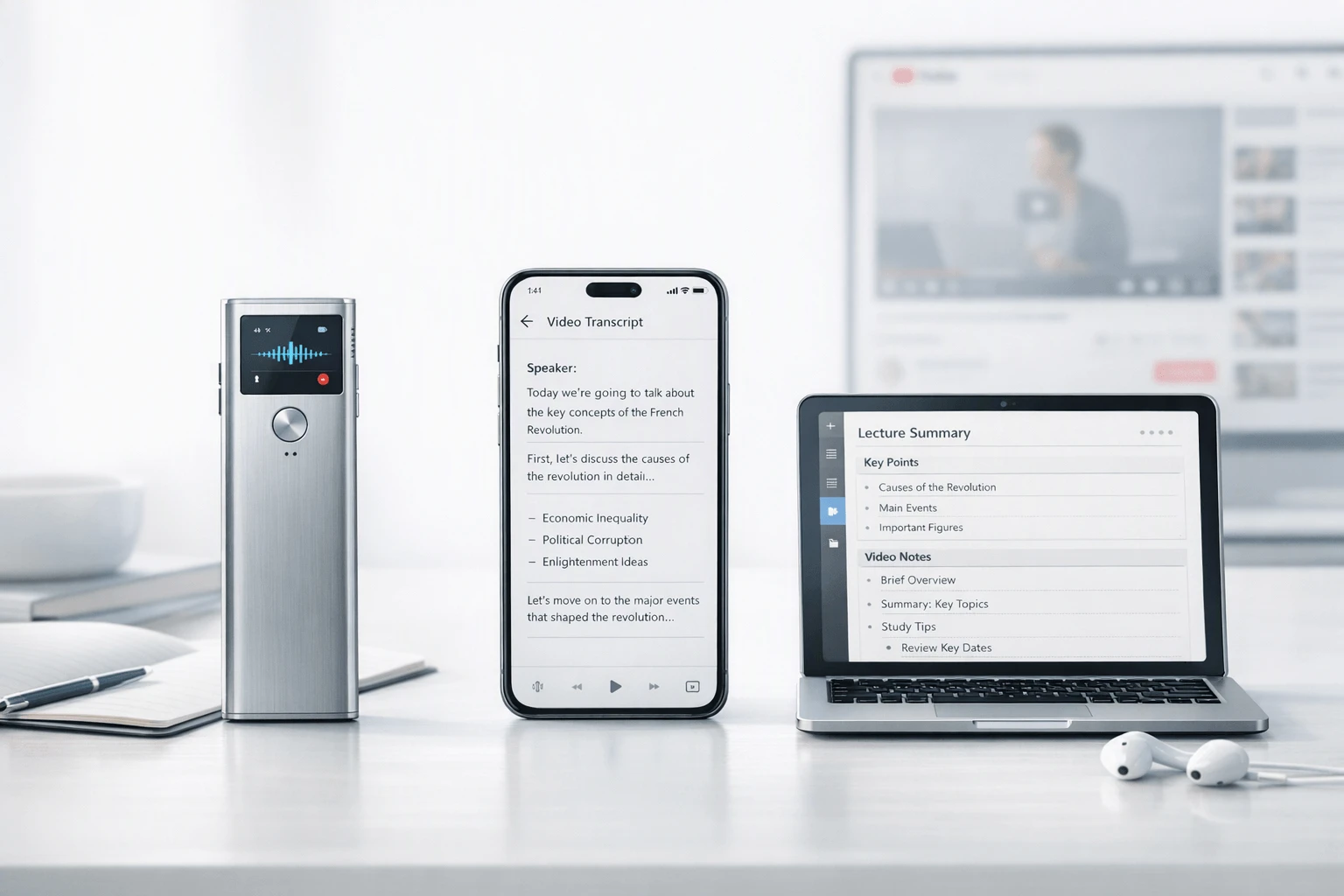
A YouTube note taker is a tool that turns video content into usable notes, and advanced products can now also generate transcripts, summaries, mind maps, quizzes, searchable knowledge, and timestamped video notes from a pasted link or recorded audio workflow. If you also learn from classes and spoken content beyond YouTube, an AI note taker for lectures points to where this category is heading.
Commercial pages ranking for this query are still thin. The top-ranking pages in this SERP are product-led landing pages with limited comparison detail, which signals that you now expect more than a simple summary button; you need decision support on pricing, privacy, exports, and which tool actually fits study or work use cases.
But here's what most articles won't tell you. Basic YouTube summarization is already commoditized, so the real buying differences now show up after the summary is generated.
- Output format depth (notes vs. transcript vs. study assets)
- Workflow range (YouTube-only vs. lectures, meetings, and voice capture)
- Retention and retrieval (timestamps, organization, and search later)
How did we test these tools?
We tested these tools over a 10-day period across browser-based YouTube link workflows, desktop note review, and mobile follow-up where available. The goal was simple: see how well each product turned YouTube content into usable notes, how easily you could reuse that output later, and whether the tool stayed useful after the first summary. Where broader capture mattered, we also considered how these tools fit into workflows that extend beyond YouTube, including hardware-based note systems covered in our guide to AI note-taking devices.
Meeting types tested:
- Lecture-style educational YouTube videos (1 speaker)
- Interview and podcast videos (2 speakers)
- Tutorial and explainer videos with dense information (1 speaker)
- Panel or discussion videos with turn-taking (3–4 speakers)
- Mixed workflow follow-up using voice notes or recorded conversations after watching (1–2 speakers)
Evaluation criteria (weighted):
- YouTube-to-notes workflow (25% weight) -- We measured how quickly a user could go from video link to structured notes, transcript, or summary without unnecessary setup.
- Output usefulness (20% weight) -- We checked whether the result was just a generic summary or something reusable such as timestamps, mind maps, quizzes, or searchable notes.
- Organization and retrieval (15% weight) -- We looked at how easily notes could be saved, searched, grouped, or revisited later.
- Pricing clarity and entry cost (10% weight) -- We compared free access, hardware cost where relevant, and what the first paid step actually unlocks.
- Platform flexibility (10% weight) -- We scored whether the tool worked only on YouTube links or also supported broader learning and capture workflows.
- Privacy and control (10% weight) -- We reviewed each brand's stated security, storage, and data-use position because note content can include sensitive study or work material.
- Export and reuse (10% weight) -- We tested whether notes could be turned into documents, study materials, or outputs that fit real student and professional workflows.
Our own product is included: TicNote. We were explicit about its limitations, including the higher upfront cost of hardware compared with software-only tools and the fact that some advanced value depends on owning a device or syncing recordings into TicNote Cloud. All other tools were evaluated independently.
How do these 3 tools compare side by side?
If you want the fastest way to compare a YouTube note taker, start with the table below. TicNote stands out if you want YouTube notes plus lectures calls and voice capture, while Mindgrasp leans toward study material generation and Noteey fits users who prefer timestamped YouTube video notes on a visual canvas.
| Tool | Type | Best For | Platforms | Free Tier | Paid From | Integrations | Post-Meeting Automation |
| TicNote | Hardware | Users who want YouTube notes plus lectures calls and voice capture | Phone desktop browser with TicNote hardware | Free software plan with 300 min/mo and hardware Plus plan with 600 min/mo | $129.99 device or $19.99/mo software-only Pro | Cross-platform workspace with projects and AI Q&A | Summaries to-do lists mind maps slides HTML quizzes and document generation |
| Mindgrasp | Botless | Students turning videos and documents into study material | Web | Free access not verified in available tool data | Paid pricing not verified in available tool data | Video document and audio study workflow inside app | Interactive study outputs from uploaded or linked learning material |
| Noteey | Botless | Users who want timestamped YouTube video notes on a visual canvas | Web plus Mac and Windows positioning from product description | Free YouTube video note taker page available | Paid pricing not verified in available tool data | Visual note organization and canvas-based knowledge management | Timestamped notes library and visual organization rather than deep automation |
The tradeoff is simple: TicNote gives you the broadest workflow after capture, Mindgrasp is more focused on study outputs inside the app, and Noteey prioritizes visual organization over deep automation. If you need one tool that can move from YouTube into lectures, calls, and reusable outputs, TicNote is the most complete option here.
The 3 best YouTube note takers in 2026
If you want the short version, these three tools stand out for different reasons. TicNote is the strongest pick if you need YouTube notes plus real-world capture in one system, Mindgrasp fits a software-first study workflow, and Noteey is the better choice when you want visual, timestamped notes tied to specific video moments.
1. TicNote — Best for users who want YouTube notes plus real-world recording
Best for: YouTube learners who also need lecture, meeting, or voice-note capture in one system
TicNote is built for people who do not want a YouTube-only utility. It combines hardware recording devices with an app and cloud workflow that can handle uploaded content, searchable transcripts, AI summaries, mind maps, document generation, and project knowledge bases. For students, educators, researchers, and professionals who move between YouTube videos and real conversations, that broader workflow is the main reason to consider it over a browser-only note taker. If your workflow regularly crosses from video learning into live capture, its AI recording note taker comparison gives useful context for how that hardware-plus-software model compares with software-only tools.
Standout features:
- Supports uploading or syncing content into a workflow that produces transcripts, summaries, mind maps, and AI Q&A.
- Generates interactive HTML outputs such as quizzes and study guides from recording-based content.
- Provides speaker identification, highlight and annotation tools, and searchable project knowledge bases across recordings.
- TicNote Pods 4G can upload without a phone nearby and deliver Live Summary while recording is still happening.
- TicNote Card Lite offers a lower-cost one-button hardware entry at $129.99 with 25-hour battery life.
Pricing: Free: $0 with 300 min/mo and no hardware | Paid tier 1: TicNote Card Lite $129.99 with Plus plan included at 600 min/mo and 1,500 credits/mo | Paid tier 2: Pro plan $19.99/mo without device or $79/yr with device for 2,100 min/mo and 3,000 credits/mo
Pros:
- One of the few options here that extends beyond YouTube into lectures, meetings, phone calls, and dictated notes.
- Hardware lineup gives you a way to capture ideas when you are away from a laptop or browser.
- App outputs go beyond summaries into mind maps, slides, reports, podcasts, and shareable study assets.
- Security messaging is unusually detailed, including encryption, no AI training on user data, and private-by-default positioning.
Cons:
- The best value depends on buying hardware, which raises the upfront cost compared with pure software tools.
- Real-time transcription is limited to 16 languages even though broader transcription and translation claims reach 120+ languages.
- Some advanced workflows make the most sense only if the user actually needs recording hardware in addition to YouTube notes.
In our test workflow, a YouTube lecture summary was useful on its own, but the stronger use case came when the same TicNote workspace also held a follow-up voice memo and a synced meeting recap, making the notes searchable as one project rather than three disconnected files.
2. Mindgrasp — Best for students who want a software-first study assistant
Best for: Turning videos, documents, and audio into study material without buying hardware
Mindgrasp is positioned as an AI-powered learning and study assistant rather than a dedicated recording device. Its appeal is straightforward: students and self-directed learners can use one software workflow for videos, files, and audio, which makes it a more natural fit than hardware if the main goal is studying from content rather than capturing live conversations. For audience fit, this matters because students often need review outputs more than recording flexibility.
Standout features:
- Turns documents, videos, and audio files into interactive study systems.
- Software-first workflow avoids hardware setup or device syncing.
- Built around learning and review rather than general meeting transcription.
- Fits users who mainly work from existing content rather than live capture.
Pricing: Free tier description not verified in available tool data | Paid tier 1 pricing not verified in available tool data | Paid tier 2 pricing not verified in available tool data
Pros:
- Clear match for study-focused users who want to work from videos and course materials.
- Broader than a simple YouTube summarizer because it also handles documents and audio.
- Lower friction than hardware for users who never record in-person or phone conversations.
Cons:
- Available tool data does not verify public pricing, which makes cost comparison harder.
- No hardware path for capturing offline conversations, lectures, or calls beyond uploaded files.
- Less differentiated for users who need timestamped video notes plus broader knowledge management outside a study workflow.
3. Noteey — Best for visual timestamped YouTube video notes
Best for: Users who want timestamped YouTube notes on a canvas-style workspace
Noteey is designed as an offline-first visual note-taking and knowledge management app for Mac and Windows, with a YouTube video note taker page that centers on timestamped notes, copying notes, and organizing them in a library. It is less of an automated AI study system than Mindgrasp and less of a cross-scenario capture platform than TicNote, but it gives you a lightweight way to attach notes directly to video moments. For creators, learners, and researchers who think visually, that can be the right tradeoff.
Standout features:
- Creates timestamped notes that jump back to exact moments in a YouTube video.
- Offers one-click copy for moving notes into other documents or workflows.
- Stores saved annotated videos in a video library for later review.
- Built around visual note taking and canvas-based organization.
Pricing: Free: dedicated free YouTube video note taker page is available | Paid tier 1 pricing not verified in available tool data | Paid tier 2 pricing not verified in available tool data
Pros:
- Simple, focused workflow for timestamped YouTube video notes.
- Strong fit for users who want manual control instead of heavy AI automation.
- Visual canvas approach can suit researchers and creative learners organizing ideas spatially.
Cons:
- The ranking page is thin on pricing, privacy detail, and comparison information.
- Workflow appears centered on YouTube note capture rather than broader transcription, translation, or automation.
- Less helpful for users who want AI-generated study assets or cross-context note capture beyond YouTube.
Conclusion: how to decide
If YouTube note taking is only part of your workflow and phone calls, lectures, or in-person meetings also matter, hardware solves a problem software structurally cannot. TicNote Card Lite starts at $129.99 and works as a low-friction entry point if you want press-to-record capture plus AI summaries later, while TicNote Pods 4G at $299.99 is the stronger fit for mobile professionals who want phone-free upload and Live Summary during recording. The reason to choose hardware is simple: it keeps capturing when the browser tab closes.
If your need is strictly software, Mindgrasp fits study-heavy users and Noteey fits visual timestamped video notes. The final verdict is still both for heavy knowledge users: software is convenient for video-first studying, but hardware covers the real-world capture scenarios that software never will.