


 Extension
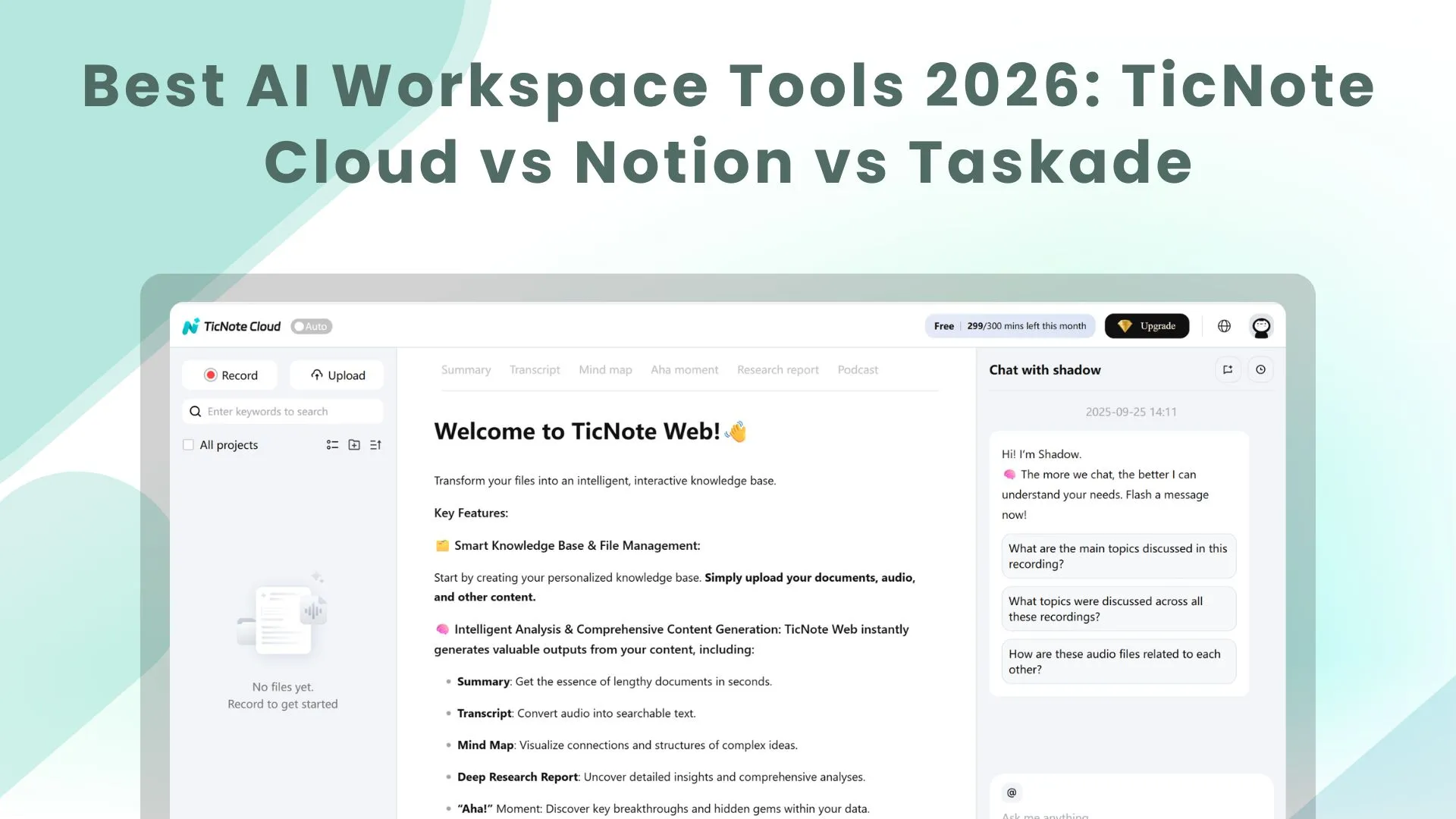
Most people think an AI workspace is just a better chatbot.
It is not.
Real work does not start in a chat box. It starts in meetings, interviews, customer calls, voice notes, research docs, messy drafts, and half-finished decisions. The best AI workspace tools in 2026 are the ones that can capture that raw input, preserve context, and turn it into something your team can actually use.
That is why this guide focuses on a simple question:
Which AI workspace helps you move from information to action with the least friction?
Quick verdict: Which AI workspace should you choose?
Choose TicNote Cloud if:
- your work starts in meetings, calls, interviews, or voice notes
- you need transcripts, summaries, action items, and reusable project knowledge in one place
- traceability matters, especially for research, consulting, sales, or multilingual teams
- you want an AI workspace built around real conversations, not just static docs
Choose Notion if:
- you want the strongest all-in-one workspace for docs, databases, projects, and team knowledge
- your team is willing to standardize its workflows in one flexible system
- AI search, AI meeting notes, and custom agents inside your workspace matter more than raw speed
Choose Taskade if:
- you want an AI-native workspace built around agents, automation, and fast execution
- you care more about getting workflows running quickly than building a deep documentation system
- lightweight collaboration and AI-first task execution are your priority
Choose Coda if:
- you want docs that behave like apps
- your team likes building internal systems with tables, hubs, trackers, and workflows
- structured operations matter more than traditional note-taking
Choose ChatGPT if:
- you want the best general AI work layer for writing, analysis, research, and connected workflows
- you already have other tools and need one strong AI brain on top
- you do not need your workspace to be meeting-first
Choose Google Workspace with Gemini if:
- your team already lives in Gmail, Docs, Drive, Meet, and Sheets
- you want AI directly inside the tools you use all day
- ecosystem fit matters more than switching to a new workspace
Choose Confluence + Atlassian Intelligence if:
- you run on Jira and need documentation tightly connected to execution
- your organization is large, process-heavy, and cross-functional
- knowledge operations matter as much as project tracking
What makes an AI workspace actually useful in 2026?
Before ranking the tools, it helps to separate table-stakes AI from real workspace value.
Table-stakes AI features
Most tools now offer these:
- AI writing help
- basic summaries
- search across some content
- chat with files or pages
Differentiating AI workspace features
This is what actually matters:
- real-world input capture: meetings, calls, interviews, audio, and live collaboration
- persistent context: the system remembers projects, documents, discussions, and linked materials
- actionability: outputs become next steps, not just nicer text
- traceability: your team can understand where decisions came from
- cross-file reasoning: AI can work across meetings, documents, and related inputs
- collaboration: knowledge survives handoff between people
- privacy and admin controls: critical for teams, client work, and sensitive information
The tools below all do some of this well. They just solve different versions of the problem.
TicNote Cloud, best overall AI workspace for meeting-driven work
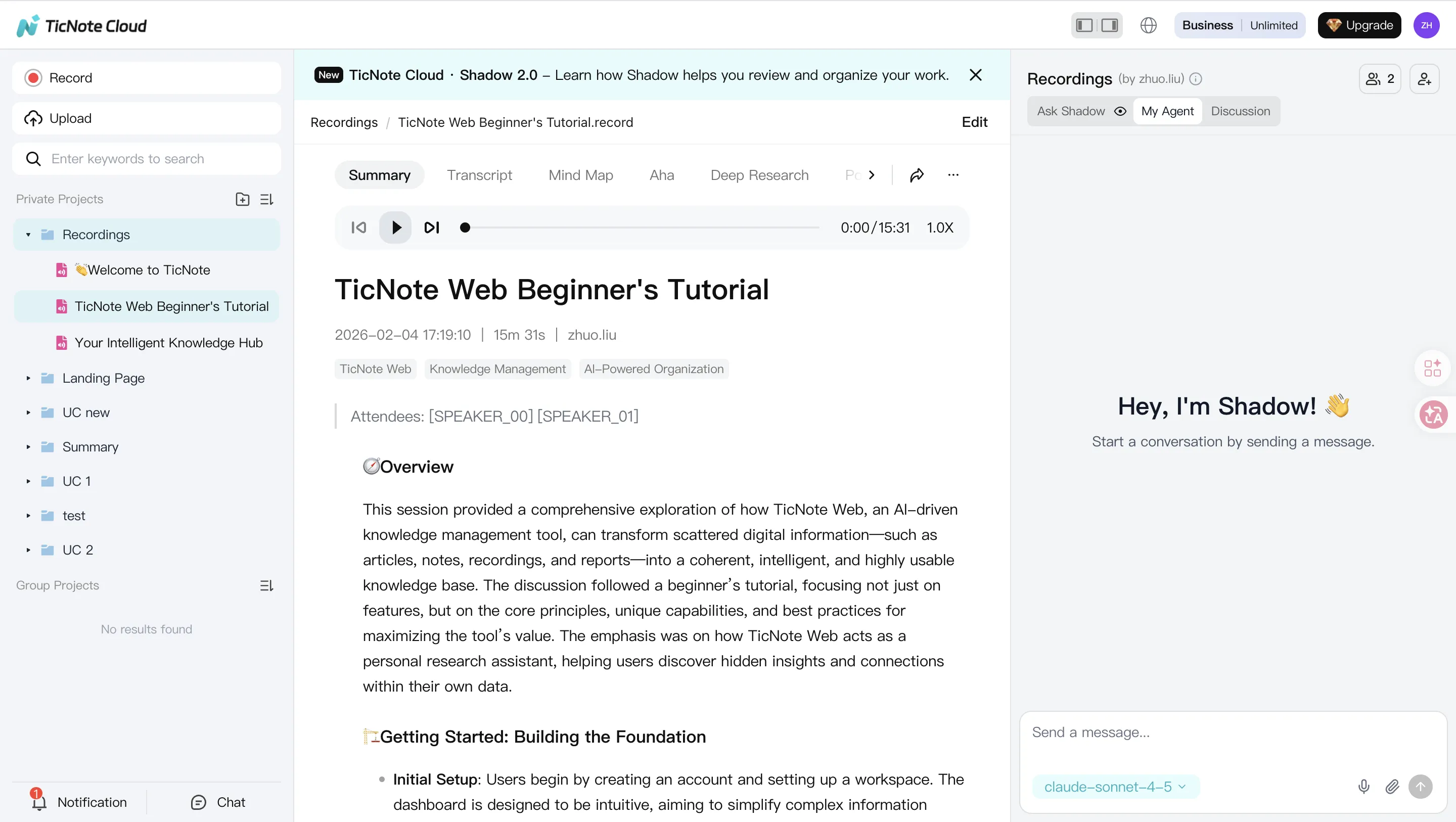
TicNote Cloud is the most compelling choice when your work begins with conversations and needs to end as usable output.
That sounds obvious, but it is where many "AI workspaces" still break. They help after the fact, once your thoughts are already cleaned up and typed into a document. TicNote starts earlier. It captures the messy part of work, then helps structure it.
What TicNote Cloud does better than anyone
- turns meetings, interviews, calls, and voice notes into structured knowledge
- supports live transcription and translation across 120+ languages
- generates summaries, action items, and mind maps from conversations
- connects meetings, transcripts, files, and project knowledge in one workspace
- lets users ask questions across files and conversation history
- fits teams that need reusable knowledge, not just one-off summaries
- offers a strong privacy position and a differentiated hardware-plus-cloud workflow
Why it ranks first
If your team loses time after every meeting, not during it, this is the clearest solution on the list.
TicNote is not trying to be a generic AI layer for everything. It is trying to solve one of the most expensive forms of modern knowledge loss: conversations that never become durable, searchable, collaborative work.
That makes it especially strong for:
- sales and customer calls
- research interviews
- product and project syncs
- multilingual teams
- content workflows built from spoken input
- legal, healthcare, and other documentation-heavy environments
Where TicNote Cloud falls short
- it is not a full project management suite in the Jira or ClickUp sense
- teams with purely spreadsheet-driven or ticket-driven workflows may prefer more traditional systems
- if you only want a general chatbot, it is more workspace than you need
Try the TicNote Cloud Free Plan
Our take
TicNote Cloud is the best AI workspace of 2026 for teams whose real work starts in conversations and needs to become traceable, reusable, shareable output.
Notion, best all-in-one AI workspace
Notion remains the strongest all-purpose AI workspace for teams that want docs, databases, projects, and knowledge management in one operating system.
Its biggest strength is breadth. Notion can be a team wiki, project tracker, meeting note system, knowledge base, and AI layer at the same time. That is why it keeps showing up near the top of almost every workspace conversation.
What Notion does best
- combines docs, projects, databases, and knowledge in one flexible system
- adds AI directly inside the workspace
- supports AI meeting notes, AI search, and custom agents
- works well for teams that want fewer tools and more standardization
Where Notion falls short
- flexibility can become sprawl without good workspace design
- teams often need time to build the right structure
- it is strongest when your team truly commits to Notion as a system of record
Our take
Notion is still the safest answer for "best all-in-one AI workspace." It just ranks below TicNote here because it is more general-purpose and less specialized in turning conversations into high-quality, traceable deliverables.
Taskade, best AI-native workspace for execution
Taskade is what an AI-native workspace looks like when the focus is speed, agents, and action.
Where Notion feels like a flexible operating system, Taskade feels like a fast-moving AI execution environment. It leans into AI agents, automations, and rapid workspace generation.
What Taskade does best
- AI-first workflows and agent-driven execution
- fast setup for teams that want results quickly
- strong fit for lightweight planning, collaboration, and automation
- built for people who want AI to actively do work, not just assist
Where Taskade falls short
- not as deep as Notion or Confluence for long-lived documentation systems
- less ideal when governance, knowledge architecture, and formal process matter
- teams with complex enterprise requirements may outgrow the lighter structure
Our take
Taskade is one of the best AI workspace tools for teams that care more about execution speed than knowledge depth. It is easy to recommend when AI agents are the main reason you are shopping.
Coda, best for docs that behave like apps
Coda remains a distinctive choice because it bridges the gap between documents and systems.
Some teams do not want a traditional workspace. They want a doc that can act like an internal tool. That is where Coda is still excellent.
What Coda does best
- combines documents, structured data, and workflow logic
- turns plans, trackers, hubs, and decision docs into living systems
- works especially well for product, operations, and cross-functional teams
- helps teams build one source of truth that is more interactive than a normal doc
Where Coda falls short
- it asks users to think like builders
- the power comes from structure, not instant simplicity
- less natural for meeting-first workflows than TicNote
Our take
Coda is a top-tier AI workspace for teams that think in operating systems, not note pages. It is strongest when your team wants docs, data, and workflows to live together.
ChatGPT, best general AI workspace layer
ChatGPT belongs on this list, but not for the same reason as TicNote or Notion.
It is best understood as a powerful AI work layer that sits across your existing tools. For many users, it is the fastest way to write, analyze, brainstorm, research, and work with connected company data.
What ChatGPT does best
- excellent general reasoning, writing, analysis, and research
- strong connected workflows through app integrations
- useful for teams that want shared projects, connected tools, and one AI assistant across many tasks
- especially strong when the problem is thinking, drafting, or synthesis
Where ChatGPT falls short
- it is not where most teams want to store all operational knowledge
- context can be powerful, but it is still different from a fully structured team workspace
- meeting capture and source-of-truth workflows are not its core design
Our take
ChatGPT is one of the best AI work tools in the world. It just is not automatically the best workspace system. Think of it as your AI brain, not always your home base.
Google Workspace with Gemini, best for Google-native teams
For organizations already built on Google, the smartest move is often not switching workspaces. It is upgrading the one they already use.
Google Workspace with Gemini puts AI inside Gmail, Docs, Sheets, Slides, Drive, Meet, and more. That matters because the lowest-friction AI is the AI already living where work happens.
What Google Workspace with Gemini does best
- brings AI directly into familiar apps
- helps with writing, meeting notes, brainstorming, and document work
- adds NotebookLM and broader AI capabilities around shared knowledge
- makes sense for teams that want ecosystem continuity
Where it falls short
- less compelling if your team is not already deep in Google
- can feel ecosystem-bound compared with more neutral workspace tools
- not as specialized as TicNote for conversation-to-deliverable workflows
Our take
For Google-native teams, this is often the most practical AI workspace choice. For everyone else, it is a strong ecosystem answer, not necessarily the best standalone answer.
Confluence + Atlassian Intelligence, best for enterprise knowledge operations
Confluence remains one of the most credible enterprise workspace platforms, especially when paired with the broader Atlassian stack.
It is not the most exciting tool on this list, but it is one of the most operationally important for larger organizations.
What Confluence does best
- connected documentation for teams already using Jira
- strong enterprise knowledge workflows
- useful AI assistance inside documentation and collaboration
- good fit for engineering, product, IT, and large cross-functional organizations
Where it falls short
- heavier than the other tools for small teams
- best value appears when you are already in Atlassian
- less elegant for solo users or lightweight teams
Our take
Confluence + Atlassian Intelligence is not the best general AI workspace for everyone. It is one of the best enterprise knowledge workspaces, and that distinction matters.
Head-to-head: how these AI workspaces differ
| Tool | Best for | Core strength | Main trade-off |
| TicNote Cloud | Meetings to deliverables | Capture, structure, and reuse conversation-driven work | Less suited for heavy ticket-based PM |
| Notion | All-in-one workspace | Docs, databases, projects, and AI in one system | Requires structure and discipline |
| Taskade | AI-native execution | Agents, automation, and fast workflows | Lighter knowledge depth |
| Coda | Docs as apps | Structured docs, tables, and operational systems | Builder mindset required |
| ChatGPT | General AI work layer | Reasoning, writing, research, connected tasks | Not a full operational home base |
| Google Workspace with Gemini | Google-native teams | AI in the flow of work across familiar apps | Best mainly inside Google ecosystem |
| Confluence + Atlassian Intelligence | Enterprise knowledge ops | Documentation tightly linked to execution | Heavier for smaller teams |
Which AI workspace should you choose?
Choose TicNote Cloud if:
- your work begins in live conversations
- context loss after meetings is your biggest productivity tax
- you need summaries, action items, and reusable knowledge from every call
- your team values traceability and output quality
Choose Notion if:
- you want one flexible workspace for docs, projects, and knowledge
- your team is ready to build a real system of record
- you need broad all-in-one capability more than conversation-first capture
Choose Taskade if:
- you want AI agents and automation quickly
- you prioritize momentum and execution
- your ideal workspace feels fast, lightweight, and AI-native
Choose Coda if:
- your team loves structured systems
- you want hubs, trackers, and workflow docs that behave like apps
- operations and product planning are central to your work
Choose ChatGPT if:
- you already have your stack and want a powerful AI layer over it
- writing, analysis, brainstorming, and research are your main use cases
- you do not need meeting-first knowledge capture
Choose Google Workspace with Gemini if:
- your team already works in Google all day
- you want AI in-place rather than a new platform
- switching cost matters more than platform novelty
Choose Confluence + Atlassian Intelligence if:
- your org runs on Jira
- knowledge operations and execution are tightly linked
- enterprise process matters more than startup simplicity
The bottom line
The best AI workspace tools in 2026 are not all trying to do the same job.
TicNote Cloud is the best overall choice when work starts in meetings, calls, interviews, and voice notes, then needs to become structured, shareable, reusable output.
Notion is the best all-in-one AI workspace.
Taskade is the best AI-native workspace for execution.
Coda is the best for docs that act like apps.
ChatGPT is the best general AI work layer.
Google Workspace with Gemini is the best choice for Google-native teams.
Confluence + Atlassian Intelligence is the best enterprise knowledge workspace.
If you want one sentence to guide the decision, use this:
Pick the AI workspace that is strongest at the earliest stage where your work usually breaks.
For many modern teams, that break happens right after the conversation. That is why TicNote Cloud ranks first.