


 Extension
TL;DR
Meeting communication skills are the abilities that determine how effectively you exchange information in meetings: listening, speaking, questioning, reading the room, and managing your presence in the conversation. Mastering these skills makes every meeting more productive for everyone in it.
Try TicNote Cloud for Free and analyze your meeting communication patterns from a real transcript in minutes.
Most professionals assume they communicate well in meetings, but assumption and reality often diverge. You don't know your actual talk share, how often you ask questions, or whether you build on others' ideas, unless you measure it. TicNote Cloud analyzes your meeting transcripts to surface concrete behavioral data, giving you a clear picture of where your communication skills stand and what to work on first.
What Are Meeting Communication Skills?
Meeting communication skills are the specific abilities that enable people to exchange information clearly, build shared understanding, and make decisions together in a meeting setting. They span both directions of communication: what you send and what you receive.
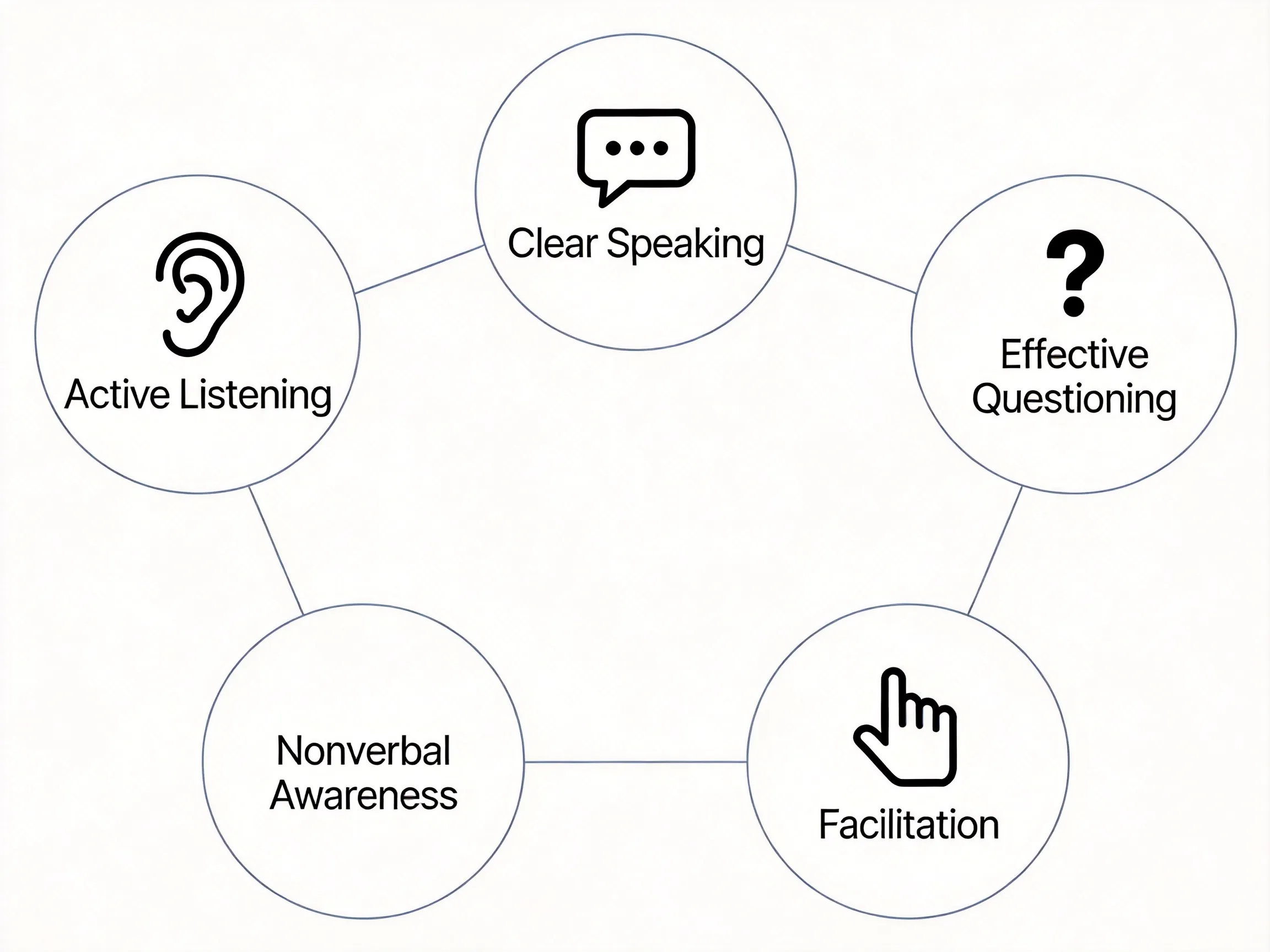
The core components
Effective meeting communication comes down to five interconnected abilities:
- Active listening: processing what others say fully, not just waiting for your turn to speak
- Clear articulation: expressing ideas concisely so others don't have to work to understand you
- Effective questioning: asking the right questions to deepen understanding and move discussion forward
- Nonverbal awareness: reading cues from others and managing your own body language and tone
- Facilitation: helping the group stay on track, surface all relevant perspectives, and reach decisions
Research on meeting effectiveness confirms the connection. A CIPD evidence review of 40+ studies found that focused communication (r=.28 to .59) and goal clarity (r=.51 to .54) are among the strongest correlates of productive meeting outcomes, making communication skill the single biggest lever available to any meeting participant.
Why they matter more now
In-person, hybrid, and fully remote meetings each create different communication challenges. Virtual formats remove most nonverbal cues and make it harder to read the room. Hybrid meetings create two-tier dynamics where remote participants are systematically disadvantaged. Meeting communication skills that work across all these formats, not just face-to-face, are now a baseline professional requirement.
7 Essential Meeting Communication Skills
Active listening
Active listening means giving your full attention to what's being said, processing it, and responding to the actual content rather than your anticipation of it.
In practice: put your phone face down, close unrelated tabs, and don't start drafting your response while someone else is still speaking. After they finish, pause briefly before responding. If you're not sure you understood correctly, paraphrase: "So what you're saying is..." This confirms understanding and signals that you were actually listening.
In virtual meetings, active listening is harder because silence reads as absence. Use verbal acknowledgments ("right," "got it," "that makes sense") to signal engagement without interrupting.
Speaking clearly and concisely
The most common meeting communication failure is not speaking too little; it's speaking too much without landing a clear point. Before you contribute, know your main message. State it first, then support it. Not the other way around.
Practical rule: if you can't summarize your point in one sentence before you start speaking, you're not ready to speak yet. Take the extra few seconds to organize your thought.
Jargon is a barrier, not a signal of expertise. If you use technical terms, define them on first use. Match your vocabulary to the audience's knowledge level, not your own.
Asking effective questions
Questions do more work in meetings than most people realize. They surface hidden information, correct misunderstandings, slow down premature decisions, and bring quiet people into the conversation.
Three question types to use deliberately:
- Clarifying: "Can you say more about what you mean by X?"
- Probing: "What's driving that assumption?"
- Broadening: "Does anyone see it differently?"
Ask questions early in the discussion, before positions harden. And when someone answers, follow up. "And what does that mean for the timeline?" turns a single exchange into a productive thread.
Reading and using nonverbal cues
In person, you have a full range of signals: posture, eye contact, facial expressions, where people are looking, who's leaning in and who's pulling back. Most of this disappears in virtual meetings.
In-person: maintain soft eye contact with whoever is speaking, face the room (not your laptop), and use open posture. Notice when people look confused or disconnected and address it directly: "I'm sensing some hesitation, is there something we haven't addressed?"
Virtual: look at your camera when speaking, not at your own face on screen. Position the camera at eye level. Keep your background clean and minimize background noise. Use reactions and chat to signal agreement or flag questions without interrupting.
Both formats: watch for signs that someone has something to say but isn't saying it. A half-raised hand, a sharp intake of breath, a pause before answering. Create space for those moments.
Providing constructive feedback
Feedback in meetings needs to be fast and specific. There's rarely time for long preambles, and vague feedback wastes everyone's time.
Good formula: observation + impact + suggestion. "The timeline in section three assumes two-week sprints, but our current capacity is closer to three. That could push the deadline by a month. Can we revise the assumptions?" That's specific, factual, and actionable.
What to avoid: feedback directed at the person rather than the work ("you're being too optimistic"), or feedback delivered as a question that's actually a challenge ("have you actually tested this?"). Both shut down conversation rather than improving the work.
Managing your airtime
Airtime is a shared resource. How much you use tells the group something about how you understand your role in the meeting.
If you typically dominate, practice restraint: make your point once, clearly, and let it land. Resist the urge to elaborate, repeat, or fill silence. If you typically say little, identify one moment per meeting where you'll contribute a question or observation, and commit to it before the meeting starts.
Adapting to audience and context
The same information needs to be communicated differently depending on who's in the room. A status update for your immediate team is shorter and more direct. A recommendation to senior leadership needs more context and clear framing. A brainstorming session invites a different kind of participation than a decision meeting.
Before any significant meeting, ask: who is in the room, what do they already know, and what do they need from me? The answers should shape how you speak, not just what you say.
How to Improve Your Meeting Communication Skills
Improvement requires knowing where you actually stand, which most people don't.
Get objective data first
Ask yourself what you actually know about your communication behavior. Do you know your average talk share across meetings? Whether you ask more questions than your colleagues? Whether you tend to interrupt? Most people don't know any of this with any precision.
How to use TicNote Cloud for meeting communication self-analysis (step-by-step)
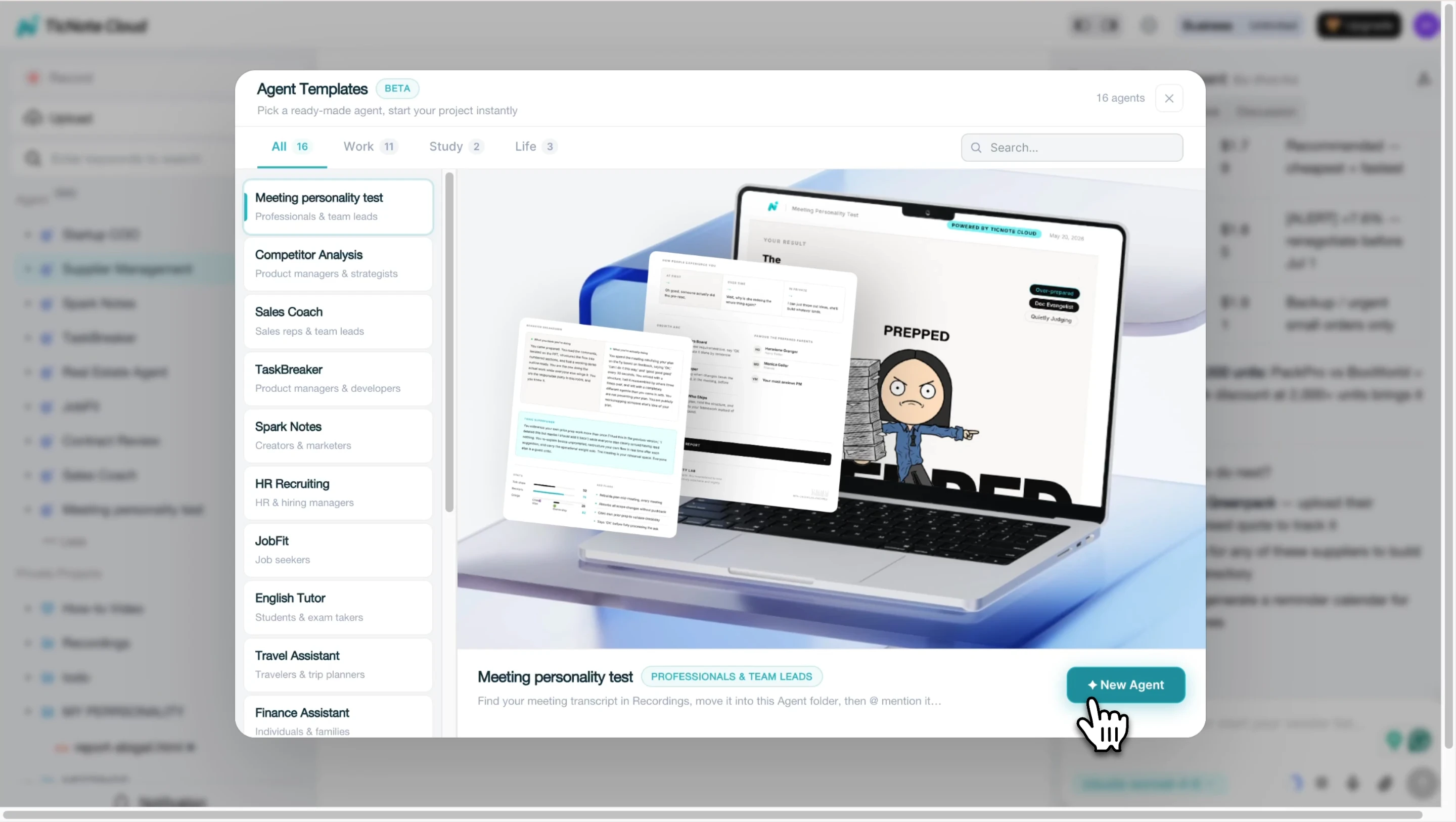
Step 1. Add the Meeting Personality Test skill agent on TicNote Cloud
In TicNote Cloud, click Add Agent and browse the Skill Agent library. Select the Meeting Personality Test skill to add it to your workspace — no configuration required.
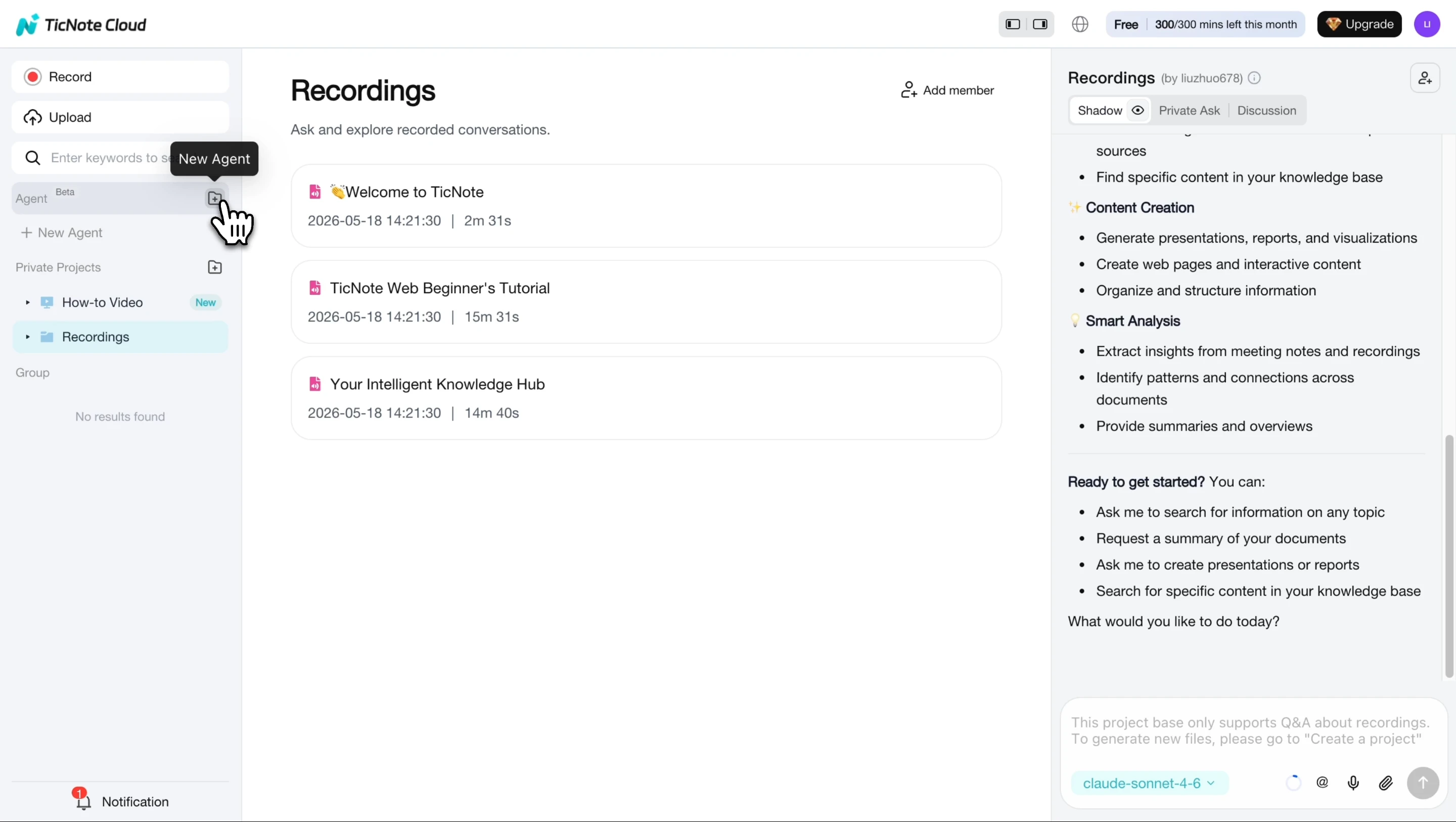
Once added, the skill agent appears in your agent list and is ready to use immediately.
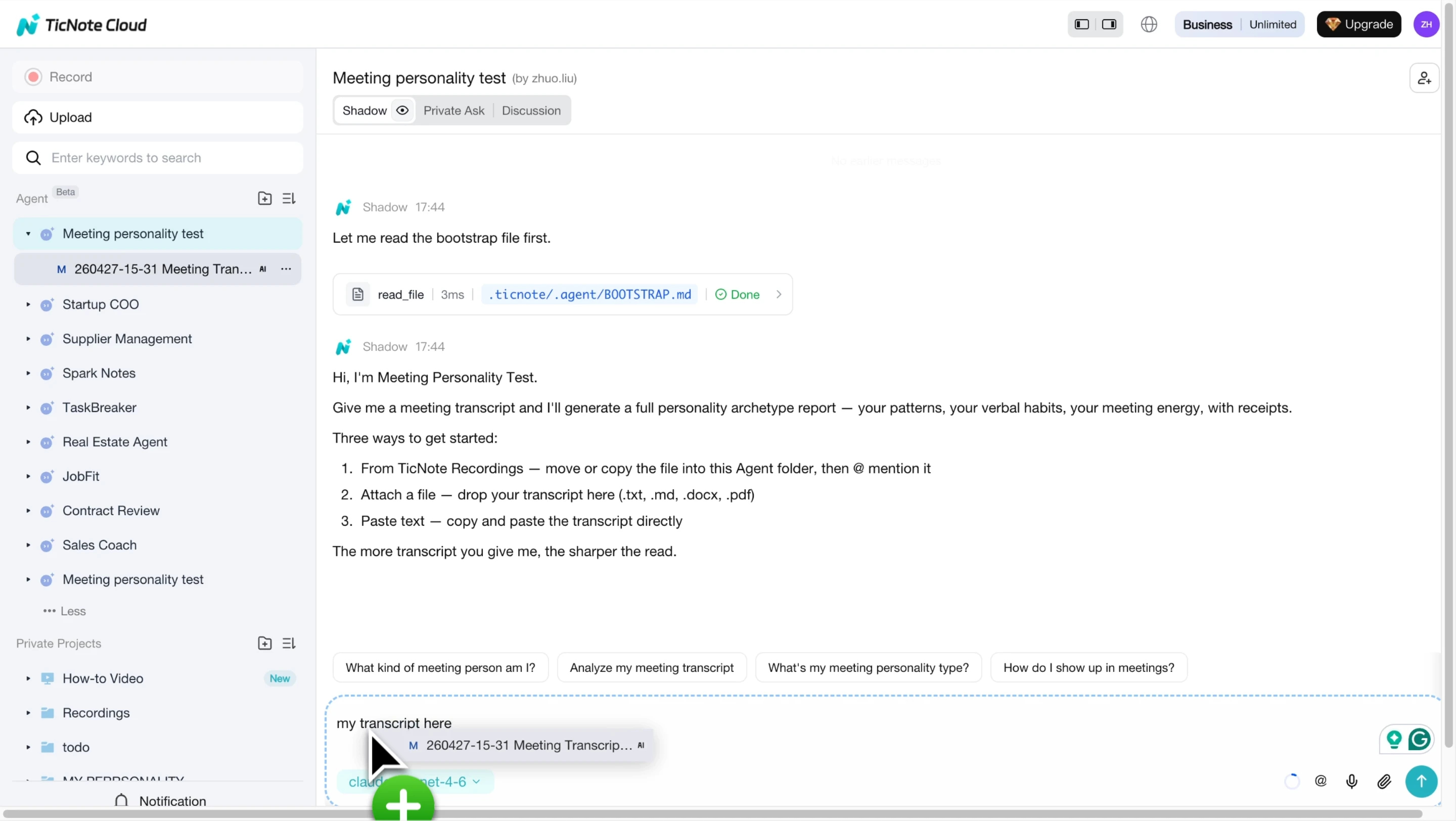
Step 2. Upload your meeting recording, audio, or transcript
Attach a meeting recording, audio file, or transcript to the chat. Tell the agent the names and genders of the participants so it can attribute behaviors accurately. The skill reads who said what and how — the more transcript you give it, the sharper the analysis.
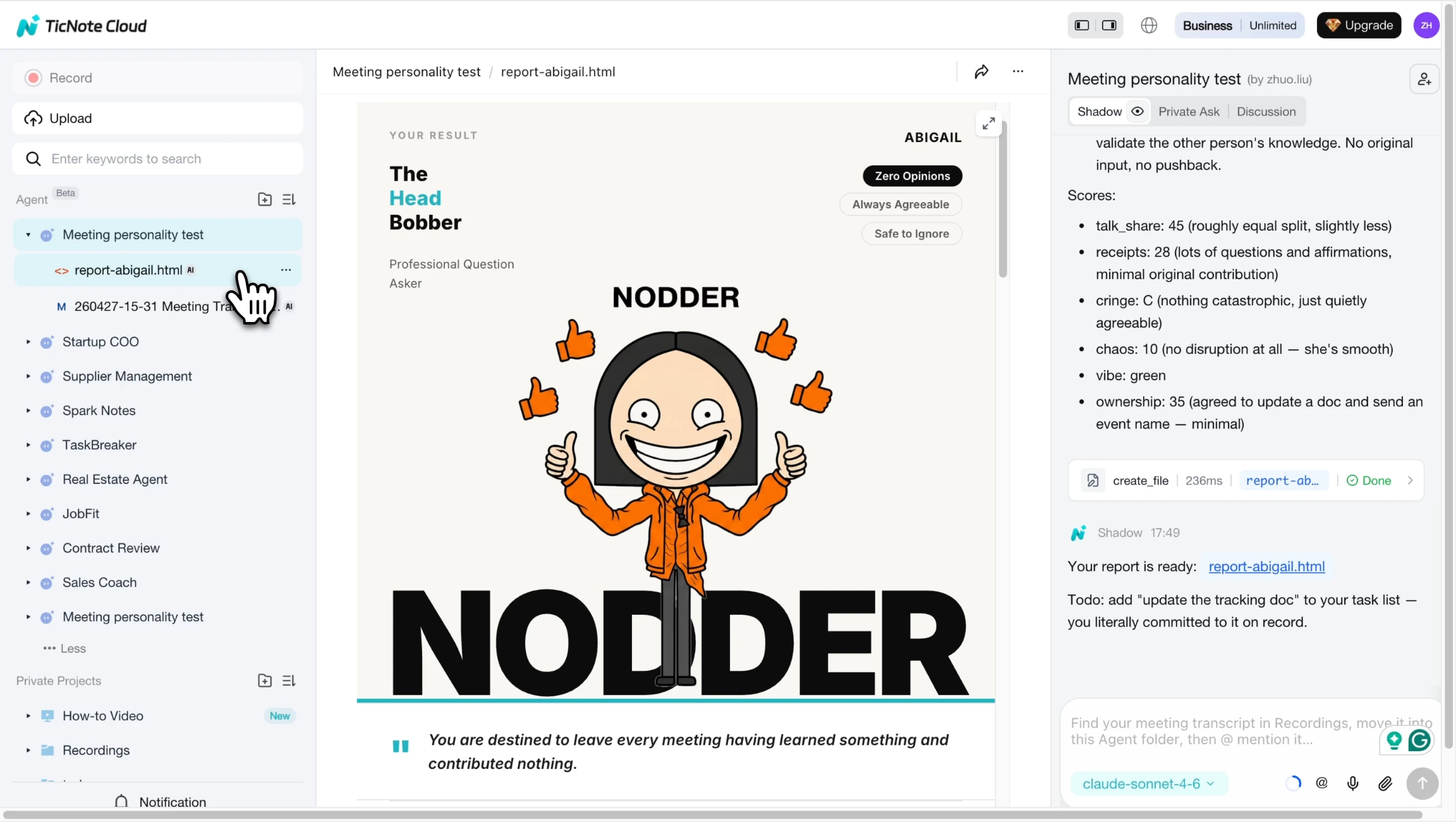
Step 3. Review the personality category result
The skill generates an HTML report and names your personality archetype. Open it to see your type — complete with a mascot illustration, archetype title, and tag labels summarizing your meeting presence at a glance.
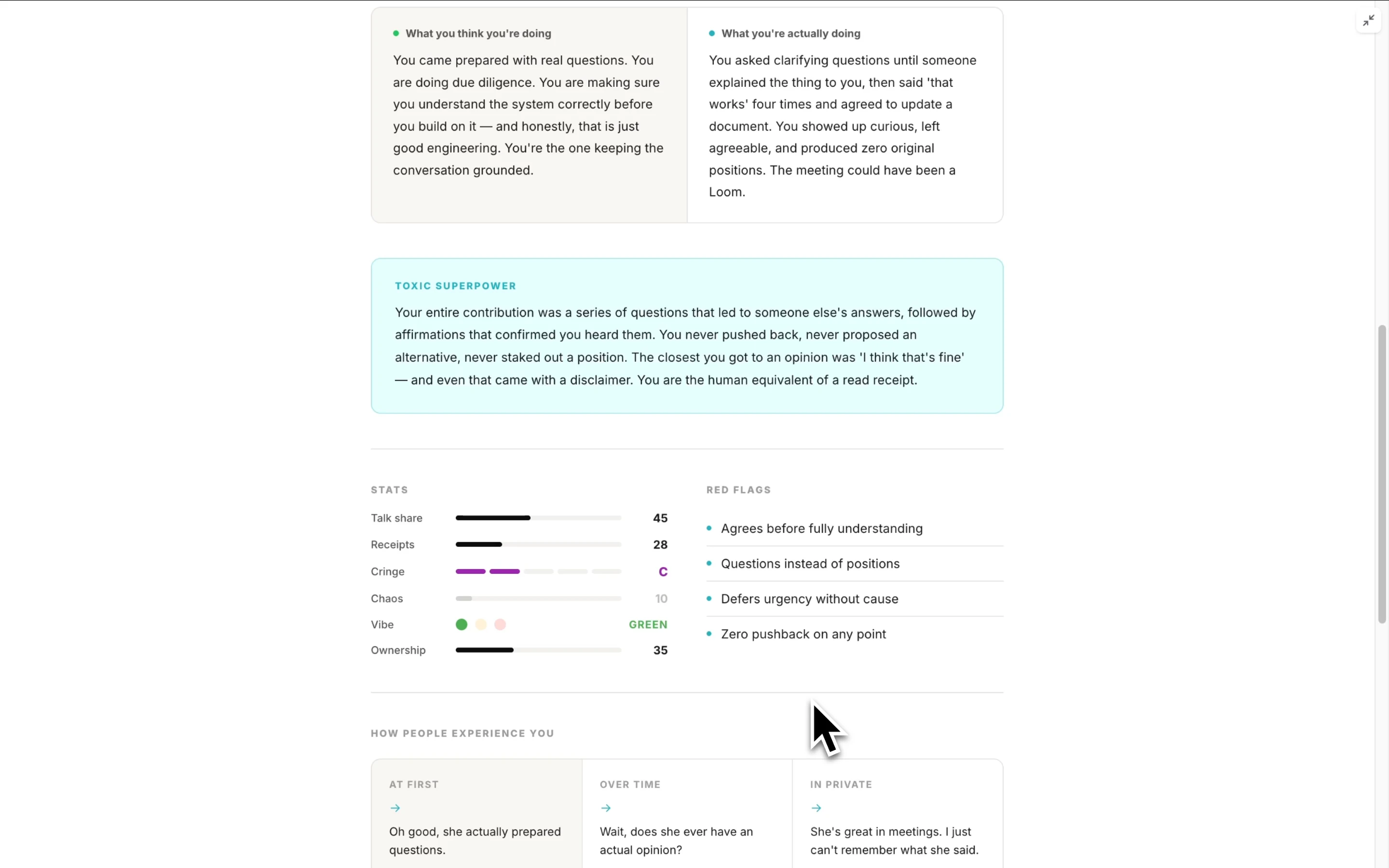
Step 4. Read the full personality analysis
Scroll through the report for the full breakdown: your toxic superpower, behavior stats with bar indicators, red flag checklist, and how people experience you across three timeframes. Each observation is grounded in actual transcript moments — not generic feedback.
Understanding your conversational patterns across multiple meetings shows you which behaviors are habits versus context-specific.
Pick one skill to focus on
Trying to improve everything at once produces improvement in nothing. Look at your data and identify one clear gap. If your talk share is over 40% in a five-person meeting, work on listening. If you rarely ask questions, commit to asking at least one per meeting for the next two weeks. Specific, measurable targets outperform vague intentions.
Practice in low-stakes settings
Not every improvement needs to happen in a critical meeting. Use team standups, 1:1s, and informal check-ins to experiment. Try stating your point in one sentence instead of three. Try asking a probing question instead of offering a solution immediately. Small adjustments in low-stakes settings build habits faster than occasional attempts in high-stakes ones.
Get feedback from a trusted colleague
Ask someone who attends meetings with you to notice one specific thing: "Do I tend to interrupt? Am I speaking clearly or rambling?" Specificity makes the feedback more useful and easier to give. General "you communicate well" feedback doesn't help anyone improve.
Common Meeting Communication Mistakes
Most communication problems in meetings are patterns, not one-off errors. Recognizing your pattern is the first step to changing it.
Multitasking while in the meeting. Checking messages, responding to emails, reading the agenda for the first time: these are all visible to other participants, signal disengagement, and mean you're missing context that will matter when it's your turn to contribute.
Rambling without a clear point. Starting to speak before you know what you want to say is the most common communication mistake in meetings. It wastes time and undermines your credibility. Organize your thought first, then speak.
Interrupting before someone finishes. Most interruptions are well-intentioned: you have a relevant point and you're afraid you'll lose it. The solution isn't to suppress the thought; it's to write it down and wait. The conversation will circle back, or your note will make for a better contribution later.
Using jargon without checking for understanding. Industry terminology, project acronyms, and internal shorthand exclude anyone who isn't already fluent. Define terms on first use, and watch for confusion signals in the room.
Dominating the airtime. Research shows that surface acting and inauthentic communication in meetings negatively correlates with meeting satisfaction (r=-.33 to -.38). When one or two people consume the majority of meeting time, others disengage. Good meeting metrics include airtime distribution, not just decisions made.
Disappearing into the background. The opposite problem: staying silent when you have a relevant perspective, deferring to others out of habit, or not engaging until directly called on. Both extremes cost the meeting quality. Find your equilibrium.
Meeting Communication Skills for Virtual vs. In-Person
The core skills are the same across both formats. What changes is how you apply them.
What's different in virtual meetings
Visual cues are reduced or absent. You can't tell if someone is engaged, confused, or multitasking unless they show it explicitly. This puts more weight on verbal signals: "I'd like to build on that," "I'm not following, can we slow down," "Does anyone have a different read on this?"
Camera position matters more than most people think. A camera at eye level creates eye contact; a camera pointed up from a laptop creates a visual hierarchy that subtly undermines authority. Muting when you're not speaking removes background noise and signals that you're paying attention.
The chat window is a useful parallel channel: good for questions that would interrupt the flow, votes, and links. But it creates a second conversation that can fragment attention. Use it deliberately, not reflexively.
What's different in in-person meetings
You have more information: posture, energy in the room, who's looking at whom. Use it. Notice when someone hasn't contributed and create space for them. Notice when energy drops and adjust your approach. The physical environment affects communication; a round table invites different dynamics than rows of seats facing a presenter.
Side conversations during an in-person meeting are more disruptive than typing in a virtual chat. They create two separate meetings, split attention, and signal disrespect. If something important comes up between two people, surface it to the room or take it offline.
What stays the same: active listening, clear speaking, asking good questions, managing your airtime, and adapting to who's in the room. Format changes the tools. It doesn't change the fundamentals.
Conclusion
Meeting communication skills are among the most high-leverage professional skills you can develop because every meeting you attend is an opportunity to practice them. Start by getting objective data on your current patterns: use TicNote Cloud to analyze a real meeting and find out where your communication actually stands.
Start improving with TicNote Cloud for free and turn your next meeting into a source of behavioral insight.