


 Extension

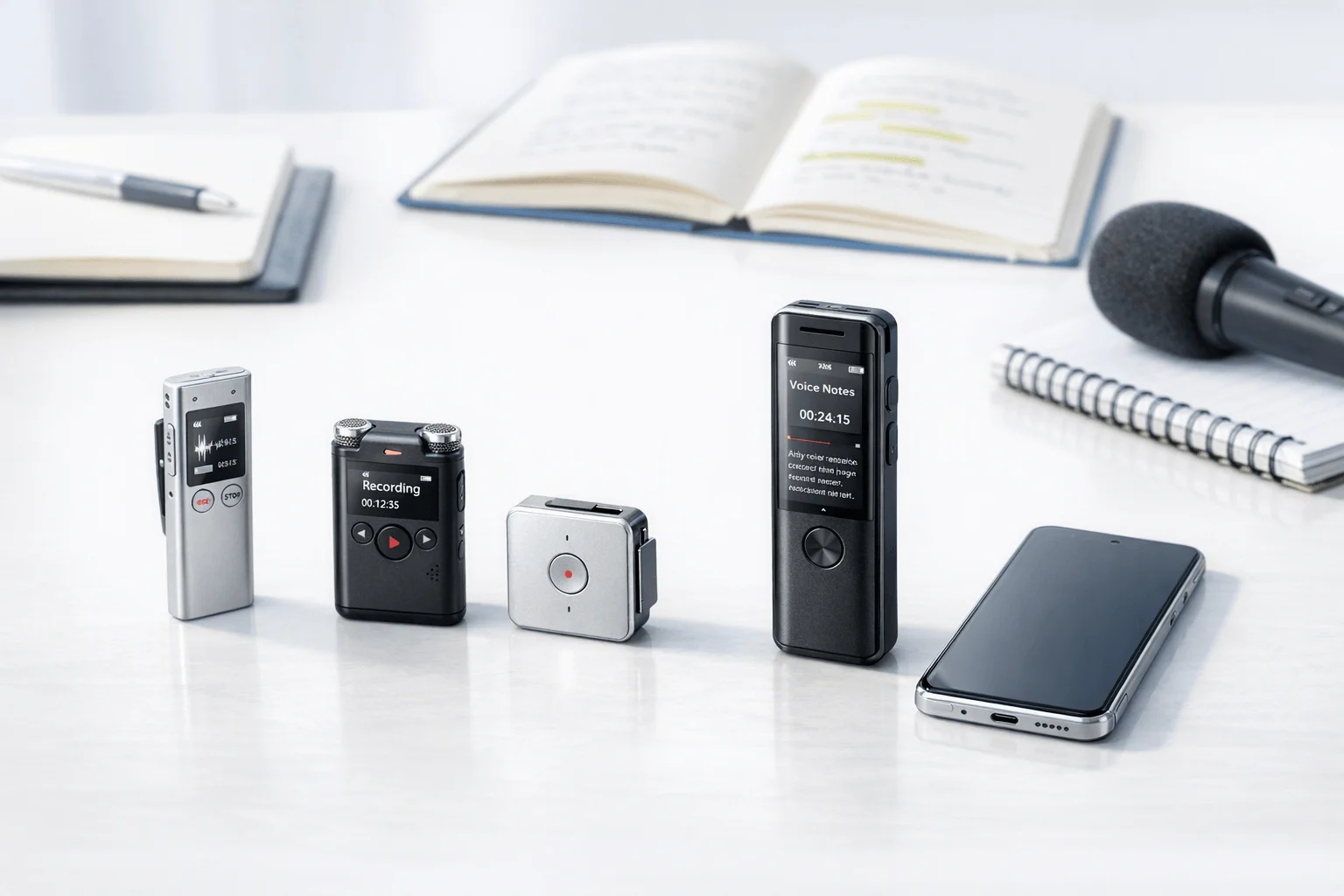
TL;DR: Top Voice Recorders for Fast Speech-to-Text Capture
Most devices promise easy transcripts, but in real use the gaps show up fast: weak pickup, slow sync, or notes that still need cleanup. For most buyers who want the best voice to text recorder, the TicNote AI Voice Recorder is the strongest all-around pick because it combines a slim dedicated recorder, offline recording, speaker ID, fast summaries, translation, and a sensible $159.99 price.
- Best overall: TicNote AI Voice Recorder
- Best budget pick: TicNote Lite AI Voice Recorder
- Best for field work: TicNote Pods 4G
- Best slim note-first alternative: PLAUD Note
- Best simple recorder without AI workflow: Sony ICD-TX800
Buy TicNote first if you're a professional, student, journalist, consultant, or multilingual user who needs reliable capture without depending on a phone. The full guide compares form factor, transcription speed, privacy, and workflow fit, not just app features.
Which is the best voice to text recorder in 2026?
The best voice to text recorder in 2026 is the one that gets the first job right: capture clean audio every time, then turn it into usable text fast. That hardware-first view matters because a dedicated recorder is different from an app. A phone app can transcribe, but a true speech-to-text recorder should also handle long sessions, offline recording, stable battery life, better mic placement, and easier storage for meetings, lectures, interviews, and field notes.
Define the category the right way
A voice to text recorder is a hardware device built to record first and process second. The best models now add speaker labels, summaries, translation, searchable transcripts, and cloud sync. But reliability still comes first.
Dedicated devices often beat app-only tools because they:
- record without draining your phone
- work better when your phone is in a bag or pocket
- stay more discreet in interviews and classes
- offer offline capture when signal is weak
- reduce workflow friction for all-day use
Use a simple scoring framework
To compare devices fairly, we use a normalized 10-point score across the factors that affect real work most:
- transcription accuracy in quiet rooms and noisy spaces
- speed of output, including live text vs post-recording results
- battery life and storage for long sessions
- offline usefulness and sync reliability
- privacy and security signals
- portability and day-to-day carry
- workflow fit for meetings, lectures, travel, and calls
This makes side-by-side choices faster. For privacy, retention and deletion rules matter as much as encryption. NIST SP 800-63B Digital Identity Guidelines: Authentication and Lifecycle Management states in Section 7.4 that records retention policies SHALL be risk-based, including "retention time(s)" and "the disposal requirements" for records containing PII.
Pick by use case
Here is the short answer:
- Best overall: TicNote AI Voice Recorder
- Best lower-cost pick: TicNote Lite AI Voice Recorder
- Best for travel and phone-free capture: TicNote Pods 4G
- Best slim alternative: PLAUD Note
- Best pure recorder for no-AI users: Sony digital recorder
TicNote AI Voice Recorder stands out because it balances price, portability, offline recording, real-time transcription, translation, speaker ID, and fast post-recording summaries better than most rivals. Lite is the smarter entry point if you want the same core AI workflow for about $30 less. Pods 4G is the strongest fit for field teams because it can upload and summarize without a phone nearby.
Explore TicNote's full device lineup to compare the best fit for your workflow.
Top 5 voice to text recorders compared
If you want the best voice to text recorder today, dedicated hardware still solves a real problem: phones are distracting, apps drain battery, and important details get lost when capture and transcription live in separate tools. The strongest devices now do more than record. They turn meetings, lectures, interviews, and field notes into searchable transcripts, summaries, and follow-up tasks fast enough to change your workflow.
1) TicNote AI Voice Recorder — best overall for meetings
For most buyers, this is the easiest recommendation. The TicNote AI Voice Recorder combines a slim card-style body, 64GB of storage, a 25-hour battery, and a 3-mic array in a device that feels built for daily carry instead of occasional use.
What stands out is the full workflow after capture:
- offline recording without needing your phone nearby
- real-time transcription support
- translation with bilingual subtitles
- speaker identification
- live highlight and annotation
- summaries and to-do lists as soon as recording ends
- broader app outputs like reports, formatted docs, and searchable project knowledge
That matters in real life. You don't just save audio; you get usable notes, action items, and a searchable record of what happened. It's the best fit for managers, consultants, sales teams, students, and anyone who sits through back-to-back meetings.
2) TicNote Lite AI Voice Recorder — best value pick
The Lite model is the smart choice if you want transcription-ready recording at a lower entry price. At $129.99, it keeps the core experience: one-button modeless recording, 25-hour battery life, a built-in magnetic sleeve, and a 3-mic array.
Its trade-offs are clear and reasonable. You get less storage and fewer premium physical extras than the main model, but the everyday experience is simpler. Press once, record, sync, and let the AI handle transcription and summaries.
For students, solo professionals, and budget-conscious buyers, that's a strong value.
- lower upfront cost
- same basic AI workflow
- easier physical operation
- fewer premium hardware touches
3) TicNote Pods 4G — best premium phone-free option
This is the most ambitious option in the lineup. TicNote Pods 4G are built for people who work in motion: consultants on site, field teams, journalists, and mobile-heavy professionals who can't rely on a phone being close by.
The key advantage is built-in 4G eSIM. That means phone-free recording and upload, plus live summary during recording. It also supports dual recording modes, automatic call recording when worn during calls, and conversation translation for bilingual exchanges.
Why pay more? Because it removes friction at the exact moment friction usually appears.
- no phone needed nearby
- live upload and live AI summary
- call recording support
- room recording from the case, call capture from the earbuds
The trade-off is price at $299.99 and shorter battery life when 4G is active. Still, if your work happens between airports, client sites, and cars, it fits the job better than a simple recorder.
4) Plaud Note — strong slim competitor
Plaud Note is one of the best-known dedicated AI recorder alternatives. Its appeal is easy to understand: slim hardware, note-focused positioning, and a clean ecosystem for people who want a minimalist recording tool.
It's a fair competitor, especially for users who like the PLAUD style and app environment. But TicNote can be stronger for buyers who care about broader post-recording output, multilingual workflows, and hardware that supports offline-first capture with a wider meeting-to-report pipeline. If you're comparing the two, this Plaud alternative breakdown is a useful next read.
5) Sony ICD-TX800 — traditional recorder baseline
Sony's ICD-TX800 is here for an important reason: it shows what a classic recorder still does well. Some buyers want familiar buttons, simple local recording, and no AI layer. According to Sony ICD-TX800 Digital Voice Recorder, the ICD-TX800 has 16 GB of built-in memory.
That simplicity can be a plus. But it also means more manual work after the recording ends. You still need separate transcription, separate summaries, and your own filing system. Compared with a modern speech-to-text recorder, the Sony approach is slower and less connected.
Mini verdict
For most people, TicNote AI Voice Recorder is the best all-around choice because it balances hardware quality, portability, offline capture, and useful AI output better than the rest. TicNote Lite is the value buy, Pods 4G is the premium mobile pick, Plaud Note is the closest dedicated AI rival, and Sony remains the baseline for buyers who want recording without the smart workflow layer.
Next, check the comparison table to see which model wins on battery, storage, transcription workflow, and mobile flexibility.
What makes TicNote different from other AI voice recorders?
What separates TicNote from many options in the best voice to text recorder category is simple: it doesn't stop at capture. The hardware records clearly, but the bigger advantage is what happens next. Across the TicNote lineup, you get real-time transcription, bilingual translation, speaker ID, highlights, annotations, synced photos, offline recording with later sync, and AI outputs you can search across devices on phone, desktop, and browser.
Focus on the workflow after recording
For many buyers, recording is the easy part. The slow part is turning raw audio into something useful. TicNote is built for that step.
- Read live transcripts while a meeting is happening
- Translate conversations with bilingual subtitles
- Mark key moments with highlights and notes
- Snap photos and link them to exact transcript timestamps
- Get summaries and to-do lists as soon as recording ends
- Ask AI questions across one recording or a full project
That matters in real work. A 60-minute lecture, interview, or client call becomes searchable notes instead of another file sitting in a folder.
Match the device to your use case
The right TicNote device depends on how you work.
- TicNote AI Voice Recorder: best for most people who want the strongest mix of storage, portability, and premium everyday use at $159.99
- TicNote Lite AI Voice Recorder: best for buyers who want lower cost and one-button simplicity at $129.99
- TicNote Pods 4G: best for field teams, sales reps, and consultants who need phone-free recording and live summaries at $299.99
In practice, the AI Voice Recorder is the broadest fit. Lite is easier if you want fewer choices. Pods 4G makes more sense when your phone isn't always nearby.
Strong fit for multilingual and summary-heavy work
TicNote has a clear edge when meetings move fast or switch languages. Real-time translation, 120+ language support, and automatic summaries cut manual admin for students, journalists, consultants, and client-facing teams. If your week includes interviews, lectures, and follow-up reports, that time savings adds up quickly.
If you want a wider look at the lineup, see this comparison of TicNote AI recorders.
How to choose the right product
If you want the best voice to text recorder for most real-world use, start with the device that creates the least friction. For meetings, lectures, interviews, and daily work, a dedicated recorder usually beats a phone when you want better focus, fewer interruptions, and dependable offline capture. If you want more context on that trade-off, see this guide on dedicated recorders vs smartphones.
Pick TicNote AI Voice Recorder for the best all-around choice
This is the default recommendation for most readers. At $159.99, it hits the best balance of portability, battery life, storage, and post-recording AI workflow. You get a slim card-style design, 64GB storage, up to 25 hours of battery, offline recording, speaker identification, summaries, and searchable transcripts without adding extra steps.
In plain terms: it does the job well almost everywhere. That matters more than one standout spec.
Pick TicNote Lite AI Voice Recorder for the lowest upfront cost
Choose the Lite if you want dedicated hardware without paying for the premium build. At $129.99, it's the strongest budget entry point for students, solo professionals, and light daily users who still want offline capture and useful AI outputs after recording stops.
You give up the more premium finish and higher storage, but you keep the core value: one-button recording, 25-hour battery life, transcription, summaries, and sync when you're back online.
Pick TicNote Pods 4G for phone-free capture and live summaries
This is the best fit for field workers, consultants, sales teams, and mobile professionals. The reason is simple: it can record and upload without a phone nearby, and it generates live summaries while the meeting is still happening.
At $299.99, it's the most expensive option here, but it's also the most capable for people who move all day and need decisions captured before they leave the room.
Pick Plaud Note for a slim note-first alternative
Plaud Note is a narrower recommendation. It's a good fit if you strongly prefer a minimal, note-capture style device and want a well-known card format with solid app features. It's less compelling as the default buy, but it makes sense for users who value that specific workflow.
Pick Sony ICD-TX800 for basic recording only
Choose Sony ICD-TX800 only if you want straightforward recording hardware and do not need built-in transcription, summaries, or AI organization. It's a recorder first, not a full capture-to-notes system.
Use privacy and connectivity as the tie-breaker
When recordings involve sensitive material, offline-capable hardware should move to the top of your list. Regulation (EU) 2016/679 (GDPR) states in Article 5(1)(c) that personal data must be "adequate, relevant and limited to what is necessary in relation to the purposes for which they are processed" (data minimisation). In practice, dedicated devices help you capture only what you need, especially in poor connectivity or higher-risk settings.
Compare the full feature table below to see which recorder best fits your workflow.
Comparison table: features that matter most
If you want the best voice to text recorder fast, use this table as a buying shortcut. It separates card-style recorders, earbud cases, and traditional stick recorders so you can match the device to the job: meetings, lectures, calls, field notes, or multilingual work. For a deeper hardware breakdown, see this guide to speech-to-text devices compared.
| Product | Form factor | Best use | Live transcription | Summary timing | Speaker ID | Offline recording | Language / translation | Privacy signals |
| TicNote AI Voice Recorder | Card recorder | Meetings, lectures, all-around use | Yes | Post-recording, instant after stop | Yes | Yes | 120+ languages; real-time translation | Encrypted recordings, upload control, private-by-default claims |
| TicNote Pods 4G | Earbud case | Calls, field work, live capture | Yes | Live during recording | Yes | Yes | 120+ languages; bilingual subtitle translation | Encrypted sync, phone-free upload, more cloud-dependent for live features |
| TicNote Lite | Card recorder | Simple recording, lower cost | Yes | Post-recording | Yes | Yes | 120+ languages | Encrypted sync, manual review after capture |
| PLAUD NotePin | Wearable recorder | Mobile in-person capture | Yes | Post-recording | Yes | Yes | PLAUD NotePin specifications list transcription in 112 languages. | Compliance-heavy privacy messaging |
| Traditional stick recorder | Stick recorder | Basic room audio only | No | None | No | Yes | No translation | Local storage, but no AI workflow |
Match the form factor to the job
Card recorders are best for desks, classrooms, and conference rooms. Earbud cases are better for calls and travel because they can switch between personal audio capture and room capture. Traditional stick recorders still work for simple audio logging, but they add a second step: you must upload and transcribe later.
Fast picks by scenario
Best for meetings: TicNote AI Voice Recorder Best for live summaries: TicNote Pods 4G Best for multilingual use: TicNote Pods 4G Best for simple recording: TicNote Lite
The key split is simple. TicNote Pods 4G leads on live summary, while TicNote AI Voice Recorder offers the best all-around value with offline capture, real-time transcription, speaker ID, and a lower price than premium wearable rivals.
Final thoughts
The best voice to text recorder depends on what you value most: all-around balance, the lowest upfront cost, phone-free mobility, or simple hardware that stays out of the way. For most buyers, TicNote AI Voice Recorder is the strongest overall pick because it balances portability, 25-hour battery life, 64GB storage, offline recording, speaker identification, and fast AI notes in one device.
If you need the best premium mobile option, TicNote Pods 4G stands out for true phone-free use and live summaries while you record. If price matters most, TicNote Lite AI Voice Recorder is the best budget-friendly dedicated option with the same core AI workflow at a lower cost.
Before you decide, review the comparison table, see our deeper meeting recorder breakdown, and compare the product pages against your daily workflow.