

 Extension
TL;DR: A Skill Agent Workflow for Assessing Candidates Beyond the Resume
For fair candidate assessment, use a skill agent workspace to turn interviews, scorecards, work samples, and panel notes into cited evidence before ranking anyone.
Resume claims are thin evidence. When notes live in chats, docs, and spreadsheets, hiring panels compare memory instead of proof. Keep each role in one Project, then summarize patterns with traceable citations while people make the final call.
Define 6–12 month success criteria, score every signal against preset rubrics, apply simple advance/stop rules, and document the reason.
Candidate Assessment Beyond Resumes: What Should You Actually Measure?
A strong candidate assessment starts with evidence, not impressions. Before the first interview, define what success looks like in the role, which behaviors prove it, and which signals deserve real weight in the decision.
Start with job analysis, not gut feel
Write a short job success profile. It should name the outcomes the person must deliver in the first 6–12 months and the "critical incidents" that separate strong performers from average ones.
For example:
- Outcome: reduce customer onboarding delays.
- Behavior: clarifies ownership across sales, support, and product.
- Evidence: gives a specific example, names trade-offs, and explains follow-up.
This keeps the panel aligned and makes resume screening more consistent. If resumes are still your first filter, pair this step with an objective resume scoring rubric so early judgments don't drift.
Separate must-haves from trainable signals
Use a simple two-tier model plus risk flags:
| Signal type | What it means | Example |
| Must-have | Required for safe, legal, or role-critical performance | Licensed certification, required language fluency |
| Can-train | Useful, but realistic to build during onboarding | Specific CRM knowledge |
| Risk flag | Hard to coach or costly if ignored | Blames others, avoids feedback |
This improves candidate fit because the team stops treating every gap as equal. It also makes job fit assessment results easier to explain.
Match each signal to the right proof
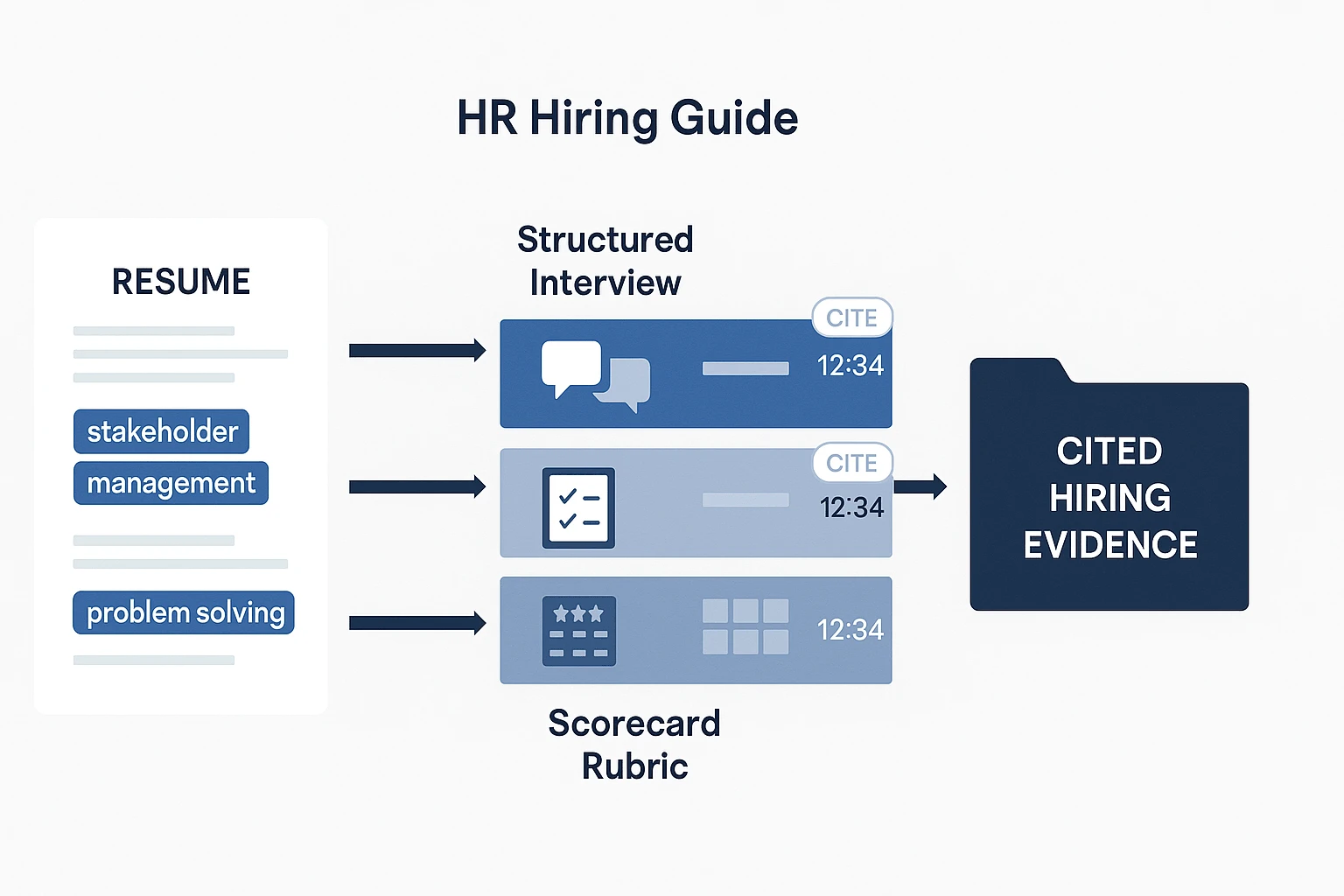
Resume claims are starting hypotheses. Test them with better evidence. The validity and utility of selection methods in personnel psychology: Practical and theoretical implications of 85 years of research (Schmidt & Hunter, 1998) conclude that work-sample tests and structured interviews are among the most valid predictors of job performance (reviewing 85 years of research).
Use structured interviews for judgment, collaboration, and problem solving. Use work samples for job tasks. Use references for context, not replacement evidence.
Replace vague "culture fit" with job-relevant behaviors: feedback response, customer empathy, ownership, and collaboration. To reduce bias, watch for:
- Halo effect: one strong answer affects all scores.
- Similarity bias: "they remind me of us."
- Confidence bias: polished delivery beats substance.
Example: turn "great stakeholder management" into a scenario question, a short prioritization work sample, and a 1–5 rubric covering clarity, trade-offs, follow-up, and evidence quality.
How Do You Build a Fair Candidate Selection Process?
A fair candidate assessment process starts with one rule: measure only what the job needs. The EEOC's Brief History of the Uniform Guidelines on Employee Selection Procedures states that the Uniform Guidelines on Employee Selection Procedures were issued in 1978, which is a useful reminder that job-relatedness and consistent use are not new ideas.
Match each assessment to one hiring question
Don't stack tests to look rigorous. Pick the lightest tool that answers the stage question:
| Stage | What to learn | Good assessment type |
| Early screen | Must-have skills and minimum fit | Skills-based questions or portfolio review |
| First interview | Judgment, communication, motivation | Structured interview and situational prompts |
| Final round | Applied execution | Time-boxed work sample or case exercise |
| Pre-offer | Past working patterns | Structured references with the same prompts |
Pair interviews with work samples
Interviews show how people reason. Work samples show what they can produce. Use a paired design: for each core competency, ask one structured interview question and request one artifact when possible.
For example, if "customer problem solving" matters, ask: "Tell us about a time you handled an unclear customer issue." Then use a 45-minute case task that mirrors the job. Tell candidates the format, time limit, scoring areas, and whether the work will be used only for evaluation.
Score before you compare
Set the rubric before reviewing candidates. A simple scorecard should include:
- Competencies tied to the role.
- Behavioral anchors for 1, 3, and 5 scores.
- Clear "meets" and "exceeds" examples.
- Notes that include quote or paraphrase, context, timestamp, and source.
Run a 15-minute calibration meeting before interviews. Have interviewers score one sample answer, compare gaps, and align on what each anchor means. For a deeper template, use a fair scorecard framework that keeps evidence separate from opinion.
Keep human judgment accountable
Use independent scoring first, then panel debrief. When scores differ, ask, "What evidence supports that?" not "Who argues best?" Overrides should require a written reason, the evidence considered, and a consistency check against prior decisions.
Fairness controls checklist:
- Same core questions for the same role.
- Same rubric and scoring scale.
- Reasonable accommodations offered and documented.
- Candidate communication sent before each assessment.
- Adverse-impact review on a set cadence, such as quarterly.
- Final decision notes linked to job-related evidence.
Where Should Assessments Sit in the Hiring Funnel?
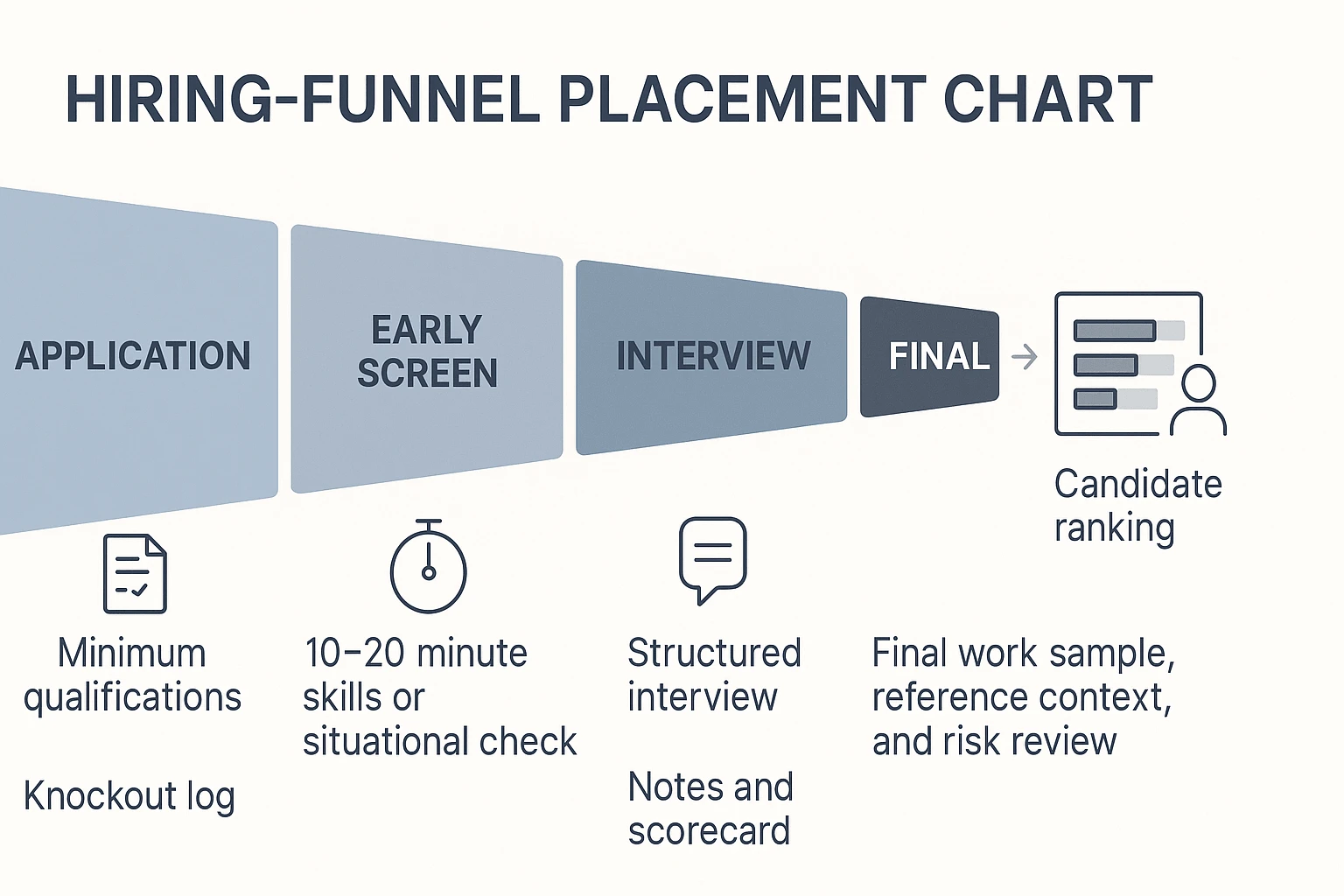
The best candidate assessment funnel uses the least effort needed to collect reliable evidence at each stage. Start with job-related must-haves, then add short skills checks, structured interviews, and final proof only when the candidate is still viable.
Application stage: screen for true minimums
Use knockout questions only for requirements that are legal, documented, and essential to the role. Common examples include work authorization where relevant, required licenses, location or shift constraints, and must-have certifications.
Avoid filtering on "nice to have" signals like brand-name employers, exact years of experience, or elite schools. If a criterion removes a candidate, record the job-related reason. For resume intake, a documented screening workflow helps keep early decisions consistent.
Early screen: use a 10–20 minute job-relevant check
At the screen stage, keep friction low. Use one of these:
- A short situational question tied to a real task
- A structured phone screen with the same prompts for every candidate
- A micro work sample that takes 20 minutes or less
Tell candidates the time limit, scoring areas, and accommodation options. Long tests this early create drop-off and often duplicate later evidence.
Interview stage: capture structured evidence
Structured interviews work best when each interviewer owns 1–2 competencies. Use the same questions, same rating scale, and same scorecard across the panel.
Good notes should capture what the candidate said or did, not a vague impression. In TicNote Cloud, teams can record interviews bot-free, edit transcripts, and save them into a hiring Project. Shadow AI can then summarize answers with citations to the transcript, so the panel can review evidence without replacing human judgment.
Final stage: confirm job fit, not popularity
Use the final stage for deeper job fit assessment: a presentation, realistic work sample, or case discussion. Reference checks should use structured questions about role-relevant behaviors, support needs, and risks. Don't let references become a popularity contest.
Example funnel for customer success
| Stage | Evidence collected | What gets scored |
| Application | Work authorization, SaaS support experience, schedule fit | Pass/fail minimums |
| Screen | 15-minute customer scenario | Communication, judgment |
| Interview | Structured competency questions | Discovery, empathy, problem solving |
| Final | Account-save presentation and references | Readiness, coaching needs, risk |
Candidate ranking should evolve as evidence accumulates. Early ranks are weak signals. Final ranks should combine scorecard ratings, cited notes, and agreed decision rules.
Avoid these anti-patterns:
- Stacking resume screen, test, case, and panel questions that measure the same skill
- Adding a new "must-have" after seeing a strong candidate
- Letting one interviewer override the scorecard with gut feel
How Should Teams Interpret Scores, Notes, and Candidate Ranking?
Candidate assessment scores should guide judgment, not replace it. The goal is to turn interview notes, work samples, and job fit assessment results into a clear decision trail that a hiring panel can explain later.
Use score bands, not false precision
A 4.2 versus 4.4 score can look scientific when it's really noise. Use score bands instead:
- Strong yes: clear evidence exceeds the role bar
- Yes: evidence meets the bar with manageable gaps
- Mixed: useful evidence, but unresolved risk remains
- No: evidence does not meet a required competency
Tie each band to behavioral anchors. For example, "Strong yes for stakeholder communication" means the candidate gave a specific example, named trade-offs, and showed measurable follow-through. This keeps panel debates focused on proof, not personal impressions.
Combine results with structured evidence
Use a simple weighted model based on the job success profile. If technical execution drives 40% of success, weight it more than a nice-to-have skill. Then add a minimum-bar rule for must-haves: a candidate can't advance if they miss a required skill, even if their total score looks strong.
When evidence conflicts, don't average it away. A strong work sample and weak interview should trigger a follow-up probe: "Can we verify whether the candidate can explain their process under normal job conditions?" Teams that already use structured resume scorecards can extend the same logic beyond screening.
Set pass-through and escalation rules
Define decision rules before reviewing candidates:
| Decision area | Rule |
| Automatic advance | Meets all must-haves and earns "yes" or better on top competencies |
| Additional review | Mixed evidence on one important skill or unusual score spread |
| Senior review | Accommodation questions, borderline must-have, or inconsistent interviewer notes |
| Stop | Fails a must-have with cited evidence |
Keep ranking evidence-led
A candidate ranking matrix should include: candidate name, target role, competency bands, must-have status, top 3 evidence points, source links or transcript references, key risks, mitigation plan, and final decision.
Avoid a spreadsheet of vibes. Write "did not define success metrics in the product launch example," not "lacks ownership." For runner-up candidates, document the "why not" clearly. This gives hiring teams a fairer record and makes every candidate selection decision easier to defend.
How to Turn Hiring Conversations Into Cited Assessment Evidence (Step-by-Step)
A strong candidate assessment process turns claims into proof. In practice, that means keeping resumes, job requirements, interview notes, work samples, and panel comments in one role workspace where the hiring team can review the same evidence, not scattered opinions. Here's how that workflow can look in TicNote Cloud, using the HR Recruiting skill agent as the example.
1) Add the HR Recruiting skill agent
In TicNote Cloud, open your workspace, click Add Agent, and browse the Skill Agent library. Choose HR Recruiting to add it to your agent list. The purpose is simple: help turn a pile of resumes and notes into structured evaluation outputs. It supports the hiring team; it doesn't make the hiring decision for them.
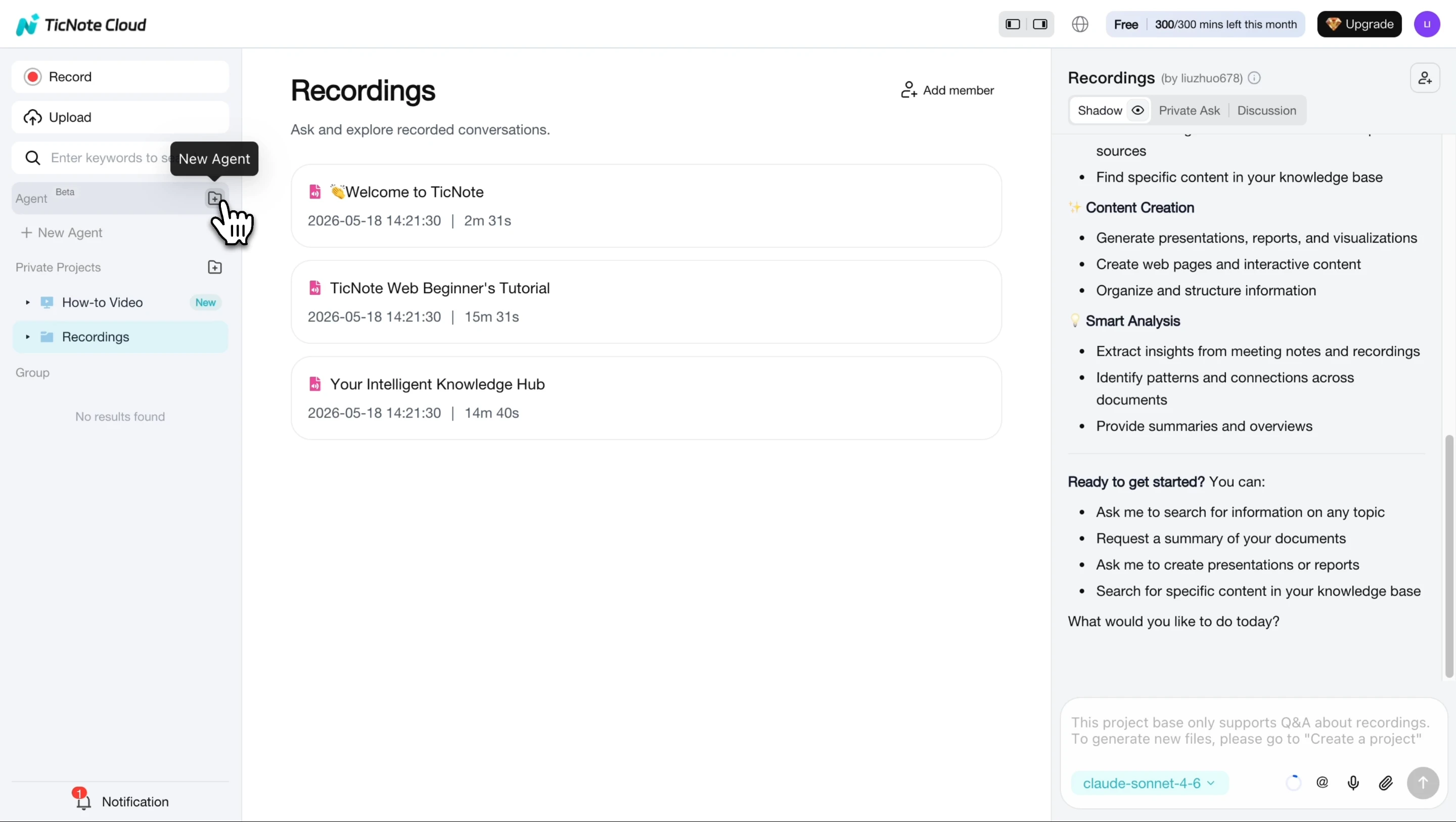
Once the agent is added, it appears in your list and is ready to use. No complex setup is required, which helps recruiters keep the process moving while still using a consistent framework.
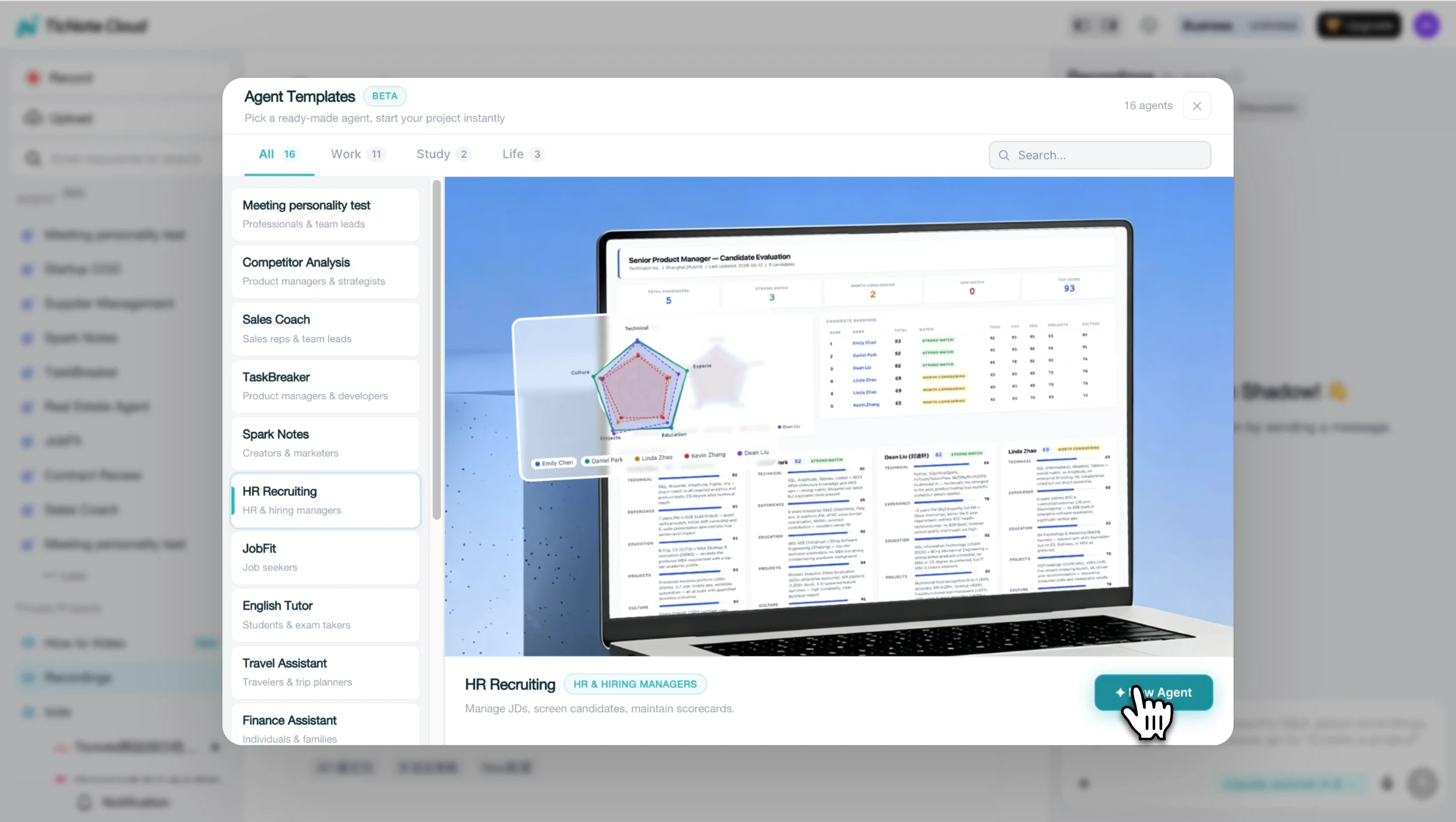
2) Create a role workspace and paste the job description
Next, create a dedicated Project or role folder for the open position. Paste the job description into the HR Recruiting agent chat. The agent extracts the job title, creates a role folder, and saves the job description as the reference point for the job fit assessment.
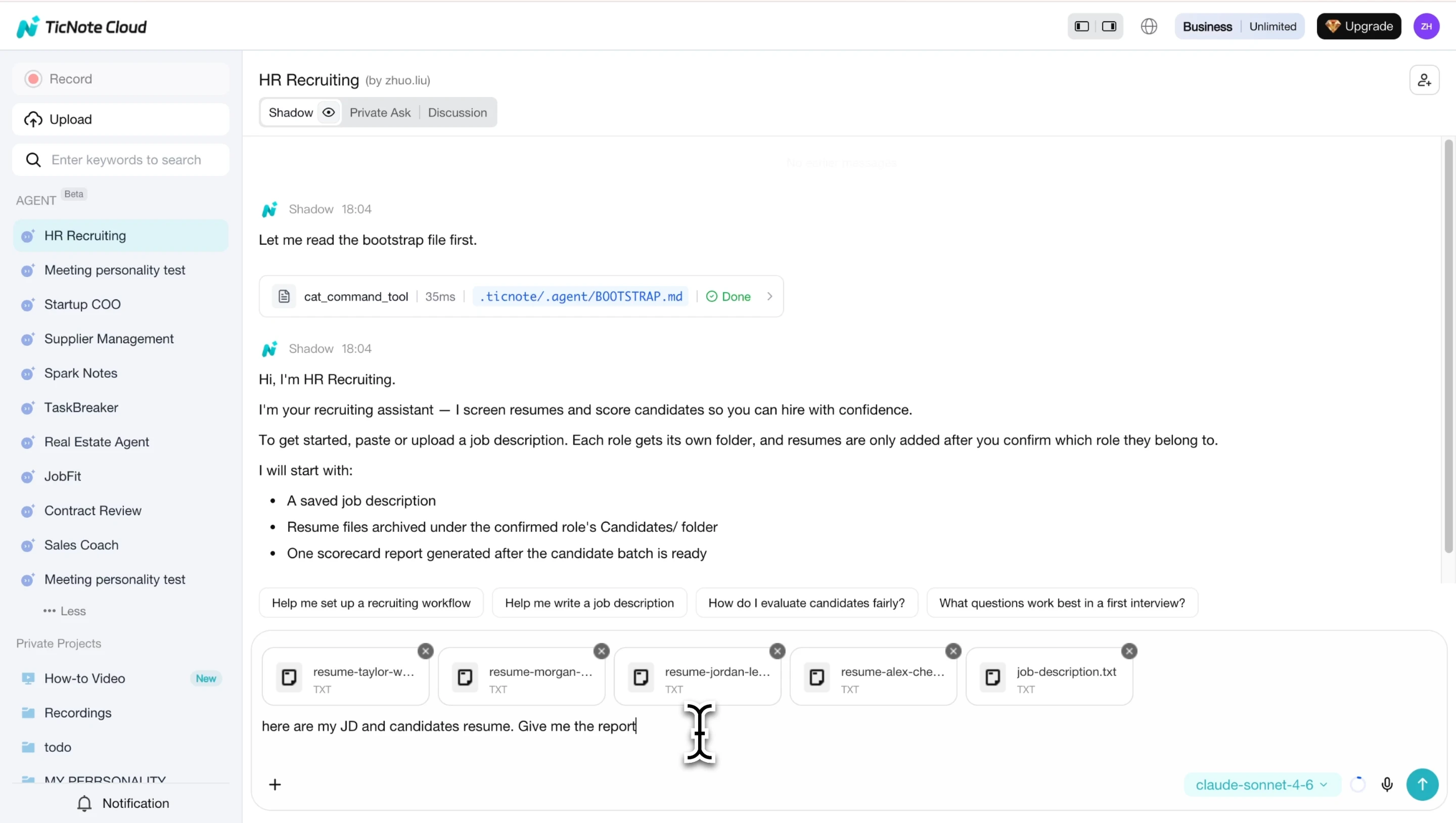
Before evaluating anyone, review the parsed job description. Confirm that requirements, responsibilities, must-haves, and nice-to-haves are separated clearly. This matters because every later score should map back to the same success profile.
3) Upload resumes and archive them with the role
Add resumes to the same workspace. You can paste resume text, upload PDFs, or drop files into the chat. Each resume is evaluated against the saved job description and archived in the job folder.
Use a simple naming rule such as CandidateName_Role_Date. That small habit makes the evidence trail easier to audit later, especially when a panel reviews 20, 50, or 100 applicants.
4) Open the evaluation report and review ranking signals
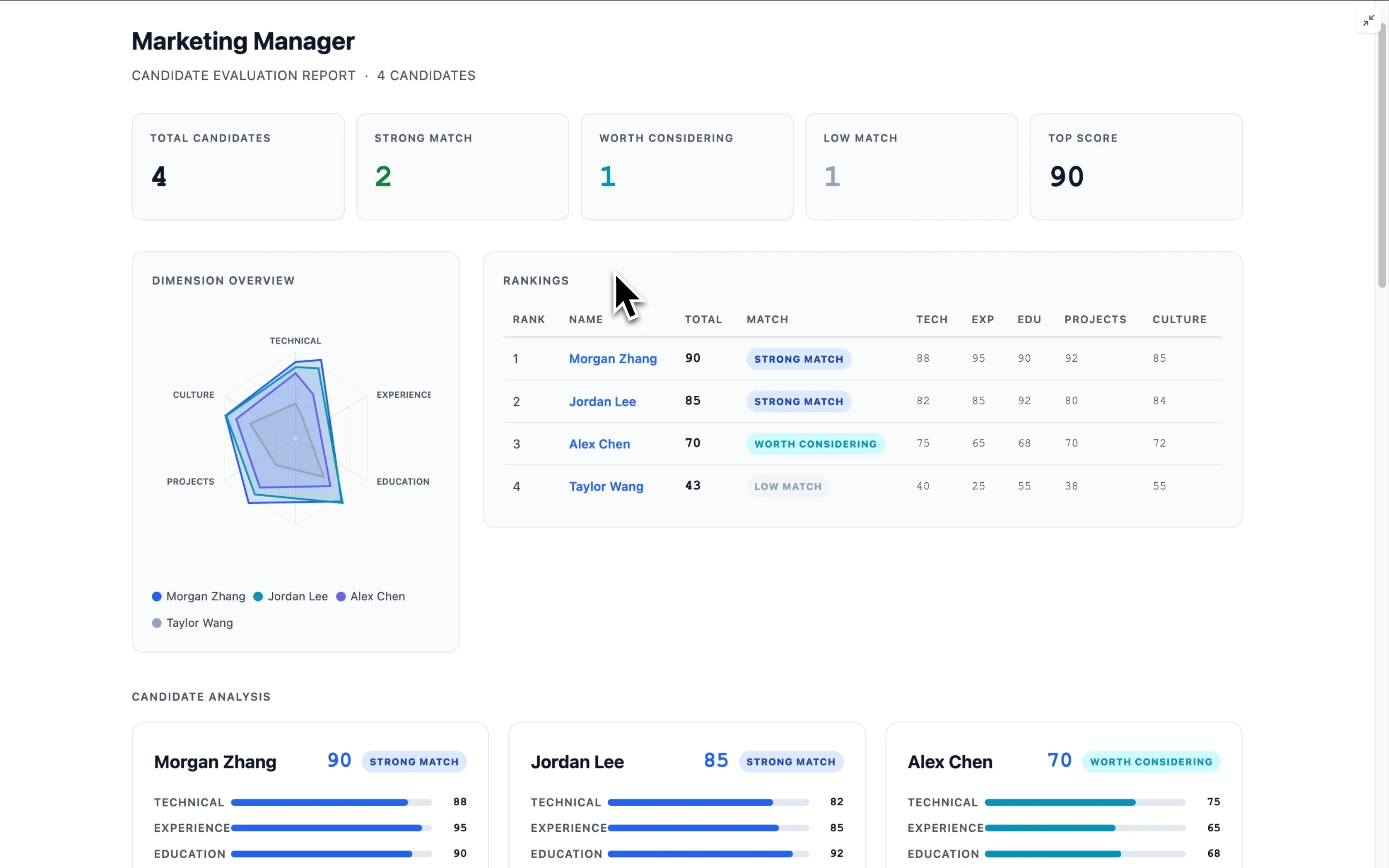
The agent generates an interactive HTML report for the role. Open it to review candidate ranking signals, radar charts, color-coded recommendations, and one-line justifications.
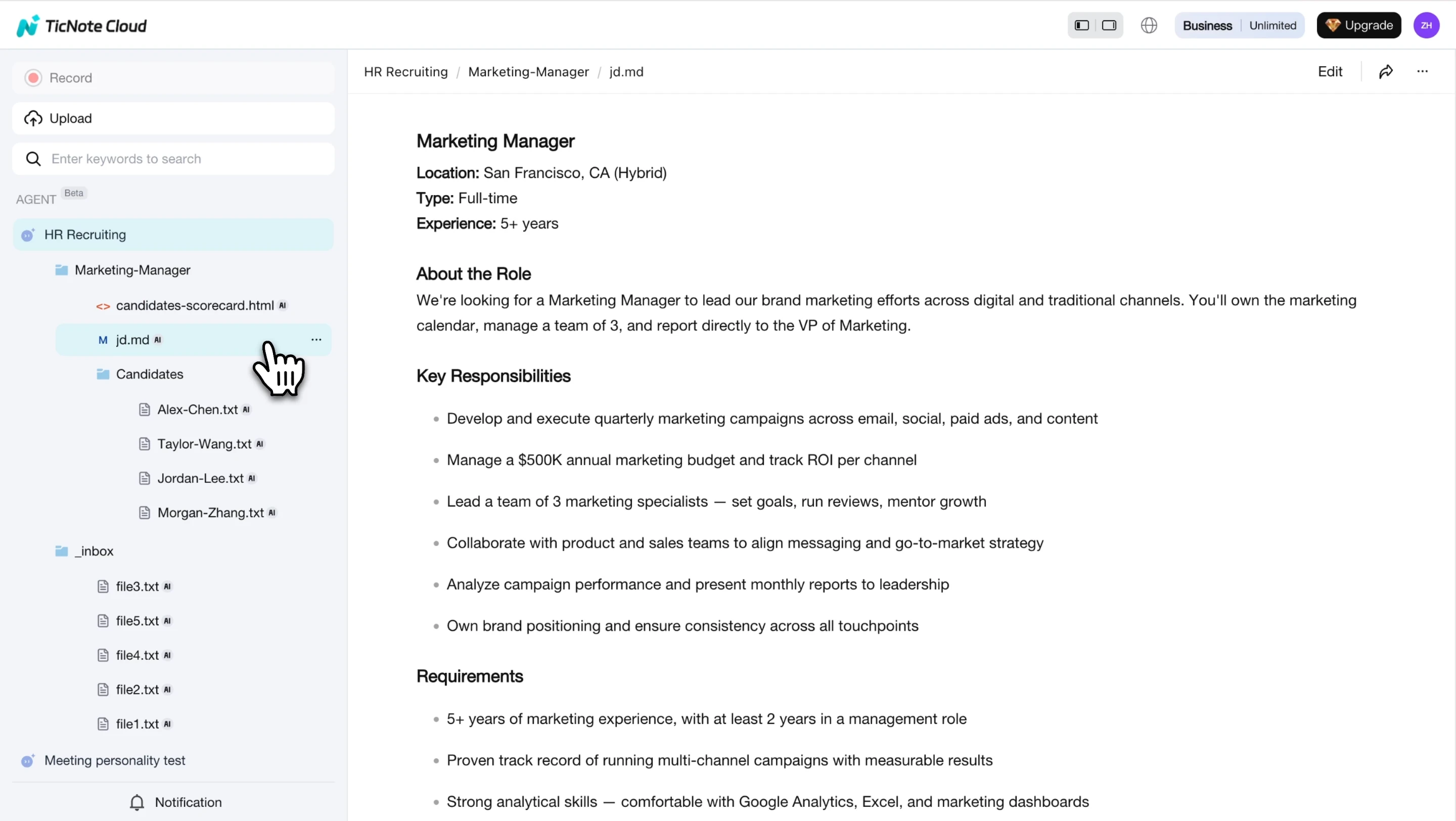
The default report uses 5 dimensions: Technical, Experience, Education, Projects, and Culture. Treat these as a starting framework, not a universal rule. A sales role, for example, may need pipeline judgment or customer discovery. An engineering role may need systems design or debugging.
Review one candidate's rationale per dimension first. Then compare candidates side by side for shortlisting.
5) Update the pool and re-evaluate consistently
When new resumes arrive, add them to the same role workspace and run the update evaluation or re-evaluate action. The same rubric is then applied across the refreshed pool.
Add one panel checkpoint before refreshing rankings: confirm that the rubric still matches the role. If the job description changes, document why. This prevents moving goalposts and keeps candidate selection fairer.
6) Add interviews and work samples, not just resumes
Resume screening is only the first layer. To assess real candidate fit, add interview transcripts, hiring manager notes, and work sample artifacts to the same Project.
Then use cross-file Q&A to ask focused questions:
- "Show evidence for competency X."
- "Summarize structured interview notes by competency."
- "List citations for each claim."
- "Compare Candidate A and Candidate B using only cited evidence."
This keeps the panel's review evidence-led. Instead of debating memory, the team can inspect source material.
Using the mobile app
The mobile app can help capture or upload candidate-related recordings and documents into the same role workspace. Keep the rules consistent: same Project, same file naming, same evaluation refresh. That way, mobile notes don't become a second, hidden hiring record.
Final Thoughts: Better Candidate Fit Comes From Better Evidence
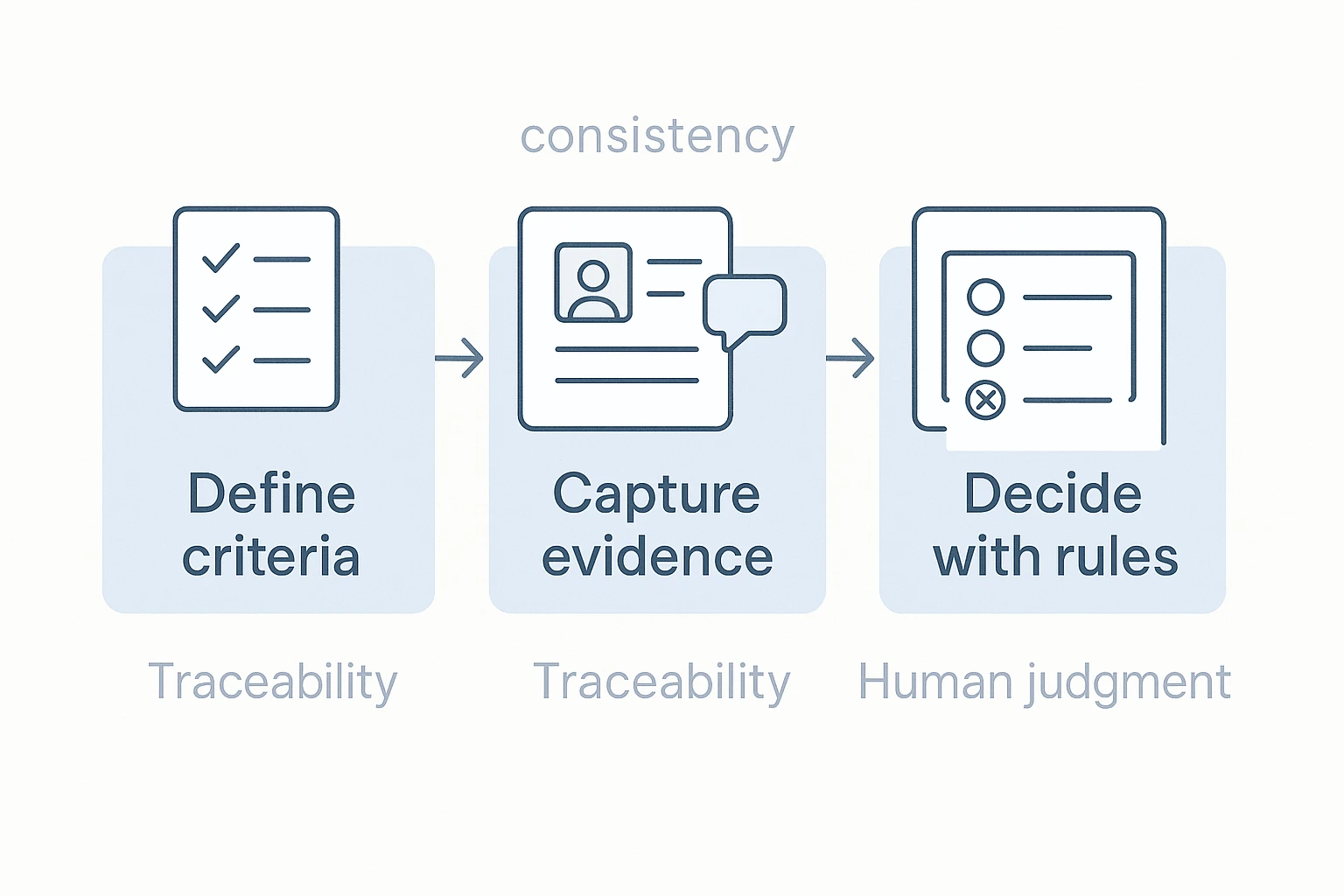
Candidate assessment works best as an evidence workflow, not a one-off test. Define success, capture job-relevant proof from structured interviews and work samples, then score that proof with the same rules for every applicant.
That chain improves candidate selection in three ways:
- Compare candidate fit across interviewers.
- Tie notes to real answers, tasks, and examples.
- Document why the panel chose, paused, or rejected.
TicNote Cloud can support the workflow as a skill agent workspace: record interviews without a bot, edit transcripts, organize each role in a Project, and ask Shadow AI for cited summaries across candidate files. It also fits a broader meeting system for cleaner decisions when panels need shared context.
Tools can organize evidence. People still decide. Final decisions need human judgment, accommodation awareness, and a clear record of why the selected person matches the role.
Try TicNote Cloud for Free. Create a Project for your next hiring process.