


 Extension
Intro
If you want an AI note taker for Zoom that also works beyond the Zoom window, this guide gives you the fast answer up front.
We compared 6 Zoom note-taking tools across four solution types — hardware recorder, native Zoom, browser extension, bot assistant, and bot-free desktop software — using the same buyer criteria: capture method, setup friction, transcript quality in multi-speaker calls, summary usefulness, privacy posture, collaboration workflow, storage limits, and long-run cost.
For remote professionals who also take phone calls or meet clients in person, TicNote Pods 4G stood out because it can record without a phone and push Live Summary while recording; for Zoom-first teams already paying for Zoom Workplace, Zoom AI Companion is the lowest-friction option. The contrarian takeaway: the real choice is not brand vs brand, but what kind of capture method fits the work that happens outside the Zoom window.
What you'll learn:
- How to choose between hardware, native Zoom, browser extension, and bot tools: the article starts with the category decision so the shortlist makes sense before pricing or feature comparisons.
- Which Zoom meeting note taker handles mixed workdays better: some tools only work inside scheduled online meetings, while others also cover phone calls and in-person conversations.
- How the 6 tools stack up in one normalized table: compare type, platform coverage, free tier, paid entry price, integrations, and post-meeting automation at a glance.
- What to pick for specific professional workflows: get direct recommendations for freelancers, consultants, project managers, founders, educators, and small teams.
- Where bot-free Zoom note takers actually win: privacy, less meeting friction, and broader capture beyond meetings with links to related device comparisons.
What is an AI note taker for Zoom, and why does everyone suddenly need one?
An AI note taker for Zoom records meeting audio, turns it into a time-stamped transcript, and generates summaries or action items. More advanced tools now also add speaker identification, translation, searchable archives, and document generation from recordings, which is why more teams are comparing options beyond a basic AI recording note taker.
The current market spans at least four distinct product types: native Zoom AI, browser extensions, bot-based meeting assistants, and hardware recorders. That shift matters because you're no longer choosing one generic "meeting notes app"; you're choosing a capture model that changes privacy, setup, and what gets recorded outside Zoom.
But here's what most articles won't tell you: basic transcription is becoming a commodity, so the real buying decision is less about who transcribes and more about what happens before and after the transcript.
- Capture method (how audio is obtained)
- Workflow depth (what the tool does with notes afterward)
- Privacy posture (where audio goes and who can access it)
How did we test these tools?
We tested these tools in a recent comparison review cycle using current public product facts and pricing. We focused on Zoom-first workflows, then checked whether each option could also support phone calls, in-person meetings, or cross-platform collaboration outside Zoom.
Meeting types tested:
- Weekly project sync (4 participants)
- Client discovery call (2 participants)
- Noisy team standup with overlap (6 participants)
- Training or lecture-style session (12 participants)
- Hybrid follow-up with phone and in-person handoff (3 participants)
Evaluation criteria (weighted):
- Capture flexibility (20% weight) -- we measured whether the tool works only inside Zoom or also covers calls, in-person conversations, and unscheduled discussions.
- Setup friction (10% weight) -- we compared how much effort is required to start recording, join meetings, or prepare devices and extensions.
- Transcript quality in noisy or multi-speaker calls (20% weight) -- we prioritized tools built to handle overlap, distance, and inconsistent meeting audio.
- Summary and action-item usefulness (15% weight) -- we evaluated whether the output is usable for follow-up, not just readable.
- Privacy posture (15% weight) -- we looked at whether tools are local-first, encrypted, bot-based, or fully cloud-dependent.
- Collaboration and integrations (10% weight) -- we considered search, exports, CRM or Slack workflows, and team use after the meeting.
- Long-term value (10% weight) -- we compared upfront device cost, free tiers, and whether monthly software fees compound over time.
TicNote is included because it is a direct fit for this keyword and buyer journey. We were explicit about its limitation: hardware does not get the same direct platform feed or native CRM workflow depth that software tools can offer. All other tools were evaluated independently.
Hardware vs. software: which approach fits you better?
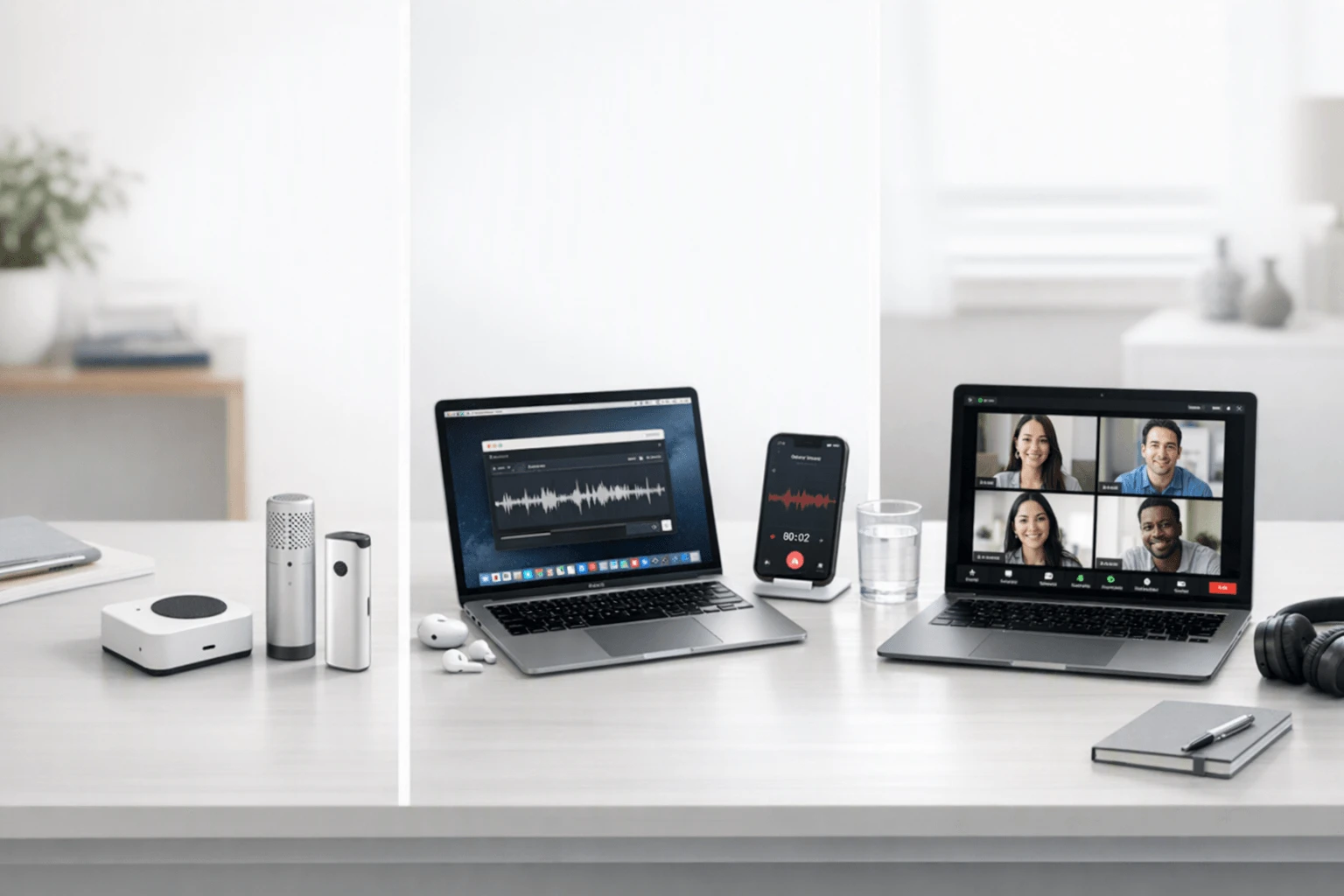
The first real decision is whether your Zoom notes should be captured by a physical recorder or by software inside the meeting stack. That choice affects what you can record, how much setup you need, and whether your notes stay useful beyond Zoom itself.
| Factor | Hardware | Software |
| Phone call recording | ✅ Core feature | ❌ Not supported |
| Face-to-face meetings | ✅ Set on the table | ❌ Needs workarounds |
| Online meeting transcription | ⭐️ Depends on room audio | ⭐️⭐️⭐️ Direct platform feed |
| Speaker identification | ⭐️ Limited | ⭐️⭐️⭐️ Automatic |
| Hands-free start | ✅ Auto-records on answer | ❌ Open app every time |
| Privacy control | ✅ Local-first, encrypted | ❌ Full cloud pipeline |
| CRM / workflow automation | ❌ Not supported | ✅ Otter, Fireflies.ai |
| Team collaboration | ❌ Not supported | ✅ Comments, search, export |
| Upfront cost | ❌ $129.99–$299.99 device | ✅ Free to start |
| Long-run cost | ✅ One-time purchase | ⭐️ Monthly fees add up |
Hardware wins when Zoom meetings are only part of the day and phone calls or in-person conversations still matter. TicNote Pods 4G can record without a phone nearby using its built-in 4G eSIM and can push Live Summary during recording, while HiDock P1 records Bluetooth earphone calls and room audio without sending a visible meeting bot into the call. Hardware also gives battery-backed capture and a more private, local-first starting point before sync. If you're comparing dedicated devices more broadly, this hardware note-taking guide helps frame where these recorders fit.
Software wins when the workflow starts and ends inside scheduled online meetings and the notes need to move into team systems fast. Otter is stronger for searchable transcripts, live notes, and collaboration inside Zoom, Meet, and Teams, while Fireflies.ai is stronger when CRM, ATS, Slack, or analytics workflows matter after the meeting.
The honest answer is both for mixed workdays. Software is better inside the meeting platform, but hardware is the one category software cannot replace when calls or in-person meetings are part of the job.
How do these 6 tools compare side by side?
If you want the fastest way to narrow your shortlist, start with the table below. It compares all 6 tools on the factors that matter most in practice: type, best fit, platform coverage, free access, starting price, integrations, and what happens after the meeting ends.
| Tool | Type | Best For | Platforms | Free Tier | Paid From | Integrations | Post-Meeting Automation |
| TicNote | Hardware | Professionals who need one system for Zoom plus calls and in-person meetings | Device + phone + desktop + browser | Free $0 with 300 min/mo; Plus included for hardware users with 600 min/mo | $129.99 device; Pro with device $79/yr | Cross-platform app and project knowledge base | Summaries, to-do lists, document generation, AI Q&A, podcast and slide generation |
| Zoom AI Companion | Botless | Zoom Workplace users who want native meeting summaries with no extra setup | Zoom | No standalone free tier; included with paid Zoom Workplace plans | Paid Zoom Workplace plan | Zoom Workplace ecosystem | Meeting summaries, action items, smart chapters, My Notes |
| Tactiq | Botless | Individuals who want real-time captions in Chrome without a meeting bot | Chrome on Zoom Meet and Teams | Limited free tier | Paid plans available | Export-focused browser workflow | Real-time captions, transcript export, post-meeting summary workflow |
| Fireflies.ai | Bot | Teams that need CRM-connected meeting notes and admin visibility | Zoom + Meet + Teams + web app | Free $0 plan | Pro $10/seat/month billed annually | CRM ATS Slack and analytics integrations | AI notes, search, comments, analytics, workflow automations |
| Otter | Bot | Teams that need searchable meeting archives and live notes across recurring calls | Zoom + Meet + Teams + mobile + web | Free plan available | Paid plans from Pro tier; Business surfaced from $19.99/user/month | Collaboration and sharing workflows | Live notes, searchable archive, summaries, custom vocabulary |
| HiDock P1 | Hardware | Mobile professionals who want bot-free Bluetooth earphone call and room capture | Device + macOS + Windows + iPhone 15+ + OTG Android | Unlimited free transcription | $169 device | HiNotes sync | Transcription, summaries, sync with optional Pro features like speaker ID and templates |
A few patterns stand out right away. If you want bot-free capture, your main choices here are TicNote, Zoom AI Companion, Tactiq, and HiDock P1. If you need broader post-meeting automation, TicNote, Fireflies.ai, and Otter push further beyond basic transcripts with summaries, action-oriented workflows, and searchable records.
The clearest split is between Zoom-only convenience and multi-context coverage. Zoom AI Companion is the simplest option inside Zoom Workplace, while TicNote is built for people who want one system across Zoom, phone calls, desktop use, browser access, and in-person meetings instead of a Zoom-only workflow.
The 6 best AI note takers for Zoom in 2026
If you want the short version, these six tools split into four clear categories: hardware recorder, native Zoom, browser extension, and bot assistant. TicNote ranks first because it covers more of your actual workday than Zoom-only software, while Zoom AI Companion, Tactiq, Fireflies.ai, Otter, and HiDock P1 each fit a narrower but valid buyer case.
1. TicNote — Best for professionals who switch between Zoom, calls, and in-person meetings
Best for: professionals who want one recorder workflow across online meetings, phone calls, and face-to-face conversations
TicNote is a hardware-based AI note-taking system built for buyers who do not want a Zoom-only tool. Its real differentiator is that the lineup covers multiple capture scenarios with distinct SKUs: Card for wallet-style recording, Card Lite for lower-cost one-button capture, Pods Wi-Fi for users who keep a phone nearby, and Pods 4G for phone-free recording and live AI summaries on the go. For remote professionals, consultants, founders, educators, and project managers, that matters because Zoom notes are often only one part of the workday, especially if you also capture video sessions with tools similar to this video note-taking comparison.
Standout features:
- Card starts at $159.99 with 64GB storage, 25-hour battery, and a 3-mic array in a 3 mm wallet-sized recorder.
- Card Lite costs $129.99 and keeps the same 25-hour battery and 3-mic array with modeless one-button recording.
- Pods Wi-Fi costs $249.99.
- Pods 4G costs $299.99 and uses a built-in 4G eSIM so the case can upload audio in real time without a phone nearby.
- Pods 4G adds Live Summary during recording and Quick Summary when recording stops.
- All TicNote devices support transcripts, summaries, to-do lists, speaker identification, AI Q&A, document generation, and 120+ languages for transcription and translation claims.
Pricing: Free plan: $0 with 300 min/mo | Plus for hardware users: $0/yr with 600 min/mo and 1,500 monthly credits | Device pricing: Card Lite $129.99, Card $159.99, Pods Wi-Fi $249.99, Pods 4G $299.99; Pro with device $79/yr
Pros:
- Covers Zoom, calls, and in-person meetings instead of only scheduled online calls.
- Pods 4G is one of the few options here that can record and upload without a phone nearby.
- Output goes beyond summaries into to-do lists, AI chat, reports, slides, podcasts, and project knowledge base workflows.
- Hardware users get a bundled Plus plan rather than starting from a blank software tier.
Cons:
- Hardware cannot pull a direct Zoom audio feed the way native or bot software can.
- The best experience requires choosing the right SKU, which adds buying complexity.
- Team collaboration and CRM automation are lighter than software-first tools such as Fireflies.ai or Otter.
- Pods 4G is the most capable option, but at $299.99 it is also the highest-cost TicNote device.
"In a mixed workday, the clearest TicNote workflow is using Pods 4G to capture a Zoom call from earbuds, get Live Summary while the call is still going, then reuse the same setup later for a phone call or an in-person follow-up without changing tools."
2. Zoom AI Companion — Best for Zoom Workplace users who want zero extra setup
Best for: paid Zoom users who want native summaries inside the platform they already use
Zoom AI Companion is the native option for buyers who want the least setup friction possible. It is built for teams that already live inside Zoom Workplace and want meeting summaries, action items, and smart chapters without adding a bot, extension, or separate device. For Zoom-heavy small teams, its main advantage is deployment simplicity rather than broad workflow coverage.
Standout features:
- Native Zoom Workplace experience with no separate recorder or browser extension.
- Meeting summaries and action items generated inside Zoom.
- Smart chapters help break long meetings into structured sections.
- My Notes support keeps output inside the Zoom environment.
Pricing: Included with paid Zoom Workplace plans | No separate standalone product tier exposed in the source data | No hardware purchase required
Pros:
- Lowest-friction setup in this list for existing Zoom customers.
- No visible meeting bot and no extra software category to manage.
- Natural fit for teams that do not need cross-context capture beyond Zoom.
Cons:
- Mostly confined to Zoom rather than broader phone-call or in-person capture.
- Less flexible than dedicated note-taking tools with deeper export or automation options.
- Value depends on already paying for Zoom Workplace.
3. Tactiq — Best for Chrome users who want bot-free live captions on Zoom
Best for: solo users and small teams who stay in Chrome and want real-time caption capture
Tactiq is a browser-extension approach rather than a full meeting intelligence platform. It is built for users who want real-time transcription without a visible bot and who are comfortable keeping their meeting workflow in Chrome across Zoom, Google Meet, and Teams. It fits lightweight professional use, but the browser dependency is a real limit for anyone who prefers the Zoom desktop client or mixed-device setups.
Standout features:
- Bot-free capture through a Chrome extension.
- Real-time transcription during live meetings.
- Works across Zoom, Google Meet, and Microsoft Teams in browser workflows.
- Fast export-oriented workflow for transcripts and notes.
Pricing: Limited free tier | Paid plans available | No hardware cost
Pros:
- No meeting bot joins the call.
- Fast to set up for users who already run Zoom in Chrome.
- Useful when the main job is getting live captions and exporting notes quickly.
Cons:
- Chrome-only approach excludes many default Zoom desktop workflows.
- Does not solve phone-call or in-person capture.
- Less depth in post-meeting workflow than tools built around search, analytics, or hardware capture.
4. Fireflies.ai — Best for teams that need CRM-connected Zoom notes
Best for: sales, recruiting, and operations teams that want notes to move into downstream systems
Fireflies.ai is built less like a simple note app and more like a meeting intelligence layer for teams. Its strongest case is when Zoom calls feed CRM, ATS, Slack, or analytics workflows after the meeting, because that is where its integrations and admin controls matter most. For project managers and cross-functional teams, it is strongest after the call rather than during the call.
Standout features:
- Free plan at $0 with paid tiers that scale by seat.
- Pro starts at $10/seat/month billed annually; Business at $19/seat/month; Enterprise at $39/seat/month.
- 100+ language support and speaker recognition.
- Comments, bookmarks, channels, user groups, analytics, and workflow integrations.
- Supports CRM, ATS, Slack, and broader team automation workflows.
Pricing: Free: $0 | Pro: $10/seat/month billed annually | Business: $19/seat/month billed annually | Enterprise: $39/seat/month billed annually
Pros:
- Strongest workflow depth here for CRM- and team-driven follow-up.
- Clear paid ladder for teams scaling usage and admin needs.
- Good fit for structured post-meeting operations, not just transcript storage.
- Security posture is relatively mature in the source data, including GDPR and SOC 2 Type II references.
Cons:
- Bot-based presence can be unwelcome in some client-facing or privacy-sensitive meetings.
- Monthly per-seat cost compounds faster than hardware over time.
- Overkill for solo users who only need a transcript and summary.
5. Otter — Best for searchable meeting archives and live notes
Best for: recurring remote meetings where teams want searchable transcripts and collaborative notes
Otter is one of the most recognizable software options in this category and is built around searchable voice notes, live transcription, and collaboration. It is a strong fit for teams that want an archive of meetings across Zoom, Teams, and Meet, especially when people need to search old conversations later. For educators, managers, and frequent meeting participants, its archive value is often more compelling than any single meeting summary.
Standout features:
- Auto-capture for Zoom, Teams, and Google Meet.
- Search, edit, organize, and share transcripts and recordings.
- Speaker identification, inline photos, and key phrase capture.
- Custom vocabulary on paid plans.
- Supports English, Spanish, French, German, Japanese, and Chinese in the pricing-page language set.
Pricing: Free plan available | Paid tiers include Pro, Business, and Enterprise | Business surfaced from $19.99/user/month in the source data
Pros:
- Strong archive and search experience for recurring meeting-heavy work.
- Useful collaboration model for teams that revisit notes later.
- Broader meeting-platform support than Zoom-only tools.
- Custom vocabulary helps in jargon-heavy environments.
Cons:
- Bot-based or auto-join style workflow is not ideal for every meeting culture.
- Paid value depends on how often teams actually search and reuse past conversations.
- Does not cover phone calls or in-person conversations the way hardware can.
6. HiDock P1 — Best for bot-free call recording with room capture
Best for: mobile professionals who use Bluetooth earphones for calls and want a hardware-first workflow
HiDock P1 is a portable hardware recorder aimed at buyers who care more about call and room capture than deep post-meeting software. Its clearest differentiation is bi-directional Bluetooth earphone recording plus bot-free capture, which makes it relevant for consultants, lawyers, educators, and managers who move between online calls and offline conversations. For Zoom-only users it is less specialized than software, but for call-heavy professionals it solves a real capture problem software cannot.
Standout features:
- P1 costs $169 and supports bi-directional Bluetooth earphone recording.
- Call, Room, and Whisper modes cover different capture scenarios.
- 64GB storage with Zoom, Meet, Teams, and Webex compatibility.
- HiDock says core transcription is unlimited and free.
- Optional Pro features add speaker identification, 39+ templates, and live transcription inside HiNotes.
Pricing: Device: $169 | Core transcription: unlimited and free | Optional Pro Membership adds advanced features; public pricing not fully disclosed in the source data
Pros:
- Strong fit for earphone-call users who dislike meeting bots.
- More affordable than premium hardware options while still covering room and call capture.
- Free core transcription improves long-run value.
Cons:
- Public pricing for advanced Pro Membership features is not fully transparent.
- Software workflow depth is lighter than Fireflies.ai or Otter.
- Laptop support and scenario fit are more constrained than all-purpose software tools.
Conclusion: how to decide
If phone calls or in-person meetings are part of your day, hardware is the category software structurally cannot replace. TicNote Pods 4G is the strongest fit when phone-free recording and Live Summary matter, while HiDock P1 is a practical lower-cost option for Bluetooth earphone calls and room capture at $169. If you prefer wallet-style recording instead, TicNote Card Lite starts at $129.99 and keeps the one-button hardware workflow simple.
If every meeting is already inside Zoom or another calendar-driven platform, Zoom AI Companion, Otter, and Fireflies.ai are easier to deploy and stronger for collaboration or CRM follow-up. But for heavy users, the long-term answer is usually both: software for scheduled online meetings, hardware for the calls and in-person moments software never reaches.