


 Extension
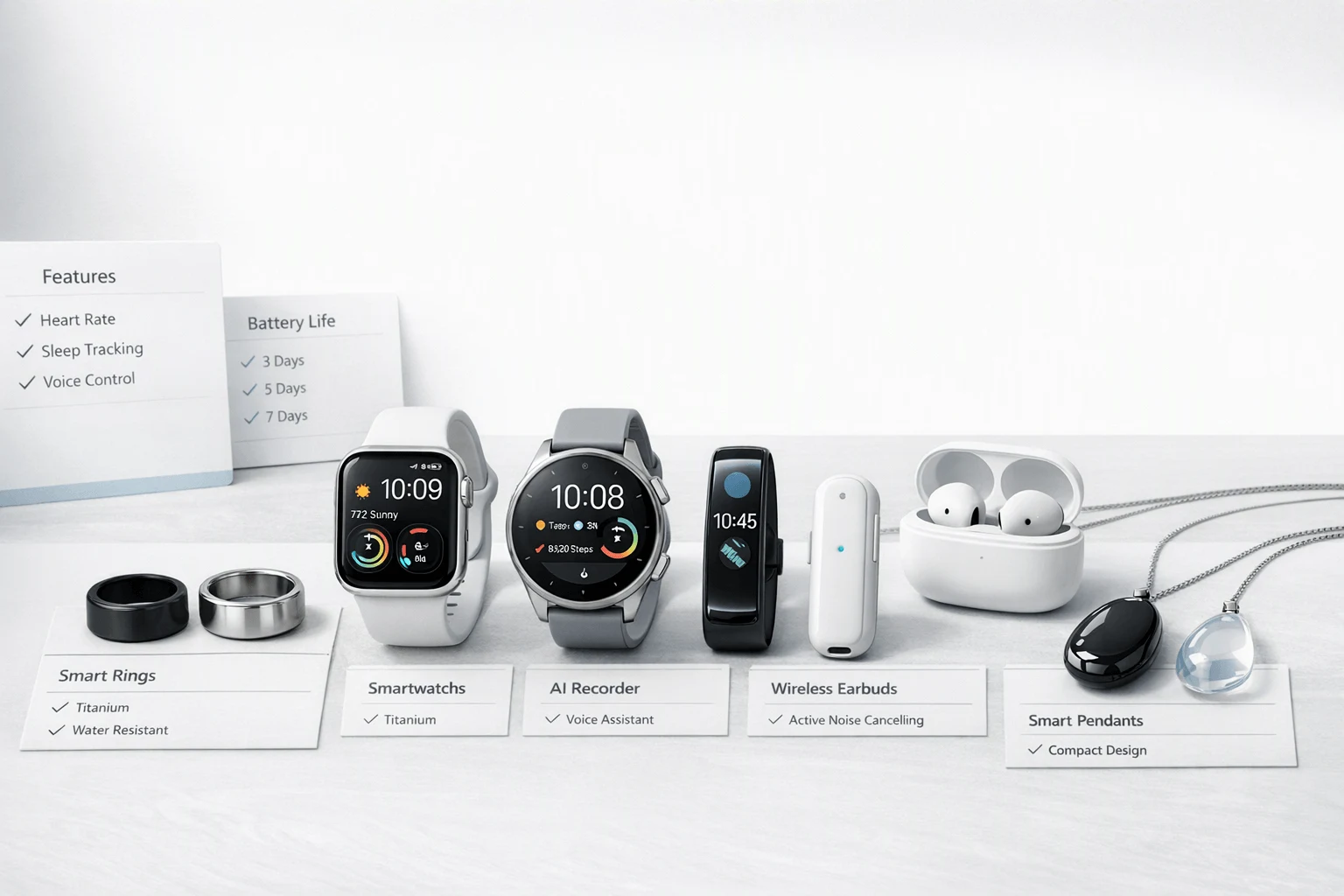
TL;DR: Wearable Tech picks for busy people
If you want the answer fast, jump to the side-by-side comparison table: the best ai wearables are only useful when they solve a clear job, not when they try to do everything. For structured notes from meetings, lectures, and calls, TicNote is the best overall pick because it turns recordings into transcripts, summaries, and action items with less friction than most rivals.
Quick picks:
- Best overall AI note taker: TicNote
- Best budget value: TicNote Card Lite
- Best for hands-free capture: Ray-Ban Meta
- Best for health tracking: RingConn if you want lower ongoing cost, or Oura if you accept a subscription
Keep the categories separate. AI voice recorders are for searchable notes, AI glasses are for hands-free capture, and smart rings are for sleep, readiness, and recovery data. Ray-Ban Meta is great for quick capture, but not for structured notes. The full guide includes a normalized comparison table, privacy guidance, and direct recommendations by use case.
Which of the best AI wearables are actually worth buying?
The best AI wearables are worth buying only when you match the device to the job. For most buyers, that means three clear lanes: an AI note taker for meetings and memory capture, AI glasses for hands-free photos, audio, and assistant access, and a smart ring for passive health tracking. If you want direct picks, TicNote is the best buy for structured conversation capture, Ray-Ban Meta is the strongest hands-free glasses option, and RingConn or Oura make the most sense for health-first users.
Pick by job, not by hype
Trying to compare every wearable as if it does the same thing creates bad buying decisions. A recorder has to produce clean transcripts, summaries, and follow-ups you can use later. Glasses need to stay comfortable on your face and make quick capture feel natural. Rings live or die on battery life, sleep tracking, and whether you will actually wear them 24/7.
Here is the simple framework:
| Category | Best for | Top pick |
| AI note taker | Meetings, lectures, client calls, memory capture | TicNote |
| AI glasses | Hands-free media, quick capture, voice assistant access | Ray-Ban Meta |
| Smart ring | Sleep, readiness, recovery, low-friction health tracking | RingConn or Oura |
The detailed side-by-side comparison table comes next, where price, battery, subscription, and privacy trade-offs are normalized across categories.
Focused devices win in real life
The most useful wearable tech solves one repeated problem well. That's why focused recorders and smart rings usually beat "do-everything" gadgets and always-listening pendants. In practice, buyers care about comfort, all-day battery, simple controls, and usable output. TicNote scores well because the hardware doesn't stop at recording; it turns conversations into transcripts, summaries, action items, and searchable project knowledge. By contrast, rings and glasses can be excellent, but in narrower roles.
Our scoring rubric
We rank devices on:
- Use-case fit
- Recording or sensing accuracy
- Comfort and wearability
- Battery life
- Subscription burden
- Privacy posture
- App workflow quality
- Total cost of ownership
That buyer-first method avoids one-size-fits-all rankings. A great ring should not beat a great note-taking wearable at meeting capture, and a great pair of glasses should not win on sleep data. Transparent trade-offs matter more than a single winner.
How TicNote leads the field for AI note-taking wearable tech
The best AI wearables only matter if they save time in real life. TicNote stands out because its lineup is split by actual use case: a wallet-ready card recorder, a simpler budget card, and earbuds built for mobile work. That makes it easier to buy the right tool instead of paying for features you won't use. If you want a broader category view first, this wearable device comparison guide gives the full landscape.
Pick TicNote Card for premium daily carry
TicNote Card is the polished option for professionals who want a recorder that disappears into a wallet. At $159.99, it pairs a slim body with serious capacity: TicNote Card is 3 mm thin. You also get 64GB of storage, up to 25 hours of battery life, a 3-mic array, and 10m pickup.
Why does the lever switch matter? It lets you move between earphone mode and speaker mode without digging through app settings. That's useful for consultants, account executives, and managers who jump from one-on-one calls to room meetings in the same day. After sync, the device turns recordings into transcripts, summaries, action items, and translation instead of leaving you with raw audio.
Buy TicNote Device See the Device
Choose Card Lite for lower cost and less friction
TicNote Card Lite is the easier recommendation for budget buyers. At $129.99, it keeps the core value: one-button recording, the same AI outputs, 25-hour battery life, a 3-mic array, and a built-in magnetic sleeve.
The trade-off is simple. Card Lite is less premium in finish and design, but faster to use. There is no lever and no mode switching. Just press and record. That lower-friction setup fits students, consultants, and busy teams that care more about speed than hardware polish.
Use Pods 4G when your phone can't be the bottleneck
TicNote Pods 4G is the most capable model in the range at $299.99. The charging case includes a built-in 4G eSIM, so it can record and upload without your phone nearby. That's the key difference.
You get live summary during meetings, quick summary as soon as recording ends, call recording when wearing the earbuds, and dual recording modes: earbuds for calls and online meetings, case for room capture. Storage is 32GB in the case, and battery runs about 13 hours with 4G on or about 22 hours with 4G off. For field work, client visits, healthcare rounds, and commuting professionals, that phone-free workflow is the feature that changes behavior.
Pick Pods Wi-Fi for global use and lower cost
TicNote Pods Wi-Fi costs $249.99 and keeps the core Pods experience without cellular dependence. It supports Wi‑Fi and Bluetooth sync, has no region lock, and makes the most sense for international users or anyone who usually keeps a phone close.
The trade-off is clear: summaries depend on the sync workflow rather than phone-free live upload. Still, for many buyers, that's a fair exchange for lower cost and broader global use.
Across all four SKUs, TicNote's edge is clarity. Each device fits a distinct job, and every model turns conversations into usable notes, reports, and follow-up documents rather than just storing recordings.
How do the top AI wearables compare side by side?
Most AI wearables solve very different problems, so the smart way to compare them is by role, not by hype. If you are shopping the best AI wearables, the real split is simple: AI note takers capture conversations, AI glasses help with hands-free media and assistant tasks, and smart rings focus on sleep, recovery, and passive health data.
Compare by job first, not just by price
| Device | Category | Best for | Starting price | Battery | Storage | Subscription | Privacy posture | Standout feature | Main limitation |
| TicNote Card / Pods | AI note taker | Meetings, lectures, searchable work knowledge | $129.99 | 22–25 hrs depending on model | 4GB to 64GB on card; 32GB case on Pods | Plus plan included with hardware | Private-by-default positioning, encrypted recordings, data not used to train AI models | Real-time transcription, summaries, document generation, cross-project AI search | Best value depends on choosing the right form factor |
| PLAUD Note / NotePin | AI note taker | Users who want a familiar recorder or clip-on path | $159 | 20–30 hrs depending on model | 64GB | Free tier plus stronger upsell to paid plans | Strong compliance claims including SOC 2 and GDPR | Broad templates, exports, and workflow integrations | More features are tied to subscription depth |
| Ray-Ban Meta | AI glasses | Hands-free photo, video, and voice assistant use | Around $299 | Usually a day of mixed use | Cloud/app dependent | No major required AI note workflow plan | Depends heavily on ecosystem and cloud assistant usage | Fast capture from your point of view | Not a true meeting-first note taker |
| Oura Ring | Smart ring | Premium sleep and readiness tracking | Around $299 | Several days | App/cloud based | Subscription commonly needed for full insights | Mature health-data posture and app ecosystem | Best-in-class sleep and recovery experience | Weak fit for recording or live note capture |
| RingConn | Smart ring | Buyers who want health tracking without monthly fees | Around $299 | 10–12 days | App/cloud based | No required subscription | Health-focused privacy posture | Long battery life; RingConn Gen 2 Specifications says 10–12 days | Less polished coaching than Oura |
Watch the trade-offs that change value
The biggest buying divide is ongoing cost. TicNote includes a hardware-linked Plus plan, which lowers the pain of the initial purchase and makes it easier to start using summaries right away. PLAUD is a close competitor in note-taking, but it leans more on paid software tiers as your usage grows.
Then there is phone independence. TicNote Pods 4G stands out because it can record and upload without your phone nearby. That matters for consultants, field workers, and anyone moving between meetings. Ray-Ban Meta is convenient for quick capture, but it is not built to turn long conversations into organized project knowledge.
Best verdict by use case
- Buy TicNote if your priority is meetings, lectures, interviews, or searchable team memory.
- Choose PLAUD if you want a familiar recorder format with strong templates and integrations.
- Pick Ray-Ban Meta if you want hands-free capture and voice assistant help.
- Choose Oura if sleep, readiness, and premium health insights matter most.
- Pick RingConn if you want smart-ring value without a monthly subscription.
If you want the strongest all-around tool for conversation capture, TicNote is the most practical pick because it records, transcribes, summarizes, and turns audio into usable documents instead of stopping at raw recordings.
What exclusive TicNote features matter most in daily use?
The best ai wearables only matter if they reduce work in the moment, not just store audio for later. That's where TicNote stands out: it moves from passive recording to active support during meetings, calls, lectures, and field work.
Get answers before the meeting ends
TicNote Pods 4G changes the value equation with Live Summary and Quick Summary.
- Live Summary shows key points while the meeting is still happening
- Quick Summary pushes a recap right after recording stops
- Action items and next steps appear faster, with less manual sorting
For project managers, consultants, and sales teams, that speed matters. You don't want a transcript two hours later if you need to send follow-ups now. In practice, this means less note cleanup and faster handoffs after client calls or internal reviews.
Search across meetings, not just inside one file
A basic recorder saves conversations. TicNote builds a working knowledge base.
With Project Knowledge Base and Ask AI, users can:
- find past decisions across multiple meetings
- pull exact quotes and commitments
- trace recurring issues by client, topic, or project
- ask questions across stored content instead of opening files one by one
That's a big step up from standalone AI voice recorders that leave each recording isolated. If you want a broader view of how wearable devices fit work and privacy needs, this is one of the clearest real-world differences.
Translate conversations as they happen
TicNote also does more than standard live transcription (text made from speech in real time). Its translation tools support bilingual subtitles, real-time translation, and specialized flows on the Pods line.
- Bilingual subtitles help multilingual meetings and classes
- Listen Translation lets the case sit near a speaker while you read translated text on your phone
- Conversation Translation supports back-and-forth communication with one person wearing the earbuds and the other reading the phone screen
That makes TicNote more useful for global teams, travel, customer support, and classroom use.
Turn recordings into finished work
The last daily-use advantage is output. TicNote can turn recordings into:
- meeting notes
- reports
- formatted documents
- slide outlines
- podcast drafts
- research summaries
That saves the most valuable resource: post-meeting admin time. Instead of just capturing audio, it helps turn conversations into usable work. See the TicNote device if you want wearable tech that does more than record and actually cuts follow-up work.
How to choose the right product
The right pick depends on the job you need done. Among the best ai wearables, note-taking devices, AI glasses, and smart rings solve very different problems. If your goal is to turn conversations into transcripts, summaries, action items, and usable documents, start with a purpose-built recorder, not a general wearable.
Choose TicNote for meeting notes that become useful work
TicNote is the strongest fit for professionals, students, consultants, and healthcare users who need reliable capture first and polished AI outputs second. The main advantage is simple: one recording can become a transcript, summary, to-do list, searchable knowledge base, or finished document.
Pick the model by where and how you work:
- TicNote Card: best for office workers and frequent meeting users who want a slim recorder in a wallet or pocket. At $159.99, it balances portability, 64GB storage, and a 25-hour battery.
- TicNote Card Lite: best for budget buyers who want one-button simplicity. At $129.99, it gives you the core recording and AI workflow for less.
- TicNote Pods Wi-Fi: best if you like earbuds and usually have your phone nearby. At $249.99, it suits commuters, remote workers, and global travelers who want no region lock.
- TicNote Pods 4G: best for field work, travel, and phone-free recording. At $299.99, it stands out with built-in 4G, live summaries during meetings, and uploads without your phone.
If you want a deeper side-by-side breakdown, this guide to wearable device reviews and comparisons gives more context.
Choose Plaud for a familiar recorder workflow
Plaud is the closest alternative if you want a simple clip-on or card-style recorder and a workflow that feels familiar. It makes sense for basic meeting capture, lectures, and standard summaries.
That said, compare the full cost before you buy. Plaud hardware starts around $159 to $189 for its core card models, and its higher-tier app value depends more on subscription limits. It can be a solid fit if you mainly want capture plus straightforward summaries, but less so if you need richer document generation, cross-project AI search, or phone-free recording.
Choose Ray-Ban Meta for hands-free capture, not structured notes
AI glasses make sense when convenience matters more than organized outputs. If you want point-of-view capture, open-ear audio, and fast access to a voice assistant, Ray-Ban Meta is the better category fit.
But be clear about the trade-off: glasses are not the best tool for meeting notes, searchable transcripts, or turning conversations into reports. They capture moments well. They do not replace a dedicated AI note taker.
Choose Oura or RingConn for health tracking
If health tracking is your priority, buy a smart ring. Oura is the polished choice for sleep, readiness, and recovery insights if you accept an ongoing fee. RingConn is the stronger value option if you want core ring tracking without a subscription.
That difference matters. Smart rings track your body. AI note wearables track your conversations and turn them into work. Don't try to make one device do every job. Buy one product for one core task, and you'll get better results.
Privacy, consent, and long-term value in AI wearables
Privacy should be part of the buying decision from day one, especially for the best ai wearables that record speech, calls, or sensitive conversations. Recording rules change by country, state, and setting, so don't assume one device policy fits all. In the U.S., for example, California Penal Code § 632 says it is unlawful to intentionally record a confidential communication without the consent of all parties.
Put consent first
Use clear disclosure in meetings, classrooms, clinics, and workplaces. Visible notice is the safest habit. For healthcare, legal, and HR use, confirm both local law and company policy before you record.
Check the privacy stack
Ask these questions before you buy:
- Is audio encrypted in transit and at rest?
- Is data used to train AI models?
- Is any processing done on-device?
- Can you delete files and control retention?
- Can admins audit access and exports?
TicNote says it offers encryption, private-by-default storage, no model training on user data, and some on-device processing. Treat that as a starting point for a buyer security review, not final proof.
Think beyond device price
Long-term value depends on the full system, not just hardware cost. Compare included cloud minutes, AI credit limits, export options, support quality, and whether the recorder still works well if you stop paying. That's what separates a useful tool from an expensive lock-in.
Trust matters here. With AI wearables, privacy isn't a bonus feature. It's core product value.
Final thoughts on the best wearable tech options
The best AI wearables are the ones that do one job well and fit into your day without friction. For most buyers, that means separating categories instead of forcing one device to do everything. If you want an AI note taker, wearable meeting recorder, or tool that turns conversations into transcripts, summaries, action items, and usable documents, TicNote is the best overall pick.
Here's the simple shortlist:
- Best overall for AI notes and meetings: TicNote
- Best for hands-free smart glasses: Ray-Ban Meta
- Best for health tracking: RingConn or Oura
TicNote stands out because it produces useful outputs, not just stored audio. It also gives buyers clear options: card recorders for simple capture, Wi-Fi earbuds for everyday use, and 4G earbuds for phone-free recording and live summaries. If you want more category context, see this wearable tech comparison guide.