


 Extension

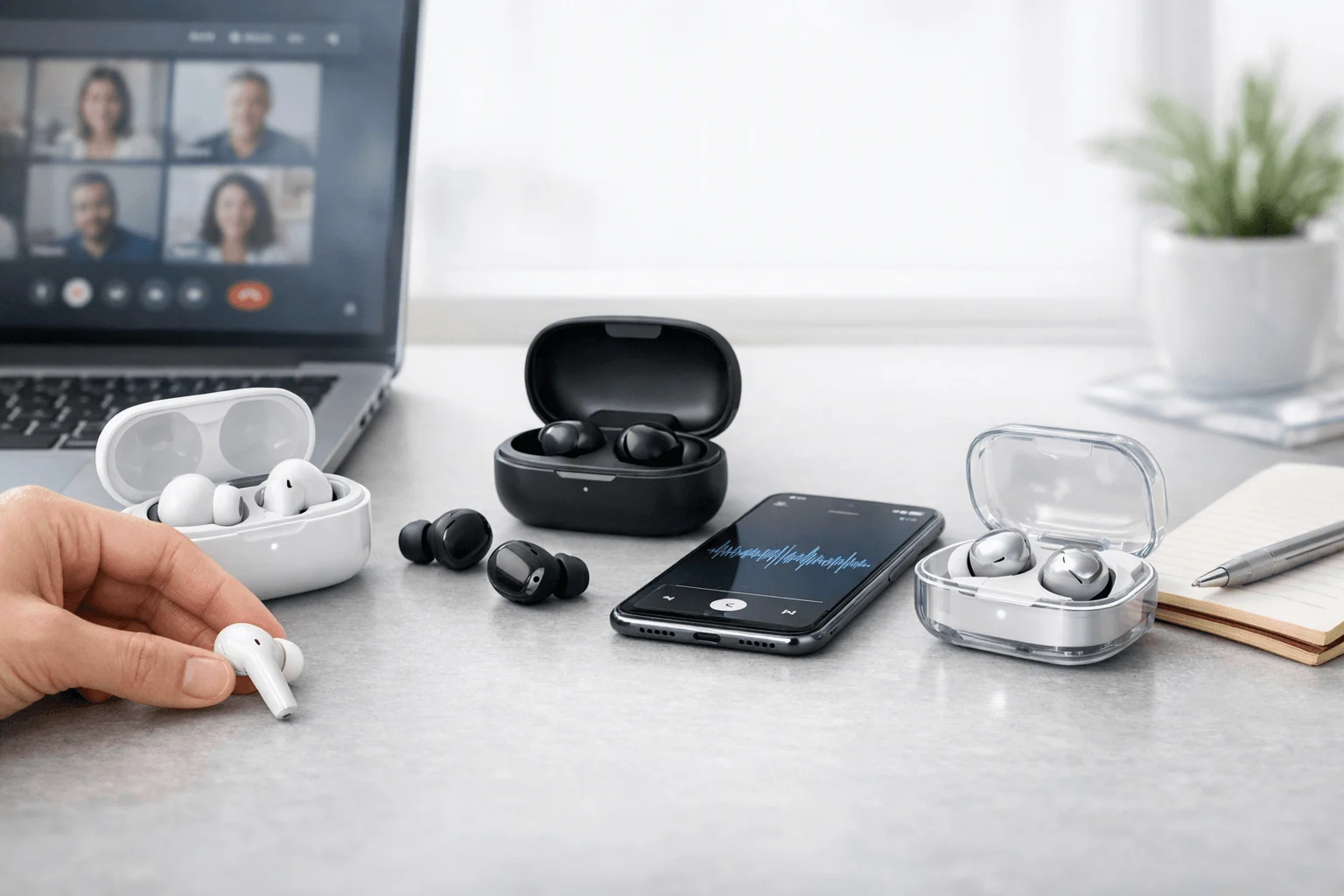
TL;DR: Voice Recorders and recording earbuds at a glance
If you need a fast answer, this recording earbuds review comes down to one thing: buy for capture reliability, not style. For work, the best pick is TicNote Pods 4G for phone-free calls, live upload, and in-meeting AI summaries, while TicNote Pods Wi-Fi is the smarter lower-cost choice for global users who want sync-based transcription without region limits.
This section is for professionals, students, consultants, and field teams who need one device to handle calls, room audio, transcripts, and summaries with less friction. Some buyers will still do better with a card-style recorder, especially if long battery life, simpler controls, and desk-to-meeting portability matter more than earbud wearability.
What matters most here:
- Recording reliability: can it capture calls and in-room speech consistently?
- Transcription workflow: are notes and summaries fast and searchable?
- Privacy controls: what stays local, and what syncs to cloud?
- Battery and value: does the price justify the workflow gain?
- Phone-free use: does it still work when your phone isn't nearby?
Recording earbuds review: what should buyers test first?
A useful recording earbuds review should start with work, not entertainment. Many earbuds sound good with music but break down in the moments that matter most: speech in a noisy room, call capture, searchable transcripts, and usable notes. If your goal is meetings, interviews, or class, it's smarter to judge them like productivity tools, much like this guide to dedicated recorders versus phones, before you care about bass or soundstage.
Test speech capture before sound quality
Buyers should score recording earbuds on six basics first:
- speech intelligibility (can you clearly understand every speaker?)
- call recording performance during mobile and app-based calls
- room pickup at different distances
- noise handling in cafés, cars, and open offices
- transcript accuracy from the recorded audio
- battery life and phone-free reliability
That lens reveals the real gap in this category. Plenty of earbuds are tuned well for music, yet their mics compress voices, miss quiet speakers, or produce transcripts that need heavy cleanup. For work use, clear words beat pleasing audio every time.
Follow the full workflow, not just the record button
The real test starts after capture. Pressing record is step one. Step two is finding the file fast, getting a searchable transcript, checking speaker identification, reviewing the AI summary, and turning that into follow-up tasks or a report.
Here are the workflow models buyers should compare:
- offline capture, then later sync
- live upload during recording
- post-upload transcription and summary
- phone-dependent capture with limited backup options
This is where work-focused systems stand out. TicNote's stack goes beyond raw audio with highlights, translation, speaker ID, cross-project AI search, and document generation. That matters for consultants, sales teams, and students who need decisions and action items, not just a sound file.
Verify privacy and transcript controls
Privacy checks should be non-negotiable. Confirm where data is stored, whether recordings are encrypted in transit and at rest, how long transcripts are retained, and whether cloud upload is required for transcription. Under Regulation (EU) 2016/679 (General Data Protection Regulation, GDPR), personal data must be kept "for no longer than is necessary for the purposes for which the personal data are processed" under Article 5(1)(e).
Also check consent laws in your region before recording calls or meetings. And don't overlook speaker identification plus source-linked summaries. Those features make reviews, follow-ups, and quote checks far faster for interviewers, account teams, and lecture-heavy users.
These are the tests that matter most, and they set up the next sections on TicNote Pods 4G and TicNote Pods Wi-Fi.
TicNote Pods 4G review: is it the best fit for phone-free work?
For mobile professionals, the biggest gap in a recording earbuds review is simple: most earbuds still assume your phone is always nearby. In real work, that breaks fast. Sales reps move between client sites, consultants jump in and out of workshops, and field teams often need a record, transcript, and summary even when their phone is in a bag, has weak signal, or can't stay in hand all day.
TicNote Pods 4G is one of the few models built around that problem first. Its built-in 4G eSIM lets the device record and upload without depending on a nearby phone, while offline recording acts as a fallback when connectivity drops. That matters more than it sounds. According to GSMA Intelligence: eSIM (2024), as of 26 March 2024, there were 116 countries and territories with 295 commercial eSIM mobile network services worldwide.
Work better when the phone isn't part of the workflow
The key advantage here is reliability. Pods 4G auto-switches between two capture modes:
- earbuds for calls and online meetings
- case recording for room conversations and in-person meetings
- automatic call recording when you're wearing the earbuds
- offline capture that syncs when connection returns
That setup removes a lot of friction. You don't have to decide which recorder to bring, prop up your phone on a table, or hope a meeting app saves a clean file. For road warriors, that's the difference between having a usable record and losing key details.
Cut post-meeting admin fast
Pods 4G earns its higher price because the value isn't consumer audio tuning. It's workflow speed. At $299.99, you're paying for phone-free upload, live AI summary during recording, and Quick Summary the moment the session ends. The included Plus plan also adds more value than many buyers expect.
Core work features include:
- real-time transcription
- translation support with bilingual subtitles
- speaker identification
- searchable transcripts
- live highlights and annotations
- cross-project AI search across recordings
- photo-to-transcript syncing for visual context
In practice, these tools reduce the usual cleanup work after meetings. Instead of relistening to calls, you can search quotes, pull action items, and ask AI to trace decisions across projects. If live recap matters, it's also worth seeing how these earbuds fit into broader live-summary meeting tools.
Where Pods 4G still asks for trade-offs
This model isn't the cheapest or the lightest option in the category. Battery life drops to about 13 hours with 4G on, versus about 22 hours with 4G off. That's still workable for a full day, but heavy travelers should note it.
The other watch-outs are straightforward:
- $299.99 is a premium price versus sync-only models
- buyers should confirm regional cellular suitability before team rollout
- privacy and cloud-sync policies should be reviewed for regulated work
Verdict
TicNote Pods 4G is the best fit for phone-free work. Among recording earbuds aimed at meetings, notes, and call capture, it stands out because it treats recording as a job-to-be-done, not a side feature. If you need dependable capture, transcription, AI summaries, and uploads without relying on a phone, this is the strongest work-first option in the current TicNote lineup.
See the Device or compare the wider lineup on the TicNote brand page.
TicNote Pods Wi-Fi review: who should choose the global sync model?
For most desk-based buyers, TicNote Pods Wi-Fi is the smarter buy. In this recording earbuds review, it stands out for global usability, a lower entry price, and a workflow that still covers the features most professionals actually use: call capture, meeting recording, transcription, summaries, and searchable notes. If you work in offices, campuses, coworking spaces, or hybrid setups, this model makes more sense than a 4G pair you may not fully use.
A product embed fits well here, followed by direct links for readers comparing the model now: see the device or buy TicNote Pods Wi-Fi.
Save money without losing the core workflow
At $249.99, Pods Wi-Fi costs $50 less than Pods 4G. That lower price still gets you the same broader TicNote Cloud workflow, including transcription, translation, speaker identification, AI search across recordings, and post-meeting summaries. Battery life is also strong at about 22 hours, which is notably better than Pods 4G when 4G is active.
For many users, that's the key value story: you give up live, always-connected processing, but keep the parts that matter after the meeting ends.
- Wi-Fi and Bluetooth sync for uploads
- Auto transcription after upload
- Auto-switch recording behavior: earbuds for calls, case for room capture
- Call recording support when worn during calls
- Offline recording, then sync later
- AI summaries after upload
- Translation and bilingual subtitle support
- Speaker identification for clearer transcripts
- No region lock, which makes it easier to deploy internationally
Know the trade-offs before you buy
Pods Wi-Fi is not truly phone-free for sync. It can record offline, but it depends on your phone nearby when it's time to move files and start cloud processing. It also does not provide live summaries during active recording like the 4G model.
That said, those limits matter less in fixed work settings. If you're usually near your phone or laptop, the sync-based system feels simple. It also makes this pair a strong fit for teams comparing wearable note-taking devices for meetings and daily capture.
Who should pick it?
Choose Pods Wi-Fi if you want dependable transcription earbuds for global use, office work, classes, or hybrid meetings. It delivers the same work-first software experience as the 4G model, but at a better device price and with fewer deployment headaches across regions.
How do TicNote recording earbuds compare with other work-focused options?
A good recording earbuds review should compare work results, not music features. For meetings, calls, and AI notes, the key test is simple: how fast the device captures audio, turns it into usable text, and syncs it back to your workflow. If you want a broader look at non-earbud options too, this guide to AI recorders for meetings and calls helps frame where earbuds fit.
Compare by work criteria, not sound tuning
| Product | Price | Storage | Battery | Phone-free recording | Call capture | Summary timing | Sync method | Speaker ID | Translation | Privacy posture | Best use case |
| TicNote Pods 4G | $299.99 | 32GB case + 256MB earbuds | ~13 hrs 4G on / ~22 hrs 4G off | Yes | Yes, auto when worn | Live during recording | Built-in 4G upload | Yes | Yes | Encrypted sync, private-by-default claims | Field work, travel, urgent recaps |
| TicNote Pods Wi-Fi | $249.99 | 32GB case + 256MB earbuds | ~22 hrs | Records offline, but needs phone nearby for sync | Yes | After upload | Wi-Fi + Bluetooth | Yes | Yes | Same cloud privacy model | Global teams, office use, lower cost |
| App-led AI earbuds | Varies | Often app/cloud dependent | Varies by earbud and phone use | Usually no | Sometimes limited or app-based | Usually post-upload | Phone app + cloud | Often limited | Often strong on translation | Depends on app vendor | Travel translation, casual notes |
| Dedicated AI recorder | Varies | Often higher local storage | Often longer | Yes | Usually weaker for earbud call use | Often post-recording | USB, app, or cloud | Often yes | Sometimes | Often better local-control options | Long meetings, interviews, lectures |
For battery context, mainstream earbuds still optimize for listening first. Google says the Pixel Buds Pro 2 offer up to 8 hours of listening time with ANC on and up to 30 hours with the case in its Google Pixel Buds Pro 2 Specs, which is useful context but not the same as all-day meeting capture.
Choose between 4G speed and Wi-Fi flexibility
The real split is clear. TicNote Pods 4G are better when speed matters more than price. They can upload without a phone nearby, generate live summaries during the meeting, and fit mobile teams that move between cars, job sites, and client offices.
TicNote Pods Wi-Fi make more sense when cost, global use, and simpler sync matter more. They keep the same earbud-plus-case workflow, but rely on Wi-Fi and phone-assisted syncing instead of live cellular upload.
- Field teams: Pods 4G
- Office staff: Pods Wi-Fi
- Students: Pods Wi-Fi
- Interviewers in fast-moving settings: Pods 4G
See where app-led earbuds fall short
Many app-led earbuds focus on translation or convenience. That's useful, but work buyers often need stronger meeting capture, offline recording, searchable transcripts, speaker tagging, and AI outputs tied back to source moments. That is where TicNote feels more complete.
Still, earbuds are not always the best answer. If you rarely need call capture through an earbud form factor, a dedicated recorder can be the better value. The balanced view is this: Pods 4G win on mobility and urgency, Pods Wi-Fi win on global flexibility and price, and standard app-first earbuds usually trail both for serious note-heavy work.
How to choose the right TicNote product for your workflow
The best choice depends less on sound quality alone and more on how you actually work. In a recording earbuds review, the right pick comes down to three questions: Do you need phone-free capture, do you travel across regions, and do you want earbuds at all?
Choose Pods 4G for live, phone-free work
TicNote Pods 4G is the strongest fit for people who record while moving. If you work in sales, consulting, field inspections, or travel-heavy roles, the built-in 4G connection is the key advantage. It can record, upload, and generate live summaries without your phone nearby, which matters when signal is uneven, your phone stays in your bag, or you need notes before the meeting even ends.
It's also the better pick for call-heavy days. The earbuds handle calls and online meetings, while the case can capture room conversations when idle. At $299.99, it's the premium option, but it solves a real workflow problem rather than adding a small convenience.
Buy TicNote Pods 4G if you need live summaries and true phone-free capture on the move.
Choose Pods Wi-Fi for lower-cost global use
TicNote Pods Wi-Fi is the smarter default for many office, campus, and international users. It costs $249.99, runs about 22 hours, and skips the 4G premium if your phone is usually nearby anyway. The big practical win is that it has no region lock, which makes it easier to recommend for global teams, study abroad, and cross-border travel.
You give up live summary during recording, but you still get the core workflow after upload: transcription, summaries, speaker ID, and AI search.
See TicNote Pods Wi-Fi if you want strong work features at a lower price with global use.
Choose a card-style recorder when earbuds aren't ideal
If you prefer long sessions, simple room capture, or just don't like wearing earbuds, TicNote's card-style recorders make more sense. The AI Voice Recorder is the better premium everyday-carry option, while the Lite is the budget-friendly pick. If you're comparing beyond earbuds, this guide to choosing the right AI recording device is the next step.
What are the biggest trade-offs with recording earbuds?
The biggest downside in any recording earbuds review is simple: earbuds promise hands-free capture, but they still obey the limits of physics, fit, and policy. They're excellent for calls, quick notes, and small meetings, yet crowded rooms, long wear sessions, and cloud compliance checks can turn a smart workflow tool into a partial solution.
Expect weaker results in noisy rooms
Even strong voice recorder earbuds struggle when three people talk at once, the speaker is across the table, or HVAC noise hums in the background. That affects both the audio file and the transcript. In practice, transcription is most accurate when one main speaker is close, speech is paced, and side chatter stays low.
Set realistic expectations:
- Best case: 1:1 calls, online meetings, interviews, and quiet offices
- Mixed case: small conference rooms with moderate overlap
- Tough case: open offices, cafés, trade shows, cars, and group discussions with cross-talk
Earbuds with call capture and ENC (environmental noise cancellation) help, but they don't fully solve overlapping speech.
Separate comfort from workflow reliability
Earbud comfort matters more at hour three than minute ten. Ear fatigue, loose fit, and case dependence are common trade-offs. Battery claims also need context: playback battery is not the same as real recording endurance when upload, 4G, Wi‑Fi, or live AI summaries are active.
For work buyers, check:
- how long the system records in real conditions
- whether the case must be nearby
- recharge speed between meetings
- whether live sync shortens battery life
Verify privacy before rollout
Before purchase, confirm consent rules, cloud region, retention controls, encryption, admin access, and whether AI summaries can be traced back to source text. That matters because under UK GDPR, Article 4(1), "personal data" means any information relating to an identified or identifiable natural person. TicNote says its platform is encrypted, private by default, and not used to train AI models, with traceable outputs and cloud controls. Those are strong claims, but procurement teams should validate them, not just accept them.
Final thoughts
The best picks in this recording earbuds review are the ones that capture clear speech, create usable transcripts, and cut note-taking time after every call or meeting. Flashy consumer audio features matter less here than reliable recording, clean sync, and fast summaries. If you want deeper context on device trade-offs, this guide to comparing AI note-taking hardware is a useful next read.
- Best for phone-free work: TicNote Pods 4G
- Best value for global and hybrid users: TicNote Pods Wi-Fi
- Best buying lens: prioritize call capture, transcript quality, privacy controls, and workflow speed
TicNote Pods 4G is the stronger choice if you need true phone-free capture, live AI help during meetings, and dependable recording on the move. TicNote Pods Wi-Fi is the smarter buy for most office, remote, and international users who want lower cost, global use, and a sync-based workflow that still covers meetings, calls, and AI notes.
Compare the pricing, review the table above, and visit the product pages that match your workflow before you buy.