


 Extension
TL;DR: skill agent workflow for faster competitor research
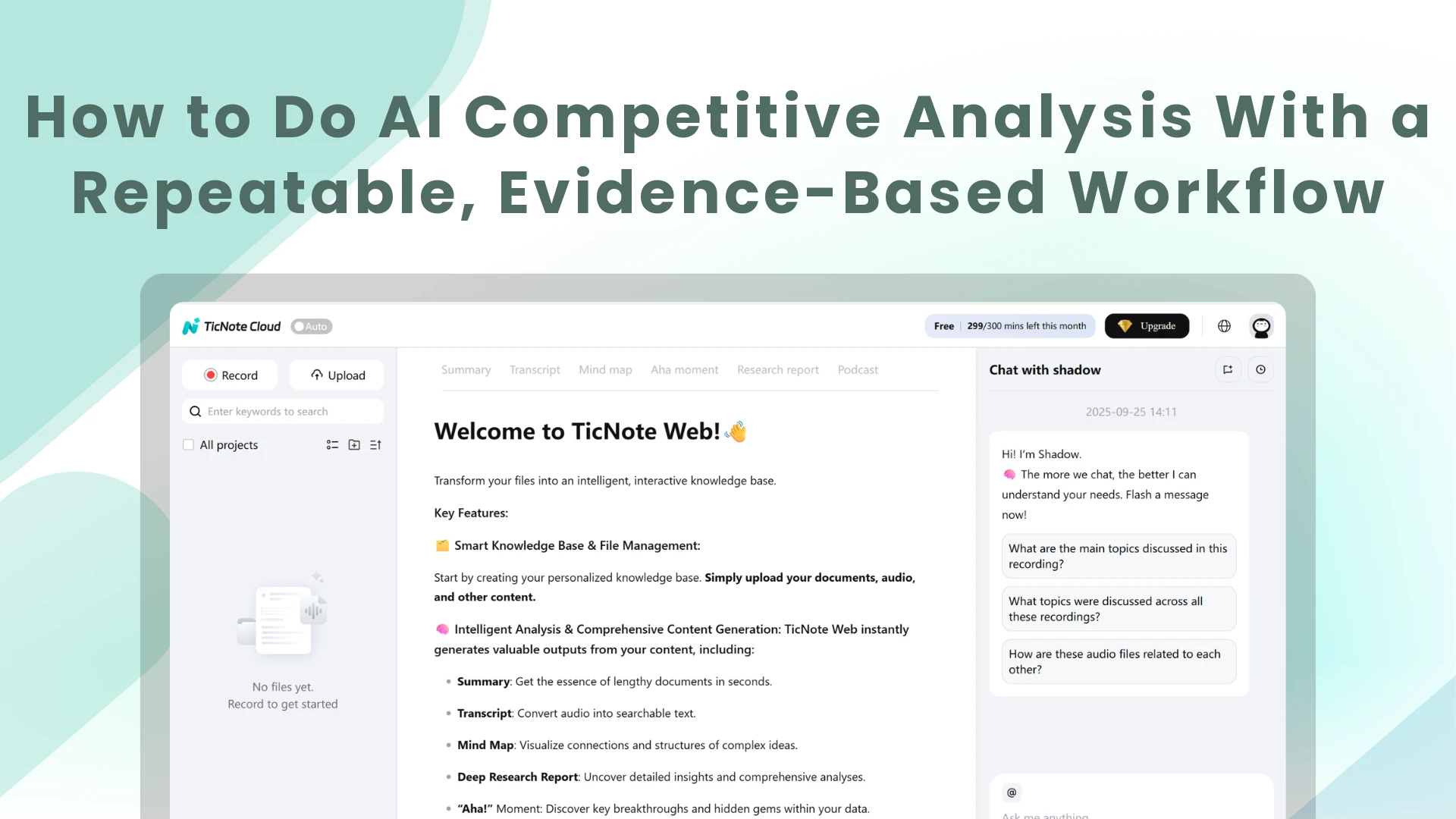
If you want faster AI competitive analysis, the quickest path is to try TicNote Cloud for free and run a repeatable workflow that keeps every claim tied to source material. This process is built for product marketers, PMs, founders, consultants, researchers, and cross-functional teams that need to turn messy inputs into clear, cited decisions.
Competitive research often breaks when notes live in one place, calls in another, and AI outputs lose the original context. That creates weak comparisons and hard-to-trust summaries. Using a project-based workspace like TicNote Cloud helps teams keep meetings, documents, and AI answers connected so the final report is easier to verify and share.
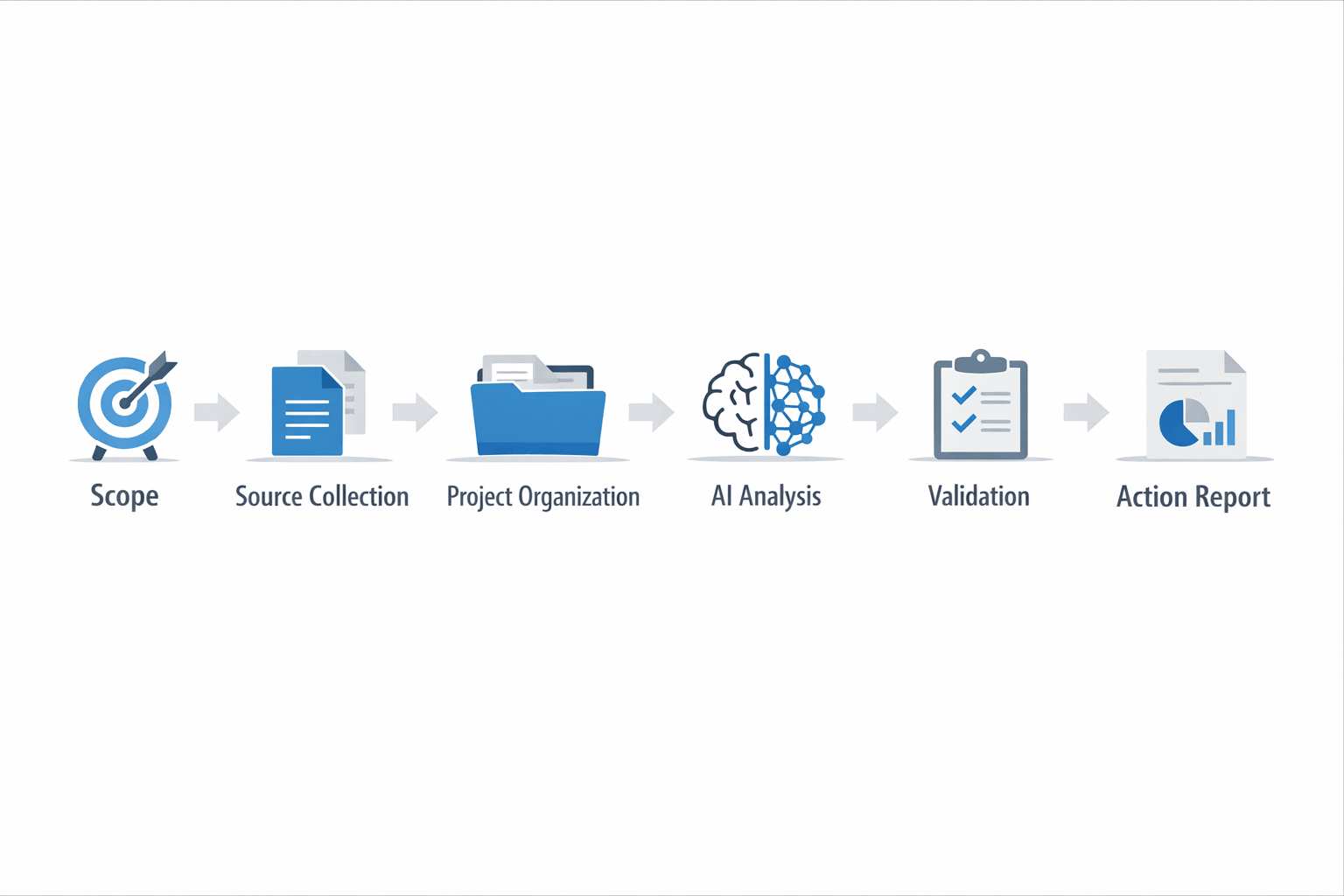
- Define the decision you need to make.
- Gather public evidence and internal inputs like interviews, calls, and notes.
- Organize sources in one project so context stays intact.
- Prompt AI to compare competitors, patterns, gaps, and risks.
- Validate the output, rank next actions, and share a report your team can trust.
How does AI competitive analysis actually work?
AI competitive analysis works best as a synthesis layer over messy evidence, not as a magic source of truth. In practice, the model takes scattered inputs, finds patterns, and turns them into a draft you can review. The quality of the output depends less on clever prompts and more on two things: a tight question and well-organized source material.
What AI can analyze well
AI is strong at high-volume pattern finding. It can scan SEO gap exports, sitemap or page inventories, homepage copy, changelogs, review-site comments, sales call notes, user interviews, win-loss interviews, and meeting transcripts faster than a person can. Then it can:
- summarize reviews and transcripts
- cluster repeated messaging themes
- spot pricing and feature differences
- turn raw exports into comparison drafts
- surface recurring objections, claims, and positioning angles
That's the real value of AI competitive analysis: speed on synthesis.
Where AI still needs human judgment
AI still needs a person to interpret what matters. It won't reliably judge source quality, segment fit, geography, or whether a competitor move changes your strategy. It can sound more certain than the evidence supports, flatten nuance, or miss why a competitor made a change. Even in structured evaluation, OpenAI SimpleQA (2024) found that GPT-4o hallucinated in 1.5% of responses on SimpleQA, while OpenAI o1 hallucinated in 44% of responses.
Use the model to draft. Use people to verify, prioritize, and decide.
Common inputs teams should combine
The strongest workflow blends public web evidence with internal conversations. Public pages show what competitors say. Calls, interviews, and transcripts show how buyers react. Together, they give a fuller picture.
One practical option is TicNote Cloud, which centralizes meetings, documents, and transcripts inside project workspaces so AI can answer across files with citations instead of relying on copied snippets. That makes competitive analysis AI more usable for teams that need traceable claims, not just polished summaries.
Set up the right competitive analysis scope before you prompt
Good AI competitive analysis starts before the prompt. If you skip scope, the model will give you a polished data dump instead of a useful answer. The fix is simple: define the decision, limit the field, and set evidence rules before you ask AI to compare anything.
Choose the business question first
Start with the decision. Not the spreadsheet. Not the feature list.
A tight question changes everything about the research. For example:
- Improve homepage positioning against two direct rivals
- Check whether pricing pressure is hurting win rates
- Find product gaps in a specific segment
- Understand why deals are lost in mid-market sales
Each question needs different inputs. Homepage positioning leans on websites, messaging, landing pages, and proof points. Pricing pressure needs pricing pages, packaging details, sales notes, and lost-deal reasons. Product gap analysis pulls in release notes, demo recordings, review sites, and customer interviews.
That also changes the prompt structure. Instead of asking AI to "analyze competitors," ask it to answer one decision-focused question, summarize only relevant evidence, and separate facts from inference.
Pick competitors and source types
Keep the set manageable. In most cases, 3 to 5 direct competitors plus 1 to 2 adjacent players is enough. More than that often creates noise, especially when teams mix very different business models.
Then map each question to source types:
- Public: websites, pricing pages, review sites, case studies, social proof, analyst notes
- Internal: sales calls, demos, win-loss notes, user interviews, support tickets, product feedback
Be specific about filters too. Note the date range, region, market segment, and customer size. Otherwise, you may blend enterprise and SMB signals or mix local pricing with global positioning.
If you need a starting point, this guide on turning competitor research into strategy helps frame the categories before you prompt.
Define success criteria and decision owners
Write a short scope brief before running any analysis. Include:
- The decision this work should inform
- Competitors in scope and out of scope
- Which sources count as evidence
- Which claims must be cited
- Who reviews the draft
- How next actions will be prioritized
A simple checklist keeps the process disciplined. The article's table will cover three gates: scope clarity, source quality, and review readiness.
This is also where tools like TicNote Cloud can help. Teams can keep competitor calls, interview transcripts, documents, and notes inside one project, then use cited answers to draft analysis without losing source context. That makes competitive analysis ai more repeatable, easier to review, and far less dependent on memory or guesswork.
How to do competitive analysis with AI step by step
A strong ai competitive analysis workflow starts with evidence, not prompts. The goal is simple: collect broad market signals, add internal customer evidence, organize it in a reusable system, ask AI for structured comparisons, and then validate every important claim before your team acts.
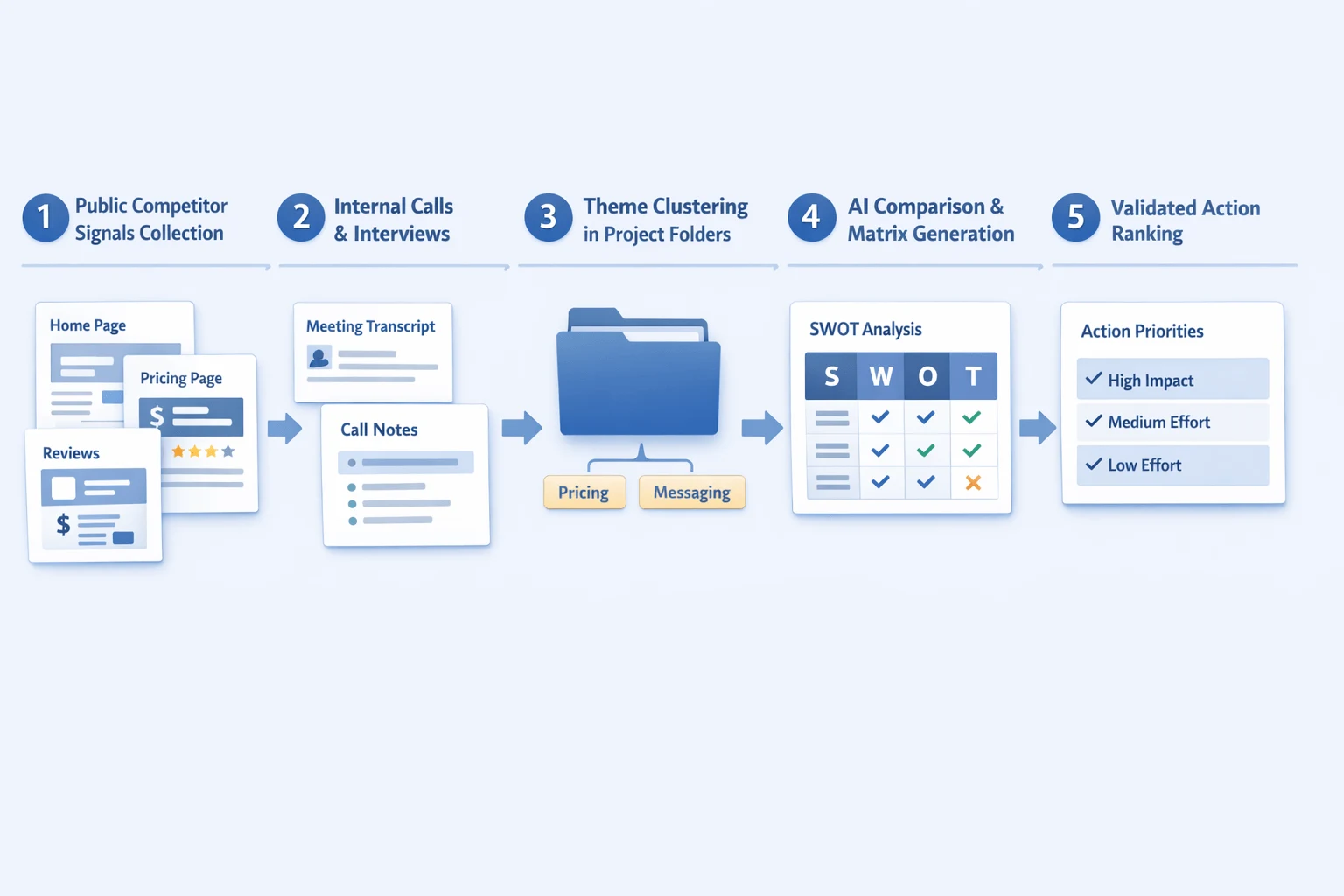
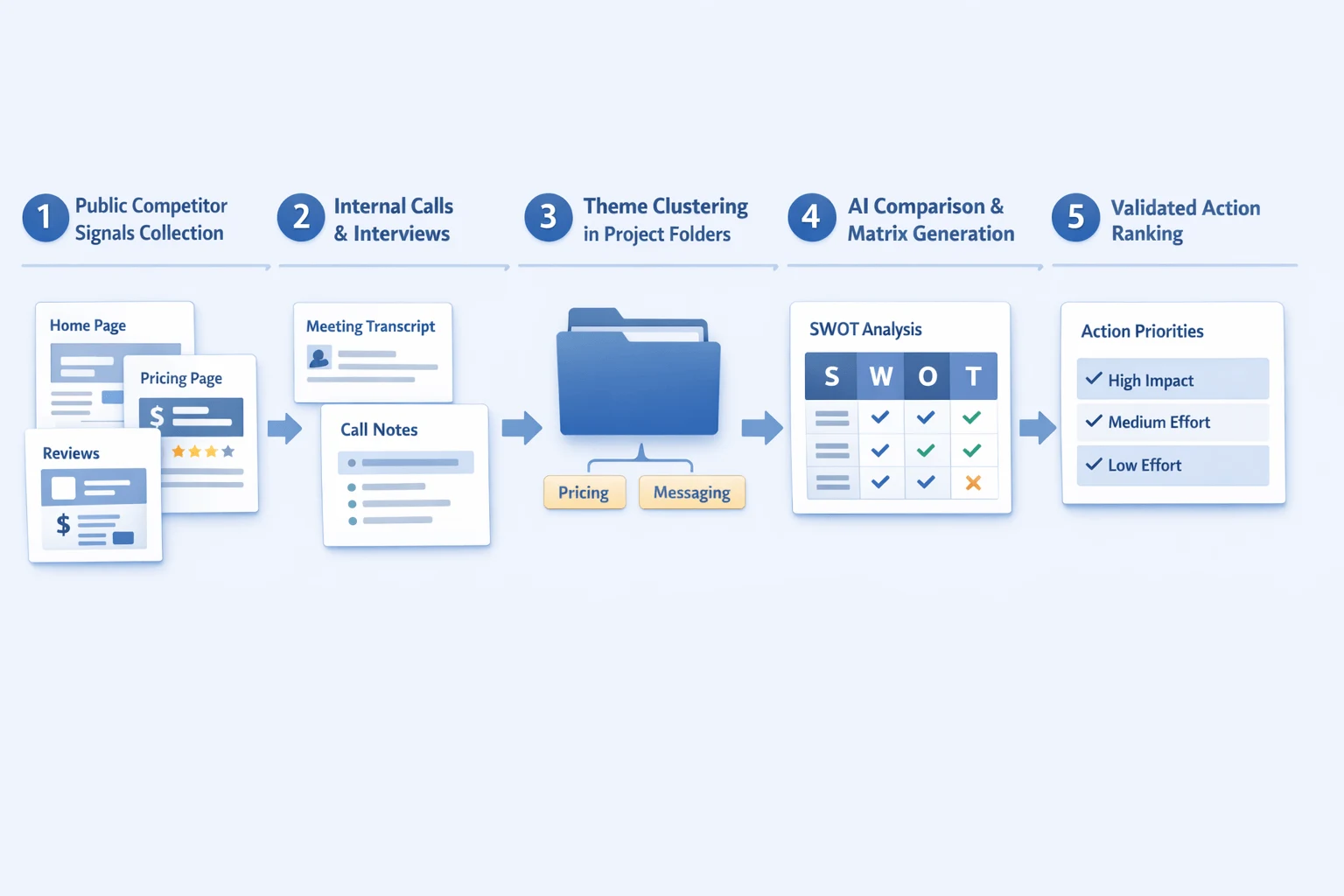
Step 1: Gather public competitor signals
Start wide. In most markets, reviewing 8 source types across 5 to 10 competitors already gives you a useful first pass.
Here's what each source is best for:
- Homepages: positioning, target audience, category language, and value props.
- Pricing pages: packaging, entry points, free plans, enterprise cues, and discount logic.
- Feature pages: product depth, integrations, workflows, and use-case emphasis.
- Changelogs: shipping speed, roadmap themes, and maturity.
- Review summaries: recurring praise, complaints, and adoption friction.
- SEO ranking exports: keyword focus, content clusters, and traffic intent.
- Sitemaps: hidden content hubs, feature depth, template libraries, and expansion areas.
- Social posts: campaign themes, launches, audience engagement, and message testing.
- Job listings: strategic bets, org gaps, new markets, and product direction.
The rule is breadth first, then depth. Don't spend 45 minutes on one rival's pricing page before you know what the full field looks like.
A helpful comparison asset for the final article is a side-by-side table with four analysis modes:
| Analysis type | Best sources | Main question | Useful output |
| SEO | rankings, sitemap, blog, templates | What demand are they capturing? | keyword gaps and content priorities |
| Messaging | homepage, ads, social, case studies | How do they frame value? | positioning matrix |
| Product | feature pages, pricing, changelog, docs | What do they actually offer? | feature comparison grid |
| Customer feedback | reviews, forums, social comments, support themes | What do users love or hate? | objection and pain-point summary |
Step 2: Add internal interviews, call notes, and market conversations
Public pages tell you what competitors want the market to believe. Internal evidence tells you what buyers actually say.
Customer interviews, sales calls, onboarding calls, support notes, win-loss reviews, and stakeholder meetings often surface the details that public materials hide: switching triggers, objection patterns, missing features, pricing friction, and competitor mentions in real buying contexts.
This is where many teams lose signal. If notes are copied into a slide deck without timestamps, speaker labels, or source links, your analysis becomes harder to trust. Keep source context attached wherever possible: who said it, when they said it, and in what setting. As ISO 9001:2015 — Quality management systems — Requirements states, organizations must "retain documented information as evidence of the results" of monitoring and measurement in clause 9.1.1.
With TicNote Cloud, teams can centralize transcripts, meeting notes, uploaded docs, and research files in one project so competitor mentions from calls stay linked to the original conversation rather than getting flattened into a summary.
Step 3: Organize sources into themes and projects
Once sources pile up, structure matters more than volume. Group evidence into themes such as:
- pricing and packaging
- positioning and category language
- feature breadth and gaps
- customer complaints
- use cases and buyer segments
- proof, reviews, and case studies
A project-based structure works better than one-off documents. It lets the same research base support monthly updates, launch planning, sales enablement, and strategy reviews. That's especially useful when using ai for competitive analysis because the system can compare old and new evidence over time instead of starting from zero.
If you want a scoring model after this stage, this competitor scorecard workflow is a practical next layer.
Step 4: Prompt AI to compare patterns, not just summarize pages
Now prompt in stages.
- Extract facts: ask AI to pull concrete claims from each source.
- Compare patterns: ask it to find differences across product, pricing, SEO, and messaging.
- Generate outputs: request matrices, SWOT-style summaries, positioning notes, and action options.
Good prompts for a competitive analysis ai tool should require:
- citations for every major claim
- confidence labels such as high, medium, or low
- missing-data flags
- structured output fields
- separation between facts and inference
For example, first ask: "List verified pricing, top feature claims, primary audience, and recent product changes for each competitor with citations." Then ask: "Compare the competitors on pricing model, feature depth, SEO topic coverage, and messaging strategy. Flag uncertainty and missing data."
Step 5: Validate claims and prioritize actions by impact and effort
This is the step that turns research into decisions.
Before sharing the final report, apply a simple validation checklist:
- confirm source dates
- verify important claims against originals
- separate fact from interpretation
- remove unsupported assumptions
- score actions by impact and effort
- assign owners and deadlines
A good output is not "Competitor X is winning." A good output is "Competitor X added self-serve pricing, ranks for three high-intent terms we don't cover, and appears in 6 recent customer mentions; create two comparison pages and test a packaging update this quarter."
The best competitive analysis ai tool is the one that keeps evidence attached to outputs so teams can trust what they're reading. In the final article, a workflow table and a validation checklist will make that process easy to repeat.
How to generate AI competitive analysis reports from meetings and research
This workflow uses TicNote Cloud as a practical example. The goal is simple: turn meetings, interview notes, and public materials into an ai competitive analysis report and visual matrix without losing the source trail behind each claim.
Build one project for the market you want to track
Start by creating a Project for one market, niche, or competitor set. That gives your team a single workspace for calls, notes, pricing pages, reviews, and research files. If you run competitor work every month, this matters because the context stays in one place instead of getting split across chat threads and docs.
In the web app, add the Competitor Analysis skill agent from the agent library. It appears in your workspace right away, so you can start without extra setup.
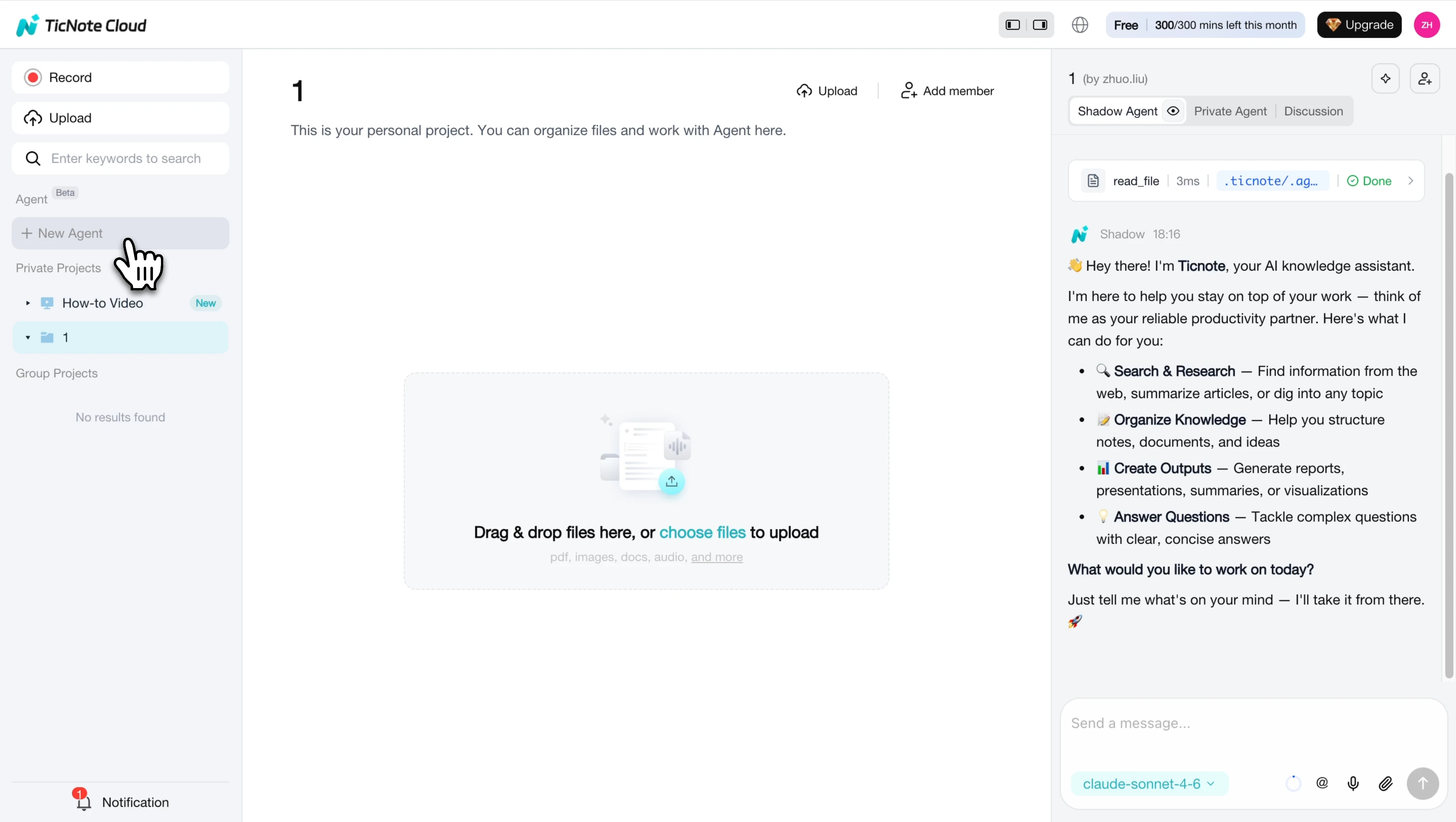
After that, choose the competitor analysis skill from your agent list.
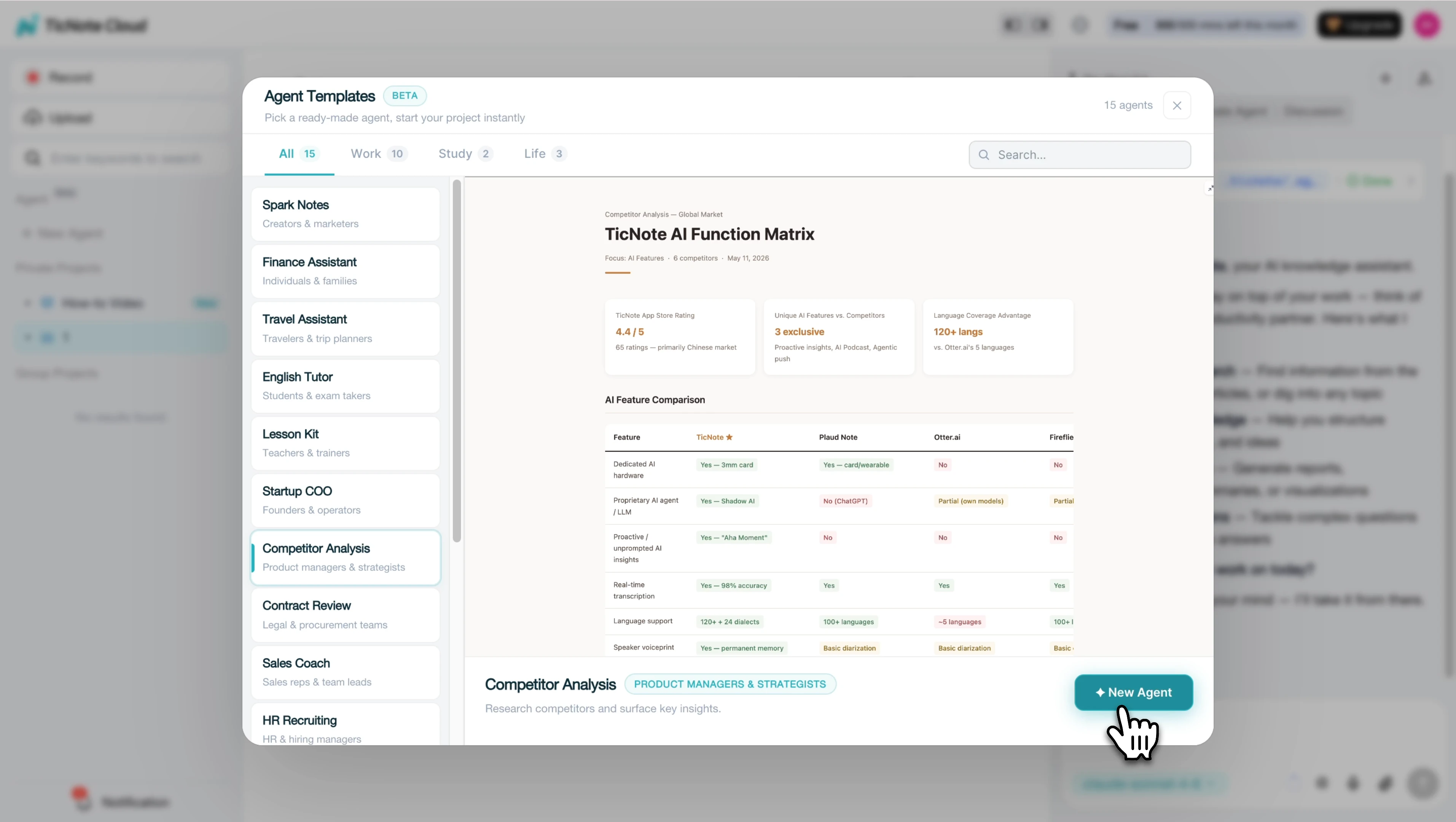
Add competitors, research inputs, and a narrow focus
Next, describe your market clearly. Add your niche, your location, and 5-10 competitor names or URLs. Then attach the materials that hold actual evidence: meeting transcripts, sales call notes, customer interviews, review exports, pricing pages, feature pages, and internal research docs.
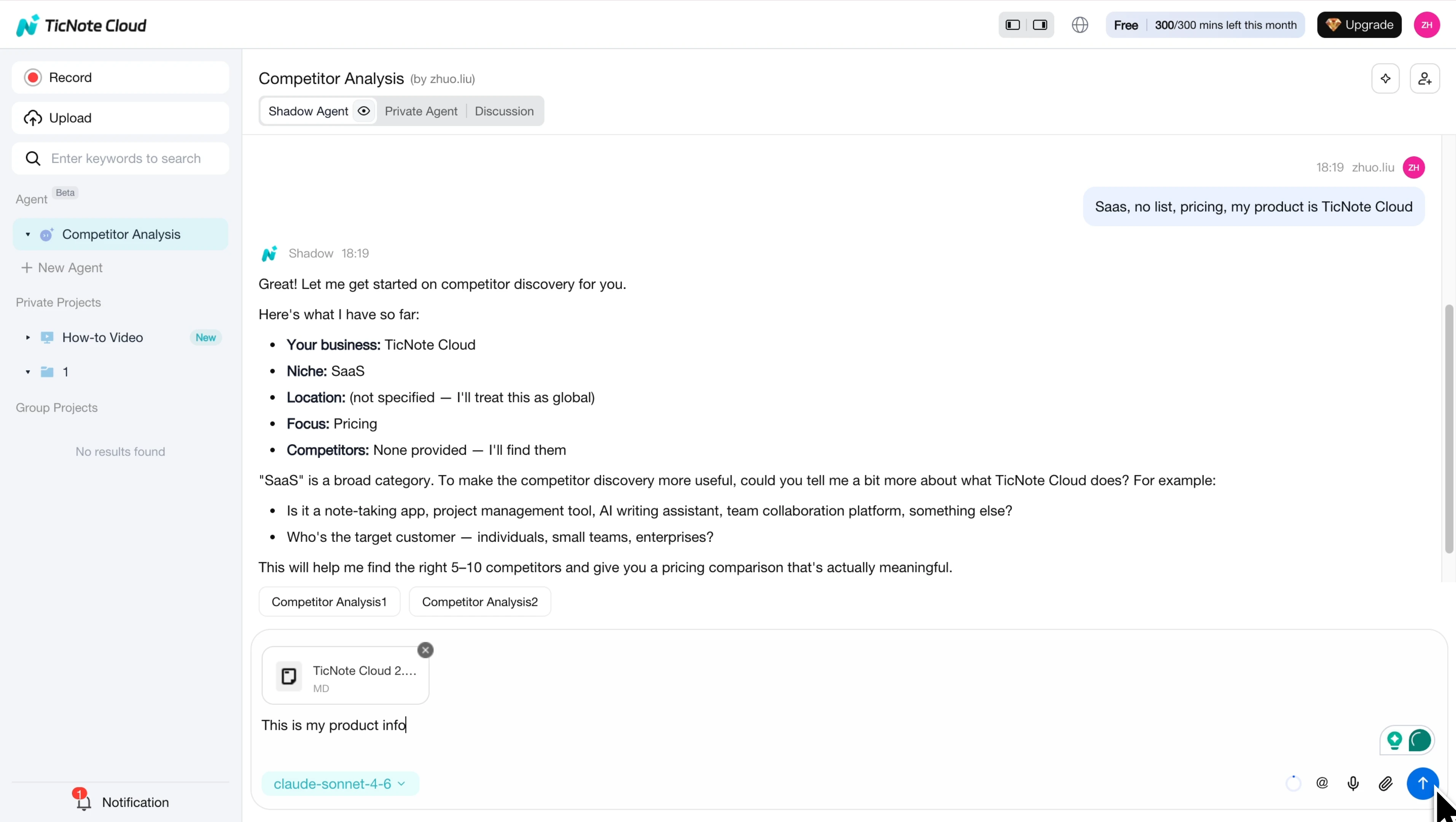
If needed, set one focus area such as pricing, reviews, social media, messaging, or product range. This keeps the analysis useful. Broad prompts often produce broad summaries. Narrow prompts usually produce sharper comparisons.
Generate the report, then verify the evidence
Run the research flow and review the outputs. The tool builds a structured report with an executive summary, comparison matrix, competitor profiles, market gaps, and recommended actions. It also creates a visual HTML matrix that is easier to share in reviews and planning meetings.
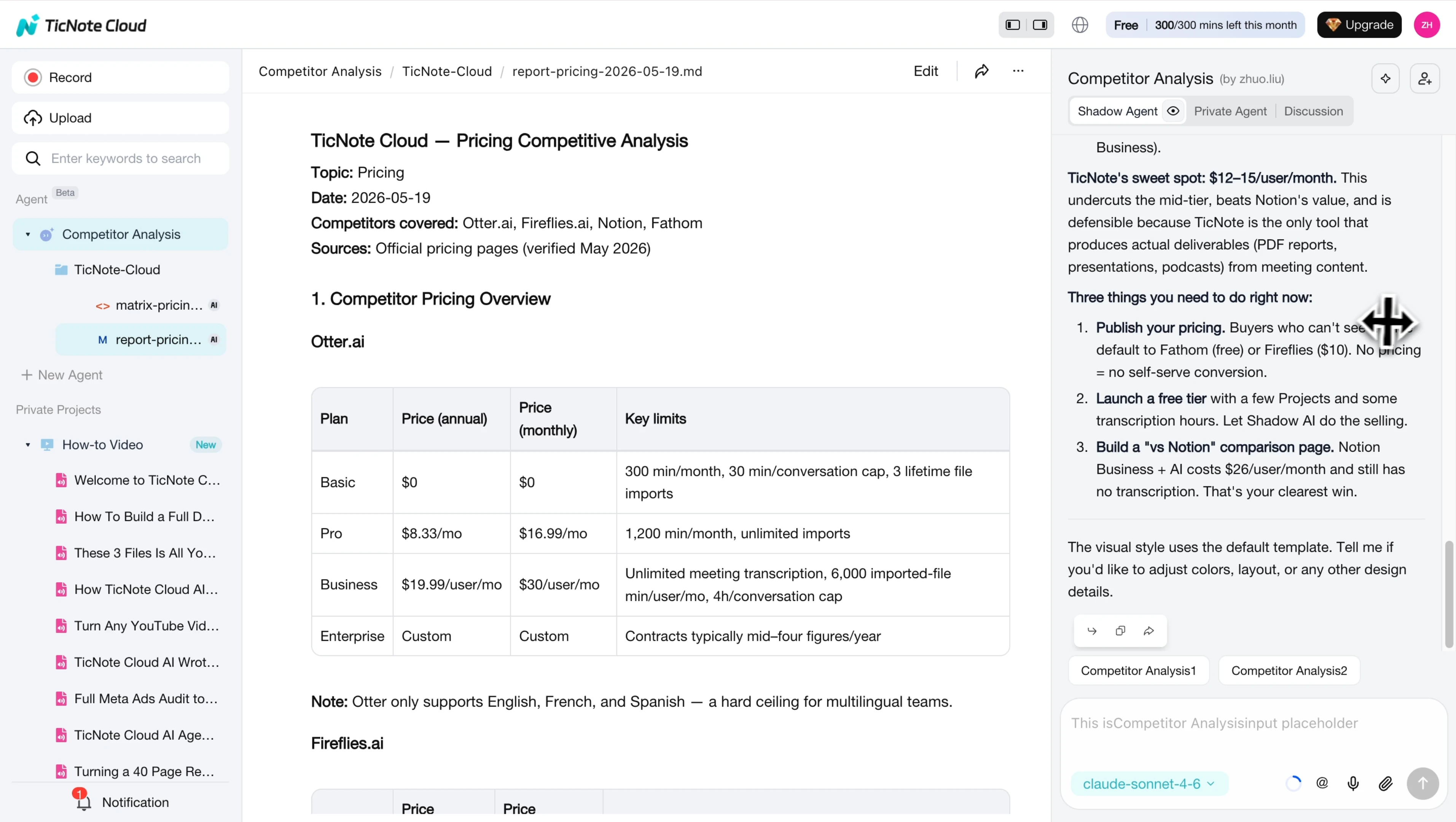
Open the report and check the citations before you circulate it. If a transcript has naming errors or a note is incomplete, edit it first, then rerun or refine the output. That is especially useful when competitive analysis ai work depends on internal calls, where one wrong product name can distort the conclusion.
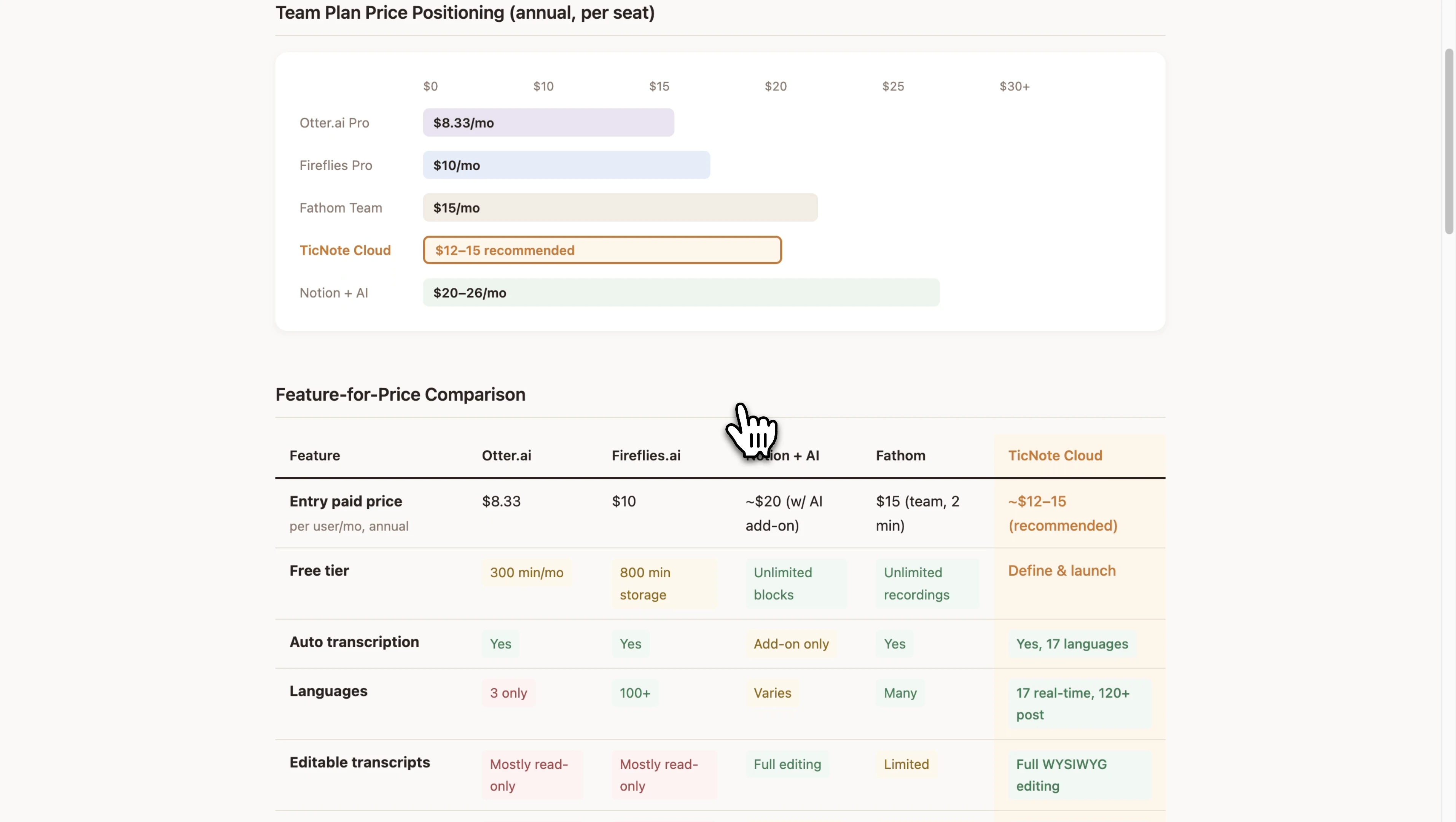
You can then polish the document for stakeholders or turn it into a presentation while keeping links back to the evidence. If you want a stronger decision format, this guide on turning findings into an action-focused report is a useful next step.
On mobile, the flow is shorter: capture or upload conversations, send them into the right Project, and continue the same analysis later from the workspace. That continuity is the real advantage. Project-level memory, editable transcripts, and cited answers help when your competitor knowledge comes from repeated interviews and team meetings, not just public web pages.
Try TicNote Cloud for Free and generate your first competitive analysis report from a meeting.
Which AI competitive analysis methods fit each team?
The best ai competitive analysis method depends on your team's inputs, speed needs, and how much evidence you need to trust the result. A founder can move fast with a lean comparison, while research-heavy teams need transcript-backed synthesis and clear citations before they act.
Solo founder or indie team
Keep it simple. Compare 3–5 competitors across four inputs:
- website homepage
- pricing page
- review sites
- a few sales or discovery calls
Then ask AI to build a first-pass matrix with positioning, pricing, strengths, gaps, and likely threats. This is the fastest method when you need direction, not perfect coverage.
Marketing and SEO team
Use AI for pattern finding across larger content sets. The most useful inputs are:
- keyword gap exports
- homepage and landing page messaging
- sitemap-level content review
- review themes and sales-call voice-of-customer notes
This helps teams spot content gaps, repeated claims, tone differences, and search intent mismatches. If you need more tooling options, this guide to competitor analysis tools for small teams is a useful next read.
Product and research team
Here, evidence depth matters more than speed. Focus on:
- feature claims versus actual workflow
- onboarding friction
- repeated customer complaints
- interview synthesis
- pattern detection across transcript sets
This is where TicNote Cloud stands out as the best ai competitive analysis tool for meeting-based and research-heavy work. It keeps calls, files, transcripts, and cited outputs in one project, so teams can trace each conclusion back to source material. Standalone chat tools work better for light synthesis after the data has already been gathered by hand.
Cross-functional leadership review
Leaders don't need raw notes. They need a short brief that answers three questions:
- What changed?
- Why does it matter?
- What should we do now?
A good AI-assisted review condenses evidence into decision-ready outputs, not a long data dump.
| Team method | Speed | Evidence depth | Best use case |
| Solo founder scan | High | Low to medium | Quick market read |
| Marketing and SEO review | Medium | Medium | Messaging and content gaps |
| Product and research synthesis | Medium | High | Feature, UX, and complaint patterns |
| Leadership summary | High | Medium to high | Priority decisions and alignment |
Mistakes, ethics, and accuracy checks to avoid
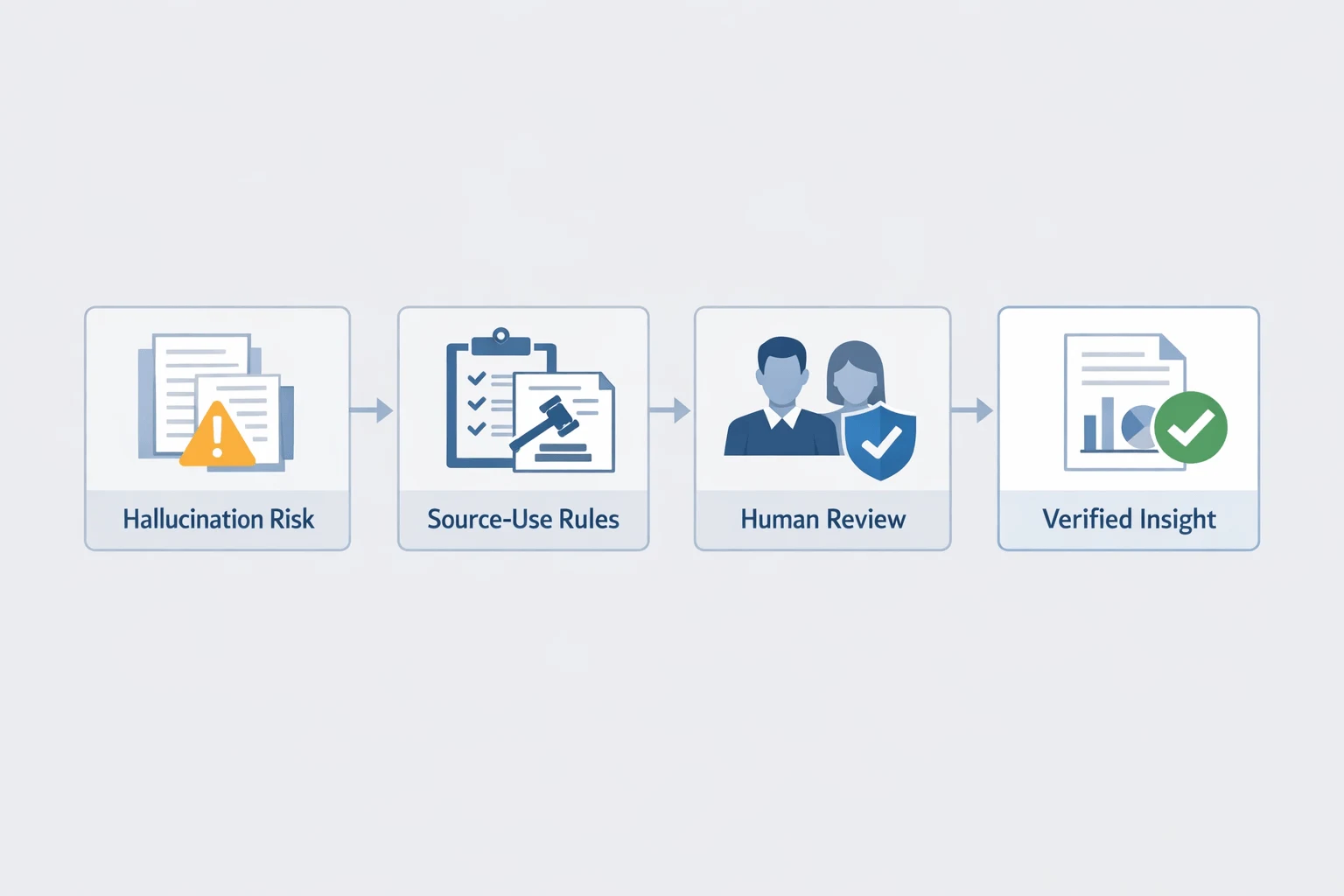
Good ai competitive analysis is not just fast. It also has to be verifiable, lawful, and safe to share. The main risks are simple: AI can invent claims, misuse weak sources, or summarize sensitive internal notes without enough review. A practical workflow reduces those risks by requiring evidence, ownership, and clear access rules.
Hallucinations and missing context
AI can state that a competitor changed pricing, launched a feature, or targets a new segment even when the source is thin or outdated. It can also blend old pages with new posts and present them as one current fact. Use a simple claim check before you trust any output:
- Link every important claim to a source
- Confirm the source date
- Separate facts, inferences, and opinions
- Flag missing evidence as unknown, not true
- Have a reviewer test the top three claims manually
Source reliability and terms of use
Public does not always mean reusable. A page may be visible online but still restricted by platform terms, copyright, or scraping limits. Read the terms for sites you monitor, especially if you collect or store third-party content at scale. In most cases, summarizing a few cited public sources is lower risk than bulk copying or automated extraction.
Privacy, governance, and human review
Internal interviews, sales calls, and win-loss notes often contain sensitive data. That means teams need role-based access, a named reviewer, and one final human decision maker. As Artificial Intelligence Risk Management Framework (AI RMF 1.0) states, "Govern" is one of the framework's four core functions. Evidence-aware systems help here: cited outputs, traceable actions, and controlled sharing make review easier and reduce avoidable mistakes.
Final thoughts
At this point, you have the core pieces: a clear way to frame the question, a practical place to start, and a repeatable rhythm you can run again. That's where ai competitive analysis works best. Start with one business decision, gather both public signals and internal evidence, ask AI for structured comparisons, and check the output before you act.
To keep the process useful, make it small and consistent. Run one project for one market question, then update it monthly or quarterly as new calls, interviews, pricing pages, and product changes come in. If you need a stronger operating model, this guide on building a repeatable competitive intelligence process can help.
If your team wants one place to capture meetings, centralize competitor files, and turn that material into cited reports, TicNote Cloud is a practical way to do it without losing source context.