


 Extension
TL;DR: AI agent quick picks for sales call summaries
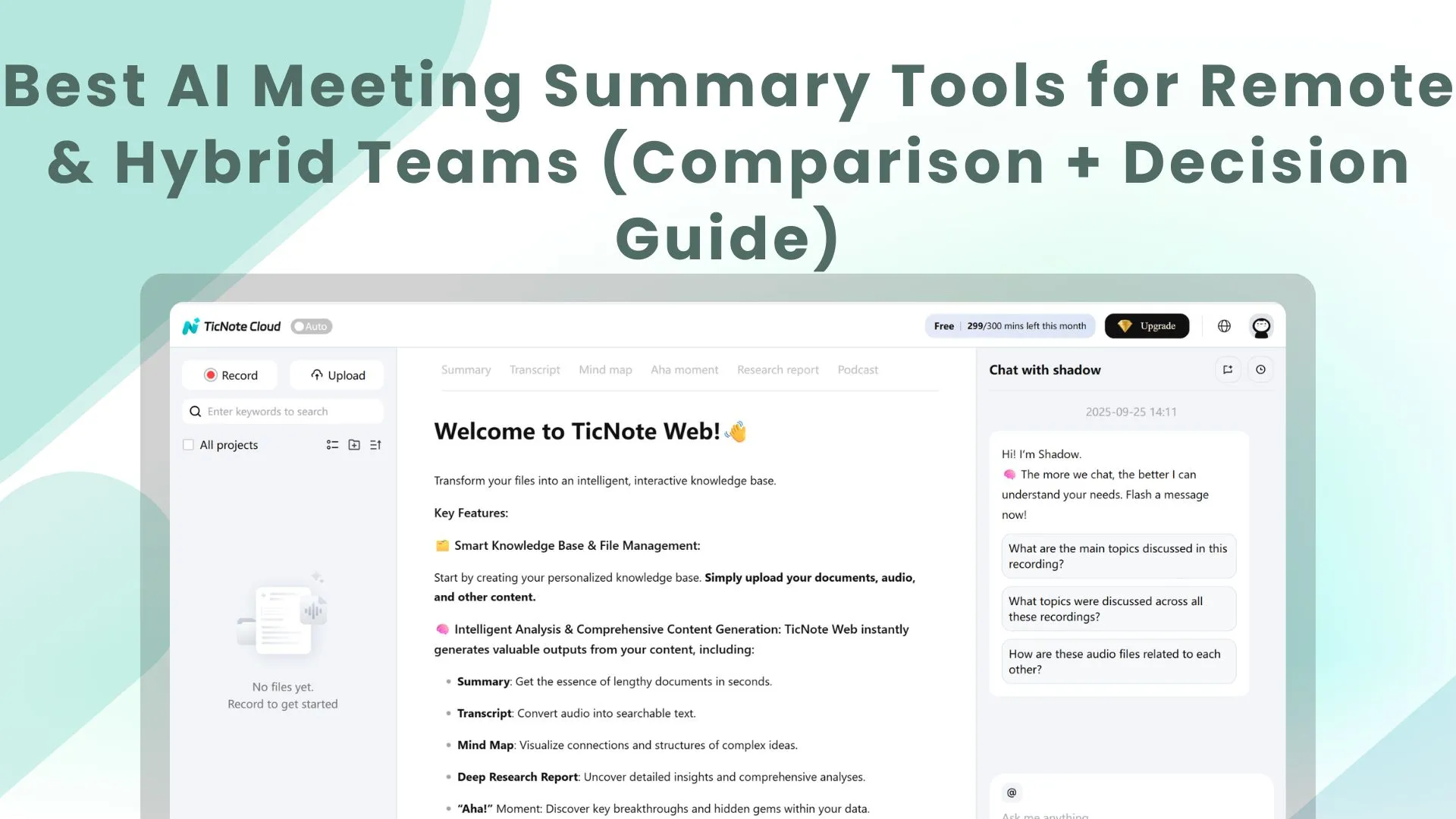
For the best AI meeting summary platforms for sales and client calls, start with TicNote Cloud if you need bot-free capture, editable transcripts, Project memory, and reusable client assets.
Sales teams often lose context after a call. That turns follow-up notes, CRM updates, and client reports into repeat manual work. With TicNote Cloud Projects + Shadow AI, summaries become searchable knowledge and one-click deliverables.
Quick picks: TicNote Cloud for editable assets; Gong for enterprise conversation intelligence; Fireflies.ai for broad integrations; Fathom for free personal recaps; Otter.ai for general meeting transcription.
Best AI meeting summary platforms for sales and client calls: quick picks
The best AI meeting summary platforms for sales and client calls should do more than capture notes. They should create CRM-ready next steps, client recaps, and reusable account knowledge.
Best overall: TicNote Cloud
TicNote Cloud is the default pick for sales leaders and client-service teams that want bot-free capture, editable transcripts, project-level memory, and client-ready outputs without copy/paste. Shadow AI works inside Projects, so notes become recaps, QBR notes, account briefs, reports, or mind maps with source context intact.
Best enterprise conversation intelligence: Gong
Gong fits large orgs focused on coaching, deal inspection, and standard pipeline reviews. Trade-offs include higher cost, heavier rollout, and analytics-first workflows over asset creation.
Best free personal note taker: Fathom
Fathom suits solo AEs and founders who want fast summaries with minimal setup. Teams may outgrow its admin controls and deeper CRM workflows.
Best broad integration hub: Fireflies.ai
Fireflies.ai is strong when summaries must land across many tools. Expect more tuning for sales-specific formats and consistent CRM-ready fields.
Best general meeting transcription: Otter.ai
Otter.ai works for internal notes and general transcription, but it's lighter on RevOps automation.
ROI example: if one rep runs 4 calls/day and saves 10–15 minutes/call, that's about 40–60 minutes/day back. Results vary by call volume and workflow discipline. For a broader buying framework, see this sales AI agent checklist.
Comparison table for sales and client-call AI note platforms
To find the best AI meeting summary platforms for sales and client calls, compare tools by the work they remove after the call. A useful sales-call rubric should measure capture, coverage, CRM fit, editing, account memory, deliverables, admin controls, and price.
Evaluation criteria used in this article
- Capture method: Bot, bot-free extension, app recording, or upload. This affects client comfort and rep adoption.
- Meeting support: Native Zoom, Google Meet, and Teams coverage reduces missed calls.
- CRM depth: Salesforce meeting notes and HubSpot call summaries prevent a "notes silo."
- Editable transcript: Editable transcripts turn raw notes into reusable sales assets.
- Project memory: Account knowledge should compound across discovery, renewal, and QBR calls.
- Deliverable generation: Look for follow-up emails, account briefs, QBR notes, and handoff docs.
- Security/admin: Check SSO/SAML, SCIM, retention, audit logs, and model-training opt-out.
- Starting price: Treat pricing as directional. Enterprise packaging changes fast.
| Platform | Capture | Zoom/Meet/Teams | CRM depth | Editable transcript | Project memory | Deliverables | Security/admin | Starting price |
| TicNote Cloud | Bot-free + upload | ✅ | Partial | ✅ | ✅ | ✅ | Partial | $$0 /$$12.99 |
| Gong | Bot + integrations | ✅ | ✅ | Partial | ✅ | Partial | ✅ | — |
| Fathom | Bot | ✅ | Partial | Partial | ❌ | Partial | Partial | Free/paid |
| Fireflies.ai | Bot + upload | ✅ | Partial | Partial | Partial | Partial | Partial | Free/paid |
| Otter.ai | Bot + upload | Partial | Partial | Partial | ❌ | Partial | Partial | Free/paid |
| Avoma | Bot | ✅ | ✅ | Partial | Partial | Partial | ✅ | Paid |
| tl;dv | Bot | ✅ | Partial | Partial | Partial | Partial | Partial | Free/paid |
| Zoom AI Companion | Native Zoom | Partial | Partial | ❌ | ❌ | Partial | ✅ | Included/paid |
"Partial" matters. It often hides setup overhead: field mapping, permission tuning, and failed sync alerts. For RevOps teams, those gaps decide whether summaries reach the CRM or stay trapped in another workspace.
Top AI meeting summary platforms for sales teams
The best AI meeting summary platforms for sales and client calls should do more than record what was said. They should capture the call, turn it into clean next steps, support CRM handoff, and help the team reuse account knowledge later. Here are the top options, ranked by sales fit, summary quality, workflow depth, and post-meeting value.
TicNote Cloud
Best for: Sales and client-call teams that want an AI agent workspace for summaries, reusable account knowledge, and client-ready deliverables.
Website | Pricing: ticnote.com | Free plan; Professional $$12.99/mo; Business$$29.99/mo; Enterprise by contact sales.
Key features: TicNote Cloud supports bot-free recording through a Chrome extension for Google Meet and Teams, plus app capture for Zoom and Lark. It also includes editable transcripts, 120+ languages, multi-level summaries, speaker recognition, timestamps, and exports to DOCX, PDF, and Markdown.
The bigger difference is the Project workspace. Sales teams can group discovery calls, onboarding meetings, proposals, notes, and documents by account or deal. Shadow AI then searches across that Project with citations and creates summaries, reports, web presentations, podcasts, and mind maps. That makes TicNote useful when a call recap needs to become a follow-up, account brief, QBR input, or implementation handoff.
Limitations: Buyers should verify SOC 2 or ISO posture, data retention controls, permission models, and CRM-specific workflows during procurement. CRM use also requires process choices, such as which fields to update, who owns edits, and what counts as a closed action item.
Why it stands out: TicNote Cloud goes beyond an AI meeting summarizer. It acts like a post-meeting asset factory while keeping capture less intrusive. If you're comparing broader workspace options, this guide to all-in-one AI workspaces is a useful next read.
Try TicNote Cloud for Free and include a simple inline signup form block in the article body so readers can start without downloading a resource.
Gong
Best for: Enterprise revenue teams that need coaching, deal inspection, and conversation intelligence at scale.
Website | Pricing: gong.io | contact sales; pricing varies.
Key features: Gong is strong for call analytics, sales coaching workflows, deal libraries, pipeline inspection, and manager review. It fits well in Salesforce and HubSpot-centered revenue operations.
Limitations: It can add seat cost, admin work, and rollout complexity. If the core need is summaries plus reusable deliverables, it may be more platform than the team needs.
Why it stands out: Gong has deep coaching insights for large sales organizations.
Fathom
Best for: Individuals and small teams that want fast summaries at low cost.
Website | Pricing: fathom.video | free tier available.
Key features: Fathom offers quick recaps, highlights, and simple sharing. It works well when speed matters more than heavy workflow design.
Limitations: Team governance, advanced RevOps automation, and deeper knowledge reuse may be limited.
Why it stands out: It gives strong entry-level value for solo reps and lean teams.
Fireflies.ai
Best for: Teams that want many integrations and searchable notes across apps.
Website | Pricing: fireflies.ai | tiers vary.
Key features: Fireflies.ai offers broad integrations, meeting summaries, call search, and shared note libraries.
Limitations: Sales-specific CRM field mapping and standardized note formats may need extra setup.
Why it stands out: Its main edge is integration breadth.
Otter.ai
Best for: General meeting transcription across internal meetings and occasional client calls.
Website | Pricing: otter.ai | tiers available.
Key features: Otter.ai is familiar, easy to adopt, and useful for transcription plus basic AI summaries.
Limitations: Sales and CRM automation is lighter. Teams may still copy and paste notes into follow-ups, CRM fields, or client updates.
Why it stands out: It is a known general-purpose note-taking tool.
Avoma
Best for: Mid-market teams that want meeting assistance and call coaching in one system.
Website | Pricing: avoma.com | tiers vary.
Key features: Avoma combines call notes, coaching signals, meeting workflows, and revenue conversation review.
Limitations: Evaluate admin effort, adoption time, and cost at higher seat counts.
Why it stands out: It balances meeting notes with coaching functionality.
tl;dv
Best for: Budget-friendly async sharing of call recaps.
Website | Pricing: tldv.io | tiers vary.
Key features: tl;dv supports summaries, clips, and shareable meeting takeaways for distributed teams.
Limitations: CRM depth, governance, and enterprise controls are lighter than sales-led platforms.
Why it stands out: It is easy to adopt for simple recap sharing.
Zoom AI Companion
Best for: Organizations standardized on Zoom that want built-in meeting summaries.
Website | Pricing: zoom.com | often bundled with Zoom plans; verify by plan.
Key features: It works natively inside Zoom, so users get summaries without adding another meeting tool.
Limitations: Platform lock-in is the trade-off. Cross-platform capture, CRM-ready workflows, and reusable knowledge bases may be limited.
Why it stands out: It is convenient for Zoom-only stacks.
A sales call recap tool is only as good as what happens after the summary: CRM updates, follow-up speed, and content reuse.
What makes Shadow AI workspaces different for sales meeting notes?
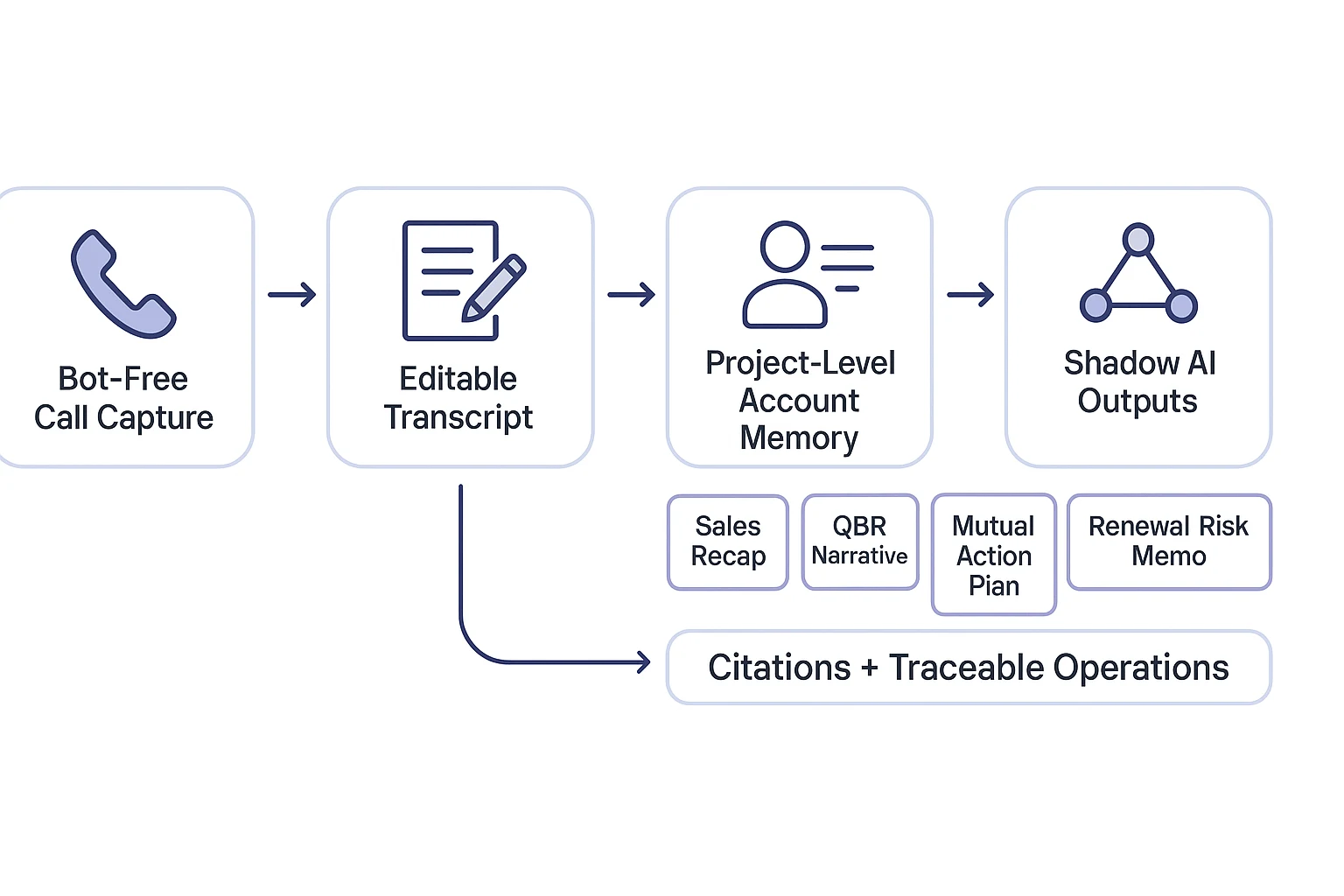
The best AI meeting summary platforms for sales and client calls shouldn't end at "summary generated." Sales teams need clean notes, account context, and reusable assets that help the next step happen faster. TicNote Cloud's Shadow AI workspace is built around that post-meeting work: capture the call, fix the transcript, connect it to the account, then create cited outputs from the full project.
Keep capture less intrusive
Bot-free recording means no extra meeting bot joins the room. That can make sensitive client calls feel more natural, especially in finance, healthcare, legal, or enterprise security reviews. Teams still need consent, notice, and internal policy alignment, but a less visible capture method often lowers adoption friction.
Turn transcripts into CRM-ready content
Editable transcripts matter because sales notes are rarely perfect on the first pass. Reps can correct names, product terms, pricing details, and quoted language before the recap becomes an official record.
That supports RevOps-grade workflows, including:
- Standard call recap templates
- Clean customer quotes for account plans
- Corrected Salesforce meeting notes
- Ready-to-paste HubSpot call summaries
- Action items with owners and dates
Connect calls into account memory
Most AI note tools treat one meeting as one note. Shadow AI works better for sales cycles because Projects can hold the full account story: discovery, demo, security review, implementation check-in, and QBR. This creates one searchable source of truth, reduces repeated questions, and helps new stakeholders onboard in minutes instead of digging through 5 separate call docs. For broader governance ideas, see this guide to AI agent knowledge systems.
Create cited outputs from the full project
Shadow AI can generate cited account briefs, mutual action plan drafts, QBR narratives, renewal risk memos, implementation recaps, and internal handoff briefs. Citations and traceable Shadow operations let teams verify claims before sharing. One-click deliverables also cut context switching because the output starts inside the workspace, not in a blank document.
How to choose the right product
The best AI meeting summary platforms for sales and client calls depend on the business outcome you want after the call. If the goal is faster follow-up plus reusable account assets, choose TicNote Cloud first—not just because it summarizes calls, but because it cuts post-call glue work.
If you care most about usable sales assets, choose TicNote Cloud
Pick TicNote Cloud when notes need to become follow-up emails, account briefs, reports, mind maps, or shared client knowledge. Its bot-free capture, editable transcripts, Project workspaces, and one-click deliverable generation help teams turn one call into reusable context. That matters when every account has 5, 10, or 20 touchpoints across sales, success, and delivery.
If your team is deciding between simple note-taking and task execution, this AI agent decision framework explains the difference clearly.
If you care most about X, choose Y
- Enterprise revenue intelligence: Choose Gong when coaching, manager dashboards, deal inspection, and large call libraries matter most. The trade-off is heavier setup and less focus on turning notes into client-ready assets.
- Low-cost individual use: Choose Fathom when one rep or founder wants to prove value fast. The upgrade trigger is usually admin control, governance, and consistent CRM-ready notes.
- Broad integrations: Choose Fireflies.ai when your team wants summaries pushed into Slack, Notion, and project tools. Check CRM field mapping carefully; many integrations can still be shallow.
- Internal alignment: Choose Otter.ai when the main use case is general meetings, not pipeline execution.
- Mid-market coaching: Choose Avoma when managers want practical coaching analytics without the heaviest enterprise stack.
- Async sharing: Choose tl;dv for distributed teams sharing recaps and clips on a budget. Expect limits around CRM depth and governance.
- Zoom simplicity: Choose Zoom AI Companion if your company is standardized on Zoom. It's simple, but cross-platform coverage is the gap.
Rollout, CRM sync, and security checks
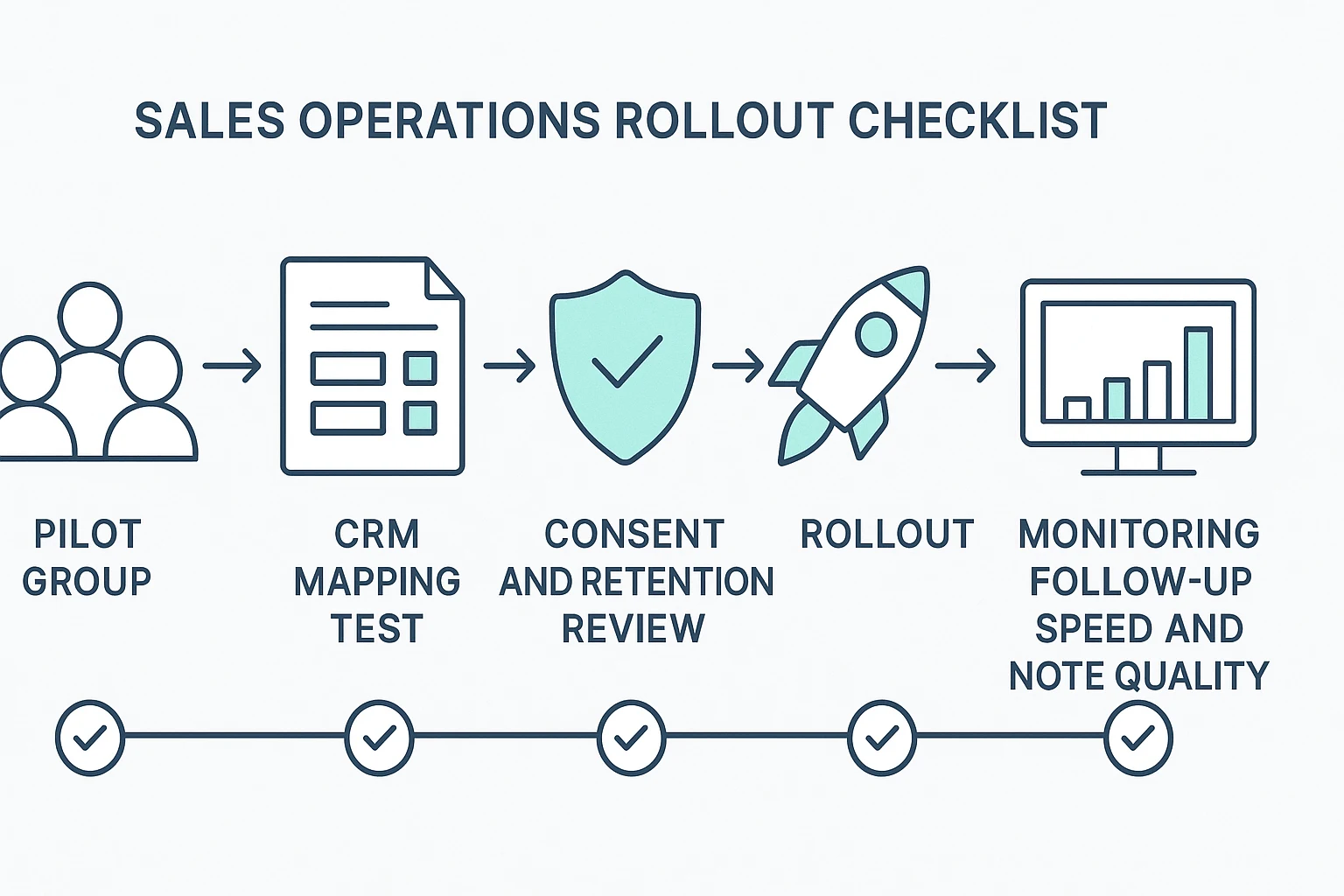
Before you roll out the best AI meeting summary platforms for sales and client calls, prove the notes can move from call to CRM without cleanup. Start with a 10-call pilot across AEs, managers, and RevOps.
Validate CRM sync before full rollout
Test Salesforce meeting notes and HubSpot call summaries for:
- Updated objects: Contact, Lead, Opportunity, Account, Deal, and Task.
- Field mapping: summary, next steps, competitors, risks, MEDDICC or SPICED.
- Attendee matching: email, domain, duplicates, and multi-contact meetings.
- Source links: transcript, recording, and whether edits resync.
- Admin controls: failed-sync alerts, retry logic, and sync logs.
- Task rules: owner, due date, priority, and manager override.
Confirm privacy, consent, and retention rules
Consent rules vary by region, so approve recording language before launch. Check retention windows, encryption, Owner/Member/Guest permissions, audit logs, SSO/SAML, SCIM, and model training opt-out. TicNote Cloud data is not used to train AI models and offers Enterprise SSO; verify additional compliance in security review.
Measure adoption by sales outcomes
Track time-to-follow-up, percentage of calls logged with usable next steps, manager recap-quality score, and fewer "what did they say?" pings. Bot-free capture can also reduce client resistance when visible meeting bots create friction.
Final thoughts: choose an AI agent that creates usable sales assets
The best AI meeting summary platforms for sales and client calls do more than transcribe. They help reps act within minutes: send clean recaps, confirm next steps, update CRM fields, and preserve account context for the next conversation.
That post-call layer is where real value appears. A transcript is useful. A searchable workspace with editable transcripts, project-level memory, and client-ready outputs is stronger because it turns every call into reusable sales knowledge.
For teams that want that full workflow in one place, TicNote Cloud is the strongest fit.