


 Extension
TL;DR: skill agent playbook for faster competitor research
Start with a clear goal, then use a simple evidence-first system to run marketing competitive analysis faster. For busy teams, the fastest path is to try TicNote Cloud for free, capture competitor proof in one place, compare patterns across messaging, channels, pricing, and offers, and turn that into a matrix, SWOT, and action list.
Most teams don't struggle with ideas. They struggle with scattered notes, screenshots, and review snippets that never become a decision. That slows campaign planning, launch prep, pricing reviews, and SEO updates. A tool like TicNote Cloud helps by keeping research in one project, analyzing files with citations, and turning raw inputs into usable summaries.
You'll learn when to use this workflow for positioning refreshes, ongoing monitoring, content updates, and brand reviews. The key takeaway is simple: the best analysis isn't a giant spreadsheet. It's a repeatable process that captures proof, spots patterns, and leads to clear next steps.
How to do marketing competitive analysis step by step
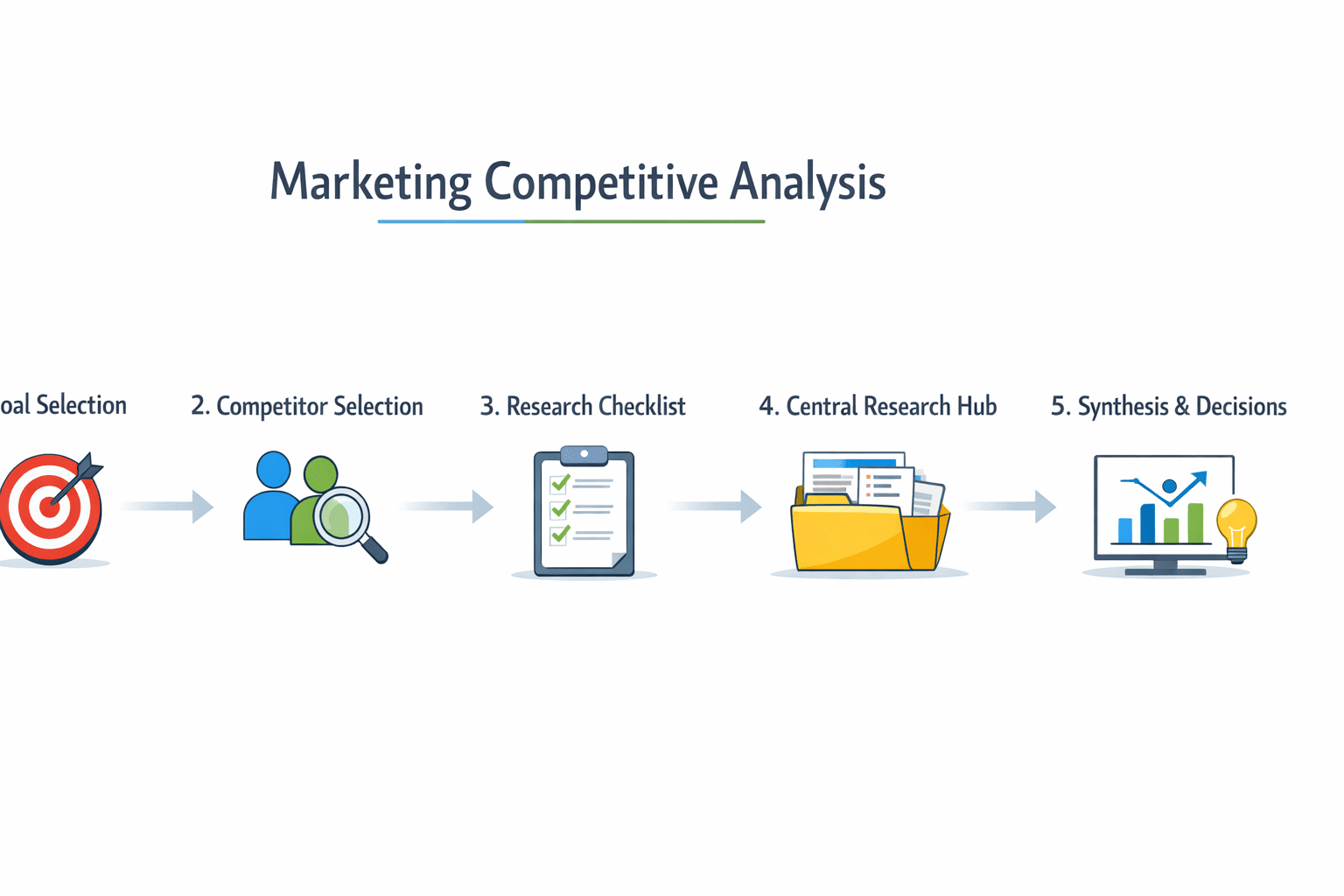
A strong marketing competitive analysis starts with one clear decision, not a giant spreadsheet. If you define the choice first, your research stays useful, faster, and easier to turn into action. The simplest flow is this: pick the decision, choose 5 to 10 competitors, collect the same evidence for each one, then compare patterns before making recommendations.
Set one decision-focused goal
Start with the business decision you need to make. That could be:
- Improve messaging on a landing page
- Check pricing pressure in your category
- Decide which channels deserve more budget
- Plan a product or campaign launch
This step matters because it stops vanity research. You don't need to track everything. You need enough evidence to support one decision with confidence.
Choose a practical competitor set
Use a short list of 5 to 10 companies. More than that usually adds noise. Split them into three groups:
- Direct competitors: same audience, similar offer
- Indirect competitors: solve the same problem differently
- Aspirational competitors: bigger brands with strong execution worth studying
Then tier them with three filters: audience overlap, product similarity, and channel visibility. A brand with high overlap in all three belongs in your top tier.
Build a simple research checklist
For each competitor, capture the same fields so your comparison stays clean:
- Positioning
- Offers and packages
- Pricing or pricing model
- Key SEO pages
- Main content themes
- Social activity
- Review themes
- Proof points such as testimonials, results, or case studies
If you want a more structured format, this competitor scorecard workflow can help turn raw notes into decisions.
Collect evidence in one research hub
Save the source behind every claim: URLs, screenshots, notes, interview excerpts, and review snippets. Traceable evidence matters because teams often forget where a conclusion came from two weeks later.
This is where a shared research hub helps. Tools like TicNote Cloud can keep interviews, uploaded documents, and working notes inside one project so findings don't end up spread across tabs, docs, and chat threads.
Compare patterns before drawing conclusions
Now step back and look across the full set. Find repeated claims, obvious gaps, weak proof, channel blind spots, and overused messaging. If six competitors say the same thing, that message may be table stakes, not differentiation.
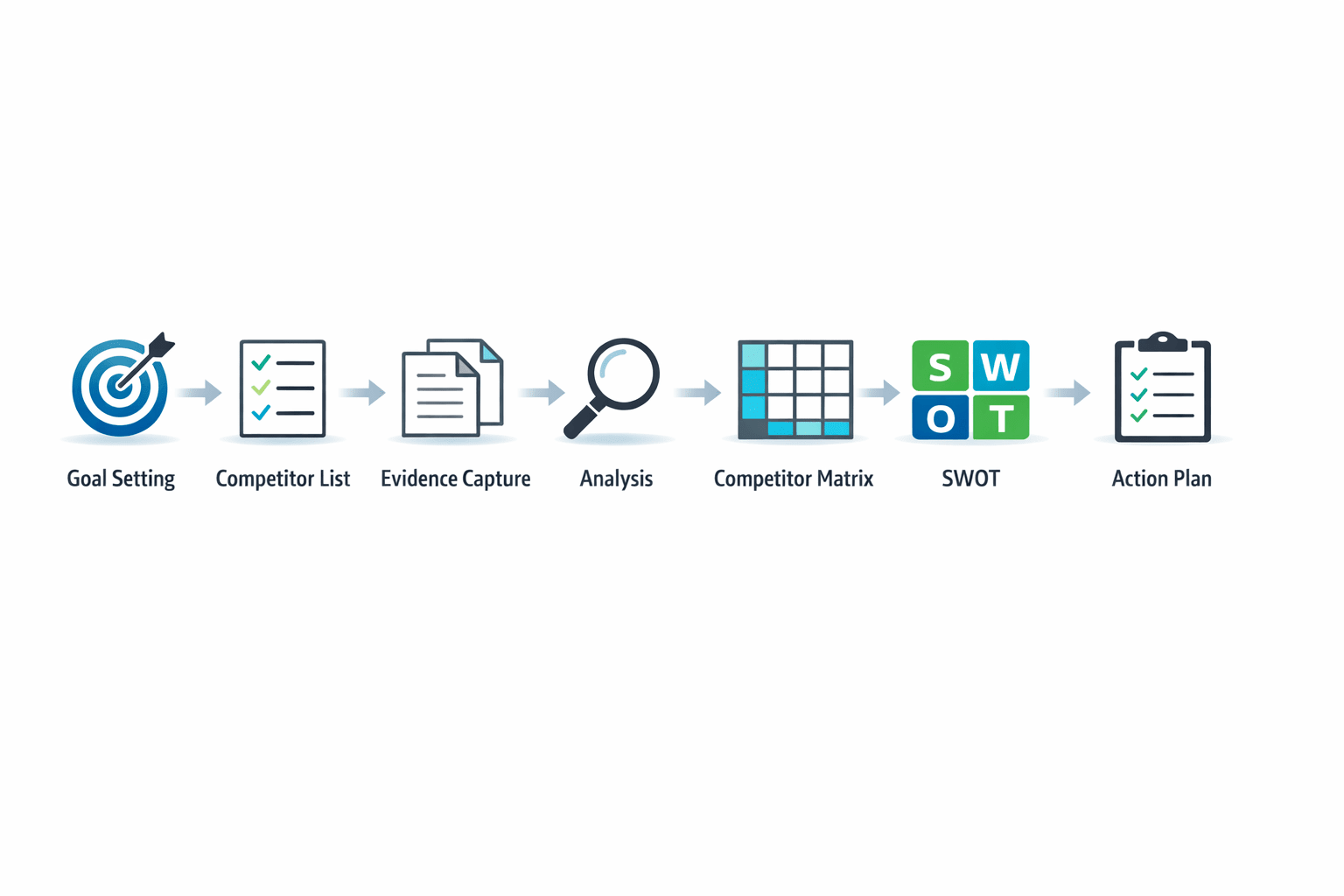
Only after that should you recommend action: change a headline, test a pricing page, shift channel focus, or sharpen launch positioning. In the next section, you'll see a simple workflow diagram that turns this process into a repeatable system.
Try TicNote Cloud for free to organize competitor research faster.
Which competitors and data sources should you include?
A strong marketing competitive analysis starts with the right comparison set. If you study the wrong rivals, your conclusions will drift fast. The goal is simple: include the competitors buyers actually compare, then pull data from sources that show messaging, visibility, offers, and customer feedback.
Separate direct, indirect, and substitute competitors
Use three buckets:
- Direct competitors: the closest alternatives. They solve the same problem for a similar buyer with a similar type of product or service.
- Indirect competitors: different solutions to the same problem. These matter because buyers may switch categories.
- Substitutes: category outsiders that still win the budget or attention. Think agencies vs software, or in-house work vs outsourcing.
Most teams should analyze 5 to 10 competitors total. That's enough to spot patterns without drowning in data.
Pull data from sources that match each channel
Start with secondary research. As the U.S. Census Bureau — Market Research and Competitive Analysis explains, "Secondary research uses existing information that has been collected for another purpose, such as census data, industry reports, and competitor websites."
Use these sources first:
- Websites and landing pages for positioning and offers
- Search results and SEO tools for organic visibility and content gaps
- Ad libraries and paid search results for campaign themes
- Social profiles for content formats and engagement patterns
- Review sites for customer pain points and competitor strengths
- Pricing pages for packaging, tiers, and upsell logic
- Press releases and help centers for product direction and updates
Review mining is often the fastest place for beginner teams to start because it reveals repeated complaints, desired outcomes, and feature praise without recruiting participants.
Choose surveys, interviews, or focus groups based on the question
Use surveys when you need broader directional input. Use interviews when you need rich explanations of why buyers switch, stall, or hesitate. Use focus groups only when message testing benefits from live discussion and reaction.
A simple rule: if you need scale, survey; if you need depth, interview; if you need group dynamics, run a focus group.
How do you analyze competitor messaging, channels, and offers?
A strong marketing competitive analysis looks past surface-level claims. You want to see how competitors frame their value, where they win attention, and how their offers shape buyer expectations. The goal isn't to copy them. It's to spot patterns, gaps, and openings your team can use to make sharper decisions.
Review brand positioning first
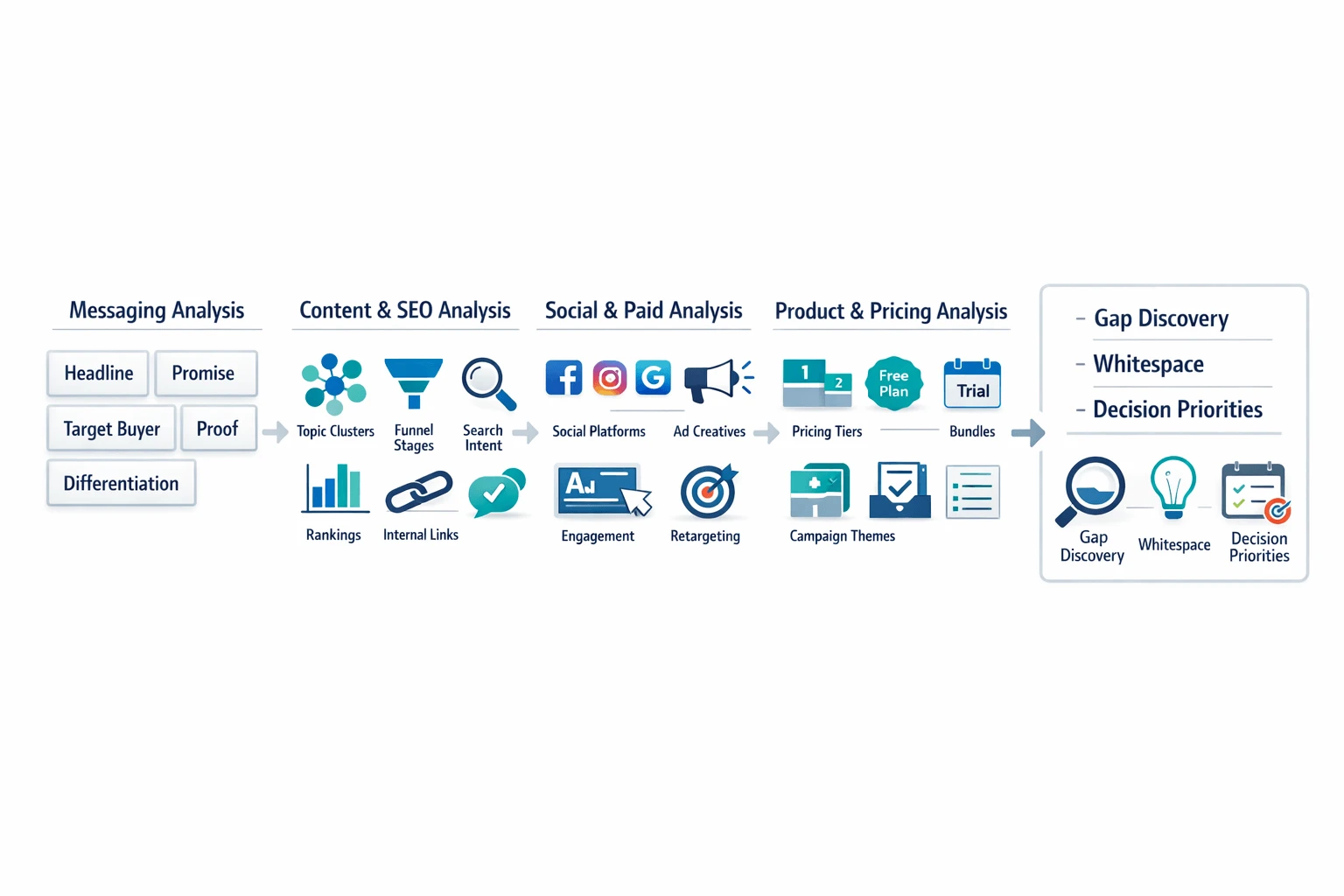
Start with each competitor's homepage, top product page, and one campaign landing page. Capture these five elements:
- headline
- core promise
- target buyer
- proof points
- differentiation angle
Then compare them against your own message. If three brands all promise "save time" with similar proof and similar language, that's sameness. If no one speaks to a specific pain point, industry, or workflow, that may be whitespace. This is where a simple positioning map and differentiation framework helps turn notes into choices.
Audit content and SEO by intent
Next, run a content competitive analysis and seo competitive analysis together. Review topic clusters, funnel coverage, search intent alignment, content format, internal links, and calls to action.
Look for patterns such as:
- heavy focus on top-of-funnel guides
- weak comparison or pricing content
- strong templates, calculators, or case studies
- rankings clustered around one use case
This shows where competitors capture demand and where they leave gaps. For example, a brand may rank well on educational terms but fail to move readers into demos or trials.
Check social and paid signals without overreacting
For social media competitive analysis, track platform mix, posting cadence, creative style, campaign themes, and engagement quality. In paid channels, study ad hooks, repeated offers, and retargeting clues such as demo reminders, case-study ads, or limited-time trials.
Avoid reading too much into one viral post or one ad. Review at least 10 to 15 recent posts or ads per brand before you draw a conclusion.
Compare product, pricing, and offer structure
Finally, compare packaging, free plans, trial language, feature emphasis, onboarding friction, guarantees, and bundling. TicNote Cloud, for example, is useful for organizing interview transcripts, review notes, and competitor calls into one project so teams can compare claims with cited context instead of scattered docs.
What matters most is buyer expectation. Good marketing competitor analysis reveals which messages, channels, and offers define the market so you can answer with a clearer point of view.
Turn findings into action with a competitor matrix and SWOT
A good marketing competitive analysis should end with decisions, not a slide deck. The simplest way to do that is to turn your notes into a weighted competitor matrix, then translate the evidence into a SWOT-style summary your team can act on.
Build a weighted comparison table
Start with 5 decision-relevant criteria. For most teams, these are enough:
- Positioning clarity
- Offer strength
- Channel presence
- Customer proof
- Pricing fit
Score each competitor from 1 to 5. Then apply weights based on your goal. If you need better acquisition, channel presence and proof may matter more. If you're refining packaging, pricing fit and offer strength should carry more weight.
| Criteria | Weight | Competitor A | Competitor B | Your brand |
| Positioning clarity | 25 | 4 | 3 | 2 |
| Offer strength | 25 | 5 | 3 | 4 |
| Channel presence | 20 | 4 | 5 | 3 |
| Customer proof | 20 | 3 | 4 | 2 |
| Pricing fit | 10 | 2 | 4 | 3 |
This keeps the comparison tied to real business priorities instead of opinion.
Run a brand competitive analysis
Don't stop at features. Compare perceived strengths, message consistency, tone, and emotional hooks. Ask:
- Do they sound premium, practical, or disruptive?
- Is the same promise repeated across homepage, ads, and social?
- What feeling do they sell: trust, speed, status, or simplicity?
This is where a brand competitive analysis often reveals why similar offers perform differently.
Spot gaps in audience, pricing, and content
Next, look for patterns the matrix exposes. Common gaps include:
- Underserved audience segments
- High prices with weak proof
- Strong visibility but vague messaging
- Repeated content topics with little depth
- Channels where competitors show up often but fail to persuade
You can also use a simple weighted SWOT scoring method to connect gaps to strategic choices faster.
Turn evidence into SWOT and next actions
Now convert findings into four buckets:
- Strengths: where your team already wins
- Weaknesses: where rivals outperform you
- Opportunities: gaps you can exploit
- Threats: moves that could reduce growth
Then assign execution details:
- Action
- Owner
- Deadline
- Review cadence
Review monthly for active markets, or quarterly for slower ones. A sample competitor matrix table and a simple CTA block can help your team move from raw notes to decisions quickly.
How to speed up competitor research workflows with AI
In this section, I'll use TicNote Cloud to demonstrate the steps. The workflow itself is tool-agnostic: the goal is to turn raw inputs into a usable marketing competitive analysis report and a visual matrix faster, with less manual sorting.
Start with a tight input brief
Before you run anything, prepare four items:
- your niche or industry
- your target location, such as local, national, or global
- 5 to 10 competitor names or URLs
- an optional focus area like pricing, reviews, social media, or product range
That short setup gives the AI enough context to return a more useful output. In most cases, the result should include an executive summary, a comparison table, competitor profiles, market gaps, recommended actions, and a visual HTML comparison matrix.
Run the web workflow first
In TicNote Cloud, add the Competitor Analysis skill agent from the agent library.
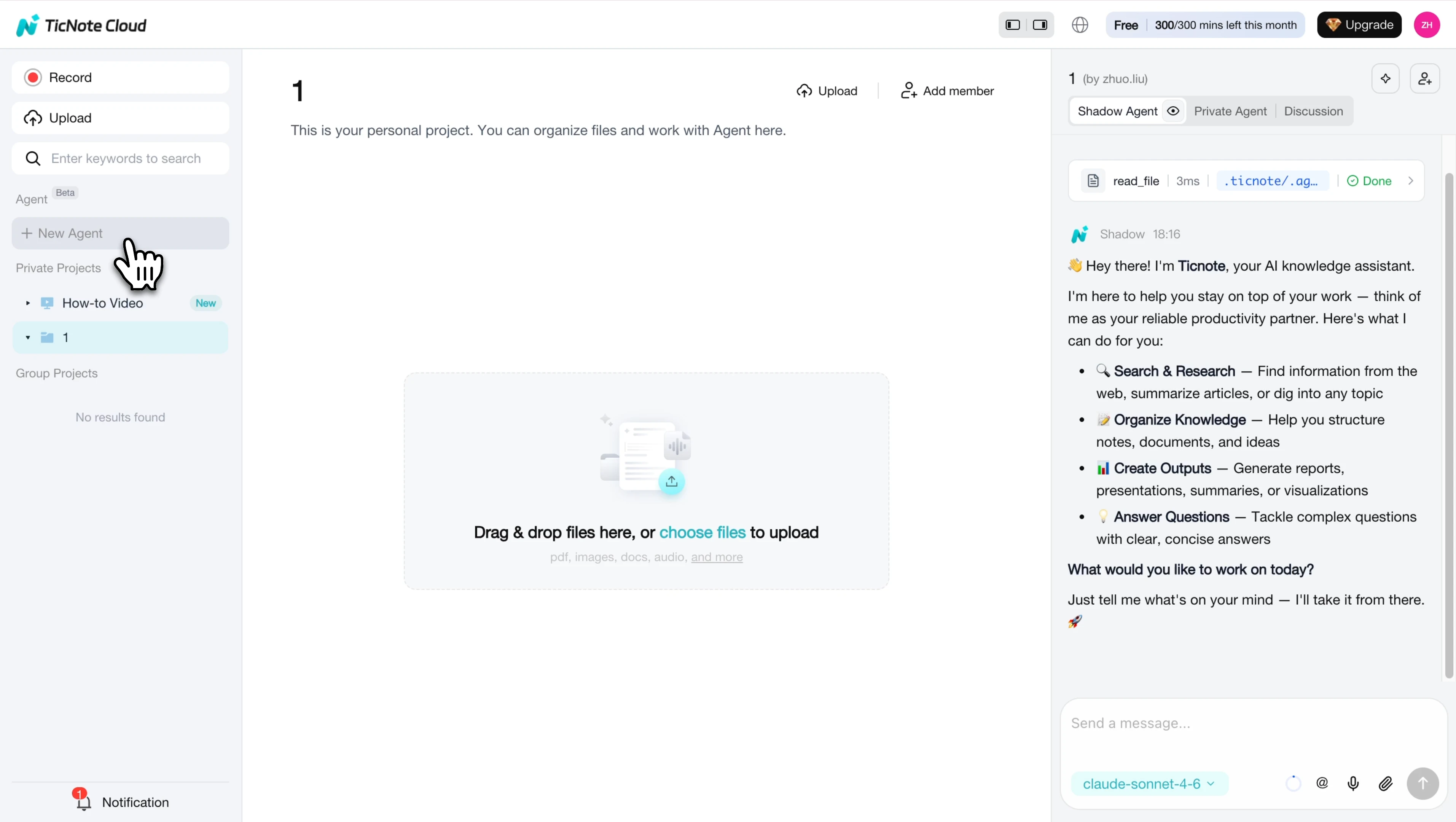
Once it appears in your workspace, select it and move into the research flow.
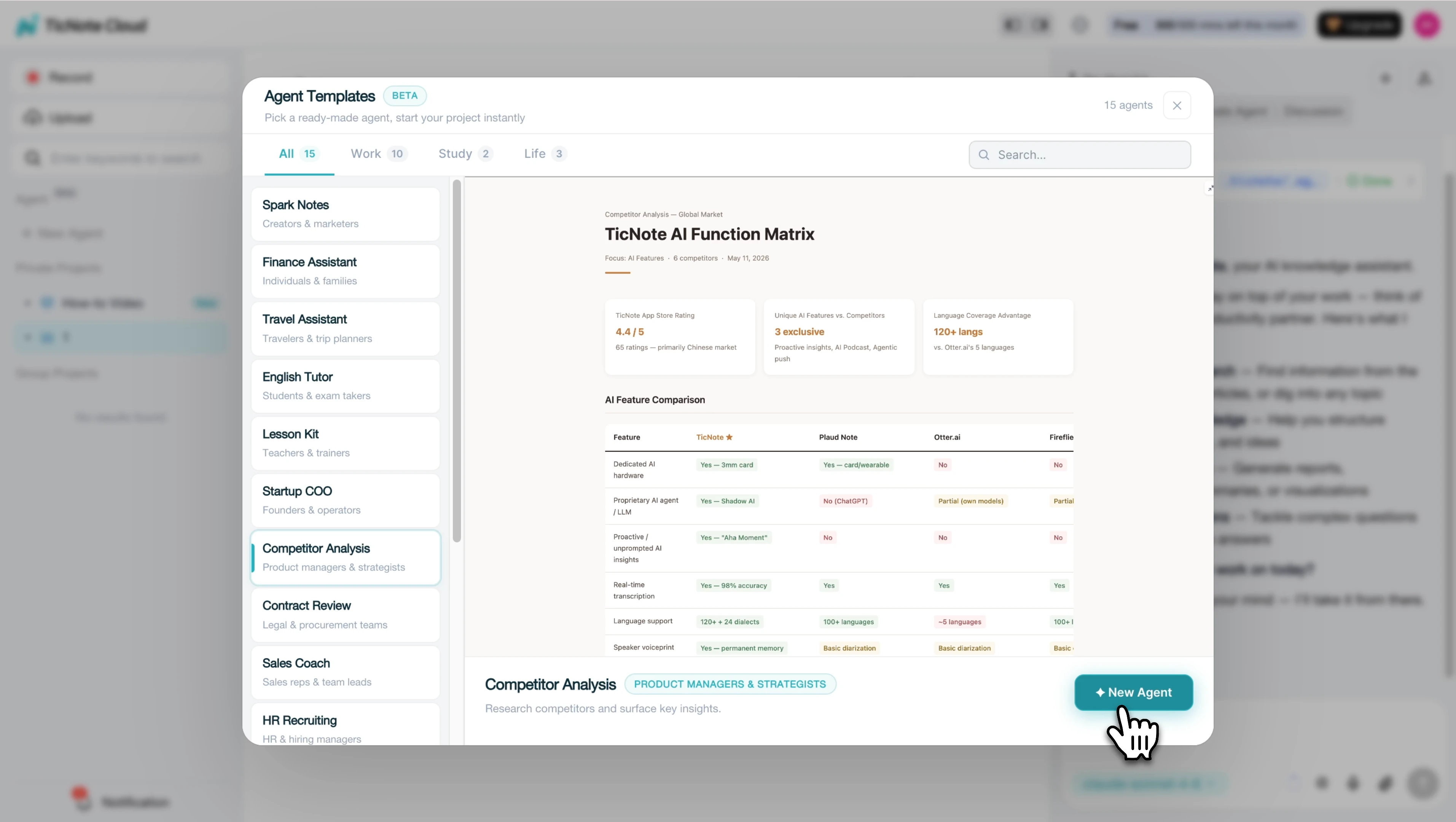
Next, enter your business context, location, and competitor list. Add a focus if you want tighter findings around one channel or topic.
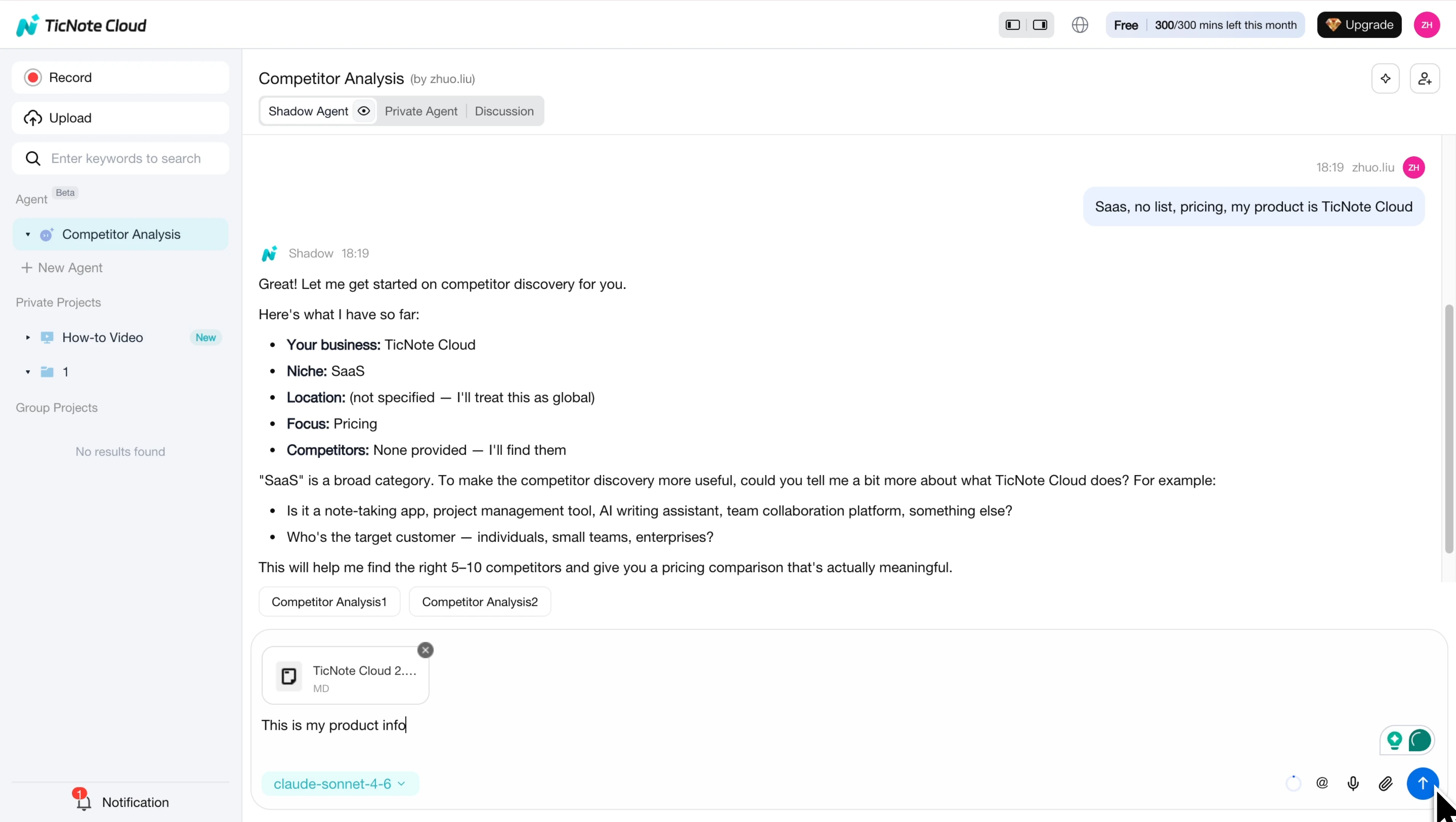
The agent then creates a saved report and matrix you can review.
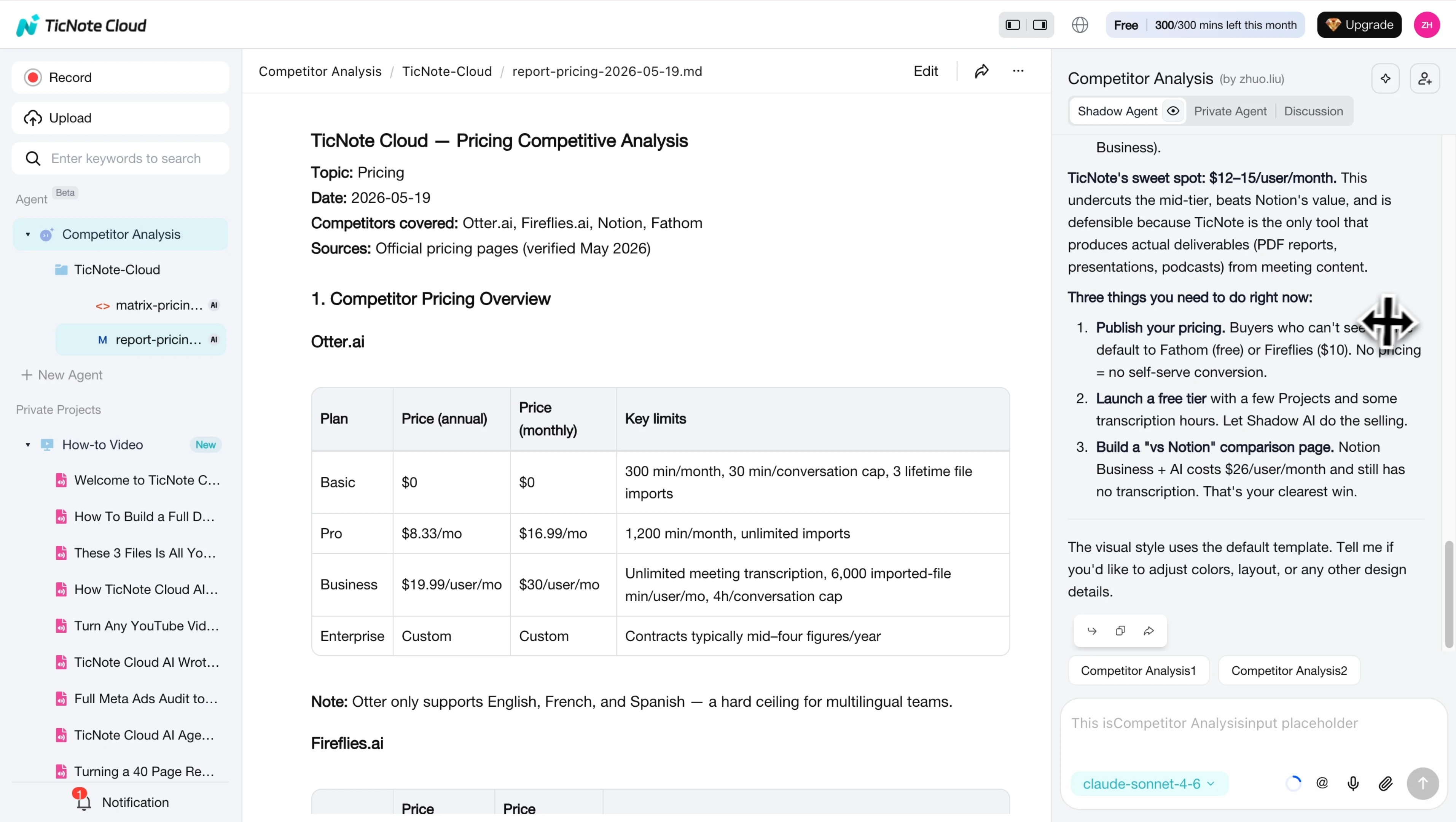
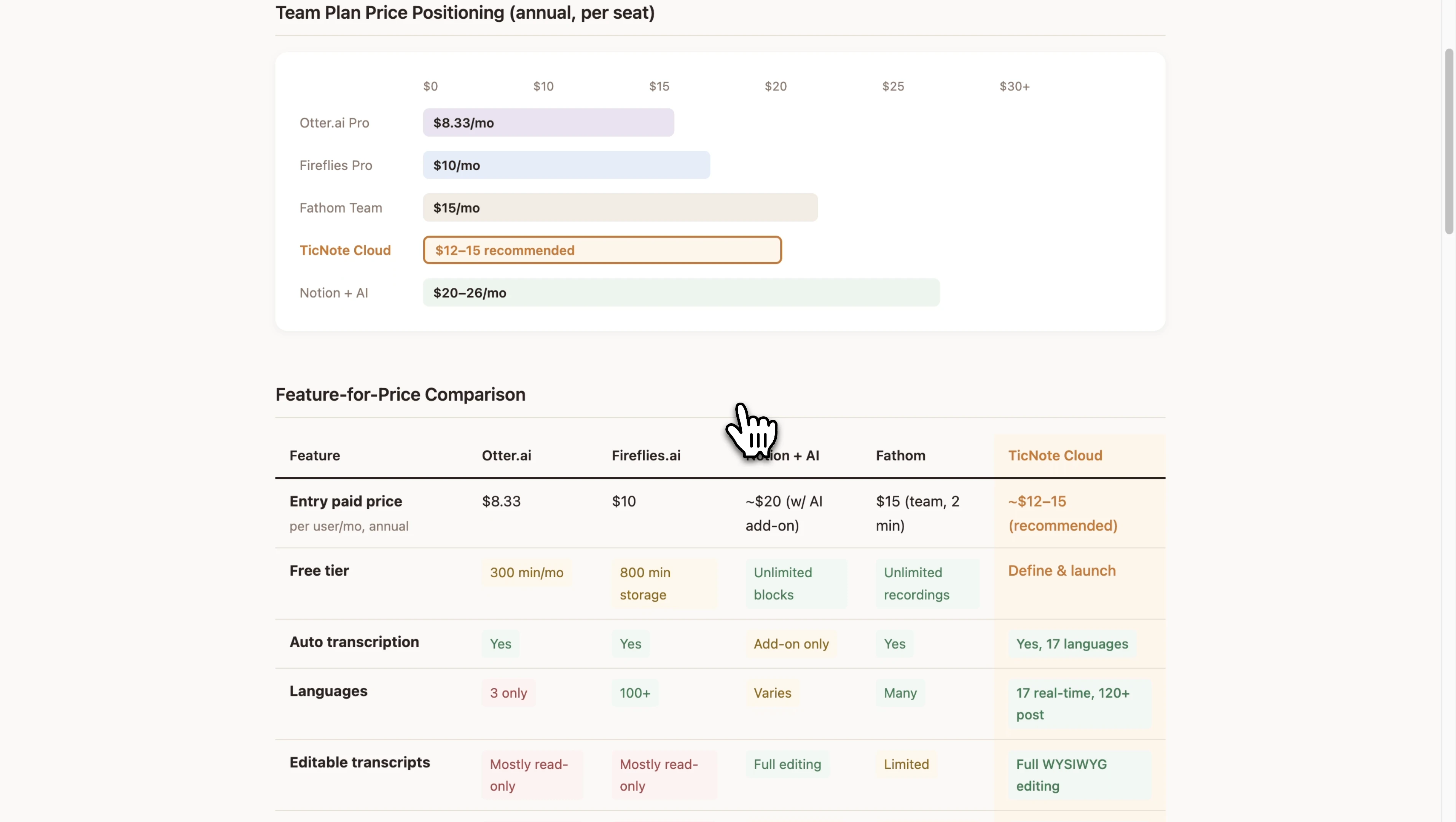
Open the outputs and check the summary, head-to-head table, and market gaps first. Then review the visual matrix for SWOT cards, feature gaps, and priority actions.
Review and strengthen the findings
Don't treat AI output as final. Check for missing evidence, thin competitor coverage, or claims that need support. If your team also runs interviews, win-loss calls, sales notes, or customer research, this is where TicNote Cloud becomes especially useful. You can keep transcripts in one project, ask Shadow AI questions across files with citations, edit transcripts directly, and generate updated summaries or reports without moving content between tools.
That makes it a strong fit for interview-heavy competitor research. It also pairs well with a broader workflow for free competitor analysis tools.
Use the app for fast field capture
The app is lighter weight. Use it to record voice memos, save field notes after sales calls, or capture quick observations from events and store checks. Then sync everything back to the same research project so your analysis stays in one place.
Place a soft free-plan CTA after the workflow or near the recap, and use real screenshots beside each product step so readers can see the exact path before they try it.
Common mistakes in digital marketing competitive analysis
Most teams don't fail at marketing competitive analysis because they lack data. They fail because they trust shaky inputs, copy what looks successful, or miss the real reasons buyers choose one brand over another. If you want better decisions, your process has to stay evidence-based, current, and tied to customer reality.
Rely on evidence, not memory
A common mistake is making claims from memory or one-off examples. Someone remembers a rival's homepage headline, a paid ad, or a webinar and treats it as the whole strategy. That's weak evidence.
For each finding, save:
- source link
- capture date
- screenshot or quote
- timestamp if it came from a video, podcast, or call
That simple habit makes your analysis easier to verify later.
Don't copy competitors too closely
It's smart to study patterns. It's a mistake to mirror them. If you copy a competitor's message, offer structure, or channel mix, you lose differentiation and drift into reactive strategy.
Instead, ask:
- What are they emphasizing?
- Where are they under-serving buyers?
- What can we say more clearly or prove more strongly?
Track update cadence and data quality
Stale screenshots, expired pricing pages, and seasonal campaigns can distort decisions fast. A spring promotion may not reflect normal positioning. An outdated landing page may no longer convert.
Document when each item was collected, then refresh the review on a fixed cadence such as monthly or quarterly.
Add customer voice to the picture
Published content shows what competitors say. Reviews, sales calls, win-loss interviews, and support tickets show why they win or lose. That's often the missing layer in digital marketing competitive analysis.
Use this quick check:
- verify every claim with a source
- label collection dates
- separate temporary campaigns from core strategy
- pull recurring themes from reviews and calls
- update the analysis on a schedule
Final thoughts
A strong marketing competitive analysis starts with one clear decision. Then you choose the right competitors, collect real evidence, study messaging, channels, and offers, and turn what you learn into a matrix and SWOT-backed action plan. That's what makes the work useful instead of interesting but vague.
The key is consistency. Good competitor research isn't a one-time project you revisit once a year. It's a repeatable habit your team can run for each campaign, launch, or positioning question. If you want to make that process stick, use a simple competitive intelligence workflow and keep every note, transcript, and takeaway in one place.
Start small: test this workflow on one campaign or one market question, then build from there.